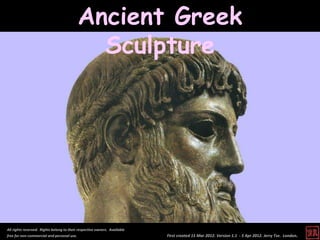
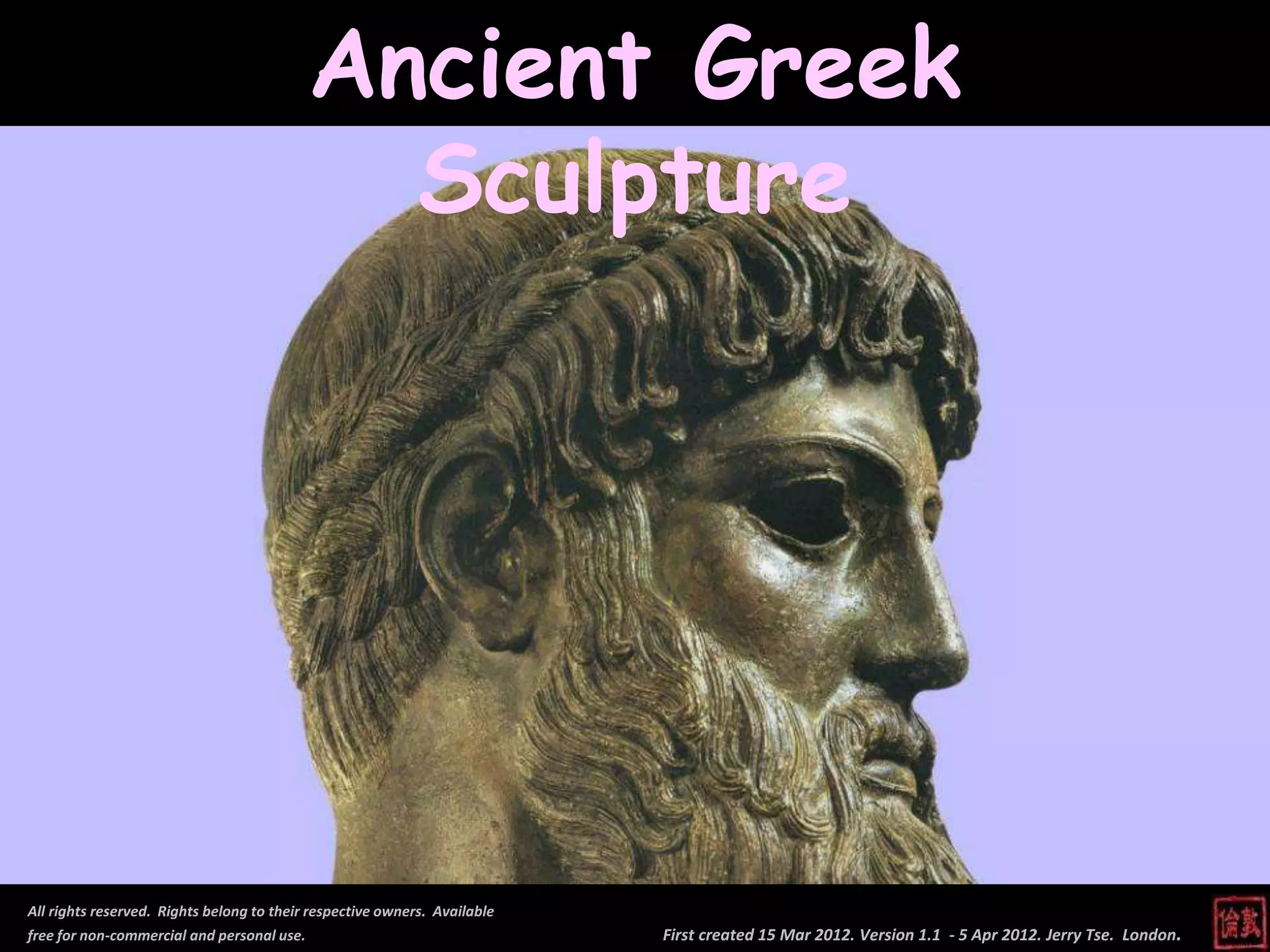
Ancient Greek
                                              Sculpture


All rights reserved. Rights belong to their respective owners. Available
free for non-commercial and personal use.                                  First created 15 Mar 2012. Version 1.1 - 5 Apr 2012. Jerry Tse. London.
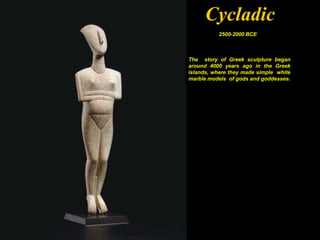
Cycladic
          2500-2000 BCE


The story of Greek sculpture began
around 4000 years ago in the Greek
islands, where they made simple white
marble models of gods and goddesses.
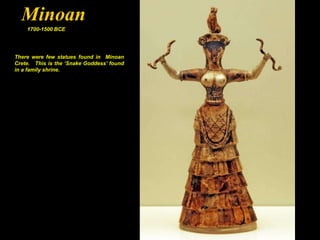
Minoan
    1700-1500 BCE


There were few statues found in Minoan
Crete. This is the „Snake Goddess‟ found
in a family shrine.
Mycenean

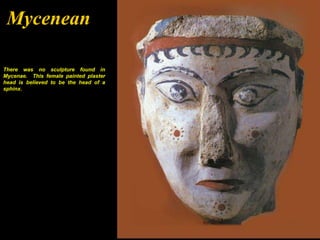
There was no sculpture found in
Mycenae. This female painted plaster
head is believed to be the head of a
sphinx.
Archaic
              700-500 BCE


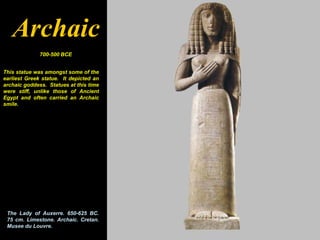
This statue was amongst some of the
earliest Greek statue. It depicted an
archaic goddess. Statues at this time
were stiff, unlike those of Ancient
Egypt and often carried an Archaic
smile.


 The Lady of Auxerre. 650-625 BC.
 75 cm. Limestone. Archaic. Cretan.
 Musee du Louvre.
Archaic


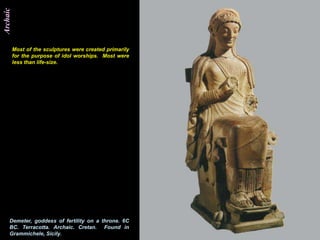
          Most of the sculptures were created primarily
          for the purpose of idol worships. Most were
          less than life-size.


     Demeter, goddess of fertility on a throne. 6C
     BC. Terracotta. Archaic. Cretan. Found in
     Grammichele, Sicily.
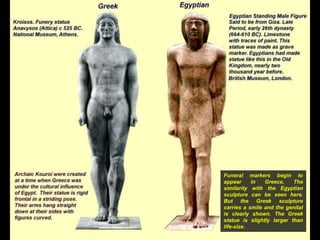
Funeral markers begin to
appear     in   Greece.    The
similarity with the Egyptian
sculpture can be seen here.
But the Greek sculpture
carries a smile and the genital
is clearly shown. The Greek
statue is slightly larger than
life-size.
Archaic
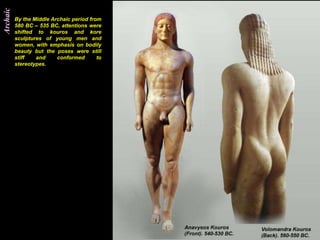
          By the Middle Archaic period from
          580 BC – 535 BC, attentions were
          shifted to kouros and kore
          sculptures of young men and
          women, with emphasis on bodily
          beauty but the poses were still
          stiff   and     conformed       to
          stereotypes.
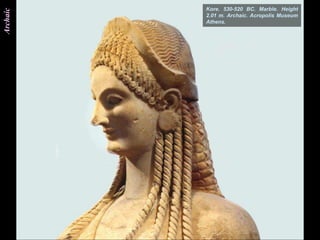
Archaic   Kore. 530-520 BC. Marble. Height
          2.01 m. Archaic. Acropolis Museum
          Athens.
Archaic
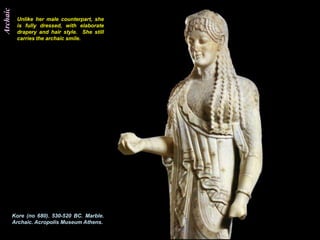
           Unlike her male counterpart, she
           is fully dressed, with elaborate
           drapery and hair style. She still
           carries the archaic smile.


          Kore (no 680). 530-520 BC. Marble.
          Archaic. Acropolis Museum Athens.
Archaic

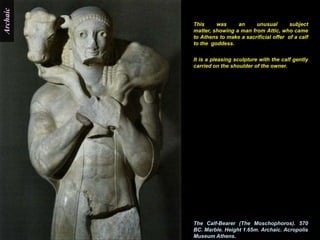
          This     was     an     unusual        subject
          matter, showing a man from Attic, who came
          to Athens to make a sacrificial offer of a calf
          to the goddess.


          It is a pleasing sculpture with the calf gently
          carried on the shoulder of the owner.


          The Calf-Bearer (The Moschophoros). 570
          BC. Marble. Height 1.65m. Archaic. Acropolis
          Museum Athens.
Archaic


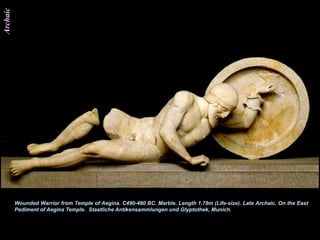
          Wounded Warrior from Temple of Aegina. C490-480 BC. Marble. Length 1.78m (Life-size). Late Archaic. On the East
          Pediment of Aegina Temple. Staatliche Antikensammlungen und Glyptothek, Munich.
Archaic
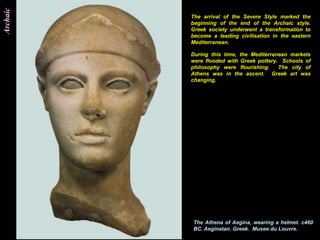
          The arrival of the Severe Style marked the
          beginning of the end of the Archaic style.
          Greek society underwent a transformation to
          become a leading civilisation in the eastern
          Mediterranean.

          During this time, the Mediterranean markets
          were flooded with Greek pottery. Schools of
          philosophy were flourishing.    The city of
          Athens was in the ascent. Greek art was
          changing.


          The Athena of Aegina, wearing a helmet. c460
          BC. Aeginetan. Greek. Musee du Louvre.
Archaic


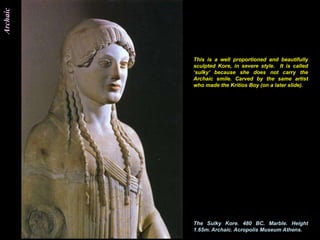
          This is a well proportioned and beautifully
          sculpted Kore, in severe style. It is called
          „sulky‟ because she does not carry the
          Archaic smile. Carved by the same artist
          who made the Kritios Boy (on a later slide).


          The Sulky Kore. 480 BC. Marble. Height
          1.65m. Archaic. Acropolis Museum Athens.
Classical
             480-336 BCE


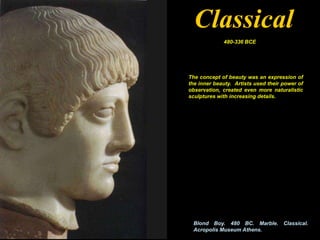
The concept of beauty was an expression of
the inner beauty. Artists used their power of
observation, created even more naturalistic
sculptures with increasing details.


 Blond Boy. 480 BC. Marble.          Classical.
 Acropolis Museum Athens.
Classical
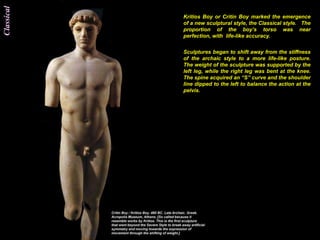
            Kritios Boy or Critin Boy marked the emergence
            of a new sculptural style, the Classical style. The
            proportion of the boy‟s torso was near
            perfection, with life-like accuracy.


            Sculptures began to shift away from the stiffness
            of the archaic style to a more life-like posture.
            The weight of the sculpture was supported by the
            left leg, while the right leg was bent at the knee.
            The spine acquired an “S” curve and the shoulder
            line dipped to the left to balance the action at the
            pelvis.
Classical
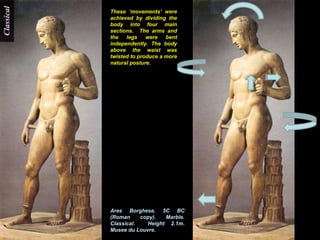
            These „movements‟ were
            achieved by dividing the
            body into four main
            sections. The arms and
            the   legs    were   bent
            independently. The body
            above the waist was
            twisted to produce a more
            natural posture.


            Ares Borghese. 5C BC
            (Roman     copy).  Marble.
            Classical.   Height 2.1m.
            Musee du Louvre.
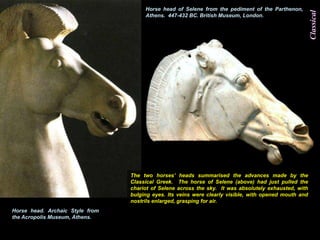
Horse head of Selene from the pediment of the Parthenon,


                                                                                                       Classical
                                      Athens. 447-432 BC. British Museum, London.


                                 The two horses‟ heads summarised the advances made by the
                                 Classical Greek. The horse of Selene (above) had just pulled the
                                 chariot of Selene across the sky. It was absolutely exhausted, with
                                 bulging eyes. Its veins were clearly visible, with opened mouth and
                                 nostrils enlarged, grasping for air.
Horse head. Archaic Style from
the Acropolis Museum, Athens.
Classical


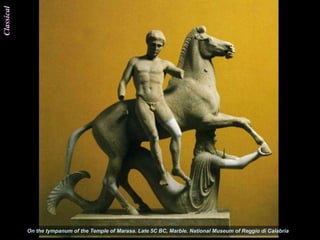
            On the tympanum of the Temple of Marasa. Late 5C BC, Marble. National Museum of Reggio di Calabria
Classical


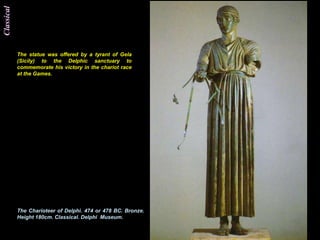
            The statue was offered by a tyrant of Gela
            (Sicily) to the Delphic sanctuary to
            commemorate his victory in the chariot race
            at the Games.


            The Charioteer of Delphi. 474 or 478 BC. Bronze.
            Height 180cm. Classical. Delphi Museum.
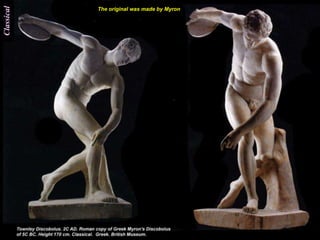
Classical   The original was made by Myron
Classical


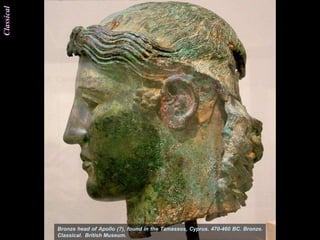
            Bronze head of Apollo (?), found in the Tamassos, Cyprus. 470-460 BC. Bronze.
            Classical. British Museum.
Classical
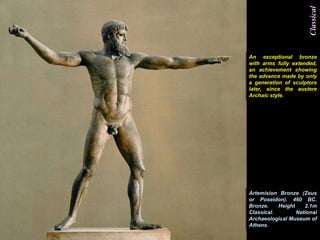
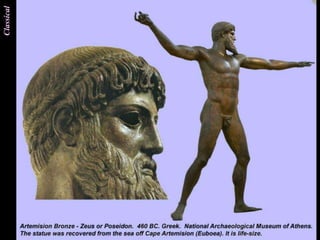
An exceptional bronze
with arms fully extended,
an achievement showing
the advance made by only
a generation of sculptors
later, since the austere
Archaic style.


Artemision Bronze (Zeus
or Poseidon). 460 BC.
Bronze.    Height    2.1m
Classical.        National
Archaeological Museum of
Athens.
Classical
Classical


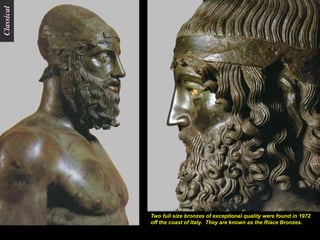
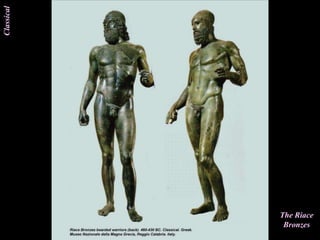
            Two full size bronzes of exceptional quality were found in 1972
            off the coast of Italy. They are known as the Riace Bronzes.
Classical


            The Riace
             Bronzes
Classical
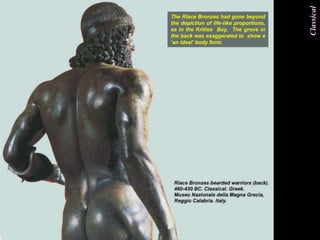
The Riace Bronzes had gone beyond
the depiction of life-like proportions,
as in the Kritios Boy. The grove in
the back was exaggerated to show a
„an ideal‟ body form.
Classical


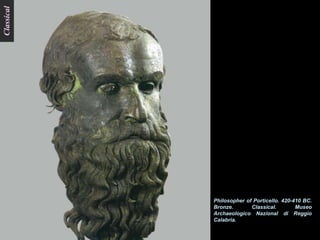
            Philosopher of Porticello. 420-410 BC.
            Bronze.       Classical.        Museo
            Archaeologico Nazional di Reggio
            Calabria.
Classical


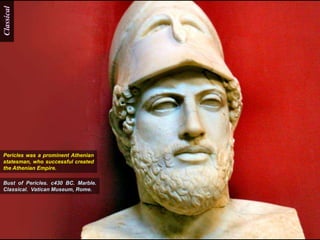
Pericles was a prominent Athenian
statesman, who successful created
the Athenian Empire.

Bust of Pericles. c430 BC. Marble.
Classical. Vatican Museum, Rome.
Classical
Classical


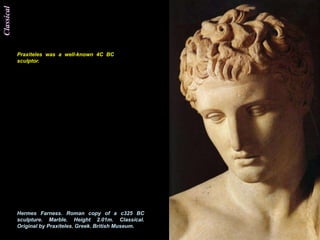
            Praxiteles was a well-known 4C BC
            sculptor.


            Hermes Farness. Roman copy of a c325 BC
            sculpture. Marble. Height 2.01m. Classical.
            Original by Praxiteles. Greek. British Museum.
Classical


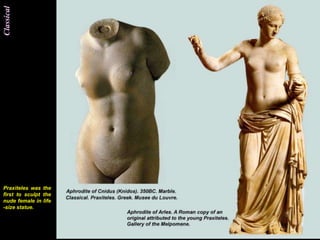
Praxiteles was the
first to sculpt the
nude female in life
-size statue.
Classical


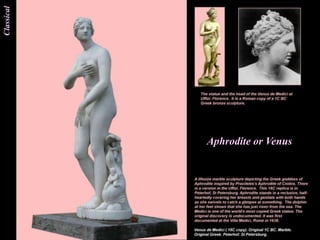
            Aphrodite or Venus
Classical


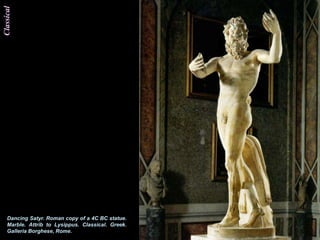
   Dancing Satyr. Roman copy of a 4C BC statue.
   Marble. Attrib to Lysippus. Classical. Greek.
   Galleria Borghese, Rome.
Hellenistic
           336-146 BCE


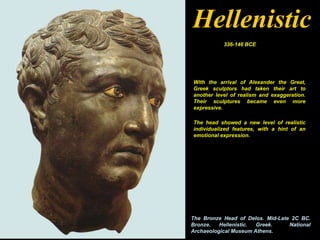
With the arrival of Alexander the Great,
Greek sculptors had taken their art to
another level of realism and exaggeration.
Their sculptures became even more
expressive.

The head showed a new level of realistic
individualized features, with a hint of an
emotional expression.


The Bronze Head of Delos. Mid-Late 2C BC.
Bronze.   Hellenistic. Greek.     National
Archaeological Museum Athens.
Classical


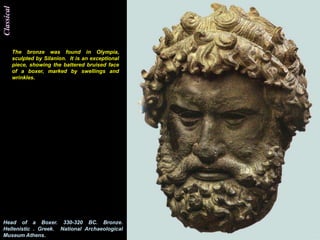
            The bronze was found in Olympia,
            sculpted by Silanion. It is an exceptional
            piece, showing the battered bruised face
            of a boxer, marked by swellings and
            wrinkles.


Head of a Boxer. 330-320 BC. Bronze.
Hellenistic . Greek. National Archaeological
Museum Athens.
Hellenistic


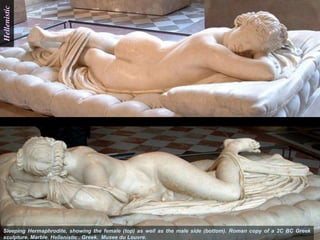
Sleeping Hermaphrodite, showing the female (top) as well as the male side (bottom). Roman copy of a 2C BC Greek
sculpture. Marble. Hellenistic . Greek. Musee du Louvre.
Hellenistic
Hellenistic


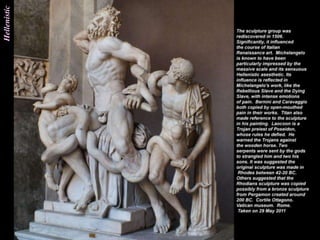
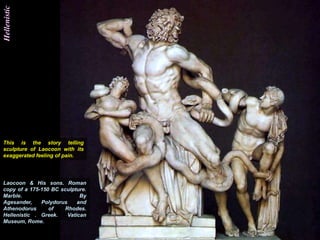
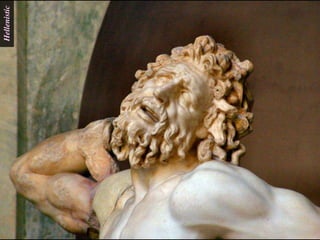
This is the story telling
sculpture of Laocoon with its
exaggerated feeling of pain.


Laocoon & His sons. Roman
copy of a 175-150 BC sculpture.
Marble.                      By
Agesander,    Polydorus     and
Athenodorus      of    Rhodes.
Hellenistic . Greek.    Vatican
Museum, Rome.
Hellenistic
Hellenistic


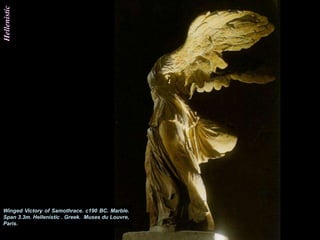
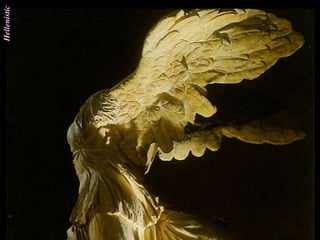
Winged Victory of Samothrace. c190 BC. Marble.
Span 3.3m. Hellenistic . Greek. Muses du Louvre,
Paris.
Hellenistic
Hellenistic


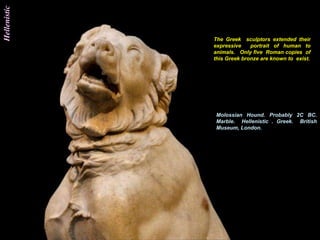
              The Greek sculptors extended their
              expressive    portrait of human to
              animals. Only five Roman copies of
              this Greek bronze are known to exist.


              Molossian Hound. Probably 2C BC.
              Marble. Hellenistic . Greek. British
              Museum, London.
Hellenistic


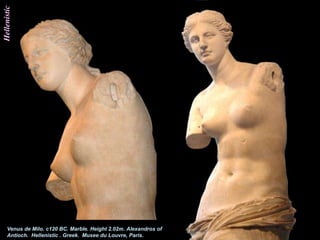
    Venus de Milo. c120 BC. Marble. Height 2.02m. Alexandros of
    Antioch. Hellenistic . Greek. Musee du Louvre, Paris.
Hellenistic


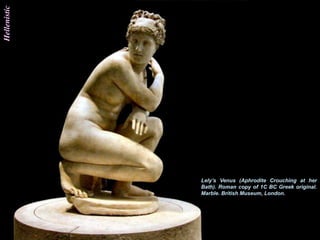
              Lely‟s Venus (Aphrodite Crouching at her
              Bath). Roman copy of 1C BC Greek original.
              Marble. British Museum, London.
Hellenistic


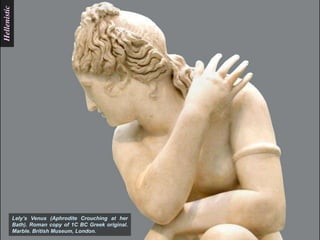
              Lely‟s Venus (Aphrodite Crouching at her
              Bath). Roman copy of 1C BC Greek original.
              Marble. British Museum, London.
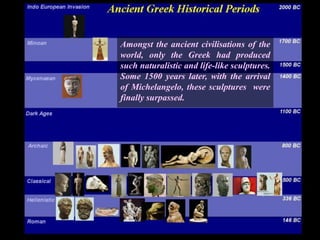
Amongst the ancient civilisations of the
world, only the Greek had produced
such naturalistic and life-like sculptures.
Some 1500 years later, with the arrival
of Michelangelo, these sculptures were
finally surpassed.
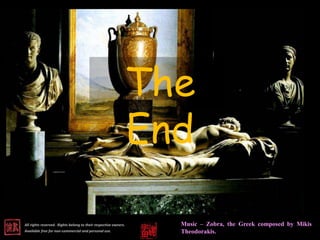
The
                                                             End

All rights reserved. Rights belong to their respective owners.   Music – Zobra, the Greek composed by Mikis
Available free for non-commercial and personal use.              Theodorakis.

Ancient greek sculpture

  • 1.
    Ancient Greek Sculpture All rights reserved. Rights belong to their respective owners. Available free for non-commercial and personal use. First created 15 Mar 2012. Version 1.1 - 5 Apr 2012. Jerry Tse. London.
  • 2.
    Cycladic 2500-2000 BCE The story of Greek sculpture began around 4000 years ago in the Greek islands, where they made simple white marble models of gods and goddesses.
  • 3.
    Minoan 1700-1500 BCE There were few statues found in Minoan Crete. This is the „Snake Goddess‟ found in a family shrine.
  • 4.
    Mycenean There was nosculpture found in Mycenae. This female painted plaster head is believed to be the head of a sphinx.
  • 5.
    Archaic 700-500 BCE This statue was amongst some of the earliest Greek statue. It depicted an archaic goddess. Statues at this time were stiff, unlike those of Ancient Egypt and often carried an Archaic smile. The Lady of Auxerre. 650-625 BC. 75 cm. Limestone. Archaic. Cretan. Musee du Louvre.
  • 6.
    Archaic Most of the sculptures were created primarily for the purpose of idol worships. Most were less than life-size. Demeter, goddess of fertility on a throne. 6C BC. Terracotta. Archaic. Cretan. Found in Grammichele, Sicily.
  • 7.
    Funeral markers beginto appear in Greece. The similarity with the Egyptian sculpture can be seen here. But the Greek sculpture carries a smile and the genital is clearly shown. The Greek statue is slightly larger than life-size.
  • 8.
    Archaic By the Middle Archaic period from 580 BC – 535 BC, attentions were shifted to kouros and kore sculptures of young men and women, with emphasis on bodily beauty but the poses were still stiff and conformed to stereotypes.
  • 9.
    Archaic Kore. 530-520 BC. Marble. Height 2.01 m. Archaic. Acropolis Museum Athens.
  • 10.
    Archaic Unlike her male counterpart, she is fully dressed, with elaborate drapery and hair style. She still carries the archaic smile. Kore (no 680). 530-520 BC. Marble. Archaic. Acropolis Museum Athens.
  • 11.
    Archaic This was an unusual subject matter, showing a man from Attic, who came to Athens to make a sacrificial offer of a calf to the goddess. It is a pleasing sculpture with the calf gently carried on the shoulder of the owner. The Calf-Bearer (The Moschophoros). 570 BC. Marble. Height 1.65m. Archaic. Acropolis Museum Athens.
  • 12.
    Archaic Wounded Warrior from Temple of Aegina. C490-480 BC. Marble. Length 1.78m (Life-size). Late Archaic. On the East Pediment of Aegina Temple. Staatliche Antikensammlungen und Glyptothek, Munich.
  • 13.
    Archaic The arrival of the Severe Style marked the beginning of the end of the Archaic style. Greek society underwent a transformation to become a leading civilisation in the eastern Mediterranean. During this time, the Mediterranean markets were flooded with Greek pottery. Schools of philosophy were flourishing. The city of Athens was in the ascent. Greek art was changing. The Athena of Aegina, wearing a helmet. c460 BC. Aeginetan. Greek. Musee du Louvre.
  • 14.
    Archaic This is a well proportioned and beautifully sculpted Kore, in severe style. It is called „sulky‟ because she does not carry the Archaic smile. Carved by the same artist who made the Kritios Boy (on a later slide). The Sulky Kore. 480 BC. Marble. Height 1.65m. Archaic. Acropolis Museum Athens.
  • 15.
    Classical 480-336 BCE The concept of beauty was an expression of the inner beauty. Artists used their power of observation, created even more naturalistic sculptures with increasing details. Blond Boy. 480 BC. Marble. Classical. Acropolis Museum Athens.
  • 16.
    Classical Kritios Boy or Critin Boy marked the emergence of a new sculptural style, the Classical style. The proportion of the boy‟s torso was near perfection, with life-like accuracy. Sculptures began to shift away from the stiffness of the archaic style to a more life-like posture. The weight of the sculpture was supported by the left leg, while the right leg was bent at the knee. The spine acquired an “S” curve and the shoulder line dipped to the left to balance the action at the pelvis.
  • 17.
    Classical These „movements‟ were achieved by dividing the body into four main sections. The arms and the legs were bent independently. The body above the waist was twisted to produce a more natural posture. Ares Borghese. 5C BC (Roman copy). Marble. Classical. Height 2.1m. Musee du Louvre.
  • 18.
    Horse head ofSelene from the pediment of the Parthenon, Classical Athens. 447-432 BC. British Museum, London. The two horses‟ heads summarised the advances made by the Classical Greek. The horse of Selene (above) had just pulled the chariot of Selene across the sky. It was absolutely exhausted, with bulging eyes. Its veins were clearly visible, with opened mouth and nostrils enlarged, grasping for air. Horse head. Archaic Style from the Acropolis Museum, Athens.
  • 19.
    Classical On the tympanum of the Temple of Marasa. Late 5C BC, Marble. National Museum of Reggio di Calabria
  • 20.
    Classical The statue was offered by a tyrant of Gela (Sicily) to the Delphic sanctuary to commemorate his victory in the chariot race at the Games. The Charioteer of Delphi. 474 or 478 BC. Bronze. Height 180cm. Classical. Delphi Museum.
  • 21.
    Classical The original was made by Myron
  • 22.
    Classical Bronze head of Apollo (?), found in the Tamassos, Cyprus. 470-460 BC. Bronze. Classical. British Museum.
  • 23.
    Classical An exceptional bronze witharms fully extended, an achievement showing the advance made by only a generation of sculptors later, since the austere Archaic style. Artemision Bronze (Zeus or Poseidon). 460 BC. Bronze. Height 2.1m Classical. National Archaeological Museum of Athens.
  • 24.
  • 25.
    Classical Two full size bronzes of exceptional quality were found in 1972 off the coast of Italy. They are known as the Riace Bronzes.
  • 26.
    Classical The Riace Bronzes
  • 27.
    Classical The Riace Bronzeshad gone beyond the depiction of life-like proportions, as in the Kritios Boy. The grove in the back was exaggerated to show a „an ideal‟ body form.
  • 28.
    Classical Philosopher of Porticello. 420-410 BC. Bronze. Classical. Museo Archaeologico Nazional di Reggio Calabria.
  • 29.
    Classical Pericles was aprominent Athenian statesman, who successful created the Athenian Empire. Bust of Pericles. c430 BC. Marble. Classical. Vatican Museum, Rome.
  • 30.
  • 31.
    Classical Praxiteles was a well-known 4C BC sculptor. Hermes Farness. Roman copy of a c325 BC sculpture. Marble. Height 2.01m. Classical. Original by Praxiteles. Greek. British Museum.
  • 32.
    Classical Praxiteles was the firstto sculpt the nude female in life -size statue.
  • 33.
    Classical Aphrodite or Venus
  • 34.
    Classical Dancing Satyr. Roman copy of a 4C BC statue. Marble. Attrib to Lysippus. Classical. Greek. Galleria Borghese, Rome.
  • 35.
    Hellenistic 336-146 BCE With the arrival of Alexander the Great, Greek sculptors had taken their art to another level of realism and exaggeration. Their sculptures became even more expressive. The head showed a new level of realistic individualized features, with a hint of an emotional expression. The Bronze Head of Delos. Mid-Late 2C BC. Bronze. Hellenistic. Greek. National Archaeological Museum Athens.
  • 36.
    Classical The bronze was found in Olympia, sculpted by Silanion. It is an exceptional piece, showing the battered bruised face of a boxer, marked by swellings and wrinkles. Head of a Boxer. 330-320 BC. Bronze. Hellenistic . Greek. National Archaeological Museum Athens.
  • 37.
    Hellenistic Sleeping Hermaphrodite, showingthe female (top) as well as the male side (bottom). Roman copy of a 2C BC Greek sculpture. Marble. Hellenistic . Greek. Musee du Louvre.
  • 38.
  • 39.
    Hellenistic This is thestory telling sculpture of Laocoon with its exaggerated feeling of pain. Laocoon & His sons. Roman copy of a 175-150 BC sculpture. Marble. By Agesander, Polydorus and Athenodorus of Rhodes. Hellenistic . Greek. Vatican Museum, Rome.
  • 40.
  • 41.
    Hellenistic Winged Victory ofSamothrace. c190 BC. Marble. Span 3.3m. Hellenistic . Greek. Muses du Louvre, Paris.
  • 42.
  • 43.
    Hellenistic The Greek sculptors extended their expressive portrait of human to animals. Only five Roman copies of this Greek bronze are known to exist. Molossian Hound. Probably 2C BC. Marble. Hellenistic . Greek. British Museum, London.
  • 44.
    Hellenistic Venus de Milo. c120 BC. Marble. Height 2.02m. Alexandros of Antioch. Hellenistic . Greek. Musee du Louvre, Paris.
  • 45.
    Hellenistic Lely‟s Venus (Aphrodite Crouching at her Bath). Roman copy of 1C BC Greek original. Marble. British Museum, London.
  • 46.
    Hellenistic Lely‟s Venus (Aphrodite Crouching at her Bath). Roman copy of 1C BC Greek original. Marble. British Museum, London.
  • 47.
    Amongst the ancientcivilisations of the world, only the Greek had produced such naturalistic and life-like sculptures. Some 1500 years later, with the arrival of Michelangelo, these sculptures were finally surpassed.
  • 48.
    The End All rights reserved. Rights belong to their respective owners. Music – Zobra, the Greek composed by Mikis Available free for non-commercial and personal use. Theodorakis.