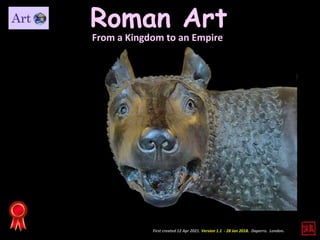
Roman Art
From a Kingdom to an Empire
First created 12 Apr 2021. Version 1.1 - 28 Jan 2018. Daperro. London.
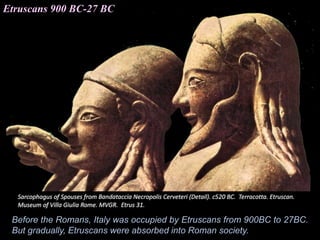
Before the Romans, Italy was occupied by Etruscans from 900BC to 27BC.
But gradually, Etruscans were absorbed into Roman society.
Etruscans 900 BC-27 BC
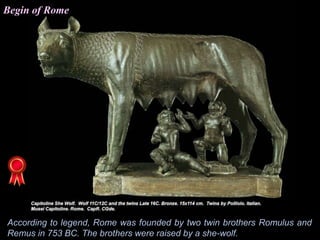
According to legend, Rome was founded by two twin brothers Romulus and
Remus in 753 BC. The brothers were raised by a she-wolf.
Begin of Rome
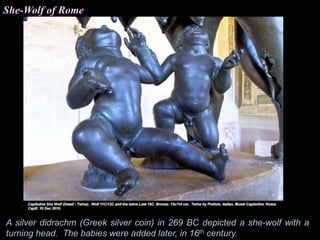
She-Wolf of Rome
A silver didrachm (Greek silver coin) in 269 BC depicted a she-wolf with a
turning head. The babies were added later, in 16th century.
Roman Republic
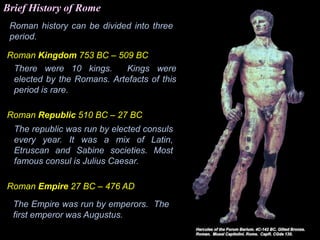
Roman history can be divided into three
period.
Roman Kingdom 753 BC – 509 BC
There were 10 kings. Kings were
elected by the Romans. Artefacts of this
period is rare.
Roman Republic 510 BC – 27 BC
The republic was run by elected consuls
every year. It was a mix of Latin,
Etruscan and Sabine societies. Most
famous consul is Julius Caesar.
Roman Empire 27 BC – 476 AD
The Empire was run by emperors. The
first emperor was Augustus.
Brief History of Rome
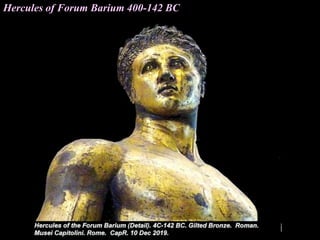
Hercules of Forum Barium 400-142 BC
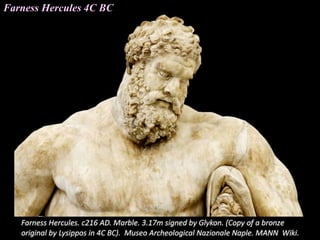
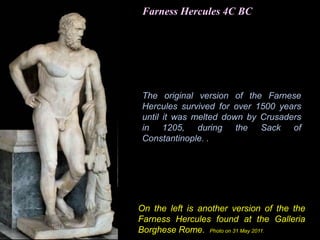
Farness Hercules 4C BC
On the left is another version of the the
Farness Hercules found at the Galleria
Borghese Rome. Photo on 31 May 2011.
The original version of the Farnese
Hercules survived for over 1500 years
until it was melted down by Crusaders
in 1205, during the Sack of
Constantinople. .
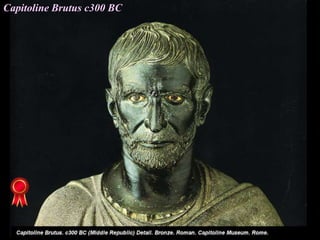
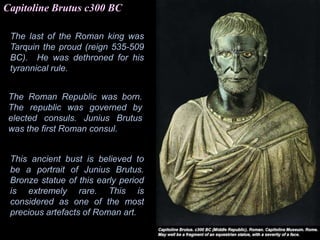
Capitoline Brutus c300 BC
The last of the Roman king was
Tarquin the proud (reign 535-509
BC). He was dethroned for his
tyrannical rule.
The Roman Republic was born.
The republic was governed by
elected consuls. Junius Brutus
was the first Roman consul.
This ancient bust is believed to
be a portrait of Junius Brutus.
Bronze statue of this early period
is extremely rare. This is
considered as one of the most
precious artefacts of Roman art.
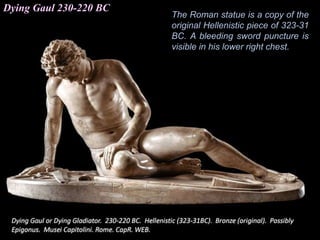
Dying Gaul 230-220 BC
The Roman statue is a copy of the
original Hellenistic piece of 323-31
BC. A bleeding sword puncture is
visible in his lower right chest.
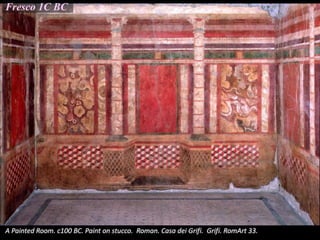
Fresco 1C BC
Fountain Horn 4C BC
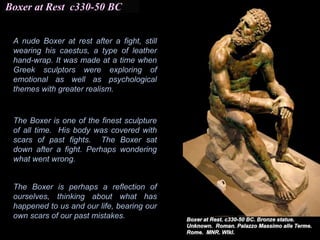
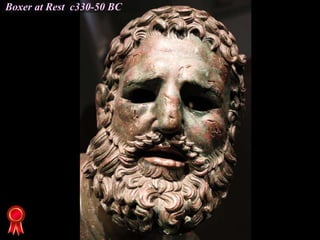
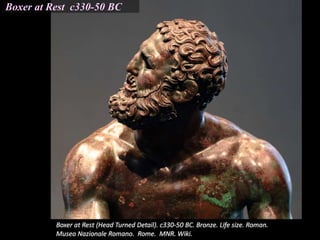
Boxer at Rest c330-50 BC
The Boxer is one of the finest sculpture
of all time. His body was covered with
scars of past fights. The Boxer sat
down after a fight. Perhaps wondering
what went wrong.
The Boxer is perhaps a reflection of
ourselves, thinking about what has
happened to us and our life, bearing our
own scars of our past mistakes.
A nude Boxer at rest after a fight, still
wearing his caestus, a type of leather
hand-wrap. It was made at a time when
Greek sculptors were exploring of
emotional as well as psychological
themes with greater realism.
Boxer at Rest c330-50 BC
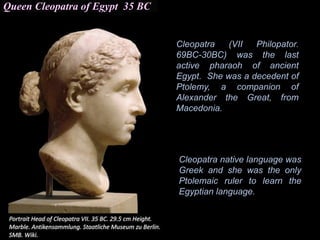
Queen Cleopatra of Egypt 35 BC
Cleopatra (VII Philopator.
69BC-30BC) was the last
active pharaoh of ancient
Egypt. She was a decedent of
Ptolemy, a companion of
Alexander the Great, from
Macedonia.
Cleopatra native language was
Greek and she was the only
Ptolemaic ruler to learn the
Egyptian language.
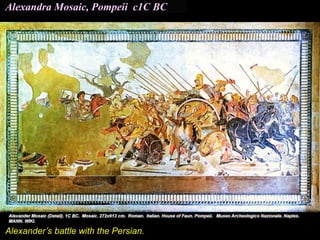
Alexandra Mosaic, Pompeii c1C BC
Alexander’s battle with the Persian.
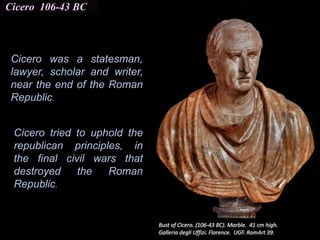
Cicero 106-43 BC
Cicero was a statesman,
lawyer, scholar and writer,
near the end of the Roman
Republic.
Cicero tried to uphold the
republican principles, in
the final civil wars that
destroyed the Roman
Republic.
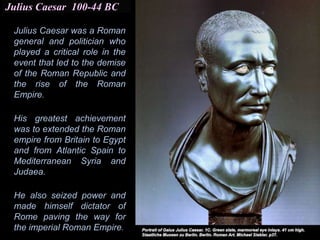
Julius Caesar 100-44 BC
Julius Caesar was a Roman
general and politician who
played a critical role in the
event that led to the demise
of the Roman Republic and
the rise of the Roman
Empire.
His greatest achievement
was to extended the Roman
empire from Britain to Egypt
and from Atlantic Spain to
Mediterranean Syria and
Judaea.
He also seized power and
made himself dictator of
Rome paving the way for
the imperial Roman Empire.
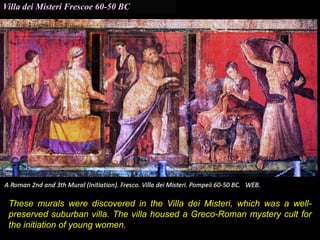
Villa dei Misteri Frescoe 60-50 BC
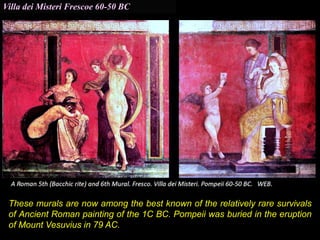
These murals were discovered in the Villa dei Misteri, which was a well-
preserved suburban villa. The villa housed a Greco-Roman mystery cult for
the initiation of young women.
Villa dei Misteri Frescoe 60-50 BC
These murals are now among the best known of the relatively rare survivals
of Ancient Roman painting of the 1C BC. Pompeii was buried in the eruption
of Mount Vesuvius in 79 AC.
Roman Empire
Augustus Caesar 63BC-14 AD
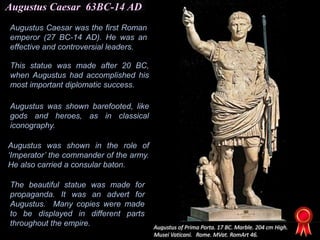
Augustus Caesar was the first Roman
emperor (27 BC-14 AD). He was an
effective and controversial leaders.
This statue was made after 20 BC,
when Augustus had accomplished his
most important diplomatic success.
Augustus was shown barefooted, like
gods and heroes, as in classical
iconography.
Augustus was shown in the role of
‘Imperator’ the commander of the army.
He also carried a consular baton.
The beautiful statue was made for
propaganda. It was an advert for
Augustus. Many copies were made
to be displayed in different parts
throughout the empire.
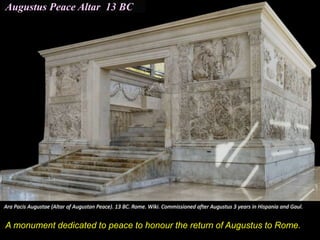
Augustus Peace Altar 13 BC
A monument dedicated to peace to honour the return of Augustus to Rome.
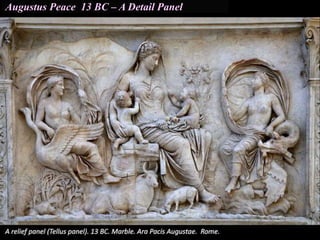
Augustus Peace 13 BC – A Detail Panel
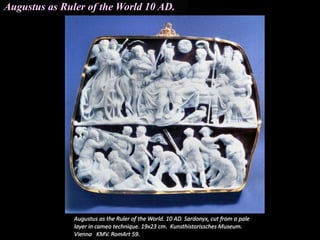
Augustus as Ruler of the World 10 AD.
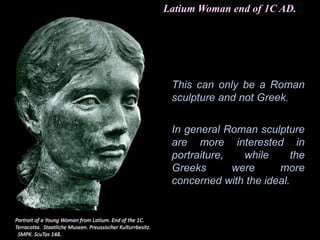
This can only be a Roman
sculpture and not Greek.
In general Roman sculpture
are more interested in
portraiture, while the
Greeks were more
concerned with the ideal.
Latium Woman end of 1C AD.
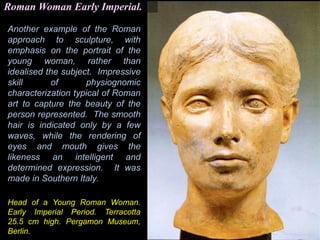
Another example of the Roman
approach to sculpture, with
emphasis on the portrait of the
young woman, rather than
idealised the subject. Impressive
skill of physiognomic
characterization typical of Roman
art to capture the beauty of the
person represented. The smooth
hair is indicated only by a few
waves, while the rendering of
eyes and mouth gives the
likeness an intelligent and
determined expression. It was
made in Southern Italy.
Roman Woman Early Imperial.
Head of a Young Roman Woman.
Early Imperial Period. Terracotta
25.5 cm high. Pergamon Museum,
Berlin.
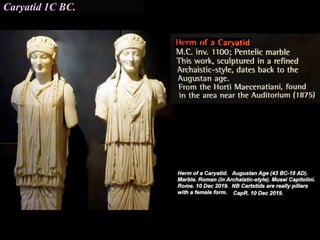
Caryatid 1C BC.
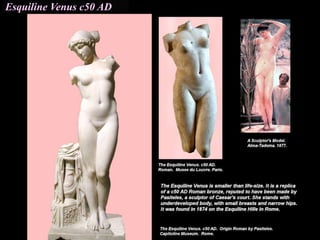
Esquiline Venus c50 AD
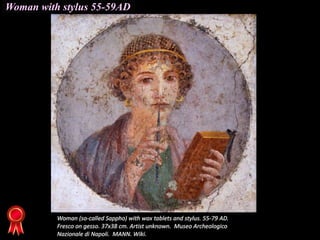
Woman with stylus 55-59AD
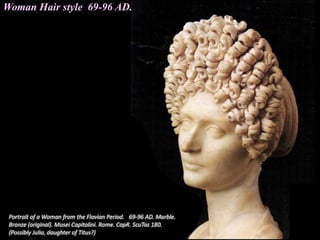
Woman Hair style 69-96 AD.
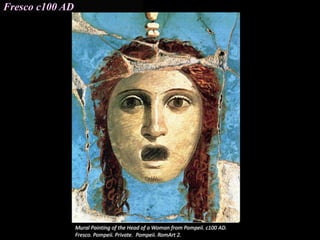
Fresco c100 AD
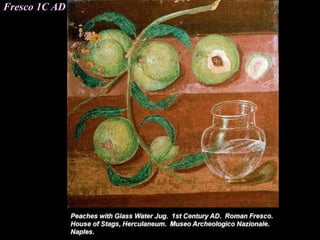
Fresco 1C AD
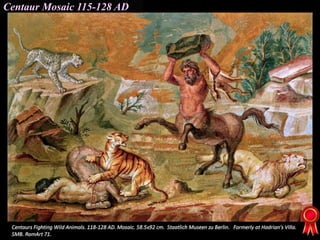
Centaur Mosaic 115-128 AD
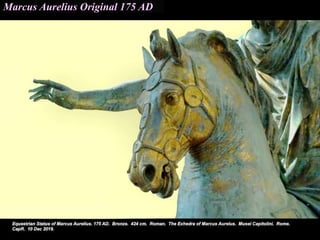
Marcus Aurelius Replica
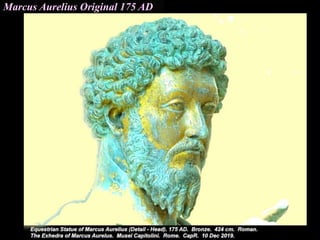
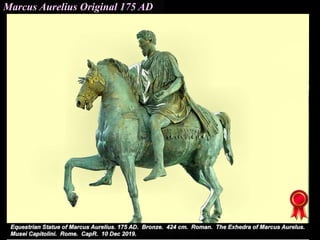
Marcus Aurelius Original 175 AD
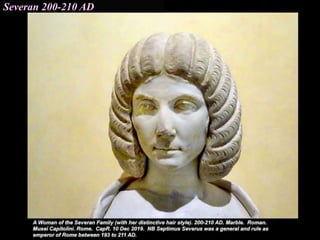
Severan 200-210 AD
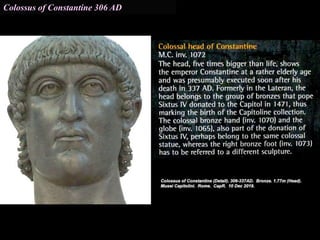
Colossus of Constantine 306 AD
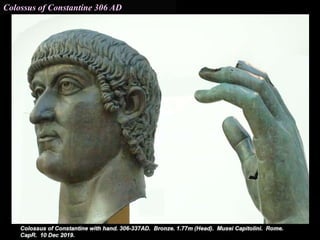
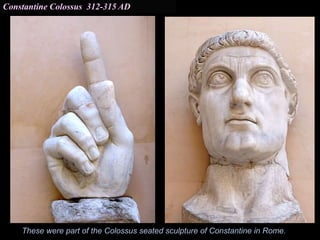
Constantine Colossus 312-315 AD
These were part of the Colossus seated sculpture of Constantine in Rome.
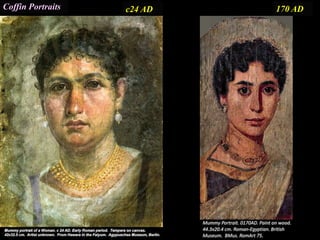
Coffin Portraits c24 AD 170 AD
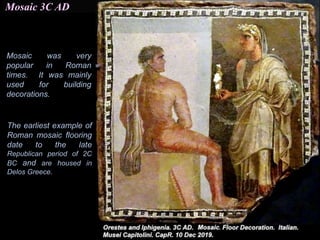
Mosaic 3C AD
Mosaic was very
popular in Roman
times. It was mainly
used for building
decorations.
The earliest example of
Roman mosaic flooring
date to the late
Republican period of 2C
BC and are housed in
Delos Greece.
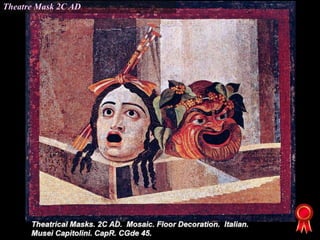
Theatre Mask 2C AD
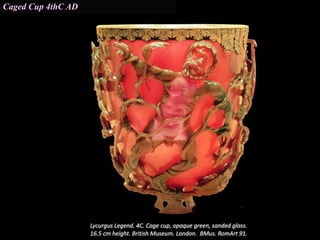
Caged Cup 4thC AD
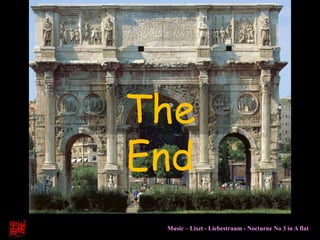
The
End
Music – Liszt - Liebestraum - Nocturne No 3 in A flat
Mediterranean History
Ancient Roman Art 1.1

Ancient Roman Art 1.1

  • 1.
    Roman Art From aKingdom to an Empire First created 12 Apr 2021. Version 1.1 - 28 Jan 2018. Daperro. London.
  • 2.
    Before the Romans,Italy was occupied by Etruscans from 900BC to 27BC. But gradually, Etruscans were absorbed into Roman society. Etruscans 900 BC-27 BC
  • 3.
    According to legend,Rome was founded by two twin brothers Romulus and Remus in 753 BC. The brothers were raised by a she-wolf. Begin of Rome
  • 4.
    She-Wolf of Rome Asilver didrachm (Greek silver coin) in 269 BC depicted a she-wolf with a turning head. The babies were added later, in 16th century.
  • 5.
  • 6.
    Roman history canbe divided into three period. Roman Kingdom 753 BC – 509 BC There were 10 kings. Kings were elected by the Romans. Artefacts of this period is rare. Roman Republic 510 BC – 27 BC The republic was run by elected consuls every year. It was a mix of Latin, Etruscan and Sabine societies. Most famous consul is Julius Caesar. Roman Empire 27 BC – 476 AD The Empire was run by emperors. The first emperor was Augustus. Brief History of Rome
  • 7.
    Hercules of ForumBarium 400-142 BC
  • 8.
  • 9.
    Farness Hercules 4CBC On the left is another version of the the Farness Hercules found at the Galleria Borghese Rome. Photo on 31 May 2011. The original version of the Farnese Hercules survived for over 1500 years until it was melted down by Crusaders in 1205, during the Sack of Constantinople. .
  • 10.
  • 11.
    Capitoline Brutus c300BC The last of the Roman king was Tarquin the proud (reign 535-509 BC). He was dethroned for his tyrannical rule. The Roman Republic was born. The republic was governed by elected consuls. Junius Brutus was the first Roman consul. This ancient bust is believed to be a portrait of Junius Brutus. Bronze statue of this early period is extremely rare. This is considered as one of the most precious artefacts of Roman art.
  • 12.
    Dying Gaul 230-220BC The Roman statue is a copy of the original Hellenistic piece of 323-31 BC. A bleeding sword puncture is visible in his lower right chest.
  • 13.
  • 14.
  • 15.
    Boxer at Restc330-50 BC The Boxer is one of the finest sculpture of all time. His body was covered with scars of past fights. The Boxer sat down after a fight. Perhaps wondering what went wrong. The Boxer is perhaps a reflection of ourselves, thinking about what has happened to us and our life, bearing our own scars of our past mistakes. A nude Boxer at rest after a fight, still wearing his caestus, a type of leather hand-wrap. It was made at a time when Greek sculptors were exploring of emotional as well as psychological themes with greater realism.
  • 16.
    Boxer at Restc330-50 BC
  • 17.
    Boxer at Restc330-50 BC
  • 18.
    Queen Cleopatra ofEgypt 35 BC Cleopatra (VII Philopator. 69BC-30BC) was the last active pharaoh of ancient Egypt. She was a decedent of Ptolemy, a companion of Alexander the Great, from Macedonia. Cleopatra native language was Greek and she was the only Ptolemaic ruler to learn the Egyptian language.
  • 19.
    Alexandra Mosaic, Pompeiic1C BC Alexander’s battle with the Persian.
  • 20.
    Cicero 106-43 BC Cicerowas a statesman, lawyer, scholar and writer, near the end of the Roman Republic. Cicero tried to uphold the republican principles, in the final civil wars that destroyed the Roman Republic.
  • 21.
    Julius Caesar 100-44BC Julius Caesar was a Roman general and politician who played a critical role in the event that led to the demise of the Roman Republic and the rise of the Roman Empire. His greatest achievement was to extended the Roman empire from Britain to Egypt and from Atlantic Spain to Mediterranean Syria and Judaea. He also seized power and made himself dictator of Rome paving the way for the imperial Roman Empire.
  • 22.
    Villa dei MisteriFrescoe 60-50 BC These murals were discovered in the Villa dei Misteri, which was a well- preserved suburban villa. The villa housed a Greco-Roman mystery cult for the initiation of young women.
  • 23.
    Villa dei MisteriFrescoe 60-50 BC These murals are now among the best known of the relatively rare survivals of Ancient Roman painting of the 1C BC. Pompeii was buried in the eruption of Mount Vesuvius in 79 AC.
  • 24.
  • 25.
    Augustus Caesar 63BC-14AD Augustus Caesar was the first Roman emperor (27 BC-14 AD). He was an effective and controversial leaders. This statue was made after 20 BC, when Augustus had accomplished his most important diplomatic success. Augustus was shown barefooted, like gods and heroes, as in classical iconography. Augustus was shown in the role of ‘Imperator’ the commander of the army. He also carried a consular baton. The beautiful statue was made for propaganda. It was an advert for Augustus. Many copies were made to be displayed in different parts throughout the empire.
  • 26.
    Augustus Peace Altar13 BC A monument dedicated to peace to honour the return of Augustus to Rome.
  • 27.
    Augustus Peace 13BC – A Detail Panel
  • 28.
    Augustus as Rulerof the World 10 AD.
  • 29.
    This can onlybe a Roman sculpture and not Greek. In general Roman sculpture are more interested in portraiture, while the Greeks were more concerned with the ideal. Latium Woman end of 1C AD.
  • 30.
    Another example ofthe Roman approach to sculpture, with emphasis on the portrait of the young woman, rather than idealised the subject. Impressive skill of physiognomic characterization typical of Roman art to capture the beauty of the person represented. The smooth hair is indicated only by a few waves, while the rendering of eyes and mouth gives the likeness an intelligent and determined expression. It was made in Southern Italy. Roman Woman Early Imperial. Head of a Young Roman Woman. Early Imperial Period. Terracotta 25.5 cm high. Pergamon Museum, Berlin.
  • 31.
  • 32.
  • 33.
  • 34.
  • 35.
  • 36.
  • 37.
  • 38.
  • 39.
  • 40.
  • 41.
  • 42.
  • 43.
  • 44.
  • 45.
    Constantine Colossus 312-315AD These were part of the Colossus seated sculpture of Constantine in Rome.
  • 46.
  • 47.
    Mosaic 3C AD Mosaicwas very popular in Roman times. It was mainly used for building decorations. The earliest example of Roman mosaic flooring date to the late Republican period of 2C BC and are housed in Delos Greece.
  • 48.
  • 49.
  • 50.
    The End Music – Liszt- Liebestraum - Nocturne No 3 in A flat
  • 51.

Editor's Notes

  • #2 While Greek statuary was created to represent idealized human forms of athletes and gods, Ancient Roman sculpture represented real, ordinary people with their natural beauty and imperfections. The main purpose of the statuary was to immortalize, though many Greek and Roman statues were originally painted with bright colors which over the centuries lost the pigment. Greek sculptors derived the facial features from the idealized inner and intellectual characteristics, whereas the Romans inferred the personality from the physical features. As a very representative example, I suggest observing any bust of Vespasian, Roman Emperor depicted with each feature without any glorification. When comparing the statuary of the two great civilizations we can notice another significant difference. The traditions of the Roman Republic equate the nudity represented by the Greek sculpture as a dishonorable impudicity, more in favor of an iconography that represents the republican values of the citizenship. The Ancient Rome .Com
  • #51 History of Major Releases Version 2.4 included three PwrPoint slides on Travel, Building & Gallery