1
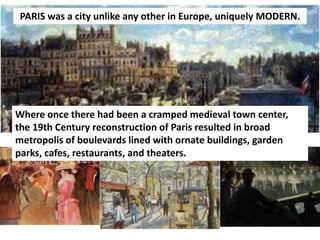
PARIS was a city unlike any other in Europe, uniquely MODERN.
Where once there had been a cramped medieval town center,
the 19th Century reconstruction of Paris resulted in broad
metropolis of boulevards lined with ornate buildings, garden
parks, cafes, restaurants, and theaters.
Claude Monet
Edgar Degas
Paul Cezanne
Pierre-August Renoir
Camille
Pissarro
Berthe Morrison
Eugene Delacroix, Liberty leading the people, 1830
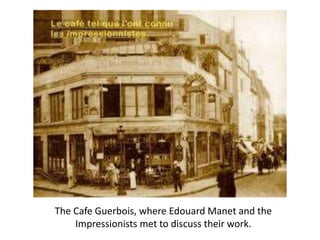
The Cafe Guerbois, where Edouard Manet and the
Impressionists met to discuss their work.
The 1st exhibit of
the Impressionists
was held at the
studio of
photographer/jou
rnalist Felix Nadar
in 1874
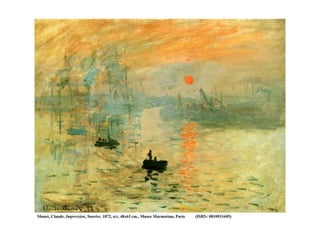
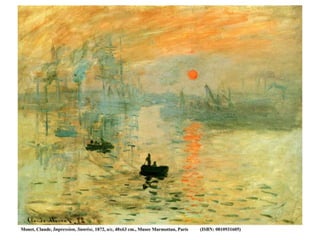
Technique… The “Signature” Character of Impressionism.
•Thick and short brush strokes (impasto)
•Capture the essence of the subject and create an impression
•No much details
•Colors are juxtaposed side-by-side with as few mixing as possible to
create a vibrant color temperature where the colors mix in the eye of
the beholder.
•Grays and dark colors are produced by mixing complementary colors
•No use of black
•Soft subject edges
•Wet paint is applied into wet paint of another color
•Surfaces are often opaque.
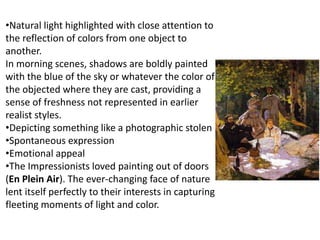
•Natural light highlighted with close attention to
the reflection of colors from one object to
another.
In morning scenes, shadows are boldly painted
with the blue of the sky or whatever the color of
the objected where they are cast, providing a
sense of freshness not represented in earlier
realist styles.
•Depicting something like a photographic stolen
•Spontaneous expression
•Emotional appeal
•The Impressionists loved painting out of doors
(En Plein Air). The ever-changing face of nature
lent itself perfectly to their interests in capturing
fleeting moments of light and color.
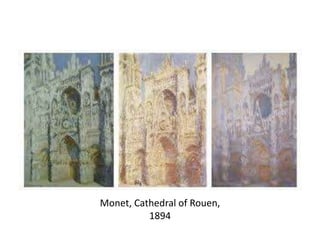
Monet, Cathedral of Rouen,
1894
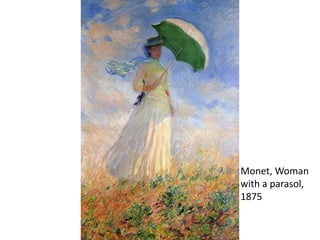
Monet, Woman
with a parasol,
1875
Monet, Woman
with a parasol,
1875
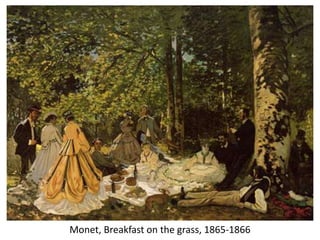
Monet, Breakfast on the grass, 1865-1866
Themes of the Impressionism:
•Mundane subjects
•The Impressionists liked to paint scenes of everyday life, of
contemporary people at work and play.
•Suburban gardens and riverside paths, rural parks and woodlands
•Landscape as Impression
•Nature is a social experience.
•Impressionist’s landscapes almost always have a human presence. Even
if people are absent, there frequently is something – a boat, or even a
haystack – to give a sign of human activity.
Manet, Bar of the Folies-Bergeres, 1881-1882
Renoir, La Grenoulliere, 1869
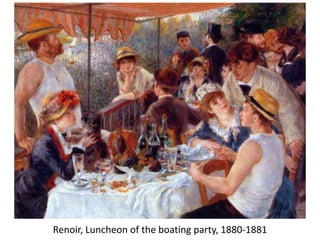
Renoir, Luncheon of the boating party, 1880-1881
Conclusion: Revolution of Art.
•Impressionism radical departure from tradition.
•When the Impressionists began painting, Ideals of art were not only
controlled, but also looked down upon and rejected by academic
institutions
Even through the hardships, the Impressionists did not give up on the
art that they believed in.
•By the end of the Impressionists period, artists felt liberated from strict
rules or composition, subject matter and technique.
“ Impressionism is at the root of all modern art, because it was the first
movement that managed to free itself from preconceived ideas, and
because it changed not only the way life was depicted but the way life
was seen” – F. Salvi
Creative Industries 1: 11  impressionism

Creative Industries 1: 11 impressionism

  • 1.
  • 6.
    PARIS was acity unlike any other in Europe, uniquely MODERN. Where once there had been a cramped medieval town center, the 19th Century reconstruction of Paris resulted in broad metropolis of boulevards lined with ornate buildings, garden parks, cafes, restaurants, and theaters.
  • 7.
    Claude Monet Edgar Degas PaulCezanne Pierre-August Renoir Camille Pissarro Berthe Morrison
  • 10.
    Eugene Delacroix, Libertyleading the people, 1830
  • 11.
    The Cafe Guerbois,where Edouard Manet and the Impressionists met to discuss their work.
  • 12.
    The 1st exhibitof the Impressionists was held at the studio of photographer/jou rnalist Felix Nadar in 1874
  • 14.
    Technique… The “Signature”Character of Impressionism. •Thick and short brush strokes (impasto) •Capture the essence of the subject and create an impression •No much details •Colors are juxtaposed side-by-side with as few mixing as possible to create a vibrant color temperature where the colors mix in the eye of the beholder. •Grays and dark colors are produced by mixing complementary colors •No use of black •Soft subject edges •Wet paint is applied into wet paint of another color •Surfaces are often opaque.
  • 15.
    •Natural light highlightedwith close attention to the reflection of colors from one object to another. In morning scenes, shadows are boldly painted with the blue of the sky or whatever the color of the objected where they are cast, providing a sense of freshness not represented in earlier realist styles. •Depicting something like a photographic stolen •Spontaneous expression •Emotional appeal •The Impressionists loved painting out of doors (En Plein Air). The ever-changing face of nature lent itself perfectly to their interests in capturing fleeting moments of light and color.
  • 16.
  • 17.
    Monet, Woman with aparasol, 1875
  • 18.
    Monet, Woman with aparasol, 1875
  • 19.
    Monet, Breakfast onthe grass, 1865-1866
  • 20.
    Themes of theImpressionism: •Mundane subjects •The Impressionists liked to paint scenes of everyday life, of contemporary people at work and play. •Suburban gardens and riverside paths, rural parks and woodlands •Landscape as Impression •Nature is a social experience. •Impressionist’s landscapes almost always have a human presence. Even if people are absent, there frequently is something – a boat, or even a haystack – to give a sign of human activity.
  • 21.
    Manet, Bar ofthe Folies-Bergeres, 1881-1882
  • 22.
  • 23.
    Renoir, Luncheon ofthe boating party, 1880-1881
  • 25.
    Conclusion: Revolution ofArt. •Impressionism radical departure from tradition. •When the Impressionists began painting, Ideals of art were not only controlled, but also looked down upon and rejected by academic institutions Even through the hardships, the Impressionists did not give up on the art that they believed in. •By the end of the Impressionists period, artists felt liberated from strict rules or composition, subject matter and technique. “ Impressionism is at the root of all modern art, because it was the first movement that managed to free itself from preconceived ideas, and because it changed not only the way life was depicted but the way life was seen” – F. Salvi