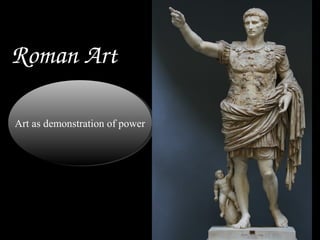
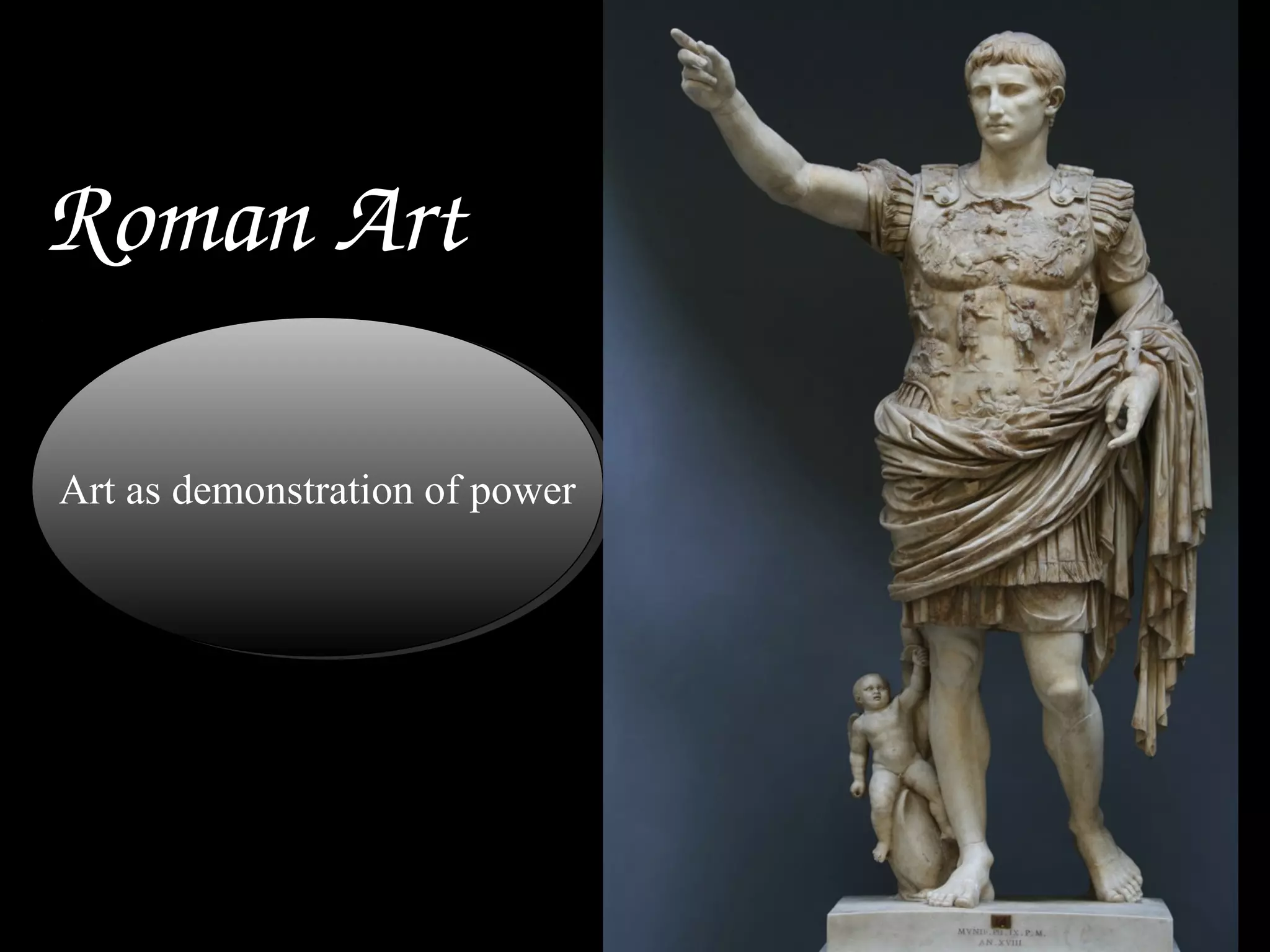
Roman Art
Art as demonstration of power
Time period: 753 BCE – 410 CE
So in other words…
8th century BCE – 5th century CE
(We’re finally in the Common Era!)
New Vocabulary (to help you review)

• Aqueduct: an overground water system
• Ashlar masonry: carefully cut and grooved stones that support a building
without the use of concrete or other kinds of masonry
• Atrium (plural: atria): a courtyard in a Roman house or before a Christian church
• Basilica: in Roman architecture, a large axially planned building with a nave, side
aisles, and apses
• Bust: a sculpture depicting a head, neck, and upper chest of a figure
• Coffer: in architecture, a sunken panel in a ceiling
• Cubiculum (plural: cubicula): a Roman bedroom flanking an atrium; in Early
Christian art, a mortuary chapel in a catacomb
• Cupola: a small dome rising over the roof of a building; in architecture, a cupola
is achieved by rotating an arch on its axis
• Encaustic: an ancient method of painting that uses colored waxes burned into a
wooden surface
• Foreshortening: a visual effect in which an object is shortened and turned deeper
into the picture plane to give the effect of receding into space
• Forum (plural: fora): a public square or market place in a Roman city
• Fresco: a painting technique that involves applying water-based paint onto a
freshly plastered wall. The paint forms a bond with the plaster that is durable and
long lasting
New vocabulary continued…

•
•
•
•
•

•
•
•
•

Impluvium: a rectangular basin in a Roman house that is placed in the open-air
atrium in order to collect rain water
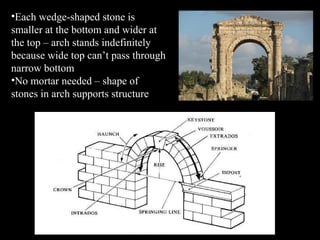
Keystone: the center stone of an arch that holds the others in place
Oculus: a circular window in a church, or a round opening at the top of a dome
Peristyle: an atrium surrounded by columns in a Roman house
Perspective: depth and recession in a painting or relief sculpture. Objects shown
in linear perspective achieve a three-dimensionality in the two-dimensional
surface of the picture plane. All lines, called orthogonals, draw the viewer back
in space to a common point (vanishing point). Sometimes there are multiple
vanishing points. Landscapes that give the illusion of distance are in
atmospheric or aerial perspective.
Pier: a vertical support that holds up an arch or vault
Spandrel: a triangular space enclosed by the curves of arches
Vault: a roof constructed with arches. When an arch is extended into space,
forming a tunnel, it is called a barrel vault. When two barrel vaults intersect at
right angles, it’s called a groin vault.
Veristic: sculptures from the Roman Republic characterized by extreme realism
of facial features
KEY IDEAS ABOUT ROMAN ART
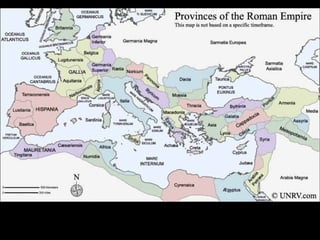
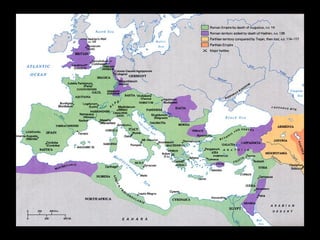
• It reflects the ambitions of a powerful empire
• Monumental buildings and sculptures reflect glory of gods and state
• Architecture is revolutionary! – understood powers of arch, vault,
and concrete
• Pompeiian villas- give us a history of Roman painting
• It shows an interest in the basic elements of perspective and
foreshortening
• The sculpture is greatly influenced by Greek models
Does Rome have a unique characteristic style of art?
•Huge admiration for Greek art- had Greek art copied, original Roman art done in
Greek style, many Roman artists were Greek in origin
•Roman authors uninterested in art of their own time- never developed literature on
the theory, history or criticism of art like the Greeks
•We hear very little of specific artists who enjoyed individual fame
•Probably looked upon their own time as a decline in art compared to Greece
•Great majority of Roman art is unsigned- could have come from anywhere in
Roman domain•Roman society very tolerant of alien traditions (if they did not threaten the security
of the state)
•Religion was not forced - many traditions of Etruscan, Near East, and Egyptians
were absorbed into Roman culture- therefore Roman style is not consistentemergent styles existing side by side
To understand Roman art, we need to know the historical CONTEXT:
•Rome rose to glory by diplomacy and military strength
•Roman influence is still around (literature, art, law, etc.)
•Rome was established by Romulus and Remus (a legend)
•Rome was first ruled by kings and then replaced by a senate (an
elected body of privileged Roman men)
•Established a sort of democracy
•Increased their fortunes and expanded their boundaries through war
•Obsessed with Greek art
•Because of the city of Pompeii, we know more about daily life in
ancient Rome than we know about any other civilization in history
PATRONAGE and ARTISTIC LIFE in ancient Rome:
•
•
•
•
•
•
•
•

Roman government and wealthy people = major patrons of the arts
Spent lavishly on themselves and homes
Dedicated to the general good of the arts
Gave generously to public projects
Huge workshops cranking out Greek-style works
Romans built houses to impress and entertain
Lavish interiors of homes (marble plumbing fixtures!)
Interiors were grand domestic spaces that announced the
importance of the owner
• Artists = low on social scale (what?!)- treated poorly – many were
slaves and never got credit for their work (whaaaaat?!??)
Let’s begin with
ARCHITECTURE
in ancient Rome…
INNOVATIONS IN ROMAN ARCHITECTURE
• Romans were master builders
• Built great roads and massive aqueducts – efficient way
to connect cities and make areas livable
• Temples = hymns to the gods, symbols of civic pride
• Arenas – awed spectators (size and engineering are
awesome)
• Perfected the arch and used it a lot (not used much
before)
• Used concrete in constructing huge buildings – but
they thought it was ugly, so they covered concrete
structures in other materials (like marble) to make them
more attractive
•Each wedge-shaped stone is
smaller at the bottom and wider at
the top – arch stands indefinitely
because wide top can’t pass through
narrow bottom
•No mortar needed – shape of
stones in arch supports structure
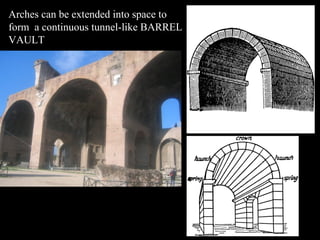
Arches can be extended into space to
form a continuous tunnel-like BARREL
VAULT
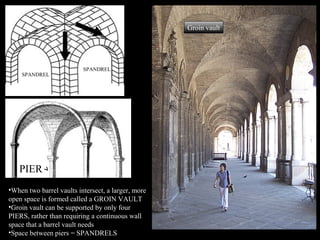
Groin vault
Groin vault

SPANDREL
SPANDREL

PIER
•When two barrel vaults intersect, a larger, more
open space is formed called a GROIN VAULT
•Groin vault can be supported by only four
PIERS, rather than requiring a continuous wall
space that a barrel vault needs
•Space between piers = SPANDRELS
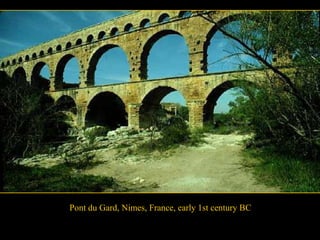
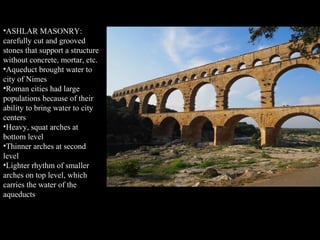
Pont du Gard, Nimes, France, early 1st century BC
•ASHLAR MASONRY:
carefully cut and grooved
stones that support a structure
without concrete, mortar, etc.
•Aqueduct brought water to
city of Nimes
•Roman cities had large
populations because of their
ability to bring water to city
centers
•Heavy, squat arches at
bottom level
•Thinner arches at second
level
•Lighter rhythm of smaller
arches on top level, which
carries the water of the
aqueducts
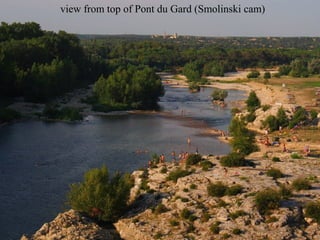
view from top of Pont du Gard (Smolinski cam)
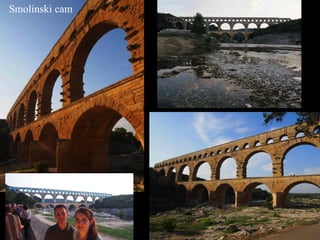
Smolinski cam
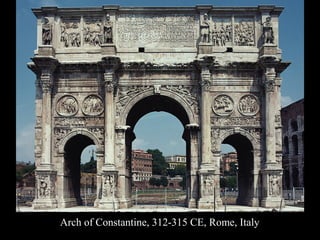
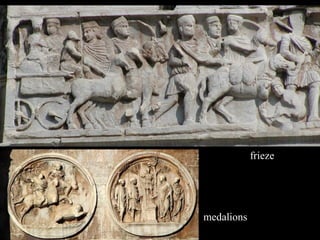
Arch of Constantine, 312-315 CE, Rome, Italy
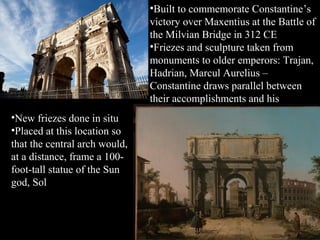
•Built to commemorate Constantine’s
victory over Maxentius at the Battle of
the Milvian Bridge in 312 CE
•Friezes and sculpture taken from
monuments to older emperors: Trajan,
Hadrian, Marcul Aurelius –
Constantine draws parallel between
their accomplishments and his
•New friezes done in situ
•Placed at this location so
that the central arch would,
at a distance, frame a 100foot-tall statue of the Sun
god, Sol
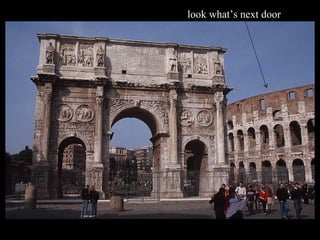
look what’s next door
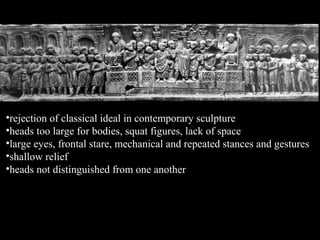
•rejection of classical ideal in contemporary sculpture
•heads too large for bodies, squat figures, lack of space
•large eyes, frontal stare, mechanical and repeated stances and gestures
•shallow relief
•heads not distinguished from one another
frieze

medalions
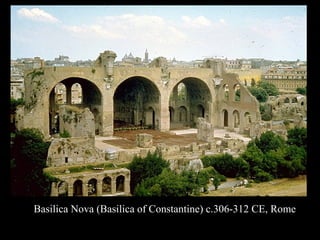
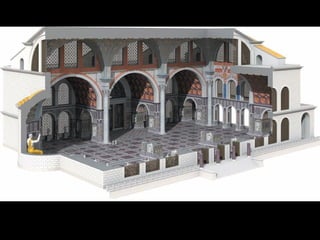
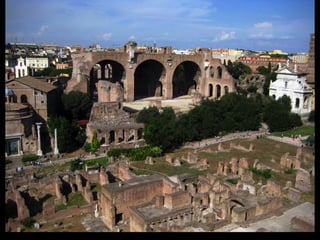
Basilica Nova (Basilica of Constantine) c.306-312 CE, Rome
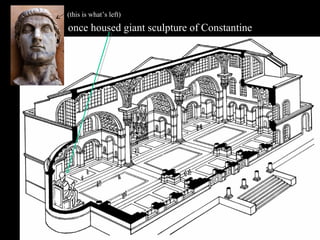
(this is what’s left)

once housed giant sculpture of Constantine
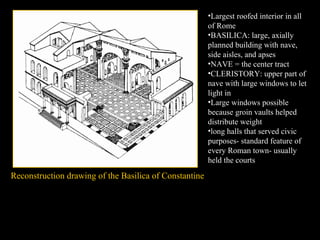
•Largest roofed interior in all
of Rome
•BASILICA: large, axially
planned building with nave,
side aisles, and apses
•NAVE = the center tract
•CLERISTORY: upper part of
nave with large windows to let
light in
•Large windows possible
because groin vaults helped
distribute weight
•long halls that served civic
purposes- standard feature of
every Roman town- usually
held the courts

Reconstruction drawing of the Basilica of Constantine
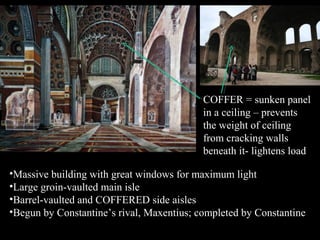
COFFER = sunken panel
in a ceiling – prevents
the weight of ceiling
from cracking walls
beneath it- lightens load
•Massive building with great windows for maximum light
•Large groin-vaulted main isle
•Barrel-vaulted and COFFERED side aisles
•Begun by Constantine’s rival, Maxentius; completed by Constantine
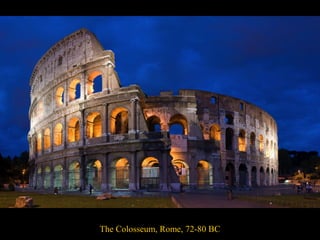
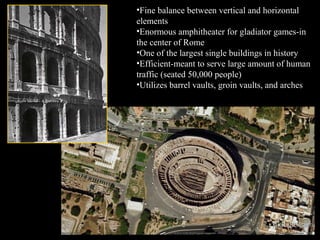
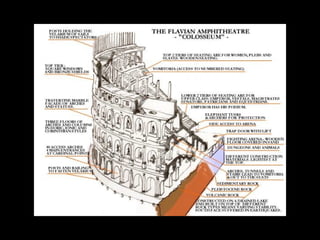
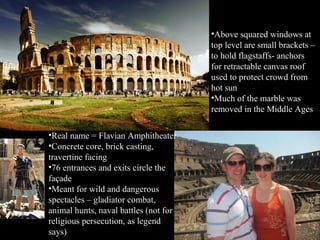
The Colosseum, Rome, 72-80 BC
•Fine balance between vertical and horizontal
elements
•Enormous amphitheater for gladiator games-in
the center of Rome
•One of the largest single buildings in history
•Efficient-meant to serve large amount of human
traffic (seated 50,000 people)
•Utilizes barrel vaults, groin vaults, and arches
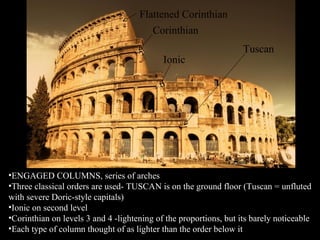
Flattened Corinthian
Corinthian
Tuscan
Ionic

•ENGAGED COLUMNS, series of arches
•Three classical orders are used- TUSCAN is on the ground floor (Tuscan = unfluted
with severe Doric-style capitals)
•Ionic on second level
•Corinthian on levels 3 and 4 -lightening of the proportions, but its barely noticeable
•Each type of column thought of as lighter than the order below it
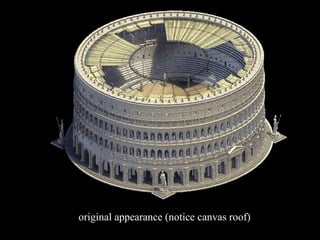
•Above squared windows at
top level are small brackets –
to hold flagstaffs- anchors
for retractable canvas roof
used to protect crowd from
hot sun
•Much of the marble was
removed in the Middle Ages
•Real name = Flavian Amphitheater
•Concrete core, brick casting,
travertine facing
•76 entrances and exits circle the
façade
•Meant for wild and dangerous
spectacles – gladiator combat,
animal hunts, naval battles (not for
religious persecution, as legend
says)
original appearance (notice canvas roof)
Check out the
Academy Awardwinning
“Spartacus”
(1960).
Smolinski two
thumbs up

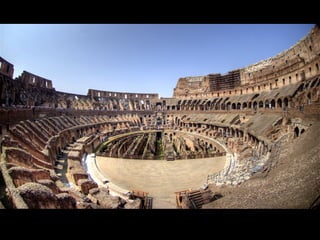
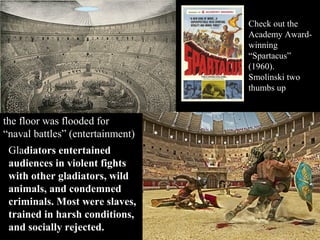
the floor was flooded for
“naval battles” (entertainment)
Gladiators entertained
audiences in violent fights
with other gladiators, wild
animals, and condemned
criminals. Most were slaves,
trained in harsh conditions,
and socially rejected.
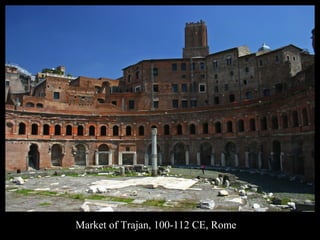
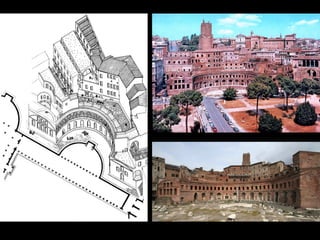
Market of Trajan, 100-112 CE, Rome
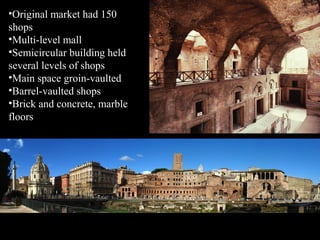
•Original market had 150
shops
•Multi-level mall
•Semicircular building held
several levels of shops
•Main space groin-vaulted
•Barrel-vaulted shops
•Brick and concrete, marble
floors
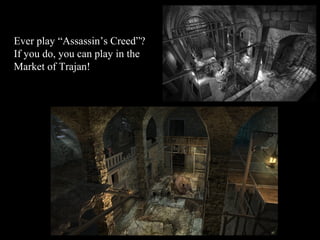
Ever play “Assassin’s Creed”?
If you do, you can play in the
Market of Trajan!
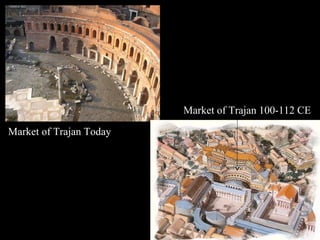
Market of Trajan 100-112 CE
Market of Trajan Today
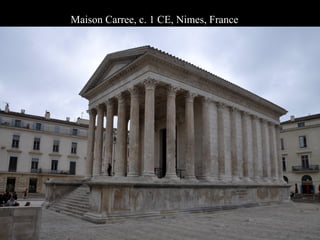
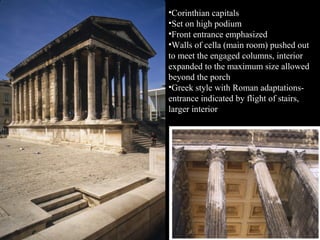
Maison Carree, c. 1 CE, Nimes, France
•Corinthian capitals
•Set on high podium
•Front entrance emphasized
•Walls of cella (main room) pushed out
to meet the engaged columns, interior
expanded to the maximum size allowed
beyond the porch
•Greek style with Roman adaptationsentrance indicated by flight of stairs,
larger interior
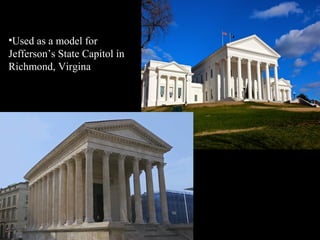
•Used as a model for
Jefferson’s State Capitol in
Richmond, Virgina
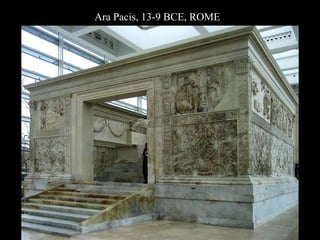
Ara Pacis, 13-9 BCE, ROME
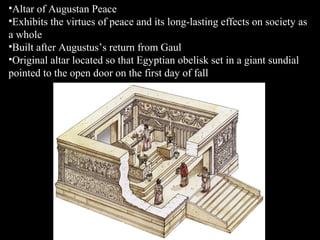
•Altar of Augustan Peace
•Exhibits the virtues of peace and its long-lasting effects on society as
a whole
•Built after Augustus’s return from Gaul
•Original altar located so that Egyptian obelisk set in a giant sundial
pointed to the open door on the first day of fall
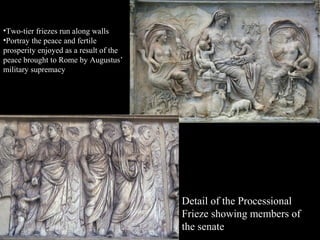
•Two-tier friezes run along walls
•Portray the peace and fertile
prosperity enjoyed as a result of the
peace brought to Rome by Augustus’
military supremacy

Detail of the Processional
Frieze showing members of
the senate
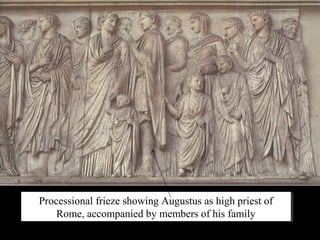
Processional frieze showing Augustus as high priest of
Rome, accompanied by members of his family
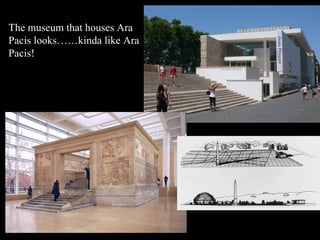
The museum that houses Ara
Pacis looks……kinda like Ara
Pacis!
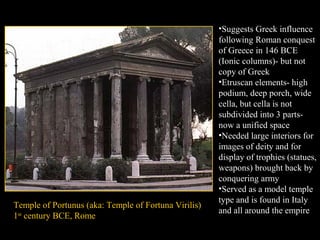
Temple of Portunus (aka: Temple of Fortuna Virilis)
1st century BCE, Rome

•Suggests Greek influence
following Roman conquest
of Greece in 146 BCE
(Ionic columns)- but not
copy of Greek
•Etruscan elements- high
podium, deep porch, wide
cella, but cella is not
subdivided into 3 partsnow a unified space
•Needed large interiors for
images of deity and for
display of trophies (statues,
weapons) brought back by
conquering army
•Served as a model temple
type and is found in Italy
and all around the empire
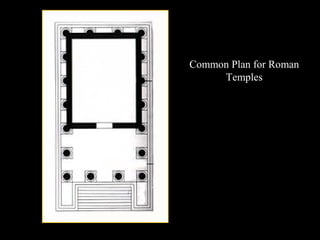
Common Plan for Roman
Temples
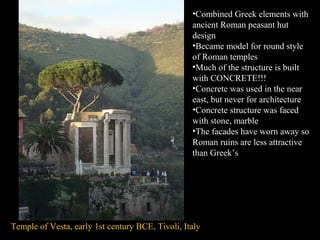
•Combined Greek elements with
ancient Roman peasant hut
design
•Became model for round style
of Roman temples
•Much of the structure is built
with CONCRETE!!!
•Concrete was used in the near
east, but never for architecture
•Concrete structure was faced
with stone, marble
•The facades have worn away so
Roman ruins are less attractive
than Greek’s

Temple of Vesta, early 1st century BCE, Tivoli, Italy
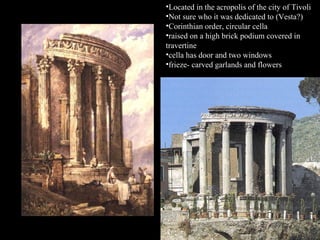
•Located in the acropolis of the city of Tivoli
•Not sure who it was dedicated to (Vesta?)
•Corinthian order, circular cella
•raised on a high brick podium covered in
travertine
•cella has door and two windows
•frieze- carved garlands and flowers
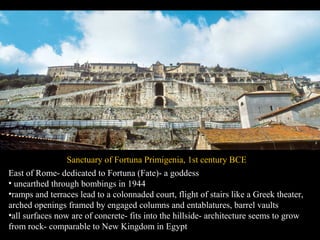
Sanctuary of Fortuna Primigenia, 1st century BCE
East of Rome- dedicated to Fortuna (Fate)- a goddess
• unearthed through bombings in 1944
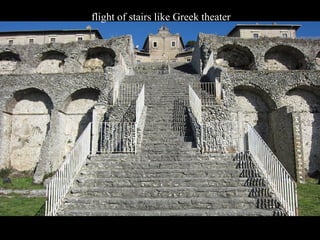
•ramps and terraces lead to a colonnaded court, flight of stairs like a Greek theater,
arched openings framed by engaged columns and entablatures, barrel vaults
•all surfaces now are of concrete- fits into the hillside- architecture seems to grow
from rock- comparable to New Kingdom in Egypt
flight of stairs like Greek theater
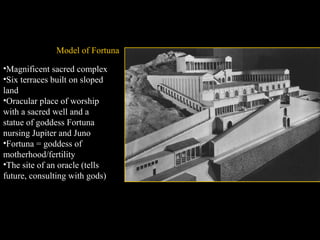
Model of Fortuna
•Magnificent sacred complex
•Six terraces built on sloped
land
•Oracular place of worship
with a sacred well and a
statue of goddess Fortuna
nursing Jupiter and Juno
•Fortuna = goddess of
motherhood/fertility
•The site of an oracle (tells
future, consulting with gods)
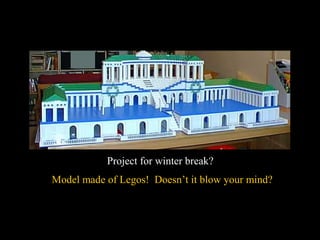
Project for winter break?
Model made of Legos! Doesn’t it blow your mind?
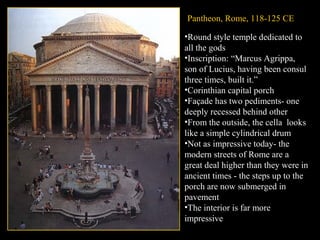
Pantheon, Rome, 118-125 CE
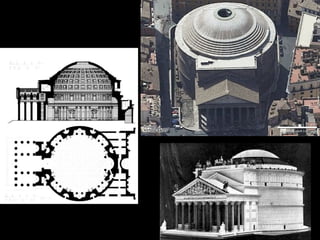
•Round style temple dedicated to
all the gods
•Inscription: “Marcus Agrippa,
son of Lucius, having been consul
three times, built it.”
•Corinthian capital porch
•Façade has two pediments- one
deeply recessed behind other
•From the outside, the cella looks
like a simple cylindrical drum
•Not as impressive today- the
modern streets of Rome are a
great deal higher than they were in
ancient times - the steps up to the
porch are now submerged in
pavement
•The interior is far more
impressive

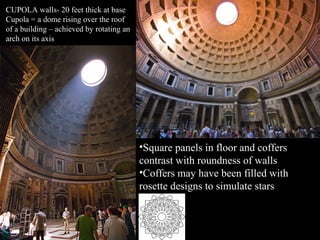
f
CUPOLA walls- 20 feet thick at base
Cupola = a dome rising over the roof
of a building – achieved by rotating an
arch on its axis

•Square panels in floor and coffers
contrast with roundness of walls
•Coffers may have been filled with
rosette designs to simulate stars
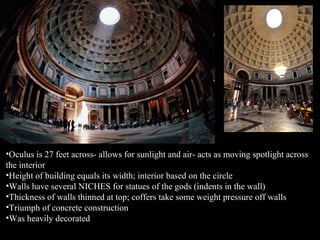
•Oculus is 27 feet across- allows for sunlight and air- acts as moving spotlight across
the interior
•Height of building equals its width; interior based on the circle
•Walls have several NICHES for statues of the gods (indents in the wall)
•Thickness of walls thinned at top; coffers take some weight pressure off walls
•Triumph of concrete construction
•Was heavily decorated
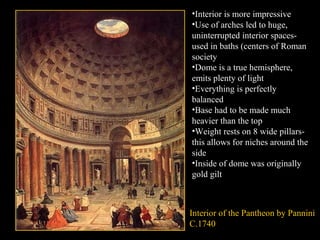
•Interior is more impressive
•Use of arches led to huge,
uninterrupted interior spacesused in baths (centers of Roman
society
•Dome is a true hemisphere,
emits plenty of light
•Everything is perfectly
balanced
•Base had to be made much
heavier than the top
•Weight rests on 8 wide pillarsthis allows for niches around the
side
•Inside of dome was originally
gold gilt

Interior of the Pantheon by Pannini
C.1740
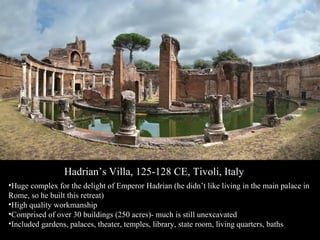
Hadrian’s Villa, 125-128 CE, Tivoli, Italy
•Huge complex for the delight of Emperor Hadrian (he didn’t like living in the main palace in
Rome, so he built this retreat)
•High quality workmanship
•Comprised of over 30 buildings (250 acres)- much is still unexcavated
•Included gardens, palaces, theater, temples, library, state room, living quarters, baths
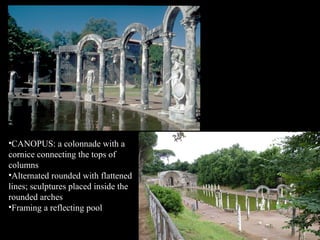
•CANOPUS: a colonnade with a
cornice connecting the tops of
columns
•Alternated rounded with flattened
lines; sculptures placed inside the
rounded arches
•Framing a reflecting pool
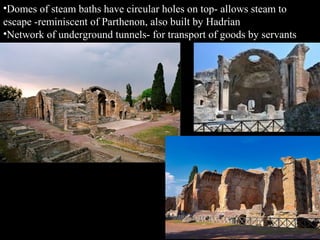
•Domes of steam baths have circular holes on top- allows steam to
escape -reminiscent of Parthenon, also built by Hadrian
•Network of underground tunnels- for transport of goods by servants
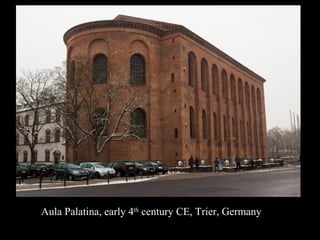
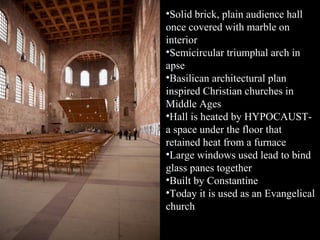
Aula Palatina, early 4th century CE, Trier, Germany
•Solid brick, plain audience hall
once covered with marble on
interior
•Semicircular triumphal arch in
apse
•Basilican architectural plan
inspired Christian churches in
Middle Ages
•Hall is heated by HYPOCAUSTa space under the floor that
retained heat from a furnace
•Large windows used lead to bind
glass panes together
•Built by Constantine
•Today it is used as an Evangelical
church
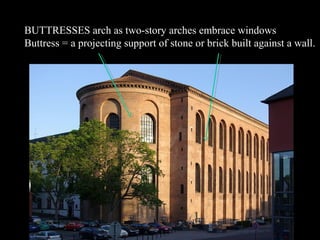
BUTTRESSES arch as two-story arches embrace windows
Buttress = a projecting support of stone or brick built against a wall.
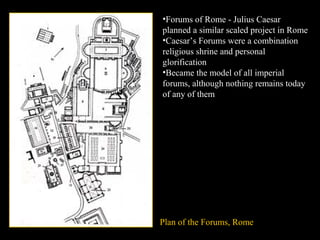
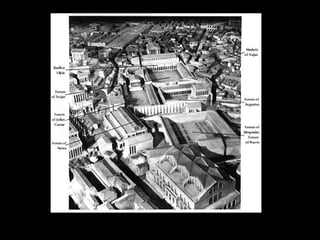
•Forums of Rome - Julius Caesar
planned a similar scaled project in Rome
•Caesar’s Forums were a combination
religious shrine and personal
glorification
•Became the model of all imperial
forums, although nothing remains today
of any of them

Plan of the Forums, Rome
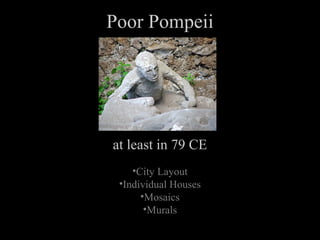
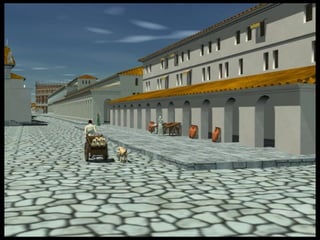
Poor Pompeii

at least in 79 CE
•City Layout
•Individual Houses
•Mosaics
•Murals
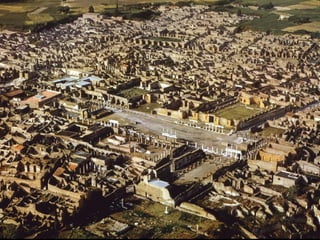
Pompeii, Italy
Explosion by Mount Vesuvius in
79 AD buried Pompeii
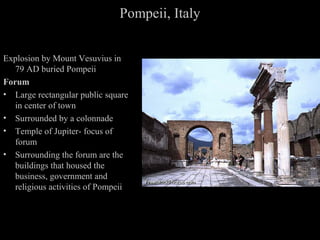
Forum
• Large rectangular public square
in center of town
• Surrounded by a colonnade
• Temple of Jupiter- focus of
forum
• Surrounding the forum are the
buildings that housed the
business, government and
religious activities of Pompeii
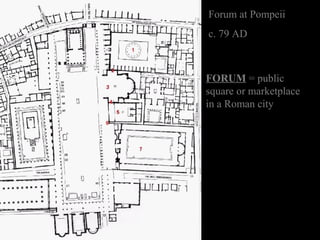
Forum at Pompeii
c. 79 AD

FORUM = public
square or marketplace
in a Roman city
Pompeii

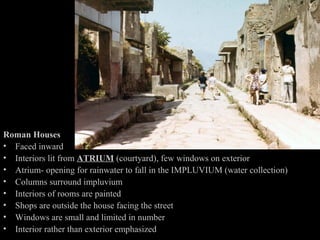
Roman Houses
• Faced inward
• Interiors lit from ATRIUM (courtyard), few windows on exterior
• Atrium- opening for rainwater to fall in the IMPLUVIUM (water collection)
• Columns surround impluvium
• Interiors of rooms are painted
• Shops are outside the house facing the street
• Windows are small and limited in number
• Interior rather than exterior emphasized
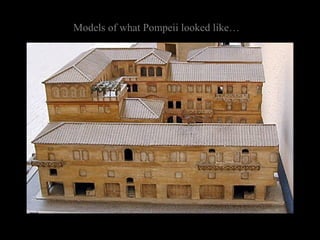
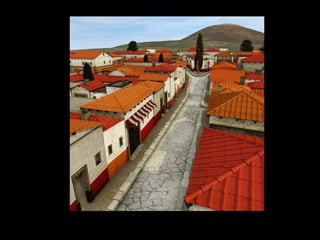
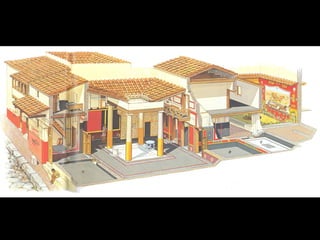
Models of what Pompeii looked like…
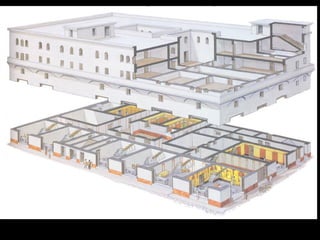
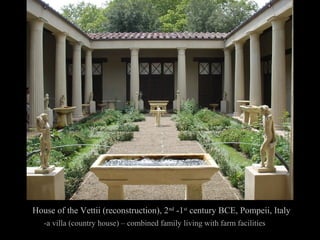
House of the Vettii (reconstruction), 2 nd -1st century BCE, Pompeii, Italy
-a villa (country house) – combined family living with farm facilities
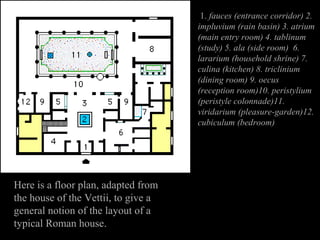
1. fauces (entrance corridor) 2.
impluvium (rain basin) 3. atrium
(main entry room) 4. tablinum
(study) 5. ala (side room) 6.
lararium (household shrine) 7.
culina (kitchen) 8. triclinium
(dining room) 9. oecus
(reception room)10. peristylium
(peristyle colonnade)11.
viridarium (pleasure-garden)12.
cubiculum (bedroom)

Here is a floor plan, adapted from
the house of the Vettii, to give a
general notion of the layout of a
typical Roman house.
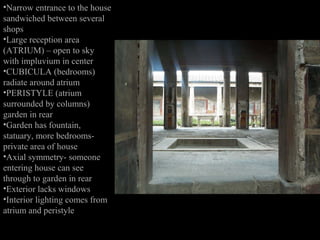
•Narrow entrance to the house
sandwiched between several
shops
•Large reception area
(ATRIUM) – open to sky
with impluvium in center
•CUBICULA (bedrooms)
radiate around atrium
•PERISTYLE (atrium
surrounded by columns)
garden in rear
•Garden has fountain,
statuary, more bedroomsprivate area of house
•Axial symmetry- someone
entering house can see
through to garden in rear
•Exterior lacks windows
•Interior lighting comes from
atrium and peristyle
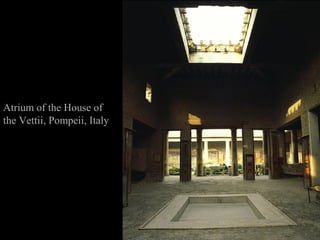
Atrium of the House of
the Vettii, Pompeii, Italy
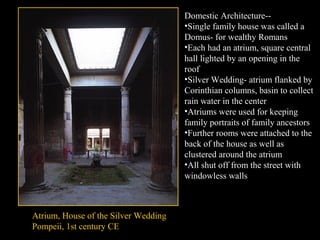
Domestic Architecture-•Single family house was called a
Domus- for wealthy Romans
•Each had an atrium, square central
hall lighted by an opening in the
roof
•Silver Wedding- atrium flanked by
Corinthian columns, basin to collect
rain water in the center
•Atriums were used for keeping
family portraits of family ancestors
•Further rooms were attached to the
back of the house as well as
clustered around the atrium
•All shut off from the street with
windowless walls

Atrium, House of the Silver Wedding
Pompeii, 1st century CE
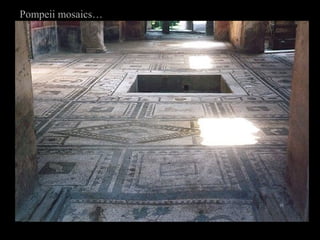
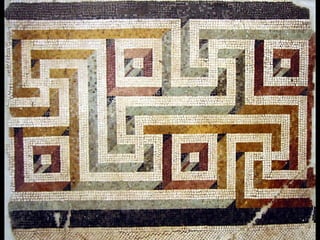
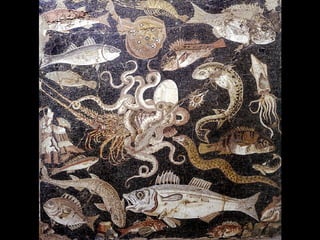
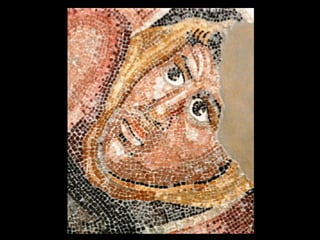
Pompeii mosaics…
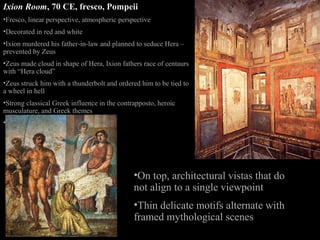
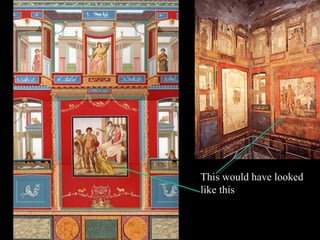
Ixion Room, 70 CE, fresco, Pompeii
•Fresco, linear perspective, atmospheric perspective
•Decorated in red and white
•Ixion murdered his father-in-law and planned to seduce Hera –
prevented by Zeus
•Zeus made cloud in shape of Hera, Ixion fathers race of centaurs
with “Hera cloud”
•Zeus struck him with a thunderbolt and ordered him to be tied to
a wheel in hell
•Strong classical Greek influence in the contrapposto, heroic
musculature, and Greek themes
•Foreshortening

•On top, architectural vistas that do
not align to a single viewpoint
•Thin delicate motifs alternate with
framed mythological scenes
This would have looked
like this
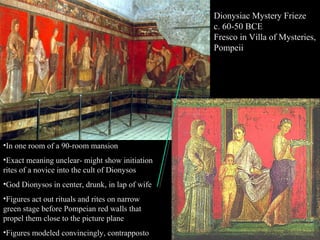
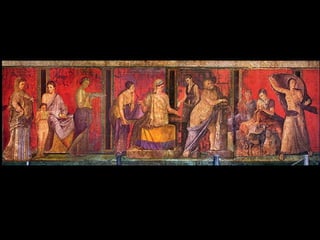
Dionysiac Mystery Frieze
c. 60-50 BCE
Fresco in Villa of Mysteries,
Pompeii

•In one room of a 90-room mansion
•Exact meaning unclear- might show initiation
rites of a novice into the cult of Dionysos
•God Dionysos in center, drunk, in lap of wife
•Figures act out rituals and rites on narrow
green stage before Pompeian red walls that
propel them close to the picture plane
•Figures modeled convincingly, contrapposto
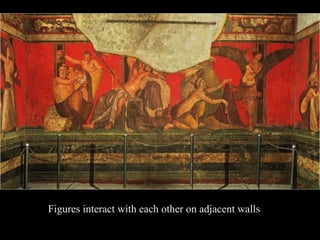
Figures interact with each other on adjacent walls
Ancient Rome Part 1

Ancient Rome Part 1

  • 1.
    Roman Art Art as demonstrationof power Art as demonstration of power
  • 4.
    Time period: 753BCE – 410 CE So in other words… 8th century BCE – 5th century CE (We’re finally in the Common Era!)
  • 5.
    New Vocabulary (tohelp you review) • Aqueduct: an overground water system • Ashlar masonry: carefully cut and grooved stones that support a building without the use of concrete or other kinds of masonry • Atrium (plural: atria): a courtyard in a Roman house or before a Christian church • Basilica: in Roman architecture, a large axially planned building with a nave, side aisles, and apses • Bust: a sculpture depicting a head, neck, and upper chest of a figure • Coffer: in architecture, a sunken panel in a ceiling • Cubiculum (plural: cubicula): a Roman bedroom flanking an atrium; in Early Christian art, a mortuary chapel in a catacomb • Cupola: a small dome rising over the roof of a building; in architecture, a cupola is achieved by rotating an arch on its axis • Encaustic: an ancient method of painting that uses colored waxes burned into a wooden surface • Foreshortening: a visual effect in which an object is shortened and turned deeper into the picture plane to give the effect of receding into space • Forum (plural: fora): a public square or market place in a Roman city • Fresco: a painting technique that involves applying water-based paint onto a freshly plastered wall. The paint forms a bond with the plaster that is durable and long lasting
  • 6.
    New vocabulary continued… • • • • • • • • • Impluvium:a rectangular basin in a Roman house that is placed in the open-air atrium in order to collect rain water Keystone: the center stone of an arch that holds the others in place Oculus: a circular window in a church, or a round opening at the top of a dome Peristyle: an atrium surrounded by columns in a Roman house Perspective: depth and recession in a painting or relief sculpture. Objects shown in linear perspective achieve a three-dimensionality in the two-dimensional surface of the picture plane. All lines, called orthogonals, draw the viewer back in space to a common point (vanishing point). Sometimes there are multiple vanishing points. Landscapes that give the illusion of distance are in atmospheric or aerial perspective. Pier: a vertical support that holds up an arch or vault Spandrel: a triangular space enclosed by the curves of arches Vault: a roof constructed with arches. When an arch is extended into space, forming a tunnel, it is called a barrel vault. When two barrel vaults intersect at right angles, it’s called a groin vault. Veristic: sculptures from the Roman Republic characterized by extreme realism of facial features
  • 7.
    KEY IDEAS ABOUTROMAN ART • It reflects the ambitions of a powerful empire • Monumental buildings and sculptures reflect glory of gods and state • Architecture is revolutionary! – understood powers of arch, vault, and concrete • Pompeiian villas- give us a history of Roman painting • It shows an interest in the basic elements of perspective and foreshortening • The sculpture is greatly influenced by Greek models
  • 8.
    Does Rome havea unique characteristic style of art? •Huge admiration for Greek art- had Greek art copied, original Roman art done in Greek style, many Roman artists were Greek in origin •Roman authors uninterested in art of their own time- never developed literature on the theory, history or criticism of art like the Greeks •We hear very little of specific artists who enjoyed individual fame •Probably looked upon their own time as a decline in art compared to Greece •Great majority of Roman art is unsigned- could have come from anywhere in Roman domain•Roman society very tolerant of alien traditions (if they did not threaten the security of the state) •Religion was not forced - many traditions of Etruscan, Near East, and Egyptians were absorbed into Roman culture- therefore Roman style is not consistentemergent styles existing side by side
  • 9.
    To understand Romanart, we need to know the historical CONTEXT: •Rome rose to glory by diplomacy and military strength •Roman influence is still around (literature, art, law, etc.) •Rome was established by Romulus and Remus (a legend) •Rome was first ruled by kings and then replaced by a senate (an elected body of privileged Roman men) •Established a sort of democracy •Increased their fortunes and expanded their boundaries through war •Obsessed with Greek art •Because of the city of Pompeii, we know more about daily life in ancient Rome than we know about any other civilization in history
  • 10.
    PATRONAGE and ARTISTICLIFE in ancient Rome: • • • • • • • • Roman government and wealthy people = major patrons of the arts Spent lavishly on themselves and homes Dedicated to the general good of the arts Gave generously to public projects Huge workshops cranking out Greek-style works Romans built houses to impress and entertain Lavish interiors of homes (marble plumbing fixtures!) Interiors were grand domestic spaces that announced the importance of the owner • Artists = low on social scale (what?!)- treated poorly – many were slaves and never got credit for their work (whaaaaat?!??)
  • 11.
  • 12.
    INNOVATIONS IN ROMANARCHITECTURE • Romans were master builders • Built great roads and massive aqueducts – efficient way to connect cities and make areas livable • Temples = hymns to the gods, symbols of civic pride • Arenas – awed spectators (size and engineering are awesome) • Perfected the arch and used it a lot (not used much before) • Used concrete in constructing huge buildings – but they thought it was ugly, so they covered concrete structures in other materials (like marble) to make them more attractive
  • 13.
    •Each wedge-shaped stoneis smaller at the bottom and wider at the top – arch stands indefinitely because wide top can’t pass through narrow bottom •No mortar needed – shape of stones in arch supports structure
  • 14.
    Arches can beextended into space to form a continuous tunnel-like BARREL VAULT
  • 15.
    Groin vault Groin vault SPANDREL SPANDREL PIER •Whentwo barrel vaults intersect, a larger, more open space is formed called a GROIN VAULT •Groin vault can be supported by only four PIERS, rather than requiring a continuous wall space that a barrel vault needs •Space between piers = SPANDRELS
  • 16.
    Pont du Gard,Nimes, France, early 1st century BC
  • 17.
    •ASHLAR MASONRY: carefully cutand grooved stones that support a structure without concrete, mortar, etc. •Aqueduct brought water to city of Nimes •Roman cities had large populations because of their ability to bring water to city centers •Heavy, squat arches at bottom level •Thinner arches at second level •Lighter rhythm of smaller arches on top level, which carries the water of the aqueducts
  • 18.
    view from topof Pont du Gard (Smolinski cam)
  • 19.
  • 20.
    Arch of Constantine,312-315 CE, Rome, Italy
  • 21.
    •Built to commemorateConstantine’s victory over Maxentius at the Battle of the Milvian Bridge in 312 CE •Friezes and sculpture taken from monuments to older emperors: Trajan, Hadrian, Marcul Aurelius – Constantine draws parallel between their accomplishments and his •New friezes done in situ •Placed at this location so that the central arch would, at a distance, frame a 100foot-tall statue of the Sun god, Sol
  • 22.
  • 23.
    •rejection of classicalideal in contemporary sculpture •heads too large for bodies, squat figures, lack of space •large eyes, frontal stare, mechanical and repeated stances and gestures •shallow relief •heads not distinguished from one another
  • 24.
  • 25.
    Basilica Nova (Basilicaof Constantine) c.306-312 CE, Rome
  • 26.
    (this is what’sleft) once housed giant sculpture of Constantine
  • 27.
    •Largest roofed interiorin all of Rome •BASILICA: large, axially planned building with nave, side aisles, and apses •NAVE = the center tract •CLERISTORY: upper part of nave with large windows to let light in •Large windows possible because groin vaults helped distribute weight •long halls that served civic purposes- standard feature of every Roman town- usually held the courts Reconstruction drawing of the Basilica of Constantine
  • 30.
    COFFER = sunkenpanel in a ceiling – prevents the weight of ceiling from cracking walls beneath it- lightens load •Massive building with great windows for maximum light •Large groin-vaulted main isle •Barrel-vaulted and COFFERED side aisles •Begun by Constantine’s rival, Maxentius; completed by Constantine
  • 31.
  • 32.
    •Fine balance betweenvertical and horizontal elements •Enormous amphitheater for gladiator games-in the center of Rome •One of the largest single buildings in history •Efficient-meant to serve large amount of human traffic (seated 50,000 people) •Utilizes barrel vaults, groin vaults, and arches
  • 34.
    Flattened Corinthian Corinthian Tuscan Ionic •ENGAGED COLUMNS,series of arches •Three classical orders are used- TUSCAN is on the ground floor (Tuscan = unfluted with severe Doric-style capitals) •Ionic on second level •Corinthian on levels 3 and 4 -lightening of the proportions, but its barely noticeable •Each type of column thought of as lighter than the order below it
  • 36.
    •Above squared windowsat top level are small brackets – to hold flagstaffs- anchors for retractable canvas roof used to protect crowd from hot sun •Much of the marble was removed in the Middle Ages •Real name = Flavian Amphitheater •Concrete core, brick casting, travertine facing •76 entrances and exits circle the façade •Meant for wild and dangerous spectacles – gladiator combat, animal hunts, naval battles (not for religious persecution, as legend says)
  • 37.
  • 38.
    Check out the AcademyAwardwinning “Spartacus” (1960). Smolinski two thumbs up the floor was flooded for “naval battles” (entertainment) Gladiators entertained audiences in violent fights with other gladiators, wild animals, and condemned criminals. Most were slaves, trained in harsh conditions, and socially rejected.
  • 39.
    Market of Trajan,100-112 CE, Rome
  • 40.
    •Original market had150 shops •Multi-level mall •Semicircular building held several levels of shops •Main space groin-vaulted •Barrel-vaulted shops •Brick and concrete, marble floors
  • 41.
    Ever play “Assassin’sCreed”? If you do, you can play in the Market of Trajan!
  • 42.
    Market of Trajan100-112 CE Market of Trajan Today
  • 44.
    Maison Carree, c.1 CE, Nimes, France
  • 45.
    •Corinthian capitals •Set onhigh podium •Front entrance emphasized •Walls of cella (main room) pushed out to meet the engaged columns, interior expanded to the maximum size allowed beyond the porch •Greek style with Roman adaptationsentrance indicated by flight of stairs, larger interior
  • 46.
    •Used as amodel for Jefferson’s State Capitol in Richmond, Virgina
  • 47.
    Ara Pacis, 13-9BCE, ROME
  • 48.
    •Altar of AugustanPeace •Exhibits the virtues of peace and its long-lasting effects on society as a whole •Built after Augustus’s return from Gaul •Original altar located so that Egyptian obelisk set in a giant sundial pointed to the open door on the first day of fall
  • 49.
    •Two-tier friezes runalong walls •Portray the peace and fertile prosperity enjoyed as a result of the peace brought to Rome by Augustus’ military supremacy Detail of the Processional Frieze showing members of the senate
  • 50.
    Processional frieze showingAugustus as high priest of Processional frieze showing Augustus as high priest of Rome, accompanied by members of his family Rome, accompanied by members of his family
  • 51.
    The museum thathouses Ara Pacis looks……kinda like Ara Pacis!
  • 52.
    Temple of Portunus(aka: Temple of Fortuna Virilis) 1st century BCE, Rome •Suggests Greek influence following Roman conquest of Greece in 146 BCE (Ionic columns)- but not copy of Greek •Etruscan elements- high podium, deep porch, wide cella, but cella is not subdivided into 3 partsnow a unified space •Needed large interiors for images of deity and for display of trophies (statues, weapons) brought back by conquering army •Served as a model temple type and is found in Italy and all around the empire
  • 53.
    Common Plan forRoman Temples
  • 54.
    •Combined Greek elementswith ancient Roman peasant hut design •Became model for round style of Roman temples •Much of the structure is built with CONCRETE!!! •Concrete was used in the near east, but never for architecture •Concrete structure was faced with stone, marble •The facades have worn away so Roman ruins are less attractive than Greek’s Temple of Vesta, early 1st century BCE, Tivoli, Italy
  • 55.
    •Located in theacropolis of the city of Tivoli •Not sure who it was dedicated to (Vesta?) •Corinthian order, circular cella •raised on a high brick podium covered in travertine •cella has door and two windows •frieze- carved garlands and flowers
  • 56.
    Sanctuary of FortunaPrimigenia, 1st century BCE East of Rome- dedicated to Fortuna (Fate)- a goddess • unearthed through bombings in 1944 •ramps and terraces lead to a colonnaded court, flight of stairs like a Greek theater, arched openings framed by engaged columns and entablatures, barrel vaults •all surfaces now are of concrete- fits into the hillside- architecture seems to grow from rock- comparable to New Kingdom in Egypt
  • 57.
    flight of stairslike Greek theater
  • 58.
    Model of Fortuna •Magnificentsacred complex •Six terraces built on sloped land •Oracular place of worship with a sacred well and a statue of goddess Fortuna nursing Jupiter and Juno •Fortuna = goddess of motherhood/fertility •The site of an oracle (tells future, consulting with gods)
  • 59.
    Project for winterbreak? Model made of Legos! Doesn’t it blow your mind?
  • 60.
    Pantheon, Rome, 118-125CE •Round style temple dedicated to all the gods •Inscription: “Marcus Agrippa, son of Lucius, having been consul three times, built it.” •Corinthian capital porch •Façade has two pediments- one deeply recessed behind other •From the outside, the cella looks like a simple cylindrical drum •Not as impressive today- the modern streets of Rome are a great deal higher than they were in ancient times - the steps up to the porch are now submerged in pavement •The interior is far more impressive f
  • 61.
    CUPOLA walls- 20feet thick at base Cupola = a dome rising over the roof of a building – achieved by rotating an arch on its axis •Square panels in floor and coffers contrast with roundness of walls •Coffers may have been filled with rosette designs to simulate stars
  • 62.
    •Oculus is 27feet across- allows for sunlight and air- acts as moving spotlight across the interior •Height of building equals its width; interior based on the circle •Walls have several NICHES for statues of the gods (indents in the wall) •Thickness of walls thinned at top; coffers take some weight pressure off walls •Triumph of concrete construction •Was heavily decorated
  • 63.
    •Interior is moreimpressive •Use of arches led to huge, uninterrupted interior spacesused in baths (centers of Roman society •Dome is a true hemisphere, emits plenty of light •Everything is perfectly balanced •Base had to be made much heavier than the top •Weight rests on 8 wide pillarsthis allows for niches around the side •Inside of dome was originally gold gilt Interior of the Pantheon by Pannini C.1740
  • 65.
    Hadrian’s Villa, 125-128CE, Tivoli, Italy •Huge complex for the delight of Emperor Hadrian (he didn’t like living in the main palace in Rome, so he built this retreat) •High quality workmanship •Comprised of over 30 buildings (250 acres)- much is still unexcavated •Included gardens, palaces, theater, temples, library, state room, living quarters, baths
  • 66.
    •CANOPUS: a colonnadewith a cornice connecting the tops of columns •Alternated rounded with flattened lines; sculptures placed inside the rounded arches •Framing a reflecting pool
  • 67.
    •Domes of steambaths have circular holes on top- allows steam to escape -reminiscent of Parthenon, also built by Hadrian •Network of underground tunnels- for transport of goods by servants
  • 68.
    Aula Palatina, early4th century CE, Trier, Germany
  • 69.
    •Solid brick, plainaudience hall once covered with marble on interior •Semicircular triumphal arch in apse •Basilican architectural plan inspired Christian churches in Middle Ages •Hall is heated by HYPOCAUSTa space under the floor that retained heat from a furnace •Large windows used lead to bind glass panes together •Built by Constantine •Today it is used as an Evangelical church
  • 70.
    BUTTRESSES arch astwo-story arches embrace windows Buttress = a projecting support of stone or brick built against a wall.
  • 71.
    •Forums of Rome- Julius Caesar planned a similar scaled project in Rome •Caesar’s Forums were a combination religious shrine and personal glorification •Became the model of all imperial forums, although nothing remains today of any of them Plan of the Forums, Rome
  • 72.
    Poor Pompeii at leastin 79 CE •City Layout •Individual Houses •Mosaics •Murals
  • 75.
    Pompeii, Italy Explosion byMount Vesuvius in 79 AD buried Pompeii Forum • Large rectangular public square in center of town • Surrounded by a colonnade • Temple of Jupiter- focus of forum • Surrounding the forum are the buildings that housed the business, government and religious activities of Pompeii
  • 76.
    Forum at Pompeii c.79 AD FORUM = public square or marketplace in a Roman city
  • 77.
    Pompeii Roman Houses • Facedinward • Interiors lit from ATRIUM (courtyard), few windows on exterior • Atrium- opening for rainwater to fall in the IMPLUVIUM (water collection) • Columns surround impluvium • Interiors of rooms are painted • Shops are outside the house facing the street • Windows are small and limited in number • Interior rather than exterior emphasized
  • 78.
    Models of whatPompeii looked like…
  • 83.
    House of theVettii (reconstruction), 2 nd -1st century BCE, Pompeii, Italy -a villa (country house) – combined family living with farm facilities
  • 84.
    1. fauces (entrancecorridor) 2. impluvium (rain basin) 3. atrium (main entry room) 4. tablinum (study) 5. ala (side room) 6. lararium (household shrine) 7. culina (kitchen) 8. triclinium (dining room) 9. oecus (reception room)10. peristylium (peristyle colonnade)11. viridarium (pleasure-garden)12. cubiculum (bedroom) Here is a floor plan, adapted from the house of the Vettii, to give a general notion of the layout of a typical Roman house.
  • 85.
    •Narrow entrance tothe house sandwiched between several shops •Large reception area (ATRIUM) – open to sky with impluvium in center •CUBICULA (bedrooms) radiate around atrium •PERISTYLE (atrium surrounded by columns) garden in rear •Garden has fountain, statuary, more bedroomsprivate area of house •Axial symmetry- someone entering house can see through to garden in rear •Exterior lacks windows •Interior lighting comes from atrium and peristyle
  • 86.
    Atrium of theHouse of the Vettii, Pompeii, Italy
  • 87.
    Domestic Architecture-•Single familyhouse was called a Domus- for wealthy Romans •Each had an atrium, square central hall lighted by an opening in the roof •Silver Wedding- atrium flanked by Corinthian columns, basin to collect rain water in the center •Atriums were used for keeping family portraits of family ancestors •Further rooms were attached to the back of the house as well as clustered around the atrium •All shut off from the street with windowless walls Atrium, House of the Silver Wedding Pompeii, 1st century CE
  • 88.
  • 92.
    Ixion Room, 70CE, fresco, Pompeii •Fresco, linear perspective, atmospheric perspective •Decorated in red and white •Ixion murdered his father-in-law and planned to seduce Hera – prevented by Zeus •Zeus made cloud in shape of Hera, Ixion fathers race of centaurs with “Hera cloud” •Zeus struck him with a thunderbolt and ordered him to be tied to a wheel in hell •Strong classical Greek influence in the contrapposto, heroic musculature, and Greek themes •Foreshortening •On top, architectural vistas that do not align to a single viewpoint •Thin delicate motifs alternate with framed mythological scenes
  • 93.
    This would havelooked like this
  • 94.
    Dionysiac Mystery Frieze c.60-50 BCE Fresco in Villa of Mysteries, Pompeii •In one room of a 90-room mansion •Exact meaning unclear- might show initiation rites of a novice into the cult of Dionysos •God Dionysos in center, drunk, in lap of wife •Figures act out rituals and rites on narrow green stage before Pompeian red walls that propel them close to the picture plane •Figures modeled convincingly, contrapposto
  • 95.
    Figures interact witheach other on adjacent walls

Editor's Notes