The ‘Quality in Further Education’
Role Play activity

‘Case study’ prepared for the University of Aberdeen
PGCert Higher Education Teaching and Learning - e-
Learning Module.
Based on a slides originally prepared by Sarah Cornelius, Carole
Gordon and Margaret Harris (University of Aberdeen) for a
presentation given at the SOLSTICE conference, Edge Hill University,
2010
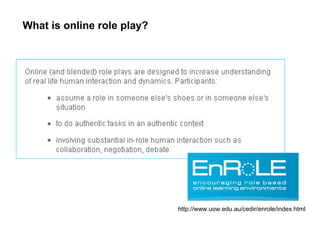
What is online role play?


                            http://www.uow.edu.au/cedir/enrole/index.html
Examples of online role plays:


Riddle, 2009 ‘The Campaign’ – political advisors and journalists in last
         four weeks of election campaign (used email)

Jordan, 2009 Role play for construction law – used wikis and forums for
collaborative problem solving

Gao, et al., 2009 Undertook a comparison of face to face and second life
         role plays on concepts of motivation

Keeffe and Austin, 2012 – Educational inclusion role play – participants
clarify and resolve the implications of an administrative decision       to
suspend a student with Asperger’s from school. Used web
conferencing for briefing/de briefing, anonymous online
discussions for activity
‘Quality in FE’ Role Play

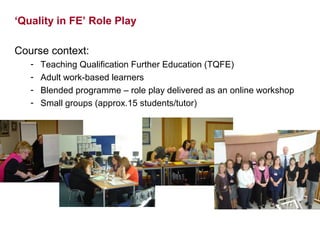
Course context:
   -   Teaching Qualification Further Education (TQFE)
   -   Adult work-based learners
   -   Blended programme – role play delivered as an online workshop
   -   Small groups (approx.15 students/tutor)
The Scenario:
              You have been invited to join a working group to
              consider issues of quality in your College. You
              are about to have your first meeting and at this
              meeting you need to consider what quality is and
              what it means in your College.


•   Design principles:
     – Real time – over a 2 hour period
     – Authentic activity – which reflects an issue of genuine concern and discussion
       within FE, virtual working and online meetings are also feature of many
       professional contexts
     – Anonymity – participants are identifiable only as their roles to allow for free and
       frank discussion
     – Familiar technology – uses online discussions in institutional VLE with which
       participants are familiar.
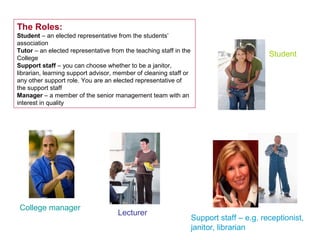
The Roles:
Student – an elected representative from the students’
association
Tutor – an elected representative from the teaching staff in the
College
                                                                                          Student
Support staff – you can choose whether to be a janitor,
librarian, learning support advisor, member of cleaning staff or
any other support role. You are an elected representative of
the support staff
Manager – a member of the senior management team with an
interest in quality


College manager
                                     Lecturer
                                                                   Support staff – e.g. receptionist,
                                                                   janitor, librarian
Process
Tutor allocates participants to roles and groups (min group size 4 – if
   larger increase number of each role attending meeting)
Task 1: Participants post an opening statement on their view of quality
   from their role’s perspective
Task 2: Participants read and comment on other postings – ask
   questions, discuss etc.
Task 3: Participants reflect on their opening position – has it shifted in
   response to the discussions?
Task 4: (if in a large group) – participants visit another discussion and
   compare issues etc.
Taks 5: Participants post ‘out of role’ reflections on the role play and
   the experience of online interaction. Tutor summarises, suggests
   next steps etc.
Implementation:
anonymous
WebCT discussion
(now using
Blackboard discussion
Forums)
Research
• Qualitative investigative approach
  – Analysis of transcripts of role play discussions by
    three researchers:
      455 messages
             36 students
                     7 role play groups


   – Semi structured interviews with 8 student volunteers

• Findings related to role engagement, anonymity and
  authenticity presented here
Role engagement
Were roles played effectively online?

Generally yes…
 “[other people played their roles] brilliantly [...]
  everyone took their roles really seriously […] it
  almost felt you were speaking to the actual
  people”
Good morning […] it is clearly important as management
                        that we ensure that standards are maintained…

          College managers:
          Formal language,                                               Lecturers:
          use of ‘we’                                                    educational
                                                                         jargon
Evidence                     …surely their [sic] should be
                                   differentiation

- Voices
                         there is nothing worse than being talked
                         at for hours at a time!!! BORING

                                                                         Students:
                                                                         informal


                   I am off for a smoke to think about my thoughts,
                            will be back in 5 to let you know

Support staff: varied
What helped ‘performance’?
•       familiarity with the role
•       direct questions to individuals
    –     “As a tutor, I would like to ask a manager how they believe
          that they can measure the quality of their lecturer through their
          training”
•       exchanges with others
    –     “the questions or the responses that were coming back […]
          made you think ‘well no, I’m going to defend my college’”
    –     “the responses of others in real time helped as they made me
          respond as if I was a janitor”
•       visualisation of real or imagined events
What hindered engagement?
Technical/navigation issues
  - “Help, I’m lost, which group am I in?”
Pace
  - reading/typing speed

Possible playing out of real life power relationships
  - “My comments were passed by the others as not important”
   (domestic)

   - “I was only really speaking to the librarian. The lecturer or the
   Principal never came into that line of conversation. I didn’t have a
   real place in the conversation” (janitor)
Real Anonymity?
• Generally accepted that anonymity was not
  ‘real’, but had an impact:

  – “I didn’t care who the other member of the team was
    that I was responding to because I was just
    responding to them as a job title and not as a person
    within our group”

  – “I think I would have given my comments even if it
    was face-to-face […] but [anonymity] made it
    interesting”
The anonymity ‘challenge’
  – “I…worked out who some people were based on their
    comments. The manager I instantly worked out”

  – “I had guessed one of them…but the others I was quite happy
    not to know who they were”

• Known peers may affect voice
  – “If its someone you know well you’re trying to be humourous with
    them, and if it’s someone you don’t know so well you’re probably
    being a bit more formal”

• But some mysteries remained
  – “I didn’t try to find out, but I would have liked to know who the
    jannie […] was”
Authenticity
• Is the activity realistic?
  – Online meetings do take place
  – “If everyone is engaged it makes it more real”


• Backstage communication?
  – “There was someone in the same workroom, but in a
    different [role play] group. She was laughing at what
    she was reading, and I was laughing at what I was
    reading. But we weren’t communicating with each
    other at all”
Effectiveness
• Appreciation of different perspectives
  – “[I now realise] how little I understood about the role
    before I started”

  – “The role play makes you realise the complexity of
    challenges for individual posts and how quality
    threads through all areas of the college.”


• Application of process
  – “We’ve done two [similar online role play activities
    with our own students]”
What does this tell us?
• Effective role engagement in online role-
  play is facilitated by:
  – Familiar roles
  – Discourse with other roles in real-time
  – Anonymity


• Barriers to engagement include
  – Technical/navigational issues
  – Lack of engagement of others
  – Pace of real-time activity
References
Gao F, Noh, J J and Koehler M J (2009) Comparing role-playing
   activities in second life and face-to-face environments. Journal of
   Interactive Learning Research 20(4) 423-443
Jordan, L (2009) Using online role-play to assess distance learning
   students in construction law. CEBE Case Study
   http://www.cebe.heacademy.ac.uk/learning/casestudies/case_pdf/LindsayJ
Keeffe M and Austin L (2012) Reciprocity, the rascal of resolution:
   collaborative problem solving in an online role play. Proceedings of
   CSEDU’11 pp252-257
Riddle M D (2009) The Campaign: a case study in identity construction
   through performance. ALT-J 17(1) 63-72


Sarah Cornelius
s.cornelius@abdn.ac.uk
September 2012

Role play case study

  • 1.
    The ‘Quality inFurther Education’ Role Play activity ‘Case study’ prepared for the University of Aberdeen PGCert Higher Education Teaching and Learning - e- Learning Module. Based on a slides originally prepared by Sarah Cornelius, Carole Gordon and Margaret Harris (University of Aberdeen) for a presentation given at the SOLSTICE conference, Edge Hill University, 2010
  • 2.
    What is onlinerole play? http://www.uow.edu.au/cedir/enrole/index.html
  • 3.
    Examples of onlinerole plays: Riddle, 2009 ‘The Campaign’ – political advisors and journalists in last four weeks of election campaign (used email) Jordan, 2009 Role play for construction law – used wikis and forums for collaborative problem solving Gao, et al., 2009 Undertook a comparison of face to face and second life role plays on concepts of motivation Keeffe and Austin, 2012 – Educational inclusion role play – participants clarify and resolve the implications of an administrative decision to suspend a student with Asperger’s from school. Used web conferencing for briefing/de briefing, anonymous online discussions for activity
  • 4.
    ‘Quality in FE’Role Play Course context: - Teaching Qualification Further Education (TQFE) - Adult work-based learners - Blended programme – role play delivered as an online workshop - Small groups (approx.15 students/tutor)
  • 5.
    The Scenario: You have been invited to join a working group to consider issues of quality in your College. You are about to have your first meeting and at this meeting you need to consider what quality is and what it means in your College. • Design principles: – Real time – over a 2 hour period – Authentic activity – which reflects an issue of genuine concern and discussion within FE, virtual working and online meetings are also feature of many professional contexts – Anonymity – participants are identifiable only as their roles to allow for free and frank discussion – Familiar technology – uses online discussions in institutional VLE with which participants are familiar.
  • 6.
    The Roles: Student –an elected representative from the students’ association Tutor – an elected representative from the teaching staff in the College Student Support staff – you can choose whether to be a janitor, librarian, learning support advisor, member of cleaning staff or any other support role. You are an elected representative of the support staff Manager – a member of the senior management team with an interest in quality College manager Lecturer Support staff – e.g. receptionist, janitor, librarian
  • 7.
    Process Tutor allocates participantsto roles and groups (min group size 4 – if larger increase number of each role attending meeting) Task 1: Participants post an opening statement on their view of quality from their role’s perspective Task 2: Participants read and comment on other postings – ask questions, discuss etc. Task 3: Participants reflect on their opening position – has it shifted in response to the discussions? Task 4: (if in a large group) – participants visit another discussion and compare issues etc. Taks 5: Participants post ‘out of role’ reflections on the role play and the experience of online interaction. Tutor summarises, suggests next steps etc.
  • 8.
  • 9.
    Research • Qualitative investigativeapproach – Analysis of transcripts of role play discussions by three researchers: 455 messages 36 students 7 role play groups – Semi structured interviews with 8 student volunteers • Findings related to role engagement, anonymity and authenticity presented here
  • 10.
    Role engagement Were rolesplayed effectively online? Generally yes… “[other people played their roles] brilliantly [...] everyone took their roles really seriously […] it almost felt you were speaking to the actual people”
  • 11.
    Good morning […]it is clearly important as management that we ensure that standards are maintained… College managers: Formal language, Lecturers: use of ‘we’ educational jargon Evidence …surely their [sic] should be differentiation - Voices there is nothing worse than being talked at for hours at a time!!! BORING Students: informal I am off for a smoke to think about my thoughts, will be back in 5 to let you know Support staff: varied
  • 12.
    What helped ‘performance’? • familiarity with the role • direct questions to individuals – “As a tutor, I would like to ask a manager how they believe that they can measure the quality of their lecturer through their training” • exchanges with others – “the questions or the responses that were coming back […] made you think ‘well no, I’m going to defend my college’” – “the responses of others in real time helped as they made me respond as if I was a janitor” • visualisation of real or imagined events
  • 13.
    What hindered engagement? Technical/navigationissues - “Help, I’m lost, which group am I in?” Pace - reading/typing speed Possible playing out of real life power relationships - “My comments were passed by the others as not important” (domestic) - “I was only really speaking to the librarian. The lecturer or the Principal never came into that line of conversation. I didn’t have a real place in the conversation” (janitor)
  • 14.
    Real Anonymity? • Generallyaccepted that anonymity was not ‘real’, but had an impact: – “I didn’t care who the other member of the team was that I was responding to because I was just responding to them as a job title and not as a person within our group” – “I think I would have given my comments even if it was face-to-face […] but [anonymity] made it interesting”
  • 15.
    The anonymity ‘challenge’ – “I…worked out who some people were based on their comments. The manager I instantly worked out” – “I had guessed one of them…but the others I was quite happy not to know who they were” • Known peers may affect voice – “If its someone you know well you’re trying to be humourous with them, and if it’s someone you don’t know so well you’re probably being a bit more formal” • But some mysteries remained – “I didn’t try to find out, but I would have liked to know who the jannie […] was”
  • 16.
    Authenticity • Is theactivity realistic? – Online meetings do take place – “If everyone is engaged it makes it more real” • Backstage communication? – “There was someone in the same workroom, but in a different [role play] group. She was laughing at what she was reading, and I was laughing at what I was reading. But we weren’t communicating with each other at all”
  • 17.
    Effectiveness • Appreciation ofdifferent perspectives – “[I now realise] how little I understood about the role before I started” – “The role play makes you realise the complexity of challenges for individual posts and how quality threads through all areas of the college.” • Application of process – “We’ve done two [similar online role play activities with our own students]”
  • 18.
    What does thistell us? • Effective role engagement in online role- play is facilitated by: – Familiar roles – Discourse with other roles in real-time – Anonymity • Barriers to engagement include – Technical/navigational issues – Lack of engagement of others – Pace of real-time activity
  • 19.
    References Gao F, Noh,J J and Koehler M J (2009) Comparing role-playing activities in second life and face-to-face environments. Journal of Interactive Learning Research 20(4) 423-443 Jordan, L (2009) Using online role-play to assess distance learning students in construction law. CEBE Case Study http://www.cebe.heacademy.ac.uk/learning/casestudies/case_pdf/LindsayJ Keeffe M and Austin L (2012) Reciprocity, the rascal of resolution: collaborative problem solving in an online role play. Proceedings of CSEDU’11 pp252-257 Riddle M D (2009) The Campaign: a case study in identity construction through performance. ALT-J 17(1) 63-72 Sarah Cornelius s.cornelius@abdn.ac.uk September 2012