“It is imperative to find ways
for students to learn
how to perform democracy
because
Democracy requires Practice”
Why the Cases
The Study of Business,
Government, and Society
Chapter 1
This chapter provides an overview of the business-government-
society field of study by:
 Defining basic terms
 Discussing the field’s importance to managers
 Introducing the four basic models of the business-
government-society relationship
 Explaining the authors’ approach to the subject matter.
McGraw-Hill/Irwin Copyright © 2009 by The McGraw-Hill Companies, Inc. All rights reserved.
What is the Business–
Government–Society Field?
 Business – broad term encompassing a
range of actions and institutions.
 Government – refers to structures and
processes in society that authoritatively
make and apply policies and rules.
 Society – a network of human relations that
includes three interacting elements:
 Ideas
 Institutions
 Material things
1-6
How Institutions Support Markets
1-7
Why is the BGS Field Important to
Managers?
 To succeed in meetings its objectives a business
must be responsive to both its economic and its
noneconomic environment.
 Recognizing that a company operates not only
within markets but within a society is critical.
 A basic agreement or social contract exists
between the business institution and society.
 Managers must respect and adhere to society’s
expectations.
 This contract defines the broad duties that
business must perform to retain society’s
support, but these duties are often ambiguous.
1-8
Four Models of the BGS Relationship:
The Market Capitalism Model
1-9
Four Models of the BGS Relationship:
The Market Capitalism Model
(continued)
 The market capitalism model depicts
business as operating within a market
environment, responding primarily to
powerful economic forces.
 The market acts as a buffer between
business and nonmarket forces.
 History and nature of markets
 Adam Smith, The Wealth of Nations
 Capitalism
 Managerial capitalism
1-10
Four Models of the BGS Relationship:
The Market Capitalism Model
(continued)
 Important assumptions of the market capitalism
model:
 Government interference in economic life is
slight (laissez-faire).
 Individuals can own private property and freely
risk investments.
 Consumers are informed about products and
prices and make rational decisions.
 Moral restraint accompanies the self-interested
behavior of business.
 Basic institutions such as banking and laws
exist to ease commerce.
 There are many producers and consumers in
competitive markets. 1-11
Four Models of the BGS Relationship
The Market Capitalism Model
(continued)
 Critiques of the Market Capitalism Model:
 Increased prosperity comes at the cost of
increased inequality.
 Results in base values being energized and
virtue being eroded.
 The BGS relationship according to the Market
Capitalism Model:
 Government regulation should be limited.
 Markets discipline private economic activity to
promote social welfare.
 The proper measure of corporate performance
is profit.
 The ethical duty of management is to promote
the interests of shareholders.
1-12
Four Models of the BGS Relationship:
The Dominance Model
1-13
Four Models of the BGS Relationship:
The Dominance Model (continued)
 Business and government dominate the
great mass of people, which results in the
enrichment of a few at the expense of
many.
 Populist reform movement opposed the
dominance model.
 Marxism emerged in Europe about the
same time.
 Most accurate in the 1800s, but is being
resurrected due to the fear of transnational
corporations in a global context.
1-14
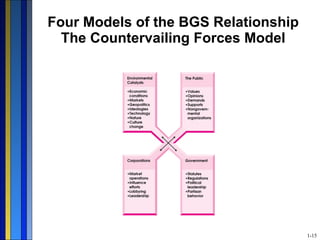
Four Models of the BGS Relationship
The Countervailing Forces Model
1-15
The Canadian-born, Berkeley-trained John Kenneth Galbraith has been considered by
many as the "Last American Institutionalist". As a result, Galbraith has remained
something of a renegade in modern economics - and his work has been nothing if not
provocative. In the 1950s, he presented economics with two tracts that needled the
mainstream:
• one developing a theory of price control (which arose out of his wartime experience in
the Office of Price Administration) which he argued for as an anti-inflation policy
(1952);
• the second, American Capitalism (1952), which argued that American post-war
success arose not out of "getting the prices right" in an orthodox sense, but rather of
"getting the prices wrong" and allowing industrial concentration to develop. It is a
formula for growth because it enables technical innovation which might otherwise not
been done. However, it can only be regarded as successful provided there is a
"countervailing power" against potential abuse in the form of trade unions, supplier and
consumer organizations and government regulation.
• Many have since argued the formula for East Asian success later in the century was
based precisely on this combination of oligopolistic power and "countervailing"
institutions.
Four Models of the BGS Relationship
The Countervailing Forces Model
(continued)
 Countervailing forces model conclusions:
 Business is deeply integrated into an open society
and must respond to many forces, both economic
and noneconomic.
 Business is a major initiator of change in society
through its interaction with government, its
production and marketing activities, and its use of
new technologies.
 Broad public support of business depends on its
adjustment to multiple social, political, and
economic forces.
 BGS relationships continuously evolve as changes
take place in the main ideas, institutions, and
processes of society.
1-16
Four Models of the BGS Relationship
The Stakeholder Model
1-17
Four Models of the BGS Relationship
The Stakeholder Model
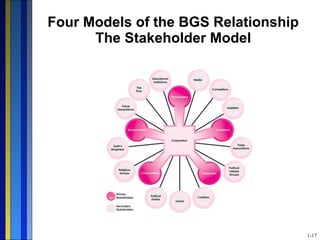
 Stakeholders are those whom the corporation
benefits or burdens by its actions and those who
benefit or burden the firm with their actions.
 Primary stakeholders
 Secondary stakeholders
 Debate about how to identify who or what is a
stakeholder.
 Stakeholder model is an ethical theory of
management in which the welfare of each
stakeholder must be considered as an end.
1-18
Four Models of the BGS Relationship
The Stakeholder Model (continued)
 Criticism of the stakeholder model:
 It is not a realistic assessment of the power
relationships between the corporation and other
entities.
 There is no single, clear, and objective measure
to evaluate the combined ethical/economic
performance of a firm.
 Advocacy for the stakeholder model:
 A corporation that embraces stakeholders
performs better.
 It is the ethical way to manage because
stakeholders have moral rights that grow from
the way powerful corporations affect them.
1-19
bgs-models

bgs-models

  • 2.
    “It is imperativeto find ways for students to learn how to perform democracy because Democracy requires Practice” Why the Cases
  • 3.
    The Study ofBusiness, Government, and Society Chapter 1 This chapter provides an overview of the business-government- society field of study by:  Defining basic terms  Discussing the field’s importance to managers  Introducing the four basic models of the business- government-society relationship  Explaining the authors’ approach to the subject matter. McGraw-Hill/Irwin Copyright © 2009 by The McGraw-Hill Companies, Inc. All rights reserved.
  • 4.
    What is theBusiness– Government–Society Field?  Business – broad term encompassing a range of actions and institutions.  Government – refers to structures and processes in society that authoritatively make and apply policies and rules.  Society – a network of human relations that includes three interacting elements:  Ideas  Institutions  Material things 1-6
  • 5.
  • 6.
    Why is theBGS Field Important to Managers?  To succeed in meetings its objectives a business must be responsive to both its economic and its noneconomic environment.  Recognizing that a company operates not only within markets but within a society is critical.  A basic agreement or social contract exists between the business institution and society.  Managers must respect and adhere to society’s expectations.  This contract defines the broad duties that business must perform to retain society’s support, but these duties are often ambiguous. 1-8
  • 7.
    Four Models ofthe BGS Relationship: The Market Capitalism Model 1-9
  • 8.
    Four Models ofthe BGS Relationship: The Market Capitalism Model (continued)  The market capitalism model depicts business as operating within a market environment, responding primarily to powerful economic forces.  The market acts as a buffer between business and nonmarket forces.  History and nature of markets  Adam Smith, The Wealth of Nations  Capitalism  Managerial capitalism 1-10
  • 9.
    Four Models ofthe BGS Relationship: The Market Capitalism Model (continued)  Important assumptions of the market capitalism model:  Government interference in economic life is slight (laissez-faire).  Individuals can own private property and freely risk investments.  Consumers are informed about products and prices and make rational decisions.  Moral restraint accompanies the self-interested behavior of business.  Basic institutions such as banking and laws exist to ease commerce.  There are many producers and consumers in competitive markets. 1-11
  • 10.
    Four Models ofthe BGS Relationship The Market Capitalism Model (continued)  Critiques of the Market Capitalism Model:  Increased prosperity comes at the cost of increased inequality.  Results in base values being energized and virtue being eroded.  The BGS relationship according to the Market Capitalism Model:  Government regulation should be limited.  Markets discipline private economic activity to promote social welfare.  The proper measure of corporate performance is profit.  The ethical duty of management is to promote the interests of shareholders. 1-12
  • 11.
    Four Models ofthe BGS Relationship: The Dominance Model 1-13
  • 12.
    Four Models ofthe BGS Relationship: The Dominance Model (continued)  Business and government dominate the great mass of people, which results in the enrichment of a few at the expense of many.  Populist reform movement opposed the dominance model.  Marxism emerged in Europe about the same time.  Most accurate in the 1800s, but is being resurrected due to the fear of transnational corporations in a global context. 1-14
  • 13.
    Four Models ofthe BGS Relationship The Countervailing Forces Model 1-15
  • 14.
    The Canadian-born, Berkeley-trainedJohn Kenneth Galbraith has been considered by many as the "Last American Institutionalist". As a result, Galbraith has remained something of a renegade in modern economics - and his work has been nothing if not provocative. In the 1950s, he presented economics with two tracts that needled the mainstream: • one developing a theory of price control (which arose out of his wartime experience in the Office of Price Administration) which he argued for as an anti-inflation policy (1952); • the second, American Capitalism (1952), which argued that American post-war success arose not out of "getting the prices right" in an orthodox sense, but rather of "getting the prices wrong" and allowing industrial concentration to develop. It is a formula for growth because it enables technical innovation which might otherwise not been done. However, it can only be regarded as successful provided there is a "countervailing power" against potential abuse in the form of trade unions, supplier and consumer organizations and government regulation. • Many have since argued the formula for East Asian success later in the century was based precisely on this combination of oligopolistic power and "countervailing" institutions.
  • 15.
    Four Models ofthe BGS Relationship The Countervailing Forces Model (continued)  Countervailing forces model conclusions:  Business is deeply integrated into an open society and must respond to many forces, both economic and noneconomic.  Business is a major initiator of change in society through its interaction with government, its production and marketing activities, and its use of new technologies.  Broad public support of business depends on its adjustment to multiple social, political, and economic forces.  BGS relationships continuously evolve as changes take place in the main ideas, institutions, and processes of society. 1-16
  • 16.
    Four Models ofthe BGS Relationship The Stakeholder Model 1-17
  • 17.
    Four Models ofthe BGS Relationship The Stakeholder Model  Stakeholders are those whom the corporation benefits or burdens by its actions and those who benefit or burden the firm with their actions.  Primary stakeholders  Secondary stakeholders  Debate about how to identify who or what is a stakeholder.  Stakeholder model is an ethical theory of management in which the welfare of each stakeholder must be considered as an end. 1-18
  • 18.
    Four Models ofthe BGS Relationship The Stakeholder Model (continued)  Criticism of the stakeholder model:  It is not a realistic assessment of the power relationships between the corporation and other entities.  There is no single, clear, and objective measure to evaluate the combined ethical/economic performance of a firm.  Advocacy for the stakeholder model:  A corporation that embraces stakeholders performs better.  It is the ethical way to manage because stakeholders have moral rights that grow from the way powerful corporations affect them. 1-19