The challenges of learner-centered
teaching in the virtual classroom
Sarah Cornelius
School of Education
University of Aberdeen, UK
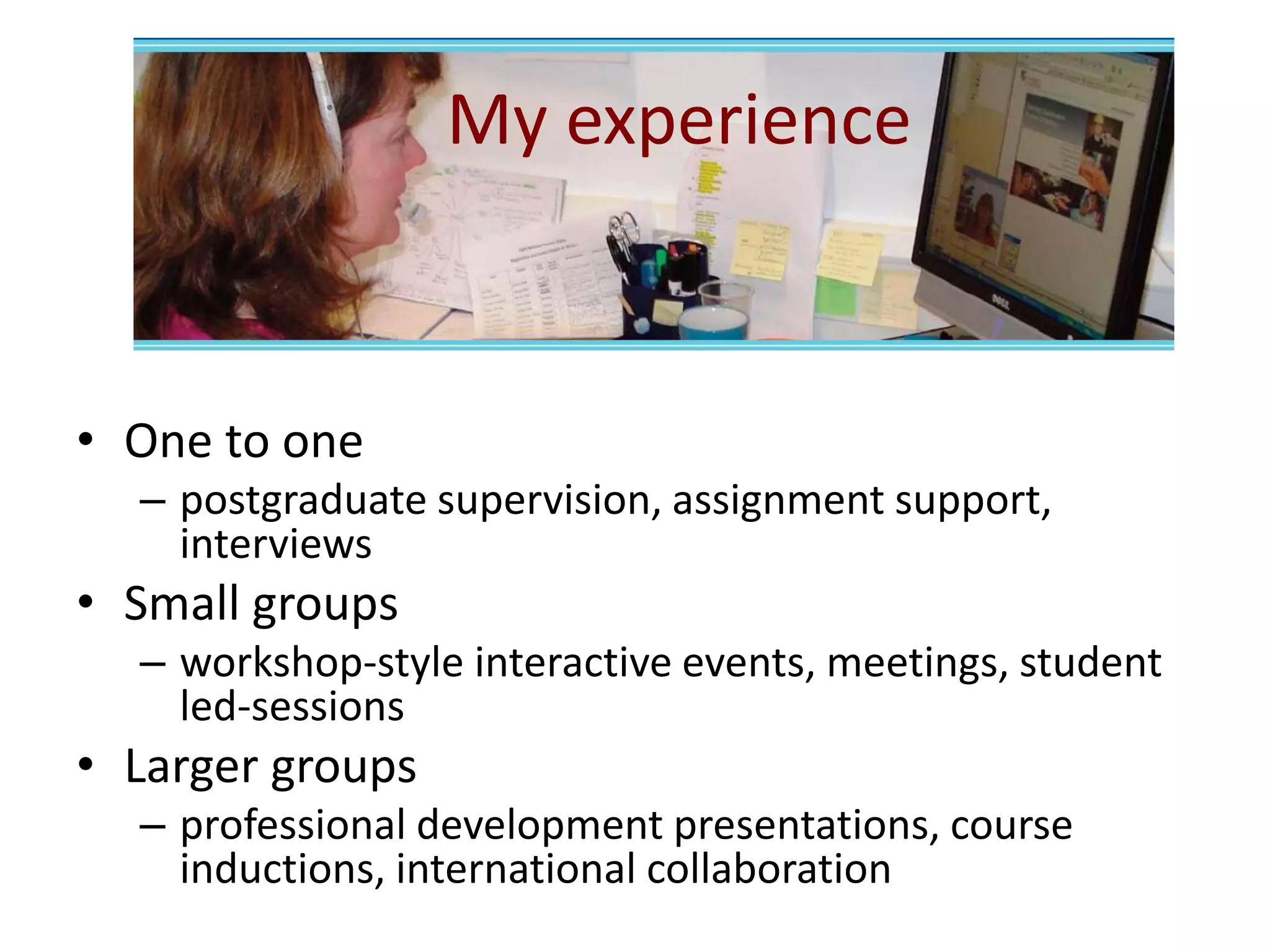
My experience
• One to one
– postgraduate supervision, assignment support,
interviews
• Small groups
– workshop-style interactive events, meetings, student
led-sessions
• Larger groups
– professional development presentations, course
inductions, international collaboration
Evidence from research suggests
– Technical problems frustrate learners
– Learners appreciate the opportunity to interact
– Increased interaction leads to greater
satisfaction/better outcomes
BUT
– Studies are often case studies, new courses, new
online learners, new facilitators
Suggestions for facilitators
– Engage learners with short learner-centered events
(Steed, 2013)
Presentation
• What is learner-centered teaching?
• Research on virtual classrooms
• Challenges in virtual classrooms
– Creating a supportive learning community
– Handing over control
– Designing learner-centered activities
• What next?
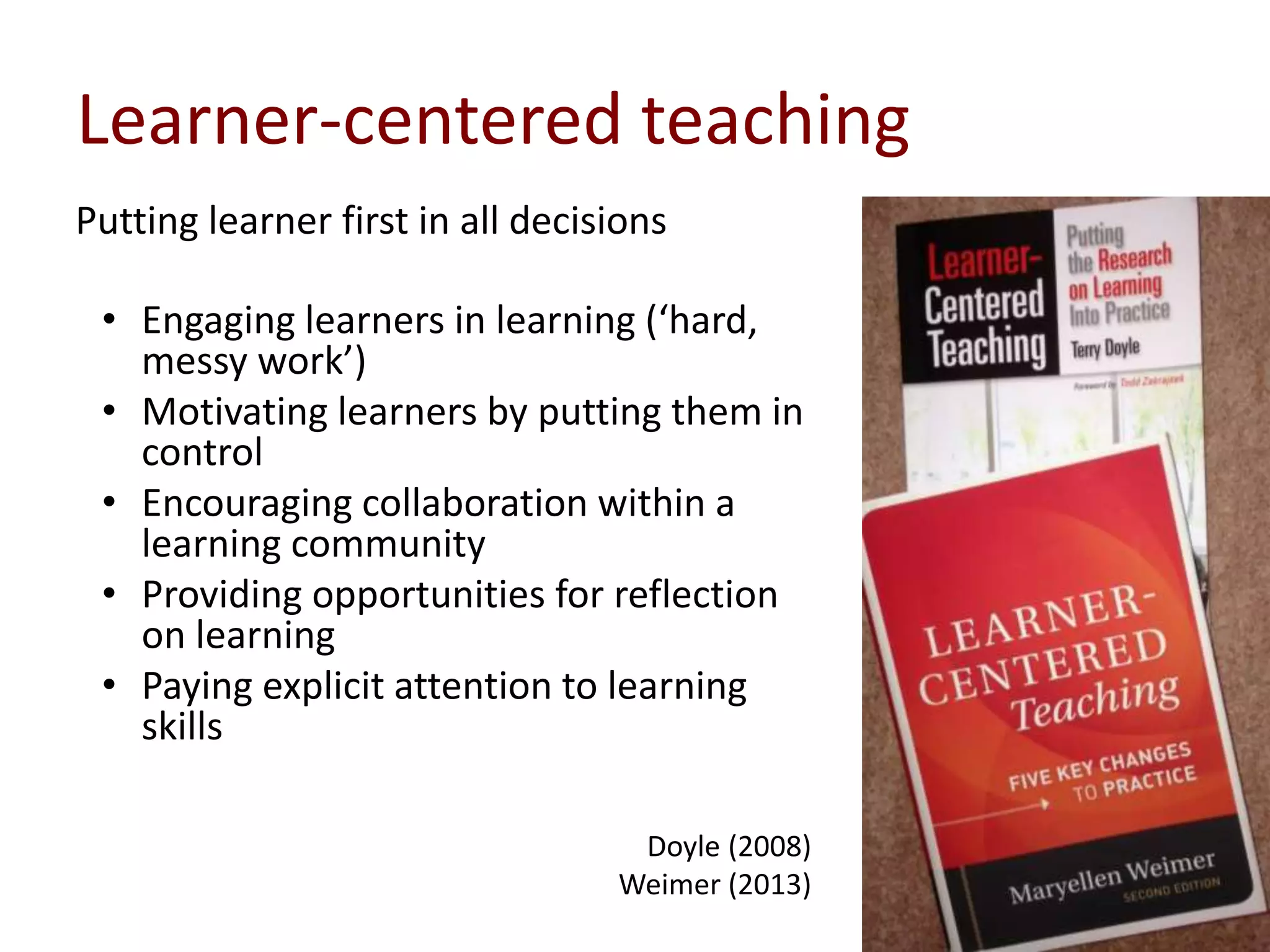
Learner-centered teaching
Putting learner first in all decisions
• Engaging learners in learning (‘hard,
messy work’)
• Motivating learners by putting them in
control
• Encouraging collaboration within a
learning community
• Providing opportunities for reflection
on learning
• Paying explicit attention to learning
skills
Doyle (2008)
Weimer (2013)
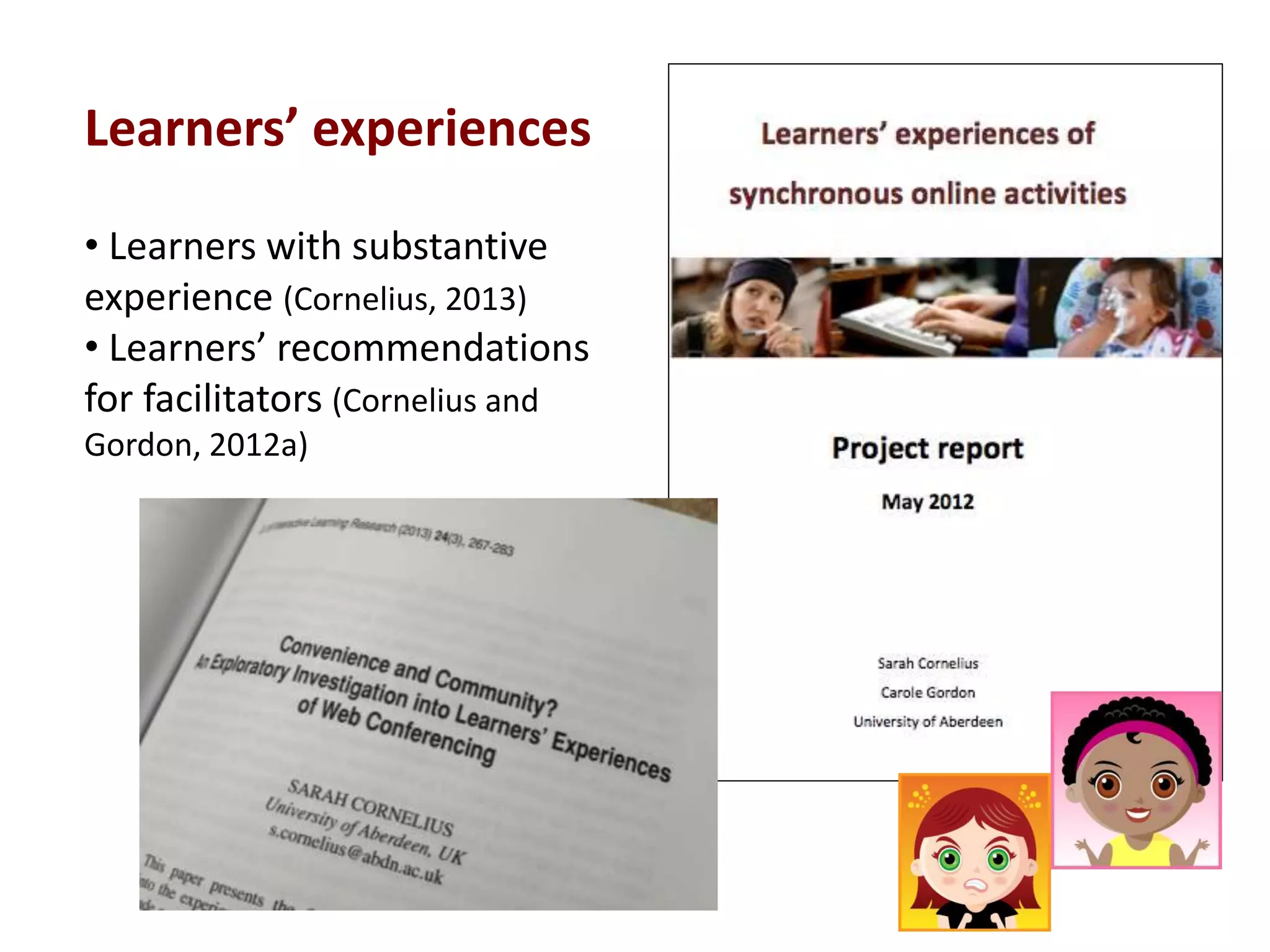
Learners’ experiences
• Learners with substantive
experience (Cornelius, 2013)
• Learners’ recommendations
for facilitators (Cornelius and
Gordon, 2012a)
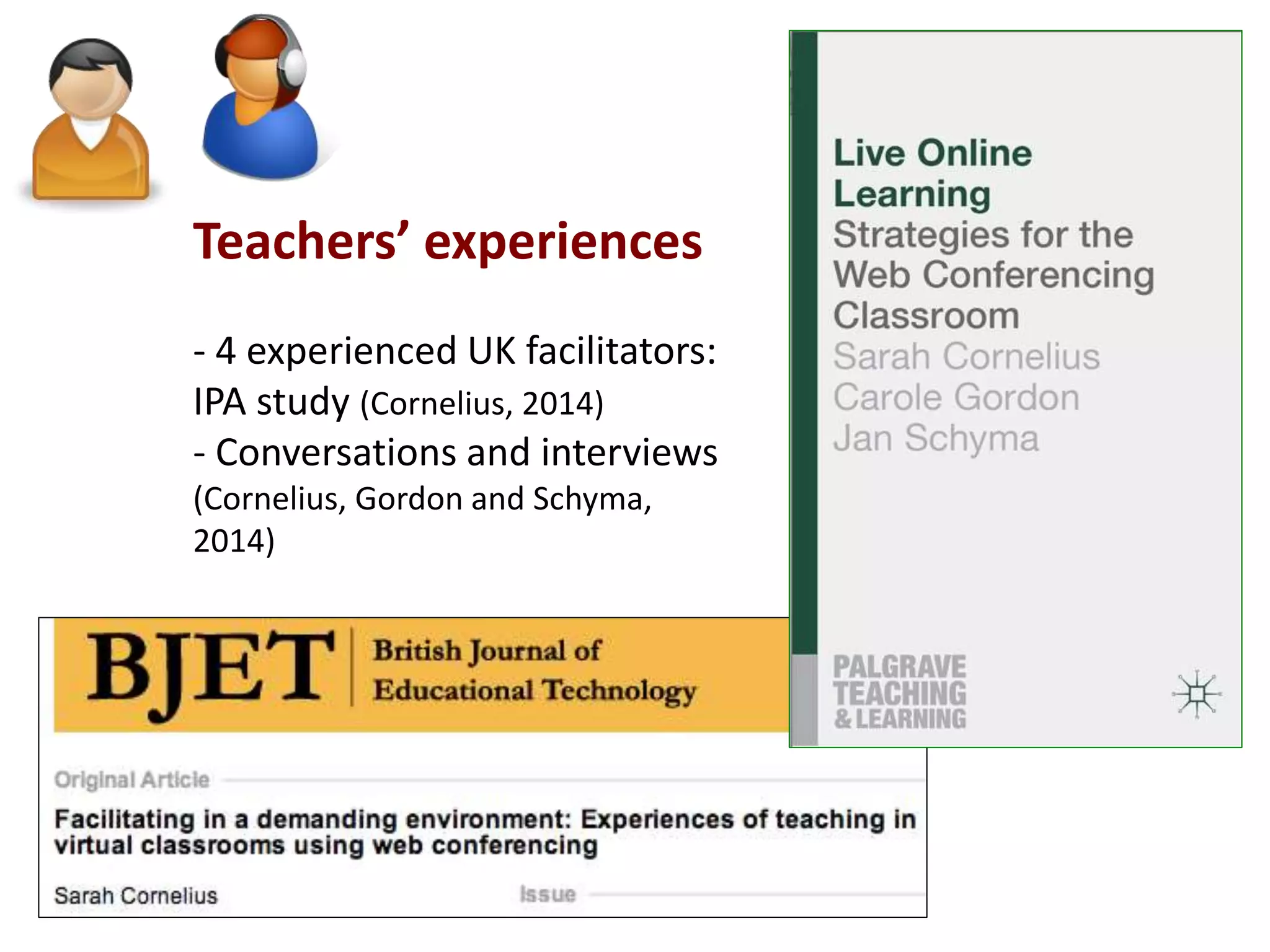
Teachers’ experiences
- 4 experienced UK facilitators:
IPA study (Cornelius, 2014)
- Conversations and interviews
(Cornelius, Gordon and Schyma,
2014)
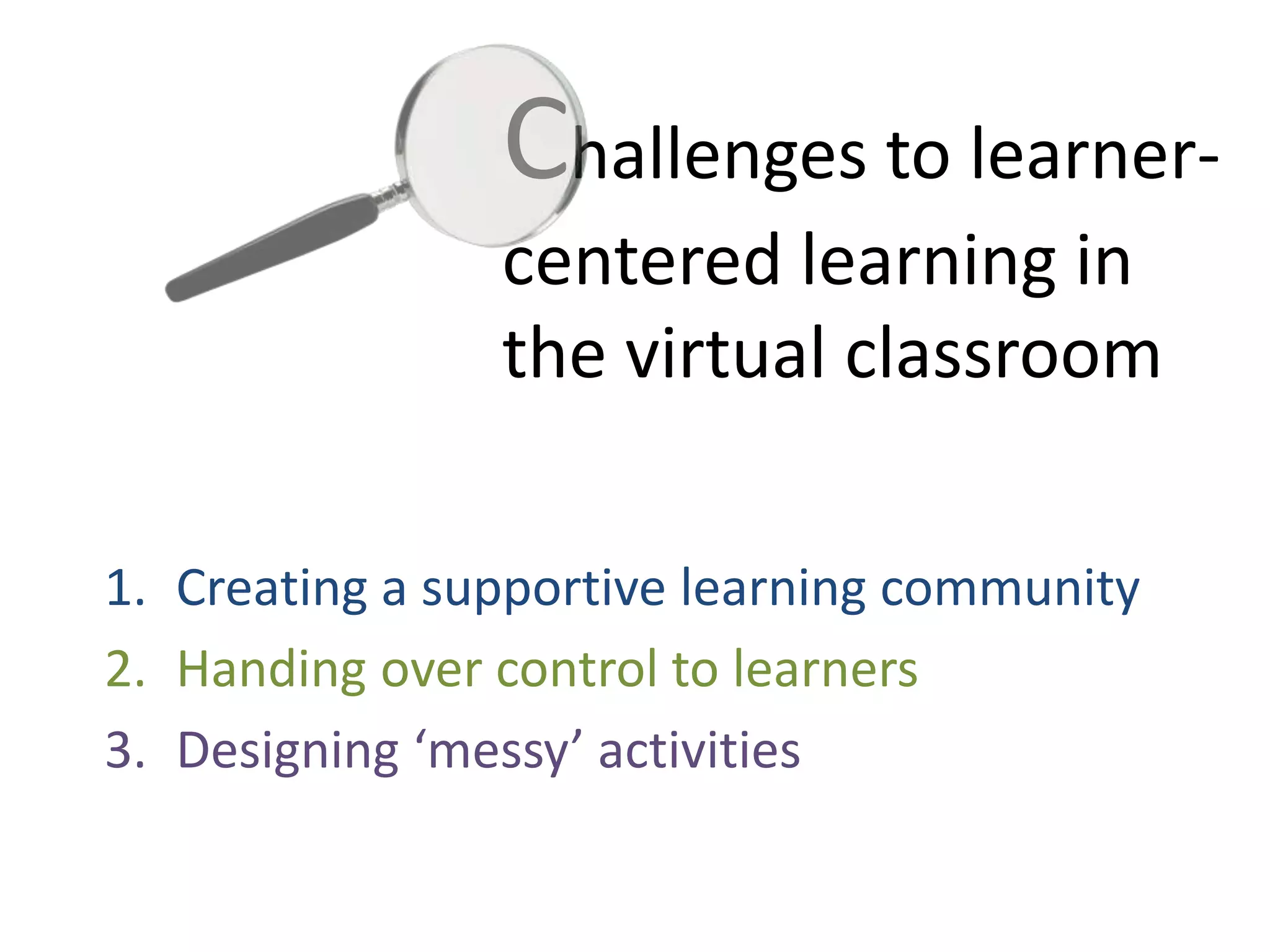
Challenges to learner-
centered learning in
the virtual classroom
1. Creating a supportive learning community
2. Handing over control to learners
3. Designing ‘messy’ activities
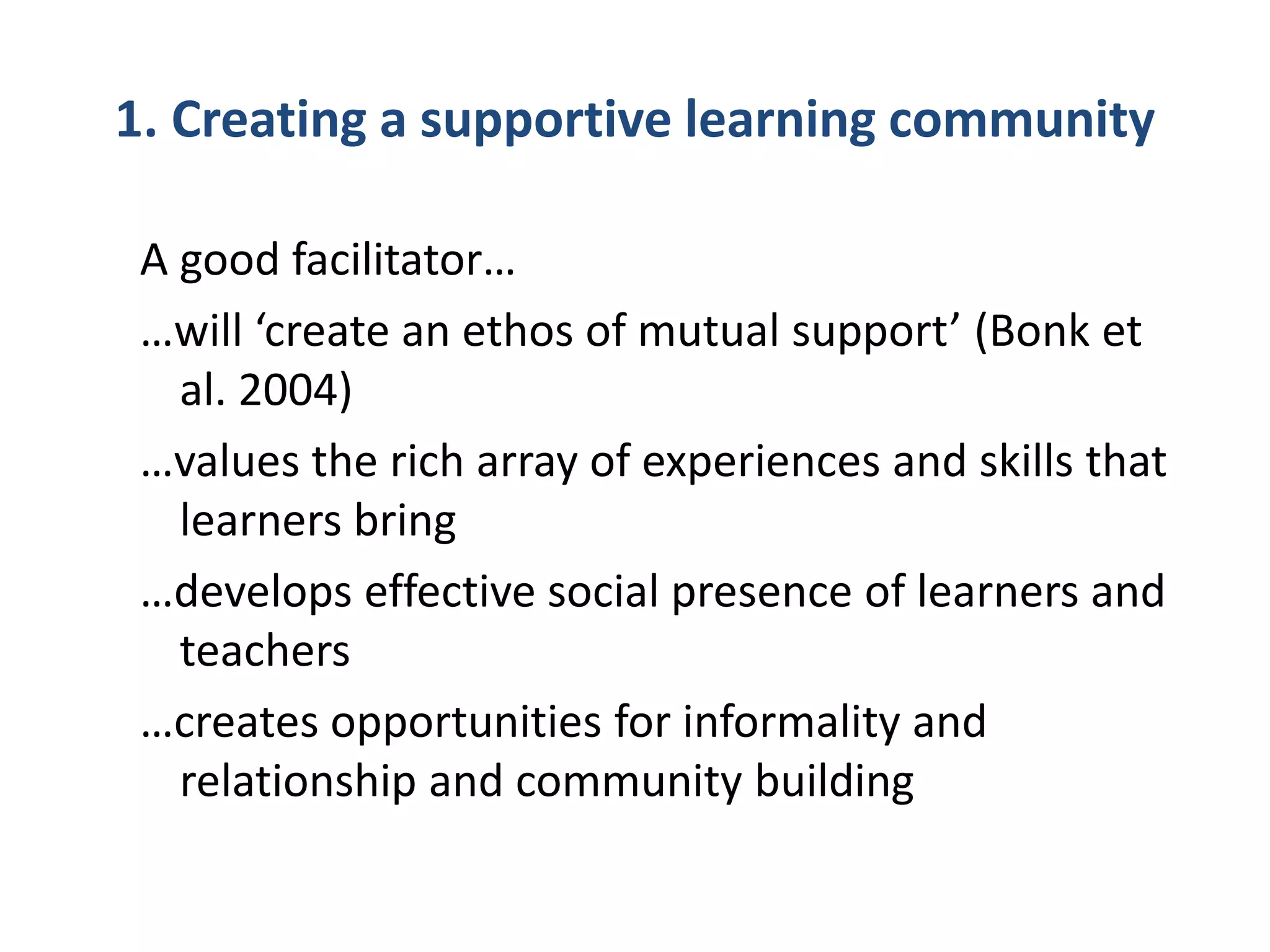
1. Creating a supportive learning community
A good facilitator…
…will ‘create an ethos of mutual support’ (Bonk et
al. 2004)
…values the rich array of experiences and skills that
learners bring
…develops effective social presence of learners and
teachers
…creates opportunities for informality and
relationship and community building
Recommendation 7. Minimalists
It was just
annoying
This has probably
been the most
stressful part of the
course for me…we
make plans, they
don’t turn up
It creates a level of
stress that possibly
you [tutors] aren’t
aware of
There were some
people, like me, who
[were] quite happy to
talk all the time, but
there were others who
weren’t…they didn’t
seem to want to
participant
Sub-recommendation 1:
Be aware that those who participate minimally have a negative effect
on their peers and consider ways to manage this
Cornelius and Gordon (2012b)
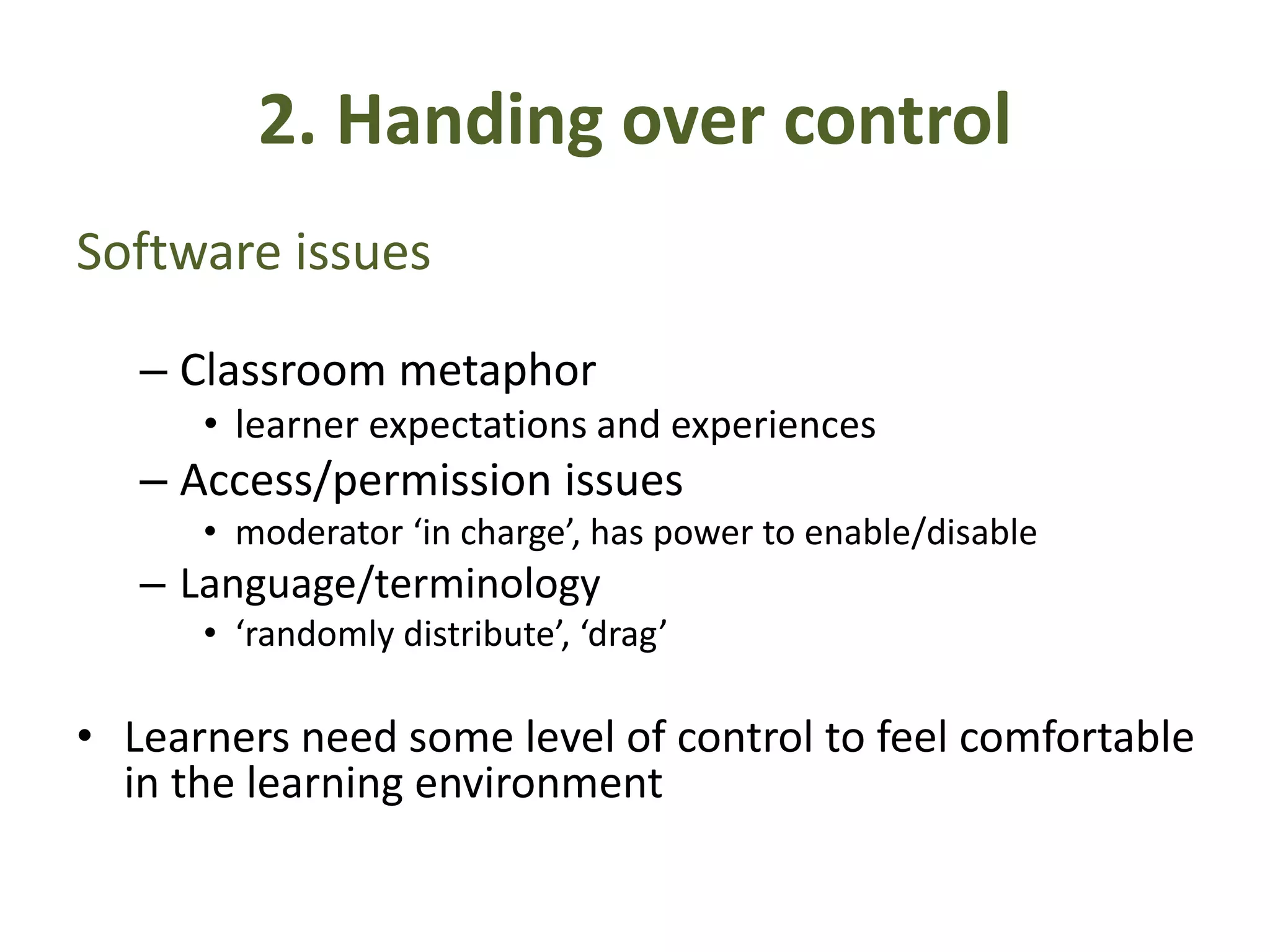
2. Handing over control
Software issues
– Classroom metaphor
• learner expectations and experiences
– Access/permission issues
• moderator ‘in charge’, has power to enable/disable
– Language/terminology
• ‘randomly distribute’, ‘drag’
• Learners need some level of control to feel comfortable
in the learning environment
I hope you never use the
‘team captains’ approach..
That would dredge up
memories of the gym class
I remember being in a
breakout room and no-one
else being there…feels lonely
Sub-recommendation 2:
Select optimum numbers for breakout rooms and
allow learners to move in and out of rooms as appropriate
It is fairly easy to get into the
breakout rooms although …I
sometimes wait until the rush is
over and then drag my name into
the room
I think [allowing participants to
move themselves to rooms] gives
participants autonomy as well, to
know that you can do that
yourself, instead of someone
taking you
Cornelius and Gordon (2012b)
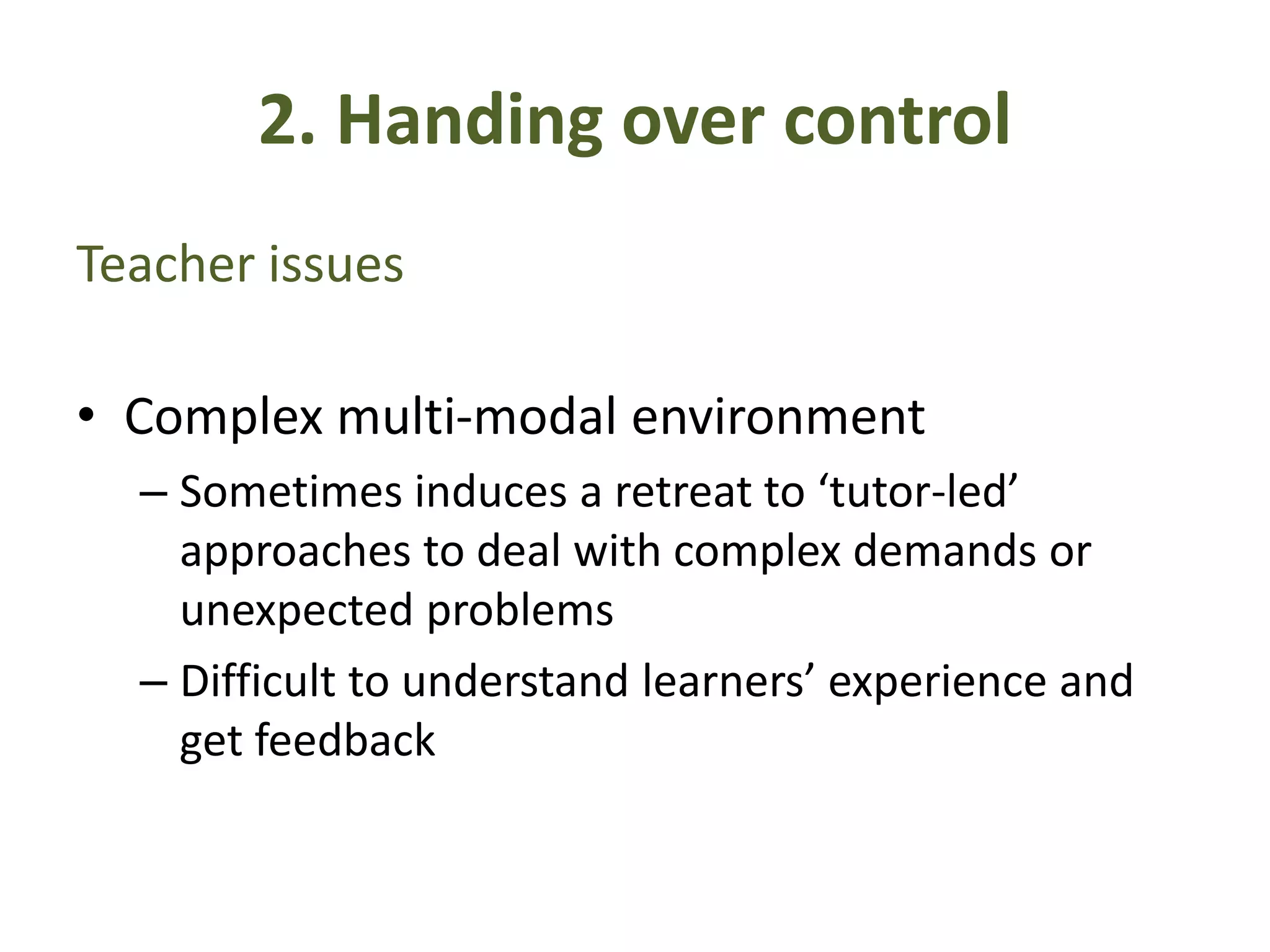
2. Handing over control
Teacher issues
• Complex multi-modal environment
– Sometimes induces a retreat to ‘tutor-led’
approaches to deal with complex demands or
unexpected problems
– Difficult to understand learners’ experience and
get feedback
In Bob’s words
I needed to have control
I definitely make sure, even in [a] bossy or more
pushy way, that everybody has at least their
chance to speak
try to be more democratic and more consistent
the chair of the meeting
Cornelius, 2014
In Claire’s words
I’ll do roughly the same tutorial face to face and
[with web conferencing]
it’s quite intense
there’s no time to waste
[I try to] make it interactive […] to make sure
everybody is being carried along and they are
following
what I find difficult is actually knowing how it is
from their perspective
Cornelius, 2014
3. Designing learner-centered activities
‘Messy activities’ require authenticity,
complexity, risk taking
– From ‘webinar’ or interactive lecture to other
possibilities:
• role play, group work, research activities
• integrating other technologies
• building in opportunities for reflection and
development of learning skills
Still needed…
• More evidence of what works and why in the
virtual classroom – particularly from the
learners’ perspective
• Exemplars of learning experiences which
exploit the opportunities offered by the virtual
classroom
• Evaluation of changes to teachers’ roles and
practices
Acknowledgements
Thanks to colleagues and collaborators…
Carole Gordon, Jan Schyma, Yvonne Bain,
Margaret Harris, Chris Aldred, Blair Stevenson
…and to participants and students
s.cornelius@abdn.ac.uk
Twitter: @sarahcornelius
Slideshare: slideshare.net/sarahcornelius
References
Bonk, C. J., Wisher, R.A., & Lee, J.-Y., (2004). Moderating learner-centered e-learning: problems and
solutions, benefits and implications. In Roberts, T. S. (ed.) Online Collaborative Learning.
Hershey: Idea Group Publishing.
Cornelius, S. (2013a). Convenience and Community? An Exploratory Investigation into Learners’
Experiences of Web Conferencing. Journal of Interactive Learning Research, 24 (3), 267-283.
Cornelius, S. (2014). Facilitating in a demanding environment: experiences of teaching in virtual
classrooms using web conferencing. British Journal of Educational Technology. 45(2) 260-271
Cornelius, S. & Gordon, C. (2012a). Learners' experiences of synchronous online activities: project
report. University of Aberdeen. http://www.slideshare.net/SarahCornelius/learners-
experiences-of-synchronous-online-activities.
Cornelius, S. and Gordon, C. (2012b) Facilitating learning with web conferencing: recommendations
based on learners’ experiences. Presentation to CSEDU conference, Lisbon, April 2012
Cornelius, S., Gordon, C., & Schyma, J. (2014). Live online learning: strategies for teaching with web
conferencing. Basingstoke: Palgrave Macmillan.
Doyle, T. (2011). Learner-centered teaching: putting the research on learning into practice. Stirling
Virginia: Stylus.
Steed, C. (2013) Live online learning – are you ready for the virtual classroom? Blog post
http://chat2lrn.wordpress.com/2013/06/10/live-online-learning-are-you-ready-for-the-virtual-
classroom
Weimer, M. (2013). Learner-centered teaching: five key changes to practice. 2nd Edition. San
Francisco: Jossey Bass.

challenges of learner-centered teaching in virtual classrooms

  • 1.
    The challenges oflearner-centered teaching in the virtual classroom Sarah Cornelius School of Education University of Aberdeen, UK
  • 3.
    My experience • Oneto one – postgraduate supervision, assignment support, interviews • Small groups – workshop-style interactive events, meetings, student led-sessions • Larger groups – professional development presentations, course inductions, international collaboration
  • 4.
    Evidence from researchsuggests – Technical problems frustrate learners – Learners appreciate the opportunity to interact – Increased interaction leads to greater satisfaction/better outcomes BUT – Studies are often case studies, new courses, new online learners, new facilitators Suggestions for facilitators – Engage learners with short learner-centered events (Steed, 2013)
  • 5.
    Presentation • What islearner-centered teaching? • Research on virtual classrooms • Challenges in virtual classrooms – Creating a supportive learning community – Handing over control – Designing learner-centered activities • What next?
  • 6.
    Learner-centered teaching Putting learnerfirst in all decisions • Engaging learners in learning (‘hard, messy work’) • Motivating learners by putting them in control • Encouraging collaboration within a learning community • Providing opportunities for reflection on learning • Paying explicit attention to learning skills Doyle (2008) Weimer (2013)
  • 7.
    Learners’ experiences • Learnerswith substantive experience (Cornelius, 2013) • Learners’ recommendations for facilitators (Cornelius and Gordon, 2012a)
  • 8.
    Teachers’ experiences - 4experienced UK facilitators: IPA study (Cornelius, 2014) - Conversations and interviews (Cornelius, Gordon and Schyma, 2014)
  • 9.
    Challenges to learner- centeredlearning in the virtual classroom 1. Creating a supportive learning community 2. Handing over control to learners 3. Designing ‘messy’ activities
  • 10.
    1. Creating asupportive learning community A good facilitator… …will ‘create an ethos of mutual support’ (Bonk et al. 2004) …values the rich array of experiences and skills that learners bring …develops effective social presence of learners and teachers …creates opportunities for informality and relationship and community building
  • 11.
    Recommendation 7. Minimalists Itwas just annoying This has probably been the most stressful part of the course for me…we make plans, they don’t turn up It creates a level of stress that possibly you [tutors] aren’t aware of There were some people, like me, who [were] quite happy to talk all the time, but there were others who weren’t…they didn’t seem to want to participant Sub-recommendation 1: Be aware that those who participate minimally have a negative effect on their peers and consider ways to manage this Cornelius and Gordon (2012b)
  • 12.
    2. Handing overcontrol Software issues – Classroom metaphor • learner expectations and experiences – Access/permission issues • moderator ‘in charge’, has power to enable/disable – Language/terminology • ‘randomly distribute’, ‘drag’ • Learners need some level of control to feel comfortable in the learning environment
  • 13.
    I hope younever use the ‘team captains’ approach.. That would dredge up memories of the gym class I remember being in a breakout room and no-one else being there…feels lonely Sub-recommendation 2: Select optimum numbers for breakout rooms and allow learners to move in and out of rooms as appropriate It is fairly easy to get into the breakout rooms although …I sometimes wait until the rush is over and then drag my name into the room I think [allowing participants to move themselves to rooms] gives participants autonomy as well, to know that you can do that yourself, instead of someone taking you Cornelius and Gordon (2012b)
  • 14.
    2. Handing overcontrol Teacher issues • Complex multi-modal environment – Sometimes induces a retreat to ‘tutor-led’ approaches to deal with complex demands or unexpected problems – Difficult to understand learners’ experience and get feedback
  • 15.
    In Bob’s words Ineeded to have control I definitely make sure, even in [a] bossy or more pushy way, that everybody has at least their chance to speak try to be more democratic and more consistent the chair of the meeting Cornelius, 2014
  • 16.
    In Claire’s words I’lldo roughly the same tutorial face to face and [with web conferencing] it’s quite intense there’s no time to waste [I try to] make it interactive […] to make sure everybody is being carried along and they are following what I find difficult is actually knowing how it is from their perspective Cornelius, 2014
  • 17.
    3. Designing learner-centeredactivities ‘Messy activities’ require authenticity, complexity, risk taking – From ‘webinar’ or interactive lecture to other possibilities: • role play, group work, research activities • integrating other technologies • building in opportunities for reflection and development of learning skills
  • 18.
    Still needed… • Moreevidence of what works and why in the virtual classroom – particularly from the learners’ perspective • Exemplars of learning experiences which exploit the opportunities offered by the virtual classroom • Evaluation of changes to teachers’ roles and practices
  • 19.
    Acknowledgements Thanks to colleaguesand collaborators… Carole Gordon, Jan Schyma, Yvonne Bain, Margaret Harris, Chris Aldred, Blair Stevenson …and to participants and students s.cornelius@abdn.ac.uk Twitter: @sarahcornelius Slideshare: slideshare.net/sarahcornelius
  • 20.
    References Bonk, C. J.,Wisher, R.A., & Lee, J.-Y., (2004). Moderating learner-centered e-learning: problems and solutions, benefits and implications. In Roberts, T. S. (ed.) Online Collaborative Learning. Hershey: Idea Group Publishing. Cornelius, S. (2013a). Convenience and Community? An Exploratory Investigation into Learners’ Experiences of Web Conferencing. Journal of Interactive Learning Research, 24 (3), 267-283. Cornelius, S. (2014). Facilitating in a demanding environment: experiences of teaching in virtual classrooms using web conferencing. British Journal of Educational Technology. 45(2) 260-271 Cornelius, S. & Gordon, C. (2012a). Learners' experiences of synchronous online activities: project report. University of Aberdeen. http://www.slideshare.net/SarahCornelius/learners- experiences-of-synchronous-online-activities. Cornelius, S. and Gordon, C. (2012b) Facilitating learning with web conferencing: recommendations based on learners’ experiences. Presentation to CSEDU conference, Lisbon, April 2012 Cornelius, S., Gordon, C., & Schyma, J. (2014). Live online learning: strategies for teaching with web conferencing. Basingstoke: Palgrave Macmillan. Doyle, T. (2011). Learner-centered teaching: putting the research on learning into practice. Stirling Virginia: Stylus. Steed, C. (2013) Live online learning – are you ready for the virtual classroom? Blog post http://chat2lrn.wordpress.com/2013/06/10/live-online-learning-are-you-ready-for-the-virtual- classroom Weimer, M. (2013). Learner-centered teaching: five key changes to practice. 2nd Edition. San Francisco: Jossey Bass.