Ideas for what, when, why and how
   Presented By:
   Tommy and Kristin
•Assessment of asynchronous discussions: what, when,
and how

•Assessment criteria for (a)synchronous discussions / chat:
participation, content/knowledge and language skills

•Ideas for activities to round up a course
Why?           To assess (a)synchronous discussion
                         forums or not

 Online discussion forums /chats are (permanent) records of
  learners’ work, and as such allow for assessment to occur
 Learners may have spent a lot of time on these and believe
  these to be important to their learning – to assess these forums
  mirrors perceptions of their worth
 If not assessed, learners may indeed decide these are ‘marginal’
  learning activities and so not worth their time
 It may promote a certain degree of involvement and
  motivation
 To feedback to learners about their knowledge of the content,
  or to focus on use of language
What?         Quantity or quality or …?

  Quantity is often NOT the chosen route as this may lead
   to a high volume of postings /chat with potential for a
   lack of quality
  Quality could be considered from many angles: in a
   language course this could be about the accuracy/fluency
   of the English used;
     in other contexts quality may come from aspects such as
      ‘relevance’ (how relevant are comments to the topic?),
      ‘initiative-taking’ (do the learners initiate a topic or another
      direction in the discussion?), ‘facilitative’ (do the learners
      facilitate understanding of their / others’ ideas by offering
      explanations and or questions) and ‘originality’ (how original
      are the discussion comments?)
 Other aspects of courses could also be considered e.g.
  task achievement – e.g has the group discussion led to
  achievement of the set task
 Not all discussion forums need be assessed.
  Forums/chats that carry a grade need to be specified and
  the criteria that will be used should be set out early on in
  the course in assessment documentation
When?
            Time, and more time

  Prior to a course starting, the tutor needs to have decided
   specifically which items / discussion forums will be
   assessed, and how these will be assessed
  If a particular forum/chat is to be assessed, then a time
   frame needs to be made clear
  This type of assessment may mean that a tutor has to look
   at a large number of recordings / forums and this may
   need a lot of time for reading / assessing – so (a) allow
   time for it, and (b) don’t use this as an end-of-semester
   assessment as it may prove far too time-consuming
Prepare
                   assessment
                      policy

                                     Decide on
Present policy
                                    the aims of
early in course
                                    discussion /
 / get learners
                                    chat in the
    feedback
                                       course
                   Course
                  Planning
                    Stage
 Aim for the
                                     What chat
 assessment
                                   sessions/which
policy to have
                                     discussion
   positive
                                  forums to assess
   impact

                     Decide
                   criteria for
                   assessment
How?           Tips for synchronous and
              asynchronous assessment
 As online discussions forums are examples of written and spoken
  English, the tutor may wish to exploit descriptors as used in public
  exams such as IELTS or FCE to assist in grading learners’ use of English
 The e-tutor need not be the only person to assess postings – there could
  be self-assessment, peer assessment or a mix of these
 Communicate the grade system and criteria to learners as soon as
  possible (preferably in a document that outlines the assessment items
  and the relevant criteria at the start of the course)
 Provide models of appropriate/ inappropriate/exemplary postings to
  aid understanding of (less concrete )criteria
 Group discussion threads rather than whole class discussion could be
  used – this may tie into task achievement, and also bring up the issue of
  awarding the same grade to all members of the group, rather than
  individual grades
 Wait until students are familiar with the chat forum before 1st chat
  assessment
 Plan chat sessions in advance in order that you provide opportunities for
  all learners and so that the assessment is done appropriately
 Have questions prepared in a word processor to quickly copy and paste to
  the chat
 For voice chat, use record function so you can assess the chat later
 For role play, you can send students private messages about their role. In
  order for different learners to have a chance at utilising different skills
  or language functions, tasks could be given in which learners are
  assigned (secret) roles to play e.g. the protagonist, the antagonist etc
 If assessing content / simulations have follow-up questions ready and
  strategies to deal with incorrect responses
 Not only tell students what is being assessed, but point out what is not
  being assessed to encourage achievement of the aim
Assessment
 Criteria 1
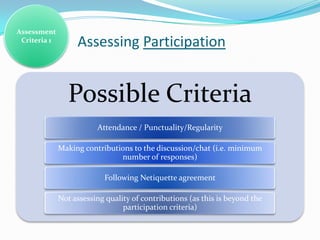
                   Assessing Participation


                Possible Criteria
                         Attendance / Punctuality/Regularity

              Making contributions to the discussion/chat (i.e. minimum
                               number of responses)

                           Following Netiquette agreement

              Not assessing quality of contributions (as this is beyond the
                                 participation criteria)
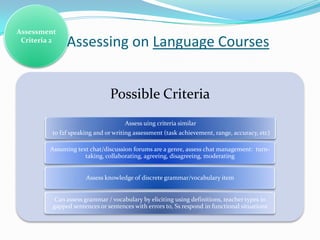
Assessment
 Criteria 2
               Assessing on Language Courses


                               Possible Criteria
                                     Assess uing criteria similar
          to f2f speaking and or writing assessment (task achievement, range, accuracy, etc)

         Assuming text chat/discussion forums are a genre, assess chat management: turn-
                     taking, collaborating, agreeing, disagreeing, moderating


                      Assess knowledge of discrete grammar/vocabulary item


           Can assess grammar / vocabulary by eliciting using definitions, teacher types in
          gapped sentences or sentences with errors to, Ss respond in functional situations
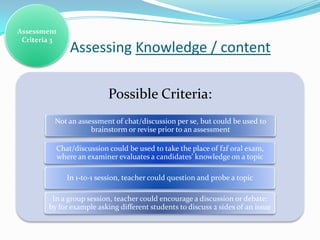
Assessment
 Criteria 3
               Assessing Knowledge / content

                           Possible Criteria:
          Not an assessment of chat/discussion per se, but could be used to
                     brainstorm or revise prior to an assessment

          Chat/discussion could be used to take the place of f2f oral exam,
          where an examiner evaluates a candidates’ knowledge on a topic

              In 1-to-1 session, teacher could question and probe a topic

         In a group session, teacher could encourage a discussion or debate:
        by for example asking different students to discuss 2 sides of an issue
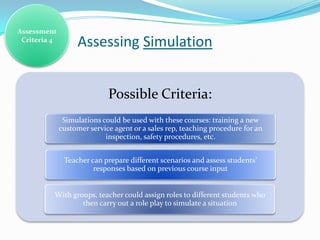
Assessment
 Criteria 4
                   Assessing Simulation


                             Possible Criteria:
               Simulations could be used with these courses: training a new
              customer service agent or a sales rep, teaching procedure for an
                            inspection, safety procedures, etc.


               Teacher can prepare different scenarios and assess students’
                        responses based on previous course input


          With groups, teacher could assign roles to different students who
                  then carry out a role play to simulate a situation
 Parting gifts (as in this course): Participants leave a
  personalized ‘gift’ for the group (Hockly & Clanfield 2010:
  89)
 Compose a how-to guide to take away from the course:
  Similar to the present task – give different groups different
  aspects of the course to some up.
 Farewell message: A space (forum, wiki or soundboard)
  for course participants to leave a goodbye message to
  everyone else. (Hockly & Clanfield 2010: 89) Or these could
  take the form of ‘fun’ certificates that students jointly
  construct on a wiki to be given to/ printed out for their
  colleagues.
 Advice for the next group: A forum or wiki e.g.
  Wallwisher where all participants leave at least one piece of
  advice for future participants who will take the next course.
  (This could be a fun activity and useful for the tutor as
  implicit feedback).
 Create a composite of the perfect e-tutor: (Example for our course)
  Using a cartoon character as an image, participants create a profile of
  the perfect e-tutor. It might say:
         Super E-tutor knows all about the tasks inside Moodle
         Super E-tutor can weave and summarize as fast as lightning
         Super E-tutor can answer 100 emails a day from students
         Super E-tutor can resolve arguments using a single line of chat
      (This activity encourages participants to sum up skills developed on the
          course, but in a light-hearted way.)
 A Yearbook: Similar to the yearbook in high school. Using a wiki,
  participants add a line to describe each participant and the tutor
  (photos included if possible), keeping the focus light-hearted and
  positive.
 A time-capsule: Participants create a ‘time-capsule’ in a forum or
  wiki. Each group should describe one aspect of the course on the
  assumption that a future generation will look at the time-capsule to
  learn what happened on the course.
 Five years from now: Similar to the yearbook idea, but participants
  predict what others will be doing five years from now based on their
  strengths during the course.
 Take it from here (Hockly & Clanfield 2010: 90) In a forum or
  wiki, participants leave a brief note saying what they take away
  from the course. Useful for individuals to reflect and for the
  group to have a record of what each person thought was most
  worth remembering from the course.
 A reflective journal piece of extensive writing: this may be
  around a page or so in length. In this the learners document
  their major pieces of learning and or reflect on what was their
  most influential ‘lighbulb’ moment. This piece may be a
  composite of ‘Take it from here’ + ‘Five years from now’.
 A review quiz: made for them to take as a review of the course
  content OR as a group task for them to make to give other
  groups.
 An end-of-course evaluation survey/questionnaire :
  candidates provide comments about and or a grading of the
  course.

E moderation resource pack group d rounding up a course - copy

  • 1.
    Ideas for what,when, why and how Presented By: Tommy and Kristin
  • 2.
    •Assessment of asynchronousdiscussions: what, when, and how •Assessment criteria for (a)synchronous discussions / chat: participation, content/knowledge and language skills •Ideas for activities to round up a course
  • 3.
    Why? To assess (a)synchronous discussion forums or not  Online discussion forums /chats are (permanent) records of learners’ work, and as such allow for assessment to occur  Learners may have spent a lot of time on these and believe these to be important to their learning – to assess these forums mirrors perceptions of their worth  If not assessed, learners may indeed decide these are ‘marginal’ learning activities and so not worth their time  It may promote a certain degree of involvement and motivation  To feedback to learners about their knowledge of the content, or to focus on use of language
  • 4.
    What? Quantity or quality or …?  Quantity is often NOT the chosen route as this may lead to a high volume of postings /chat with potential for a lack of quality  Quality could be considered from many angles: in a language course this could be about the accuracy/fluency of the English used;  in other contexts quality may come from aspects such as ‘relevance’ (how relevant are comments to the topic?), ‘initiative-taking’ (do the learners initiate a topic or another direction in the discussion?), ‘facilitative’ (do the learners facilitate understanding of their / others’ ideas by offering explanations and or questions) and ‘originality’ (how original are the discussion comments?)
  • 5.
     Other aspectsof courses could also be considered e.g. task achievement – e.g has the group discussion led to achievement of the set task  Not all discussion forums need be assessed. Forums/chats that carry a grade need to be specified and the criteria that will be used should be set out early on in the course in assessment documentation
  • 6.
    When? Time, and more time  Prior to a course starting, the tutor needs to have decided specifically which items / discussion forums will be assessed, and how these will be assessed  If a particular forum/chat is to be assessed, then a time frame needs to be made clear  This type of assessment may mean that a tutor has to look at a large number of recordings / forums and this may need a lot of time for reading / assessing – so (a) allow time for it, and (b) don’t use this as an end-of-semester assessment as it may prove far too time-consuming
  • 7.
    Prepare assessment policy Decide on Present policy the aims of early in course discussion / / get learners chat in the feedback course Course Planning Stage Aim for the What chat assessment sessions/which policy to have discussion positive forums to assess impact Decide criteria for assessment
  • 8.
    How? Tips for synchronous and asynchronous assessment  As online discussions forums are examples of written and spoken English, the tutor may wish to exploit descriptors as used in public exams such as IELTS or FCE to assist in grading learners’ use of English  The e-tutor need not be the only person to assess postings – there could be self-assessment, peer assessment or a mix of these  Communicate the grade system and criteria to learners as soon as possible (preferably in a document that outlines the assessment items and the relevant criteria at the start of the course)  Provide models of appropriate/ inappropriate/exemplary postings to aid understanding of (less concrete )criteria  Group discussion threads rather than whole class discussion could be used – this may tie into task achievement, and also bring up the issue of awarding the same grade to all members of the group, rather than individual grades
  • 9.
     Wait untilstudents are familiar with the chat forum before 1st chat assessment  Plan chat sessions in advance in order that you provide opportunities for all learners and so that the assessment is done appropriately  Have questions prepared in a word processor to quickly copy and paste to the chat  For voice chat, use record function so you can assess the chat later  For role play, you can send students private messages about their role. In order for different learners to have a chance at utilising different skills or language functions, tasks could be given in which learners are assigned (secret) roles to play e.g. the protagonist, the antagonist etc  If assessing content / simulations have follow-up questions ready and strategies to deal with incorrect responses  Not only tell students what is being assessed, but point out what is not being assessed to encourage achievement of the aim
  • 10.
    Assessment Criteria 1 Assessing Participation Possible Criteria Attendance / Punctuality/Regularity Making contributions to the discussion/chat (i.e. minimum number of responses) Following Netiquette agreement Not assessing quality of contributions (as this is beyond the participation criteria)
  • 11.
    Assessment Criteria 2 Assessing on Language Courses Possible Criteria Assess uing criteria similar to f2f speaking and or writing assessment (task achievement, range, accuracy, etc) Assuming text chat/discussion forums are a genre, assess chat management: turn- taking, collaborating, agreeing, disagreeing, moderating Assess knowledge of discrete grammar/vocabulary item Can assess grammar / vocabulary by eliciting using definitions, teacher types in gapped sentences or sentences with errors to, Ss respond in functional situations
  • 12.
    Assessment Criteria 3 Assessing Knowledge / content Possible Criteria: Not an assessment of chat/discussion per se, but could be used to brainstorm or revise prior to an assessment Chat/discussion could be used to take the place of f2f oral exam, where an examiner evaluates a candidates’ knowledge on a topic In 1-to-1 session, teacher could question and probe a topic In a group session, teacher could encourage a discussion or debate: by for example asking different students to discuss 2 sides of an issue
  • 13.
    Assessment Criteria 4 Assessing Simulation Possible Criteria: Simulations could be used with these courses: training a new customer service agent or a sales rep, teaching procedure for an inspection, safety procedures, etc. Teacher can prepare different scenarios and assess students’ responses based on previous course input With groups, teacher could assign roles to different students who then carry out a role play to simulate a situation
  • 15.
     Parting gifts(as in this course): Participants leave a personalized ‘gift’ for the group (Hockly & Clanfield 2010: 89)  Compose a how-to guide to take away from the course: Similar to the present task – give different groups different aspects of the course to some up.  Farewell message: A space (forum, wiki or soundboard) for course participants to leave a goodbye message to everyone else. (Hockly & Clanfield 2010: 89) Or these could take the form of ‘fun’ certificates that students jointly construct on a wiki to be given to/ printed out for their colleagues.  Advice for the next group: A forum or wiki e.g. Wallwisher where all participants leave at least one piece of advice for future participants who will take the next course. (This could be a fun activity and useful for the tutor as implicit feedback).
  • 16.
     Create acomposite of the perfect e-tutor: (Example for our course) Using a cartoon character as an image, participants create a profile of the perfect e-tutor. It might say:  Super E-tutor knows all about the tasks inside Moodle  Super E-tutor can weave and summarize as fast as lightning  Super E-tutor can answer 100 emails a day from students  Super E-tutor can resolve arguments using a single line of chat (This activity encourages participants to sum up skills developed on the course, but in a light-hearted way.)  A Yearbook: Similar to the yearbook in high school. Using a wiki, participants add a line to describe each participant and the tutor (photos included if possible), keeping the focus light-hearted and positive.  A time-capsule: Participants create a ‘time-capsule’ in a forum or wiki. Each group should describe one aspect of the course on the assumption that a future generation will look at the time-capsule to learn what happened on the course.  Five years from now: Similar to the yearbook idea, but participants predict what others will be doing five years from now based on their strengths during the course.
  • 17.
     Take itfrom here (Hockly & Clanfield 2010: 90) In a forum or wiki, participants leave a brief note saying what they take away from the course. Useful for individuals to reflect and for the group to have a record of what each person thought was most worth remembering from the course.  A reflective journal piece of extensive writing: this may be around a page or so in length. In this the learners document their major pieces of learning and or reflect on what was their most influential ‘lighbulb’ moment. This piece may be a composite of ‘Take it from here’ + ‘Five years from now’.  A review quiz: made for them to take as a review of the course content OR as a group task for them to make to give other groups.  An end-of-course evaluation survey/questionnaire : candidates provide comments about and or a grading of the course.