Raleigh & Rosse: Measures to
motivate Exceptional Service


          By Group 9:
R&R DASHBOARD
           
 Specialty retailer of luxury goods
 38 retail locations with average revenue per square
  foot of 1200$ significantly higher than industry
  average of 675$
 Extraordinary customer service, deep customer
  loyalty
 Strategy: “Own your business, own your customer
  relationship”
R&R ownership culture &
     SPH Program
                                 
 The following are the policy changes
     Shifting focus from experienced sales professionals to
      college graduates and training them
     Maintaining internal promotions system thereby improving
      the experience level of mid mgmt. team
     Revamped sales associates commission system
     Investment in IT
     Greater autonomy to sales managers
   Sales per Hour Program
     Measurement of sales associates – by weekly sales
     Sales managers were measured by standard metrics like
      revenues, gross margin etc.
PROBLEM STATEMENT
         
 Introduction of SPH led to


   More intense work environment

   Sharking

   Off the clock work hours
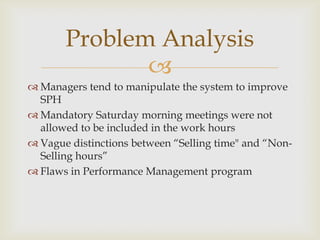
Problem Analysis
              
 Managers tend to manipulate the system to improve
  SPH
 Mandatory Saturday morning meetings were not
  allowed to be included in the work hours
 Vague distinctions between “Selling time" and “Non-
  Selling hours”
 Flaws in Performance Management program
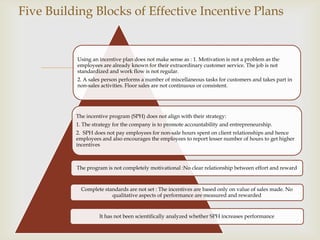
Five Building Blocks of Effective Incentive Plans


                                        
          Using an incentive plan does not make sense as : 1. Motivation is not a problem as the
          employees are already known for their extraordinary customer service. The job is not
          standardized and work flow is not regular.
          2. A sales person performs a number of miscellaneous tasks for customers and takes part in
          non-sales activities. Floor sales are not continuous or consistent.


          The incentive program (SPH) does not align with their strategy:
          1. The strategy for the company is to promote accountability and entrepreneurship.
          2. SPH does not pay employees for non-sale hours spent on client relationships and hence
          employees and also encourages the employees to report lesser number of hours to get higher
          incentives


          The program is not completely motivational :No clear relationship between effort and reward


            Complete standards are not set : The incentives are based only on value of sales made. No
                        qualitative aspects of performance are measured and rewarded


                   It has not been scientifically analyzed whether SPH increases performance
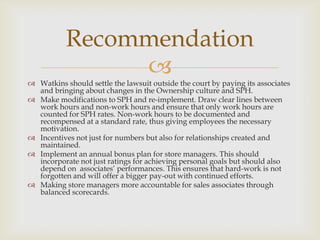
Recommendation
                
 Watkins should settle the lawsuit outside the court by paying its associates
  and bringing about changes in the Ownership culture and SPH.
 Make modifications to SPH and re-implement. Draw clear lines between
  work hours and non-work hours and ensure that only work hours are
  counted for SPH rates. Non-work hours to be documented and
  recompensed at a standard rate, thus giving employees the necessary
  motivation.
 Incentives not just for numbers but also for relationships created and
  maintained.
 Implement an annual bonus plan for store managers. This should
  incorporate not just ratings for achieving personal goals but should also
  depend on associates’ performances. This ensures that hard-work is not
  forgotten and will offer a bigger pay-out with continued efforts.
 Making store managers more accountable for sales associates through
  balanced scorecards.
Thanks

Section s3 group9 raleighrosse - copy

  • 1.
    Raleigh & Rosse:Measures to motivate Exceptional Service By Group 9:
  • 2.
    R&R DASHBOARD   Specialty retailer of luxury goods  38 retail locations with average revenue per square foot of 1200$ significantly higher than industry average of 675$  Extraordinary customer service, deep customer loyalty  Strategy: “Own your business, own your customer relationship”
  • 3.
    R&R ownership culture& SPH Program   The following are the policy changes  Shifting focus from experienced sales professionals to college graduates and training them  Maintaining internal promotions system thereby improving the experience level of mid mgmt. team  Revamped sales associates commission system  Investment in IT  Greater autonomy to sales managers  Sales per Hour Program  Measurement of sales associates – by weekly sales  Sales managers were measured by standard metrics like revenues, gross margin etc.
  • 4.
    PROBLEM STATEMENT   Introduction of SPH led to  More intense work environment  Sharking  Off the clock work hours
  • 5.
    Problem Analysis   Managers tend to manipulate the system to improve SPH  Mandatory Saturday morning meetings were not allowed to be included in the work hours  Vague distinctions between “Selling time" and “Non- Selling hours”  Flaws in Performance Management program
  • 6.
    Five Building Blocksof Effective Incentive Plans  Using an incentive plan does not make sense as : 1. Motivation is not a problem as the employees are already known for their extraordinary customer service. The job is not standardized and work flow is not regular. 2. A sales person performs a number of miscellaneous tasks for customers and takes part in non-sales activities. Floor sales are not continuous or consistent. The incentive program (SPH) does not align with their strategy: 1. The strategy for the company is to promote accountability and entrepreneurship. 2. SPH does not pay employees for non-sale hours spent on client relationships and hence employees and also encourages the employees to report lesser number of hours to get higher incentives The program is not completely motivational :No clear relationship between effort and reward Complete standards are not set : The incentives are based only on value of sales made. No qualitative aspects of performance are measured and rewarded It has not been scientifically analyzed whether SPH increases performance
  • 7.
    Recommendation   Watkins should settle the lawsuit outside the court by paying its associates and bringing about changes in the Ownership culture and SPH.  Make modifications to SPH and re-implement. Draw clear lines between work hours and non-work hours and ensure that only work hours are counted for SPH rates. Non-work hours to be documented and recompensed at a standard rate, thus giving employees the necessary motivation.  Incentives not just for numbers but also for relationships created and maintained.  Implement an annual bonus plan for store managers. This should incorporate not just ratings for achieving personal goals but should also depend on associates’ performances. This ensures that hard-work is not forgotten and will offer a bigger pay-out with continued efforts.  Making store managers more accountable for sales associates through balanced scorecards.
  • 8.