Plant Polyphenols –
Properties and Applications
Dr. Jibu Thomas
Department of Biotechnology
Coimbatore, Tamilnadu, India
Email: jibuthomas.t@gmail.com
PLANT
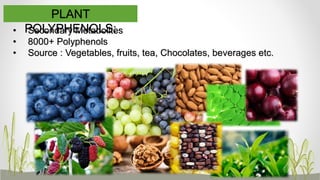
POLYPHENOLS:• Secondary Metabolites
• 8000+ Polyphenols
• Source : Vegetables, fruits, tea, Chocolates, beverages etc.
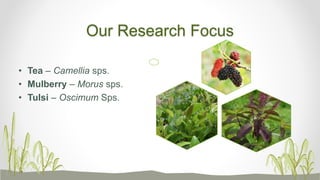
Our Research Focus
• Tea – Camellia sps.
• Mulberry – Morus sps.
• Tulsi – Oscimum Sps.
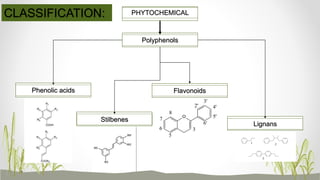
PHYTOCHEMICAL
Polyphenols
Phenolic acids
Stilbenes
Flavonoids
Lignans
CLASSIFICATION:
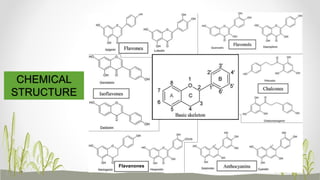
CHEMICAL
STRUCTURE
Flavanones
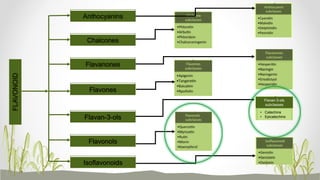
FLAVONOID Anthocyanins
Chalcones
Flavanones
Flavones
Flavonols
Isoflavonoids
Flavan-3-ols
Flavan-3-ols
subclasses
• Catechins
• Epicatechins
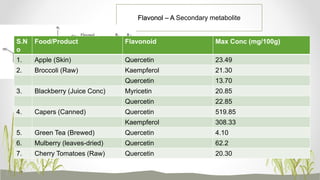
Flavonol – A Secondary metabolite
S.N
o
Food/Product Flavonoid Max Conc (mg/100g)
1. Apple (Skin) Quercetin 23.49
2. Broccoli (Raw) Kaempferol 21.30
Quercetin 13.70
3. Blackberry (Juice Conc) Myricetin 20.85
Quercetin 22.85
4. Capers (Canned) Quercetin 519.85
Kaempferol 308.33
5. Green Tea (Brewed) Quercetin 4.10
6. Mulberry (leaves-dried) Quercetin 62.2
7. Cherry Tomatoes (Raw) Quercetin 20.30
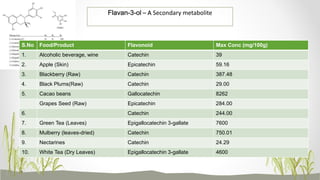
Flavan-3-ol – A Secondary metabolite
S.No Food/Product Flavonoid Max Conc (mg/100g)
1. Alcoholic beverage, wine Catechin 39
2. Apple (Skin) Epicatechin 59.16
3. Blackberry (Raw) Catechin 387.48
4. Black Plums(Raw) Catechin 29.00
5. Cacao beans Gallocatechin 8262
Grapes Seed (Raw) Epicatechin 284.00
6. Catechin 244.00
7. Green Tea (Leaves) Epigallocatechin 3-gallate 7600
8. Mulberry (leaves-dried) Catechin 750.01
9. Nectarines Catechin 24.29
10. White Tea (Dry Leaves) Epigallocatechin 3-gallate 4600
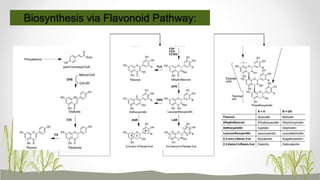
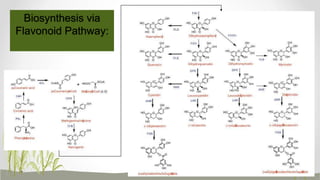
Biosynthesis via Flavonoid Pathway:
Biosynthesis via
Flavonoid Pathway:
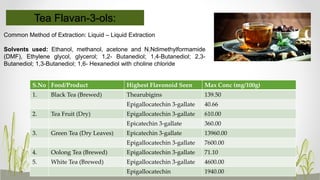
Tea Flavan-3-ols:
Common Method of Extraction: Liquid – Liquid Extraction
Solvents used: Ethanol, methanol, acetone and N,Ndimethylformamide
(DMF), Ethylene glycol, glycerol; 1,2- Butanediol; 1,4-Butanediol; 2,3-
Butanediol; 1,3-Butanediol; 1,6- Hexanediol with choline chloride
S.No Food/Product Highest Flavonoid Seen Max Conc (mg/100g)
1. Black Tea (Brewed) Thearubigins 139.50
Epigallocatechin 3-gallate 40.66
2. Tea Fruit (Dry) Epigallocatechin 3-gallate 610.00
Epicatechin 3-gallate 360.00
3. Green Tea (Dry Leaves) Epicatechin 3-gallate 13960.00
Epigallocatechin 3-gallate 7600.00
4. Oolong Tea (Brewed) Epigallocatechin 3-gallate 71.10
5. White Tea (Brewed) Epigallocatechin 3-gallate 4600.00
Epigallocatechin 1940.00
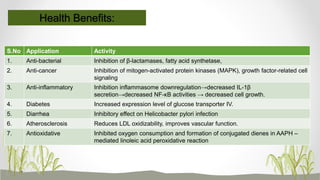
S.No Application Activity
1. Anti-bacterial Inhibition of β-lactamases, fatty acid synthetase,
2. Anti-cancer Inhibition of mitogen-activated protein kinases (MAPK), growth factor-related cell
signaling
3. Anti-inflammatory Inhibition inflammasome downregulation→decreased IL-1β
secretion→decreased NF-κB activities → decreased cell growth.
4. Diabetes Increased expression level of glucose transporter IV.
5. Diarrhea Inhibitory effect on Helicobacter pylori infection
6. Atherosclerosis Reduces LDL oxidizability, improves vascular function.
7. Antioxidative Inhibited oxygen consumption and formation of conjugated dienes in AAPH –
mediated linoleic acid peroxidative reaction
Health Benefits:
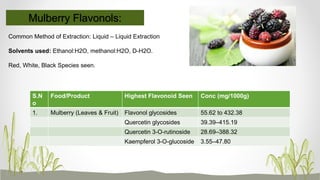
S.N
o
Food/Product Highest Flavonoid Seen Conc (mg/1000g)
1. Mulberry (Leaves & Fruit) Flavonol glycosides 55.62 to 432.38
Quercetin glycosides 39.39–415.19
Quercetin 3-O-rutinoside 28.69–388.32
Kaempferol 3-O-glucoside 3.55–47.80
Mulberry Flavonols:
Common Method of Extraction: Liquid – Liquid Extraction
Solvents used: Ethanol:H2O, methanol:H2O, D-H2O.
Red, White, Black Species seen.
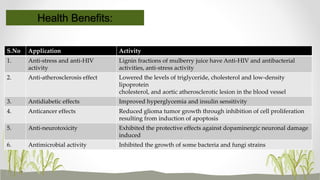
Health Benefits:
S.No Application Activity
1. Anti-stress and anti-HIV
activity
Lignin fractions of mulberry juice have Anti-HIV and antibacterial
activities, anti-stress activity
2. Anti-atherosclerosis effect Lowered the levels of triglyceride, cholesterol and low-density
lipoprotein
cholesterol, and aortic atherosclerotic lesion in the blood vessel
3. Antidiabetic effects Improved hyperglycemia and insulin sensitivity
4. Anticancer effects Reduced glioma tumor growth through inhibition of cell proliferation
resulting from induction of apoptosis
5. Anti-neurotoxicity Exhibited the protective effects against dopaminergic neuronal damage
induced
6. Antimicrobial activity Inhibited the growth of some bacteria and fungi strains
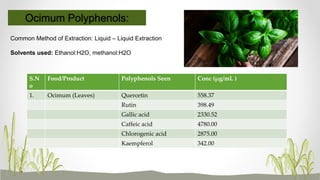
S.N
o
Food/Product Polyphenols Seen Conc (μg/mL )
1. Ocimum (Leaves) Quercetin 558.37
Rutin 398.49
Gallic acid 2330.52
Caffeic acid 4780.00
Chlorogenic acid 2875.00
Kaempferol 342.00
Ocimum Polyphenols:
Common Method of Extraction: Liquid – Liquid Extraction
Solvents used: Ethanol:H2O, methanol:H2O
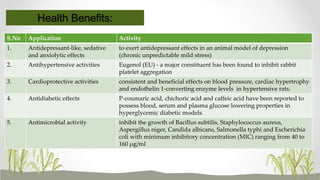
S.No Application Activity
1. Antidepressant-like, sedative
and anxiolytic effects
to exert antidepressant effects in an animal model of depression
(chronic unpredictable mild stress)
2. Antihypertensive activities Eugenol (EU) - a major constituent has been found to inhibit rabbit
platelet aggregation
3. Cardioprotective activities consistent and beneficial effects on blood pressure, cardiac hypertrophy
and endothelin 1-converting enzyme levels in hypertensive rats.
4. Antidiabetic effects P-coumaric acid, chichoric acid and caffeic acid have been reported to
possess blood, serum and plasma glucose lowering properties in
hyperglycemic diabetic models.
5. Antimicrobial activity inhibit the growth of Bacillus subtilis, Staphylococcus aureus,
Aspergillus niger, Candida albicans, Salmonella typhi and Escherichia
coli with minimum inhibitory concentration (MIC) ranging from 40 to
160 µg/ml
Health Benefits:
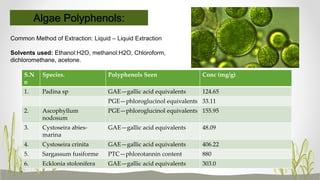
S.N
o
Species. Polyphenols Seen Conc (mg/g)
1. Padina sp GAE—gallic acid equivalents 124.65
PGE—phloroglucinol equivalents 33.11
2. Ascophyllum
nodosum
PGE—phloroglucinol equivalents 155.95
3. Cystoseira abies-
marina
GAE—gallic acid equivalents 48.09
4. Cystoseira crinita GAE—gallic acid equivalents 406.22
5. Sargassum fusiforme PTC—phlorotannin content 880
6. Ecklonia stolonifera GAE—gallic acid equivalents 303.0
Algae Polyphenols:
Common Method of Extraction: Liquid – Liquid Extraction
Solvents used: Ethanol:H2O, methanol:H2O, Chloroform,
dichloromethane, acetone.
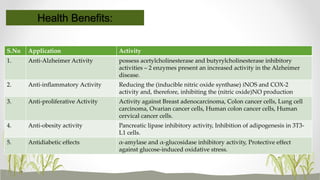
S.No Application Activity
1. Anti-Alzheimer Activity possess acetylcholinesterase and butyrylcholinesterase inhibitory
activities – 2 enzymes present an increased activity in the Alzheimer
disease.
2. Anti-inflammatory Activity Reducing the (inducible nitric oxide synthase) iNOS and COX-2
activity and, therefore, inhibiting the (nitric oxide)NO production
3. Anti-proliferative Activity Activity against Breast adenocarcinoma, Colon cancer cells, Lung cell
carcinoma, Ovarian cancer cells, Human colon cancer cells, Human
cervical cancer cells.
4. Anti-obesity activity Pancreatic lipase inhibitory activity, Inhibition of adipogenesis in 3T3-
L1 cells.
5. Antidiabetic effects α-amylase and α-glucosidase inhibitory activity, Protective effect
against glucose-induced oxidative stress.
Health Benefits:
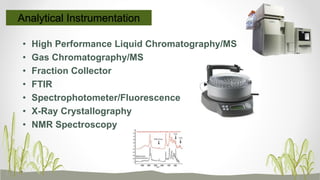
Analytical Instrumentation
• High Performance Liquid Chromatography/MS
• Gas Chromatography/MS
• Fraction Collector
• FTIR
• Spectrophotometer/Fluorescence
• X-Ray Crystallography
• NMR Spectroscopy
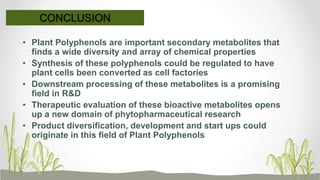
CONCLUSION
• Plant Polyphenols are important secondary metabolites that
finds a wide diversity and array of chemical properties
• Synthesis of these polyphenols could be regulated to have
plant cells been converted as cell factories
• Downstream processing of these metabolites is a promising
field in R&D
• Therapeutic evaluation of these bioactive metabolites opens
up a new domain of phytopharmaceutical research
• Product diversification, development and start ups could
originate in this field of Plant Polyphenols

Plant polyphenols for slideshare

  • 1.
    Plant Polyphenols – Propertiesand Applications Dr. Jibu Thomas Department of Biotechnology Coimbatore, Tamilnadu, India Email: jibuthomas.t@gmail.com
  • 2.
    PLANT POLYPHENOLS:• Secondary Metabolites •8000+ Polyphenols • Source : Vegetables, fruits, tea, Chocolates, beverages etc.
  • 3.
    Our Research Focus •Tea – Camellia sps. • Mulberry – Morus sps. • Tulsi – Oscimum Sps.
  • 5.
  • 6.
  • 7.
  • 8.
    Flavonol – ASecondary metabolite S.N o Food/Product Flavonoid Max Conc (mg/100g) 1. Apple (Skin) Quercetin 23.49 2. Broccoli (Raw) Kaempferol 21.30 Quercetin 13.70 3. Blackberry (Juice Conc) Myricetin 20.85 Quercetin 22.85 4. Capers (Canned) Quercetin 519.85 Kaempferol 308.33 5. Green Tea (Brewed) Quercetin 4.10 6. Mulberry (leaves-dried) Quercetin 62.2 7. Cherry Tomatoes (Raw) Quercetin 20.30
  • 9.
    Flavan-3-ol – ASecondary metabolite S.No Food/Product Flavonoid Max Conc (mg/100g) 1. Alcoholic beverage, wine Catechin 39 2. Apple (Skin) Epicatechin 59.16 3. Blackberry (Raw) Catechin 387.48 4. Black Plums(Raw) Catechin 29.00 5. Cacao beans Gallocatechin 8262 Grapes Seed (Raw) Epicatechin 284.00 6. Catechin 244.00 7. Green Tea (Leaves) Epigallocatechin 3-gallate 7600 8. Mulberry (leaves-dried) Catechin 750.01 9. Nectarines Catechin 24.29 10. White Tea (Dry Leaves) Epigallocatechin 3-gallate 4600
  • 10.
  • 11.
  • 12.
    Tea Flavan-3-ols: Common Methodof Extraction: Liquid – Liquid Extraction Solvents used: Ethanol, methanol, acetone and N,Ndimethylformamide (DMF), Ethylene glycol, glycerol; 1,2- Butanediol; 1,4-Butanediol; 2,3- Butanediol; 1,3-Butanediol; 1,6- Hexanediol with choline chloride S.No Food/Product Highest Flavonoid Seen Max Conc (mg/100g) 1. Black Tea (Brewed) Thearubigins 139.50 Epigallocatechin 3-gallate 40.66 2. Tea Fruit (Dry) Epigallocatechin 3-gallate 610.00 Epicatechin 3-gallate 360.00 3. Green Tea (Dry Leaves) Epicatechin 3-gallate 13960.00 Epigallocatechin 3-gallate 7600.00 4. Oolong Tea (Brewed) Epigallocatechin 3-gallate 71.10 5. White Tea (Brewed) Epigallocatechin 3-gallate 4600.00 Epigallocatechin 1940.00
  • 13.
    S.No Application Activity 1.Anti-bacterial Inhibition of β-lactamases, fatty acid synthetase, 2. Anti-cancer Inhibition of mitogen-activated protein kinases (MAPK), growth factor-related cell signaling 3. Anti-inflammatory Inhibition inflammasome downregulation→decreased IL-1β secretion→decreased NF-κB activities → decreased cell growth. 4. Diabetes Increased expression level of glucose transporter IV. 5. Diarrhea Inhibitory effect on Helicobacter pylori infection 6. Atherosclerosis Reduces LDL oxidizability, improves vascular function. 7. Antioxidative Inhibited oxygen consumption and formation of conjugated dienes in AAPH – mediated linoleic acid peroxidative reaction Health Benefits:
  • 14.
    S.N o Food/Product Highest FlavonoidSeen Conc (mg/1000g) 1. Mulberry (Leaves & Fruit) Flavonol glycosides 55.62 to 432.38 Quercetin glycosides 39.39–415.19 Quercetin 3-O-rutinoside 28.69–388.32 Kaempferol 3-O-glucoside 3.55–47.80 Mulberry Flavonols: Common Method of Extraction: Liquid – Liquid Extraction Solvents used: Ethanol:H2O, methanol:H2O, D-H2O. Red, White, Black Species seen.
  • 15.
    Health Benefits: S.No ApplicationActivity 1. Anti-stress and anti-HIV activity Lignin fractions of mulberry juice have Anti-HIV and antibacterial activities, anti-stress activity 2. Anti-atherosclerosis effect Lowered the levels of triglyceride, cholesterol and low-density lipoprotein cholesterol, and aortic atherosclerotic lesion in the blood vessel 3. Antidiabetic effects Improved hyperglycemia and insulin sensitivity 4. Anticancer effects Reduced glioma tumor growth through inhibition of cell proliferation resulting from induction of apoptosis 5. Anti-neurotoxicity Exhibited the protective effects against dopaminergic neuronal damage induced 6. Antimicrobial activity Inhibited the growth of some bacteria and fungi strains
  • 16.
    S.N o Food/Product Polyphenols SeenConc (μg/mL ) 1. Ocimum (Leaves) Quercetin 558.37 Rutin 398.49 Gallic acid 2330.52 Caffeic acid 4780.00 Chlorogenic acid 2875.00 Kaempferol 342.00 Ocimum Polyphenols: Common Method of Extraction: Liquid – Liquid Extraction Solvents used: Ethanol:H2O, methanol:H2O
  • 17.
    S.No Application Activity 1.Antidepressant-like, sedative and anxiolytic effects to exert antidepressant effects in an animal model of depression (chronic unpredictable mild stress) 2. Antihypertensive activities Eugenol (EU) - a major constituent has been found to inhibit rabbit platelet aggregation 3. Cardioprotective activities consistent and beneficial effects on blood pressure, cardiac hypertrophy and endothelin 1-converting enzyme levels in hypertensive rats. 4. Antidiabetic effects P-coumaric acid, chichoric acid and caffeic acid have been reported to possess blood, serum and plasma glucose lowering properties in hyperglycemic diabetic models. 5. Antimicrobial activity inhibit the growth of Bacillus subtilis, Staphylococcus aureus, Aspergillus niger, Candida albicans, Salmonella typhi and Escherichia coli with minimum inhibitory concentration (MIC) ranging from 40 to 160 µg/ml Health Benefits:
  • 18.
    S.N o Species. Polyphenols SeenConc (mg/g) 1. Padina sp GAE—gallic acid equivalents 124.65 PGE—phloroglucinol equivalents 33.11 2. Ascophyllum nodosum PGE—phloroglucinol equivalents 155.95 3. Cystoseira abies- marina GAE—gallic acid equivalents 48.09 4. Cystoseira crinita GAE—gallic acid equivalents 406.22 5. Sargassum fusiforme PTC—phlorotannin content 880 6. Ecklonia stolonifera GAE—gallic acid equivalents 303.0 Algae Polyphenols: Common Method of Extraction: Liquid – Liquid Extraction Solvents used: Ethanol:H2O, methanol:H2O, Chloroform, dichloromethane, acetone.
  • 19.
    S.No Application Activity 1.Anti-Alzheimer Activity possess acetylcholinesterase and butyrylcholinesterase inhibitory activities – 2 enzymes present an increased activity in the Alzheimer disease. 2. Anti-inflammatory Activity Reducing the (inducible nitric oxide synthase) iNOS and COX-2 activity and, therefore, inhibiting the (nitric oxide)NO production 3. Anti-proliferative Activity Activity against Breast adenocarcinoma, Colon cancer cells, Lung cell carcinoma, Ovarian cancer cells, Human colon cancer cells, Human cervical cancer cells. 4. Anti-obesity activity Pancreatic lipase inhibitory activity, Inhibition of adipogenesis in 3T3- L1 cells. 5. Antidiabetic effects α-amylase and α-glucosidase inhibitory activity, Protective effect against glucose-induced oxidative stress. Health Benefits:
  • 20.
    Analytical Instrumentation • HighPerformance Liquid Chromatography/MS • Gas Chromatography/MS • Fraction Collector • FTIR • Spectrophotometer/Fluorescence • X-Ray Crystallography • NMR Spectroscopy
  • 21.
    CONCLUSION • Plant Polyphenolsare important secondary metabolites that finds a wide diversity and array of chemical properties • Synthesis of these polyphenols could be regulated to have plant cells been converted as cell factories • Downstream processing of these metabolites is a promising field in R&D • Therapeutic evaluation of these bioactive metabolites opens up a new domain of phytopharmaceutical research • Product diversification, development and start ups could originate in this field of Plant Polyphenols