Active Ingredients – Bioactive
Component Extraction Process
An Academic presentation by
Dr. Nancy Agnes, Head, Technical Operations, FoodResearchLab
Group:  www.foodresearchlab.com
Email: info@foodresearchlab.com
Introduction
Conventional Method of Extraction
Biocomponent Extraction with Modern
Techniques
Components of Green techniques
TODAY'S DISCUSSION
INTRODUCTION
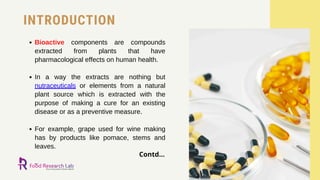
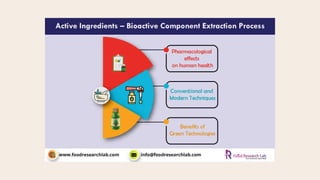
Bioactive components are compounds
extracted from plants that have
pharmacological effects on human health.
In a way the extracts are nothing but
nutraceuticals or elements from a natural
plant source which is extracted with the
purpose of making a cure for an existing
disease or as a preventive measure.
For example, grape used for wine making
has by products like pomace, stems and
leaves.
Contd...
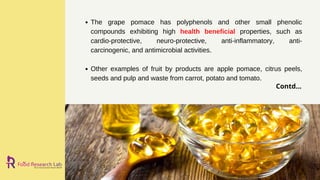
The grape pomace has polyphenols and other small phenolic
compounds exhibiting high health beneficial properties, such as
cardio-protective, neuro-protective, anti-inflammatory, anti-
carcinogenic, and antimicrobial activities.
Other examples of fruit by products are apple pomace, citrus peels,
seeds and pulp and waste from carrot, potato and tomato.
Contd...
They are extracted by both conventional and modern techniques.
The examples of bioactive compounds are carotenoids, flavonoids,
carnitine, choline, coenzyme Q, dithiolthiones, phytosterols,
phytoestrogens, glucosinolates, polyphenols, and taurine.
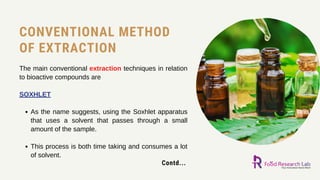
As the name suggests, using the Soxhlet apparatus
that uses a solvent that passes through a small
amount of the sample.
This process is both time taking and consumes a lot
of solvent.
The main conventional extraction techniques in relation
to bioactive compounds are
SOXHLET
CONVENTIONAL METHOD
OF EXTRACTION
Contd...
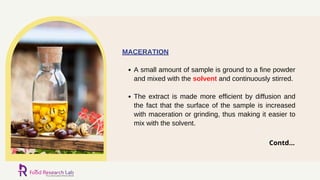
A small amount of sample is ground to a fine powder
and mixed with the solvent and continuously stirred.
The extract is made more efficient by diffusion and
the fact that the surface of the sample is increased
with maceration or grinding, thus making it easier to
mix with the solvent.
MACERATION
Contd...
Contd...
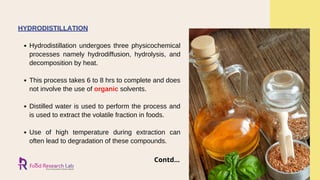
Hydrodistillation undergoes three physicochemical
processes namely hydrodiffusion, hydrolysis, and
decomposition by heat.
This process takes 6 to 8 hrs to complete and does
not involve the use of organic solvents.
Distilled water is used to perform the process and
is used to extract the volatile fraction in foods.
Use of high temperature during extraction can
often lead to degradation of these compounds.
HYDRODISTILLATION
Contd...
This is one of the limitations of this technique.
Hydrodistillation is a very complete process.
Both volatile organic compounds and non-volatile
organic compounds can be extracted and
physically separated in one step.
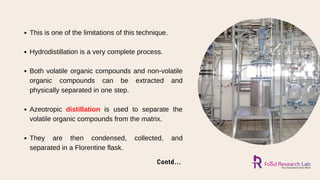
Azeotropic distillation is used to separate the
volatile organic compounds from the matrix.
They are then condensed, collected, and
separated in a Florentine flask.
The soluble non-volatile organic compounds are
extracted in the boiling water.
There is of course high levels of energy
consumption and is time consuming.
There is always a risk involved about the toxicity of
the solvents used to extract the bioactive compounds
and the chances of presence of the same in the
extracts along with low yield when the conventional
methods are used.
Contd...
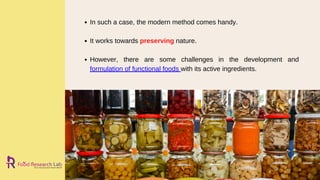
In such a case, the modern method comes handy.
It works towards preserving nature.
However, there are some challenges in the development and
formulation of functional foods with its active ingredients.
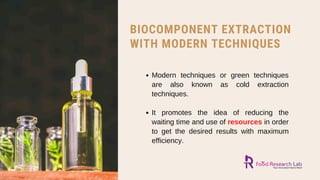
BIOCOMPONENT EXTRACTION
WITH MODERN TECHNIQUES
Modern techniques or green techniques
are also known as cold extraction
techniques.
It promotes the idea of reducing the
waiting time and use of resources in order
to get the desired results with maximum
efficiency.
Faster extraction rate
More effective energy use
Increased mass and heat transfer
Reduced equipment size and reduction in the
number of processing steps.
The benefits of the green technologies over the
conventional methods are as follows:
COMPONENTS OF GREEN
TECHNIQUES
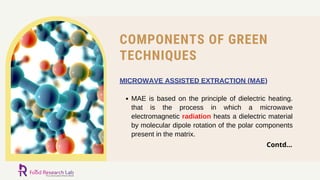
MAE is based on the principle of dielectric heating.
that is the process in which a microwave
electromagnetic radiation heats a dielectric material
by molecular dipole rotation of the polar components
present in the matrix.
MICROWAVE ASSISTED EXTRACTION (MAE)
Contd...
Contd...
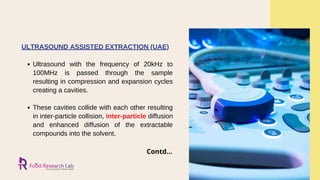
Ultrasound with the frequency of 20kHz to
100MHz is passed through the sample
resulting in compression and expansion cycles
creating a cavities.
These cavities collide with each other resulting
in inter-particle collision, inter-particle diffusion
and enhanced diffusion of the extractable
compounds into the solvent.
ULTRASOUND ASSISTED EXTRACTION (UAE)
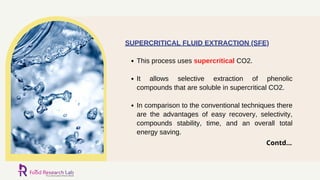
This process uses supercritical CO2.
It allows selective extraction of phenolic
compounds that are soluble in supercritical CO2.
In comparison to the conventional techniques there
are the advantages of easy recovery, selectivity,
compounds stability, time, and an overall total
energy saving.
SUPERCRITICAL FLUID EXTRACTION (SFE)
Contd...
Contd...
The physico-chemical parameters of sCO2.
are temperature, pressure, and amount of co-
solvent and the biomass nature and processing
before extraction (lyophilization, micronization,
etc.) deeply affect the final extraction yields and
composition
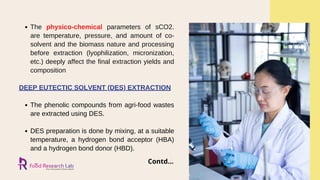
The phenolic compounds from agri-food wastes
are extracted using DES.
DES preparation is done by mixing, at a suitable
temperature, a hydrogen bond acceptor (HBA)
and a hydrogen bond donor (HBD).
DEEP EUTECTIC SOLVENT (DES) EXTRACTION
Compared to common organic solvents, DES offer many advantages
such as low price, easy preparation, and easy availability.
Moreover, most of them are biodegradable with very low toxicity.
There are many new food product development consultants that offers
you with food consulting services, as they provide an easy method to
accomplish any need you might have.
+44- 74248 10299
UNITED KINGDOM
+91 9566299022
EMAIL
INDIA
info@foodresearchlab.com
Contact Us

Bioactive compound extraction process

  • 1.
    Active Ingredients –Bioactive Component Extraction Process An Academic presentation by Dr. Nancy Agnes, Head, Technical Operations, FoodResearchLab Group:  www.foodresearchlab.com Email: info@foodresearchlab.com
  • 2.
    Introduction Conventional Method ofExtraction Biocomponent Extraction with Modern Techniques Components of Green techniques TODAY'S DISCUSSION
  • 3.
    INTRODUCTION Bioactive components arecompounds extracted from plants that have pharmacological effects on human health. In a way the extracts are nothing but nutraceuticals or elements from a natural plant source which is extracted with the purpose of making a cure for an existing disease or as a preventive measure. For example, grape used for wine making has by products like pomace, stems and leaves. Contd...
  • 4.
    The grape pomacehas polyphenols and other small phenolic compounds exhibiting high health beneficial properties, such as cardio-protective, neuro-protective, anti-inflammatory, anti- carcinogenic, and antimicrobial activities. Other examples of fruit by products are apple pomace, citrus peels, seeds and pulp and waste from carrot, potato and tomato. Contd...
  • 5.
    They are extractedby both conventional and modern techniques. The examples of bioactive compounds are carotenoids, flavonoids, carnitine, choline, coenzyme Q, dithiolthiones, phytosterols, phytoestrogens, glucosinolates, polyphenols, and taurine.
  • 6.
    As the namesuggests, using the Soxhlet apparatus that uses a solvent that passes through a small amount of the sample. This process is both time taking and consumes a lot of solvent. The main conventional extraction techniques in relation to bioactive compounds are SOXHLET CONVENTIONAL METHOD OF EXTRACTION Contd...
  • 8.
    A small amountof sample is ground to a fine powder and mixed with the solvent and continuously stirred. The extract is made more efficient by diffusion and the fact that the surface of the sample is increased with maceration or grinding, thus making it easier to mix with the solvent. MACERATION Contd...
  • 9.
    Contd... Hydrodistillation undergoes threephysicochemical processes namely hydrodiffusion, hydrolysis, and decomposition by heat. This process takes 6 to 8 hrs to complete and does not involve the use of organic solvents. Distilled water is used to perform the process and is used to extract the volatile fraction in foods. Use of high temperature during extraction can often lead to degradation of these compounds. HYDRODISTILLATION
  • 10.
    Contd... This is oneof the limitations of this technique. Hydrodistillation is a very complete process. Both volatile organic compounds and non-volatile organic compounds can be extracted and physically separated in one step. Azeotropic distillation is used to separate the volatile organic compounds from the matrix. They are then condensed, collected, and separated in a Florentine flask.
  • 12.
    The soluble non-volatileorganic compounds are extracted in the boiling water. There is of course high levels of energy consumption and is time consuming. There is always a risk involved about the toxicity of the solvents used to extract the bioactive compounds and the chances of presence of the same in the extracts along with low yield when the conventional methods are used. Contd...
  • 13.
    In such acase, the modern method comes handy. It works towards preserving nature. However, there are some challenges in the development and formulation of functional foods with its active ingredients.
  • 14.
    BIOCOMPONENT EXTRACTION WITH MODERNTECHNIQUES Modern techniques or green techniques are also known as cold extraction techniques. It promotes the idea of reducing the waiting time and use of resources in order to get the desired results with maximum efficiency.
  • 15.
    Faster extraction rate Moreeffective energy use Increased mass and heat transfer Reduced equipment size and reduction in the number of processing steps. The benefits of the green technologies over the conventional methods are as follows:
  • 16.
    COMPONENTS OF GREEN TECHNIQUES MAEis based on the principle of dielectric heating. that is the process in which a microwave electromagnetic radiation heats a dielectric material by molecular dipole rotation of the polar components present in the matrix. MICROWAVE ASSISTED EXTRACTION (MAE) Contd...
  • 17.
    Contd... Ultrasound with thefrequency of 20kHz to 100MHz is passed through the sample resulting in compression and expansion cycles creating a cavities. These cavities collide with each other resulting in inter-particle collision, inter-particle diffusion and enhanced diffusion of the extractable compounds into the solvent. ULTRASOUND ASSISTED EXTRACTION (UAE)
  • 18.
    This process usessupercritical CO2. It allows selective extraction of phenolic compounds that are soluble in supercritical CO2. In comparison to the conventional techniques there are the advantages of easy recovery, selectivity, compounds stability, time, and an overall total energy saving. SUPERCRITICAL FLUID EXTRACTION (SFE) Contd...
  • 19.
    Contd... The physico-chemical parametersof sCO2. are temperature, pressure, and amount of co- solvent and the biomass nature and processing before extraction (lyophilization, micronization, etc.) deeply affect the final extraction yields and composition The phenolic compounds from agri-food wastes are extracted using DES. DES preparation is done by mixing, at a suitable temperature, a hydrogen bond acceptor (HBA) and a hydrogen bond donor (HBD). DEEP EUTECTIC SOLVENT (DES) EXTRACTION
  • 20.
    Compared to commonorganic solvents, DES offer many advantages such as low price, easy preparation, and easy availability. Moreover, most of them are biodegradable with very low toxicity. There are many new food product development consultants that offers you with food consulting services, as they provide an easy method to accomplish any need you might have.
  • 21.
    +44- 74248 10299 UNITEDKINGDOM +91 9566299022 EMAIL INDIA info@foodresearchlab.com Contact Us