Emerging Risk Report 2017
Society and Security
Future Cities:
Building energy
infrastructure
resilience
02
City Infrastructure Resilience – Designing the Future
Lloyd’s of London Disclaimer
This report has been co-produced by Lloyd's and Arup
for general information purposes only. While care has
been taken in gathering the data and preparing the
report Lloyd's does not make any representations or
warranties as to its accuracy or completeness and
expressly excludes to the maximum extent permitted by
law all those that might otherwise be implied.
Lloyd's accepts no responsibility or liability for any loss
or damage of any nature occasioned to any person as a
result of acting or refraining from acting as a result of, or
in reliance on, any statement, fact, figure or expression
of opinion or belief contained in this report. This report
does not constitute advice of any kind.
© Lloyd’s 2017
All rights reserved
About Lloyd’s
Lloyd's is the world's specialist insurance and
reinsurance market. Under our globally trusted name,
we act as the market's custodian. Backed by diverse
global capital and excellent financial ratings, Lloyd's
works with a global network to grow the insured world –
building resilience of local communities and
strengthening global economic growth.
With expertise earned over centuries, Lloyd's is the
foundation of the insurance industry and the future of it.
Led by expert underwriters and brokers who cover more
than 200 territories, the Lloyd’s market develops the
essential, complex and critical insurance needed to
underwrite human progress.
Key Contacts
Trevor Maynard
Head of Innovation
trevor.maynard@lloyds.com
Lucy Stanbrough
Executive, Emerging Risks and Research
lucy.stanbrough@lloyds.com
For general enquiries about this report and Lloyd’s
work on emerging risks, please contact
emergingrisks@lloyds.com
About the authors
Trevor Maynard PhD, MSc, FIA has degrees in pure
maths and statistics and is a Fellow of the Institute of
Actuaries. He Head of Innovation at Lloyd’s including
responsibility for horizon scanning and emerging risks.
Subjects covered in recent years include: the economic
and social implications of a food system shock; the
effects of cyber-attacks on the US energy grid and an
exploration of aggregation modelling methods for
liability risks.
He is co-chairman of OASIS, an open modelling
platform for catastrophe models and sits on the Board
of the Lighthill Risk Network.
Lucy Stanbrough MSc, BSc, LCGI, is an Executive in
the Innovation team at Lloyd’s. Prior to joining Lloyd’s,
she worked for over 10 years as a natural hazards and
GIS consultant, alongside working at the UCL Hazard
Centre, where she maintains an Honorary Research
Associate. Lucy has contributed to a number of books
on the use of technology and online systems pre,
during, and post-disaster, and has been involved in
research across regions and hazards. She maintains
an interest in the integration of scientific knowledge to
business applications, and connecting knowledge to
people, and people to knowledge.
Samantha Stratton-Short, PhD, RIBA, MAPM, FRSA, is
Associate Director of Arup International Development.
Samantha has over 20 years of experience specialising
in the performance of complex programmes,
organisations and institutions striving to meet the
demands for a resilient future in both post-disaster and
development contexts. Her experience as a
programme manager and advisor in post-disaster
situations such as Sri Lanka, Pakistan, Bangladesh and
Haiti, has given her first-hand exposure to the issues of
vulnerability to the increasing hazards facing societies
globally.
Belinda Hewitt, ME, MESt, BA, BSc, is a Senior Climate
Change Adaptation and Resilience Consultant with
Arup International Development. Belinda has 10 years
of international experience working in consultancy,
academia and private sector. Her work focuses on
building resilience and reducing vulnerability of
infrastructure, cities, and communities to climate
change, environmental risk, and other critical global
challenges.
03
City Infrastructure Resilience – Designing the Future
Acknowledgements
The following people were interviewed, took part in
workshops or roundtables, or commented on earlier
drafts of the report; we would like to thank them all for
their contributions:
Insurance industry workshop and consultation
Chris Allison, Travelers; Oliver Bettis, Institute and
Faculty of Actuaries; Ian Branagan, RenaissanceRe;
Neil Farrell, Aviva; Matthew Free, Arup; Tom Herbstein,
ClimateWise; Belinda Hewitt, Arup; Nancy Kete, Arup;
Greg Lowe, Aon; Amy Nicholass, ClimateWise; Paul
Nunn, Scor; Samantha Stratton-Short, Arup; David
Simmons, Willis Towers Watson; Swenja Surminski,
London School of Economics; Richard Trubshaw, MAP
Underwriting; Calum Wood, Travelers.
Arup project team and area of expertise
 Samantha Stratton-Short, Associate-Director
Urban and infrastructure resilience
 Belinda Hewitt, Senior Consultant
Urban climate change resilience
 Kieran Birtill, Consultant
Disaster risk and resilience
Arup sector specialists
 Justin Abbott, Director
Water
 Ian Carradice, Director
Urban infrastructure
 Stephen Cook, Associate Director
Energy
 Jo da Silva, Director
City and infrastructure resilience
 Matthew Dillon, Associate
Integrated city planning and transport
 Matthew Free, Director
Hazards and seismic resilience
 Nancy Kete, Programme Director
Joint Programme for Resilience Engineering
 Will McBain, Associate Director
Flood resilience
 Juliet Mian, Associate Director
Integrated infrastructure systems
 Polly Turton, Associate
Climate change resilience
 Richard Bond, Senior Consultant
Security, risk and resilience
 Ken Kilfedder, Principal Consultant
ICT
Lloyd’s project team
 Trevor Maynard, Head of Innovation
 Keith Smith, Emerging risks and research
 Lucy Stanbrough, Emerging risks and research
 Anika Malde, Emerging risks and research
 Phil Goddard, Head of Claims
 Ian Shelley, Class of Business
Date of publication: March 2017
Contents 04
City Infrastructure Resilience – Designing the Future
Contents
Executive summary...............................................................................................................................................................5
1. Energy infrastructure.......................................................................................................................................................10
2. Recommendations for enhancing city infrastructure resilience: implications for the insurance industry .......................14
3. Next steps.......................................................................................................................................................................19
References..........................................................................................................................................................................21
Executive summary 05
City Infrastructure Resilience – Designing the Future
Executive summary
Global exposure to disasters has risen over recent
decades (United Nations, 2015). This trend that is likely
to continue because most global population increases will
take place in Asian and sub-Saharan African cities, which
are more at risk from natural hazards (United Nations,
2014b).
In addition, cities are also exposed to a greater diversity
of risks than ever before, including rapidly emerging
cyber threats and terrorism (Lloyd’s, 2015a).
The rising costs of disasters is a growing concern for the
public sector and the insurance industry alike; direct
losses from disasters in the past decade are estimated at
US $1.4 trillion (United Nations Office for Disaster Risk
Reduction, 2014).
The Lloyd’s City Risk Index found that $4.6 trillion of the
projected GDP of 301 of the world’s leading cities is at
risk from 18 threats over the next decade.
Clearly, cities must mitigate these risks if they are to
realise their growth aims but this is a complex task.
Cities are made up of a diverse and complex mix of
institutions, ecosystems, assets and infrastructure that
are connected and mutually interdependent. Disruption to
one part of the system - utility and transport networks,
communications systems and water supplies, for
example – can cause failure in other parts, with far-
reaching local and global implications.
This makes assessing city risk extremely challenging -
secondary and cascading impacts cannot be predicted
through traditional approaches such as spatial risk
assessment. The task is made more difficult by the rapid
growth and development of urban systems, particularly in
emerging economies.
While risk management remains a priority for cities, it is
not enough on its own. Increasingly, city officials,
investors and insurers are looking to build resilience as a
complementary approach to address urban risk and
uncertainty (Cambridge Centre for Risk Studies, 2015).
In order to better manage risk and recover quickly from
future disasters infrastructure owners and operators must
move beyond asset-by-asset risk management to build
resilience within, and between, infrastructure systems.
This requires consideration of how infrastructure
performance might change when shock or stress events
occur.
Report overview
Lloyd’s worked with Arup to develop a new set of
principles to guide the planning, design, construction and
operation of some of the key components of city
infrastructure to improve resilience.
The study analyses four different critical infrastructure
systems - energy, water supply, Information
Communications Technology (ICT) and transport -
through three case studies. These demonstrate how
infrastructure has been impacted by catastrophic events
in the past, how stakeholders responded at the time, and
indicates what actions they could take in the future to
effectively address risk and enhance resilience.
The report presents:
 An introduction to infrastructure resilience and city
resilience concepts.
 An overview and analysis of the key trends that affect
city infrastructure risks and resilience.
 Discussion of the key city risk and resilience
principles derived from analysis of real-world case
studies and consultation with infrastructure sector
specialists.
 Analysis of the potential implications and
considerations for the insurance industry, including
sector-specific insight.
 A series of recommendations and next steps that
could help move action forwards within the insurance
industry.
Executive summary 06
City Infrastructure Resilience – Designing the Future
Key findings
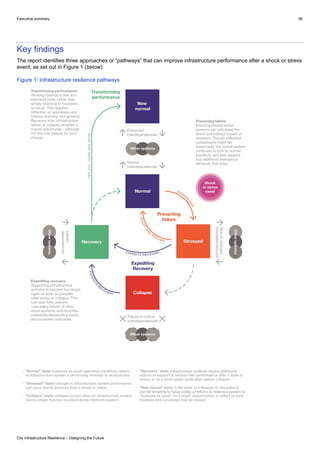
The report identifies three approaches or “pathways” that can improve infrastructure performance after a shock or stress
event, as set out in Figure 1 (below):
Figure 1: Infrastructure resilience pathways
Executive summary 07
City Infrastructure Resilience – Designing the Future
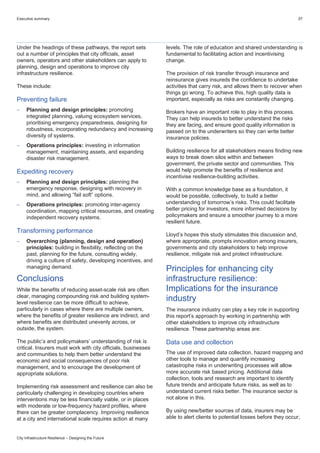
Under the headings of these pathways, the report sets
out a number of principles that city officials, asset
owners, operators and other stakeholders can apply to
planning, design and operations to improve city
infrastructure resilience.
These include:
Preventing failure
 Planning and design principles: promoting
integrated planning, valuing ecosystem services,
prioritising emergency preparedness, designing for
robustness, incorporating redundancy and increasing
diversity of systems.
 Operations principles: investing in information
management, maintaining assets, and expanding
disaster risk management.
Expediting recovery
 Planning and design principles: planning the
emergency response, designing with recovery in
mind, and allowing “fail soft” options.
 Operations principles: promoting inter-agency
coordination, mapping critical resources, and creating
independent recovery systems.
Transforming performance
 Overarching (planning, design and operation)
principles: building in flexibility, reflecting on the
past, planning for the future, consulting widely,
driving a culture of safety, developing incentives, and
managing demand.
Conclusions
While the benefits of reducing asset-scale risk are often
clear, managing compounding risk and building system-
level resilience can be more difficult to achieve,
particularly in cases where there are multiple owners,
where the benefits of greater resilience are indirect, and
where benefits are distributed unevenly across, or
outside, the system.
The public’s and policymakers’ understanding of risk is
critical. Insurers must work with city officials, businesses
and communities to help them better understand the
economic and social consequences of poor risk
management, and to encourage the development of
appropriate solutions.
Implementing risk assessment and resilience can also be
particularly challenging in developing countries where
interventions may be less financially viable, or in places
with moderate or low-frequency hazard profiles, where
there can be greater complacency. Improving resilience
at a city and international scale requires action at many
levels. The role of education and shared understanding is
fundamental to facilitating action and incentivising
change.
The provision of risk transfer through insurance and
reinsurance gives insureds the confidence to undertake
activities that carry risk, and allows them to recover when
things go wrong. To achieve this, high quality data is
important, especially as risks are constantly changing.
Brokers have an important role to play in this process.
They can help insureds to better understand the risks
they are facing, and ensure good quality information is
passed on to the underwriters so they can write better
insurance policies.
Building resilience for all stakeholders means finding new
ways to break down silos within and between
government, the private sector and communities. This
would help promote the benefits of resilience and
incentivise resilience-building activities.
With a common knowledge base as a foundation, it
would be possible, collectively, to build a better
understanding of tomorrow’s risks. This could facilitate
better pricing for investors, more informed decisions by
policymakers and ensure a smoother journey to a more
resilient future.
Lloyd’s hopes this study stimulates this discussion and,
where appropriate, prompts innovation among insurers,
governments and city stakeholders to help improve
resilience, mitigate risk and protect infrastructure.
Principles for enhancing city
infrastructure resilience:
Implications for the insurance
industry
The insurance industry can play a key role in supporting
this report’s approach by working in partnership with
other stakeholders to improve city infrastructure
resilience. These partnership areas are:
Data use and collection
The use of improved data collection, hazard mapping and
other tools to manage and quantify increasing
catastrophe risks in underwriting processes will allow
more accurate risk based pricing. Additional data
collection, tools and research are important to identify
future trends and anticipate future risks, as well as to
understand current risks better. The insurance sector is
not alone in this.
By using new/better sources of data, insurers may be
able to alert clients to potential losses before they occur,
Executive summary 08
City Infrastructure Resilience – Designing the Future
assess damage in close to real-time, speed up claims
processes and prevent false claims, reduce
administration through automation, and create more
personalised products and services (Gasc, 2016).
The use of metrics
In many cases, the report suggests that indices be
created to track the current level of resilience. If such
indices were created then they could, in principle, be
used in models and underwriting processes as well as by
city planners and other stakeholders. Ensuring that any
metrics, such as those involved in the Sendai Framework
for Disaster Risk Reduction, are useful and useable by
stakeholders will be the key to their uptake.
Ensuring that more detailed data is available at city-wide
level is important considering there can be high levels of
spatial variation of risk – even at asset level. If each
building had standardised data files containing agreed
exposure information, this could be used directly by
insurers, banks, asset managers and facilities managers.
Insurers should work with governments to help them
understand their risks, and develop policies aimed at
improving construction standards or building in
inappropriate areas (such as flood plains). Better risk
management could lead to lower risk premium pricing,
reducing the overall cost to economic growth.
Models and tools development
Risk models are often created on a case-by-case basis in
response to specific requests. The greatest need for this
work is in developing countries and areas with low
insurance penetration. Finding a way to take a strategic
view to allow proactive development for countries – such
as the Vulnerable Twenty Group (V20a
) – so they can be
taken off the shelf, ready to use, is an area currently
being explored by the Insurance Development Forum.
Insurers need to work collaboratively with other
stakeholders to provide tools that could offer a more
transparent and comprehensive approach for analysing
and pricing risk from extreme events. Ensuring these
tools and their outputs are in an agreed format that can
be used by other stakeholders will facilitate the flow of
engineering and scientific knowledge throughout society.
Using models to quantify risk quantification
As the number of models and the amount of data
available increases, so does the potential for
stakeholders other than insurers to use that information
to make risk assessments and to anticipate the potential
impacts of hazards. This would help governments,
a
The Vulnerable Twenty (V20) Group of Ministers of Finance of the
Climate Vulnerable Forum is a dedicated cooperation initiative of
economies systemically vulnerable to climate change.
communities and individuals to make informed decisions
about resilience, insurance, investment, wider policies
and interventions. Risk quantification is the key to this.
Without quantification it is difficult to assess resilience
and how effective action might be taken to enhance it.
Models can be used to help make transparent
statements, such as:
“This asset is currently resilient to 1 in 10 risk of
flooding. To be resilient to a 1 in 200 risk the
following is recommended…”
This kind of explicit disclosure of risk could act as a way
to encourage stakeholders to understand and maintain
their own detailed risk registers, and to hold open
dialogue on the risks under consideration.
Designing resilient assets
Infrastructure lasts a long time and risk levels are
changing all the time due to ongoing global megatrends,
therefore it is important to create building codes that are
robust in the light of both current and future risks.
Engineering studies will be necessary to achieve this
since past data will not always be a good guide to the
future. If such studies could be encapsulated in an index,
then insurers could more easily factor this information
into underwriting decision
Common building codes that include resilience provide a
level playing field for insurers and other stakeholders,
and make homes and buildings less vulnerable to the
effects of hazards with less need for public or private
disaster relief.
Incentivising investment
Resilience ratings could help investors integrate
resilience considerations into all aspects of their portfolio-
management activities. For example, if credit-rating
agencies start to look at resilience as a measure of
performance and factor this in to their assessments, this
could provide an incentive to take action. Ensuring this
information is in a useful and usable format will be the
key to its use in city infrastructure risk assessment.
There is also a need to improve the risk/return profile of
investment in green growth in this space, which can
include adaptation (Climate Business Group, 2012). By
focusing on reducing and managing the risk side of
investment, this could facilitate the deployment of other
forms of capital at the scale needed for growth.
Executive summary 09
City Infrastructure Resilience – Designing the Future
Incentivising resilience
It is in the interest of policyholders and governments to
implement risk-mitigation measures, thereby potentially
reducing both the cost of insurance and the damage from
natural catastrophes. One way for the insurance industry
to incentivise policyholders to introduce risk-mitigation
measures is through risk-based premiums.
Another method is for insurers to give policyholders the
option to share a greater proportion of the risk through
offering policies with higher deductibles. All things being
equal, this reduces the costs of insurance but leaves the
policyholder exposed to more risk. They may, therefore,
be incentivised to take action to reduce their residual
risks.
Consistent with the ClimateWise “Investing for
Resilience” report, insurers could also offer “resilience
services”, which could include aspects of facilities
management, disaster recovery, “build and operate”
contracts, and insurance. This could include upgrading
the property covered by the service to improve its
resilience, carrying out regular maintenance, recovery
and repairs, and providing financial compensation in the
event of a disaster.
Next steps for stakeholders
Many of the resilience principles identified in this
research are already actively promoted and implemented
as best practice by planners, designers, and asset
owners and operators across the world. Lloyd’s and Arup
hope this study adds to knowledge of resilience issues,
stimulates new ideas and raises new research questions.
There are numerous next steps that stakeholders could
take to improve city and infrastructure resilience – the
challenge remains in making change happen at scale.
One starting point is the establishment of a demonstrator
city to act as a testbed.
Emergency response and disaster relief agencies often
hold live exercises to test their plans, which could provide
a common starting point among stakeholders. Adopting
a shared scenario process and risk models for a given
city could help develop a broader systems model for all
parties to coordinate and plan their responses. The
results could be used to create a template that could be
applied to all cities.
Continued innovation, reflection and collaboration across
sectors and industries are critical to address any
constraints on creating resilient, inclusive, prosperous
cities. The framework in this report can guide all those
stakeholders that are interested in ensuring tomorrow’s
cities are built on resilient foundations.
Methodology
This report was developed collaboratively by Lloyd’s and
Arup.
Arup undertook a structured research process across
four key stages: a comprehensive desktop review of
existing literature; development of a new research model;
case study research; and consultation with key
infrastructure sector specialists to develop principles for
enhancing infrastructure resilience through planning,
design and operation.
Lloyd’s delivered a collaborative workshop involving city-
sector experts and insurance practitioners to discuss the
key findings in Arup’s research, and identify potential
implications and considerations for the insurance
industry. This resulted in a series of recommendations
and next steps that could help the insurance industry
contribute to making cities and infrastructure more
resilient.
1. Energy infrastructure 10
City Infrastructure Resilience – Designing the Future
1. Energy infrastructure
Understanding and managing interdependencies
Today’s energy systems provide critical services that underpin basic human needs and are deeply interconnected with
an extensive range of urban systems:
 Energy systems directly support the operation of
many other infrastructure systems, including
transport, information and communications
technology (ICT) and water, freight and logistical
infrastructure systems - for example, by providing
electricity to operate water-pumping stations and
traffic lights. The ability of a city to repair and
reinstate its energy networks after a major disaster is
a critical factor that can influence levels of human
casualty and economic disruption, and determine the
rate at which other infrastructure systems (including
transport, water supply and ICT) can recover.
 Energy systems also indirectly support infrastructure
performance in many ways, for example, by
supporting the wellbeing of staff that service and
operate energy networks.
 Energy infrastructure system performance is
dependent upon a variety of other infrastructure
systems; in particular, digital networks are
increasingly critical to monitor system performance,
manage loads and demand accordingly.
In addition to the overarching principles for
enhancing resilience outlined at the start of this
section, a number of principles specific to
planning, design and operation of energy
infrastructure systems are provided overleaf
Box 1 – Global trends shaping infrastructure risk
Energy infrastructure is a critical provisioning system, which has expanded steadily across the world over recent decades
alongside urbanisation and economic growth. The International Energy Agency estimates that the investment required each year
to supply the world’s energy needs from now to 2035 will rise steadily to US $2,000bn (International Energy Agency, 2014).
Energy networks play a critical role in supporting human and economic wellbeing. The nature of energy-system growth can
determine the cost and quality of consumer energy supply, and influence major global trends such as energy access and climate
change (Arup and Siemens, 2016). Many rapidly urbanising cities around the world are struggling as growth in demand is rapidly
outpacing network capacity. Around 1.2bn people (17% of the world’s population) have very limited or no access to electricity,
which poses enormous constraint on livelihoods, economic growth and community resilience to shocks and stress events
(International Energy Agency, 2017).
Even where best practice is adopted in system planning and operation, today’s vast urban energy networks are exposed to
increasing threat from natural and manmade hazards, which can cause major social and economic disruption. For example, the
2003 US-Canada blackout affected around 50mn people and had an economic cost of around US $6.4bn (Electricity Consumers
Resource Council, 2004).
Globally a number of themes are emerging in relation to energy-network resilience at a systems level, including decentralisation,
diversification, adaptive management and intelligent design. Crucially, energy infrastructure forms a provisioning system that
cannot be managed only from the supply side. Achieving truly resilient networks means managing demand from the consumer-
side through education and awareness, incentives and appropriate pricing.
Source: Arup.
1. Energy infrastructure 11
City Infrastructure Resilience – Designing the Future
Planning
1. Decentralise energy systems
Decentralised energy networks such as micro-
renewables and precinct-scale heating and cooling can
provide communities and businesses with protection from
large-scale grid disruption.
2. Diversify energy sources
Incorporating diverse energy sources (including
renewables) is particularly important to reduce the impact
of diminishing global oil and gas reserves, and fuel price
fluctuation.
3. Protect vital dependent functions
Protecting energy supply to vital urban functions such as
hospitals can be prioritised during stress (surge) or shock
(disaster) events.
Manage existing demand and plan for the future
Resilient network design will account for future demand
profiles and surge scenarios to minimise the chance of
extensive failure. Demand-management technologies
can provide other valuable resilience services to the
wider grid, such as frequency and voltage stabilisation.
Design
4. Adopt robust design approaches
Meshed microgrids and interconnectors between main
grids can support networks to cope with rapid fluctuations
in load and supply, and node failure, and to maintain
overall system functioning during stress and shock
events.
5. Isolate critical assets
Providing individual critical systems (such as hospitals
and water-pumping stations) with the capability to
operate in islanded mode will provide local resistance to
a failure in the main grid.
6. Build in redundancy
Back-up power supplies, reserve capacity and alternative
network pathways play an important role in accessing
additional capacity during crises.
7. Integrate “smart” technology
Integrating real-time information and communication
technology within the power grid can support operators to
identify opportunities for system optimisation, more
efficient generation, reduced transmission and
distribution losses, and demand-side management.
8. Design for maintenance access
ICT infrastructure can pose particular access challenges
for maintenance and repair – for example, cellular ICT
infrastructure is commonly located on rooftops, which
might be difficult to access quickly during a disaster due
to building damage, physical barriers or ownership
issues.
9. Allow for flexibility
ICT technology is experiencing rapid and ongoing
change, meaning that designing for future flexibility is
important. Avoiding over-specificity in design can help to
accommodate future changes in both users and uses.
10.Integrate “smart” technology
Intelligent design of ICT networks ensures their
performance is monitored on a real-time basis in order to
isolate network errors and enhance integration with the
range of other urban infrastructure systems they support.
1. Energy infrastructure 12
City Infrastructure Resilience – Designing the Future
Operation
11.Operate adaptively
Real-time performance monitoring enables operators to
undertake more cost-effective predictive maintenance to
reduce the frequency of unplanned outages, reduces risk
by managing demand and reducing non-critical loads,
and increases overall reliability of the system by
correcting faults in real-time. This technology paves the
way for more distributed and renewable energy
generation.
Real-time information can also empower operators to
change behaviour to minimise the impact of service
interruption or reduce the cost of energy.
12.Price for repair
Owners and operators can take responsibility for
ensuring contingency funds are on hand for both
immediate and long-term repair and recovery in the wake
of a disaster; for example, by building the cost of repair or
insurance into energy pricing.
13.Prioritise vital functions
Energy network operators can take a proactive role in
identifying the critical city assets and systems they
service, and ensuring energy is restored to these users
with priority if system-wide failure occurs to minimise loss
of life and economic impact.
14.Promote coordination
Coordination across asset owners, distributors, and
regulators can help spread the risk of network failure
(and repair costs) in a more manageable way across
different multiple stakeholders, and allow pooling of
regional resources to support more effective disaster
response.
15.Ensure equal access for all
Quality energy networks promote human wellbeing
alongside economic growth. Asset owners, operators and
regulators have a role to play in building city-level
resilience by ensuring energy is safe, clean and
affordable.
16.Reduce demand
User education, awareness, appropriate pricing and
incentives can improve resilience by improving demand
profiles and reducing overall demand.
1. Energy infrastructure 13
City Infrastructure Resilience – Designing the Future
Box 2: Constraints to implementation
While the principles outlined in this chapter reflect the key to future infrastructure resilience, their effective application
has challenges grounded in often political, financial and behavioural realities.
Both general and sector-specific principles highlight the importance of effective infrastructure emergency planning
and the creation of a culture of safety. Implementing these ideas can be expensive, and may not be perceived as
important in developing countries as promoting economic growth and development gains. In locations with moderate
or low-frequency hazard profiles, complacency towards efforts can be greater (Da Silva et al., 2016) and this
compounds the challenges of expensive planning. Emergency planning approaches that prioritise protection or
support of certain infrastructure systems in an emergency scenario may also be controversial and difficult to
negotiate, as demonstrated in the Bangkok case study around transport.
Improving resilience often requires significant capacity and resources beyond business-as-usual, for example
innovative urban design or up-to-date quality infrastructure maintenance. Many cities will face challenges to
effectively mobilise additional finance, and source appropriate local skills and knowledge.
Where most national and city governments serve relatively short terms of 3-5 years, the political cycle can be
disruptive to long-term cohesive planning and robust, sustainable infrastructure. Without committed and engaged
political and/or wider multi-stakeholder collaboration, the effective implementation of long-term strategic planning is
difficult.
Inclusive approaches require overcoming structural barriers presented by departmental and fragmented
management practices. For example, inclusive service access requires many different parties involved in delivery
and operation of infrastructure, each with varying interests and objectives. Developing inclusive infrastructure
systems requires strong leadership, effective infrastructure planning, strong sector regulation and enabling finance.
Related to leadership is the need for effective multi-stakeholder communication and collaboration, including between
regional and national parties, and across systems such as water bodies or energy networks that are transboundary
in nature, potentially posing wider political challenges.
Reducing demand, effective land use and infrastructure planning are crucial across all sectors. Rapid urbanisation
and urban sprawl pose significant challenges to these objectives, and emphasise the need for effective urban and
regional planning and innovative technological and planning solutions.
Whilst sector diversification reduces the likelihood of complete system failure, this approach can lead to greater
difficulties in addressing technical and institutional problems, as issues are spread across multiple locations and
stakeholders.
Ensuring an appropriate level of infrastructure redundancy can come at the expense of efficiency and an appropriate
balance needs to be found, particularly within energy and water systems.
Smart technology can contribute to the resilience of all infrastructure sectors identified in this report. Whilst this
technology might enhance awareness, control and efficiency of system operation, it also creates additional
dependency on ICT infrastructure. Furthermore, without appropriate supporting programming, transition to
technology-based systems needs to be delivered in a way that is inclusive, providing proper skills and training, and
avoiding access constraints for those that cannot afford technology.
The challenges outlined above are not insurmountable. Actively seeking to identify and acknowledge constraints
enables more effective planning, education and the identification of appropriate actions. Over the past 50 years cities
have witnessed dramatic and successful changes in the way that infrastructure is delivered, with significant
improvement to quality reliability, safety and continuity through technological advance, effective planning and
learning. As with other complex challenges, building in the ability to learn and adapt as quickly as possible is key to
finding the right balance for each context. Many of the principles outlined in this research are already actively
promoted and implemented as “best practice” by planners, designers, and asset owners and operators across the
world. Continued innovation, reflection and collaboration across sectors and industries are critical to address
constraints in support of more resilient, inclusive, prosperous cities.
2. Principles for enhancing city infrastructure 14
City Infrastructure Resilience – Designing the Future
2. Recommendations for enhancing city
infrastructure resilience: implications for
the insurance industry
To facilitate the pathways for infrastructure resilience identified in this report, there are a number of areas where Lloyd’s
believes the insurance industry can work in partnership with other stakeholders. Local insurance markets will have an
important role to play in starting meaningful dialogue with governments, businesses, and asset owners, and to take
these infrastructure pathways forwards in their own city perspectives.
1. Shared understanding
There is a need to understand how all the
components and stakeholders of cities interact, and
what the key areas and concerns are for each
stakeholder. The role of education and shared
understanding is fundamental to facilitating action
and incentivising change.
Crisis management and disaster response are significant
parts of what the Lloyd’s market specialises in, but with
most of the world being either uninsured or underinsured
there are too many disasters where the (re)insurance
industry suffers little loss and does not play a significant
part in the rebuilding (Lloyd’s, 2015b). For the insurance
industry, there remains an education challenge.
Public and policymaker understanding of risk is critical,
and governments, insurers and other stakeholders
should work together to ensure there is a greater
understanding of the role of all parties in the economic
and social consequences of poor risk management, and
to allow the development of appropriate solutions.
One way to do this could be to work with a city to develop
a proof-of-concept framework that could be tested with
the goal of applying the framework at a replicable,
worldwide scale. This concept is described in “Next
steps” (see p19), in this section.
2. Data for decisions
Improved data collection, hazard mapping and other
tools to manage and quantify increasing catastrophe
risks in our underwriting processes will allow more
accurate risk based pricing. Additional data
collection, tools and research are important to
identify future trends and anticipate future risks, as
well as to better understand current risks, and the
insurance sector is not alone in this.
Over the past five years the world has reached a point
where some aspirations of resilience could be met by
fully embracing the technology of today. There has been
an exponential increase in data availability. In 1906
airships were used to survey damage from the San
Francisco earthquake to be studied by people to make
damage assessments (Taylor, 2016).
Today, satellites can capture imagery in a variety of
image bands to derive various datasets (Bulter, 2013),
which can then be processed by automatic classification
software to detect access roads, damage patterns and
the extent of the damage (Jean et al., 2016; International
Disasters Charter, 2017; Satellite Applications Catapult,
2012).
This technological capability has the potential to be
pushed forwards again with the rise of the “Internet of
Things”b (Meola, 2016). By using new sources of data,
insurers may be able to alert clients of potential losses
before they occur, assess damage in real time, speed up
the claims process and prevent false claims, reduce
b
A network of internet-connected objects able to collect and exchange
data using embedded sensors (Meola, 2016).
2. Principles for enhancing city infrastructure 15
City Infrastructure Resilience – Designing the Future
administration through automation, and allow more
personalised products and services to be developed
(Gasc, 2016), aiding overall response. City officials might
also be able to track maintenance, manage responses
and model impacts for more integrated decision-making.
Assigning responsibility at the lowest key stakeholder
during multi-stakeholder scenario and response planning
could unlock administrative red tape and confusion in the
wake of events.
3. Establishing metrics
This report considers many areas in which resilience
can be enhanced. In many cases we have suggested
that indices be created to track the current level of
resilience. If such indices are created then they can, in
principle, be used in models and underwriting
processes as well as by city planners and other
stakeholders.
Ensuring that any metrics, such as those involved in
the Sendai Framework for Disaster Risk Reduction,
are useful and useable by stakeholders will be key to
their uptake. Conversely the absence of such indices
will severely affect the degree to which insurers can
actively incorporate resilience into our process given
the level of complexity and number of locations
involved.
If each building had a standardised data file containing
agreed exposure information this could be consumed
directly by insurers.
This report has called for indices in the following areas:
 Efficacy of natural defences
 Degree of diversity
 Asset maintenance levels
 Emergency response times
 Levels of critical resources
 Levels of independence of recovery services.
These could be combined into a single index or better still
made available individually. Indeed indices relating to
any of the items included in the Rockefeller Foundation
City Resilience Framework would be useful.
Any data collection would need standards to ensure it is
collated in a usable and useful format. Ensuring that data
is available at greater granularity on a city-wide level is
important, given there can be high levels of spatial
variation. In the workshop held as part of information
gathering process for this report, one of the attendees
commented that the UK’s Department for Environment,
Food, Economic and Rural Affairs (DEFRA) flood models
take a mean value across the data available. This can
result in information that is not usable as the actual risk
underwriters are being asked to take isn’t always at the
granularity needed for an asset-level decision.
Insurers should work with government to administer
policies aimed, for example, at improving construction
standards or discouraging building in inappropriate areas.
Better risk management could lead to lower pricing,
reducing the overall cost to economic growth.
Initiatives such as Building Research Establishment
Environmental Assessment Method (BREEAM, 2017)
and Building Information Modelling (BIM) (Davidson,
2014) demonstrate the potential to generate demand and
incentivise action by pushing initiative adoptees to
engage in the design criteria. The next stage of BIM,
level three, aims to get people working together and
sharing data through defined processes, metrics and
technology by using a single, shared project model that is
held in a central repository (NBS, 2017).
If each building had standardised data files containing
agreed exposure information, this could be consumed
directly by insurers, banks, asset managers and facilities
managers.
4. Developing models and tools
Models are often created on a case-by-case basis in
response to requests. Finding a way to take a
strategic view to allow proactive development for
countries – such as the Vulnerable Twenty Group
(V20c) – so they can be taken off the shelf, ready to
use, is an area currently being explored by the
Insurance Development Forum.
There is a need to provide tools that could offer a more
transparent and comprehensive approach for analysing
and pricing risk from extreme events. Ensuring that
models are developed and maintained in a collaborative
way is also an area to consider. As was seen in
Hurricane Katrina, levee failure wasn’t fully understood
and accepted by some stakeholders but was well
recognised by others. The scale of the risk was
underestimated, and the response was insufficient to
prevent or limit the impacts that unfolded.
Modelling potential scenarios and their impacts may also
help in the debate on sustainability and general risk
management in the built environment. The role of tools
and models in informing actions to prevent failure and
improve recovery is clear, but their potential role in
supporting insurers and decision-makers to support long-
c
The Vulnerable Twenty (V20) Group of Ministers of Finance of the
Climate Vulnerable Forum is a dedicated cooperation initiative of
economies systemically vulnerable to climate change.
2. Principles for enhancing city infrastructure 16
City Infrastructure Resilience – Designing the Future
term transformation towards improved practice might also
be considered.
Ensuring these tools or their outputs are in an agreed
format that can be integrated into other stakeholder
systems will allow integration. The greatest need for this
work is in developing countries and areas with low
insurance penetration. A suggestion could be made to
pool resourcing through initiatives such as the Insurance
Development Forum to build the knowledge and capacity
of developing and emerging countries, to allow them to
manage and implement sustainable financing, and
resilient investment.
The Oasis Loss Modelling Framework (Oasis LMF) is one
initiative looking to support the use of catastrophe models
beyond the (re)insurance industry to facilitate risk-
informed planning and decision-making. It aims to
generate an open marketplace for models and data, to
lead to wider access to understandable tools for
catastrophe risk assessment (Oasis Loss Modelling
Framework, 2017).
The framework provides “plug and play” data interfaces
and web services that enable members to calculate the
economic and insurance consequences of catastrophe
events. The open-source aspect means that the latest
thinking on natural disasters and climate change can be
incorporated into Oasis’ models. For example,
government agencies could use the Oasis LMF to build
their own flood model and work with an engineering firm
to model the financial impacts of building mitigation
infrastructure (Lloyd’s, 2014).
If initiatives such as this are adopted and used by a wider
set of stakeholders it could demonstrate the potential for
insurance models to be used by all sectors to provide
common understanding and a shared knowledge base to
understand cities and risks as systems to help inform
action to enhance resilience.
5. Use models to quantify risks
With the increase in the model availability and amount of
data available comes the potential to use that information
to make assessments about risks and to anticipate the
potential impacts of hazards. This would help
governments, communities and individuals to make
informed decisions about resilience, insurance,
investment, and wider policies and interventions.
Quantification is the key to this.
Models can be used to help make transparent
statements, such as:
 “This asset is currently resilient to 1 in 10
risk of flooding.
 To be resilient to a 1 in 200 risk the following
is recommended…”
This kind of explicit disclosure of risk could act as a way
to encourage stakeholders to understand and maintain
their own detailed risk registers, and to hold open
dialogue on the risks under consideration. Initiatives such
as the “1-in-100 Initiative” are working towards this
(United Nations, 2014a). It could also allow
understanding about the differences between return
periods and security.
Models are only as good as the data they are based on,
and the insurance industry needs improved data
collection, hazard mapping and other tools to assess
increasing natural catastrophe risks in its underwriting
processes. These overlap to some extent with what local
and regional adaptation planners require to plan, and
make recommendations for government-funded or
mandated risk mitigation and adaptation measures.
Improved resilience to some risks is likely to result in
more residual risks becoming, or remaining, insurable.
This is an area to develop, as increasing resilience in one
area can adversely change the resilience of others; for
example, improvements to energy performance through
insulation products led to unacceptable fire loads that
could lead to a total loss (Zurich Municipal, 2011).
6. Design resilient assets
Infrastructure lasts a long time and risk levels are
changing due to many megatrends, therefore it is
important to create building codes that are robust to both
current and future risks. Engineering studies will be
necessary to achieve this since past data will not always
be a good guide to the future.
Common building codes that incorporate resilience
provide a level playing field for insurers and other
stakeholders and make homes and buildings less
vulnerable to the effects of hazards with less need for
public or private disaster relief.
The study illustrates a range of tools and methods that
could be relevant to the planning stage; the challenge is
building them into the process, and establishing where
they could be integrated. Equipment and other
infrastructure components may be replaceable and
upgradeable but many aspects of infrastructure
performance that are set out at the design stage can be
expensive and difficult to change.
Foundations and other parts of building envelopes can
typically be in place for 50 years or more (Vaughan and
Turner, 2013) – what meets current building and design
2. Principles for enhancing city infrastructure 17
City Infrastructure Resilience – Designing the Future
codes of today may not meet future requirements to
prevent infrastructure system failure.
Even if the impact of future catastrophes were known
with certainty, it would not necessarily be understood
exactly how the standards would need to be adjusted to
reflect new levels of stress and resilience. Engineering
research and network studies could help to identify the
gaps between current standards for resilience, and the
standards required under increasingly connected, human
driven risks.
When stakeholders can rely on common sets of codes for
planning, design, construction, and modelling, it is easier
to assess and track appropriate metrics to understand
critical infrastructure. Common building codes that
should be applicable after a disaster strikes can
encourage a “build back better” system but, at the same
time, provide a level playing field for insurers. If this is
only offered as an option within policies it can lead to low
take up since premium rates are often higher, as a
consequence of the costs of delivering increased
resilience.
7. Incentivising investment
Finding ways to finance or support investment is a key
challenge that often comes back to what information is
available, and the way that knowledge is presented and
used.
The ability to rate the resilience of assets would also be
of use on the investment side, and resilience ratings
could enable investors to integrate resilience
considerations into all aspects of their portfolio-
management activities. For example, if credit-rating
agencies start to look at resilience as a measure of
performance and factor this in to their assessments, this
could provide an incentive to take action.
Underwriters can integrate indices and metrics into their
assessment of risk. Ensuring that information is in a
useful and usable format will be the key to effective
adoption in the risk-assessment process.
This is an area that has received increasing attention
from financial regulators in the past 18 months with
initiatives such as the Financial Stability Board Taskforce
on Climate-related Disclosure (FSB-TCFD). The group is
working towards developing voluntary, consistent
climate-related financial risk disclosures for use by
companies. This information would provide information to
investors, lenders, insurers, and other stakeholders to aid
their decision-making processes by classifying risks (Sitt,
2016).
There is also a need to improve the risk/return profile of
investment in green growth in this space, which can
include adaptation (Climate Business Group, 2012). By
focusing on reducing and managing the risk side of
investment, this could facilitate the deployment of other
forms of capital at the scale needed for growth.
The challenge of getting investors to commit funds has
been recognised at the highest level by the G20 Green
Finance Study Group. The group is working with the
private sector and centres of excellence to develop a
forum on environmental and financial risk, to facilitate
knowledge on risk analysis and management within the
financial sector (Cambridge Institute for Sustainability
Leadership, 2016).
This is a complicated area that requires further research
and dialogue as there is the potential for short-term moral
and ethical questions for those with poor resilience
ratings if they become unattractive risks. Yet this process
could also help cities in the long-term to understand and
communicate their risk and resilience strategies to
stakeholders.
8. Incentivising resilience
It is in the interest of policyholders and governments to
implement risk-mitigation measures, thereby potentially
reducing both the damage from natural catastrophes and
the cost of insurance.
One way the insurance industry incentivises
policyholders to introduce risk-mitigation measures where
local regulation prevails, is through risk-based premiums
for implementing appropriate mitigating actions (Lloyd’s
2011).
Another method is for insurers to give policyholders the
option to share a greater proportion of the risk through
offering policies with higher deductibles. Other things
equal this reduces the costs of insurance but leaves the
policyholder exposed to more risk, as such they may they
are incentivised to take action to reduce their residual
risks.
By offering risk-based premiums to asset owners or
managers who have mitigated risk, the premiums would
tend to be lower than average, other things being equal.
In some cases this could even be made a condition for
insurance.
Another option is for policyholders to share a greater
proportion of the risk through choosing policies with
higher deductibles. This provides a financial incentive for
policyholder to implement cost-effective risk-mitigation
measures in order to keep losses as low as possible
below the full deductible amount. The incentive is also
provided in part through savings in insurance premiums
in return for them bearing more of the risk.
2. Principles for enhancing city infrastructure 18
City Infrastructure Resilience – Designing the Future
It is important to note that not every loss is recoverable
under an insurance policy or may be a loss inside the
deductibles. As such, individuals and businesses may
experience resilience benefits if city policymakers and
Administrators take action to enhance their resilience to
events.
Offer resilience services
Consistent with the ClimateWise “Investing for
Resilience” report, insurers could offer “resilience
services”, which could include aspects of facilities
management, disaster recovery, “build and operate”
contracts, and insurance (CISL 2016). This could include
upgrading the property covered by the service to improve
its resilience, carrying out regular maintenance, recovery
and repairs, and providing financial compensation in the
event of a disaster.
This point was raised in a recent ClimateWise report
(CISL 2016), raising a key innovation and development
area for those working in the resilience space. The
foundations of resilience service provision can be seen in
the risk-management advice and assistance already
provided by many insurers and brokers.
Resilience services could potentially be attractive to small
and medium enterprises (SMEs) and larger corporates
alike, who are accustomed to outsourcing parts of their
operations. It could also be of interest to governments to
help illustrate the value of insurance and how it can be
integrated into government finance budgets as a value
delivery aspect.
Providers of resilience services could also be incentivised
to improve the resilience of the broader environment
surrounding a property. These providers might be
insurers, or might include other service providers. In this
instance, risk transfer becomes one part of the overall
service for risk that cannot be managed through other
means.
3. Next steps 19
City Infrastructure Resilience – Designing the Future
3. Next steps
This report promotes a continual process of reflection,
learning and action to promote infrastructure system
improvement and transformation towards a “new normal”
state; responding to global trends such as climate
change, demographic change and technological
advancement that can alter risk, demand, and
performance requirements over time. However, there are
challenges of implementation and adoption as the
insurance industry is often presented with a final risk for
assessment, rather than having been involved in the
design, planning and procurement stages where change
can reasonably take place.
There are many examples of individual initiatives that
have tried to solve these issues, including but in no way
limited to:
 100 Resilient Cities
 African Risk Capacity
 Insurance Development Forum
 G7 InsurResilience
 My New Home
 R4 Rural Resilience Initiative
The challenge remains in making change happen at
scale – ultimately insurers are competing entities and
coverage levels may differ in the approaches taken, so
there is real importance in making collaboration happen
in the precompetitive space.
Insurers often assume that they can get in to a loss site
swiftly and start the assessment process to get insureds
back on their feet, but this can be a bottleneck point
where access is prevented and that halts forward
momentum (Thomson, 2016). In the Fort McMurray
wildfire of 2016, due to the shifting fires insurers were not
allowed onsite until day 26 (Edmonton Sun, 2016). This
access issue saw a number of stakeholders, not just
insurers, investigating innovative satellite technology to
capture imagery to be used for remote damage
assessment (Mogg, 2016).
This effect – also known as the duration effect – where
insurers and other stakeholders cannot access loss sites
is one of the key issues to solve, and can be more
effectively explored in the “expediting the recovery
pathway” (see the main report “Future Cities: building
infrastructure resilience”, Section 5.2, p48). The use of
remote damage assessment technology, either via
satellite or drone aided, is an innovation space that is
rapidly developing, and is an opportunity for action, not
only for insurers but all those involved in and responsible
for the recovery of cities and communities.
Establishing a demonstrator city
Emergency response and disaster relief agencies often
hold live exercises to test their plans, and adopting a
shared scenario process and risk models could be used
to develop a broader systems model for all parties to
coordinate and plan their responses. Local offices should
explore partnerships in their cities that run these
exercises to ensure insurers’ views are heard, and can
demonstrate the tools and expertise that could be used to
develop contingency and operations plans with agreed
standards and guidelines, and expected responses by
stakeholders with assigned ownership and
responsibilities (African Risk Capacity, 2017).
Assigning responsibility for actions at the lowest key
stakeholder level – e.g. defining who exactly is
responsible for what in a city Department, such as
planning teams distributing building information – during
multi-stakeholder scenario and response planning could
cut red tape and confusion in the wake of events.
Partnerships are the only way this will happen.
Establishing answers to the following basic questions
could help processes flow to get cities up and running –
something that all stakeholders are working towards:
 What is needed?
 Who is responsible for what?
 Who gets access when?
 Where resources and data can be shared between
stakeholders with common goals?
3. Next steps 20
City Infrastructure Resilience – Designing the Future
A single demonstrator city could be chosen to explore
this framework so a template approach can be applied to
cities around the world. This kind of scenario approach
could also be adopted and expanded to cover other
pathway responses. All parties – government, private
sector, communities, etc – should be involved to see
what is possible under each pathway, and through the
process of building common understanding and building
relationships in advance identify what would help during
of the first critical hours of disaster response.
This common understanding could also enhance the
development and value of coupled modelsd to
understand the flow of impacts and reactions, such as
what and where the costs are for cities, and how systems
respond to changes, to test the impacts and effects. This
could facilitate better pricing for investors and more
informed decisions by policymakers, and ensure a
smoother journey to a more resilient future.
d
State-of-the-art computer simulations of past, present, and future
states.
References 21
City Infrastructure Resilience – Designing the Future
References
African Risk Capacity 2017. Contingency Planning [online]. Available at:
http://www.africanriskcapacity.org/2016/10/31/contingency-planning/
Arup. and Siemens. 2016. Distributed Energy Systems: Flexible and Efficient Power for the New Energy Era. [online].
Available at: http://publications.arup.com/~/media/Publications/Files/Publications/D/DES_Full report.ashx
BREEAM 2017. Why BREEAM [online]. Available at: http://www.breeam.com/why-breeam
Bulter, K. 2013. ArcGIS Blog: Band Combinations for Landsat 8 [online]. Available at:
https://blogs.esri.com/esri/arcgis/2013/07/24/band-combinations-for-landsat-8/
Cambridge Centre for Risk Studies 2015. World City Risk 2025: Part 1 Overview and Results. [online]. Cambridge.
Available at: http://cambridgeriskframework.com/getdocument/24
Cambridge Institute for Sustainability Leadership 2016. Environmental risk analysis by financial institutions – a review of
global practice. [online]. Cambridge. Available at: http://www.cisl.cam.ac.uk/publications/publication-pdfs/environmental-
risk-analysis.pdf
Climate Business Group 2012. Private Investment in Inclusive Green Growth and Climate-related Activities: Key
Messages from the Literature and Bibliography. [online]. Available at:
https://www.ifc.org/wps/wcm/connect/074930004d5b706faac3ea2389a1bab4/IFC+G20+-
+Private+investment+in+green+growth+and+climate-related+activities+-+Issues+Note.pdf?MOD=AJPERES
Davidson, S. 2014. What is BIM? [online]. Available at: http://www.rics.org/uk/knowledge/glossary/bim-intro/
Edmonton Sun 2016. Some Fort McMurray companies complain about problems getting access for work Edmonton
Sun. 16 May.
Electricity Consumers Resource Council. 2004. The Economic Impacts of the August 2003 Blackout [online]. Available
at: https://elcon.org/economic-impacts-august-2003-blackout/
Gasc, J.-F. 2016. Insurtech firms point the way to major changes in the insurance industry with their Internet of Things
offerings Accenture Insurance Blog. [online] 15 Nov. Available at: http://insuranceblog.accenture.com/insurtech-firms-
point-the-way-to-major-changes-in-the-insurance-industry-with-their-internet-of-things-offerings/
International Disasters Charter 2017. Frequently Asked Questions (FAQs) [online]. Available at:
https://www.disasterscharter.org/web/guest/faq
International Energy Agency. 2014. World Energy Outlook 2014. [online]. Available at:
http://www.iea.org/publications/freepublications/publication/WEO2014.pdf
International Energy Agency. 2017. Energy poverty [online]. Available at: http://www.iea.org/topics/energypoverty/
References 22
City Infrastructure Resilience – Designing the Future
Jean, N., Burke, M., Xie, M., Davis, W.M., Lobell, D.B. and Ermon, S. 2016. Combining satellite imagery and machine
learning to predict poverty Science, [online] 353(6301), pp.790–794. Available at:
http://www.sciencemag.org/cgi/doi/10.1126/science.aaf7894
Lloyd’s 2014. A new era of disaster modelling [online]. Available at: https://www.lloyds.com/news-and-insight/news-and-
features/market-news/industry-news-2014/a-new-era-of-disaster-modelling
Lloyd’s 2015a. Lloyd’s City Risk Index [online]. Available at: http://www.lloyds.com/cityriskindex
Lloyd’s 2015b. Lloyd’s syndicates combine to help developing economies build resilience against natural catastrophes
[online]. Available at: https://www.lloyds.com/news-and-insight/press-centre/press-releases/2015/11/lloyds-syndicates-
combine-to-help-developing-economies
Meola, A. 2016. What is the Internet of Things (IoT)? Buisness Insider UK. [online] 19 Dec. Available at:
http://uk.businessinsider.com/what-is-the-internet-of-things-definition-2016-8
Mogg, T. 2016. Canada using drones to discover cause of its massive wildfire Digital Trends. 9 May.
NBS 2017. BIM Levels explained [online]. Available at: https://www.thenbs.com/knowledge/bim-levels-explained
Oasis Loss Modelling Framework 2017. Oasis Loss Modelling Framework [online]. Available at: http://www.oasislmf.org/
OECD 2006. Infrastructure to 2030: Telecom, Land Transport, Water and Electricity. [online]. Paris. Available at:
http://www.keepeek.com/Digital-Asset-Management/oecd/economics/infrastructure-to-2030_9789264023994-
en#.WLBAIdLyhhE
Satellite Applications Catapult 2012. Case study - Geospatial insight: Using satellite data to help clients gain an
‘information edge’. [online]. Available at: https://sa.catapult.org.uk/wp-content/uploads/2016/03/Geospatial-Insight-case-
study.pdf
Da Silva, J., Stratton-Short, S., Hewitt, B., Bhoite, S., Nadkarny, S., Charles, A., Montero, M., Ahumada, J.M., Birtill, K.
and Morera, B.E. 2016. City Resilience Framework Research Report - Volume 5: Lessons from the Pilots. [online].
Available at: http://www.cityresilienceindex.org/wp-content/uploads/2016/05/Vol5-LessonsfromthePilots.pdf
Sitt, D. 2016. Revving the yellow brick roack to resilience Asia Insurance Review. [online] Jun. Available at:
https://www.allianzre.com/v_1465186999000/media/Revving_the_yellow_brick_road_to_resilience_AIR_June_2016.pdf
Taylor, A. 2016. The Great San Francisco Earthquake: Photographs From 110 Years Ago The Atlantic. 11 Apr.
Thomson, S. 2016. Frustration flares in Fort McMurray over wildfire insurance claims Edmonton Journal. 29 Sep.
United Nations 2014a. Integrating Risks into the Financial System: The 1-in-100 Initiative [online]. Available at:
http://www.un.org/climatechange/summit/wp-content/uploads/sites/2/2014/09/RESILIENCE-1-in-100-initiative.pdf
United Nations 2014b. World Urbanization Prospects: The 2014 Revision, Highlights (ST/ESA/SERA/352). [online]. New
York, United. Available at: http://esa.un.org/unpd/wup/Highlights/WUP2014-Highlights.pdf
United Nations 2015. Sendai Framework for Disaster Risk Reduction 2015-2030 - UNISDR. [online]. Available at:
http://www.unisdr.org/we/inform/publications/43291
United Nations Office for Disaster Risk Reduction 2014. Disaster Statistics [online]. Available at:
https://www.unisdr.org/we/inform/disaster-statistics
Urama, K.C., Koefoed Bjørnsen, P., Riegels, N., Vairavamoorthy, K., Herrick, J., Kauppi, L., McNeely, J.A., McGlade, J.,
Eboh, E., Smith, M., Acheampong, E., Pengue, W., Siriban-Manalag, A. and Swilling, M. 2015. Options for decoupling
economic growth from water use and water pollution.

Lloyds arup future cities 2017 energy

  • 1.
    Emerging Risk Report2017 Society and Security Future Cities: Building energy infrastructure resilience
  • 2.
    02 City Infrastructure Resilience– Designing the Future Lloyd’s of London Disclaimer This report has been co-produced by Lloyd's and Arup for general information purposes only. While care has been taken in gathering the data and preparing the report Lloyd's does not make any representations or warranties as to its accuracy or completeness and expressly excludes to the maximum extent permitted by law all those that might otherwise be implied. Lloyd's accepts no responsibility or liability for any loss or damage of any nature occasioned to any person as a result of acting or refraining from acting as a result of, or in reliance on, any statement, fact, figure or expression of opinion or belief contained in this report. This report does not constitute advice of any kind. © Lloyd’s 2017 All rights reserved About Lloyd’s Lloyd's is the world's specialist insurance and reinsurance market. Under our globally trusted name, we act as the market's custodian. Backed by diverse global capital and excellent financial ratings, Lloyd's works with a global network to grow the insured world – building resilience of local communities and strengthening global economic growth. With expertise earned over centuries, Lloyd's is the foundation of the insurance industry and the future of it. Led by expert underwriters and brokers who cover more than 200 territories, the Lloyd’s market develops the essential, complex and critical insurance needed to underwrite human progress. Key Contacts Trevor Maynard Head of Innovation trevor.maynard@lloyds.com Lucy Stanbrough Executive, Emerging Risks and Research lucy.stanbrough@lloyds.com For general enquiries about this report and Lloyd’s work on emerging risks, please contact emergingrisks@lloyds.com About the authors Trevor Maynard PhD, MSc, FIA has degrees in pure maths and statistics and is a Fellow of the Institute of Actuaries. He Head of Innovation at Lloyd’s including responsibility for horizon scanning and emerging risks. Subjects covered in recent years include: the economic and social implications of a food system shock; the effects of cyber-attacks on the US energy grid and an exploration of aggregation modelling methods for liability risks. He is co-chairman of OASIS, an open modelling platform for catastrophe models and sits on the Board of the Lighthill Risk Network. Lucy Stanbrough MSc, BSc, LCGI, is an Executive in the Innovation team at Lloyd’s. Prior to joining Lloyd’s, she worked for over 10 years as a natural hazards and GIS consultant, alongside working at the UCL Hazard Centre, where she maintains an Honorary Research Associate. Lucy has contributed to a number of books on the use of technology and online systems pre, during, and post-disaster, and has been involved in research across regions and hazards. She maintains an interest in the integration of scientific knowledge to business applications, and connecting knowledge to people, and people to knowledge. Samantha Stratton-Short, PhD, RIBA, MAPM, FRSA, is Associate Director of Arup International Development. Samantha has over 20 years of experience specialising in the performance of complex programmes, organisations and institutions striving to meet the demands for a resilient future in both post-disaster and development contexts. Her experience as a programme manager and advisor in post-disaster situations such as Sri Lanka, Pakistan, Bangladesh and Haiti, has given her first-hand exposure to the issues of vulnerability to the increasing hazards facing societies globally. Belinda Hewitt, ME, MESt, BA, BSc, is a Senior Climate Change Adaptation and Resilience Consultant with Arup International Development. Belinda has 10 years of international experience working in consultancy, academia and private sector. Her work focuses on building resilience and reducing vulnerability of infrastructure, cities, and communities to climate change, environmental risk, and other critical global challenges.
  • 3.
    03 City Infrastructure Resilience– Designing the Future Acknowledgements The following people were interviewed, took part in workshops or roundtables, or commented on earlier drafts of the report; we would like to thank them all for their contributions: Insurance industry workshop and consultation Chris Allison, Travelers; Oliver Bettis, Institute and Faculty of Actuaries; Ian Branagan, RenaissanceRe; Neil Farrell, Aviva; Matthew Free, Arup; Tom Herbstein, ClimateWise; Belinda Hewitt, Arup; Nancy Kete, Arup; Greg Lowe, Aon; Amy Nicholass, ClimateWise; Paul Nunn, Scor; Samantha Stratton-Short, Arup; David Simmons, Willis Towers Watson; Swenja Surminski, London School of Economics; Richard Trubshaw, MAP Underwriting; Calum Wood, Travelers. Arup project team and area of expertise  Samantha Stratton-Short, Associate-Director Urban and infrastructure resilience  Belinda Hewitt, Senior Consultant Urban climate change resilience  Kieran Birtill, Consultant Disaster risk and resilience Arup sector specialists  Justin Abbott, Director Water  Ian Carradice, Director Urban infrastructure  Stephen Cook, Associate Director Energy  Jo da Silva, Director City and infrastructure resilience  Matthew Dillon, Associate Integrated city planning and transport  Matthew Free, Director Hazards and seismic resilience  Nancy Kete, Programme Director Joint Programme for Resilience Engineering  Will McBain, Associate Director Flood resilience  Juliet Mian, Associate Director Integrated infrastructure systems  Polly Turton, Associate Climate change resilience  Richard Bond, Senior Consultant Security, risk and resilience  Ken Kilfedder, Principal Consultant ICT Lloyd’s project team  Trevor Maynard, Head of Innovation  Keith Smith, Emerging risks and research  Lucy Stanbrough, Emerging risks and research  Anika Malde, Emerging risks and research  Phil Goddard, Head of Claims  Ian Shelley, Class of Business Date of publication: March 2017
  • 4.
    Contents 04 City InfrastructureResilience – Designing the Future Contents Executive summary...............................................................................................................................................................5 1. Energy infrastructure.......................................................................................................................................................10 2. Recommendations for enhancing city infrastructure resilience: implications for the insurance industry .......................14 3. Next steps.......................................................................................................................................................................19 References..........................................................................................................................................................................21
  • 5.
    Executive summary 05 CityInfrastructure Resilience – Designing the Future Executive summary Global exposure to disasters has risen over recent decades (United Nations, 2015). This trend that is likely to continue because most global population increases will take place in Asian and sub-Saharan African cities, which are more at risk from natural hazards (United Nations, 2014b). In addition, cities are also exposed to a greater diversity of risks than ever before, including rapidly emerging cyber threats and terrorism (Lloyd’s, 2015a). The rising costs of disasters is a growing concern for the public sector and the insurance industry alike; direct losses from disasters in the past decade are estimated at US $1.4 trillion (United Nations Office for Disaster Risk Reduction, 2014). The Lloyd’s City Risk Index found that $4.6 trillion of the projected GDP of 301 of the world’s leading cities is at risk from 18 threats over the next decade. Clearly, cities must mitigate these risks if they are to realise their growth aims but this is a complex task. Cities are made up of a diverse and complex mix of institutions, ecosystems, assets and infrastructure that are connected and mutually interdependent. Disruption to one part of the system - utility and transport networks, communications systems and water supplies, for example – can cause failure in other parts, with far- reaching local and global implications. This makes assessing city risk extremely challenging - secondary and cascading impacts cannot be predicted through traditional approaches such as spatial risk assessment. The task is made more difficult by the rapid growth and development of urban systems, particularly in emerging economies. While risk management remains a priority for cities, it is not enough on its own. Increasingly, city officials, investors and insurers are looking to build resilience as a complementary approach to address urban risk and uncertainty (Cambridge Centre for Risk Studies, 2015). In order to better manage risk and recover quickly from future disasters infrastructure owners and operators must move beyond asset-by-asset risk management to build resilience within, and between, infrastructure systems. This requires consideration of how infrastructure performance might change when shock or stress events occur. Report overview Lloyd’s worked with Arup to develop a new set of principles to guide the planning, design, construction and operation of some of the key components of city infrastructure to improve resilience. The study analyses four different critical infrastructure systems - energy, water supply, Information Communications Technology (ICT) and transport - through three case studies. These demonstrate how infrastructure has been impacted by catastrophic events in the past, how stakeholders responded at the time, and indicates what actions they could take in the future to effectively address risk and enhance resilience. The report presents:  An introduction to infrastructure resilience and city resilience concepts.  An overview and analysis of the key trends that affect city infrastructure risks and resilience.  Discussion of the key city risk and resilience principles derived from analysis of real-world case studies and consultation with infrastructure sector specialists.  Analysis of the potential implications and considerations for the insurance industry, including sector-specific insight.  A series of recommendations and next steps that could help move action forwards within the insurance industry.
  • 6.
    Executive summary 06 CityInfrastructure Resilience – Designing the Future Key findings The report identifies three approaches or “pathways” that can improve infrastructure performance after a shock or stress event, as set out in Figure 1 (below): Figure 1: Infrastructure resilience pathways
  • 7.
    Executive summary 07 CityInfrastructure Resilience – Designing the Future Under the headings of these pathways, the report sets out a number of principles that city officials, asset owners, operators and other stakeholders can apply to planning, design and operations to improve city infrastructure resilience. These include: Preventing failure  Planning and design principles: promoting integrated planning, valuing ecosystem services, prioritising emergency preparedness, designing for robustness, incorporating redundancy and increasing diversity of systems.  Operations principles: investing in information management, maintaining assets, and expanding disaster risk management. Expediting recovery  Planning and design principles: planning the emergency response, designing with recovery in mind, and allowing “fail soft” options.  Operations principles: promoting inter-agency coordination, mapping critical resources, and creating independent recovery systems. Transforming performance  Overarching (planning, design and operation) principles: building in flexibility, reflecting on the past, planning for the future, consulting widely, driving a culture of safety, developing incentives, and managing demand. Conclusions While the benefits of reducing asset-scale risk are often clear, managing compounding risk and building system- level resilience can be more difficult to achieve, particularly in cases where there are multiple owners, where the benefits of greater resilience are indirect, and where benefits are distributed unevenly across, or outside, the system. The public’s and policymakers’ understanding of risk is critical. Insurers must work with city officials, businesses and communities to help them better understand the economic and social consequences of poor risk management, and to encourage the development of appropriate solutions. Implementing risk assessment and resilience can also be particularly challenging in developing countries where interventions may be less financially viable, or in places with moderate or low-frequency hazard profiles, where there can be greater complacency. Improving resilience at a city and international scale requires action at many levels. The role of education and shared understanding is fundamental to facilitating action and incentivising change. The provision of risk transfer through insurance and reinsurance gives insureds the confidence to undertake activities that carry risk, and allows them to recover when things go wrong. To achieve this, high quality data is important, especially as risks are constantly changing. Brokers have an important role to play in this process. They can help insureds to better understand the risks they are facing, and ensure good quality information is passed on to the underwriters so they can write better insurance policies. Building resilience for all stakeholders means finding new ways to break down silos within and between government, the private sector and communities. This would help promote the benefits of resilience and incentivise resilience-building activities. With a common knowledge base as a foundation, it would be possible, collectively, to build a better understanding of tomorrow’s risks. This could facilitate better pricing for investors, more informed decisions by policymakers and ensure a smoother journey to a more resilient future. Lloyd’s hopes this study stimulates this discussion and, where appropriate, prompts innovation among insurers, governments and city stakeholders to help improve resilience, mitigate risk and protect infrastructure. Principles for enhancing city infrastructure resilience: Implications for the insurance industry The insurance industry can play a key role in supporting this report’s approach by working in partnership with other stakeholders to improve city infrastructure resilience. These partnership areas are: Data use and collection The use of improved data collection, hazard mapping and other tools to manage and quantify increasing catastrophe risks in underwriting processes will allow more accurate risk based pricing. Additional data collection, tools and research are important to identify future trends and anticipate future risks, as well as to understand current risks better. The insurance sector is not alone in this. By using new/better sources of data, insurers may be able to alert clients to potential losses before they occur,
  • 8.
    Executive summary 08 CityInfrastructure Resilience – Designing the Future assess damage in close to real-time, speed up claims processes and prevent false claims, reduce administration through automation, and create more personalised products and services (Gasc, 2016). The use of metrics In many cases, the report suggests that indices be created to track the current level of resilience. If such indices were created then they could, in principle, be used in models and underwriting processes as well as by city planners and other stakeholders. Ensuring that any metrics, such as those involved in the Sendai Framework for Disaster Risk Reduction, are useful and useable by stakeholders will be the key to their uptake. Ensuring that more detailed data is available at city-wide level is important considering there can be high levels of spatial variation of risk – even at asset level. If each building had standardised data files containing agreed exposure information, this could be used directly by insurers, banks, asset managers and facilities managers. Insurers should work with governments to help them understand their risks, and develop policies aimed at improving construction standards or building in inappropriate areas (such as flood plains). Better risk management could lead to lower risk premium pricing, reducing the overall cost to economic growth. Models and tools development Risk models are often created on a case-by-case basis in response to specific requests. The greatest need for this work is in developing countries and areas with low insurance penetration. Finding a way to take a strategic view to allow proactive development for countries – such as the Vulnerable Twenty Group (V20a ) – so they can be taken off the shelf, ready to use, is an area currently being explored by the Insurance Development Forum. Insurers need to work collaboratively with other stakeholders to provide tools that could offer a more transparent and comprehensive approach for analysing and pricing risk from extreme events. Ensuring these tools and their outputs are in an agreed format that can be used by other stakeholders will facilitate the flow of engineering and scientific knowledge throughout society. Using models to quantify risk quantification As the number of models and the amount of data available increases, so does the potential for stakeholders other than insurers to use that information to make risk assessments and to anticipate the potential impacts of hazards. This would help governments, a The Vulnerable Twenty (V20) Group of Ministers of Finance of the Climate Vulnerable Forum is a dedicated cooperation initiative of economies systemically vulnerable to climate change. communities and individuals to make informed decisions about resilience, insurance, investment, wider policies and interventions. Risk quantification is the key to this. Without quantification it is difficult to assess resilience and how effective action might be taken to enhance it. Models can be used to help make transparent statements, such as: “This asset is currently resilient to 1 in 10 risk of flooding. To be resilient to a 1 in 200 risk the following is recommended…” This kind of explicit disclosure of risk could act as a way to encourage stakeholders to understand and maintain their own detailed risk registers, and to hold open dialogue on the risks under consideration. Designing resilient assets Infrastructure lasts a long time and risk levels are changing all the time due to ongoing global megatrends, therefore it is important to create building codes that are robust in the light of both current and future risks. Engineering studies will be necessary to achieve this since past data will not always be a good guide to the future. If such studies could be encapsulated in an index, then insurers could more easily factor this information into underwriting decision Common building codes that include resilience provide a level playing field for insurers and other stakeholders, and make homes and buildings less vulnerable to the effects of hazards with less need for public or private disaster relief. Incentivising investment Resilience ratings could help investors integrate resilience considerations into all aspects of their portfolio- management activities. For example, if credit-rating agencies start to look at resilience as a measure of performance and factor this in to their assessments, this could provide an incentive to take action. Ensuring this information is in a useful and usable format will be the key to its use in city infrastructure risk assessment. There is also a need to improve the risk/return profile of investment in green growth in this space, which can include adaptation (Climate Business Group, 2012). By focusing on reducing and managing the risk side of investment, this could facilitate the deployment of other forms of capital at the scale needed for growth.
  • 9.
    Executive summary 09 CityInfrastructure Resilience – Designing the Future Incentivising resilience It is in the interest of policyholders and governments to implement risk-mitigation measures, thereby potentially reducing both the cost of insurance and the damage from natural catastrophes. One way for the insurance industry to incentivise policyholders to introduce risk-mitigation measures is through risk-based premiums. Another method is for insurers to give policyholders the option to share a greater proportion of the risk through offering policies with higher deductibles. All things being equal, this reduces the costs of insurance but leaves the policyholder exposed to more risk. They may, therefore, be incentivised to take action to reduce their residual risks. Consistent with the ClimateWise “Investing for Resilience” report, insurers could also offer “resilience services”, which could include aspects of facilities management, disaster recovery, “build and operate” contracts, and insurance. This could include upgrading the property covered by the service to improve its resilience, carrying out regular maintenance, recovery and repairs, and providing financial compensation in the event of a disaster. Next steps for stakeholders Many of the resilience principles identified in this research are already actively promoted and implemented as best practice by planners, designers, and asset owners and operators across the world. Lloyd’s and Arup hope this study adds to knowledge of resilience issues, stimulates new ideas and raises new research questions. There are numerous next steps that stakeholders could take to improve city and infrastructure resilience – the challenge remains in making change happen at scale. One starting point is the establishment of a demonstrator city to act as a testbed. Emergency response and disaster relief agencies often hold live exercises to test their plans, which could provide a common starting point among stakeholders. Adopting a shared scenario process and risk models for a given city could help develop a broader systems model for all parties to coordinate and plan their responses. The results could be used to create a template that could be applied to all cities. Continued innovation, reflection and collaboration across sectors and industries are critical to address any constraints on creating resilient, inclusive, prosperous cities. The framework in this report can guide all those stakeholders that are interested in ensuring tomorrow’s cities are built on resilient foundations. Methodology This report was developed collaboratively by Lloyd’s and Arup. Arup undertook a structured research process across four key stages: a comprehensive desktop review of existing literature; development of a new research model; case study research; and consultation with key infrastructure sector specialists to develop principles for enhancing infrastructure resilience through planning, design and operation. Lloyd’s delivered a collaborative workshop involving city- sector experts and insurance practitioners to discuss the key findings in Arup’s research, and identify potential implications and considerations for the insurance industry. This resulted in a series of recommendations and next steps that could help the insurance industry contribute to making cities and infrastructure more resilient.
  • 10.
    1. Energy infrastructure10 City Infrastructure Resilience – Designing the Future 1. Energy infrastructure Understanding and managing interdependencies Today’s energy systems provide critical services that underpin basic human needs and are deeply interconnected with an extensive range of urban systems:  Energy systems directly support the operation of many other infrastructure systems, including transport, information and communications technology (ICT) and water, freight and logistical infrastructure systems - for example, by providing electricity to operate water-pumping stations and traffic lights. The ability of a city to repair and reinstate its energy networks after a major disaster is a critical factor that can influence levels of human casualty and economic disruption, and determine the rate at which other infrastructure systems (including transport, water supply and ICT) can recover.  Energy systems also indirectly support infrastructure performance in many ways, for example, by supporting the wellbeing of staff that service and operate energy networks.  Energy infrastructure system performance is dependent upon a variety of other infrastructure systems; in particular, digital networks are increasingly critical to monitor system performance, manage loads and demand accordingly. In addition to the overarching principles for enhancing resilience outlined at the start of this section, a number of principles specific to planning, design and operation of energy infrastructure systems are provided overleaf Box 1 – Global trends shaping infrastructure risk Energy infrastructure is a critical provisioning system, which has expanded steadily across the world over recent decades alongside urbanisation and economic growth. The International Energy Agency estimates that the investment required each year to supply the world’s energy needs from now to 2035 will rise steadily to US $2,000bn (International Energy Agency, 2014). Energy networks play a critical role in supporting human and economic wellbeing. The nature of energy-system growth can determine the cost and quality of consumer energy supply, and influence major global trends such as energy access and climate change (Arup and Siemens, 2016). Many rapidly urbanising cities around the world are struggling as growth in demand is rapidly outpacing network capacity. Around 1.2bn people (17% of the world’s population) have very limited or no access to electricity, which poses enormous constraint on livelihoods, economic growth and community resilience to shocks and stress events (International Energy Agency, 2017). Even where best practice is adopted in system planning and operation, today’s vast urban energy networks are exposed to increasing threat from natural and manmade hazards, which can cause major social and economic disruption. For example, the 2003 US-Canada blackout affected around 50mn people and had an economic cost of around US $6.4bn (Electricity Consumers Resource Council, 2004). Globally a number of themes are emerging in relation to energy-network resilience at a systems level, including decentralisation, diversification, adaptive management and intelligent design. Crucially, energy infrastructure forms a provisioning system that cannot be managed only from the supply side. Achieving truly resilient networks means managing demand from the consumer- side through education and awareness, incentives and appropriate pricing. Source: Arup.
  • 11.
    1. Energy infrastructure11 City Infrastructure Resilience – Designing the Future Planning 1. Decentralise energy systems Decentralised energy networks such as micro- renewables and precinct-scale heating and cooling can provide communities and businesses with protection from large-scale grid disruption. 2. Diversify energy sources Incorporating diverse energy sources (including renewables) is particularly important to reduce the impact of diminishing global oil and gas reserves, and fuel price fluctuation. 3. Protect vital dependent functions Protecting energy supply to vital urban functions such as hospitals can be prioritised during stress (surge) or shock (disaster) events. Manage existing demand and plan for the future Resilient network design will account for future demand profiles and surge scenarios to minimise the chance of extensive failure. Demand-management technologies can provide other valuable resilience services to the wider grid, such as frequency and voltage stabilisation. Design 4. Adopt robust design approaches Meshed microgrids and interconnectors between main grids can support networks to cope with rapid fluctuations in load and supply, and node failure, and to maintain overall system functioning during stress and shock events. 5. Isolate critical assets Providing individual critical systems (such as hospitals and water-pumping stations) with the capability to operate in islanded mode will provide local resistance to a failure in the main grid. 6. Build in redundancy Back-up power supplies, reserve capacity and alternative network pathways play an important role in accessing additional capacity during crises. 7. Integrate “smart” technology Integrating real-time information and communication technology within the power grid can support operators to identify opportunities for system optimisation, more efficient generation, reduced transmission and distribution losses, and demand-side management. 8. Design for maintenance access ICT infrastructure can pose particular access challenges for maintenance and repair – for example, cellular ICT infrastructure is commonly located on rooftops, which might be difficult to access quickly during a disaster due to building damage, physical barriers or ownership issues. 9. Allow for flexibility ICT technology is experiencing rapid and ongoing change, meaning that designing for future flexibility is important. Avoiding over-specificity in design can help to accommodate future changes in both users and uses. 10.Integrate “smart” technology Intelligent design of ICT networks ensures their performance is monitored on a real-time basis in order to isolate network errors and enhance integration with the range of other urban infrastructure systems they support.
  • 12.
    1. Energy infrastructure12 City Infrastructure Resilience – Designing the Future Operation 11.Operate adaptively Real-time performance monitoring enables operators to undertake more cost-effective predictive maintenance to reduce the frequency of unplanned outages, reduces risk by managing demand and reducing non-critical loads, and increases overall reliability of the system by correcting faults in real-time. This technology paves the way for more distributed and renewable energy generation. Real-time information can also empower operators to change behaviour to minimise the impact of service interruption or reduce the cost of energy. 12.Price for repair Owners and operators can take responsibility for ensuring contingency funds are on hand for both immediate and long-term repair and recovery in the wake of a disaster; for example, by building the cost of repair or insurance into energy pricing. 13.Prioritise vital functions Energy network operators can take a proactive role in identifying the critical city assets and systems they service, and ensuring energy is restored to these users with priority if system-wide failure occurs to minimise loss of life and economic impact. 14.Promote coordination Coordination across asset owners, distributors, and regulators can help spread the risk of network failure (and repair costs) in a more manageable way across different multiple stakeholders, and allow pooling of regional resources to support more effective disaster response. 15.Ensure equal access for all Quality energy networks promote human wellbeing alongside economic growth. Asset owners, operators and regulators have a role to play in building city-level resilience by ensuring energy is safe, clean and affordable. 16.Reduce demand User education, awareness, appropriate pricing and incentives can improve resilience by improving demand profiles and reducing overall demand.
  • 13.
    1. Energy infrastructure13 City Infrastructure Resilience – Designing the Future Box 2: Constraints to implementation While the principles outlined in this chapter reflect the key to future infrastructure resilience, their effective application has challenges grounded in often political, financial and behavioural realities. Both general and sector-specific principles highlight the importance of effective infrastructure emergency planning and the creation of a culture of safety. Implementing these ideas can be expensive, and may not be perceived as important in developing countries as promoting economic growth and development gains. In locations with moderate or low-frequency hazard profiles, complacency towards efforts can be greater (Da Silva et al., 2016) and this compounds the challenges of expensive planning. Emergency planning approaches that prioritise protection or support of certain infrastructure systems in an emergency scenario may also be controversial and difficult to negotiate, as demonstrated in the Bangkok case study around transport. Improving resilience often requires significant capacity and resources beyond business-as-usual, for example innovative urban design or up-to-date quality infrastructure maintenance. Many cities will face challenges to effectively mobilise additional finance, and source appropriate local skills and knowledge. Where most national and city governments serve relatively short terms of 3-5 years, the political cycle can be disruptive to long-term cohesive planning and robust, sustainable infrastructure. Without committed and engaged political and/or wider multi-stakeholder collaboration, the effective implementation of long-term strategic planning is difficult. Inclusive approaches require overcoming structural barriers presented by departmental and fragmented management practices. For example, inclusive service access requires many different parties involved in delivery and operation of infrastructure, each with varying interests and objectives. Developing inclusive infrastructure systems requires strong leadership, effective infrastructure planning, strong sector regulation and enabling finance. Related to leadership is the need for effective multi-stakeholder communication and collaboration, including between regional and national parties, and across systems such as water bodies or energy networks that are transboundary in nature, potentially posing wider political challenges. Reducing demand, effective land use and infrastructure planning are crucial across all sectors. Rapid urbanisation and urban sprawl pose significant challenges to these objectives, and emphasise the need for effective urban and regional planning and innovative technological and planning solutions. Whilst sector diversification reduces the likelihood of complete system failure, this approach can lead to greater difficulties in addressing technical and institutional problems, as issues are spread across multiple locations and stakeholders. Ensuring an appropriate level of infrastructure redundancy can come at the expense of efficiency and an appropriate balance needs to be found, particularly within energy and water systems. Smart technology can contribute to the resilience of all infrastructure sectors identified in this report. Whilst this technology might enhance awareness, control and efficiency of system operation, it also creates additional dependency on ICT infrastructure. Furthermore, without appropriate supporting programming, transition to technology-based systems needs to be delivered in a way that is inclusive, providing proper skills and training, and avoiding access constraints for those that cannot afford technology. The challenges outlined above are not insurmountable. Actively seeking to identify and acknowledge constraints enables more effective planning, education and the identification of appropriate actions. Over the past 50 years cities have witnessed dramatic and successful changes in the way that infrastructure is delivered, with significant improvement to quality reliability, safety and continuity through technological advance, effective planning and learning. As with other complex challenges, building in the ability to learn and adapt as quickly as possible is key to finding the right balance for each context. Many of the principles outlined in this research are already actively promoted and implemented as “best practice” by planners, designers, and asset owners and operators across the world. Continued innovation, reflection and collaboration across sectors and industries are critical to address constraints in support of more resilient, inclusive, prosperous cities.
  • 14.
    2. Principles forenhancing city infrastructure 14 City Infrastructure Resilience – Designing the Future 2. Recommendations for enhancing city infrastructure resilience: implications for the insurance industry To facilitate the pathways for infrastructure resilience identified in this report, there are a number of areas where Lloyd’s believes the insurance industry can work in partnership with other stakeholders. Local insurance markets will have an important role to play in starting meaningful dialogue with governments, businesses, and asset owners, and to take these infrastructure pathways forwards in their own city perspectives. 1. Shared understanding There is a need to understand how all the components and stakeholders of cities interact, and what the key areas and concerns are for each stakeholder. The role of education and shared understanding is fundamental to facilitating action and incentivising change. Crisis management and disaster response are significant parts of what the Lloyd’s market specialises in, but with most of the world being either uninsured or underinsured there are too many disasters where the (re)insurance industry suffers little loss and does not play a significant part in the rebuilding (Lloyd’s, 2015b). For the insurance industry, there remains an education challenge. Public and policymaker understanding of risk is critical, and governments, insurers and other stakeholders should work together to ensure there is a greater understanding of the role of all parties in the economic and social consequences of poor risk management, and to allow the development of appropriate solutions. One way to do this could be to work with a city to develop a proof-of-concept framework that could be tested with the goal of applying the framework at a replicable, worldwide scale. This concept is described in “Next steps” (see p19), in this section. 2. Data for decisions Improved data collection, hazard mapping and other tools to manage and quantify increasing catastrophe risks in our underwriting processes will allow more accurate risk based pricing. Additional data collection, tools and research are important to identify future trends and anticipate future risks, as well as to better understand current risks, and the insurance sector is not alone in this. Over the past five years the world has reached a point where some aspirations of resilience could be met by fully embracing the technology of today. There has been an exponential increase in data availability. In 1906 airships were used to survey damage from the San Francisco earthquake to be studied by people to make damage assessments (Taylor, 2016). Today, satellites can capture imagery in a variety of image bands to derive various datasets (Bulter, 2013), which can then be processed by automatic classification software to detect access roads, damage patterns and the extent of the damage (Jean et al., 2016; International Disasters Charter, 2017; Satellite Applications Catapult, 2012). This technological capability has the potential to be pushed forwards again with the rise of the “Internet of Things”b (Meola, 2016). By using new sources of data, insurers may be able to alert clients of potential losses before they occur, assess damage in real time, speed up the claims process and prevent false claims, reduce b A network of internet-connected objects able to collect and exchange data using embedded sensors (Meola, 2016).
  • 15.
    2. Principles forenhancing city infrastructure 15 City Infrastructure Resilience – Designing the Future administration through automation, and allow more personalised products and services to be developed (Gasc, 2016), aiding overall response. City officials might also be able to track maintenance, manage responses and model impacts for more integrated decision-making. Assigning responsibility at the lowest key stakeholder during multi-stakeholder scenario and response planning could unlock administrative red tape and confusion in the wake of events. 3. Establishing metrics This report considers many areas in which resilience can be enhanced. In many cases we have suggested that indices be created to track the current level of resilience. If such indices are created then they can, in principle, be used in models and underwriting processes as well as by city planners and other stakeholders. Ensuring that any metrics, such as those involved in the Sendai Framework for Disaster Risk Reduction, are useful and useable by stakeholders will be key to their uptake. Conversely the absence of such indices will severely affect the degree to which insurers can actively incorporate resilience into our process given the level of complexity and number of locations involved. If each building had a standardised data file containing agreed exposure information this could be consumed directly by insurers. This report has called for indices in the following areas:  Efficacy of natural defences  Degree of diversity  Asset maintenance levels  Emergency response times  Levels of critical resources  Levels of independence of recovery services. These could be combined into a single index or better still made available individually. Indeed indices relating to any of the items included in the Rockefeller Foundation City Resilience Framework would be useful. Any data collection would need standards to ensure it is collated in a usable and useful format. Ensuring that data is available at greater granularity on a city-wide level is important, given there can be high levels of spatial variation. In the workshop held as part of information gathering process for this report, one of the attendees commented that the UK’s Department for Environment, Food, Economic and Rural Affairs (DEFRA) flood models take a mean value across the data available. This can result in information that is not usable as the actual risk underwriters are being asked to take isn’t always at the granularity needed for an asset-level decision. Insurers should work with government to administer policies aimed, for example, at improving construction standards or discouraging building in inappropriate areas. Better risk management could lead to lower pricing, reducing the overall cost to economic growth. Initiatives such as Building Research Establishment Environmental Assessment Method (BREEAM, 2017) and Building Information Modelling (BIM) (Davidson, 2014) demonstrate the potential to generate demand and incentivise action by pushing initiative adoptees to engage in the design criteria. The next stage of BIM, level three, aims to get people working together and sharing data through defined processes, metrics and technology by using a single, shared project model that is held in a central repository (NBS, 2017). If each building had standardised data files containing agreed exposure information, this could be consumed directly by insurers, banks, asset managers and facilities managers. 4. Developing models and tools Models are often created on a case-by-case basis in response to requests. Finding a way to take a strategic view to allow proactive development for countries – such as the Vulnerable Twenty Group (V20c) – so they can be taken off the shelf, ready to use, is an area currently being explored by the Insurance Development Forum. There is a need to provide tools that could offer a more transparent and comprehensive approach for analysing and pricing risk from extreme events. Ensuring that models are developed and maintained in a collaborative way is also an area to consider. As was seen in Hurricane Katrina, levee failure wasn’t fully understood and accepted by some stakeholders but was well recognised by others. The scale of the risk was underestimated, and the response was insufficient to prevent or limit the impacts that unfolded. Modelling potential scenarios and their impacts may also help in the debate on sustainability and general risk management in the built environment. The role of tools and models in informing actions to prevent failure and improve recovery is clear, but their potential role in supporting insurers and decision-makers to support long- c The Vulnerable Twenty (V20) Group of Ministers of Finance of the Climate Vulnerable Forum is a dedicated cooperation initiative of economies systemically vulnerable to climate change.
  • 16.
    2. Principles forenhancing city infrastructure 16 City Infrastructure Resilience – Designing the Future term transformation towards improved practice might also be considered. Ensuring these tools or their outputs are in an agreed format that can be integrated into other stakeholder systems will allow integration. The greatest need for this work is in developing countries and areas with low insurance penetration. A suggestion could be made to pool resourcing through initiatives such as the Insurance Development Forum to build the knowledge and capacity of developing and emerging countries, to allow them to manage and implement sustainable financing, and resilient investment. The Oasis Loss Modelling Framework (Oasis LMF) is one initiative looking to support the use of catastrophe models beyond the (re)insurance industry to facilitate risk- informed planning and decision-making. It aims to generate an open marketplace for models and data, to lead to wider access to understandable tools for catastrophe risk assessment (Oasis Loss Modelling Framework, 2017). The framework provides “plug and play” data interfaces and web services that enable members to calculate the economic and insurance consequences of catastrophe events. The open-source aspect means that the latest thinking on natural disasters and climate change can be incorporated into Oasis’ models. For example, government agencies could use the Oasis LMF to build their own flood model and work with an engineering firm to model the financial impacts of building mitigation infrastructure (Lloyd’s, 2014). If initiatives such as this are adopted and used by a wider set of stakeholders it could demonstrate the potential for insurance models to be used by all sectors to provide common understanding and a shared knowledge base to understand cities and risks as systems to help inform action to enhance resilience. 5. Use models to quantify risks With the increase in the model availability and amount of data available comes the potential to use that information to make assessments about risks and to anticipate the potential impacts of hazards. This would help governments, communities and individuals to make informed decisions about resilience, insurance, investment, and wider policies and interventions. Quantification is the key to this. Models can be used to help make transparent statements, such as:  “This asset is currently resilient to 1 in 10 risk of flooding.  To be resilient to a 1 in 200 risk the following is recommended…” This kind of explicit disclosure of risk could act as a way to encourage stakeholders to understand and maintain their own detailed risk registers, and to hold open dialogue on the risks under consideration. Initiatives such as the “1-in-100 Initiative” are working towards this (United Nations, 2014a). It could also allow understanding about the differences between return periods and security. Models are only as good as the data they are based on, and the insurance industry needs improved data collection, hazard mapping and other tools to assess increasing natural catastrophe risks in its underwriting processes. These overlap to some extent with what local and regional adaptation planners require to plan, and make recommendations for government-funded or mandated risk mitigation and adaptation measures. Improved resilience to some risks is likely to result in more residual risks becoming, or remaining, insurable. This is an area to develop, as increasing resilience in one area can adversely change the resilience of others; for example, improvements to energy performance through insulation products led to unacceptable fire loads that could lead to a total loss (Zurich Municipal, 2011). 6. Design resilient assets Infrastructure lasts a long time and risk levels are changing due to many megatrends, therefore it is important to create building codes that are robust to both current and future risks. Engineering studies will be necessary to achieve this since past data will not always be a good guide to the future. Common building codes that incorporate resilience provide a level playing field for insurers and other stakeholders and make homes and buildings less vulnerable to the effects of hazards with less need for public or private disaster relief. The study illustrates a range of tools and methods that could be relevant to the planning stage; the challenge is building them into the process, and establishing where they could be integrated. Equipment and other infrastructure components may be replaceable and upgradeable but many aspects of infrastructure performance that are set out at the design stage can be expensive and difficult to change. Foundations and other parts of building envelopes can typically be in place for 50 years or more (Vaughan and Turner, 2013) – what meets current building and design
  • 17.
    2. Principles forenhancing city infrastructure 17 City Infrastructure Resilience – Designing the Future codes of today may not meet future requirements to prevent infrastructure system failure. Even if the impact of future catastrophes were known with certainty, it would not necessarily be understood exactly how the standards would need to be adjusted to reflect new levels of stress and resilience. Engineering research and network studies could help to identify the gaps between current standards for resilience, and the standards required under increasingly connected, human driven risks. When stakeholders can rely on common sets of codes for planning, design, construction, and modelling, it is easier to assess and track appropriate metrics to understand critical infrastructure. Common building codes that should be applicable after a disaster strikes can encourage a “build back better” system but, at the same time, provide a level playing field for insurers. If this is only offered as an option within policies it can lead to low take up since premium rates are often higher, as a consequence of the costs of delivering increased resilience. 7. Incentivising investment Finding ways to finance or support investment is a key challenge that often comes back to what information is available, and the way that knowledge is presented and used. The ability to rate the resilience of assets would also be of use on the investment side, and resilience ratings could enable investors to integrate resilience considerations into all aspects of their portfolio- management activities. For example, if credit-rating agencies start to look at resilience as a measure of performance and factor this in to their assessments, this could provide an incentive to take action. Underwriters can integrate indices and metrics into their assessment of risk. Ensuring that information is in a useful and usable format will be the key to effective adoption in the risk-assessment process. This is an area that has received increasing attention from financial regulators in the past 18 months with initiatives such as the Financial Stability Board Taskforce on Climate-related Disclosure (FSB-TCFD). The group is working towards developing voluntary, consistent climate-related financial risk disclosures for use by companies. This information would provide information to investors, lenders, insurers, and other stakeholders to aid their decision-making processes by classifying risks (Sitt, 2016). There is also a need to improve the risk/return profile of investment in green growth in this space, which can include adaptation (Climate Business Group, 2012). By focusing on reducing and managing the risk side of investment, this could facilitate the deployment of other forms of capital at the scale needed for growth. The challenge of getting investors to commit funds has been recognised at the highest level by the G20 Green Finance Study Group. The group is working with the private sector and centres of excellence to develop a forum on environmental and financial risk, to facilitate knowledge on risk analysis and management within the financial sector (Cambridge Institute for Sustainability Leadership, 2016). This is a complicated area that requires further research and dialogue as there is the potential for short-term moral and ethical questions for those with poor resilience ratings if they become unattractive risks. Yet this process could also help cities in the long-term to understand and communicate their risk and resilience strategies to stakeholders. 8. Incentivising resilience It is in the interest of policyholders and governments to implement risk-mitigation measures, thereby potentially reducing both the damage from natural catastrophes and the cost of insurance. One way the insurance industry incentivises policyholders to introduce risk-mitigation measures where local regulation prevails, is through risk-based premiums for implementing appropriate mitigating actions (Lloyd’s 2011). Another method is for insurers to give policyholders the option to share a greater proportion of the risk through offering policies with higher deductibles. Other things equal this reduces the costs of insurance but leaves the policyholder exposed to more risk, as such they may they are incentivised to take action to reduce their residual risks. By offering risk-based premiums to asset owners or managers who have mitigated risk, the premiums would tend to be lower than average, other things being equal. In some cases this could even be made a condition for insurance. Another option is for policyholders to share a greater proportion of the risk through choosing policies with higher deductibles. This provides a financial incentive for policyholder to implement cost-effective risk-mitigation measures in order to keep losses as low as possible below the full deductible amount. The incentive is also provided in part through savings in insurance premiums in return for them bearing more of the risk.
  • 18.
    2. Principles forenhancing city infrastructure 18 City Infrastructure Resilience – Designing the Future It is important to note that not every loss is recoverable under an insurance policy or may be a loss inside the deductibles. As such, individuals and businesses may experience resilience benefits if city policymakers and Administrators take action to enhance their resilience to events. Offer resilience services Consistent with the ClimateWise “Investing for Resilience” report, insurers could offer “resilience services”, which could include aspects of facilities management, disaster recovery, “build and operate” contracts, and insurance (CISL 2016). This could include upgrading the property covered by the service to improve its resilience, carrying out regular maintenance, recovery and repairs, and providing financial compensation in the event of a disaster. This point was raised in a recent ClimateWise report (CISL 2016), raising a key innovation and development area for those working in the resilience space. The foundations of resilience service provision can be seen in the risk-management advice and assistance already provided by many insurers and brokers. Resilience services could potentially be attractive to small and medium enterprises (SMEs) and larger corporates alike, who are accustomed to outsourcing parts of their operations. It could also be of interest to governments to help illustrate the value of insurance and how it can be integrated into government finance budgets as a value delivery aspect. Providers of resilience services could also be incentivised to improve the resilience of the broader environment surrounding a property. These providers might be insurers, or might include other service providers. In this instance, risk transfer becomes one part of the overall service for risk that cannot be managed through other means.
  • 19.
    3. Next steps19 City Infrastructure Resilience – Designing the Future 3. Next steps This report promotes a continual process of reflection, learning and action to promote infrastructure system improvement and transformation towards a “new normal” state; responding to global trends such as climate change, demographic change and technological advancement that can alter risk, demand, and performance requirements over time. However, there are challenges of implementation and adoption as the insurance industry is often presented with a final risk for assessment, rather than having been involved in the design, planning and procurement stages where change can reasonably take place. There are many examples of individual initiatives that have tried to solve these issues, including but in no way limited to:  100 Resilient Cities  African Risk Capacity  Insurance Development Forum  G7 InsurResilience  My New Home  R4 Rural Resilience Initiative The challenge remains in making change happen at scale – ultimately insurers are competing entities and coverage levels may differ in the approaches taken, so there is real importance in making collaboration happen in the precompetitive space. Insurers often assume that they can get in to a loss site swiftly and start the assessment process to get insureds back on their feet, but this can be a bottleneck point where access is prevented and that halts forward momentum (Thomson, 2016). In the Fort McMurray wildfire of 2016, due to the shifting fires insurers were not allowed onsite until day 26 (Edmonton Sun, 2016). This access issue saw a number of stakeholders, not just insurers, investigating innovative satellite technology to capture imagery to be used for remote damage assessment (Mogg, 2016). This effect – also known as the duration effect – where insurers and other stakeholders cannot access loss sites is one of the key issues to solve, and can be more effectively explored in the “expediting the recovery pathway” (see the main report “Future Cities: building infrastructure resilience”, Section 5.2, p48). The use of remote damage assessment technology, either via satellite or drone aided, is an innovation space that is rapidly developing, and is an opportunity for action, not only for insurers but all those involved in and responsible for the recovery of cities and communities. Establishing a demonstrator city Emergency response and disaster relief agencies often hold live exercises to test their plans, and adopting a shared scenario process and risk models could be used to develop a broader systems model for all parties to coordinate and plan their responses. Local offices should explore partnerships in their cities that run these exercises to ensure insurers’ views are heard, and can demonstrate the tools and expertise that could be used to develop contingency and operations plans with agreed standards and guidelines, and expected responses by stakeholders with assigned ownership and responsibilities (African Risk Capacity, 2017). Assigning responsibility for actions at the lowest key stakeholder level – e.g. defining who exactly is responsible for what in a city Department, such as planning teams distributing building information – during multi-stakeholder scenario and response planning could cut red tape and confusion in the wake of events. Partnerships are the only way this will happen. Establishing answers to the following basic questions could help processes flow to get cities up and running – something that all stakeholders are working towards:  What is needed?  Who is responsible for what?  Who gets access when?  Where resources and data can be shared between stakeholders with common goals?
  • 20.
    3. Next steps20 City Infrastructure Resilience – Designing the Future A single demonstrator city could be chosen to explore this framework so a template approach can be applied to cities around the world. This kind of scenario approach could also be adopted and expanded to cover other pathway responses. All parties – government, private sector, communities, etc – should be involved to see what is possible under each pathway, and through the process of building common understanding and building relationships in advance identify what would help during of the first critical hours of disaster response. This common understanding could also enhance the development and value of coupled modelsd to understand the flow of impacts and reactions, such as what and where the costs are for cities, and how systems respond to changes, to test the impacts and effects. This could facilitate better pricing for investors and more informed decisions by policymakers, and ensure a smoother journey to a more resilient future. d State-of-the-art computer simulations of past, present, and future states.
  • 21.
    References 21 City InfrastructureResilience – Designing the Future References African Risk Capacity 2017. Contingency Planning [online]. Available at: http://www.africanriskcapacity.org/2016/10/31/contingency-planning/ Arup. and Siemens. 2016. Distributed Energy Systems: Flexible and Efficient Power for the New Energy Era. [online]. Available at: http://publications.arup.com/~/media/Publications/Files/Publications/D/DES_Full report.ashx BREEAM 2017. Why BREEAM [online]. Available at: http://www.breeam.com/why-breeam Bulter, K. 2013. ArcGIS Blog: Band Combinations for Landsat 8 [online]. Available at: https://blogs.esri.com/esri/arcgis/2013/07/24/band-combinations-for-landsat-8/ Cambridge Centre for Risk Studies 2015. World City Risk 2025: Part 1 Overview and Results. [online]. Cambridge. Available at: http://cambridgeriskframework.com/getdocument/24 Cambridge Institute for Sustainability Leadership 2016. Environmental risk analysis by financial institutions – a review of global practice. [online]. Cambridge. Available at: http://www.cisl.cam.ac.uk/publications/publication-pdfs/environmental- risk-analysis.pdf Climate Business Group 2012. Private Investment in Inclusive Green Growth and Climate-related Activities: Key Messages from the Literature and Bibliography. [online]. Available at: https://www.ifc.org/wps/wcm/connect/074930004d5b706faac3ea2389a1bab4/IFC+G20+- +Private+investment+in+green+growth+and+climate-related+activities+-+Issues+Note.pdf?MOD=AJPERES Davidson, S. 2014. What is BIM? [online]. Available at: http://www.rics.org/uk/knowledge/glossary/bim-intro/ Edmonton Sun 2016. Some Fort McMurray companies complain about problems getting access for work Edmonton Sun. 16 May. Electricity Consumers Resource Council. 2004. The Economic Impacts of the August 2003 Blackout [online]. Available at: https://elcon.org/economic-impacts-august-2003-blackout/ Gasc, J.-F. 2016. Insurtech firms point the way to major changes in the insurance industry with their Internet of Things offerings Accenture Insurance Blog. [online] 15 Nov. Available at: http://insuranceblog.accenture.com/insurtech-firms- point-the-way-to-major-changes-in-the-insurance-industry-with-their-internet-of-things-offerings/ International Disasters Charter 2017. Frequently Asked Questions (FAQs) [online]. Available at: https://www.disasterscharter.org/web/guest/faq International Energy Agency. 2014. World Energy Outlook 2014. [online]. Available at: http://www.iea.org/publications/freepublications/publication/WEO2014.pdf International Energy Agency. 2017. Energy poverty [online]. Available at: http://www.iea.org/topics/energypoverty/
  • 22.
    References 22 City InfrastructureResilience – Designing the Future Jean, N., Burke, M., Xie, M., Davis, W.M., Lobell, D.B. and Ermon, S. 2016. Combining satellite imagery and machine learning to predict poverty Science, [online] 353(6301), pp.790–794. Available at: http://www.sciencemag.org/cgi/doi/10.1126/science.aaf7894 Lloyd’s 2014. A new era of disaster modelling [online]. Available at: https://www.lloyds.com/news-and-insight/news-and- features/market-news/industry-news-2014/a-new-era-of-disaster-modelling Lloyd’s 2015a. Lloyd’s City Risk Index [online]. Available at: http://www.lloyds.com/cityriskindex Lloyd’s 2015b. Lloyd’s syndicates combine to help developing economies build resilience against natural catastrophes [online]. Available at: https://www.lloyds.com/news-and-insight/press-centre/press-releases/2015/11/lloyds-syndicates- combine-to-help-developing-economies Meola, A. 2016. What is the Internet of Things (IoT)? Buisness Insider UK. [online] 19 Dec. Available at: http://uk.businessinsider.com/what-is-the-internet-of-things-definition-2016-8 Mogg, T. 2016. Canada using drones to discover cause of its massive wildfire Digital Trends. 9 May. NBS 2017. BIM Levels explained [online]. Available at: https://www.thenbs.com/knowledge/bim-levels-explained Oasis Loss Modelling Framework 2017. Oasis Loss Modelling Framework [online]. Available at: http://www.oasislmf.org/ OECD 2006. Infrastructure to 2030: Telecom, Land Transport, Water and Electricity. [online]. Paris. Available at: http://www.keepeek.com/Digital-Asset-Management/oecd/economics/infrastructure-to-2030_9789264023994- en#.WLBAIdLyhhE Satellite Applications Catapult 2012. Case study - Geospatial insight: Using satellite data to help clients gain an ‘information edge’. [online]. Available at: https://sa.catapult.org.uk/wp-content/uploads/2016/03/Geospatial-Insight-case- study.pdf Da Silva, J., Stratton-Short, S., Hewitt, B., Bhoite, S., Nadkarny, S., Charles, A., Montero, M., Ahumada, J.M., Birtill, K. and Morera, B.E. 2016. City Resilience Framework Research Report - Volume 5: Lessons from the Pilots. [online]. Available at: http://www.cityresilienceindex.org/wp-content/uploads/2016/05/Vol5-LessonsfromthePilots.pdf Sitt, D. 2016. Revving the yellow brick roack to resilience Asia Insurance Review. [online] Jun. Available at: https://www.allianzre.com/v_1465186999000/media/Revving_the_yellow_brick_road_to_resilience_AIR_June_2016.pdf Taylor, A. 2016. The Great San Francisco Earthquake: Photographs From 110 Years Ago The Atlantic. 11 Apr. Thomson, S. 2016. Frustration flares in Fort McMurray over wildfire insurance claims Edmonton Journal. 29 Sep. United Nations 2014a. Integrating Risks into the Financial System: The 1-in-100 Initiative [online]. Available at: http://www.un.org/climatechange/summit/wp-content/uploads/sites/2/2014/09/RESILIENCE-1-in-100-initiative.pdf United Nations 2014b. World Urbanization Prospects: The 2014 Revision, Highlights (ST/ESA/SERA/352). [online]. New York, United. Available at: http://esa.un.org/unpd/wup/Highlights/WUP2014-Highlights.pdf United Nations 2015. Sendai Framework for Disaster Risk Reduction 2015-2030 - UNISDR. [online]. Available at: http://www.unisdr.org/we/inform/publications/43291 United Nations Office for Disaster Risk Reduction 2014. Disaster Statistics [online]. Available at: https://www.unisdr.org/we/inform/disaster-statistics Urama, K.C., Koefoed Bjørnsen, P., Riegels, N., Vairavamoorthy, K., Herrick, J., Kauppi, L., McNeely, J.A., McGlade, J., Eboh, E., Smith, M., Acheampong, E., Pengue, W., Siriban-Manalag, A. and Swilling, M. 2015. Options for decoupling economic growth from water use and water pollution.