Presented By: 
Rohit Raina 
0613-MBA-2013
Introduction 
 Program Evaluation and Review 
Technique. 
 Analyze the tasks. 
 United States Navy. 
 Event-oriented Technique 
 Major Factor – Time 
 Ex: 1968 Winter Olympics in Grenoble
 The main objective of PERT : 
 To facilitate decision making and 
 To reduce both the time and cost 
required to complete a project. 
 Related Tools: 
 Critical Path Method. 
 Gantt chart 
 Applied to: 
 Very large-scale, 
 One-time, 
 Complex, 
 Non-routine infrastructure and 
 Research and Development projects
Planning Steps 
 Specific activities and milestones. 
 Sequence of the activities. 
 Network diagram. 
 Estimate the time. 
 Critical path. 
 Update the PERT chart.
What Happens 
 Identify the specific activities and 
milestones 
 Activities. 
 Milestones. 
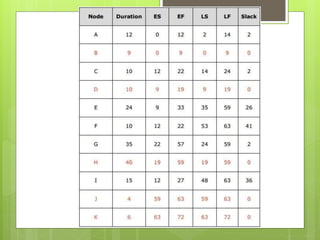
 It is helpful to list the tasks in a table.
 
 May be combined with the activity 
identification step 
 Since the activity sequence is evident for 
some tasks. 
 Other tasks may require more analysis 
 To determine the exact order in which they 
must be performed.
 
 Activity sequence information 
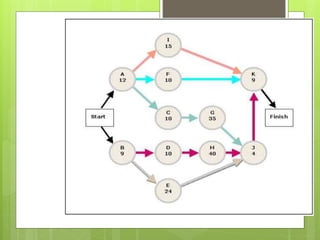
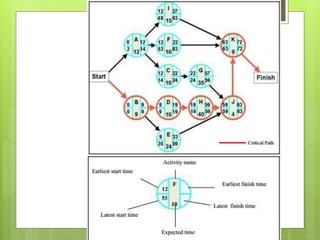
 A network diagram can be drawn showing the 
sequence of the serial and parallel activities. 
 Each activity represents: A node in the 
network, 
 The arrows represent: The relation between 
activities. 
 Software packages simplify this task 
 By automatically converting tabular activity 
information into a network diagram.
 
 Weeks are a commonly used unit of time for 
activity completion. 
 A distinguishing feature of PERT. 
 Its ability to deal with uncertainty in activity completion 
time. 
 Optimistic time(O) 
 The shortest time in which the activity can be 
completed. 
 To specify optimistic time to be three standards 
deviations from the mean. 
 Most likely time(M) 
 The completion time having the highest probability.
 Pessimistic time (P) 
 the maximum possible time required to accomplish a 
task, assuming everything goes wrong (but excluding 
major catastrophes). 
 PERT assumes a beta probability 
distribution for the time estimates. 
 Estimated Time(TE) 
 The best estimate of the time required to 
accomplish a task, accounting for the fact that 
things don't always proceed as normal. 
TE = (O + 4M + P) ÷ 6
 
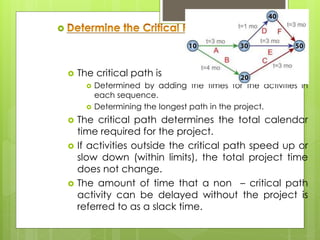
 The critical path is 
 Determined by adding the times for the activities in 
each sequence. 
 Determining the longest path in the project. 
 The critical path determines the total calendar 
time required for the project. 
 If activities outside the critical path speed up or 
slow down (within limits), the total project time 
does not change. 
 The amount of time that a non – critical path 
activity can be delayed without the project is 
referred to as a slack time.
 Critical Path is helpful to determine 
 ES – Earliest Start time 
 EF - Earliest Finish time 
 LS – Latest Start time 
 LF - Latest Finish time 
 The variance in the project completion time 
can be calculated by summing the 
variances in the completion times of the 
activities in the critical path. 
 The project can be accelerated by adding 
the resources required to decrease the time 
for the activities in the critical path. 
 Shortening of the project sometimes is 
referred to as Project Crashing.
 
 Make adjustments in the PERT chart as the 
project progresses. 
 As the project unfolds, the estimated 
times can be replaced with actual times. 
 In cases where 
 There are delays, 
 Additional resources may be needed to stay 
on schedule 
 The PERT chart may be modified to reflect the 
new situation.
Advantages 
 Explicitly defines and makes visible 
dependencies between the WBS elements 
 Facilitates identification of the critical 
path. 
 Facilitates identification of 
 Start date, 
 End date, and 
 Slack time for each activity, 
 Provides potentially reduced project 
duration. 
 The large amount of project data can be 
organized & presented in diagram for use 
in decision making.
Disadvantages 
 Hundreds or thousands of activities and 
individual dependency relationships 
 Not easily scalable for smaller projects 
 The network charts tend to be large and 
unwieldy requiring several pages to print. 
 The lack of a timeframe on most charts 
makes it harder to show status although 
colours can help 
When the charts become unwieldy, they 
are no longer used to manage the project.
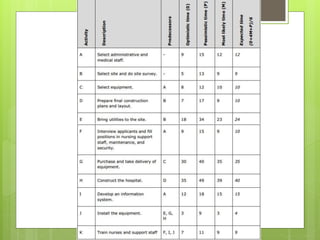
Case Study 
 In this Case Study, the Project 
manager knows 
 The succession of the project 
activities , 
 Optimistic Time, 
 Pessimistic Time and 
 Most Likely Time 
All the times known are in weeks.
Thank You !!

or-pert

  • 1.
    Presented By: RohitRaina 0613-MBA-2013
  • 2.
    Introduction  ProgramEvaluation and Review Technique.  Analyze the tasks.  United States Navy.  Event-oriented Technique  Major Factor – Time  Ex: 1968 Winter Olympics in Grenoble
  • 3.
     The mainobjective of PERT :  To facilitate decision making and  To reduce both the time and cost required to complete a project.  Related Tools:  Critical Path Method.  Gantt chart  Applied to:  Very large-scale,  One-time,  Complex,  Non-routine infrastructure and  Research and Development projects
  • 4.
    Planning Steps Specific activities and milestones.  Sequence of the activities.  Network diagram.  Estimate the time.  Critical path.  Update the PERT chart.
  • 5.
    What Happens Identify the specific activities and milestones  Activities.  Milestones.  It is helpful to list the tasks in a table.
  • 6.
      Maybe combined with the activity identification step  Since the activity sequence is evident for some tasks.  Other tasks may require more analysis  To determine the exact order in which they must be performed.
  • 7.
      Activitysequence information  A network diagram can be drawn showing the sequence of the serial and parallel activities.  Each activity represents: A node in the network,  The arrows represent: The relation between activities.  Software packages simplify this task  By automatically converting tabular activity information into a network diagram.
  • 8.
      Weeksare a commonly used unit of time for activity completion.  A distinguishing feature of PERT.  Its ability to deal with uncertainty in activity completion time.  Optimistic time(O)  The shortest time in which the activity can be completed.  To specify optimistic time to be three standards deviations from the mean.  Most likely time(M)  The completion time having the highest probability.
  • 9.
     Pessimistic time(P)  the maximum possible time required to accomplish a task, assuming everything goes wrong (but excluding major catastrophes).  PERT assumes a beta probability distribution for the time estimates.  Estimated Time(TE)  The best estimate of the time required to accomplish a task, accounting for the fact that things don't always proceed as normal. TE = (O + 4M + P) ÷ 6
  • 10.
      Thecritical path is  Determined by adding the times for the activities in each sequence.  Determining the longest path in the project.  The critical path determines the total calendar time required for the project.  If activities outside the critical path speed up or slow down (within limits), the total project time does not change.  The amount of time that a non – critical path activity can be delayed without the project is referred to as a slack time.
  • 11.
     Critical Pathis helpful to determine  ES – Earliest Start time  EF - Earliest Finish time  LS – Latest Start time  LF - Latest Finish time  The variance in the project completion time can be calculated by summing the variances in the completion times of the activities in the critical path.  The project can be accelerated by adding the resources required to decrease the time for the activities in the critical path.  Shortening of the project sometimes is referred to as Project Crashing.
  • 12.
      Makeadjustments in the PERT chart as the project progresses.  As the project unfolds, the estimated times can be replaced with actual times.  In cases where  There are delays,  Additional resources may be needed to stay on schedule  The PERT chart may be modified to reflect the new situation.
  • 13.
    Advantages  Explicitlydefines and makes visible dependencies between the WBS elements  Facilitates identification of the critical path.  Facilitates identification of  Start date,  End date, and  Slack time for each activity,  Provides potentially reduced project duration.  The large amount of project data can be organized & presented in diagram for use in decision making.
  • 14.
    Disadvantages  Hundredsor thousands of activities and individual dependency relationships  Not easily scalable for smaller projects  The network charts tend to be large and unwieldy requiring several pages to print.  The lack of a timeframe on most charts makes it harder to show status although colours can help When the charts become unwieldy, they are no longer used to manage the project.
  • 15.
    Case Study In this Case Study, the Project manager knows  The succession of the project activities ,  Optimistic Time,  Pessimistic Time and  Most Likely Time All the times known are in weeks.
  • 20.

Editor's Notes

  • #3 -1-PERT was developed primarily to simplify the planning and scheduling of large and complex projects -3- First developed by the United States Navy in 1950s. -4-Event-oriented Technique rather than start- and completion-oriented.
  • #4 The critical path method (CPM) is an algorithm for scheduling a set of project activities.
  • #5 -1-Identify the specific activities and milestones. -2-Determine the proper sequence of the activities. -3-Construct a network diagram. -4-Estimate the time required for each activity. -5-Determine the critical path. -6-Update the PERT chart as the project progresses.
  • #6 -1-The activities are the tasks required to complete a project. -2-The milestones are the events marking the beginning and the end of one or more activities. -3-It is helpful to list the tasks in a table that in later steps can be expanded to include information on sequence and duration.
  • #9 -1-Weeks are a commonly used unit of time for activity completion, any consistent unit of time can be used. -3-2-So that there is a approximately a 1% chance that the activity will be completed within the optimistic time. -4-Note that this time is different from the expected time.
  • #10 The implication being that the expected time is the average time the task would require if the task were repeated on a number of occasions over an extended period of time.
  • #14 -1-A work breakdown structure element may be a product, data, a service, or any combination -4-Better understanding of dependencies leading to improved overlapping of activities and tasks were feasible.