Program Evaluation Review
Technique (PERT)
Prepared by :
Krishna Kumar
Program (Project) Evaluation and Review Technique (PERT): is
a project management tool used to schedule, organize, and
coordinate tasks within a project. It is basically a method to
analyse the tasks involved in completing a given project,
especially the time needed to complete each task, and to
identify the minimum time needed to complete the total
project.
What is the PERT ?
Objective of the pert
 To facilitate decision making and
 To reduce both the time and cost required to
complete a project.
When we use PERT ?
• PERT is used when activity times are uncertain.
– Determine the duration of the project .
– Decision making under risk (“P” for probabilistic)
– Critical Path is helpful to determine
 ES – Earliest Start time
 EF - Earliest Finish time
 LS – Late Start time
 LF - Late Finish time
Conti….
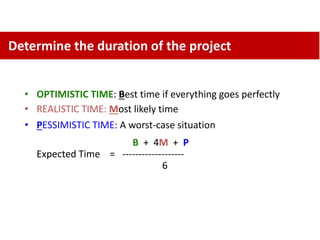
Determine the duration of the project
• OPTIMISTIC TIME: Best time if everything goes perfectly
• REALISTIC TIME: Most likely time
• PESSIMISTIC TIME: A worst-case situation
B + 4M + P
Expected Time = -------------------
6
Determine the duration of the project
• Example:
For excavation activity let :
B = 12 days
M = 18 days
P = 60
What is the expected time for this activity?
Sol :
12 + 4(18) + 60
Expected Time = -------------------------
6
= 24 days
Pert Process
• Specify activities
• Sequence of the activities.
• Network diagram.
• Estimate the time.
• Critical path.
PERT PROCESS
Activity sequence information
 A network diagram can be drawn showing the sequence of
the serial and parallel activities.
Each activity represents: A part in the network,
The arrows represent: The relation between activities.
Construct a network diagram
• Simple to understand and use
• Identify the activities that need closer
attention (critical)
• Determine the flexibility available with
activities
• Show potential risk with activities (PERT)
• Help to set priorities among activities and
resource allocation as per priority
Advantages-
PERT

PERT

  • 1.
    Program Evaluation Review Technique(PERT) Prepared by : Krishna Kumar
  • 2.
    Program (Project) Evaluationand Review Technique (PERT): is a project management tool used to schedule, organize, and coordinate tasks within a project. It is basically a method to analyse the tasks involved in completing a given project, especially the time needed to complete each task, and to identify the minimum time needed to complete the total project. What is the PERT ?
  • 3.
    Objective of thepert  To facilitate decision making and  To reduce both the time and cost required to complete a project.
  • 4.
    When we usePERT ? • PERT is used when activity times are uncertain. – Determine the duration of the project . – Decision making under risk (“P” for probabilistic)
  • 5.
    – Critical Pathis helpful to determine  ES – Earliest Start time  EF - Earliest Finish time  LS – Late Start time  LF - Late Finish time Conti….
  • 6.
    Determine the durationof the project • OPTIMISTIC TIME: Best time if everything goes perfectly • REALISTIC TIME: Most likely time • PESSIMISTIC TIME: A worst-case situation B + 4M + P Expected Time = ------------------- 6
  • 7.
    Determine the durationof the project • Example: For excavation activity let : B = 12 days M = 18 days P = 60 What is the expected time for this activity? Sol : 12 + 4(18) + 60 Expected Time = ------------------------- 6 = 24 days
  • 8.
    Pert Process • Specifyactivities • Sequence of the activities. • Network diagram. • Estimate the time. • Critical path. PERT PROCESS
  • 9.
    Activity sequence information A network diagram can be drawn showing the sequence of the serial and parallel activities. Each activity represents: A part in the network, The arrows represent: The relation between activities. Construct a network diagram
  • 10.
    • Simple tounderstand and use • Identify the activities that need closer attention (critical) • Determine the flexibility available with activities • Show potential risk with activities (PERT) • Help to set priorities among activities and resource allocation as per priority Advantages-