Module 3
Project management techniques and
quantitative techniques in
management
Network analysis
• Critical path method
• Program Evaluation and Review Technique
(PERT)
Critical path method
• The critical path method is a technique that
allows you to identify tasks that are necessary
for project completion.
• The critical path in project management is the
longest sequence of activities that must be
finished on time to complete the entire
project.
• A technique where you identify tasks that are
necessary for project completion and determine
scheduling flexibilities.
• Critical path in project management is the longest
sequence of activities that must be finished on time in
order for the entire project to be complete.
• Any delays in critical tasks will delay the whole project.
Why use critical path analysis?
• CPA can provide valuable insight on how to
plan projects, allocate resources, pace
towards milestones, and schedule tasks.
• Here are some reasons why you should use
the critical path method:
• Improves future planning: CPM can be used
to compare expectations with actual progress.
• The data used from current projects can
inform future project plans.
• Facilitates more effective resource
management: CPM helps project managers
prioritize tasks, giving them a better idea of
how to avoid resource constraints.
• Helps avoid bottlenecks: Bottlenecks in
projects can result in lost valuable time.
• Plotting out project dependencies using a
network diagram will give you a better idea of
which activities can and can’t run in parallel,
allowing you to schedule work accordingly.
How to find a project's critical path
• Finding the critical path involves identifying
the longest path between the start and end of
the project by comparing the duration of
critical and non-critical tasks.
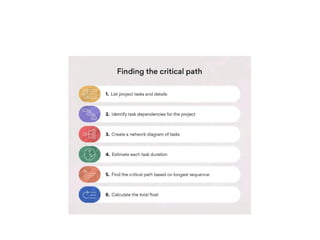
1. List activities
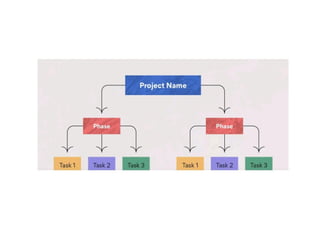
• Use a work breakdown structure to list all the
project activities or tasks required to produce
the deliverables.
• The list of activities in the work breakdown
structure serves as the foundation for the rest
of the CPM.
• Use a to list all the project activities or tasks
required to produce the deliverables.
• The list of activities in the work breakdown
structure serves as the foundation for the rest
of the CPM.
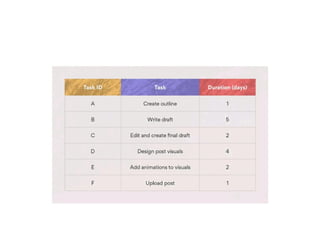
• For example, let’s say the marketing team is producing a new
interactive blog post.
• Here are some tasks that might be in the work breakdown
structure:
• Once you have a high-level idea of everything
that needs to be done, you can start
identifying task dependencies for the whole
project.
2. Identify dependencies
• Based on your work breakdown structure,
determine the tasks that are dependent on
one another.
• This will also help you identify any work that
can be done in parallel with other tasks.
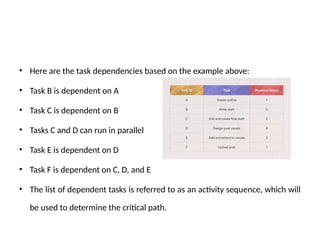
• Here are the task dependencies based on the example above:
• Task B is dependent on A
• Task C is dependent on B
• Tasks C and D can run in parallel
• Task E is dependent on D
• Task F is dependent on C, D, and E
• The list of dependent tasks is referred to as an activity sequence, which will
be used to determine the critical path.
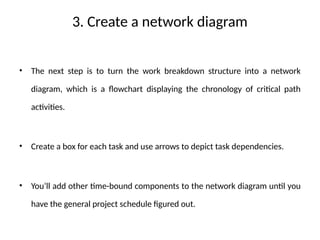
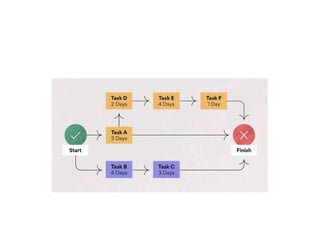
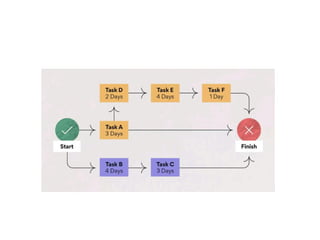
3. Create a network diagram
• The next step is to turn the work breakdown structure into a network
diagram, which is a flowchart displaying the chronology of critical path
activities.
• Create a box for each task and use arrows to depict task dependencies.
• You’ll add other time-bound components to the network diagram until you
have the general project schedule figured out.
4. Estimate task duration
• To calculate the critical path, the longest sequence of
tasks, you first need to estimate the duration of each
activity.
• To estimate the duration, try:
– Making educated guesses based on experience and knowledge
– Estimating based on previous project data
– Estimating based on industry standards
• Alternatively, try using the forward pass and backward pass technique:
• Forward pass: This is used to calculate earliest start time (ES) and earliest finish
time (EF) by using a previously specified start date.
• ES is the highest EF value from immediate predecessors, whereas EF is ES +
duration.
• The calculation starts with 0 at the ES of the first activity and proceeds through
the schedule.
• Determining ES and EF dates allows for early allocation of resources to the project.
5. Calculate the critical path
• Steps to calculate the critical path
• Step 1: Write down the start and end time next to each
sequence of activities to calculate the sequence's "duration."
– Find the start time of the first activity in the sequence
– Find the end time of the last activity in the sequence
– The duration is the end time of the last activity minus the start
time of the first activity
• Step 2: Determine the number of dependencies along each
sequence.
• Step 3: The sequence of activities with the longest duration (end of
sequence date - beginning of sequence date) is the critical path.
• If multiple sequences of activities have the same duration, the
sequence with the greater number of dependencies is the critical
path.
6. Calculate the float
• Float, or slack, refers to the amount of flexibility of a
given task.
• It indicates how much the task can be delayed without
impacting subsequent tasks or the project end date.
• Finding the float is useful in gauging how much flexibility
the project has. Float is a resource that should be used to
cover project risks or unexpected issues that come up.
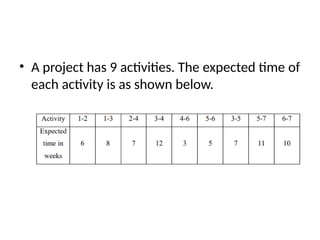
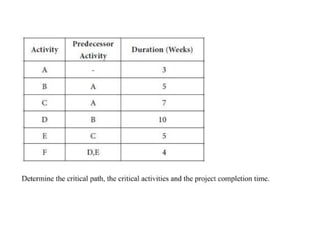
• A project has 9 activities. The expected time of
each activity is as shown below.
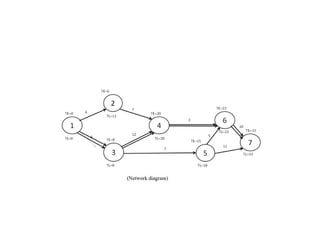
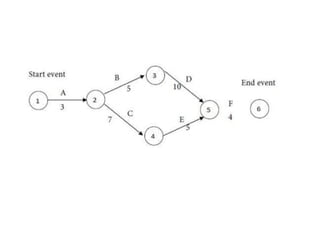
– Draw the project network
– Identify the critical path
– Find project duration
•
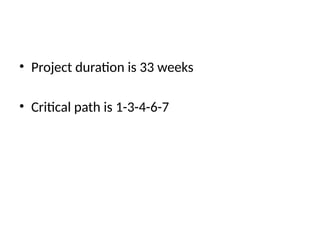
• Project duration is 33 weeks
• Critical path is 1-3-4-6-7
Project Evaluation Review Technique (PERT)
• Project Evaluation Review Technique, or PERT, is used to
identify the time it takes to finish a particular task or
activity.
• It is a system that helps in the proper scheduling and
coordination of all tasks throughout a project.
• It also helps in keeping track of the progress, or lack
thereof, of the overall project.
• In the 1950s, the Project Evaluation Review
Technique was developed by the US Navy to
manage the Polaris submarine missile
program of their Special Projects Office.
Creating a PERT Chart
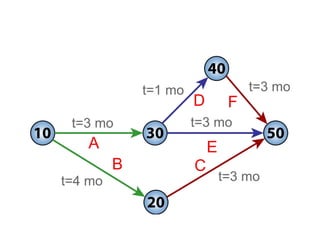
• A flowchart is used to depict the Project Evaluation
Review Technique.
• Nodes represent the events, indicating the start or end
of activities or tasks.
• The directorial lines indicate the tasks that need to be
completed, and the arrows show the sequence of the
activities.
Definitions of time used to estimate project
time requirements
• Optimistic time – The least amount of time it can take to complete a
task
• Pessimistic time – The maximum amount of time it should take to
complete a task
• Most likely time – Assuming there are no problems, the best or most
reasonable estimate of how long it should take to complete a task.
• Expected time – Assuming there are problems, the best estimate of
how much time will be required to complete a task.
Here are several terms used in a PERT chart:
• Float/Slack – Refers to the amount of time a task can be
delayed without resulting in an overall delay in completion
of other tasks or the project
• Critical Path – Indicates the longest possible continuous
path from the start to the end of a task or event
• Critical Path Activity – Refers to an activity without any slack
• Lead Time – Refers to the amount of time needed to finish a
task without affecting subsequent tasks
• Lag Time – The earliest time by which a successor event/task
can follow a prior event/task
• Fast Tracking – Refers to handling tasks or activities in parallel
• Crashing Critical Path – Shortening the amount of time to do
a critical task
To implement a PERT chart:
• Identify the different tasks needed to complete a
project. Make sure to add these in the right order
and indicate the duration of each task.
• Create a network diagram. Use arrows to represent
the activities and use nodes as milestones.
• Determine the critical path and possible slack.
Advantages of PERT
• It helps maximize the use of resources.
• It makes project planning more manageable.
• It’s useful even if there is little or no previous
schedule data.
• It enables project managers to better estimate or
determine a more definite completion date.
Disadvantages of PERT
• In complex projects, many find PERT hard to interpret, so they may
also use a Gantt chart, another popular method for project
management.
• It can be tedious to update, modify, and maintain the PERT
diagram.
• It entails a subjective time analysis of activities and, for those who
are less experienced or are biased, this may affect the project’s
schedule.
How to Make a PERT Chart
– 1. Break Down Your Project Scope
• Begin by identifying the project milestones and then
identify the individual tasks required to achieve them.
• Then, figure out the sequence of your project tasks and
their dependencies.
• 2. Create Your PERT Chart
– Now that you have the information that you need,
you can now make the PERT diagram.
• 3. Estimate Your Project Duration
– Now that you have drafted a PERT diagram and
added task details, it’s time to add the estimated
durations of all tasks to create a project schedule.
– If you’re drawing your PERT diagram, you’ll use
the PERT chart formula to do so.
• 4. Find the Critical Path & Slack
– While CPM and PERT are two different methods,
once you have a PERT chart that has your project
tasks, their durations and due dates, you can
calculate the critical path and identify any possible
slack.
PERT Chart Example
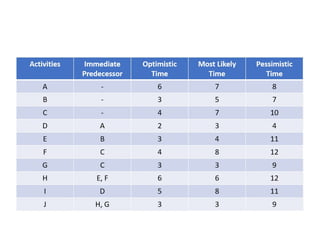
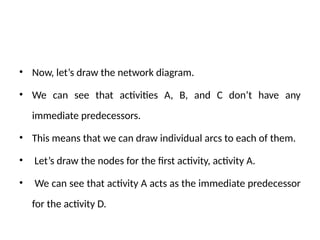
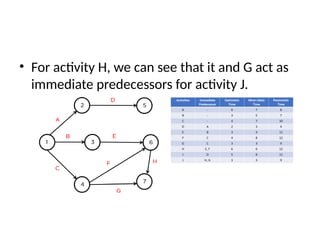
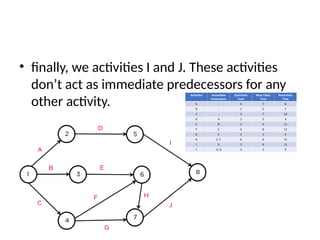
• Now, let’s draw the network diagram.
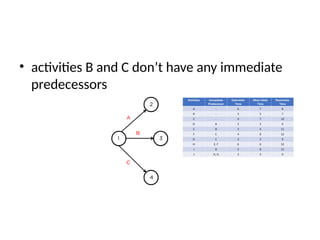
• We can see that activities A, B, and C don’t have any
immediate predecessors.
• This means that we can draw individual arcs to each of them.
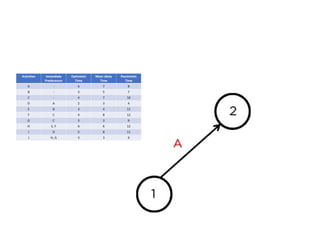
• Let’s draw the nodes for the first activity, activity A.
• We can see that activity A acts as the immediate predecessor
for the activity D.
• activities B and C don’t have any immediate
predecessors
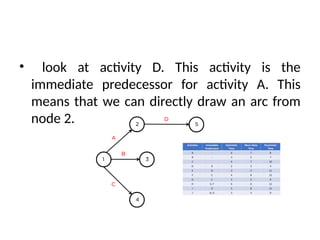
• look at activity D. This activity is the
immediate predecessor for activity A. This
means that we can directly draw an arc from
node 2.
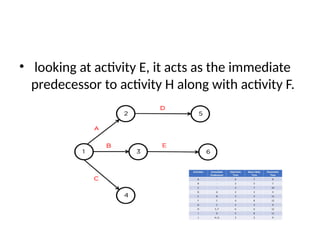
• looking at activity E, it acts as the immediate
predecessor to activity H along with activity F.
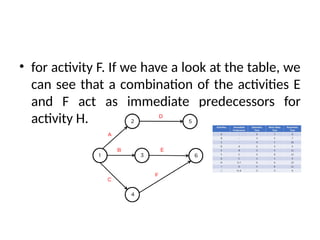
• for activity F. If we have a look at the table, we
can see that a combination of the activities E
and F act as immediate predecessors for
activity H.
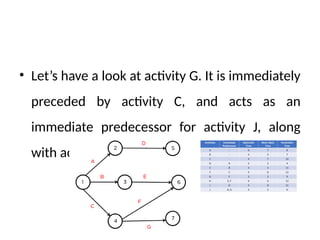
• Let’s have a look at activity G. It is immediately
preceded by activity C, and acts as an
immediate predecessor for activity J, along
with activity H.
• For activity H, we can see that it and G act as
immediate predecessors for activity J.
• finally, we activities I and J. These activities
don’t act as immediate predecessors for any
other activity.
Linear programming (LP)
• Linear programming (LP) is a mathematical
technique used in management to optimize
resource allocation and decision-making
processes.
Definition
• Linear Programming is a method for achieving the
best outcome (such as maximum profit or minimum
cost) in a mathematical model whose requirements
are represented by linear relationships.
• The goal is to determine the optimal way to allocate
limited resources.
Key Components
• Objective Function: This is the function that needs to be
optimized. For instance, maximizing profit or minimizing costs.
• Decision Variables: These are the variables that decision-
makers will decide the values of, such as the quantity of
products to produce or the number of workers to hire.
• Constraints: These are the restrictions or limitations on resources,
such as budget limits, resource availability, or time constraints.
Constraints are usually linear equations or inequalities.
• Non-negativity Constraints: These ensure that the decision
variables cannot take negative values, reflecting practical
constraints like not being able to produce a negative number of
products.
Applications
• Resource Allocation: Linear programming helps in determining the most efficient
way to allocate resources among various projects or departments to achieve
maximum profitability or efficiency.
• Production Planning: It assists in deciding the optimal quantity of each product
to manufacture to maximize profit while considering constraints like labor,
materials, and machine time.
• Scheduling: LP can be used to develop schedules that optimize the use of
resources, such as workforce scheduling, production schedules, or delivery
schedules.
• Financial Management: It helps in optimizing investment portfolios or
managing budgets by finding the best mix of assets or expenditures to
achieve financial goals.
• Supply Chain Management: LP is used to optimize logistics, such as
minimizing transportation costs, managing inventory levels, or balancing
supply and demand.
• Marketing and Sales: It can help in setting sales targets, determining the
optimal distribution of marketing resources, or deciding on pricing strategies.
• LP problems can be solved using various methods, such as:
• Graphical Method: Useful for problems with two decision variables. The
feasible region is graphed, and the optimal solution is found at the
vertices of the feasible region.
• Simplex Method: A widely used algorithm for solving LP problems,
especially for problems with more than two variables.
• Interior Point Methods: Another approach used for larger problems,
providing an efficient way to find the optimal solution.
Transportation problem
• The transportation problem is a type of linear
programming problem used to determine the most
cost-effective way to transport goods from multiple
suppliers to multiple consumers.
• The objective is to minimize the total transportation
cost while satisfying supply and demand constraints.
Definition
• Transportation Problem: It involves finding the
optimal distribution plan that minimizes the
total transportation cost of shipping goods
from a set of suppliers (or sources) to a set of
consumers (or destinations), given the supply
and demand constraints.
Key Components
• Suppliers: Entities that provide goods. Each
supplier has a certain supply capacity.
• Consumers: Entities that receive goods. Each
consumer has a certain demand that needs to
be fulfilled.
• Cost Matrix: A matrix representing the cost of
transporting one unit of goods from each
supplier to each consumer.
• Supply Constraints: Each supplier's total
shipment must not exceed its supply capacity.
• Demand Constraints: Each consumer’s total
receipt must meet its demand exactly.
Special Cases
• Balanced Transportation Problem: If the total
supply equals the total demand, the problem
is balanced.
• In this case, every unit of supply is exactly
used to meet demand.
• Unbalanced Transportation Problem: If the
total supply does not equal total demand,
dummy suppliers or consumers are introduced
to balance the problem.
• Dummy suppliers have zero costs and supply,
while dummy consumers have zero demand.
Benefits
• Cost Efficiency: Helps in minimizing transportation
costs, leading to significant savings.
• Optimal Allocation: Ensures that supply meets
demand in the most economical way.
• Scalability: Can be adapted to various sizes and
complexities of transportation networks.
Limitations
• Linear Assumptions: Assumes linear costs and
constraints, which may not capture all real-
world scenarios.
• Complexity in Large Problems: Solving large-
scale transportation problems can be
computationally intensive.
Module 3 Industrial Management and safety.pptx

  • 1.
    Module 3 Project managementtechniques and quantitative techniques in management
  • 2.
    Network analysis • Criticalpath method • Program Evaluation and Review Technique (PERT)
  • 3.
    Critical path method •The critical path method is a technique that allows you to identify tasks that are necessary for project completion. • The critical path in project management is the longest sequence of activities that must be finished on time to complete the entire project.
  • 4.
    • A techniquewhere you identify tasks that are necessary for project completion and determine scheduling flexibilities. • Critical path in project management is the longest sequence of activities that must be finished on time in order for the entire project to be complete. • Any delays in critical tasks will delay the whole project.
  • 5.
    Why use criticalpath analysis? • CPA can provide valuable insight on how to plan projects, allocate resources, pace towards milestones, and schedule tasks.
  • 6.
    • Here aresome reasons why you should use the critical path method: • Improves future planning: CPM can be used to compare expectations with actual progress. • The data used from current projects can inform future project plans.
  • 7.
    • Facilitates moreeffective resource management: CPM helps project managers prioritize tasks, giving them a better idea of how to avoid resource constraints.
  • 8.
    • Helps avoidbottlenecks: Bottlenecks in projects can result in lost valuable time. • Plotting out project dependencies using a network diagram will give you a better idea of which activities can and can’t run in parallel, allowing you to schedule work accordingly.
  • 9.
    How to finda project's critical path • Finding the critical path involves identifying the longest path between the start and end of the project by comparing the duration of critical and non-critical tasks.
  • 10.
    1. List activities •Use a work breakdown structure to list all the project activities or tasks required to produce the deliverables. • The list of activities in the work breakdown structure serves as the foundation for the rest of the CPM.
  • 11.
    • Use ato list all the project activities or tasks required to produce the deliverables. • The list of activities in the work breakdown structure serves as the foundation for the rest of the CPM.
  • 13.
    • For example,let’s say the marketing team is producing a new interactive blog post. • Here are some tasks that might be in the work breakdown structure:
  • 15.
    • Once youhave a high-level idea of everything that needs to be done, you can start identifying task dependencies for the whole project.
  • 16.
    2. Identify dependencies •Based on your work breakdown structure, determine the tasks that are dependent on one another. • This will also help you identify any work that can be done in parallel with other tasks.
  • 17.
    • Here arethe task dependencies based on the example above: • Task B is dependent on A • Task C is dependent on B • Tasks C and D can run in parallel • Task E is dependent on D • Task F is dependent on C, D, and E • The list of dependent tasks is referred to as an activity sequence, which will be used to determine the critical path.
  • 18.
    3. Create anetwork diagram • The next step is to turn the work breakdown structure into a network diagram, which is a flowchart displaying the chronology of critical path activities. • Create a box for each task and use arrows to depict task dependencies. • You’ll add other time-bound components to the network diagram until you have the general project schedule figured out.
  • 20.
    4. Estimate taskduration • To calculate the critical path, the longest sequence of tasks, you first need to estimate the duration of each activity. • To estimate the duration, try: – Making educated guesses based on experience and knowledge – Estimating based on previous project data – Estimating based on industry standards
  • 21.
    • Alternatively, tryusing the forward pass and backward pass technique: • Forward pass: This is used to calculate earliest start time (ES) and earliest finish time (EF) by using a previously specified start date. • ES is the highest EF value from immediate predecessors, whereas EF is ES + duration. • The calculation starts with 0 at the ES of the first activity and proceeds through the schedule. • Determining ES and EF dates allows for early allocation of resources to the project.
  • 22.
    5. Calculate thecritical path • Steps to calculate the critical path • Step 1: Write down the start and end time next to each sequence of activities to calculate the sequence's "duration." – Find the start time of the first activity in the sequence – Find the end time of the last activity in the sequence – The duration is the end time of the last activity minus the start time of the first activity
  • 23.
    • Step 2:Determine the number of dependencies along each sequence. • Step 3: The sequence of activities with the longest duration (end of sequence date - beginning of sequence date) is the critical path. • If multiple sequences of activities have the same duration, the sequence with the greater number of dependencies is the critical path.
  • 24.
    6. Calculate thefloat • Float, or slack, refers to the amount of flexibility of a given task. • It indicates how much the task can be delayed without impacting subsequent tasks or the project end date. • Finding the float is useful in gauging how much flexibility the project has. Float is a resource that should be used to cover project risks or unexpected issues that come up.
  • 27.
    • A projecthas 9 activities. The expected time of each activity is as shown below.
  • 28.
    – Draw theproject network – Identify the critical path – Find project duration •
  • 30.
    • Project durationis 33 weeks • Critical path is 1-3-4-6-7
  • 33.
    Project Evaluation ReviewTechnique (PERT) • Project Evaluation Review Technique, or PERT, is used to identify the time it takes to finish a particular task or activity. • It is a system that helps in the proper scheduling and coordination of all tasks throughout a project. • It also helps in keeping track of the progress, or lack thereof, of the overall project.
  • 34.
    • In the1950s, the Project Evaluation Review Technique was developed by the US Navy to manage the Polaris submarine missile program of their Special Projects Office.
  • 36.
    Creating a PERTChart • A flowchart is used to depict the Project Evaluation Review Technique. • Nodes represent the events, indicating the start or end of activities or tasks. • The directorial lines indicate the tasks that need to be completed, and the arrows show the sequence of the activities.
  • 37.
    Definitions of timeused to estimate project time requirements • Optimistic time – The least amount of time it can take to complete a task • Pessimistic time – The maximum amount of time it should take to complete a task • Most likely time – Assuming there are no problems, the best or most reasonable estimate of how long it should take to complete a task. • Expected time – Assuming there are problems, the best estimate of how much time will be required to complete a task.
  • 38.
    Here are severalterms used in a PERT chart: • Float/Slack – Refers to the amount of time a task can be delayed without resulting in an overall delay in completion of other tasks or the project • Critical Path – Indicates the longest possible continuous path from the start to the end of a task or event • Critical Path Activity – Refers to an activity without any slack
  • 39.
    • Lead Time– Refers to the amount of time needed to finish a task without affecting subsequent tasks • Lag Time – The earliest time by which a successor event/task can follow a prior event/task • Fast Tracking – Refers to handling tasks or activities in parallel • Crashing Critical Path – Shortening the amount of time to do a critical task
  • 40.
    To implement aPERT chart: • Identify the different tasks needed to complete a project. Make sure to add these in the right order and indicate the duration of each task. • Create a network diagram. Use arrows to represent the activities and use nodes as milestones. • Determine the critical path and possible slack.
  • 41.
    Advantages of PERT •It helps maximize the use of resources. • It makes project planning more manageable. • It’s useful even if there is little or no previous schedule data. • It enables project managers to better estimate or determine a more definite completion date.
  • 42.
    Disadvantages of PERT •In complex projects, many find PERT hard to interpret, so they may also use a Gantt chart, another popular method for project management. • It can be tedious to update, modify, and maintain the PERT diagram. • It entails a subjective time analysis of activities and, for those who are less experienced or are biased, this may affect the project’s schedule.
  • 43.
    How to Makea PERT Chart – 1. Break Down Your Project Scope • Begin by identifying the project milestones and then identify the individual tasks required to achieve them. • Then, figure out the sequence of your project tasks and their dependencies.
  • 44.
    • 2. CreateYour PERT Chart – Now that you have the information that you need, you can now make the PERT diagram.
  • 45.
    • 3. EstimateYour Project Duration – Now that you have drafted a PERT diagram and added task details, it’s time to add the estimated durations of all tasks to create a project schedule. – If you’re drawing your PERT diagram, you’ll use the PERT chart formula to do so.
  • 46.
    • 4. Findthe Critical Path & Slack – While CPM and PERT are two different methods, once you have a PERT chart that has your project tasks, their durations and due dates, you can calculate the critical path and identify any possible slack.
  • 47.
  • 49.
    • Now, let’sdraw the network diagram. • We can see that activities A, B, and C don’t have any immediate predecessors. • This means that we can draw individual arcs to each of them. • Let’s draw the nodes for the first activity, activity A. • We can see that activity A acts as the immediate predecessor for the activity D.
  • 51.
    • activities Band C don’t have any immediate predecessors
  • 52.
    • look atactivity D. This activity is the immediate predecessor for activity A. This means that we can directly draw an arc from node 2.
  • 53.
    • looking atactivity E, it acts as the immediate predecessor to activity H along with activity F.
  • 54.
    • for activityF. If we have a look at the table, we can see that a combination of the activities E and F act as immediate predecessors for activity H.
  • 55.
    • Let’s havea look at activity G. It is immediately preceded by activity C, and acts as an immediate predecessor for activity J, along with activity H.
  • 56.
    • For activityH, we can see that it and G act as immediate predecessors for activity J.
  • 57.
    • finally, weactivities I and J. These activities don’t act as immediate predecessors for any other activity.
  • 58.
    Linear programming (LP) •Linear programming (LP) is a mathematical technique used in management to optimize resource allocation and decision-making processes.
  • 59.
    Definition • Linear Programmingis a method for achieving the best outcome (such as maximum profit or minimum cost) in a mathematical model whose requirements are represented by linear relationships. • The goal is to determine the optimal way to allocate limited resources.
  • 60.
    Key Components • ObjectiveFunction: This is the function that needs to be optimized. For instance, maximizing profit or minimizing costs. • Decision Variables: These are the variables that decision- makers will decide the values of, such as the quantity of products to produce or the number of workers to hire.
  • 61.
    • Constraints: Theseare the restrictions or limitations on resources, such as budget limits, resource availability, or time constraints. Constraints are usually linear equations or inequalities. • Non-negativity Constraints: These ensure that the decision variables cannot take negative values, reflecting practical constraints like not being able to produce a negative number of products.
  • 62.
    Applications • Resource Allocation:Linear programming helps in determining the most efficient way to allocate resources among various projects or departments to achieve maximum profitability or efficiency. • Production Planning: It assists in deciding the optimal quantity of each product to manufacture to maximize profit while considering constraints like labor, materials, and machine time. • Scheduling: LP can be used to develop schedules that optimize the use of resources, such as workforce scheduling, production schedules, or delivery schedules.
  • 63.
    • Financial Management:It helps in optimizing investment portfolios or managing budgets by finding the best mix of assets or expenditures to achieve financial goals. • Supply Chain Management: LP is used to optimize logistics, such as minimizing transportation costs, managing inventory levels, or balancing supply and demand. • Marketing and Sales: It can help in setting sales targets, determining the optimal distribution of marketing resources, or deciding on pricing strategies.
  • 64.
    • LP problemscan be solved using various methods, such as: • Graphical Method: Useful for problems with two decision variables. The feasible region is graphed, and the optimal solution is found at the vertices of the feasible region. • Simplex Method: A widely used algorithm for solving LP problems, especially for problems with more than two variables. • Interior Point Methods: Another approach used for larger problems, providing an efficient way to find the optimal solution.
  • 65.
    Transportation problem • Thetransportation problem is a type of linear programming problem used to determine the most cost-effective way to transport goods from multiple suppliers to multiple consumers. • The objective is to minimize the total transportation cost while satisfying supply and demand constraints.
  • 66.
    Definition • Transportation Problem:It involves finding the optimal distribution plan that minimizes the total transportation cost of shipping goods from a set of suppliers (or sources) to a set of consumers (or destinations), given the supply and demand constraints.
  • 67.
    Key Components • Suppliers:Entities that provide goods. Each supplier has a certain supply capacity. • Consumers: Entities that receive goods. Each consumer has a certain demand that needs to be fulfilled. • Cost Matrix: A matrix representing the cost of transporting one unit of goods from each supplier to each consumer.
  • 68.
    • Supply Constraints:Each supplier's total shipment must not exceed its supply capacity. • Demand Constraints: Each consumer’s total receipt must meet its demand exactly.
  • 69.
    Special Cases • BalancedTransportation Problem: If the total supply equals the total demand, the problem is balanced. • In this case, every unit of supply is exactly used to meet demand.
  • 70.
    • Unbalanced TransportationProblem: If the total supply does not equal total demand, dummy suppliers or consumers are introduced to balance the problem. • Dummy suppliers have zero costs and supply, while dummy consumers have zero demand.
  • 71.
    Benefits • Cost Efficiency:Helps in minimizing transportation costs, leading to significant savings. • Optimal Allocation: Ensures that supply meets demand in the most economical way. • Scalability: Can be adapted to various sizes and complexities of transportation networks.
  • 72.
    Limitations • Linear Assumptions:Assumes linear costs and constraints, which may not capture all real- world scenarios. • Complexity in Large Problems: Solving large- scale transportation problems can be computationally intensive.