Steps In Using Network Technique
•Plan the project
•Schedule the project
•Monitor the project
Plan the project:
– Analyze the project by determining all the
individual activities that must be performed to
complete it.
– Show the planned sequence of these activities on
a network(graphical representation where arrow
and circle represent the relation among acitivities
in the project ).
Schedule the project
• Estimate how long it will take to perform each
activity.
• Perform calculation to locate the critical path
(the longest time chain of sequential activities
which determines the duration of the project).
• Use this information to develop a more
economical and efficient schedule.
Monitor the project
• Use the plan to control and monitor the
progress.
• Revise and update the schedule through out
the execution of the project so that the
schedule represent the current plans and the
current status of the project.
WBS: Work Break Structure
• Project: Build a 10 storied building
• Task: A) Land acquisition, B) Land Preparation,
C) Design, D)Foundation, E)Structure, F)Walls,
G) Door Window, H) Plumbing, I) Electrical
wiring, J) Painting and decoration.
Precedence relationship
• Some activities cannot be performed until
other activities have been completed. This
type of requirements establish a technical
relationship which is called precedence
relationship.
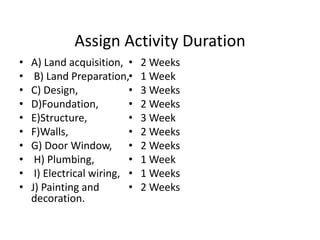
Assign Activity Duration
• A) Land acquisition,
• B) Land Preparation,
• C) Design,
• D)Foundation,
• E)Structure,
• F)Walls,
• G) Door Window,
• H) Plumbing,
• I) Electrical wiring,
• J) Painting and
decoration.
• 2 Weeks
• 1 Week
• 3 Weeks
• 2 Weeks
• 3 Week
• 2 Weeks
• 2 Weeks
• 1 Week
• 1 Weeks
• 2 Weeks
Network convention
• A network is a graph using circles and arrows
to represent the planned relationship among
the activities required to complete the
project. Either of two conventions can be used
to develop a network:
– Activity on Node (AON): use circle to represent
activities and arrow to link them.
– Activity on Arrow (AOA): use arrow to represent
activities and circle to connect them.
Example 01
Task Predecessor Duration
A None 2
B None 8
C A 4
D A 6
E C,D 9
F B,E 11
G B 3
H F,G 1
Draw AON and AOA diagram of following project
AON
AOA
Task Predecessor Duration
A None 2
B A 6
C B 4
D A 4
E C 5
F E 6
G E 3
H F 3
I D,F 3
J F,G 5
K H 2
L J 3
M I,K,L 1
Task Optimistic time Most likely time Pessimistic time
1-2 2 3 5
2-3 3 4 6
3-6 6 8 11
2-4 5 6 9
4-6 6 8 10
4-5 4 5 6
5-7 5 6 9
6-8 2 3 4
6-7 0 0 0
7-8 1 3 5
8-9 4 5 8
9-10 2 3 5
7-10 5 9 11
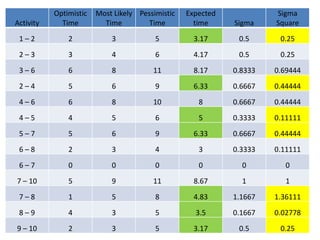
• Expected Time = [(Optimistic Time + 4 x Most
likely Time + Pessimistic Time)]/6
• σ2 = [(Pessimistic Time - Optimistic Time)/6]2
Task Optimistic
time
Most likely
time
Pessimistic
time
Expected
Time (Te)
Sigma
Square
Sigma
Activity
Optimistic
Time
Most Likely
Time
Pessimistic
Time
Expected
time Sigma
Sigma
Square
1 – 2 2 3 5 3.17 0.5 0.25
2 – 3 3 4 6 4.17 0.5 0.25
3 – 6 6 8 11 8.17 0.8333 0.69444
2 – 4 5 6 9 6.33 0.6667 0.44444
4 – 6 6 8 10 8 0.6667 0.44444
4 – 5 4 5 6 5 0.3333 0.11111
5 – 7 5 6 9 6.33 0.6667 0.44444
6 – 8 2 3 4 3 0.3333 0.11111
6 – 7 0 0 0 0 0 0
7 – 10 5 9 11 8.67 1 1
7 – 8 1 5 8 4.83 1.1667 1.36111
8 – 9 4 3 5 3.5 0.1667 0.02778
9 – 10 2 3 5 3.167 0.5 0.25
• Expected Time = [(Optimistic Time + 4 x Most
likely Time + Pessimistic Time)]/6
• σ2 = [(Pessimistic Time - Optimistic Time)/6]2
Activity
Optimistic
Time
Most Likely
Time
Pessimistic
Time
Expected
time Sigma
Sigma
Square
1 – 2 2 3 5 3.17 0.5 0.25
2 – 3 3 4 6 4.17 0.5 0.25
3 – 6 6 8 11 8.17 0.8333 0.69444
2 – 4 5 6 9 6.33 0.6667 0.44444
4 – 6 6 8 10 8 0.6667 0.44444
4 – 5 4 5 6 5 0.3333 0.11111
5 – 7 5 6 9 6.33 0.6667 0.44444
6 – 8 2 3 4 3 0.3333 0.11111
6 – 7 0 0 0 0 0 0
7 – 10 5 9 11 8.67 1 1
7 – 8 1 5 8 4.83 1.1667 1.36111
8 – 9 4 3 5 3.5 0.1667 0.02778
9 – 10 2 3 5 3.17 0.5 0.25

Network scheduling

  • 1.
    Steps In UsingNetwork Technique •Plan the project •Schedule the project •Monitor the project
  • 2.
    Plan the project: –Analyze the project by determining all the individual activities that must be performed to complete it. – Show the planned sequence of these activities on a network(graphical representation where arrow and circle represent the relation among acitivities in the project ).
  • 3.
    Schedule the project •Estimate how long it will take to perform each activity. • Perform calculation to locate the critical path (the longest time chain of sequential activities which determines the duration of the project). • Use this information to develop a more economical and efficient schedule.
  • 4.
    Monitor the project •Use the plan to control and monitor the progress. • Revise and update the schedule through out the execution of the project so that the schedule represent the current plans and the current status of the project.
  • 5.
    WBS: Work BreakStructure • Project: Build a 10 storied building • Task: A) Land acquisition, B) Land Preparation, C) Design, D)Foundation, E)Structure, F)Walls, G) Door Window, H) Plumbing, I) Electrical wiring, J) Painting and decoration.
  • 6.
    Precedence relationship • Someactivities cannot be performed until other activities have been completed. This type of requirements establish a technical relationship which is called precedence relationship.
  • 7.
    Assign Activity Duration •A) Land acquisition, • B) Land Preparation, • C) Design, • D)Foundation, • E)Structure, • F)Walls, • G) Door Window, • H) Plumbing, • I) Electrical wiring, • J) Painting and decoration. • 2 Weeks • 1 Week • 3 Weeks • 2 Weeks • 3 Week • 2 Weeks • 2 Weeks • 1 Week • 1 Weeks • 2 Weeks
  • 8.
    Network convention • Anetwork is a graph using circles and arrows to represent the planned relationship among the activities required to complete the project. Either of two conventions can be used to develop a network: – Activity on Node (AON): use circle to represent activities and arrow to link them. – Activity on Arrow (AOA): use arrow to represent activities and circle to connect them.
  • 9.
    Example 01 Task PredecessorDuration A None 2 B None 8 C A 4 D A 6 E C,D 9 F B,E 11 G B 3 H F,G 1 Draw AON and AOA diagram of following project
  • 10.
  • 11.
  • 12.
    Task Predecessor Duration ANone 2 B A 6 C B 4 D A 4 E C 5 F E 6 G E 3 H F 3 I D,F 3 J F,G 5 K H 2 L J 3 M I,K,L 1
  • 13.
    Task Optimistic timeMost likely time Pessimistic time 1-2 2 3 5 2-3 3 4 6 3-6 6 8 11 2-4 5 6 9 4-6 6 8 10 4-5 4 5 6 5-7 5 6 9 6-8 2 3 4 6-7 0 0 0 7-8 1 3 5 8-9 4 5 8 9-10 2 3 5 7-10 5 9 11
  • 14.
    • Expected Time= [(Optimistic Time + 4 x Most likely Time + Pessimistic Time)]/6 • σ2 = [(Pessimistic Time - Optimistic Time)/6]2
  • 15.
  • 16.
    Activity Optimistic Time Most Likely Time Pessimistic Time Expected time Sigma Sigma Square 1– 2 2 3 5 3.17 0.5 0.25 2 – 3 3 4 6 4.17 0.5 0.25 3 – 6 6 8 11 8.17 0.8333 0.69444 2 – 4 5 6 9 6.33 0.6667 0.44444 4 – 6 6 8 10 8 0.6667 0.44444 4 – 5 4 5 6 5 0.3333 0.11111 5 – 7 5 6 9 6.33 0.6667 0.44444 6 – 8 2 3 4 3 0.3333 0.11111 6 – 7 0 0 0 0 0 0 7 – 10 5 9 11 8.67 1 1 7 – 8 1 5 8 4.83 1.1667 1.36111 8 – 9 4 3 5 3.5 0.1667 0.02778 9 – 10 2 3 5 3.167 0.5 0.25
  • 19.
    • Expected Time= [(Optimistic Time + 4 x Most likely Time + Pessimistic Time)]/6 • σ2 = [(Pessimistic Time - Optimistic Time)/6]2
  • 20.
    Activity Optimistic Time Most Likely Time Pessimistic Time Expected time Sigma Sigma Square 1– 2 2 3 5 3.17 0.5 0.25 2 – 3 3 4 6 4.17 0.5 0.25 3 – 6 6 8 11 8.17 0.8333 0.69444 2 – 4 5 6 9 6.33 0.6667 0.44444 4 – 6 6 8 10 8 0.6667 0.44444 4 – 5 4 5 6 5 0.3333 0.11111 5 – 7 5 6 9 6.33 0.6667 0.44444 6 – 8 2 3 4 3 0.3333 0.11111 6 – 7 0 0 0 0 0 0 7 – 10 5 9 11 8.67 1 1 7 – 8 1 5 8 4.83 1.1667 1.36111 8 – 9 4 3 5 3.5 0.1667 0.02778 9 – 10 2 3 5 3.17 0.5 0.25