   Introduction
   Objectives
   Specifications
   Payloads
   End of mission
   Accomplishment
   Chandrayaan-2
   Conclusion
   References
 CHANDRAYAAN mission was
  India's “ first lunar exploration”.
 It was been launched by a
  modified version of PSLV C11.
 It was an unmanned lunar exploration
  undertaken by ISRO( Indian space research
  organization)
 It was launched on 22nd October 2008; 6:23
  IST from SATISH DHAWAN SPACE CENTRE ,
  SRIHARIKOTA, ANDHRA PRADESH.
Organization       Indian Space Research Organization
Mission type       Orbiter
Satellite of       Moon
Launch date        22 October 2008 from Sriharikota, India
Launch vehicle     PSLV-C11
Mission duration   2 years
NSSDC ID           2008-052A
Home page          Chandrayaan-1
Mass               523 kg (1,153 lb)

                             Orbital Elements
Eccentricity       near circular
Inclination        polar
Apoapsis           initial 7,500 km (4,660 mi), final 100 km (62 mi)
Periapsis          initial 500 km (311 mi), final 100 km (62 mi)
 The main objective was to carry out
  scientific studies and to conduct high-
  resolution mapping of topographic features
  in 3D,distribution of various minerals and
  chemical species such as           radioactive
  nuclides that cover the surface of the
  moon.
 To Impact a sub-satellite ( Moon Impact
  Probe -MIP ) on the surface on the Moon as
  a fore-runner to future soft landing missions.
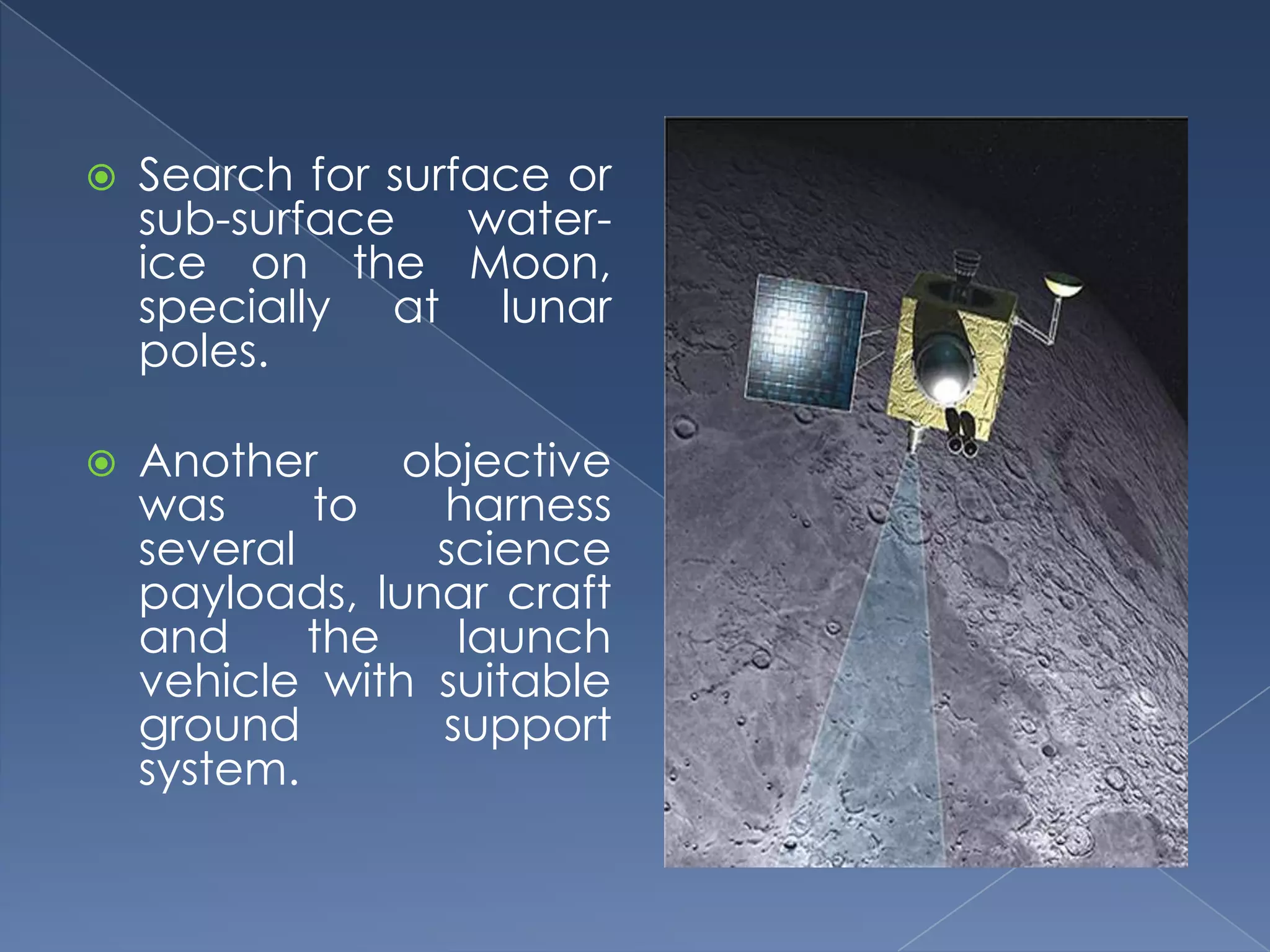
   Search for surface or
    sub-surface    water-
    ice on the Moon,
    specially at lunar
    poles.

   Another     objective
    was     to   harness
    several      science
    payloads, lunar craft
    and     the   launch
    vehicle with suitable
    ground       support
    system.
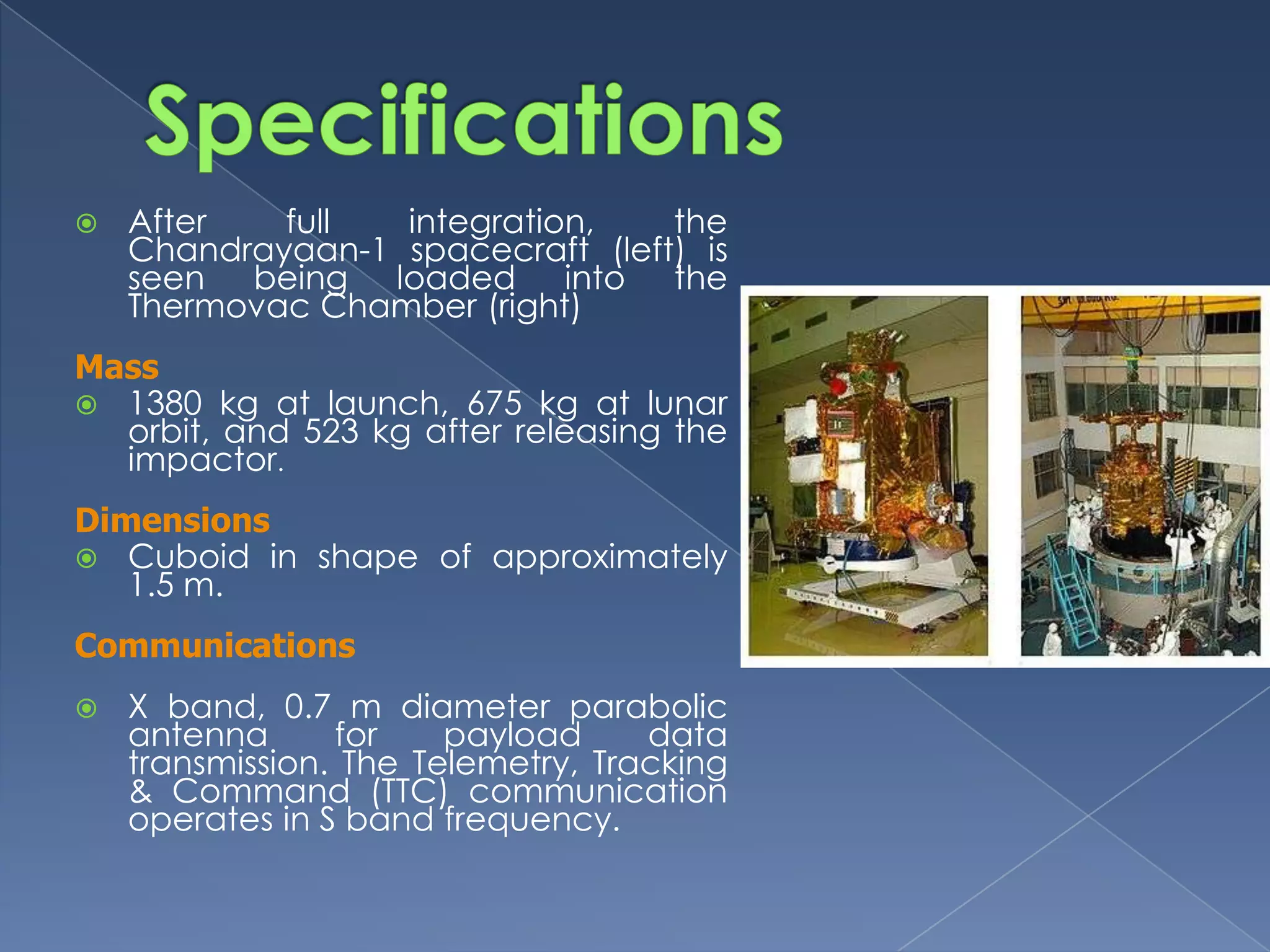
   After   full  integration,    the
    Chandrayaan-1 spacecraft (left) is
    seen being loaded into the
    Thermovac Chamber (right)
Mass
 1380 kg at launch, 675 kg at lunar
  orbit, and 523 kg after releasing the
  impactor.
Dimensions
 Cuboid in shape of approximately
   1.5 m.
Communications
   X band, 0.7 m diameter parabolic
    antenna      for    payload     data
    transmission. The Telemetry, Tracking
    & Command (TTC) communication
    operates in S band frequency.
Power
 The spacecraft was mainly powered by its solar array, which
   included one solar panel covering a total area of 2.15 x 1.8
   m generating 700 W of power, which was stored in a 36 A·h
   Lithium-ion battery.
Propulsion
 The spacecraft used a bipropellant integrated propulsion
   system to reach lunar orbit as well as orbit and altitude
   maintenance while orbiting the Moon.

Navigation and Control
 The craft was 3-axis stabilized with two star sensors, gyros and
  four reaction wheels.
PAYLOADS                     SENSOR CONFIGURATION          OBJECTIVE
TERRAIN MAPPING CAMERA(         Three stereo cameras with      Topographic mapping
    TMC)                        pixelated detectors
HYPERSPECTRAL IMAGER (HySI)     Wedge filter pixelated         AREAL MAPPING OF MINERALS


LUNAR LASER RANGING             Pulsed Nd-Yag laser with       HEIGHT OF THE SURFACE
INSTRUMENT (LLRI)               optical system                 TOPOGRAPHY
HIGH ENERGY X-RAY               CdZnTe detector                U, Th, 210Pb and other
SPECTROMETER (HEX)                                             radioactive elements
                                                               mapping
MOON IMPACT PROBE (MIP)         C-band Radar, avideo imaging   Taking images and measuring
                                system and mass spectrometer   constituents of the lunar
                                                               atmosphere.
X-RAY FLUROSCENCE               Swept charged CCD              Chemical mapping
SPECTROMETER (C1XS)                                            (Mg, Al, Si, Ca, Ti, Fe)
SUB ATOM REFLECTING ANALYSER    Mass spectrometer and          Mineral composition
(SARA)                          solar wind monitor
MOON MINEROLOGY MAPPER          Grating spectrometer and       Areal mineral
(M3)                            HgCdTe detector                and resource .

INFRARED SPECTROMETER (SIR-2)   Grating spectrometer           Linear mapping
                                                               Of minerals
SYNTHETIC APPERTURE RADAR       Radar, Scatterometer and       Lunar polar ice.
(MINI SAR)                      altimeter
RADIATION DOSE MONITOR          Si semiconductor               Radiation environment
(RADOM)
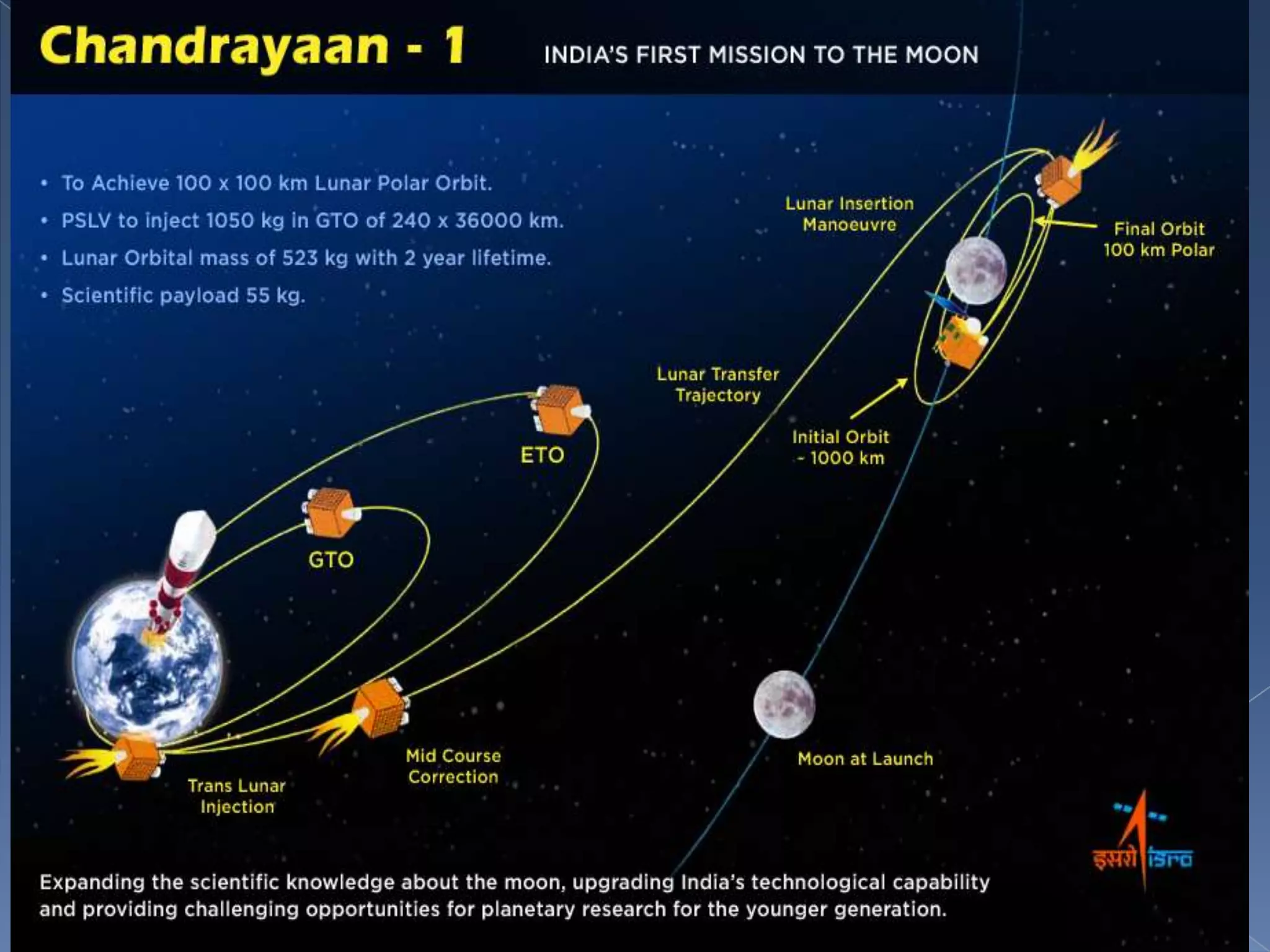
   CHANDRAYAAN -1 was sent to moon in a series
    of orbit increasing man oeuvres around the
    earth as opposed to the launching of craft on
    a direct trajectory to moon.
   Chandrayaan -1 successfully completed the
    lunar orbit insertion operation on 8th Nov 2008,
    with this India became the fifth nation to put
    vehicle in lunar orbit.
   The MIP landed on lunar surface on 14th Nov
    2008, which kept on sending information to the
    mother satellite.
   The M3 retrieved the presence of iron and also
    changes in rock and mineral composition.
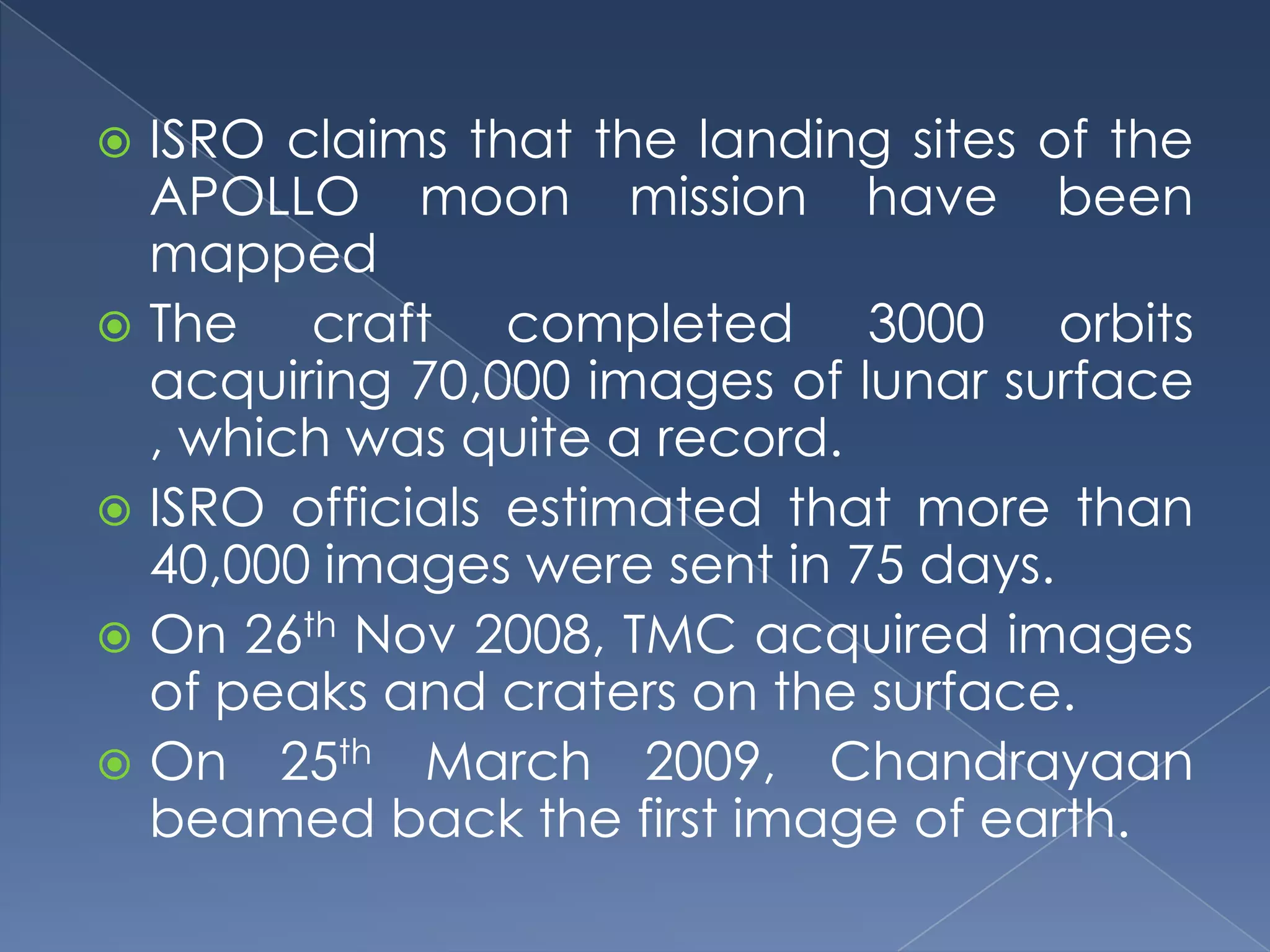
 ISRO claims that the landing sites of the
  APOLLO moon mission have been
  mapped
 The   craft completed 3000 orbits
  acquiring 70,000 images of lunar surface
  , which was quite a record.
 ISRO officials estimated that more than
  40,000 images were sent in 75 days.
 On 26th Nov 2008, TMC acquired images
  of peaks and craters on the surface.
 On 25th March 2009, Chandrayaan
  beamed back the first image of earth.
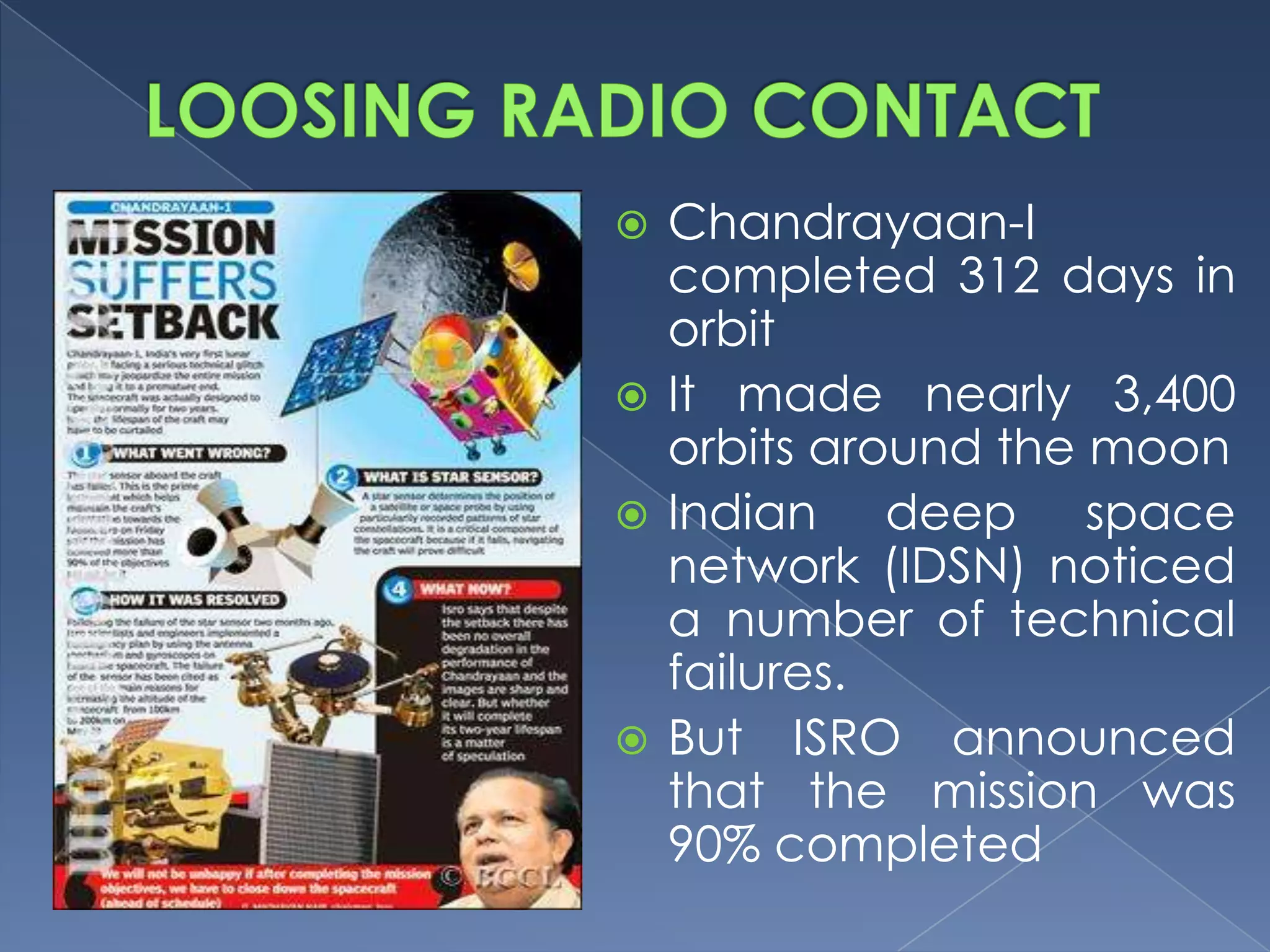
 Chandrayaan-I
  completed 312 days in
  orbit
 It made nearly 3,400
  orbits around the moon
 Indian    deep space
  network (IDSN) noticed
  a number of technical
  failures.
 But ISRO announced
  that the mission was
  90% completed
   To construct the complex
    spacecraft       with   11-
    payloads.
   To place the spacecraft in
    a circular orbit around the
    moon.
   To place the flag of India
    on the moon.
   To carry out imaging
    operation and to collect
    data on mineral content.
   Discovery of large caves
    on the lunar surface.
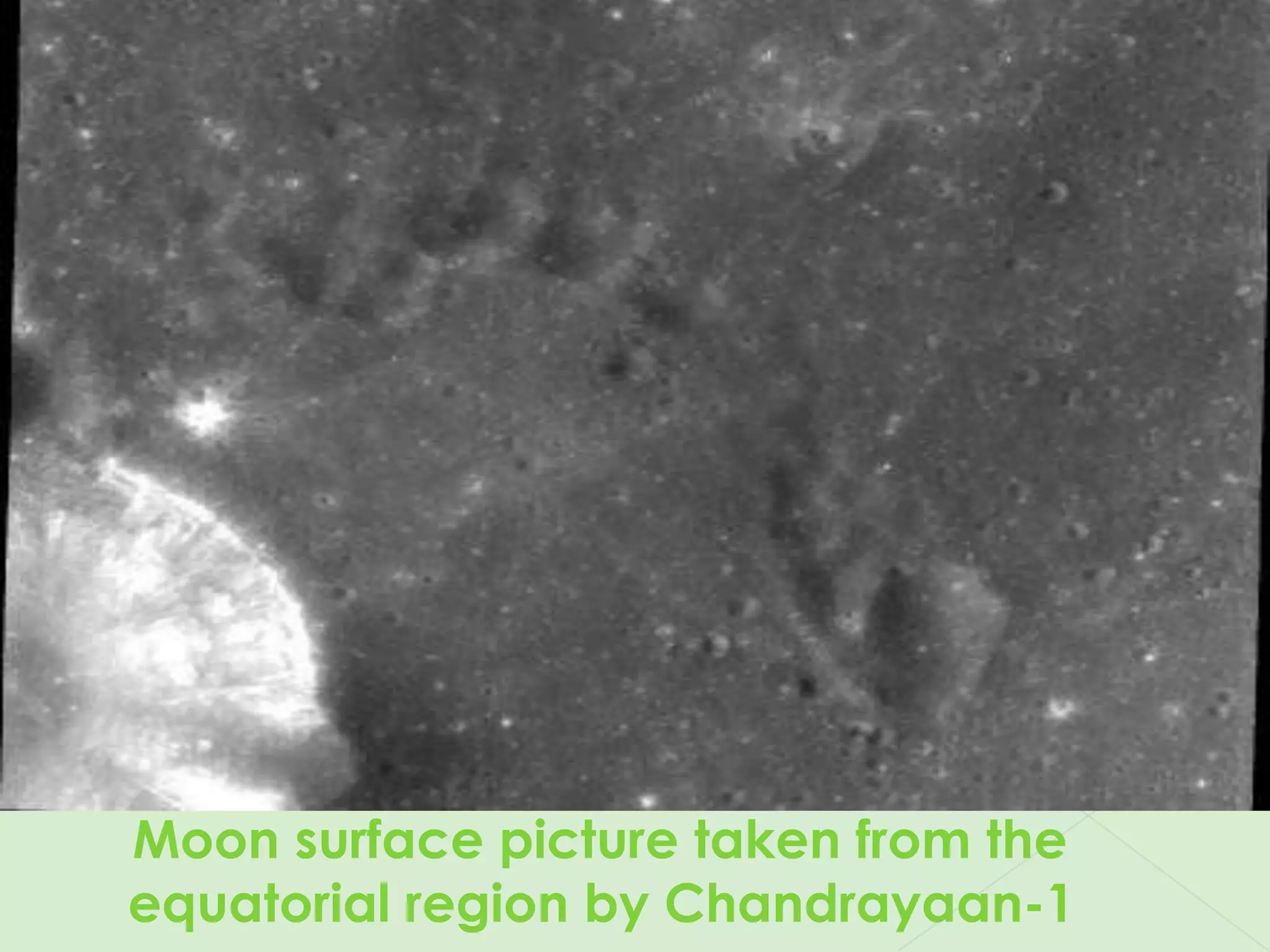
Moon surface picture taken from the
equatorial region by Chandrayaan-1
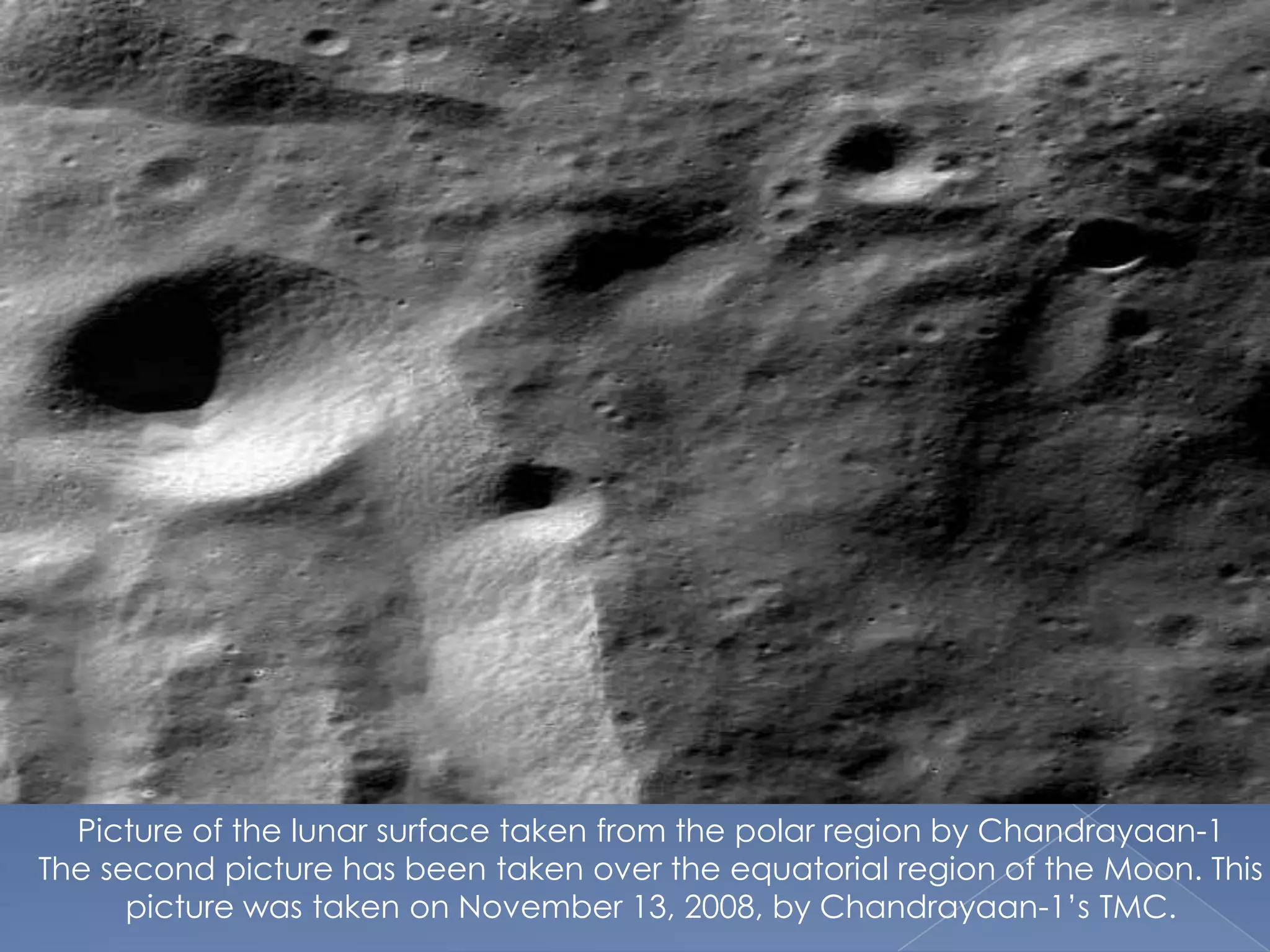
Picture of the lunar surface taken from the polar region by Chandrayaan-1
The second picture has been taken over the equatorial region of the Moon. This
      picture was taken on November 13, 2008, by Chandrayaan-1’s TMC.
The American institute of Aeronautics
and Astronautics(AIAA) had selected
ISRO’s Chandrayaan-1 mission as one of
its annual AIAA Space 2009 awards.
The scientists considered instrumental to the success of the
    Chandrayaan-1 project are::

   G. Madhavan Nair – Chairman, Indian Space Research Organisation
   T. K. Alex – Director, ISAC (ISRO Satellite Centre)
   Mylswamy Annadurai – Project director
   S. K. Shivkumar – Director - Telemetry, Tracking and Command
    Network.
   George Koshi –Mission Director
   Srinivasa Hegde – Mission Director
   M Y S Prasad – Associate Director of the Sriharikota Complex and
    Range Operations Director
   J N Goswami – Director of the Ahmedabad-based Physical Research
    Laboratory and Principal Scientific Investigator of Chandrayaan-1
   Narendra Bhandari – Head, ISRO`s Planetary Sciences and Exploration
    program.
 It is a joint mission proposed by ISRO and
  Russian Federal Space Agency.
 The projected cost is Rs 425 crores.
 The mission is proposed to be launched in
  2013 by a GSLV launch vehicle.
 It includes a lunar orbiter and a rover and a
  lander.
 There would be 7 payloads, 5 for the orbiter
  and 2 for the rover.
CURRENT STATUS::
  On 30 August 2010, ISRO has finalized
  payloads for CHANDRAYAAN -2 mission.
 India’s first lunar exploration.
 India has started its journey to moon.
 The Chandrayaan-1 was one of the
  “touchstones of India”.
   http://www.chandrayaan-i.com
   THE HINDU , 26th November (Wednesday),2008.
   THE HINDU,31ST October, 2009.
   "India kisses the Moon, Chandrayaan MIP lands". IBN Live. 14
    November 2008. http://ibnlive.in.com/news/india-kisses-the-moon-
    chandrayaan-mip-lands/78179-11.html. Retrieved 18 November
    2008.
   Chandrayaan-1 mission terminated The Hindu. 31 August 2009.
   "ISRO       completes       Chandrayaan-2          design      news".
    http://www.domain-
    b.com/aero/space/spacemissions/20090817_chandrayaan-
    2_design.html. Retrieved 2009-08-20.
   "Payloads for Chandrayaan-2 Mission Finalised". Indian Space
    Research     Organisation    (ISRO)   (ISRO).   August     30,  2010.
    http://www.isro.gov.in/pressrelease/scripts/pressreleasein.aspx?Aug
    30_2010. Retrieved 2010-09-02.
THANK YOU

A seminar on chandrayaan mission

  • 2.
    Introduction  Objectives  Specifications  Payloads  End of mission  Accomplishment  Chandrayaan-2  Conclusion  References
  • 3.
     CHANDRAYAAN missionwas India's “ first lunar exploration”.  It was been launched by a modified version of PSLV C11.  It was an unmanned lunar exploration undertaken by ISRO( Indian space research organization)  It was launched on 22nd October 2008; 6:23 IST from SATISH DHAWAN SPACE CENTRE , SRIHARIKOTA, ANDHRA PRADESH.
  • 4.
    Organization Indian Space Research Organization Mission type Orbiter Satellite of Moon Launch date 22 October 2008 from Sriharikota, India Launch vehicle PSLV-C11 Mission duration 2 years NSSDC ID 2008-052A Home page Chandrayaan-1 Mass 523 kg (1,153 lb) Orbital Elements Eccentricity near circular Inclination polar Apoapsis initial 7,500 km (4,660 mi), final 100 km (62 mi) Periapsis initial 500 km (311 mi), final 100 km (62 mi)
  • 6.
     The mainobjective was to carry out scientific studies and to conduct high- resolution mapping of topographic features in 3D,distribution of various minerals and chemical species such as radioactive nuclides that cover the surface of the moon.  To Impact a sub-satellite ( Moon Impact Probe -MIP ) on the surface on the Moon as a fore-runner to future soft landing missions.
  • 7.
    Search for surface or sub-surface water- ice on the Moon, specially at lunar poles.  Another objective was to harness several science payloads, lunar craft and the launch vehicle with suitable ground support system.
  • 8.
    After full integration, the Chandrayaan-1 spacecraft (left) is seen being loaded into the Thermovac Chamber (right) Mass  1380 kg at launch, 675 kg at lunar orbit, and 523 kg after releasing the impactor. Dimensions  Cuboid in shape of approximately 1.5 m. Communications  X band, 0.7 m diameter parabolic antenna for payload data transmission. The Telemetry, Tracking & Command (TTC) communication operates in S band frequency.
  • 9.
    Power  The spacecraftwas mainly powered by its solar array, which included one solar panel covering a total area of 2.15 x 1.8 m generating 700 W of power, which was stored in a 36 A·h Lithium-ion battery. Propulsion  The spacecraft used a bipropellant integrated propulsion system to reach lunar orbit as well as orbit and altitude maintenance while orbiting the Moon. Navigation and Control  The craft was 3-axis stabilized with two star sensors, gyros and four reaction wheels.
  • 10.
    PAYLOADS SENSOR CONFIGURATION OBJECTIVE TERRAIN MAPPING CAMERA( Three stereo cameras with Topographic mapping TMC) pixelated detectors HYPERSPECTRAL IMAGER (HySI) Wedge filter pixelated AREAL MAPPING OF MINERALS LUNAR LASER RANGING Pulsed Nd-Yag laser with HEIGHT OF THE SURFACE INSTRUMENT (LLRI) optical system TOPOGRAPHY HIGH ENERGY X-RAY CdZnTe detector U, Th, 210Pb and other SPECTROMETER (HEX) radioactive elements mapping MOON IMPACT PROBE (MIP) C-band Radar, avideo imaging Taking images and measuring system and mass spectrometer constituents of the lunar atmosphere. X-RAY FLUROSCENCE Swept charged CCD Chemical mapping SPECTROMETER (C1XS) (Mg, Al, Si, Ca, Ti, Fe) SUB ATOM REFLECTING ANALYSER Mass spectrometer and Mineral composition (SARA) solar wind monitor MOON MINEROLOGY MAPPER Grating spectrometer and Areal mineral (M3) HgCdTe detector and resource . INFRARED SPECTROMETER (SIR-2) Grating spectrometer Linear mapping Of minerals SYNTHETIC APPERTURE RADAR Radar, Scatterometer and Lunar polar ice. (MINI SAR) altimeter RADIATION DOSE MONITOR Si semiconductor Radiation environment (RADOM)
  • 13.
    CHANDRAYAAN -1 was sent to moon in a series of orbit increasing man oeuvres around the earth as opposed to the launching of craft on a direct trajectory to moon.  Chandrayaan -1 successfully completed the lunar orbit insertion operation on 8th Nov 2008, with this India became the fifth nation to put vehicle in lunar orbit.  The MIP landed on lunar surface on 14th Nov 2008, which kept on sending information to the mother satellite.  The M3 retrieved the presence of iron and also changes in rock and mineral composition.
  • 14.
     ISRO claimsthat the landing sites of the APOLLO moon mission have been mapped  The craft completed 3000 orbits acquiring 70,000 images of lunar surface , which was quite a record.  ISRO officials estimated that more than 40,000 images were sent in 75 days.  On 26th Nov 2008, TMC acquired images of peaks and craters on the surface.  On 25th March 2009, Chandrayaan beamed back the first image of earth.
  • 15.
     Chandrayaan-I completed 312 days in orbit  It made nearly 3,400 orbits around the moon  Indian deep space network (IDSN) noticed a number of technical failures.  But ISRO announced that the mission was 90% completed
  • 16.
    To construct the complex spacecraft with 11- payloads.  To place the spacecraft in a circular orbit around the moon.  To place the flag of India on the moon.  To carry out imaging operation and to collect data on mineral content.  Discovery of large caves on the lunar surface.
  • 17.
    Moon surface picturetaken from the equatorial region by Chandrayaan-1
  • 18.
    Picture of thelunar surface taken from the polar region by Chandrayaan-1 The second picture has been taken over the equatorial region of the Moon. This picture was taken on November 13, 2008, by Chandrayaan-1’s TMC.
  • 19.
    The American instituteof Aeronautics and Astronautics(AIAA) had selected ISRO’s Chandrayaan-1 mission as one of its annual AIAA Space 2009 awards.
  • 20.
    The scientists consideredinstrumental to the success of the Chandrayaan-1 project are::  G. Madhavan Nair – Chairman, Indian Space Research Organisation  T. K. Alex – Director, ISAC (ISRO Satellite Centre)  Mylswamy Annadurai – Project director  S. K. Shivkumar – Director - Telemetry, Tracking and Command Network.  George Koshi –Mission Director  Srinivasa Hegde – Mission Director  M Y S Prasad – Associate Director of the Sriharikota Complex and Range Operations Director  J N Goswami – Director of the Ahmedabad-based Physical Research Laboratory and Principal Scientific Investigator of Chandrayaan-1  Narendra Bhandari – Head, ISRO`s Planetary Sciences and Exploration program.
  • 21.
     It isa joint mission proposed by ISRO and Russian Federal Space Agency.  The projected cost is Rs 425 crores.  The mission is proposed to be launched in 2013 by a GSLV launch vehicle.  It includes a lunar orbiter and a rover and a lander.  There would be 7 payloads, 5 for the orbiter and 2 for the rover. CURRENT STATUS:: On 30 August 2010, ISRO has finalized payloads for CHANDRAYAAN -2 mission.
  • 22.
     India’s firstlunar exploration.  India has started its journey to moon.  The Chandrayaan-1 was one of the “touchstones of India”.
  • 23.
    http://www.chandrayaan-i.com  THE HINDU , 26th November (Wednesday),2008.  THE HINDU,31ST October, 2009.  "India kisses the Moon, Chandrayaan MIP lands". IBN Live. 14 November 2008. http://ibnlive.in.com/news/india-kisses-the-moon- chandrayaan-mip-lands/78179-11.html. Retrieved 18 November 2008.  Chandrayaan-1 mission terminated The Hindu. 31 August 2009.  "ISRO completes Chandrayaan-2 design news". http://www.domain- b.com/aero/space/spacemissions/20090817_chandrayaan- 2_design.html. Retrieved 2009-08-20.  "Payloads for Chandrayaan-2 Mission Finalised". Indian Space Research Organisation (ISRO) (ISRO). August 30, 2010. http://www.isro.gov.in/pressrelease/scripts/pressreleasein.aspx?Aug 30_2010. Retrieved 2010-09-02.
  • 24.