Introduction to Hybrid
Rockets
Prepared for a regular seminar classes
ROCKET
Rocket is a missile , space craft , aircraft or other
vehicles that obtain thrust from the rocket engines
Rocket engines are divided into three types based on
their propellants
They are
1. Solid Propellants
2. Liquid Propellants
3. Hybrid Propellants
HYBRID ROCKET
One component propellant is stored in liquid phase
and other in solid phase are called Hybrid rockets.
These rockets mostly employs a liquid oxidizer and
solid fuel.
Liquid oxidizers are used because solid oxidizers are
problematic and lower performing than liquid.
Solid fuels are used because of their higher density
than liquid fuels.
The main advantage of this rockets are mechanically
simpler and denser fuels.
BASIC CONCEPTS
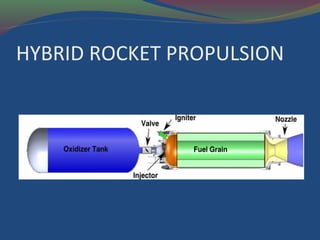
Hybrid rockets consists of pressure vessel contains
liquid oxygen.
The combustion chamber contains solid fuel and
valve isolate the two.
When thrust is desired a suitable ignition is
introduced into combustion chamber.
The liquid propellant flows into combustion chamber
where it is vaporized.
It reacts with the solid propellant occours in a
boundary layer diffusion flame adjacent to the surface
of the solid fuel.
HYBRID ROCKET OXIDIZERS
Oxidizers are used to throttle the rockets and to
restart the motor
Pressurizing the liquid oxidizer is not an important
element of hybrid technology.
Liquid oxidizer either can be cryogenic or non
cryogenic liquid depending upon the requirement.
The most common liquid oxidizer is nitrous oxide.
HYBRID ROCKET FUEL
The solid fuel is used as a fuel.
Solid fuels allows for the incorporation of the metal
additives to fuel grain increasing specific impulse .
The mass flow rate increases with increase in pressure
Burning rate increases with in pressure
If some amount of additional impurities , mass flow
rate decreases with increase in pressure but the
burning rate increases
Working
Liquid oxidizer which is stored in separate tank is
injected into the combustion chamber
When liquid oxidizer mixes with solid fuel in the
combustion chamber combustion takes place
When this happens very high temperature and
pressure gases are produced which comes out
through the nozzle section
Due to the high velocity gases comes out from the
nozzle thrust is produced
ADVANTAGES COMPARED WITH
SOLID ROCKETS
Higher theoretical ISP is obtained.
More controllable.
Less explosion hazard.
Safety during fabrication, storing and operation.
The ability to smoothly change motor thrust over a
wide range on demand.
Environmental safety
Disadvantages
Mixture ratio and hence specific impulse will vary
somewhat during steady state operation and
throttling
Lower density – Specific impulse than solid
propellants system
Some fuel sliver may be retained in the combustion
chamber at the end of burning which slightly reduces
the motor mass fraction
Unproven propulsion system in large scale
Oxidizer to fuel ratio shift
HYBRID ROCKET PROPULSION
LIQUID OXYGEN
Liquid oxygen is highly paramagnetic.
It has the density of 1.141kg/cm3.
It is highly cryogenic with the freezing point of 50.5k.
It has the boiling point of about 90.19k.
Liquid oxygen has expansion ratio 1:861 at 293k.
Liquid oxygen is highly useful because it creates a
very high specific impulse.
Paraffin wax
Paraffin wax has a typical melting point between
about 46 and 68 °C (115 and 154 °F), and having a
density of around 0.9 g/cm3.
Pure paraffin wax is an excellent electrical insulator,
with an electrical resistivity of between 1013 and 1017
ohm metre
Paraffin wax is an excellent material to store heat,
having a specific heat capacity of 2.14–2.9 J g−1 K−1
(joule per gram Kelvin) and a heat of fusion of 200–
220 J g−1.
Hybrid Safety
Pressure vessel failures - Chamber insulation
failure may allow hot combustion gases near the
chamber walls leading to a "burn-through" in which
the vessel ruptures.
Blow back - For oxidizers that decompose
exothermically.
Hard starts - An excess of oxidizer in the
combustion chamber prior to ignition.
Future aspects
This type of rockets are cheap and economic and can
be used in large scales
New type of solid fuels with high graininess can be
found and used in this rockets
Fuel and oxidizer ratio may be changed to increase
the performance
They can be used as short span power boosters in
space props
Conclusion
We have seen a small explanation about hybrid
rocket and its working.
 This type of rocket has many advantages over the
other type of rockets though it has some
disadvantages also.
 The rocket can be modified to overcome these
disadvantages.
Thus we conclude that hybrid rockets will play a
major role in propulsion in future.

Introduction to Hybrid Rockets

  • 1.
    Introduction to Hybrid Rockets Preparedfor a regular seminar classes
  • 2.
    ROCKET Rocket is amissile , space craft , aircraft or other vehicles that obtain thrust from the rocket engines Rocket engines are divided into three types based on their propellants They are 1. Solid Propellants 2. Liquid Propellants 3. Hybrid Propellants
  • 3.
    HYBRID ROCKET One componentpropellant is stored in liquid phase and other in solid phase are called Hybrid rockets. These rockets mostly employs a liquid oxidizer and solid fuel. Liquid oxidizers are used because solid oxidizers are problematic and lower performing than liquid. Solid fuels are used because of their higher density than liquid fuels. The main advantage of this rockets are mechanically simpler and denser fuels.
  • 4.
    BASIC CONCEPTS Hybrid rocketsconsists of pressure vessel contains liquid oxygen. The combustion chamber contains solid fuel and valve isolate the two. When thrust is desired a suitable ignition is introduced into combustion chamber. The liquid propellant flows into combustion chamber where it is vaporized. It reacts with the solid propellant occours in a boundary layer diffusion flame adjacent to the surface of the solid fuel.
  • 5.
    HYBRID ROCKET OXIDIZERS Oxidizersare used to throttle the rockets and to restart the motor Pressurizing the liquid oxidizer is not an important element of hybrid technology. Liquid oxidizer either can be cryogenic or non cryogenic liquid depending upon the requirement. The most common liquid oxidizer is nitrous oxide.
  • 6.
    HYBRID ROCKET FUEL Thesolid fuel is used as a fuel. Solid fuels allows for the incorporation of the metal additives to fuel grain increasing specific impulse . The mass flow rate increases with increase in pressure Burning rate increases with in pressure If some amount of additional impurities , mass flow rate decreases with increase in pressure but the burning rate increases
  • 7.
    Working Liquid oxidizer whichis stored in separate tank is injected into the combustion chamber When liquid oxidizer mixes with solid fuel in the combustion chamber combustion takes place When this happens very high temperature and pressure gases are produced which comes out through the nozzle section Due to the high velocity gases comes out from the nozzle thrust is produced
  • 8.
    ADVANTAGES COMPARED WITH SOLIDROCKETS Higher theoretical ISP is obtained. More controllable. Less explosion hazard. Safety during fabrication, storing and operation. The ability to smoothly change motor thrust over a wide range on demand. Environmental safety
  • 9.
    Disadvantages Mixture ratio andhence specific impulse will vary somewhat during steady state operation and throttling Lower density – Specific impulse than solid propellants system Some fuel sliver may be retained in the combustion chamber at the end of burning which slightly reduces the motor mass fraction Unproven propulsion system in large scale Oxidizer to fuel ratio shift
  • 10.
  • 11.
    LIQUID OXYGEN Liquid oxygenis highly paramagnetic. It has the density of 1.141kg/cm3. It is highly cryogenic with the freezing point of 50.5k. It has the boiling point of about 90.19k. Liquid oxygen has expansion ratio 1:861 at 293k. Liquid oxygen is highly useful because it creates a very high specific impulse.
  • 12.
    Paraffin wax Paraffin waxhas a typical melting point between about 46 and 68 °C (115 and 154 °F), and having a density of around 0.9 g/cm3. Pure paraffin wax is an excellent electrical insulator, with an electrical resistivity of between 1013 and 1017 ohm metre Paraffin wax is an excellent material to store heat, having a specific heat capacity of 2.14–2.9 J g−1 K−1 (joule per gram Kelvin) and a heat of fusion of 200– 220 J g−1.
  • 13.
    Hybrid Safety Pressure vesselfailures - Chamber insulation failure may allow hot combustion gases near the chamber walls leading to a "burn-through" in which the vessel ruptures. Blow back - For oxidizers that decompose exothermically. Hard starts - An excess of oxidizer in the combustion chamber prior to ignition.
  • 14.
    Future aspects This typeof rockets are cheap and economic and can be used in large scales New type of solid fuels with high graininess can be found and used in this rockets Fuel and oxidizer ratio may be changed to increase the performance They can be used as short span power boosters in space props
  • 15.
    Conclusion We have seena small explanation about hybrid rocket and its working.  This type of rocket has many advantages over the other type of rockets though it has some disadvantages also.  The rocket can be modified to overcome these disadvantages. Thus we conclude that hybrid rockets will play a major role in propulsion in future.