QUADCOPTER
CONTENTS
 Introduction
 Basic Materials Required
 Working Principle
 Block Diagram
 Circuit Diagram
 Advantages
 Disadvantages
 Applications
 References
INTRODUCTION
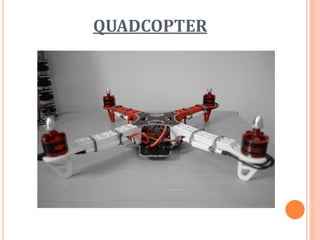
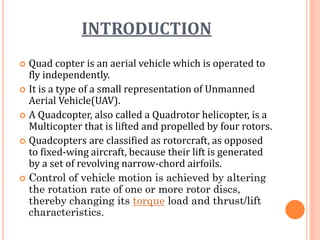
 Quad copter is an aerial vehicle which is operated to
fly independently.
 It is a type of a small representation of Unmanned
Aerial Vehicle(UAV).
 A Quadcopter, also called a Quadrotor helicopter, is a
Multicopter that is lifted and propelled by four rotors.
 Quadcopters are classified as rotorcraft, as opposed
to fixed-wing aircraft, because their lift is generated
by a set of revolving narrow-chord airfoils.
 Control of vehicle motion is achieved by altering
the rotation rate of one or more rotor discs,
thereby changing its torque load and thrust/lift
characteristics.
BASIC MATERIALS REQUIRED
 K.K. Multicontroller v.5.5
 Brushless Motors – 1200kV
 1.2 GHz Transmitter and Receiver
 Electronic Speed Controllers (ESC)
 Bullet Connectors
 Propellers
 Gyroscope
 Accelerometer
 A strong base as to hold the structure
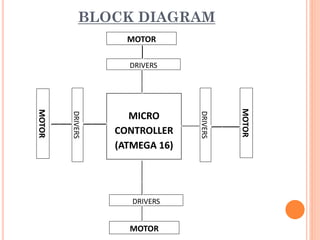
DRIVERS
DRIVERS
DRIVERS
DRIVERS
MOTOR
MOTOR
MOTOR
MOTOR
MICRO
CONTROLLER
(ATMEGA 16)
BLOCK DIAGRAM
WORKING PRINCIPLE
 Quadcopter is a device with a intense mixture of
Electronics, Mechanical and mainly on the principle of
Aviation.
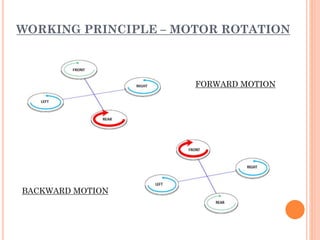
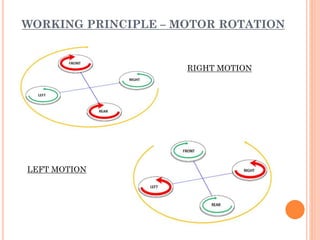
 The Quadcopter has 4 motors whose speed of rotation and
the direction of rotation changes according to the users
desire to move the device in a particular direction (i.e
Takeoff motion, Landing motion, Forward motion,
Backward motion, Left motion, Right Morion. )
 The rotation of Motors changes as per the transmitted
signal send from the 6-Channel transmitter.
 The program for which is written in the AT-MEGA 16 chip.
 The signal from microcontroller goes to ESC’s which
in turn control the speed of motor.
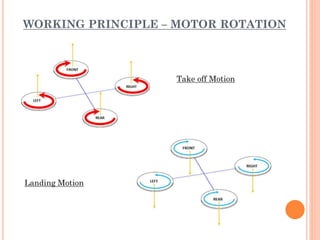
WORKING PRINCIPLE – MOTOR ROTATION
Take off Motion
Landing Motion
WORKING PRINCIPLE – MOTOR ROTATION
BACKWARD MOTION
FORWARD MOTION
WORKING PRINCIPLE – MOTOR ROTATION
RIGHT MOTION
LEFT MOTION
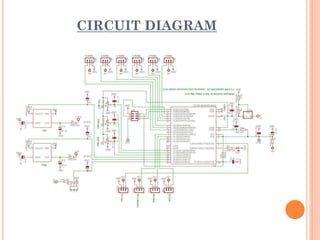
CIRCUIT DIAGRAM
ADVANTAGES
 Small-scale quad -copters have frames that
enclose the rotors, permitting flights through
more challenging environments, with lower risk
of damaging the vehicle or its surroundings.
 Small-scale UAV’s makes the vehicles safer for
close interaction.
 Quadcopters do not require mechanical linkages
to vary the rotor blade pitch angle as they spin.
This simplifies the design and maintenance of
the vehicle.
 The use of four rotors allows each individual
rotor to have a smaller diameter than the
equivalent helicopter rotor, allowing them to
possess less kinetic energy during flight.
DISADVANTAGES
 The most significant problem to date have been
an ambitious development schedule coupled with
very limited funds.
 The ambition is followed by complexity in
calculation and designing.
APPLICATIONS - MILITARY
 Quadcopter - Unmanned Arial Vehicle are used for
surveillance and reconnaissance by military and law
enforcement agencies, as well as search and rescue
missions in urban environments.
 One such example is the Aeryon Scout, created by
Canadian company Aeryon Labs, which is a small UAV
that can quietly hover in place and use a camera to observe
people and objects on the ground. The company claims that
the machine played a key role in a drug bust in Central
America by providing visual surveillance of a Drug
Traffickers compound deep in the jungle (Aeryon won't
reveal the country's name and other specifics).
APPLICATIONS – COMMERCIAL
 The largest use of Quadcopters has been in the
field of aerial imagery although, in the USA, it is
currently illegal to use remote controlled vehicles
for commercial purposes. Quadcopter UAVs are
suitable for this job because of their autonomous
nature and huge cost savings.
 Quadcopters are now used in India for the same
applications.
 One such example was Zee Cine Awards held in
2013 used Quadcopter for shooting the award
function for better viewing from the top.
REFERENCES
 Google.
 Wikipedia.
 Reference from Manish Parekh.
Quadcopter

Quadcopter

  • 2.
  • 3.
    CONTENTS  Introduction  BasicMaterials Required  Working Principle  Block Diagram  Circuit Diagram  Advantages  Disadvantages  Applications  References
  • 4.
    INTRODUCTION  Quad copteris an aerial vehicle which is operated to fly independently.  It is a type of a small representation of Unmanned Aerial Vehicle(UAV).  A Quadcopter, also called a Quadrotor helicopter, is a Multicopter that is lifted and propelled by four rotors.  Quadcopters are classified as rotorcraft, as opposed to fixed-wing aircraft, because their lift is generated by a set of revolving narrow-chord airfoils.  Control of vehicle motion is achieved by altering the rotation rate of one or more rotor discs, thereby changing its torque load and thrust/lift characteristics.
  • 5.
    BASIC MATERIALS REQUIRED K.K. Multicontroller v.5.5  Brushless Motors – 1200kV  1.2 GHz Transmitter and Receiver  Electronic Speed Controllers (ESC)  Bullet Connectors  Propellers  Gyroscope  Accelerometer  A strong base as to hold the structure
  • 6.
  • 7.
    WORKING PRINCIPLE  Quadcopteris a device with a intense mixture of Electronics, Mechanical and mainly on the principle of Aviation.  The Quadcopter has 4 motors whose speed of rotation and the direction of rotation changes according to the users desire to move the device in a particular direction (i.e Takeoff motion, Landing motion, Forward motion, Backward motion, Left motion, Right Morion. )  The rotation of Motors changes as per the transmitted signal send from the 6-Channel transmitter.  The program for which is written in the AT-MEGA 16 chip.  The signal from microcontroller goes to ESC’s which in turn control the speed of motor.
  • 8.
    WORKING PRINCIPLE –MOTOR ROTATION Take off Motion Landing Motion
  • 9.
    WORKING PRINCIPLE –MOTOR ROTATION BACKWARD MOTION FORWARD MOTION
  • 10.
    WORKING PRINCIPLE –MOTOR ROTATION RIGHT MOTION LEFT MOTION
  • 11.
  • 12.
    ADVANTAGES  Small-scale quad-copters have frames that enclose the rotors, permitting flights through more challenging environments, with lower risk of damaging the vehicle or its surroundings.  Small-scale UAV’s makes the vehicles safer for close interaction.  Quadcopters do not require mechanical linkages to vary the rotor blade pitch angle as they spin. This simplifies the design and maintenance of the vehicle.  The use of four rotors allows each individual rotor to have a smaller diameter than the equivalent helicopter rotor, allowing them to possess less kinetic energy during flight.
  • 13.
    DISADVANTAGES  The mostsignificant problem to date have been an ambitious development schedule coupled with very limited funds.  The ambition is followed by complexity in calculation and designing.
  • 14.
    APPLICATIONS - MILITARY Quadcopter - Unmanned Arial Vehicle are used for surveillance and reconnaissance by military and law enforcement agencies, as well as search and rescue missions in urban environments.  One such example is the Aeryon Scout, created by Canadian company Aeryon Labs, which is a small UAV that can quietly hover in place and use a camera to observe people and objects on the ground. The company claims that the machine played a key role in a drug bust in Central America by providing visual surveillance of a Drug Traffickers compound deep in the jungle (Aeryon won't reveal the country's name and other specifics).
  • 15.
    APPLICATIONS – COMMERCIAL The largest use of Quadcopters has been in the field of aerial imagery although, in the USA, it is currently illegal to use remote controlled vehicles for commercial purposes. Quadcopter UAVs are suitable for this job because of their autonomous nature and huge cost savings.  Quadcopters are now used in India for the same applications.  One such example was Zee Cine Awards held in 2013 used Quadcopter for shooting the award function for better viewing from the top.
  • 16.
    REFERENCES  Google.  Wikipedia. Reference from Manish Parekh.