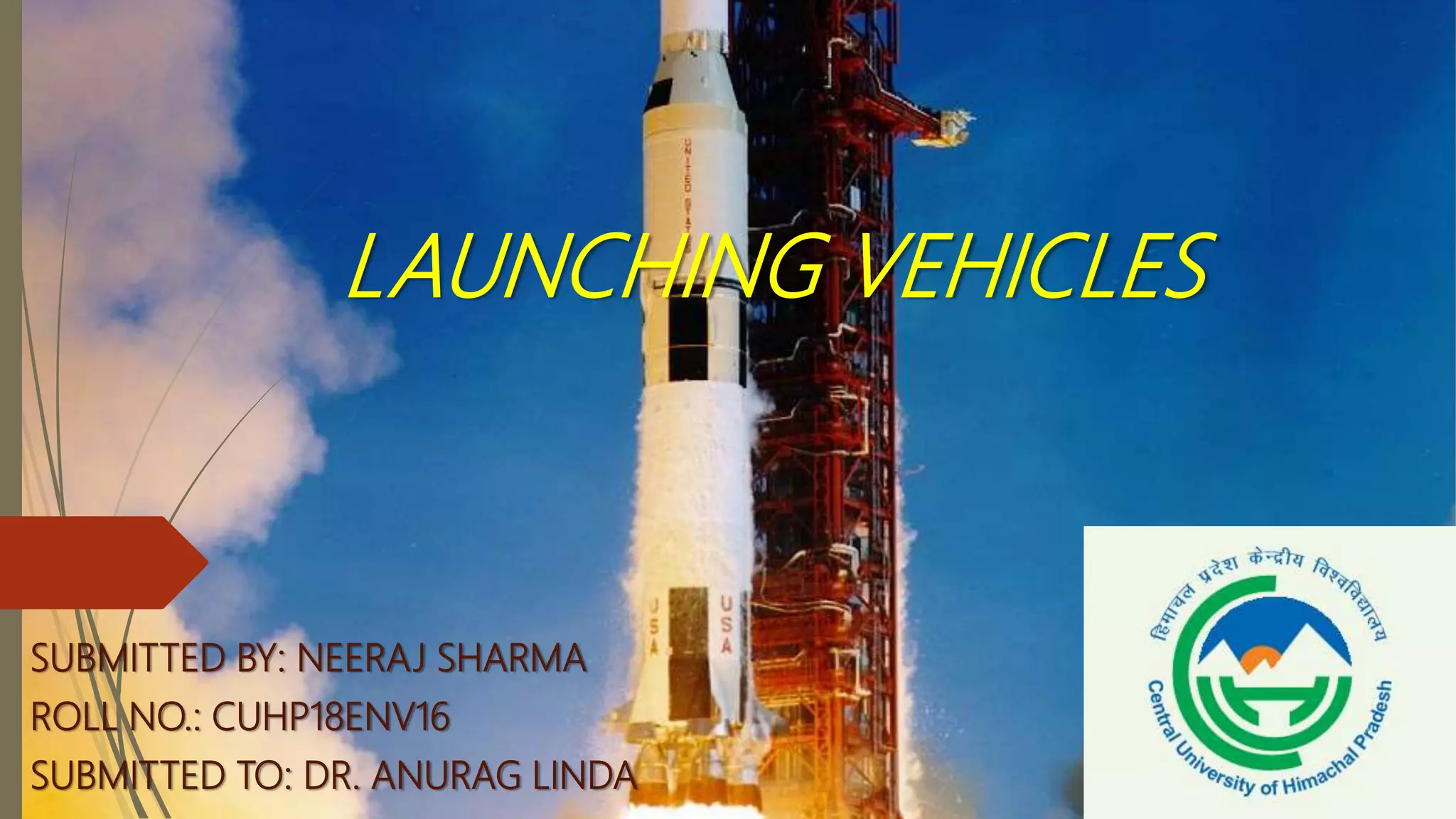
LAUNCHING VEHICLES
SUBMITTED BY: NEERAJ SHARMA
ROLL NO.: CUHP18ENV16
SUBMITTED TO: DR. ANURAG LINDA
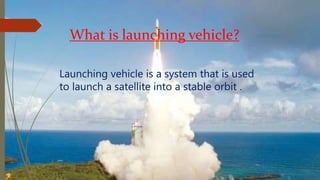
What is launching vehicle?
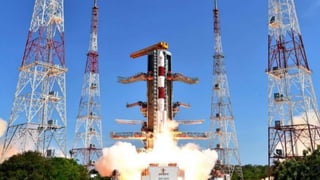
Launching vehicle is a system that is used
to launch a satellite into a stable orbit .
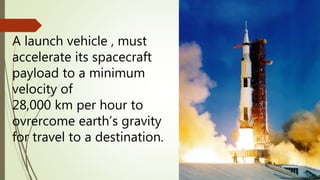
A launch vehicle , must
accelerate its spacecraft
payload to a minimum
velocity of
28,000 km per hour to
ovrercome earth’s gravity
for travel to a destination.
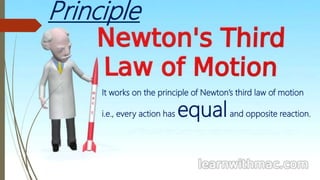
It works on the principle of Newton’s third law of motion
i.e., every action has equaland opposite reaction.
Principle
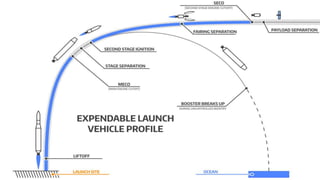
TYPES• Expendable launch vehicles are designed for one-time use. They usually
separate from their payload and disintegrate during atmospheric reentry.
• Reusable launch vehicles are designed to be recovered intact and
launched again. The Space Shuttle was a launch vehicle with components used for
multiple orbital space flights.
• Launch vehicles are often classified by the amount of mass they can carry into orbit.
example, a Proton rocket can lift 22,000 kilograms into low Earth orbit(LEO). Launch
vehicles are also characterized by their number of stages. Rockets with as many as five
stages have been successfully launched, and there have been designs for several
stage-to-orbit vehicles. Additionally, launch vehicles are very often supplied with
supplying high early thrust, normally burning with other engines. Boosters allow the
remaining engines to be smaller, reducing the burnout mass of later stages to allow
larger payloads.
• Other frequently-reported characteristics of launch vehicles are the launching nation
space agency and the company or consortium manufacturing and launching the
A launch vehicle is a good illustration of Newton’s third law of motion,
“For every action, there is an equal and opposite reaction.” In the case of a
launch vehicle, the “action” is the flow out the rear of the vehicle of
exhaust gases produced by the combustion of the vehicle’s fuel in its
rocket engine, and the “reaction” is the pressure, called thrust, applied to
the internal structure of the launch vehicle that pushes it in the direction
opposite to the exhaust flow. Unlike jet engines, which operate on the
same action-reaction principle but obtain the oxygen needed for burning
their fuel from the atmosphere, rockets carry with them their own
oxidizing agent. In that way, they can operate in the vacuum beyond the
atmosphere.
HOW A LAUNCH VEHICLE WORKS?
• The primary goal of launch vehicle designers is to maximize the vehicle’s
weight-lifting capability while at the same time providing an adequate level of
reliability at an acceptable cost. Achieving a balance among these three factors is
challenging. In order for the launch vehicle to lift off of Earth, its upward thrust
must be greater than the combined weight of its spacecraft payload, the vehicle’s
propellants, and its structure. This puts a premium on making the vehicle’s
mechanical structure, fuel tanks, and rocket engines as light as possible but
strong enough to withstand the forces and stresses associated with rapid
acceleration through a resistant atmosphere. Most often, propellant makes up 80
percent or more of the total weight of a launch vehicle– spacecraft combination
prior to launch.
HOW A LAUNCH VEHICLE WORKS?
Types of launching
vehicles
Classified based on propellants used:
1.Solid rockets
2.Liquid rockets
3.Hybrid rockets
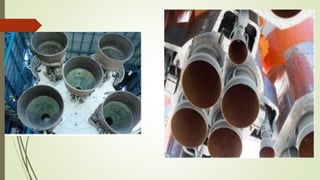
The fuel used to power rockets can be divided into two broad categories: liquid and
solid.
• Liquid fuels can range from a widely available substance such as ordinary kerosene,
which can be used at ground temperature, to liquid hydrogen, which must be
maintained at the extremely low temperature of 20 °K .In order to burn, liquid rocket
fuel must be mixed in the combustion chamber of a rocket engine with an oxygen-rich
substance, called an oxidizer. The oxidizer usually used with both kerosene and liquid
hydrogen is liquid oxygen . Oxygen must be kept at a temperature less than −183 °C
in order to remain in a liquid state. The oxidizer used with hypergolic fuel is usually
nitrogen tetroxide or nitric acid.
• Liquid-fuel rocket engines are complex machines. In order to reach maximum
efficiency, both fuel and oxidizer must be pumped into the engine’s combustion
chamber at high rates, under high pressure, and in suitable mixtures.
FUEL
solid-propellant rocket motors are simple in design, in many ways resembling large
fireworks. They consist of a casing filled with a rubbery mixture of solid compounds
(both fuel and oxidizer) that burn at a rapid rate after ignition. The fuel is usually some
organic material or powdered aluminum; the oxidizer is most often ammonium
perchlorate. These are mixed together and are cured with a binder to form the rocket
propellant. Solid rocket motors are most often used as strap-ones to the liquid-fueled
first stage of a launch vehicle to provide additional thrust during liftoff and the first few
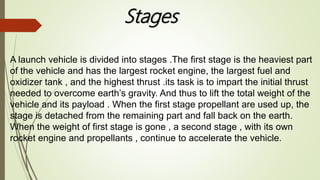
minutes of flight .The exhaust from the burning of the fuel emerges through a nozzle at
the bottom of the rocket casing, and that nozzle shapes and accelerates the exhaust to
provide the reactive forward thrust.
FUEL
Stages
A launch vehicle is divided into stages .The first stage is the heaviest part
of the vehicle and has the largest rocket engine, the largest fuel and
oxidizer tank , and the highest thrust .its task is to impart the initial thrust
needed to overcome earth’s gravity. And thus to lift the total weight of the
vehicle and its payload . When the first stage propellant are used up, the
stage is detached from the remaining part and fall back on the earth.
When the weight of first stage is gone , a second stage , with its own
rocket engine and propellants , continue to accelerate the vehicle.
Launch vehicles recently used
by ISRO
1. SLV
2. ASLV
3. PSLV
4. GSLV
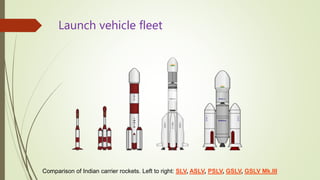
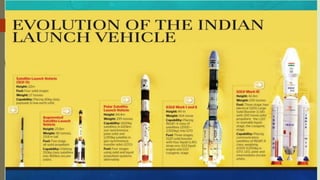
Launch vehicle fleet
Comparison of Indian carrier rockets. Left to right: SLV, ASLV, PSLV, GSLV, GSLV Mk.III
Usually known by its abbreviation SLV or SLV-3 was a
4-stage solid-fuel light launcher.
It was intended to reach a height of 500 km and carry a
payload of 40 kg.
Its first launch took place in 1979 with 2 more in each
subsequent year, and the final launch in 1983.
Only two of its four test flights were successful
Satellite Launch Vehicle (SLV)
ASLV (Augmented
satellite launch vehicle)
• Development in the traditional
SLV
• Due to incorporation of boosters
• It consisted of more than one
stage.
• It was designed to carry payload up to 150 kg.
PSLV
• Employed to place a satellite in
polar orbit
• Satellites are particularly useful
remote sensing, earth atmospheric
conditions
•Its first launch took place in
September 20 , 1993
•It can carry payload up to
GSLV
• It is employed to place satellite in the
geostationary orbit
• First launch April 18th 2001
• Telecommunication, environmental
monitoring, navigation, remote sensing
etc.
•It can carry payload up to 4,000 kg.
Launching vehicles

Launching vehicles

  • 1.
    LAUNCHING VEHICLES SUBMITTED BY:NEERAJ SHARMA ROLL NO.: CUHP18ENV16 SUBMITTED TO: DR. ANURAG LINDA
  • 2.
    What is launchingvehicle? Launching vehicle is a system that is used to launch a satellite into a stable orbit .
  • 3.
    A launch vehicle, must accelerate its spacecraft payload to a minimum velocity of 28,000 km per hour to ovrercome earth’s gravity for travel to a destination.
  • 4.
    It works onthe principle of Newton’s third law of motion i.e., every action has equaland opposite reaction. Principle
  • 5.
    TYPES• Expendable launchvehicles are designed for one-time use. They usually separate from their payload and disintegrate during atmospheric reentry. • Reusable launch vehicles are designed to be recovered intact and launched again. The Space Shuttle was a launch vehicle with components used for multiple orbital space flights. • Launch vehicles are often classified by the amount of mass they can carry into orbit. example, a Proton rocket can lift 22,000 kilograms into low Earth orbit(LEO). Launch vehicles are also characterized by their number of stages. Rockets with as many as five stages have been successfully launched, and there have been designs for several stage-to-orbit vehicles. Additionally, launch vehicles are very often supplied with supplying high early thrust, normally burning with other engines. Boosters allow the remaining engines to be smaller, reducing the burnout mass of later stages to allow larger payloads. • Other frequently-reported characteristics of launch vehicles are the launching nation space agency and the company or consortium manufacturing and launching the
  • 6.
    A launch vehicleis a good illustration of Newton’s third law of motion, “For every action, there is an equal and opposite reaction.” In the case of a launch vehicle, the “action” is the flow out the rear of the vehicle of exhaust gases produced by the combustion of the vehicle’s fuel in its rocket engine, and the “reaction” is the pressure, called thrust, applied to the internal structure of the launch vehicle that pushes it in the direction opposite to the exhaust flow. Unlike jet engines, which operate on the same action-reaction principle but obtain the oxygen needed for burning their fuel from the atmosphere, rockets carry with them their own oxidizing agent. In that way, they can operate in the vacuum beyond the atmosphere. HOW A LAUNCH VEHICLE WORKS?
  • 7.
    • The primarygoal of launch vehicle designers is to maximize the vehicle’s weight-lifting capability while at the same time providing an adequate level of reliability at an acceptable cost. Achieving a balance among these three factors is challenging. In order for the launch vehicle to lift off of Earth, its upward thrust must be greater than the combined weight of its spacecraft payload, the vehicle’s propellants, and its structure. This puts a premium on making the vehicle’s mechanical structure, fuel tanks, and rocket engines as light as possible but strong enough to withstand the forces and stresses associated with rapid acceleration through a resistant atmosphere. Most often, propellant makes up 80 percent or more of the total weight of a launch vehicle– spacecraft combination prior to launch. HOW A LAUNCH VEHICLE WORKS?
  • 8.
    Types of launching vehicles Classifiedbased on propellants used: 1.Solid rockets 2.Liquid rockets 3.Hybrid rockets
  • 9.
    The fuel usedto power rockets can be divided into two broad categories: liquid and solid. • Liquid fuels can range from a widely available substance such as ordinary kerosene, which can be used at ground temperature, to liquid hydrogen, which must be maintained at the extremely low temperature of 20 °K .In order to burn, liquid rocket fuel must be mixed in the combustion chamber of a rocket engine with an oxygen-rich substance, called an oxidizer. The oxidizer usually used with both kerosene and liquid hydrogen is liquid oxygen . Oxygen must be kept at a temperature less than −183 °C in order to remain in a liquid state. The oxidizer used with hypergolic fuel is usually nitrogen tetroxide or nitric acid. • Liquid-fuel rocket engines are complex machines. In order to reach maximum efficiency, both fuel and oxidizer must be pumped into the engine’s combustion chamber at high rates, under high pressure, and in suitable mixtures. FUEL
  • 10.
    solid-propellant rocket motorsare simple in design, in many ways resembling large fireworks. They consist of a casing filled with a rubbery mixture of solid compounds (both fuel and oxidizer) that burn at a rapid rate after ignition. The fuel is usually some organic material or powdered aluminum; the oxidizer is most often ammonium perchlorate. These are mixed together and are cured with a binder to form the rocket propellant. Solid rocket motors are most often used as strap-ones to the liquid-fueled first stage of a launch vehicle to provide additional thrust during liftoff and the first few minutes of flight .The exhaust from the burning of the fuel emerges through a nozzle at the bottom of the rocket casing, and that nozzle shapes and accelerates the exhaust to provide the reactive forward thrust. FUEL
  • 13.
    Stages A launch vehicleis divided into stages .The first stage is the heaviest part of the vehicle and has the largest rocket engine, the largest fuel and oxidizer tank , and the highest thrust .its task is to impart the initial thrust needed to overcome earth’s gravity. And thus to lift the total weight of the vehicle and its payload . When the first stage propellant are used up, the stage is detached from the remaining part and fall back on the earth. When the weight of first stage is gone , a second stage , with its own rocket engine and propellants , continue to accelerate the vehicle.
  • 15.
    Launch vehicles recentlyused by ISRO 1. SLV 2. ASLV 3. PSLV 4. GSLV
  • 16.
    Launch vehicle fleet Comparisonof Indian carrier rockets. Left to right: SLV, ASLV, PSLV, GSLV, GSLV Mk.III
  • 17.
    Usually known byits abbreviation SLV or SLV-3 was a 4-stage solid-fuel light launcher. It was intended to reach a height of 500 km and carry a payload of 40 kg. Its first launch took place in 1979 with 2 more in each subsequent year, and the final launch in 1983. Only two of its four test flights were successful Satellite Launch Vehicle (SLV)
  • 18.
    ASLV (Augmented satellite launchvehicle) • Development in the traditional SLV • Due to incorporation of boosters • It consisted of more than one stage. • It was designed to carry payload up to 150 kg.
  • 19.
    PSLV • Employed toplace a satellite in polar orbit • Satellites are particularly useful remote sensing, earth atmospheric conditions •Its first launch took place in September 20 , 1993 •It can carry payload up to
  • 20.
    GSLV • It isemployed to place satellite in the geostationary orbit • First launch April 18th 2001 • Telecommunication, environmental monitoring, navigation, remote sensing etc. •It can carry payload up to 4,000 kg.