PRESENTED BY –
MITESH NAIK
INDEX
1)Introduction .
2)Working .
3)Applications:-
I. Torpedo .
II. RAMICS .
III. Supercavitating Propellor .
IV. Supercavitating Boat .
V. Supercavitating Ammunition .
Supercavitation is the use of cavitation effects to
create a bubble of gas inside a liquid large enough to
encompass an object travelling through the liquid, greatly
reducing the skin friction drag on the object and enabling
achievement of very high speeds.
Cavitation is the formation of vapour cavities in a liquid – i.e.
small liquid-free zones (bubbles or voids) – that are the
consequence of forces acting upon the liquid. It usually occurs
when a liquid is subjected to rapid changes of pressure that
cause the formation of cavities where the pressure is relatively
low. When subjected to higher pressure, the voids implode and
can generate an intense shockwave.
Cavitation becomes a blessing under a condition called
Supercavitation i.e., when a single cavity called supercavity is
formed enveloping the moving object almost completely. In
Supercavitation, the small gas bubbles produced by cavitation
expand and combine to form one large, stable, and predictable
bubble around the supercavitating object.
A SUPERCAVITATING OBJECT is a high speed submerged object that is
designed to initiate a cavitation bubble at the nose which extends
past the end of the object substantially reducing the skin friction drag
that would be present if the sides of the object were in contact with
the liquid in which the object is submerged. A key feature of the
supercavitating object is the nose (cavitator), which may be shaped
as a flat disk or cone behind which the cavitation bubble forms. If the
bubble is of insufficient length to encompass the object, especially at
slower speeds, the bubble can be enlarged and extended by
injection of high pressure gas near the object's nose.
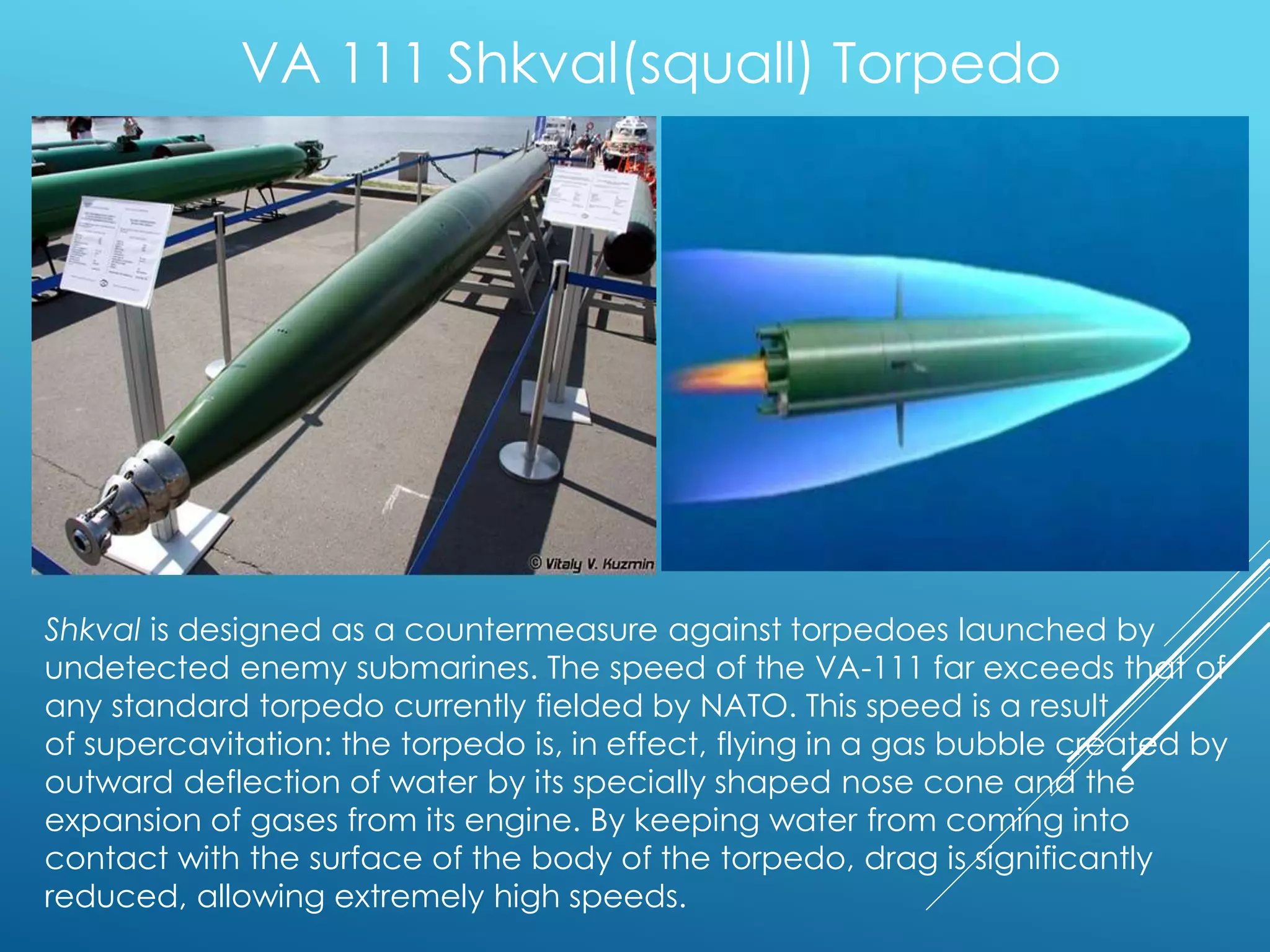
VA 111 Shkval(squall) Torpedo
Shkval is designed as a countermeasure against torpedoes launched by
undetected enemy submarines. The speed of the VA-111 far exceeds that of
any standard torpedo currently fielded by NATO. This speed is a result
of supercavitation: the torpedo is, in effect, flying in a gas bubble created by
outward deflection of water by its specially shaped nose cone and the
expansion of gases from its engine. By keeping water from coming into
contact with the surface of the body of the torpedo, drag is significantly
reduced, allowing extremely high speeds.
Launched from
533 mm torpedo tubes, the VA-
111 exits the tube at 50 knots
(93 km/h). Shortly afterwards,
its liquid-fuel rocket ignites and
propels it to speeds of up to 200
knots (370 km/h). The torpedo
controls its direction using four
fins that skim the inner surface
of the supercavitation
envelope. To change direction,
the fin or fins on the inside of
the desired turn are extended,
and the opposing fins are
retracted. To make faster turns,
the push plate on the nose can
be used to control the shape of
the bubble the missile is
traveling in.
Advantages :-
•Achieves very high speeds in short interval of time.
Disadvantages :-
• Produces large amount of sounds on attaining high speeds giving
up your location to the enemy
Hence this torpedoes can be used as the last shot to save
yourselves.
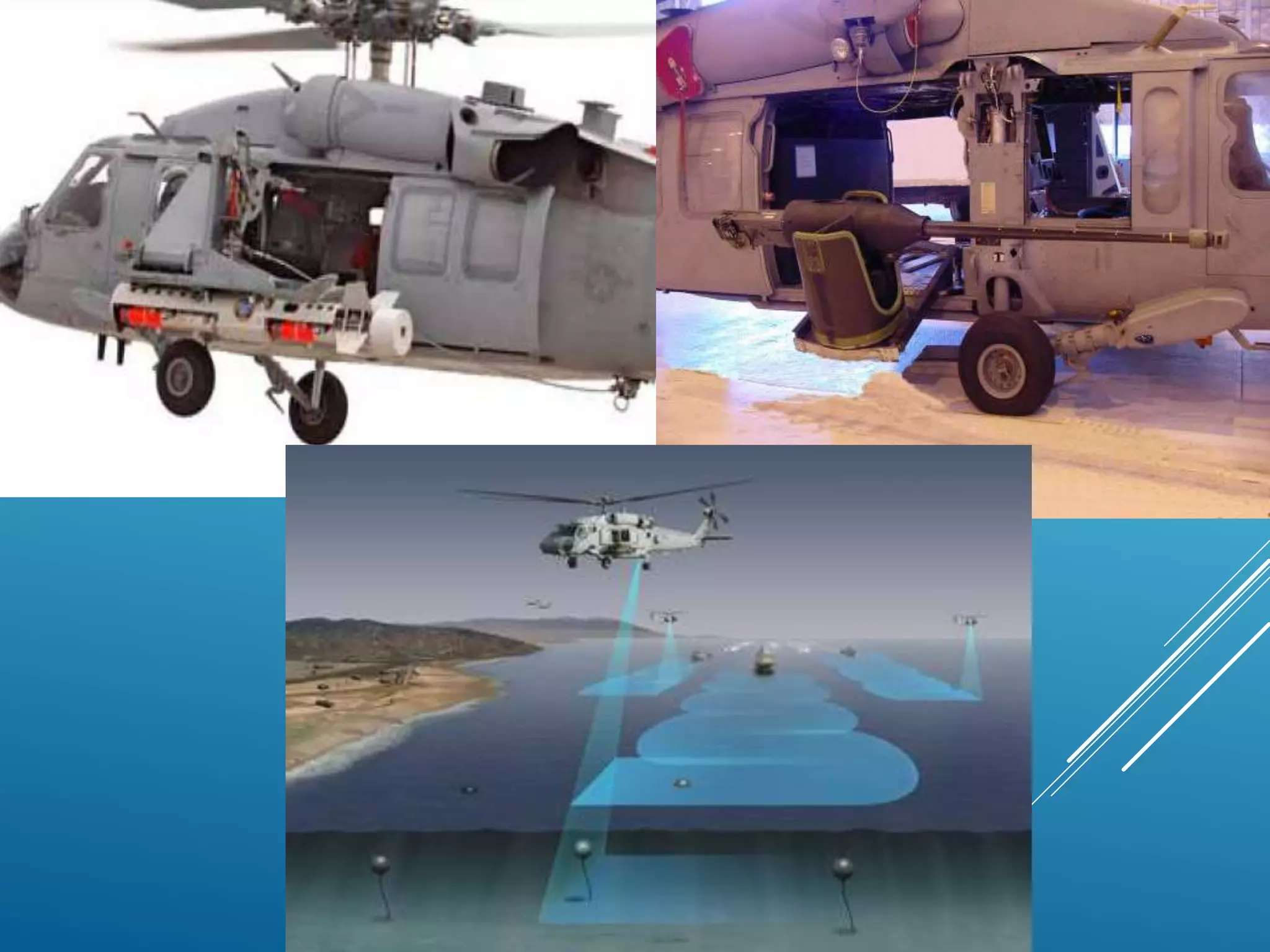
RAMICS uses a gated electro-optic Laser Imaging Detection and
Ranging sensor for target re-acquisition and a 30mm MK44 Bushmaster
II gun for neutralization.
The gun uses a MK 258 Mod 1 armor-piercing, fin-stabilized tracer round
which is stable during flight, and after penetrating the water,
supercavitates to greatly reduce drag and improves underwater flight
performance. Supercavitation takes place when the tip of the high
velocity RAMICS projectile vaporizes the water to steam allowing the
projectile to travel through the resulting gas pocket in the water column.
The accuracy of the system will destroy the mine with a minimum
number of rounds.
RAMICS
RAPID AIRBORNE MINE CLEARANCE SYSTEM
SUPERCAVITATING
PROPELLOR
The supercavitating propeller operates submerged with the
entire diameter of the blade below the water line. Its
blades are wedge-shaped to force cavitation at the
leading edge and to avoid water skin friction along the
whole forward face. As the cavity collapses well behind
the blade, the supercavitating propeller avoids the spalling
damage due to cavitation that is a problem with
conventional propellers.
Imagine a boat that moves through the water differently from any other
boat in existence. It uses “supercavitation”—the creation of a gaseous
bubble layer around the hull to reduce friction underwater—to reach
very high speeds at relatively low fuel cost. Its speed and shape means
it can evade detection by sonar or ship radar. It can outrun torpedoes.
Its fuel efficiency means it has greater range and can run longer
missions than conventional boats and helicopters.
Supercavitating Boat ‘GHOST’
The propellers are powered
by a modified gas turbine
— a jet engine — housed in
each foil; the air intake and
exhaust ports for the
engines are in the struts. As
the ship moves through the
water, the motion of the
propellers creates a thin
layer of bubbly water vapor
that surrounds each foil
from front to back, helped
along by the presence of
“air trap fins” that keep the
vapor in contact with the
hull (and keep liquid away
from the hull). The vapor is
what constitutes the
supercavitation, so the foils
can glide effortlessly
through the bubbles.
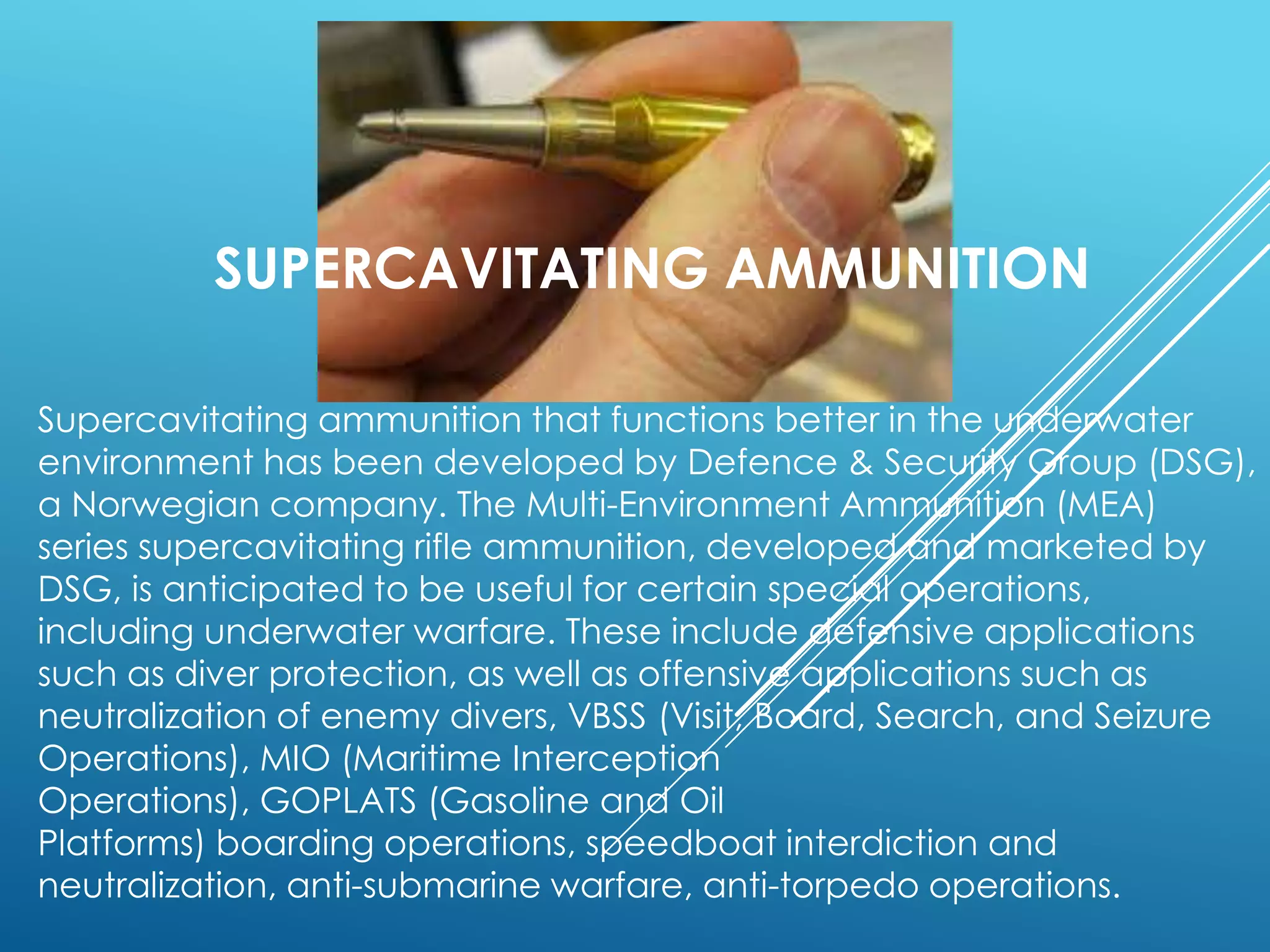
Supercavitating ammunition that functions better in the underwater
environment has been developed by Defence & Security Group (DSG),
a Norwegian company. The Multi-Environment Ammunition (MEA)
series supercavitating rifle ammunition, developed and marketed by
DSG, is anticipated to be useful for certain special operations,
including underwater warfare. These include defensive applications
such as diver protection, as well as offensive applications such as
neutralization of enemy divers, VBSS (Visit, Board, Search, and Seizure
Operations), MIO (Maritime Interception
Operations), GOPLATS (Gasoline and Oil
Platforms) boarding operations, speedboat interdiction and
neutralization, anti-submarine warfare, anti-torpedo operations.
SUPERCAVITATING AMMUNITION
The ballistic characteristics of MEA series ammunition allows the user
to fire at an underwater target from above the water, an above-the-
water target from below the surface, or from an underwater location
at a target which is also underwater. This ammunition allows the user
to fire from above the surface into the water at a very low angle of
incidence. After entering the water, the bullet will continue its original
trajectory. The user does however need to compensate for the
refractive index of the water (roughly 1.333 for fresh water at 20 °C).
Any questions ?

SUPERCAVITATION

  • 1.
  • 2.
    INDEX 1)Introduction . 2)Working . 3)Applications:- I.Torpedo . II. RAMICS . III. Supercavitating Propellor . IV. Supercavitating Boat . V. Supercavitating Ammunition .
  • 3.
    Supercavitation is theuse of cavitation effects to create a bubble of gas inside a liquid large enough to encompass an object travelling through the liquid, greatly reducing the skin friction drag on the object and enabling achievement of very high speeds.
  • 4.
    Cavitation is theformation of vapour cavities in a liquid – i.e. small liquid-free zones (bubbles or voids) – that are the consequence of forces acting upon the liquid. It usually occurs when a liquid is subjected to rapid changes of pressure that cause the formation of cavities where the pressure is relatively low. When subjected to higher pressure, the voids implode and can generate an intense shockwave.
  • 6.
    Cavitation becomes ablessing under a condition called Supercavitation i.e., when a single cavity called supercavity is formed enveloping the moving object almost completely. In Supercavitation, the small gas bubbles produced by cavitation expand and combine to form one large, stable, and predictable bubble around the supercavitating object.
  • 7.
    A SUPERCAVITATING OBJECTis a high speed submerged object that is designed to initiate a cavitation bubble at the nose which extends past the end of the object substantially reducing the skin friction drag that would be present if the sides of the object were in contact with the liquid in which the object is submerged. A key feature of the supercavitating object is the nose (cavitator), which may be shaped as a flat disk or cone behind which the cavitation bubble forms. If the bubble is of insufficient length to encompass the object, especially at slower speeds, the bubble can be enlarged and extended by injection of high pressure gas near the object's nose.
  • 8.
    VA 111 Shkval(squall)Torpedo Shkval is designed as a countermeasure against torpedoes launched by undetected enemy submarines. The speed of the VA-111 far exceeds that of any standard torpedo currently fielded by NATO. This speed is a result of supercavitation: the torpedo is, in effect, flying in a gas bubble created by outward deflection of water by its specially shaped nose cone and the expansion of gases from its engine. By keeping water from coming into contact with the surface of the body of the torpedo, drag is significantly reduced, allowing extremely high speeds.
  • 9.
    Launched from 533 mmtorpedo tubes, the VA- 111 exits the tube at 50 knots (93 km/h). Shortly afterwards, its liquid-fuel rocket ignites and propels it to speeds of up to 200 knots (370 km/h). The torpedo controls its direction using four fins that skim the inner surface of the supercavitation envelope. To change direction, the fin or fins on the inside of the desired turn are extended, and the opposing fins are retracted. To make faster turns, the push plate on the nose can be used to control the shape of the bubble the missile is traveling in.
  • 10.
    Advantages :- •Achieves veryhigh speeds in short interval of time. Disadvantages :- • Produces large amount of sounds on attaining high speeds giving up your location to the enemy Hence this torpedoes can be used as the last shot to save yourselves.
  • 11.
    RAMICS uses agated electro-optic Laser Imaging Detection and Ranging sensor for target re-acquisition and a 30mm MK44 Bushmaster II gun for neutralization. The gun uses a MK 258 Mod 1 armor-piercing, fin-stabilized tracer round which is stable during flight, and after penetrating the water, supercavitates to greatly reduce drag and improves underwater flight performance. Supercavitation takes place when the tip of the high velocity RAMICS projectile vaporizes the water to steam allowing the projectile to travel through the resulting gas pocket in the water column. The accuracy of the system will destroy the mine with a minimum number of rounds. RAMICS RAPID AIRBORNE MINE CLEARANCE SYSTEM
  • 13.
    SUPERCAVITATING PROPELLOR The supercavitating propelleroperates submerged with the entire diameter of the blade below the water line. Its blades are wedge-shaped to force cavitation at the leading edge and to avoid water skin friction along the whole forward face. As the cavity collapses well behind the blade, the supercavitating propeller avoids the spalling damage due to cavitation that is a problem with conventional propellers.
  • 14.
    Imagine a boatthat moves through the water differently from any other boat in existence. It uses “supercavitation”—the creation of a gaseous bubble layer around the hull to reduce friction underwater—to reach very high speeds at relatively low fuel cost. Its speed and shape means it can evade detection by sonar or ship radar. It can outrun torpedoes. Its fuel efficiency means it has greater range and can run longer missions than conventional boats and helicopters. Supercavitating Boat ‘GHOST’
  • 15.
    The propellers arepowered by a modified gas turbine — a jet engine — housed in each foil; the air intake and exhaust ports for the engines are in the struts. As the ship moves through the water, the motion of the propellers creates a thin layer of bubbly water vapor that surrounds each foil from front to back, helped along by the presence of “air trap fins” that keep the vapor in contact with the hull (and keep liquid away from the hull). The vapor is what constitutes the supercavitation, so the foils can glide effortlessly through the bubbles.
  • 16.
    Supercavitating ammunition thatfunctions better in the underwater environment has been developed by Defence & Security Group (DSG), a Norwegian company. The Multi-Environment Ammunition (MEA) series supercavitating rifle ammunition, developed and marketed by DSG, is anticipated to be useful for certain special operations, including underwater warfare. These include defensive applications such as diver protection, as well as offensive applications such as neutralization of enemy divers, VBSS (Visit, Board, Search, and Seizure Operations), MIO (Maritime Interception Operations), GOPLATS (Gasoline and Oil Platforms) boarding operations, speedboat interdiction and neutralization, anti-submarine warfare, anti-torpedo operations. SUPERCAVITATING AMMUNITION
  • 17.
    The ballistic characteristicsof MEA series ammunition allows the user to fire at an underwater target from above the water, an above-the- water target from below the surface, or from an underwater location at a target which is also underwater. This ammunition allows the user to fire from above the surface into the water at a very low angle of incidence. After entering the water, the bullet will continue its original trajectory. The user does however need to compensate for the refractive index of the water (roughly 1.333 for fresh water at 20 °C).
  • 18.