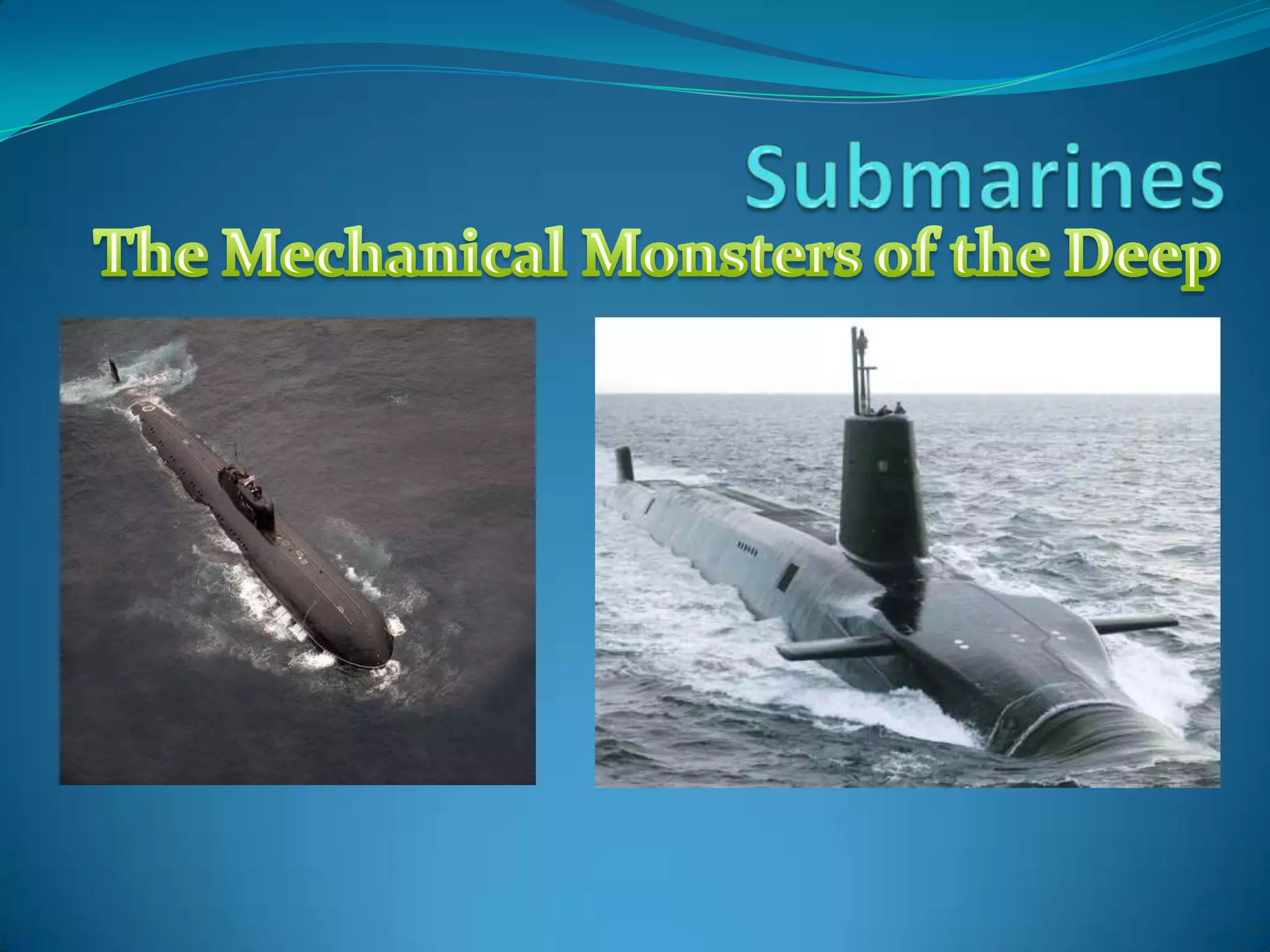
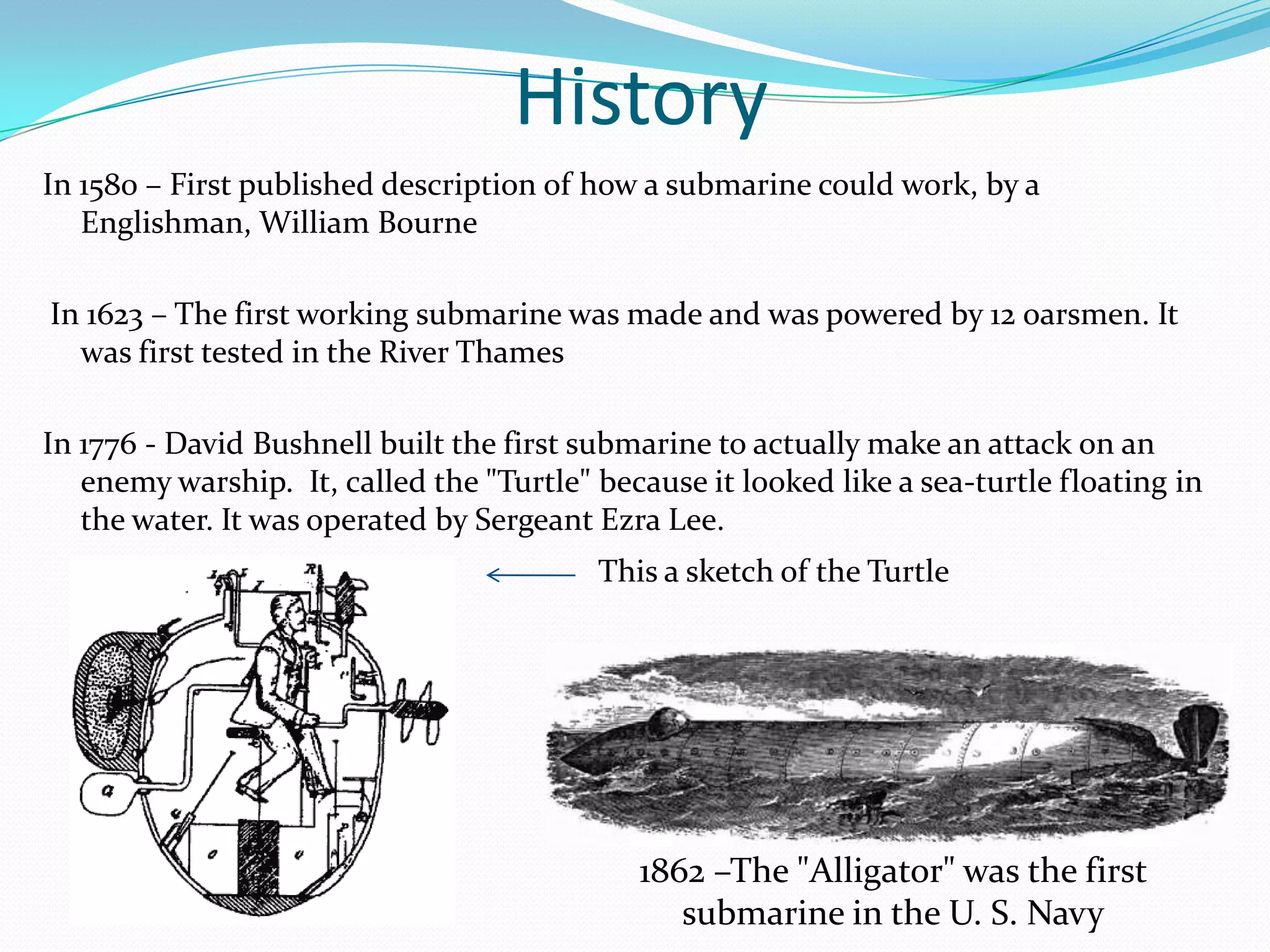
SubmarinesThe Mechanical Monsters of the Deep
The History
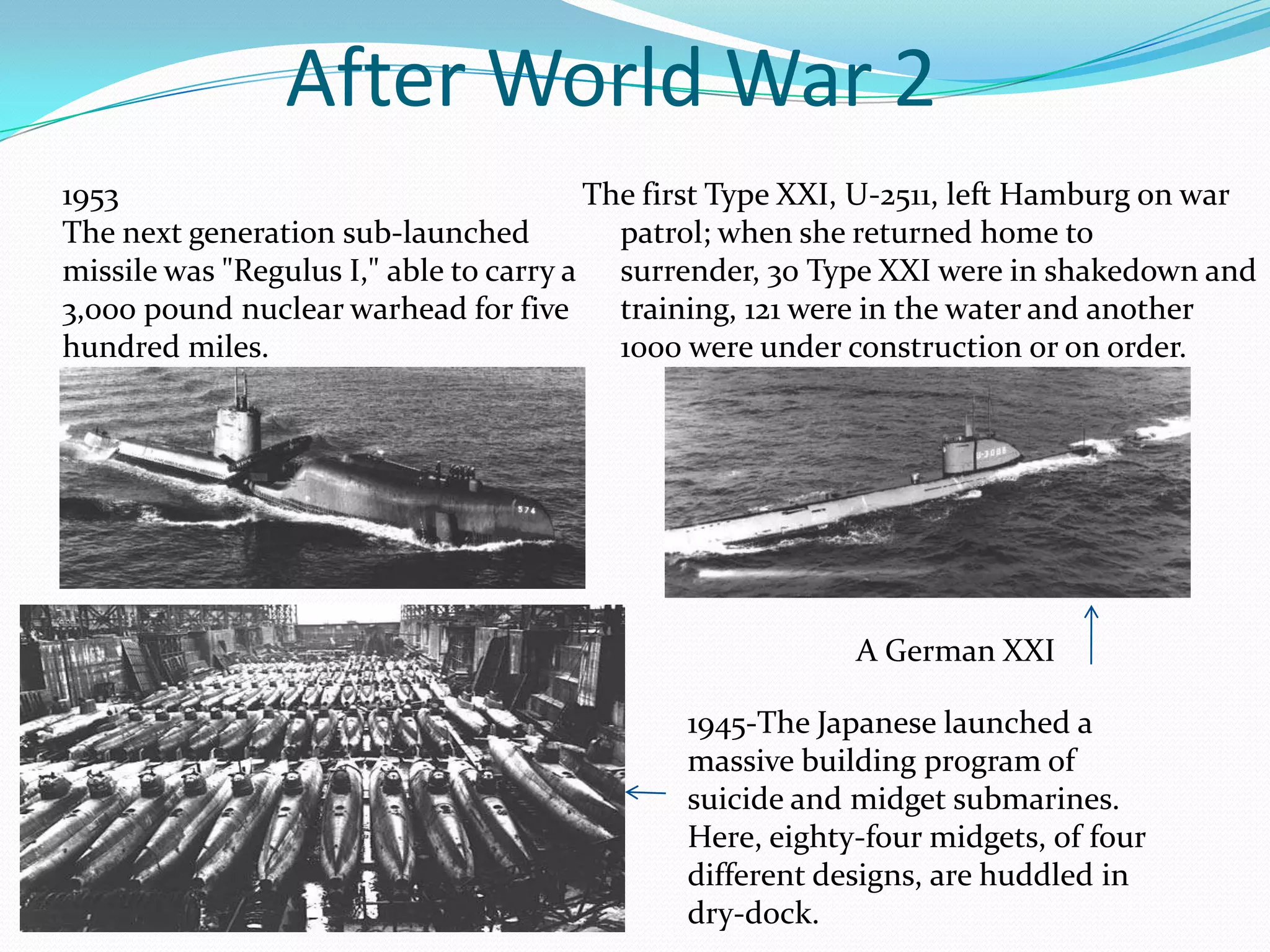
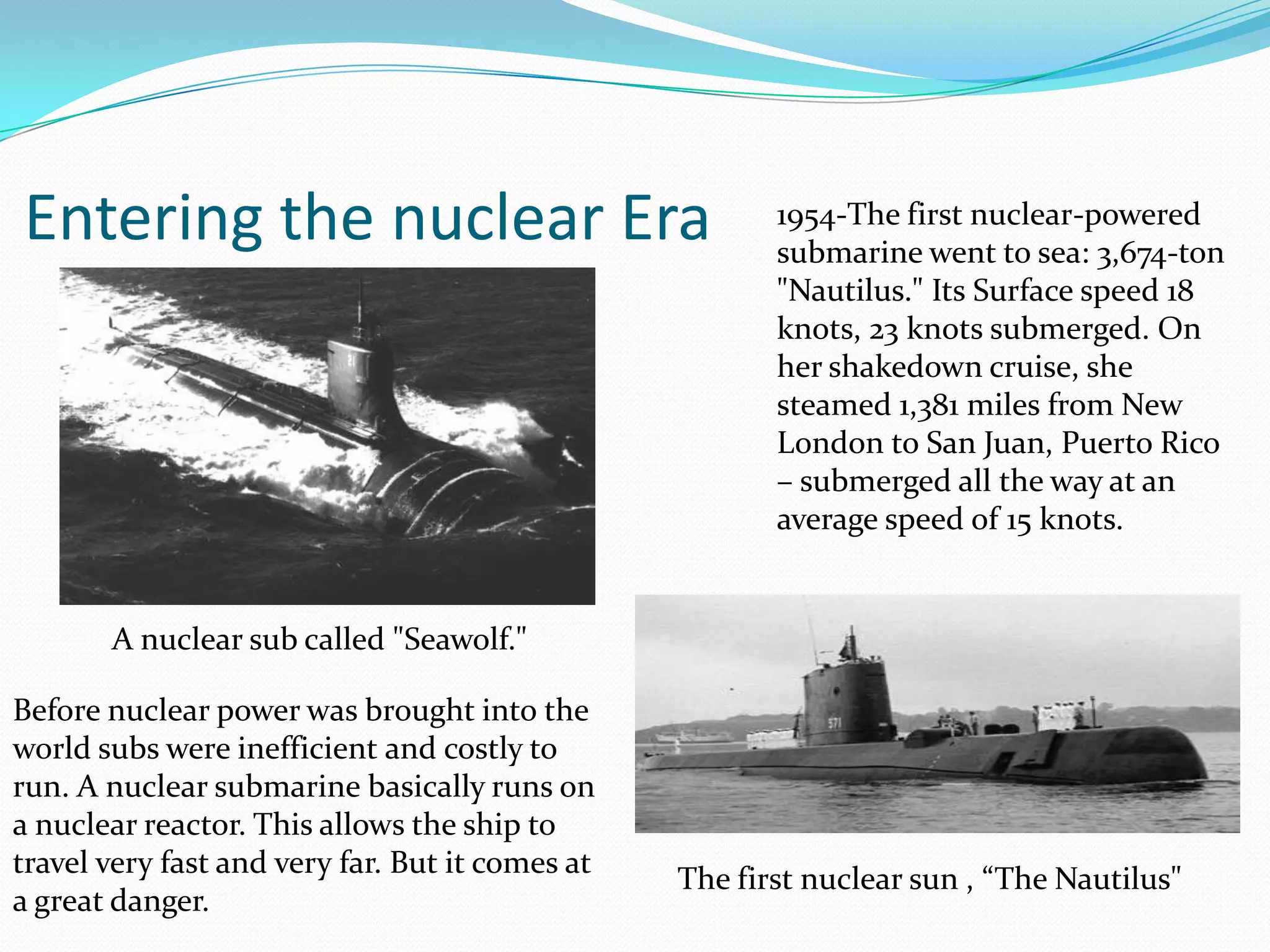
HistoryIn 1580 – First published description of how a submarine could work, by a Englishman, William Bourne In 1623 – The first working submarine was made and was powered by 12 oarsmen. It was first tested in the River ThamesIn 1776 - David Bushnell built the first submarine to actually make an attack on an enemy warship.  It, called the "Turtle" because it looked like a sea-turtle floating in the water. It was operated by Sergeant Ezra Lee. This a sketch of the Turtle 1862 –The "Alligator" was the first submarine in the U. S. Navy
History In 1885, “Nordenfeldt I” was launched, a steam powered submarine with an external torpedo tubeIn 1900, Britain navy had theuse of 5 submarines. However, many thought the use of these machines to be “underhand, unfair and un-English”. In 1906, the first German “u-boat” was launched
The rise off World War 1In the first world war submarines began to be recognised as lethal. Submarines were a recent invention but they were advanced nevertheless.	German U Boats were the first truly effective submarines. They wrecked havoc on British and Allied warships and shipping. This is the final German U-Boat
World War 21939 – 1945-When  the Second World War broke out submarines were used often. Italy joined Germany in June, bringing 105 submarines to the Mediterranean theatre. Luckily they did not have much impact.In August  1941, U-570 became the first and the only submarine ever captured by an aircraft; under attack, she was forced to the surface and surrendered. An escort ship soon arrived and took over. U-570 was thus transferred to the Royal navy, where, re-designated as "Graph.”1935 the first of a new series, U-1, entered service and there was soon 16 u-boats in service
After World War 2The first Type XXI, U-2511, left Hamburg on war patrol; when she returned home to surrender, 30 Type XXI were in shakedown and training, 121 were in the water and another 1000 were under construction or on order. 1953 The next generation sub-launched missile was "Regulus I," able to carry a 3,000 pound nuclear warhead for five hundred miles. A German XXI 1945-The Japanese launched a massive building program of suicide and midget submarines.Here, eighty-four midgets, of four different designs, are huddled in dry-dock.
Entering the nuclear Era1954-The first nuclear-powered submarine went to sea: 3,674-ton "Nautilus." Its Surface speed 18 knots, 23 knots submerged. On her shakedown cruise, she steamed 1,381 miles from New London to San Juan, Puerto Rico – submerged all the way at an average speed of 15 knots.A nuclear sub called "Seawolf." Before nuclear power was brought into the world subs were inefficient and costly to run. A nuclear submarine basically runs on a nuclear reactor. This allows the ship to travel very fast and very far. But it comes at a great danger.The first nuclear sun , “The Nautilus"
Submersibles
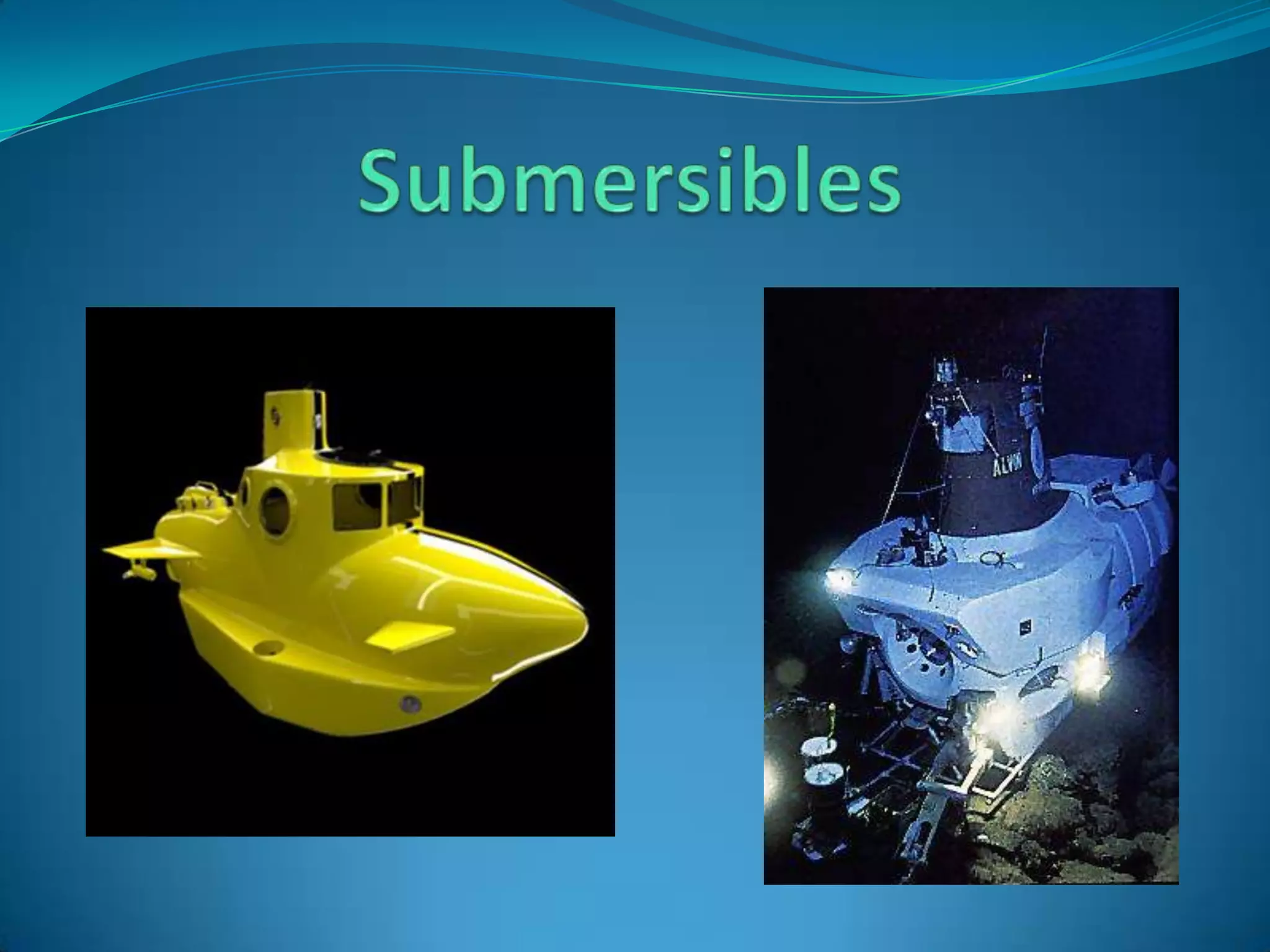
  SubmersiblesA submersible is a submarine that is mainly used for exploration and can only go a limited depth under  water or will be crushed by the force of water pressure
How a Submarine Works
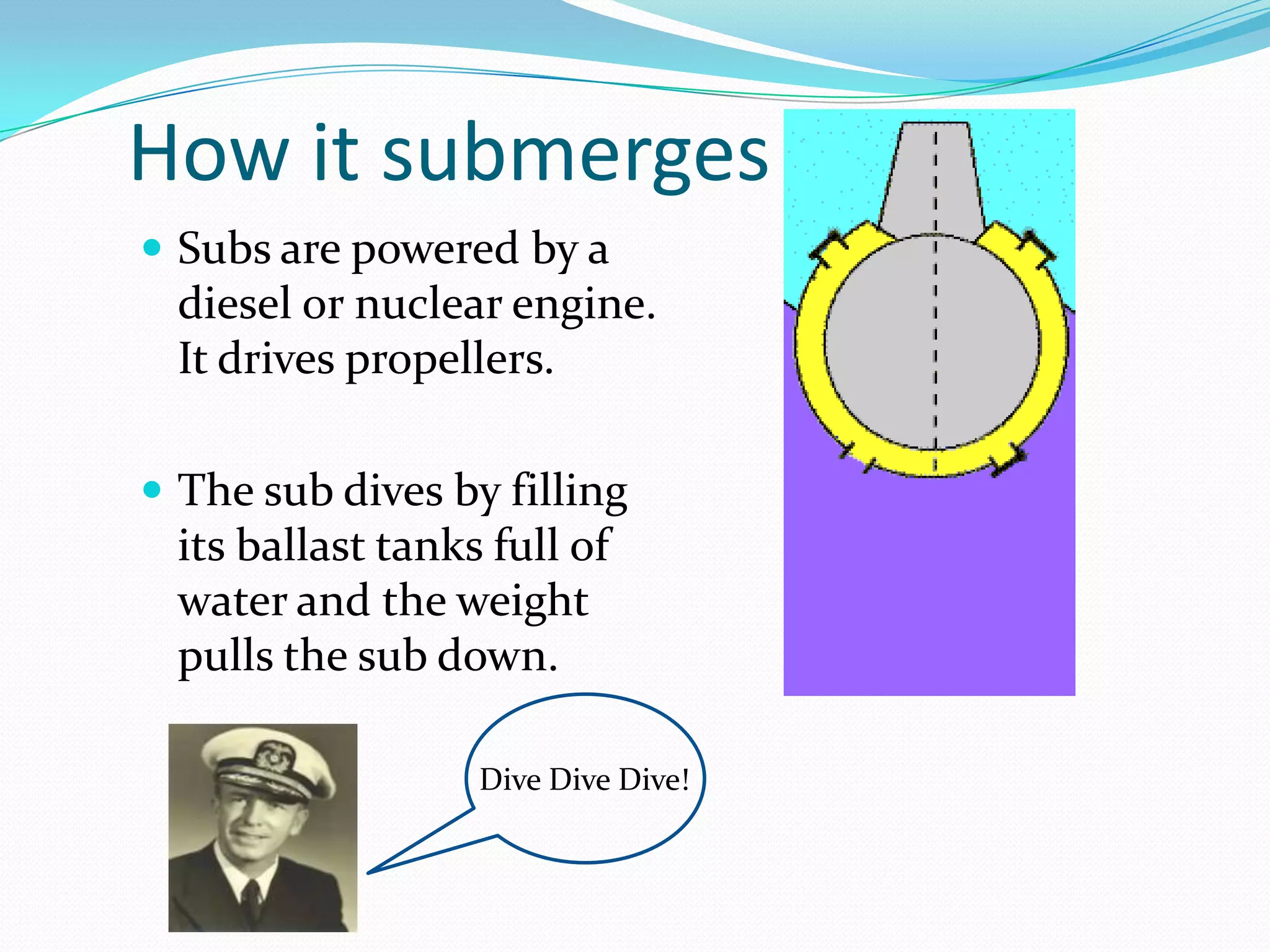
How it submerges Subs are powered by a diesel or nuclear engine. It drives propellers.
The sub dives by filling its ballast tanks full of water and the weight pulls the sub down. Dive DiveDive!
How Submarines SeeSubmarines generally don’t have windows to look out ofInstead, they are piloted with the use of Sonar (sound navigation and ranging)A pulse of sound is sent out from the submarineIf there is an object in the way, the sound waves are reflected back to the submarine – the time taken for the pulse to return to the submarine is used to calculate the distance to the object.
PeriscopeA periscope is on nearly every submarine. Using a series of mirrors, it allows submarines to see things above water so they do not have to rise to the surface.
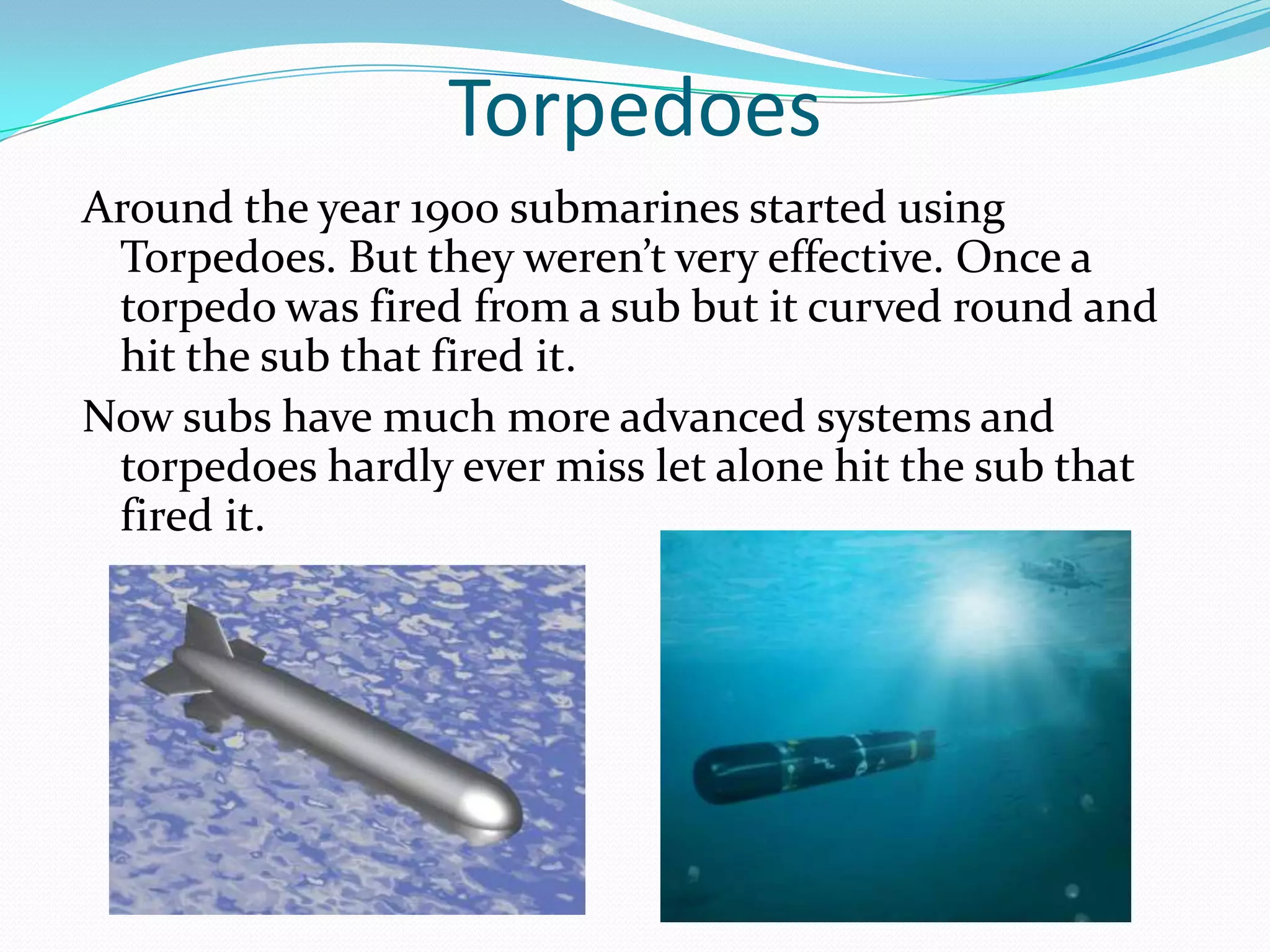
TorpedoesAround the year 1900 submarines started using Torpedoes. But they weren’t very effective. Once a torpedo was fired from a sub but it curved round and hit the sub that fired it. Now subs have much more advanced systems and torpedoes hardly ever miss let alone hit the sub that fired it.
What a torpedo can do to a ship
Life on a Submarine
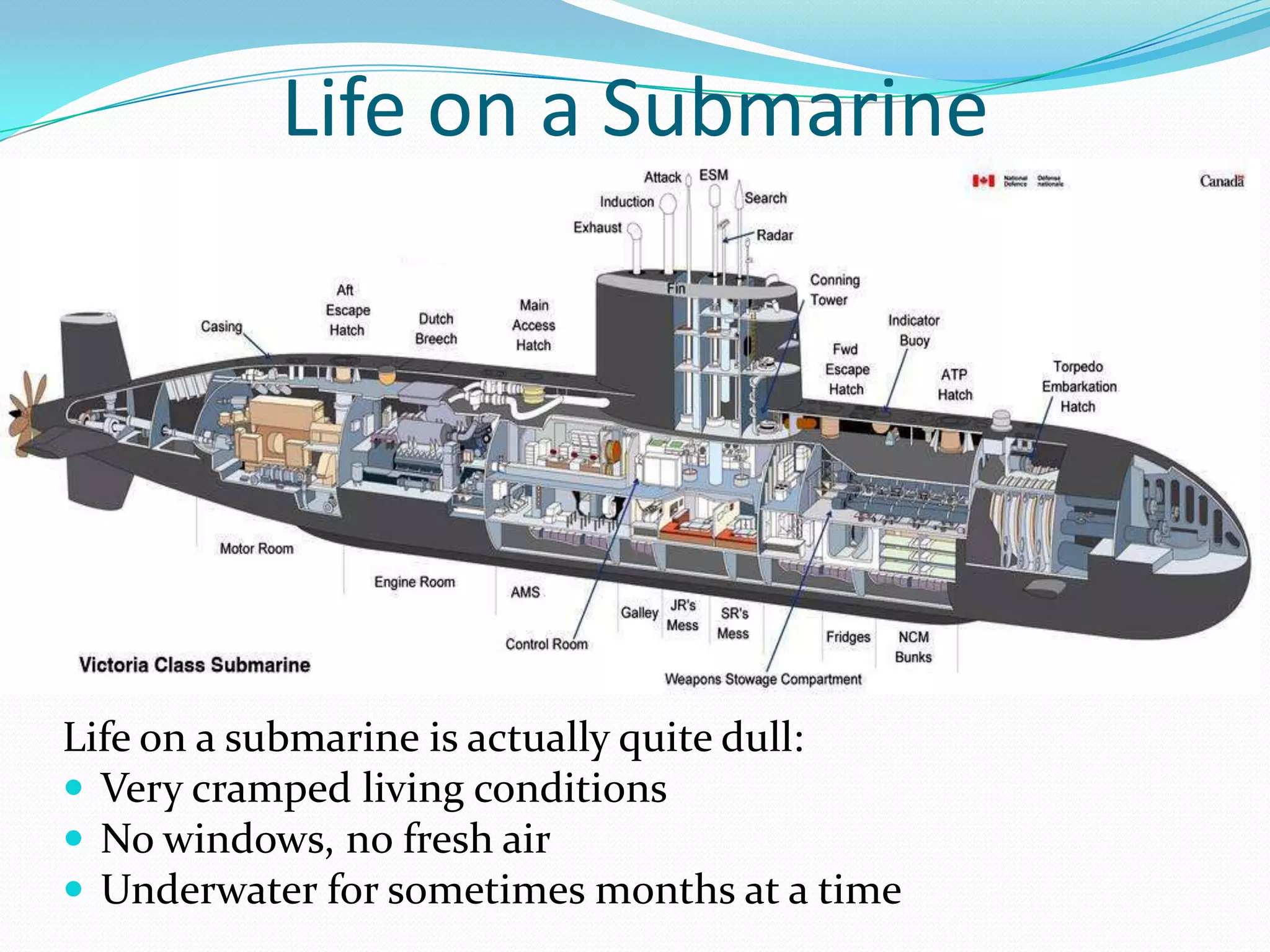
Life on a SubmarineLife on a submarine is actually quite dull: Very cramped living conditionsNo windows, no fresh airUnderwater for sometimes months at a time
The FactsFact
Typoon
Vanguard class submarine
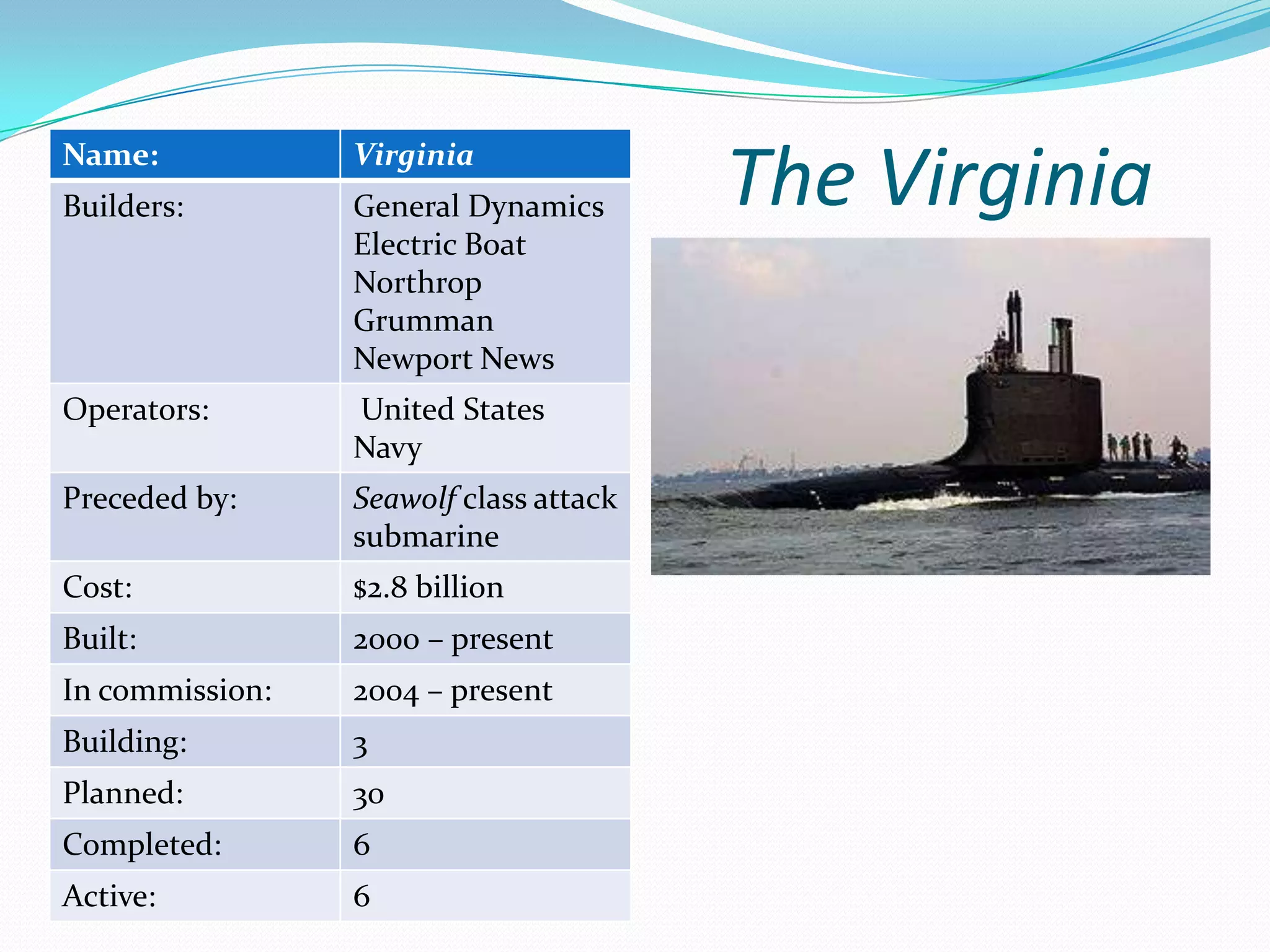
The Virginia
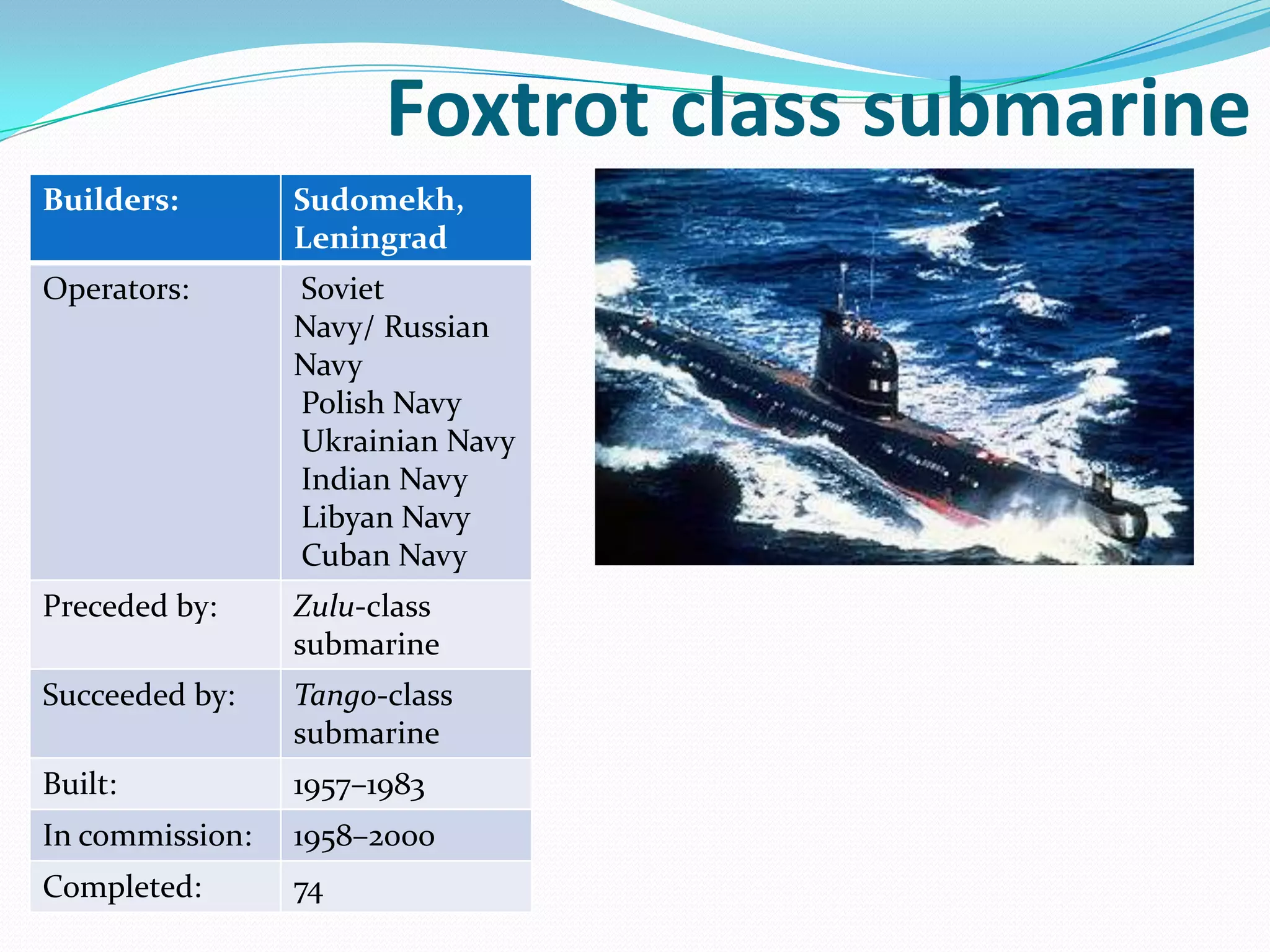
Foxtrot class submarine

Submarines

  • 1.
  • 2.
  • 3.
    HistoryIn 1580 –First published description of how a submarine could work, by a Englishman, William Bourne In 1623 – The first working submarine was made and was powered by 12 oarsmen. It was first tested in the River ThamesIn 1776 - David Bushnell built the first submarine to actually make an attack on an enemy warship. It, called the "Turtle" because it looked like a sea-turtle floating in the water. It was operated by Sergeant Ezra Lee. This a sketch of the Turtle 1862 –The "Alligator" was the first submarine in the U. S. Navy
  • 4.
    History In 1885,“Nordenfeldt I” was launched, a steam powered submarine with an external torpedo tubeIn 1900, Britain navy had theuse of 5 submarines. However, many thought the use of these machines to be “underhand, unfair and un-English”. In 1906, the first German “u-boat” was launched
  • 5.
    The rise offWorld War 1In the first world war submarines began to be recognised as lethal. Submarines were a recent invention but they were advanced nevertheless. German U Boats were the first truly effective submarines. They wrecked havoc on British and Allied warships and shipping. This is the final German U-Boat
  • 6.
    World War 21939– 1945-When the Second World War broke out submarines were used often. Italy joined Germany in June, bringing 105 submarines to the Mediterranean theatre. Luckily they did not have much impact.In August 1941, U-570 became the first and the only submarine ever captured by an aircraft; under attack, she was forced to the surface and surrendered. An escort ship soon arrived and took over. U-570 was thus transferred to the Royal navy, where, re-designated as "Graph.”1935 the first of a new series, U-1, entered service and there was soon 16 u-boats in service
  • 7.
    After World War2The first Type XXI, U-2511, left Hamburg on war patrol; when she returned home to surrender, 30 Type XXI were in shakedown and training, 121 were in the water and another 1000 were under construction or on order. 1953 The next generation sub-launched missile was "Regulus I," able to carry a 3,000 pound nuclear warhead for five hundred miles. A German XXI 1945-The Japanese launched a massive building program of suicide and midget submarines.Here, eighty-four midgets, of four different designs, are huddled in dry-dock.
  • 8.
    Entering the nuclearEra1954-The first nuclear-powered submarine went to sea: 3,674-ton "Nautilus." Its Surface speed 18 knots, 23 knots submerged. On her shakedown cruise, she steamed 1,381 miles from New London to San Juan, Puerto Rico – submerged all the way at an average speed of 15 knots.A nuclear sub called "Seawolf." Before nuclear power was brought into the world subs were inefficient and costly to run. A nuclear submarine basically runs on a nuclear reactor. This allows the ship to travel very fast and very far. But it comes at a great danger.The first nuclear sun , “The Nautilus"
  • 9.
  • 10.
    SubmersiblesAsubmersible is a submarine that is mainly used for exploration and can only go a limited depth under water or will be crushed by the force of water pressure
  • 11.
  • 12.
    How it submergesSubs are powered by a diesel or nuclear engine. It drives propellers.
  • 13.
    The sub divesby filling its ballast tanks full of water and the weight pulls the sub down. Dive DiveDive!
  • 14.
    How Submarines SeeSubmarinesgenerally don’t have windows to look out ofInstead, they are piloted with the use of Sonar (sound navigation and ranging)A pulse of sound is sent out from the submarineIf there is an object in the way, the sound waves are reflected back to the submarine – the time taken for the pulse to return to the submarine is used to calculate the distance to the object.
  • 15.
    PeriscopeA periscope ison nearly every submarine. Using a series of mirrors, it allows submarines to see things above water so they do not have to rise to the surface.
  • 16.
    TorpedoesAround the year1900 submarines started using Torpedoes. But they weren’t very effective. Once a torpedo was fired from a sub but it curved round and hit the sub that fired it. Now subs have much more advanced systems and torpedoes hardly ever miss let alone hit the sub that fired it.
  • 17.
    What a torpedocan do to a ship
  • 18.
    Life on aSubmarine
  • 19.
    Life on aSubmarineLife on a submarine is actually quite dull: Very cramped living conditionsNo windows, no fresh airUnderwater for sometimes months at a time
  • 20.
  • 21.
  • 22.
  • 23.
  • 24.
  • 25.

Editor's Notes

  • #5 http://www.submarine-history.com/NOVAtwo.htm