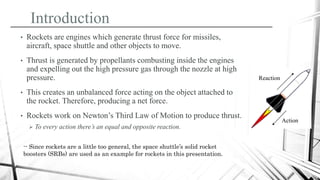
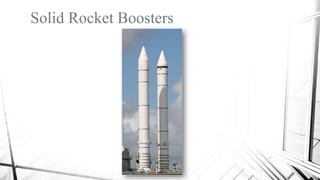
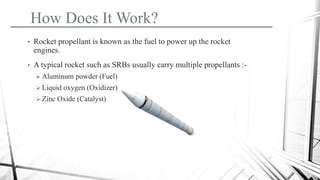
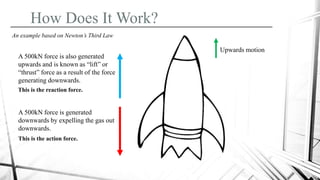
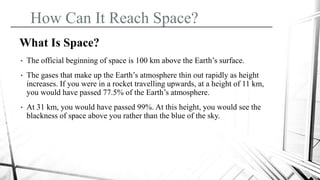
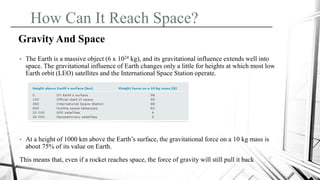
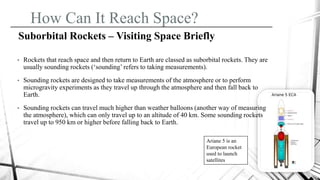
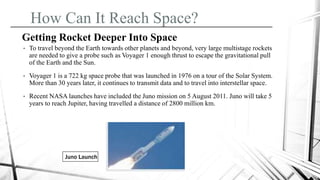
Rocket engines generate thrust by combusting propellants like aluminum powder and liquid oxygen in their combustion chambers. This produces hot gases that are expelled through a nozzle, pushing the rocket upward due to Newton's Third Law of equal and opposite reaction. To reach space, rockets must travel over 100 km high to pass through the atmosphere and overcome Earth's gravity. Orbital rockets require even more thrust to achieve speeds over 28,000 km/h to maintain stable orbits around the Earth. Advanced multistage rockets can propel probes far beyond Earth's orbit and into interplanetary space using Newton's laws of motion.




![Other Uses of Rockets
A Weapon of War
•Used by the Military for War
-Shoulder-fired rocket launcher
-Rocket Pod [used by attack aircrafts]
Research and Science
•Sounding rockets
-Research in aeronomy
-Track the rocket that launched to the space](https://image.slidesharecdn.com/presentation1-150425091423-conversion-gate01/85/How-A-Rocket-is-Launched-into-Space-20-320.jpg)