One Health and
antimicrobial resistance
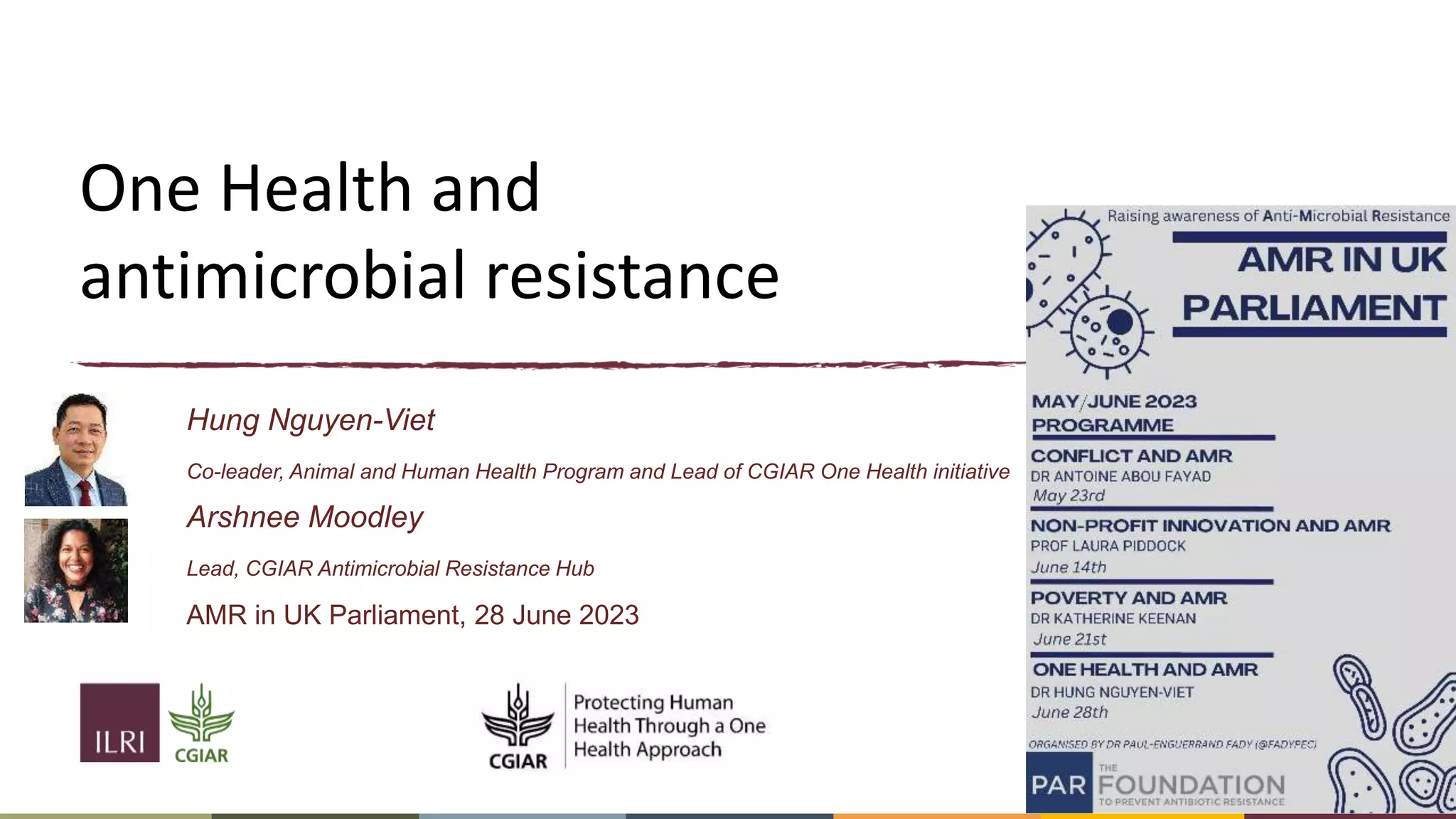
Hung Nguyen-Viet
Co-leader, Animal and Human Health Program and Lead of CGIAR One Health initiative
Arshnee Moodley
Lead, CGIAR Antimicrobial Resistance Hub
AMR in UK Parliament, 28 June 2023
2
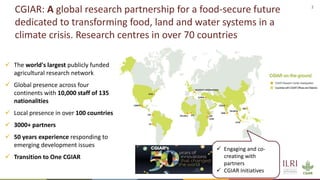
CGIAR: A global research partnership for a food-secure future
dedicated to transforming food, land and water systems in a
climate crisis. Research centres in over 70 countries
 Engaging and co-
creating with
partners
 CGIAR Initiatives
 The world's largest publicly funded
agricultural research network
 Global presence across four
continents with 10,000 staff of 135
nationalities
 Local presence in over 100 countries
 3000+ partners
 50 years experience responding to
emerging development issues
 Transition to One CGIAR
3
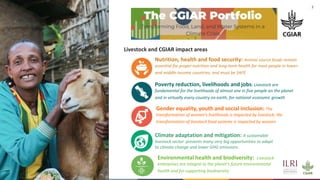
Livestock and CGIAR impact areas
Nutrition, health and food security: Animal source foods remain
essential for proper nutrition and long-term health for most people in lower-
and middle-income countries; and must be SAFE
Poverty reduction, livelihoods and jobs: Livestock are
fundamental for the livelihoods of almost one in five people on the planet
and in virtually every country on earth, for national economic growth
Gender equality, youth and social inclusion: The
transformation of women’s livelihoods is impacted by livestock; the
transformation of livestock food systems is impacted by women
Climate adaptation and mitigation: A sustainable
livestock sector presents many very big opportunities to adapt
to climate change and lower GHG emissions
Environmental health and biodiversity: Livestock
enterprises are integral to the planet’s future environmental
health and for supporting biodiversity
4
Outline
• Context and One Health approach
• AMR in LMICs
• Solutions to AMR and One Health
• Conclusion
www.cgiar.org Resilient AgriFood Systems (RAFS)
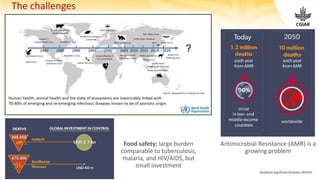
The challenges
Antimicrobial Resistance (AMR) is a
growing problem
Food safety: large burden
comparable to tuberculosis,
malaria, and HIV/AIDS, but
small investment
6
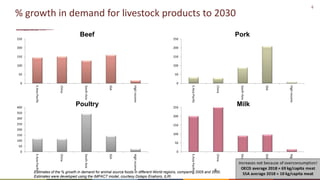
% growth in demand for livestock products to 2030
0
50
100
150
200
250
E.Asia
Pacific
China
South
Asia
SSA
High
income
6
0
50
100
150
200
250
E.Asia
Pacific
China
South
Asia
SSA
High
income
0
50
100
150
200
250
300
350
400
E.Asia
Pacific
China
South
Asia
SSA
High
income
0
50
100
150
200
250
E.Asia
Pacific
China
South
Asia
SSA
High
income
Poultry Milk
Beef Pork
Estimates of the % growth in demand for animal source foods in different World regions, comparing 2005 and 2030.
Estimates were developed using the IMPACT model, courtesy Dolapo Enahoro, ILRI.
7
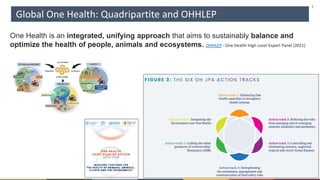
One Health is an integrated, unifying approach that aims to sustainably balance and
optimize the health of people, animals and ecosystems. OHHLEP - One Health High Level Expert Panel (2021)
Global One Health: Quadripartite and OHHLEP
8
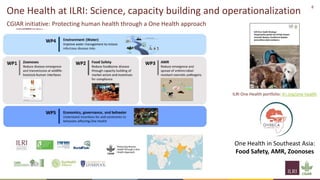
One Health at ILRI: Science, capacity building and operationalization
ILRI One Health portfolio: ilri.org/one-health
CGIAR initiative: Protecting human health through a One Health approach
One Health in Southeast Asia:
Food Safety, AMR, Zoonoses
9
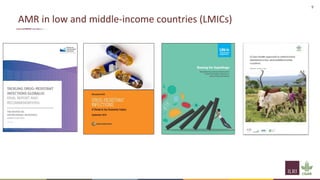
AMR in low and middle-income countries (LMICs)
10
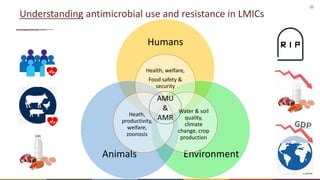
Understanding antimicrobial use and resistance in LMICs
Humans
Environment
Animals
Health, welfare,
Food safety &
security
Water & soil
quality,
climate
change, crop
production
Heath,
productivity,
welfare,
zoonosis
AMU
&
AMR
11
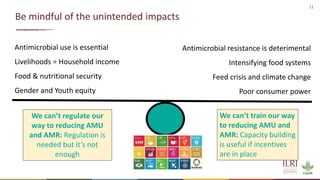
Be mindful of the unintended impacts
Antimicrobial use is essential
Livelihoods = Household income
Food & nutritional security
Gender and Youth equity
Antimicrobial resistance is deterimental
Intensifying food systems
Feed crisis and climate change
Poor consumer power
We can’t regulate our
way to reducing AMU
and AMR: Regulation is
needed but it’s not
enough
We can’t train our way
to reducing AMU and
AMR: Capacity building
is useful if incentives
are in place
12
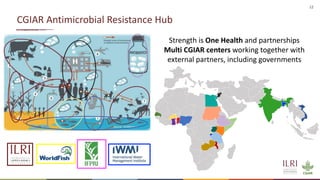
CGIAR Antimicrobial Resistance Hub
Strength is One Health and partnerships
Multi CGIAR centers working together with
external partners, including governments
14
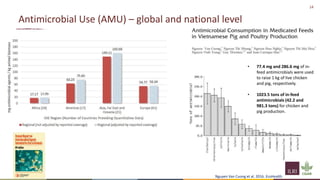
Antimicrobial Use (AMU) – global and national level
• 77.4 mg and 286.6 mg of in-
feed antimicrobials were used
to raise 1 kg of live chicken
and pig, respectively.
• 1023.5 tons of in-feed
antimicrobials (42.2 and
981.3 tons) for chicken and
pig production.
Nguyen Van Cuong et al. 2016. EcoHealth
25.7
38
44.9
43.4
45.5
30.8
25.7
14
16.7
0 10 20 30 40 50 60 70 80 90 100
Poultry producers (n= 113)
Pig producers (n= 121)
Aquaculture producers (n= 78)
%
Own experience Other farmers Friends
Relatives Veterinarians/ para-vet Drug marketing staff
Veterinary medicine sellers Other
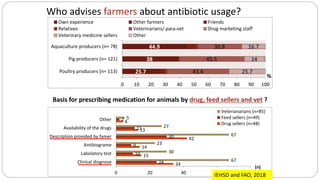
Who advises farmers about antibiotic usage?
34
15
14
42
13
4
24
10
9
30
11
2
67
30
23
67
27
5
0 20 40 60 80
Clinical diognose
Labolatory test
Antibiograme
Description provided by famer
Availability of the drugs
Other
(n)
Veterianarians (n=85)
Feed sellers (n=49)
Drug sellers (n=48)
Basis for prescribing medication for animals by drug, feed sellers and vet ?
IEHSD and FAO, 2018
16
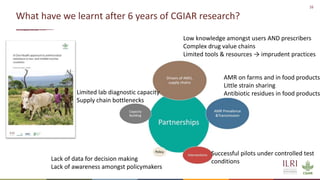
What have we learnt after 6 years of CGIAR research?
Low knowledge amongst users AND prescribers
Complex drug value chains
Limited tools & resources → imprudent practices
AMR on farms and in food products
Little strain sharing
Antibiotic residues in food products
Successful pilots under controlled test
conditions
Lack of data for decision making
Lack of awareness amongst policymakers
Limited lab diagnostic capacity
Supply chain bottlenecks
17
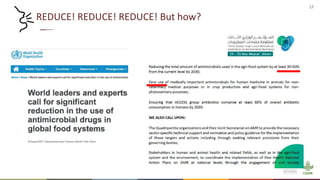
REDUCE! REDUCE! REDUCE! But how?
18
AMR and AMU in HICs works with regulation reinforcement
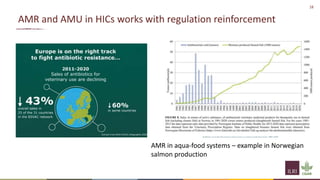
AMR in aqua-food systems – example in Norwegian
salmon production
19
AMR and AMU in HICs works with regulation reinforcement
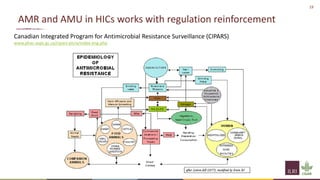
Canadian Integrated Program for Antimicrobial Resistance Surveillance (CIPARS)
www.phac-aspc.gc.ca/cipars-picra/index-eng.php
20
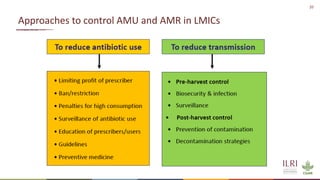
Approaches to control AMU and AMR in LMICs
21
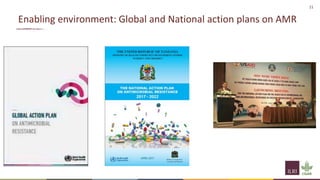
Enabling environment: Global and National action plans on AMR
22
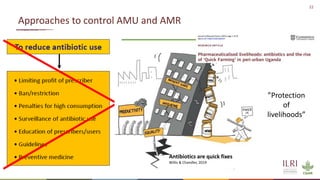
Approaches to control AMU and AMR
Antibiotics are quick fixes
Willis & Chandler, 2019
”Protection
of
livelihoods”
23
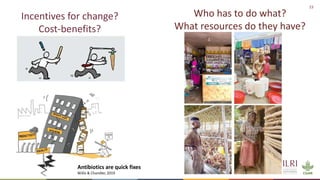
Incentives for change?
Cost-benefits?
Antibiotics are quick fixes
Willis & Chandler, 2019
Who has to do what?
What resources do they have?
24
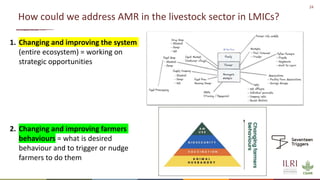
How could we address AMR in the livestock sector in LMICs?
1. Changing and improving the system
(entire ecosystem) = working on
strategic opportunities
2. Changing and improving farmers
behaviours = what is desired
behaviour and to trigger or nudge
farmers to do them
25
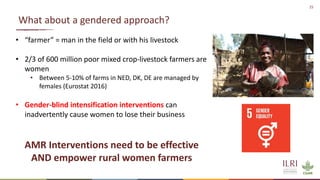
What about a gendered approach?
• “farmer” = man in the field or with his livestock
• 2/3 of 600 million poor mixed crop-livestock farmers are
women
• Between 5-10% of farms in NED, DK, DE are managed by
females (Eurostat 2016)
• Gender-blind intensification interventions can
inadvertently cause women to lose their business
AMR Interventions need to be effective
AND empower rural women farmers
26
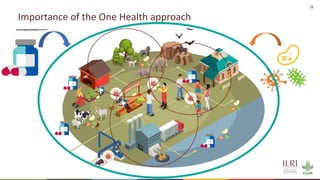
Importance of the One Health approach
27
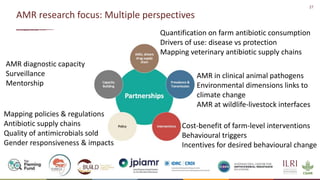
AMR research focus: Multiple perspectives
Quantification on farm antibiotic consumption
Drivers of use: disease vs protection
Mapping veterinary antibiotic supply chains
Cost-benefit of farm-level interventions
Behavioural triggers
Incentives for desired behavioural change
Mapping policies & regulations
Antibiotic supply chains
Quality of antimicrobials sold
Gender responsiveness & impacts
AMR diagnostic capacity
Surveillance
Mentorship
AMR in clinical animal pathogens
Environmental dimensions links to
climate change
AMR at wildlife-livestock interfaces
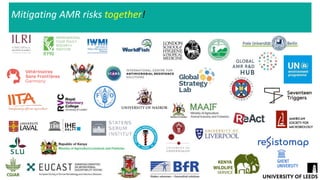
Mitigating AMR risks together!
29
UK investments in AMR and ILRI
30
Acknowledgements
Prof Lord Trees, House of Lords
Dr Harriet Davenport
Dr Paul-Enguerrand Fady
Prof Eric Fevre, ILRI & Liverpool University
Prof Delia Grace, Ms Susan MacMillan,
Dr Shirley Tarawali, and Dr Dieter Schillinger, ILRI
THANK YOU

One Health and antimicrobial resistance

  • 1.
    One Health and antimicrobialresistance Hung Nguyen-Viet Co-leader, Animal and Human Health Program and Lead of CGIAR One Health initiative Arshnee Moodley Lead, CGIAR Antimicrobial Resistance Hub AMR in UK Parliament, 28 June 2023
  • 2.
    2 CGIAR: A globalresearch partnership for a food-secure future dedicated to transforming food, land and water systems in a climate crisis. Research centres in over 70 countries  Engaging and co- creating with partners  CGIAR Initiatives  The world's largest publicly funded agricultural research network  Global presence across four continents with 10,000 staff of 135 nationalities  Local presence in over 100 countries  3000+ partners  50 years experience responding to emerging development issues  Transition to One CGIAR
  • 3.
    3 Livestock and CGIARimpact areas Nutrition, health and food security: Animal source foods remain essential for proper nutrition and long-term health for most people in lower- and middle-income countries; and must be SAFE Poverty reduction, livelihoods and jobs: Livestock are fundamental for the livelihoods of almost one in five people on the planet and in virtually every country on earth, for national economic growth Gender equality, youth and social inclusion: The transformation of women’s livelihoods is impacted by livestock; the transformation of livestock food systems is impacted by women Climate adaptation and mitigation: A sustainable livestock sector presents many very big opportunities to adapt to climate change and lower GHG emissions Environmental health and biodiversity: Livestock enterprises are integral to the planet’s future environmental health and for supporting biodiversity
  • 4.
    4 Outline • Context andOne Health approach • AMR in LMICs • Solutions to AMR and One Health • Conclusion
  • 5.
    www.cgiar.org Resilient AgriFoodSystems (RAFS) The challenges Antimicrobial Resistance (AMR) is a growing problem Food safety: large burden comparable to tuberculosis, malaria, and HIV/AIDS, but small investment
  • 6.
    6 % growth indemand for livestock products to 2030 0 50 100 150 200 250 E.Asia Pacific China South Asia SSA High income 6 0 50 100 150 200 250 E.Asia Pacific China South Asia SSA High income 0 50 100 150 200 250 300 350 400 E.Asia Pacific China South Asia SSA High income 0 50 100 150 200 250 E.Asia Pacific China South Asia SSA High income Poultry Milk Beef Pork Estimates of the % growth in demand for animal source foods in different World regions, comparing 2005 and 2030. Estimates were developed using the IMPACT model, courtesy Dolapo Enahoro, ILRI.
  • 7.
    7 One Health isan integrated, unifying approach that aims to sustainably balance and optimize the health of people, animals and ecosystems. OHHLEP - One Health High Level Expert Panel (2021) Global One Health: Quadripartite and OHHLEP
  • 8.
    8 One Health atILRI: Science, capacity building and operationalization ILRI One Health portfolio: ilri.org/one-health CGIAR initiative: Protecting human health through a One Health approach One Health in Southeast Asia: Food Safety, AMR, Zoonoses
  • 9.
    9 AMR in lowand middle-income countries (LMICs)
  • 10.
    10 Understanding antimicrobial useand resistance in LMICs Humans Environment Animals Health, welfare, Food safety & security Water & soil quality, climate change, crop production Heath, productivity, welfare, zoonosis AMU & AMR
  • 11.
    11 Be mindful ofthe unintended impacts Antimicrobial use is essential Livelihoods = Household income Food & nutritional security Gender and Youth equity Antimicrobial resistance is deterimental Intensifying food systems Feed crisis and climate change Poor consumer power We can’t regulate our way to reducing AMU and AMR: Regulation is needed but it’s not enough We can’t train our way to reducing AMU and AMR: Capacity building is useful if incentives are in place
  • 12.
    12 CGIAR Antimicrobial ResistanceHub Strength is One Health and partnerships Multi CGIAR centers working together with external partners, including governments
  • 13.
    14 Antimicrobial Use (AMU)– global and national level • 77.4 mg and 286.6 mg of in- feed antimicrobials were used to raise 1 kg of live chicken and pig, respectively. • 1023.5 tons of in-feed antimicrobials (42.2 and 981.3 tons) for chicken and pig production. Nguyen Van Cuong et al. 2016. EcoHealth
  • 14.
    25.7 38 44.9 43.4 45.5 30.8 25.7 14 16.7 0 10 2030 40 50 60 70 80 90 100 Poultry producers (n= 113) Pig producers (n= 121) Aquaculture producers (n= 78) % Own experience Other farmers Friends Relatives Veterinarians/ para-vet Drug marketing staff Veterinary medicine sellers Other Who advises farmers about antibiotic usage? 34 15 14 42 13 4 24 10 9 30 11 2 67 30 23 67 27 5 0 20 40 60 80 Clinical diognose Labolatory test Antibiograme Description provided by famer Availability of the drugs Other (n) Veterianarians (n=85) Feed sellers (n=49) Drug sellers (n=48) Basis for prescribing medication for animals by drug, feed sellers and vet ? IEHSD and FAO, 2018
  • 15.
    16 What have welearnt after 6 years of CGIAR research? Low knowledge amongst users AND prescribers Complex drug value chains Limited tools & resources → imprudent practices AMR on farms and in food products Little strain sharing Antibiotic residues in food products Successful pilots under controlled test conditions Lack of data for decision making Lack of awareness amongst policymakers Limited lab diagnostic capacity Supply chain bottlenecks
  • 16.
  • 17.
    18 AMR and AMUin HICs works with regulation reinforcement AMR in aqua-food systems – example in Norwegian salmon production
  • 18.
    19 AMR and AMUin HICs works with regulation reinforcement Canadian Integrated Program for Antimicrobial Resistance Surveillance (CIPARS) www.phac-aspc.gc.ca/cipars-picra/index-eng.php
  • 19.
    20 Approaches to controlAMU and AMR in LMICs
  • 20.
    21 Enabling environment: Globaland National action plans on AMR
  • 21.
    22 Approaches to controlAMU and AMR Antibiotics are quick fixes Willis & Chandler, 2019 ”Protection of livelihoods”
  • 22.
    23 Incentives for change? Cost-benefits? Antibioticsare quick fixes Willis & Chandler, 2019 Who has to do what? What resources do they have?
  • 23.
    24 How could weaddress AMR in the livestock sector in LMICs? 1. Changing and improving the system (entire ecosystem) = working on strategic opportunities 2. Changing and improving farmers behaviours = what is desired behaviour and to trigger or nudge farmers to do them
  • 24.
    25 What about agendered approach? • “farmer” = man in the field or with his livestock • 2/3 of 600 million poor mixed crop-livestock farmers are women • Between 5-10% of farms in NED, DK, DE are managed by females (Eurostat 2016) • Gender-blind intensification interventions can inadvertently cause women to lose their business AMR Interventions need to be effective AND empower rural women farmers
  • 25.
    26 Importance of theOne Health approach
  • 26.
    27 AMR research focus:Multiple perspectives Quantification on farm antibiotic consumption Drivers of use: disease vs protection Mapping veterinary antibiotic supply chains Cost-benefit of farm-level interventions Behavioural triggers Incentives for desired behavioural change Mapping policies & regulations Antibiotic supply chains Quality of antimicrobials sold Gender responsiveness & impacts AMR diagnostic capacity Surveillance Mentorship AMR in clinical animal pathogens Environmental dimensions links to climate change AMR at wildlife-livestock interfaces
  • 27.
  • 28.
  • 29.
    30 Acknowledgements Prof Lord Trees,House of Lords Dr Harriet Davenport Dr Paul-Enguerrand Fady Prof Eric Fevre, ILRI & Liverpool University Prof Delia Grace, Ms Susan MacMillan, Dr Shirley Tarawali, and Dr Dieter Schillinger, ILRI
  • 30.

Editor's Notes

  • #7 FAO. 2011. Mapping supply and demand for animal-source foods to 2030, by T.P. Robinson & F. Pozzi. Animal Production and Health Working Paper. No. 2. Rome. IMPACT results generally suggested smaller changes in demand compared to FAO. Among other drivers of the results, the observed differences may be related to the underlying assumptions on how future demand will respond to prices and incomes. FAO projections could for example be assuming big shifts to Chicken Meat consumption (e.g., from pork) as incomes grow in Asia. IMPACT makes the same assumption in terms of direction, but with the expected shifts a bit more dampened. High income countries include much of Europe. In fact, if one looks at individual European nations in many cases there is a DECLINE in demand (Switzerland for beef (-22%) and pork (-14%) for example) Figures for meat consumption: https://data.oecd.org/agroutput/meat-consumption.htm
  • #8 One Health is an integrated, unifying approach that aims to sustainably balance and optimize the health of people, animals and ecosystems. It recognizes the health of humans, domestic and wild animals, plants, and the wider environment (including ecosystems) are closely linked and inter-dependent. The approach mobilizes multiple sectors, disciplines and communities at varying levels of society to work together to foster well-being and tackle threats to health and ecosystems, while addressing the collective need for clean water, energy and air, safe and nutritious food, taking action on climate changes and contributing to sustainable development. (3) 1st Quadripartite Executive Annual Meeting on One Health - YouTube
  • #9 A few major projects among others. More on One Health @ILRI: ilri.org/one-health
  • #11 Importance to understanding the role antimicrobials play in terms of ensuring health, welfare and productivity. Antimicrobials are essentials. Flip side is that use over time will leads to resistance and the impacts are mortality, morbidity, loss in producitivity, less food, and economic losses Multiple efforts, global and national to reduce antimicrobial use and reduce antimicrobial resistance in pathogens
  • #12 While we recognise the importance of perserving the efficacy of antimicrobials, and the importance of action, we need to be mindful on the unintended impacts of any AMU/AMR reducing interventions in LMICs that have so many challenges. It’s a balancing act
  • #14 To help understand the challenge of AMR, the Hub is based on 5 interconnected pillars AMU AMR Interventions Policy Capacity Development
  • #16 Basis la % ???
  • #17 Before the launch of the 1CG initiatives, we decided to take stock of the AMR research conducted under the CRPs and associated bilateral projects between 2015-2021 We produced this Synthesis report which summarises and highlights what we have learnt and also identify gaps. This was used to et the new AMR research agenda. The size of bubble indicates where we previously focused on
  • #18 Global call to reduce use of antimicrobials in food systems. Upcoming UN Meeting on AMR in 9.2024 But how?
  • #19 European Medical Agency report. Delia: Nearly all the AMR and fish issue comes from aquaculture in China. Salmon in cages used to be a problem: the biggest producer is Norway then Chile. AM use remains high in Chile but Norway has succeeded in almost eliminating AM while increasing production. So AM use in aquaculture is a solvable problem.
  • #20 In Canada, a national surveillance system to monitor AMR was formally recommended in 1997 Steering Committee, the Canadian Committee on Antibiotic Resistance Advisory Committee on Animal Uses of Antimicrobials and Impact on Resistance and Human Health-2002 Laboratory for Foodborne Zoonoses National Microbiology Laboratory Canadian Food Inspection Agency Canadian Public Health Laboratory Network
  • #24 But we also need to understand What are the cost-benefits of any intervention and the incentives for change Moreover we have to ask who has to change their behaviour? What resources do they have
  • #28 Current AMR agenda. We are drawing from our learnings in the AMR synthesis report and we are coming at the problem from different angles. ILRI and the CGIAR are uniquely positioned.
  • #29 Key partners we work. There are more but these are the ones we work closely with.