MYCOTOXINS
AHMAD ABD ELKHABIR
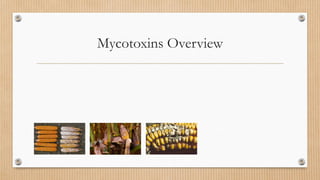
Mycotoxins Overview
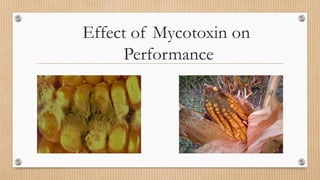
Effect of Mycotoxin on
Performance
• Certain species of fungi
• Moldy feeds are :
• Less palatable and reduce dry matter intake.
• Reduce digestibility and energy content.
• Reducing energy values by as much as 10% (i.e., 90% of energy value).
Moulds
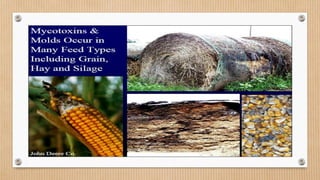
“Mycotoxins are toxic secondary metabolites of certain species of fungi
(molds)”
Thousands of Mycotoxins are present on earth but only 300 have been
discovered
Mycotoxins
Major toxigenic fungi and the Mycotoxin thought to
be the most
prevalent and potentially toxic to animal
Fungal Mycotoxin
Aspergillus Aflatoxin, Ochratoxin, Sterigmatocystin, Fumitremorgens, Fumitoxins, Fumigaclavines, Cyclopiazonoic
Acid and Gliotoxin
Fusarium Deoxynivalenol, Zearalenone, T-2 Toxin, Fumonisin, Moniliformin, Nivalenol, Diacetoxyscirpenol,
Butenolide, Neosolaniol, Fusaric Acid, Fusarochromanone, Wortmannin, Fusarin C and Fusaproliferin
Penicillium Ochratoxin, PR Toxin, Patulin, Penicillic Acid, Citrinin, Penetrem, Cyclopiazonic acid, Roquefortine,
isofumigaclavines A and B and Mycophenolic acid
Claviceps Ergot alkaloids in seed/grain of small grains, sorghum and grasses
Epichloe,
Neotyphodium
Ergot alkaloids in fescue grass
Stachybotrys Stachybotryotoxins and trichothecenes
They produced mainly by fungi genera of :
Aspergillus
Fusarium
Penicillium
Climatic conditions affect the production of mycotoxins:
 Hot humid weather encourages Aspergillus toxin formation.
 Fusarium diseases are more commonly associated with cold conditions and
with insect damage and wet conditions late in the growing season.
 Penicillium molds grow in wet and cool conditions and some require little
oxygen.
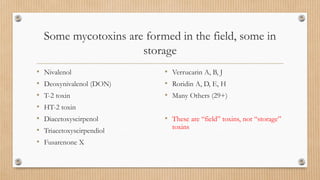
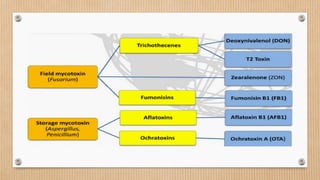
Some mycotoxins are formed in the field, some in
storage
• Nivalenol
• Deoxynivalenol (DON)
• T-2 toxin
• HT-2 toxin
• Diacetoxyscirpenol
• Triacetoxyscirpendiol
• Fusarenone X
• Verrucarin A, B, J
• Roridin A, D, E, H
• Many Others (29+)
• These are “field” toxins, not “storage”
toxins
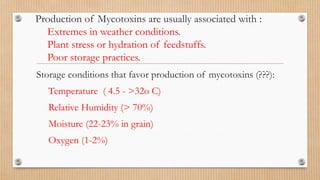
Production of Mycotoxins are usually associated with :
Extremes in weather conditions.
Plant stress or hydration of feedstuffs.
Poor storage practices.
Storage conditions that favor production of mycotoxins (???):
Temperature ( 4.5 - >32o C)
Relative Humidity (> 70%)
Moisture (22-23% in grain)
Oxygen (1-2%)
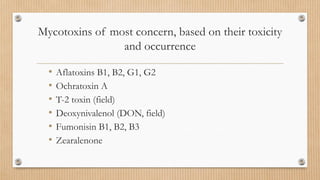
Mycotoxins of most concern, based on their toxicity
and occurrence
• Aflatoxins B1, B2, G1, G2
• Ochratoxin A
• T-2 toxin (field)
• Deoxynivalenol (DON, field)
• Fumonisin B1, B2, B3
• Zearalenone
Mycotoxicosis
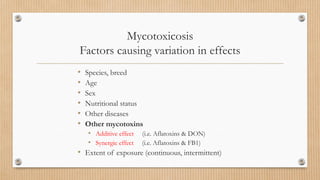
Factors causing variation in effects
• Species, breed
• Age
• Sex
• Nutritional status
• Other diseases
• Other mycotoxins
• Additive effect (i.e. Aflatoxins & DON)
• Synergic effect (i.e. Aflatoxins & FB1)
• Extent of exposure (continuous, intermittent)
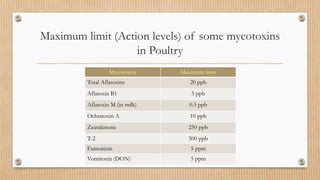
Maximum limit (Action levels) of some mycotoxins
in Poultry
Mycotoxins Maximum limit
Total Aflatoxins 20 ppb
Aflatoxin B1 5 ppb
Aflatoxin M (in milk) 0.5 ppb
Ochratoxin A 10 ppb
Zearalenone 250 ppb
T-2 500 ppb
Fumonisin 5 ppm
Vomitoxin (DON) 5 ppm
Even with the best quality-control systems in the world,
animal producers often find themselves owning
mycotoxins-contaminated grain or feed (natural toxins).
Now the question is : "Is the level of
Mycotoxin present safe to feed my animals on
it?”
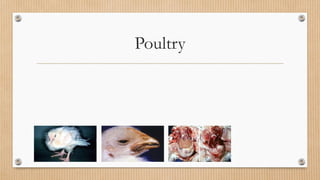
Poultry
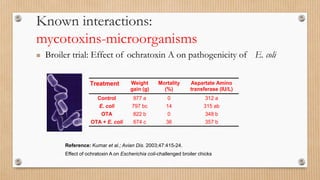
Known interactions:
mycotoxins-microorganisms
Treatment Weight
gain (g)
Mortality
(%)
Aspartate Amino
transferase (IU/L)
Control 977 a 0 312 a
E. coli 797 bc 14 315 ab
OTA 822 b 0 348 b
OTA + E. coli 674 c 36 357 b
Reference: Kumar et al.; Avian Dis. 2003;47:415-24.
Effect of ochratoxin A on Escherichia coli-challenged broiler chicks
 Broiler trial: Effect of ochratoxin A on pathogenicity of E. coli
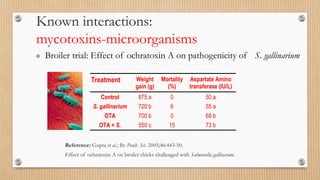
Treatment Weight
gain (g)
Mortality
(%)
Aspartate Amino
transferase (IU/L)
Control 875 a 0 50 a
S. gallinarium 720 b 6 55 a
OTA 700 b 0 68 b
OTA + S. 550 c 15 73 b
Reference: Gupta et al.; Br. Poult. Sci. 2005;46:443-50.
Effect of ochratoxin A on broiler chicks challenged with Salmonella gallinarum.
Known interactions:
mycotoxins-microorganisms
 Broiler trial: Effect of ochratoxin A on pathogenicity of S. gallinarium
Reference: Swamy et al.; Indian J. Poult. (1998) Sci. 33:273-278.
Ability of Mycosorb in counteracting aflatoxicosis in commercial broilers.
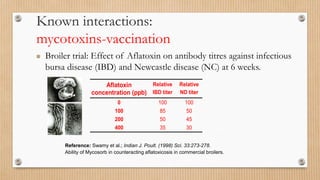
Aflatoxin
concentration (ppb)
Relative
IBD titer
Relative
ND titer
0 100 100
100 85 50
200 50 45
400 35 30
 Broiler trial: Effect of Aflatoxin on antibody titres against infectious
bursa disease (IBD) and Newcastle disease (NC) at 6 weeks.
Known interactions:
mycotoxins-vaccination
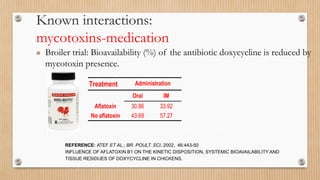
Treatment Administration
Oral IM
Aflatoxin 30.86 33.92
No aflatoxin 43.69 57.27
 Broiler trial: Bioavailability (%) of the antibiotic doxycycline is reduced by
mycotoxin presence.
Known interactions:
mycotoxins-medication
REFERENCE: ATEF ET AL.; BR. POULT. SCI. 2002, 46:443-50
INFLUENCE OF AFLATOXIN B1 ON THE KINETIC DISPOSITION, SYSTEMIC BIOAVAILABILITY AND
TISSUE RESIDUES OF DOXYCYCLINE IN CHICKENS.
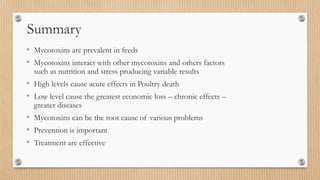
• Mycotoxins are prevalent in feeds
• Mycotoxins interact with other mycotoxins and others factors
such as nutrition and stress producing variable results
• High levels cause acute effects in Poultry death
• Low level cause the greatest economic loss – chronic effects –
greater diseases
• Mycotoxins can be the root cause of various problems
• Prevention is important
• Treatment are effective
Summary
Livestock
Mycotoxin concerns have increases
• Learned more about mycotoxins & their toxicity.
• Better analytical methods.
• High producing cows, buffaloes & Calves are more susceptible:
• More stress – more diseases
• Nutrient deficiencies
• Low ruminal mycotoxin degradation – increase toxicity
• Higher feed (and grain) consumption – increase rumen turnover
• Lower fiber – low pH – fewer protozoa
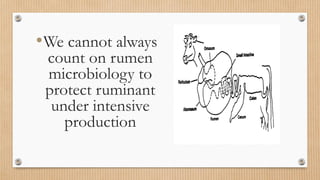
•We cannot always
count on rumen
microbiology to
protect ruminant
under intensive
production
Mycotoxins are detoxified in the rumen but
the rate of detoxification :
• Differs for the different types of mycotoxins (Ochratoxins Vs Zearalenol).
• OTA by Rumem microrganism converted to OTA  (less toxic)
• Capacity of rumen decrease by 20% in high concentrate diets
• Zearalenol converted in rumen to  Zearalenone (10 times more toxic)
• Rumen turnover rates are about 8 times longer in beef cows than lactating dairy cows.
• The original dose level.
• 5 and 10 ppm DON were completely transformed to the reportedly less toxic deepoxy DON or
DOM-1 within 24 hours when incubated in rumen fluid.
• More than 50% of the DON remained from the 50 and 100 ppm DON treatments at 24 hours
incubation.
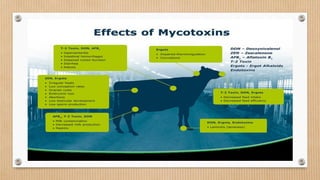
Symptoms of Mycotoxicosis in dairy cows
• The more stressed cows, such as fresh cows, are most
affected.
• Symptoms of mycotoxins may be nonspecific and wide
ranging (90% sub clinical).
General Symptoms
• Reduced production,
• Reduced feed consumption
• Intermittent diarrhea (sometimes with bloody or dark manure),
• Unthriftiness, rough hair coat,
• Increase in incidence of disease, such as displaced abomasum, ketosis,
retained placenta, metritis, mastitis, and fatty livers.
• Decrease feed efficiency & growth rate in calves & heifers
• Animals do not respond well to veterinary therapy.
Subclinical effects of mycotoxins can be seen in:
• Immune system
• Antibody titers after vaccination
• Phagocytic activity
• Phagocytic index
• Immunoglobulins (Ig: A,G, M, D, E)
• Lymphocytes
• Chemotactic index
• Antioxidants
• Uric acids
• Glutathione (or Se)
• Malondialdehyde (MDA)
• GGT
Summary
• Mycotoxins are prevalent in feeds
• Mycotoxins are toxic to dairy cattle
• Mycotoxins interact with other mycotoxins and others factors
such as nutrition and stress producing variable results
• High levels cause acute effects in cattle – death
• Low level cause the greatest economic loss – chronic effects –
milk loss – greater diseases
• Mycotoxins can be the root cause of various problems
• Prevention is important
• Treatment are effective
THANK YOU

Mycotoxins

  • 1.
  • 2.
  • 3.
    Effect of Mycotoxinon Performance
  • 4.
    • Certain speciesof fungi • Moldy feeds are : • Less palatable and reduce dry matter intake. • Reduce digestibility and energy content. • Reducing energy values by as much as 10% (i.e., 90% of energy value). Moulds
  • 5.
    “Mycotoxins are toxicsecondary metabolites of certain species of fungi (molds)” Thousands of Mycotoxins are present on earth but only 300 have been discovered Mycotoxins
  • 6.
    Major toxigenic fungiand the Mycotoxin thought to be the most prevalent and potentially toxic to animal Fungal Mycotoxin Aspergillus Aflatoxin, Ochratoxin, Sterigmatocystin, Fumitremorgens, Fumitoxins, Fumigaclavines, Cyclopiazonoic Acid and Gliotoxin Fusarium Deoxynivalenol, Zearalenone, T-2 Toxin, Fumonisin, Moniliformin, Nivalenol, Diacetoxyscirpenol, Butenolide, Neosolaniol, Fusaric Acid, Fusarochromanone, Wortmannin, Fusarin C and Fusaproliferin Penicillium Ochratoxin, PR Toxin, Patulin, Penicillic Acid, Citrinin, Penetrem, Cyclopiazonic acid, Roquefortine, isofumigaclavines A and B and Mycophenolic acid Claviceps Ergot alkaloids in seed/grain of small grains, sorghum and grasses Epichloe, Neotyphodium Ergot alkaloids in fescue grass Stachybotrys Stachybotryotoxins and trichothecenes
  • 7.
    They produced mainlyby fungi genera of : Aspergillus Fusarium Penicillium Climatic conditions affect the production of mycotoxins:  Hot humid weather encourages Aspergillus toxin formation.  Fusarium diseases are more commonly associated with cold conditions and with insect damage and wet conditions late in the growing season.  Penicillium molds grow in wet and cool conditions and some require little oxygen.
  • 8.
    Some mycotoxins areformed in the field, some in storage • Nivalenol • Deoxynivalenol (DON) • T-2 toxin • HT-2 toxin • Diacetoxyscirpenol • Triacetoxyscirpendiol • Fusarenone X • Verrucarin A, B, J • Roridin A, D, E, H • Many Others (29+) • These are “field” toxins, not “storage” toxins
  • 10.
    Production of Mycotoxinsare usually associated with : Extremes in weather conditions. Plant stress or hydration of feedstuffs. Poor storage practices. Storage conditions that favor production of mycotoxins (???): Temperature ( 4.5 - >32o C) Relative Humidity (> 70%) Moisture (22-23% in grain) Oxygen (1-2%)
  • 11.
    Mycotoxins of mostconcern, based on their toxicity and occurrence • Aflatoxins B1, B2, G1, G2 • Ochratoxin A • T-2 toxin (field) • Deoxynivalenol (DON, field) • Fumonisin B1, B2, B3 • Zearalenone
  • 12.
    Mycotoxicosis Factors causing variationin effects • Species, breed • Age • Sex • Nutritional status • Other diseases • Other mycotoxins • Additive effect (i.e. Aflatoxins & DON) • Synergic effect (i.e. Aflatoxins & FB1) • Extent of exposure (continuous, intermittent)
  • 13.
    Maximum limit (Actionlevels) of some mycotoxins in Poultry Mycotoxins Maximum limit Total Aflatoxins 20 ppb Aflatoxin B1 5 ppb Aflatoxin M (in milk) 0.5 ppb Ochratoxin A 10 ppb Zearalenone 250 ppb T-2 500 ppb Fumonisin 5 ppm Vomitoxin (DON) 5 ppm
  • 14.
    Even with thebest quality-control systems in the world, animal producers often find themselves owning mycotoxins-contaminated grain or feed (natural toxins).
  • 15.
    Now the questionis : "Is the level of Mycotoxin present safe to feed my animals on it?”
  • 16.
  • 18.
    Known interactions: mycotoxins-microorganisms Treatment Weight gain(g) Mortality (%) Aspartate Amino transferase (IU/L) Control 977 a 0 312 a E. coli 797 bc 14 315 ab OTA 822 b 0 348 b OTA + E. coli 674 c 36 357 b Reference: Kumar et al.; Avian Dis. 2003;47:415-24. Effect of ochratoxin A on Escherichia coli-challenged broiler chicks  Broiler trial: Effect of ochratoxin A on pathogenicity of E. coli
  • 19.
    Treatment Weight gain (g) Mortality (%) AspartateAmino transferase (IU/L) Control 875 a 0 50 a S. gallinarium 720 b 6 55 a OTA 700 b 0 68 b OTA + S. 550 c 15 73 b Reference: Gupta et al.; Br. Poult. Sci. 2005;46:443-50. Effect of ochratoxin A on broiler chicks challenged with Salmonella gallinarum. Known interactions: mycotoxins-microorganisms  Broiler trial: Effect of ochratoxin A on pathogenicity of S. gallinarium
  • 20.
    Reference: Swamy etal.; Indian J. Poult. (1998) Sci. 33:273-278. Ability of Mycosorb in counteracting aflatoxicosis in commercial broilers. Aflatoxin concentration (ppb) Relative IBD titer Relative ND titer 0 100 100 100 85 50 200 50 45 400 35 30  Broiler trial: Effect of Aflatoxin on antibody titres against infectious bursa disease (IBD) and Newcastle disease (NC) at 6 weeks. Known interactions: mycotoxins-vaccination
  • 21.
    Treatment Administration Oral IM Aflatoxin30.86 33.92 No aflatoxin 43.69 57.27  Broiler trial: Bioavailability (%) of the antibiotic doxycycline is reduced by mycotoxin presence. Known interactions: mycotoxins-medication REFERENCE: ATEF ET AL.; BR. POULT. SCI. 2002, 46:443-50 INFLUENCE OF AFLATOXIN B1 ON THE KINETIC DISPOSITION, SYSTEMIC BIOAVAILABILITY AND TISSUE RESIDUES OF DOXYCYCLINE IN CHICKENS.
  • 22.
    • Mycotoxins areprevalent in feeds • Mycotoxins interact with other mycotoxins and others factors such as nutrition and stress producing variable results • High levels cause acute effects in Poultry death • Low level cause the greatest economic loss – chronic effects – greater diseases • Mycotoxins can be the root cause of various problems • Prevention is important • Treatment are effective Summary
  • 23.
  • 25.
    Mycotoxin concerns haveincreases • Learned more about mycotoxins & their toxicity. • Better analytical methods. • High producing cows, buffaloes & Calves are more susceptible: • More stress – more diseases • Nutrient deficiencies • Low ruminal mycotoxin degradation – increase toxicity • Higher feed (and grain) consumption – increase rumen turnover • Lower fiber – low pH – fewer protozoa
  • 26.
    •We cannot always counton rumen microbiology to protect ruminant under intensive production
  • 27.
    Mycotoxins are detoxifiedin the rumen but the rate of detoxification : • Differs for the different types of mycotoxins (Ochratoxins Vs Zearalenol). • OTA by Rumem microrganism converted to OTA  (less toxic) • Capacity of rumen decrease by 20% in high concentrate diets • Zearalenol converted in rumen to  Zearalenone (10 times more toxic) • Rumen turnover rates are about 8 times longer in beef cows than lactating dairy cows. • The original dose level. • 5 and 10 ppm DON were completely transformed to the reportedly less toxic deepoxy DON or DOM-1 within 24 hours when incubated in rumen fluid. • More than 50% of the DON remained from the 50 and 100 ppm DON treatments at 24 hours incubation.
  • 29.
    Symptoms of Mycotoxicosisin dairy cows • The more stressed cows, such as fresh cows, are most affected. • Symptoms of mycotoxins may be nonspecific and wide ranging (90% sub clinical).
  • 30.
    General Symptoms • Reducedproduction, • Reduced feed consumption • Intermittent diarrhea (sometimes with bloody or dark manure), • Unthriftiness, rough hair coat, • Increase in incidence of disease, such as displaced abomasum, ketosis, retained placenta, metritis, mastitis, and fatty livers. • Decrease feed efficiency & growth rate in calves & heifers • Animals do not respond well to veterinary therapy.
  • 31.
    Subclinical effects ofmycotoxins can be seen in: • Immune system • Antibody titers after vaccination • Phagocytic activity • Phagocytic index • Immunoglobulins (Ig: A,G, M, D, E) • Lymphocytes • Chemotactic index • Antioxidants • Uric acids • Glutathione (or Se) • Malondialdehyde (MDA) • GGT
  • 32.
    Summary • Mycotoxins areprevalent in feeds • Mycotoxins are toxic to dairy cattle • Mycotoxins interact with other mycotoxins and others factors such as nutrition and stress producing variable results • High levels cause acute effects in cattle – death • Low level cause the greatest economic loss – chronic effects – milk loss – greater diseases • Mycotoxins can be the root cause of various problems • Prevention is important • Treatment are effective
  • 33.