Food Safety
Risk Analysis
Part 1

Safefood 360º provides food safety management software for
industry leading food businesses everywhere in the world
Visit Safefood360.com to see the award-winning food safety management software in action
Visit Safefood360.com for more food safety management resources
Visit Safefood360.com to see the award-winning food safety management software in action
INTRODUCTION TO
RISK ANALYSIS
Visit Safefood360.com to see the award-winning food safety management software in action
Introduction to Risk Analysis
•

•
•
•

The main goal of Food Safety
Management is the reduction of
the incidents of food-borne
illness to the lowest practical
level

•

This can only be achieved by
taking steps at each point of the
food chain where hazards can
occur
Limited resources at regulatory
and local level mean decisions
must be taken regarding which
actions are prioritised

•

Risk Assessment
Risk Management
Risk Communication

•

•

Risk Analysis Framework
consists of 3 activities

Risk Analysis is the tool used to
determine such actions

Visit Safefood360.com to see the award-winning food safety management software in action
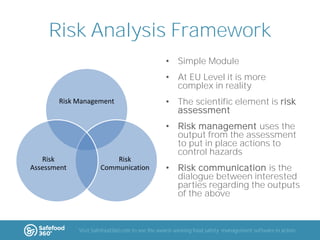
Risk Analysis Framework
• Simple Module
• At EU Level it is more
complex in reality
Risk Management

Risk
Assessment

Risk
Communication

• The scientific element is risk
assessment
• Risk management uses the
output from the assessment
to put in place actions to
control hazards

• Risk communication is the
dialogue between interested
parties regarding the outputs
of the above

Visit Safefood360.com to see the award-winning food safety management software in action
HISTORY AND EVOLUTION OF
FOOD SAFETY RISK ANALYSIS
Visit Safefood360.com to see the award-winning food safety management software in action
1
• Preoccupation of humans
• Community based food production 17,000
years ago barley in Egypt
• Dry storage improved preservation
• Other methods developed

• Honey, olive oil, heating and salting

Visit Safefood360.com to see the award-winning food safety management software in action
2
• In time humans learned to identify safe food
• Trial and error

adverse health effects

• Lessons found expression in religious taboos

• Eating pigs in Jewish and Muslim religions
• Hygiene

India

•
• Early example of banning of foods

Visit Safefood360.com to see the award-winning food safety management software in action
3
• However lack of understanding of causes of
food poisoning
• Illness persisted

• Scientific understanding commenced in 1795
• French Government offered reward of effective
method of food preservation

• Nicolas Appert stuffed food into wide mouth jar,
sealed and placed in boiling water for 6 hours

Visit Safefood360.com to see the award-winning food safety management software in action
4
• 1810 Englishman

Durand

• Method using tin cans
• Knew How but not Why
• Both unaware of the discovery of
Leeuwenhoek in 1677

heat sensitive

• Not until 1854 was the scientific basis for thermal preservation
understood
• Louis Pasteur showed that certain bacteria caused food spoilage
or poisoning

• Commercial heat treatment of wine was introduced i.e.
Pasteurisation

Visit Safefood360.com to see the award-winning food safety management software in action
5
• Link established
• Food hygiene control introduced
• Standards established
• Early laws based on Prohibition
• Eventually prevention was introduced
• 1922 process criteria for low acid canned foods
•

)

• 1971 principle of identifying and controlling critical steps in
process was introduced. HACCP Pillsbury in the U.S.

Visit Safefood360.com to see the award-winning food safety management software in action
Origin of Quantitative Risk Analysis
• Since 1955, systematic risk analysis has been
used by the FAO / WHO
• Evaluation of the levels of food additives

• Est. Expert Committee JEFCA
• 1962 Codex Alimentarius Commission CAC est.
• Intergovernmental committee responsible for
establishing food safety standards

Visit Safefood360.com to see the award-winning food safety management software in action
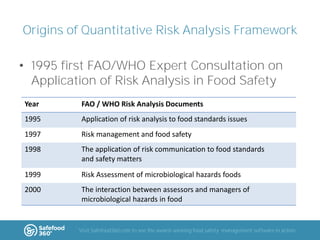
Origins of Quantitative Risk Analysis Framework

• 1995 first FAO/WHO Expert Consultation on
Application of Risk Analysis in Food Safety
Year

FAO / WHO Risk Analysis Documents

1995

Application of risk analysis to food standards issues

1997

Risk management and food safety

1998

The application of risk communication to food standards
and safety matters

1999

Risk Assessment of microbiological hazards foods

2000

The interaction between assessors and managers of
microbiological hazards in food

Visit Safefood360.com to see the award-winning food safety management software in action
Why is risk important in food safety?

WHAT IS RISK?

Visit Safefood360.com to see the award-winning food safety management software in action
Definition of food
• Food: Any substance whether processed,
semi-processed or raw which is intended for
human consumption, including drinks,
chewing gum and any substance which has
been used in the manufacture, preparation or
treatment of food but excluding cosmetics,
tobacco and substances used as drugs

Visit Safefood360.com to see the award-winning food safety management software in action
Definition of hazard
• Hazard: A biological, chemical or physical
agent in or property of food that may have
adverse health effects.

Visit Safefood360.com to see the award-winning food safety management software in action
Nature of risk 1
• Risk is part of everyday life
• Getting out of bed, driving etc.
• Elimination of risk is either impossible or impractical

• We make judgements daily regarding risk and what is
acceptable
•

is an essential part of a normal and

fulfilling life
• Balance - risk vs. reward

Visit Safefood360.com to see the award-winning food safety management software in action
Nature of risk 2
• Understanding of risk analysis requires an
understanding of the concept of risk itself
• Encompasses a large element of human
psychological responses

• Perception and understanding varies
• Some languages do not discriminate
between hazard and risk

• Perception often based on person or group.
• E.g. Age, gender, social class etc.

Visit Safefood360.com to see the award-winning food safety management software in action
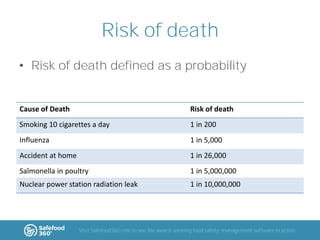
Risk of death
• Risk of death defined as a probability

Cause of Death

Risk of death

Smoking 10 cigarettes a day

1 in 200

Influenza

1 in 5,000

Accident at home

1 in 26,000

Salmonella in poultry

1 in 5,000,000

Nuclear power station radiation leak

1 in 10,000,000

Visit Safefood360.com to see the award-winning food safety management software in action
Nature of risk 3
• In Food Safety Management
• An understanding of RISK is one of the most
important skills you will learn

• Specifically how to assess risk and make
effective management decisions based on this
assessment
• Poor understanding of risk (including perception
& communication) leads to poor decisions e.g.
BSE, German Bean Sprouts?

Visit Safefood360.com to see the award-winning food safety management software in action
Nature of risk 4
• Impossible to eliminate risk of food safety
hazards in food
• Objective - reduction to acceptable levels
• To do this criteria must be employed
• This is conducted at international, national,
agency and processing level

Visit Safefood360.com to see the award-winning food safety management software in action
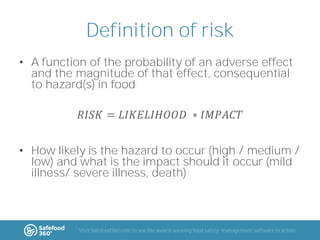
Definition of risk
• A function of the probability of an adverse effect
and the magnitude of that effect, consequential
to hazard(s) in food
𝑅𝐼𝑆𝐾 = 𝐿𝐼𝐾𝐸𝐿𝐼𝐻𝑂𝑂𝐷 ∗ 𝐼𝑀𝑃𝐴𝐶𝑇
• How likely is the hazard to occur (high / medium /
low) and what is the impact should it occur (mild
illness/ severe illness, death)

Visit Safefood360.com to see the award-winning food safety management software in action
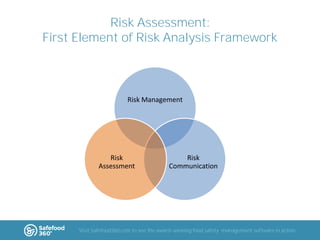
Risk Assessment:
First Element of Risk Analysis Framework

Risk Management

Risk
Assessment

Risk
Communication

Visit Safefood360.com to see the award-winning food safety management software in action
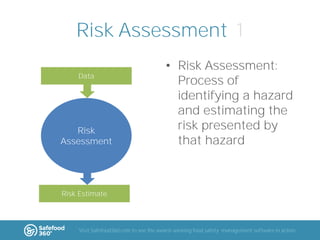
Risk Assessment 1
Data

Risk
Assessment

• Risk Assessment:
Process of
identifying a hazard
and estimating the
risk presented by
that hazard

Risk Estimate

Visit Safefood360.com to see the award-winning food safety management software in action
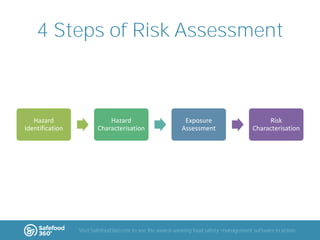
4 Steps of Risk Assessment

Hazard
Identification

Hazard
Characterisation

Exposure
Assessment

Risk
Characterisation

Visit Safefood360.com to see the award-winning food safety management software in action
Risk Assessment 2
• It may be quantitative or qualitative
•

quantitative)

• Detailed quantitative RA is not always
available

• Risk Assessment more often characterised by
what we don't know than what we do know

Visit Safefood360.com to see the award-winning food safety management software in action
Risk Assessment 3
• Structured
• Assists decision makers

RM tool

• Initiates interventions

• Actions Regulatory, voluntary activities and / or
educational initiatives
• Takes account of various factors such as quality,
acceptable risk, technical feasibility, cost
• Develop more effective HACCP plans

Visit Safefood360.com to see the award-winning food safety management software in action
Risk Assessment 4
• Contributes to better understanding
of whole food systems
•

changes

•
account of new data

•
foods or various hazards within the same food

Visit Safefood360.com to see the award-winning food safety management software in action
Risk Assessment 5
• RA plays role in international food trade
• Provides tool to determine equivalent levels
of public health protection between countries
• Establish scientifically based food safety
requirements

Visit Safefood360.com to see the award-winning food safety management software in action
Qualitative Risk Assessment
• Qualitative Risk assessment based on
qualitative data or giving a qualitative result
• Results are often stated in an estimate range
there is a high, medium or low risk of certain
outcome occurring

Visit Safefood360.com to see the award-winning food safety management software in action
Quantitative Risk Assessment
• Risk assessment that uses modelling to
determine the probability of what can go
wrong, how likely it is to happen and how
sever are the likely health impacts
• Results are stated in numerical terms
• 42% probability that a certain illness may
occur from eating a serving (g) of food X with
a certain health outcome

Visit Safefood360.com to see the award-winning food safety management software in action
Why Risk Assessment?
• Identify food safety issues
• Set priorities
• Address specific public health food safety
problems. Justify or evaluate new of alternative
measures, technology or inspection system
• Issues may come from any source...
• RM, FSO, FSM, Government, Codex, disease
surveillance, industry, consumer, new technologies,
trade

Visit Safefood360.com to see the award-winning food safety management software in action
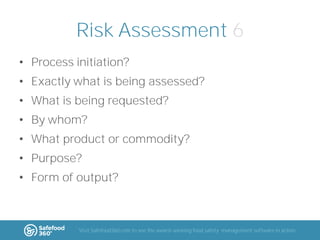
Risk Assessment 6
• Process initiation?
• Exactly what is being assessed?
• What is being requested?

• By whom?
• What product or commodity?
• Purpose?
• Form of output?

Visit Safefood360.com to see the award-winning food safety management software in action
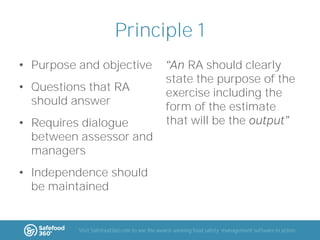
Principle 1
• Purpose and objective
• Questions that RA
should answer

• Requires dialogue
between assessor and
managers

RA should clearly
state the purpose of the
exercise including the
form of the estimate
that will be the

• Independence should
be maintained

Visit Safefood360.com to see the award-winning food safety management software in action
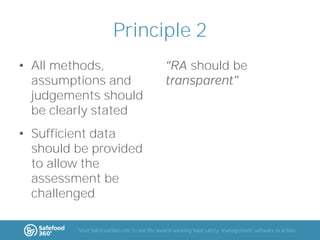
Principle 2
• All methods,
assumptions and
judgements should
be clearly stated

should be

• Sufficient data
should be provided
to allow the
assessment be
challenged
Visit Safefood360.com to see the award-winning food safety management software in action
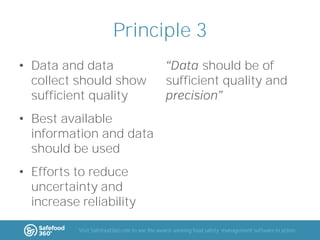
Principle 3
• Data and data
collect should show
sufficient quality

should be of
sufficient quality and

• Best available
information and data
should be used
• Efforts to reduce
uncertainty and
increase reliability
Visit Safefood360.com to see the award-winning food safety management software in action
Principle 4
• Describe the
limitations of the
data, methods or
models utilised

Risk should
contain a description
of uncertainty and
where the uncertainty
arose during the risk
assessment

Visit Safefood360.com to see the award-winning food safety management software in action
Principle 5
• For micro hazards,
growth, survival or
death should be
explicitly considered
• Interaction between
human and the
agent should be
assessed

appropriate,
the RA should consider
the fate of the
hazard(s) in food and
the disease process
following infection

Visit Safefood360.com to see the award-winning food safety management software in action
Principle 6
• It should not be a
static entity
• Reviews should be
conducted as
required

Risk estimates, where
possible, should be re
assessed over time
against independent
human illness data
and new data as it
becomes available.

Visit Safefood360.com to see the award-winning food safety management software in action
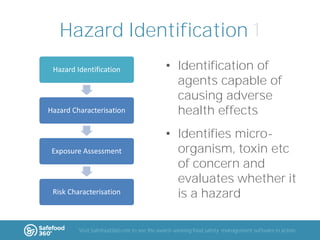
Hazard Identification 1
Hazard Identification

Hazard Characterisation

Exposure Assessment

Risk Characterisation

• Identification of
agents capable of
causing adverse
health effects
• Identifies microorganism, toxin etc
of concern and
evaluates whether it
is a hazard

Visit Safefood360.com to see the award-winning food safety management software in action
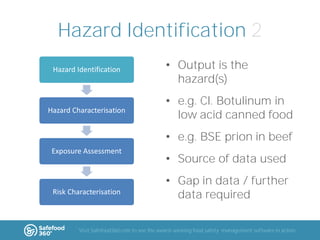
Hazard Identification 2
Hazard Identification

Hazard Characterisation

• Output is the
hazard(s)
• e.g. Cl. Botulinum in
low acid canned food
• e.g. BSE prion in beef

Exposure Assessment

Risk Characterisation

• Source of data used
• Gap in data / further
data required

Visit Safefood360.com to see the award-winning food safety management software in action
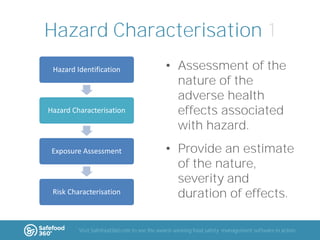
Hazard Characterisation 1
Hazard Identification

Hazard Characterisation

Exposure Assessment

Risk Characterisation

• Assessment of the
nature of the
adverse health
effects associated
with hazard.
• Provide an estimate
of the nature,
severity and
duration of effects.

Visit Safefood360.com to see the award-winning food safety management software in action
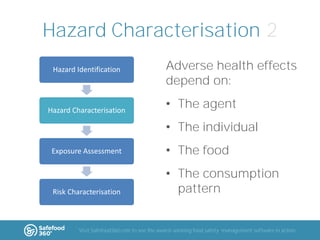
Hazard Characterisation 2
Hazard Identification

Hazard Characterisation

Adverse health effects
depend on:
• The agent

• The individual
Exposure Assessment

• The food

Risk Characterisation

• The consumption
pattern

Visit Safefood360.com to see the award-winning food safety management software in action
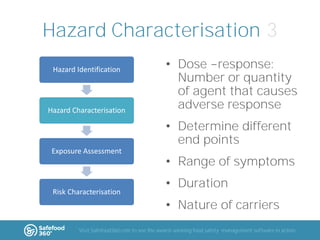
Hazard Characterisation 3
Hazard Identification

Hazard Characterisation

• Dose response:
Number or quantity
of agent that causes
adverse response
• Determine different
end points

Exposure Assessment

Risk Characterisation

• Range of symptoms
• Duration
• Nature of carriers

Visit Safefood360.com to see the award-winning food safety management software in action
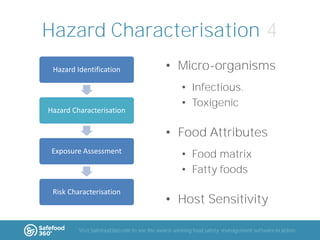
Hazard Characterisation 4
Hazard Identification

Hazard Characterisation

• Micro-organisms
• Infectious.
• Toxigenic

• Food Attributes
Exposure Assessment

• Food matrix
• Fatty foods

Risk Characterisation

• Host Sensitivity

Visit Safefood360.com to see the award-winning food safety management software in action
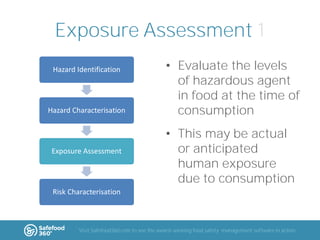
Exposure Assessment 1
Hazard Identification

Hazard Characterisation

Exposure Assessment

• Evaluate the levels
of hazardous agent
in food at the time of
consumption
• This may be actual
or anticipated
human exposure
due to consumption

Risk Characterisation

Visit Safefood360.com to see the award-winning food safety management software in action
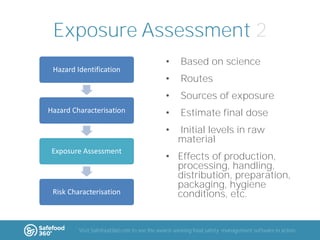
Exposure Assessment 2

Exposure Assessment

Risk Characterisation

•

Routes
Sources of exposure

•

Estimate final dose

•

Hazard Characterisation

Based on science

•

Hazard Identification

•

Initial levels in raw
material

• Effects of production,
processing, handling,
distribution, preparation,
packaging, hygiene
conditions, etc.

Visit Safefood360.com to see the award-winning food safety management software in action
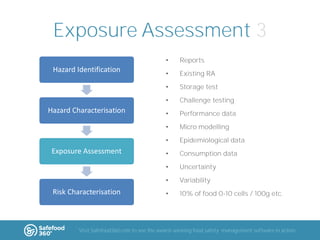
Exposure Assessment 3
•

Challenge testing

•

Performance data
Micro modelling

•

Epidemiological data

•

Consumption data

•

Uncertainty

•

Risk Characterisation

Storage test

•

Exposure Assessment

Existing RA

•

Hazard Characterisation

•
•

Hazard Identification

Reports

Variability

•

10% of food 0-10 cells / 100g etc.

Visit Safefood360.com to see the award-winning food safety management software in action
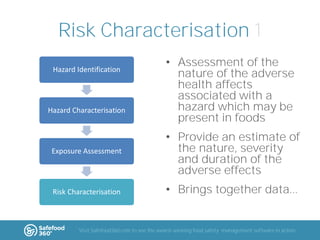
Risk Characterisation 1
Hazard Identification

Hazard Characterisation

• Assessment of the
nature of the adverse
health affects
associated with a
hazard which may be
present in foods

Exposure Assessment

• Provide an estimate of
the nature, severity
and duration of the
adverse effects

Risk Characterisation

• Brings together data...

Visit Safefood360.com to see the award-winning food safety management software in action
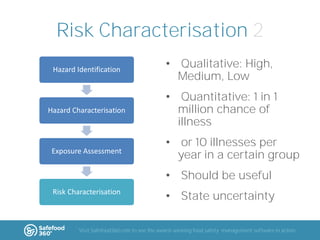
Risk Characterisation 2
Hazard Identification

• Qualitative: High,
Medium, Low

Hazard Characterisation

• Quantitative: 1 in 1
million chance of
illness

Exposure Assessment

• or 10 illnesses per
year in a certain group
• Should be useful

Risk Characterisation

• State uncertainty

Visit Safefood360.com to see the award-winning food safety management software in action
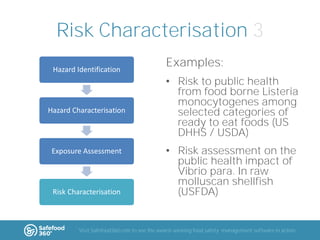
Risk Characterisation 3
Hazard Identification

Hazard Characterisation

Exposure Assessment

Risk Characterisation

Examples:
• Risk to public health
from food borne Listeria
monocytogenes among
selected categories of
ready to eat foods (US
DHHS / USDA)
• Risk assessment on the
public health impact of
Vibrio para. In raw
molluscan shellfish
(USFDA)

Visit Safefood360.com to see the award-winning food safety management software in action
Risk Assessment Report
• Describe Uncertainty
• Clearly state estimates
• Suggestions for management
• Need for more research
• Methods used
• Who conducted RA

• Sources of information and data. (More about this later)

Visit Safefood360.com to see the award-winning food safety management software in action
Visit Safefood360.com for more food safety management resources
Visit Safefood360.com to see the award-winning food safety management software in action

Food Safety Risk Analysis - Part 1

  • 1.
    Food Safety Risk Analysis Part1 Safefood 360º provides food safety management software for industry leading food businesses everywhere in the world Visit Safefood360.com to see the award-winning food safety management software in action
  • 2.
    Visit Safefood360.com formore food safety management resources Visit Safefood360.com to see the award-winning food safety management software in action
  • 3.
    INTRODUCTION TO RISK ANALYSIS VisitSafefood360.com to see the award-winning food safety management software in action
  • 4.
    Introduction to RiskAnalysis • • • • The main goal of Food Safety Management is the reduction of the incidents of food-borne illness to the lowest practical level • This can only be achieved by taking steps at each point of the food chain where hazards can occur Limited resources at regulatory and local level mean decisions must be taken regarding which actions are prioritised • Risk Assessment Risk Management Risk Communication • • Risk Analysis Framework consists of 3 activities Risk Analysis is the tool used to determine such actions Visit Safefood360.com to see the award-winning food safety management software in action
  • 5.
    Risk Analysis Framework •Simple Module • At EU Level it is more complex in reality Risk Management Risk Assessment Risk Communication • The scientific element is risk assessment • Risk management uses the output from the assessment to put in place actions to control hazards • Risk communication is the dialogue between interested parties regarding the outputs of the above Visit Safefood360.com to see the award-winning food safety management software in action
  • 6.
    HISTORY AND EVOLUTIONOF FOOD SAFETY RISK ANALYSIS Visit Safefood360.com to see the award-winning food safety management software in action
  • 7.
    1 • Preoccupation ofhumans • Community based food production 17,000 years ago barley in Egypt • Dry storage improved preservation • Other methods developed • Honey, olive oil, heating and salting Visit Safefood360.com to see the award-winning food safety management software in action
  • 8.
    2 • In timehumans learned to identify safe food • Trial and error adverse health effects • Lessons found expression in religious taboos • Eating pigs in Jewish and Muslim religions • Hygiene India • • Early example of banning of foods Visit Safefood360.com to see the award-winning food safety management software in action
  • 9.
    3 • However lackof understanding of causes of food poisoning • Illness persisted • Scientific understanding commenced in 1795 • French Government offered reward of effective method of food preservation • Nicolas Appert stuffed food into wide mouth jar, sealed and placed in boiling water for 6 hours Visit Safefood360.com to see the award-winning food safety management software in action
  • 10.
    4 • 1810 Englishman Durand •Method using tin cans • Knew How but not Why • Both unaware of the discovery of Leeuwenhoek in 1677 heat sensitive • Not until 1854 was the scientific basis for thermal preservation understood • Louis Pasteur showed that certain bacteria caused food spoilage or poisoning • Commercial heat treatment of wine was introduced i.e. Pasteurisation Visit Safefood360.com to see the award-winning food safety management software in action
  • 11.
    5 • Link established •Food hygiene control introduced • Standards established • Early laws based on Prohibition • Eventually prevention was introduced • 1922 process criteria for low acid canned foods • ) • 1971 principle of identifying and controlling critical steps in process was introduced. HACCP Pillsbury in the U.S. Visit Safefood360.com to see the award-winning food safety management software in action
  • 12.
    Origin of QuantitativeRisk Analysis • Since 1955, systematic risk analysis has been used by the FAO / WHO • Evaluation of the levels of food additives • Est. Expert Committee JEFCA • 1962 Codex Alimentarius Commission CAC est. • Intergovernmental committee responsible for establishing food safety standards Visit Safefood360.com to see the award-winning food safety management software in action
  • 13.
    Origins of QuantitativeRisk Analysis Framework • 1995 first FAO/WHO Expert Consultation on Application of Risk Analysis in Food Safety Year FAO / WHO Risk Analysis Documents 1995 Application of risk analysis to food standards issues 1997 Risk management and food safety 1998 The application of risk communication to food standards and safety matters 1999 Risk Assessment of microbiological hazards foods 2000 The interaction between assessors and managers of microbiological hazards in food Visit Safefood360.com to see the award-winning food safety management software in action
  • 14.
    Why is riskimportant in food safety? WHAT IS RISK? Visit Safefood360.com to see the award-winning food safety management software in action
  • 15.
    Definition of food •Food: Any substance whether processed, semi-processed or raw which is intended for human consumption, including drinks, chewing gum and any substance which has been used in the manufacture, preparation or treatment of food but excluding cosmetics, tobacco and substances used as drugs Visit Safefood360.com to see the award-winning food safety management software in action
  • 16.
    Definition of hazard •Hazard: A biological, chemical or physical agent in or property of food that may have adverse health effects. Visit Safefood360.com to see the award-winning food safety management software in action
  • 17.
    Nature of risk1 • Risk is part of everyday life • Getting out of bed, driving etc. • Elimination of risk is either impossible or impractical • We make judgements daily regarding risk and what is acceptable • is an essential part of a normal and fulfilling life • Balance - risk vs. reward Visit Safefood360.com to see the award-winning food safety management software in action
  • 18.
    Nature of risk2 • Understanding of risk analysis requires an understanding of the concept of risk itself • Encompasses a large element of human psychological responses • Perception and understanding varies • Some languages do not discriminate between hazard and risk • Perception often based on person or group. • E.g. Age, gender, social class etc. Visit Safefood360.com to see the award-winning food safety management software in action
  • 19.
    Risk of death •Risk of death defined as a probability Cause of Death Risk of death Smoking 10 cigarettes a day 1 in 200 Influenza 1 in 5,000 Accident at home 1 in 26,000 Salmonella in poultry 1 in 5,000,000 Nuclear power station radiation leak 1 in 10,000,000 Visit Safefood360.com to see the award-winning food safety management software in action
  • 20.
    Nature of risk3 • In Food Safety Management • An understanding of RISK is one of the most important skills you will learn • Specifically how to assess risk and make effective management decisions based on this assessment • Poor understanding of risk (including perception & communication) leads to poor decisions e.g. BSE, German Bean Sprouts? Visit Safefood360.com to see the award-winning food safety management software in action
  • 21.
    Nature of risk4 • Impossible to eliminate risk of food safety hazards in food • Objective - reduction to acceptable levels • To do this criteria must be employed • This is conducted at international, national, agency and processing level Visit Safefood360.com to see the award-winning food safety management software in action
  • 22.
    Definition of risk •A function of the probability of an adverse effect and the magnitude of that effect, consequential to hazard(s) in food 𝑅𝐼𝑆𝐾 = 𝐿𝐼𝐾𝐸𝐿𝐼𝐻𝑂𝑂𝐷 ∗ 𝐼𝑀𝑃𝐴𝐶𝑇 • How likely is the hazard to occur (high / medium / low) and what is the impact should it occur (mild illness/ severe illness, death) Visit Safefood360.com to see the award-winning food safety management software in action
  • 23.
    Risk Assessment: First Elementof Risk Analysis Framework Risk Management Risk Assessment Risk Communication Visit Safefood360.com to see the award-winning food safety management software in action
  • 24.
    Risk Assessment 1 Data Risk Assessment •Risk Assessment: Process of identifying a hazard and estimating the risk presented by that hazard Risk Estimate Visit Safefood360.com to see the award-winning food safety management software in action
  • 25.
    4 Steps ofRisk Assessment Hazard Identification Hazard Characterisation Exposure Assessment Risk Characterisation Visit Safefood360.com to see the award-winning food safety management software in action
  • 26.
    Risk Assessment 2 •It may be quantitative or qualitative • quantitative) • Detailed quantitative RA is not always available • Risk Assessment more often characterised by what we don't know than what we do know Visit Safefood360.com to see the award-winning food safety management software in action
  • 27.
    Risk Assessment 3 •Structured • Assists decision makers RM tool • Initiates interventions • Actions Regulatory, voluntary activities and / or educational initiatives • Takes account of various factors such as quality, acceptable risk, technical feasibility, cost • Develop more effective HACCP plans Visit Safefood360.com to see the award-winning food safety management software in action
  • 28.
    Risk Assessment 4 •Contributes to better understanding of whole food systems • changes • account of new data • foods or various hazards within the same food Visit Safefood360.com to see the award-winning food safety management software in action
  • 29.
    Risk Assessment 5 •RA plays role in international food trade • Provides tool to determine equivalent levels of public health protection between countries • Establish scientifically based food safety requirements Visit Safefood360.com to see the award-winning food safety management software in action
  • 30.
    Qualitative Risk Assessment •Qualitative Risk assessment based on qualitative data or giving a qualitative result • Results are often stated in an estimate range there is a high, medium or low risk of certain outcome occurring Visit Safefood360.com to see the award-winning food safety management software in action
  • 31.
    Quantitative Risk Assessment •Risk assessment that uses modelling to determine the probability of what can go wrong, how likely it is to happen and how sever are the likely health impacts • Results are stated in numerical terms • 42% probability that a certain illness may occur from eating a serving (g) of food X with a certain health outcome Visit Safefood360.com to see the award-winning food safety management software in action
  • 32.
    Why Risk Assessment? •Identify food safety issues • Set priorities • Address specific public health food safety problems. Justify or evaluate new of alternative measures, technology or inspection system • Issues may come from any source... • RM, FSO, FSM, Government, Codex, disease surveillance, industry, consumer, new technologies, trade Visit Safefood360.com to see the award-winning food safety management software in action
  • 33.
    Risk Assessment 6 •Process initiation? • Exactly what is being assessed? • What is being requested? • By whom? • What product or commodity? • Purpose? • Form of output? Visit Safefood360.com to see the award-winning food safety management software in action
  • 34.
    Principle 1 • Purposeand objective • Questions that RA should answer • Requires dialogue between assessor and managers RA should clearly state the purpose of the exercise including the form of the estimate that will be the • Independence should be maintained Visit Safefood360.com to see the award-winning food safety management software in action
  • 35.
    Principle 2 • Allmethods, assumptions and judgements should be clearly stated should be • Sufficient data should be provided to allow the assessment be challenged Visit Safefood360.com to see the award-winning food safety management software in action
  • 36.
    Principle 3 • Dataand data collect should show sufficient quality should be of sufficient quality and • Best available information and data should be used • Efforts to reduce uncertainty and increase reliability Visit Safefood360.com to see the award-winning food safety management software in action
  • 37.
    Principle 4 • Describethe limitations of the data, methods or models utilised Risk should contain a description of uncertainty and where the uncertainty arose during the risk assessment Visit Safefood360.com to see the award-winning food safety management software in action
  • 38.
    Principle 5 • Formicro hazards, growth, survival or death should be explicitly considered • Interaction between human and the agent should be assessed appropriate, the RA should consider the fate of the hazard(s) in food and the disease process following infection Visit Safefood360.com to see the award-winning food safety management software in action
  • 39.
    Principle 6 • Itshould not be a static entity • Reviews should be conducted as required Risk estimates, where possible, should be re assessed over time against independent human illness data and new data as it becomes available. Visit Safefood360.com to see the award-winning food safety management software in action
  • 40.
    Hazard Identification 1 HazardIdentification Hazard Characterisation Exposure Assessment Risk Characterisation • Identification of agents capable of causing adverse health effects • Identifies microorganism, toxin etc of concern and evaluates whether it is a hazard Visit Safefood360.com to see the award-winning food safety management software in action
  • 41.
    Hazard Identification 2 HazardIdentification Hazard Characterisation • Output is the hazard(s) • e.g. Cl. Botulinum in low acid canned food • e.g. BSE prion in beef Exposure Assessment Risk Characterisation • Source of data used • Gap in data / further data required Visit Safefood360.com to see the award-winning food safety management software in action
  • 42.
    Hazard Characterisation 1 HazardIdentification Hazard Characterisation Exposure Assessment Risk Characterisation • Assessment of the nature of the adverse health effects associated with hazard. • Provide an estimate of the nature, severity and duration of effects. Visit Safefood360.com to see the award-winning food safety management software in action
  • 43.
    Hazard Characterisation 2 HazardIdentification Hazard Characterisation Adverse health effects depend on: • The agent • The individual Exposure Assessment • The food Risk Characterisation • The consumption pattern Visit Safefood360.com to see the award-winning food safety management software in action
  • 44.
    Hazard Characterisation 3 HazardIdentification Hazard Characterisation • Dose response: Number or quantity of agent that causes adverse response • Determine different end points Exposure Assessment Risk Characterisation • Range of symptoms • Duration • Nature of carriers Visit Safefood360.com to see the award-winning food safety management software in action
  • 45.
    Hazard Characterisation 4 HazardIdentification Hazard Characterisation • Micro-organisms • Infectious. • Toxigenic • Food Attributes Exposure Assessment • Food matrix • Fatty foods Risk Characterisation • Host Sensitivity Visit Safefood360.com to see the award-winning food safety management software in action
  • 46.
    Exposure Assessment 1 HazardIdentification Hazard Characterisation Exposure Assessment • Evaluate the levels of hazardous agent in food at the time of consumption • This may be actual or anticipated human exposure due to consumption Risk Characterisation Visit Safefood360.com to see the award-winning food safety management software in action
  • 47.
    Exposure Assessment 2 ExposureAssessment Risk Characterisation • Routes Sources of exposure • Estimate final dose • Hazard Characterisation Based on science • Hazard Identification • Initial levels in raw material • Effects of production, processing, handling, distribution, preparation, packaging, hygiene conditions, etc. Visit Safefood360.com to see the award-winning food safety management software in action
  • 48.
    Exposure Assessment 3 • Challengetesting • Performance data Micro modelling • Epidemiological data • Consumption data • Uncertainty • Risk Characterisation Storage test • Exposure Assessment Existing RA • Hazard Characterisation • • Hazard Identification Reports Variability • 10% of food 0-10 cells / 100g etc. Visit Safefood360.com to see the award-winning food safety management software in action
  • 49.
    Risk Characterisation 1 HazardIdentification Hazard Characterisation • Assessment of the nature of the adverse health affects associated with a hazard which may be present in foods Exposure Assessment • Provide an estimate of the nature, severity and duration of the adverse effects Risk Characterisation • Brings together data... Visit Safefood360.com to see the award-winning food safety management software in action
  • 50.
    Risk Characterisation 2 HazardIdentification • Qualitative: High, Medium, Low Hazard Characterisation • Quantitative: 1 in 1 million chance of illness Exposure Assessment • or 10 illnesses per year in a certain group • Should be useful Risk Characterisation • State uncertainty Visit Safefood360.com to see the award-winning food safety management software in action
  • 51.
    Risk Characterisation 3 HazardIdentification Hazard Characterisation Exposure Assessment Risk Characterisation Examples: • Risk to public health from food borne Listeria monocytogenes among selected categories of ready to eat foods (US DHHS / USDA) • Risk assessment on the public health impact of Vibrio para. In raw molluscan shellfish (USFDA) Visit Safefood360.com to see the award-winning food safety management software in action
  • 52.
    Risk Assessment Report •Describe Uncertainty • Clearly state estimates • Suggestions for management • Need for more research • Methods used • Who conducted RA • Sources of information and data. (More about this later) Visit Safefood360.com to see the award-winning food safety management software in action
  • 53.
    Visit Safefood360.com formore food safety management resources Visit Safefood360.com to see the award-winning food safety management software in action