
Mrs.R.Sinthiya
Assistant Professor
Department of Food Processing and Preservation Technology
Faculty of Engineering
Avinashilingam Institute for Home Science & Higher Education
for Women University, Coimbatore
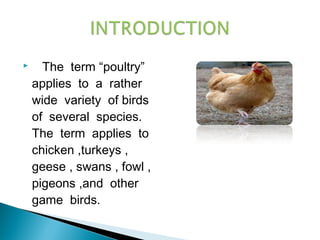
 The term “poultry”
applies to a rather
wide variety of birds
of several species.
The term applies to
chicken ,turkeys ,
geese , swans , fowl ,
pigeons ,and other
game birds.
 There are 4 classes of poultry
commonly raised
 EGG PRODUCING POULTRY
 BROILER MEAT CHICKENS
 TURKEYS
 DUCKS & GEESE
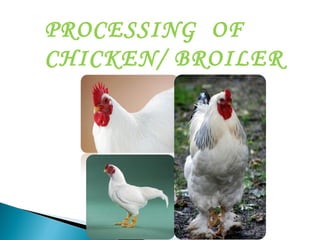
PROCESSING OF
CHICKEN/ BROILER
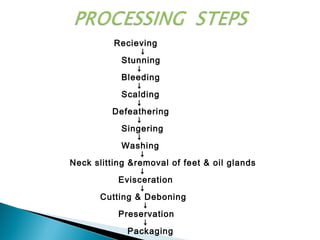
Recieving
↓
Stunning
↓
Bleeding
↓
Scalding
↓
Defeathering
↓
Singering
↓
Washing
↓
Neck slitting &removal of feet & oil glands
↓
Evisceration
↓
Cutting & Deboning
↓
Preservation
↓
Packaging
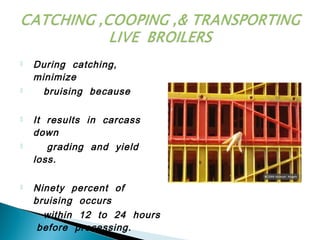
 During catching,
minimize
 bruising because
 It results in carcass
down
 grading and yield
loss.
 Ninety percent of
bruising occurs
 within 12 to 24 hours
before processing.
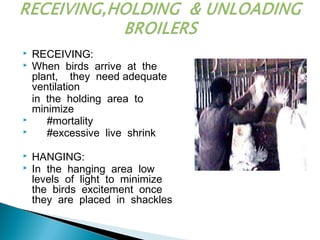
 RECEIVING:
 When birds arrive at the
plant, they need adequate
ventilation
in the holding area to
minimize
 #mortality
 #excessive live shrink
 HANGING:
 In the hanging area low
levels of light to minimize
the birds excitement once
they are placed in shackles
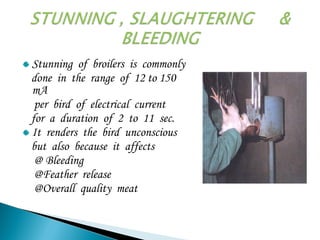
Stunning of broilers is commonly
done in the range of 12 to 150
mA
per bird of electrical current
for a duration of 2 to 11 sec.
It renders the bird unconscious
but also because it affects
@ Bleeding
@Feather release
@Overall quality meat
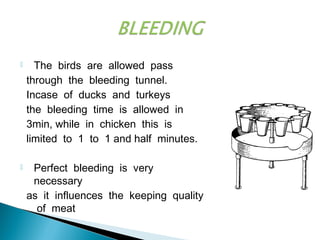
 The birds are allowed pass
through the bleeding tunnel.
Incase of ducks and turkeys
the bleeding time is allowed in
3min, while in chicken this is
limited to 1 to 1 and half minutes.
 Perfect bleeding is very
necessary
as it influences the keeping quality
of meat
Scalding is a technique of
immersing birds in hot water
at a specified temperature for
a particular duration that
assits in loosening of the
feathers
For broiler chicken the
suitable scalding temperature is
53 for 120 seconds.
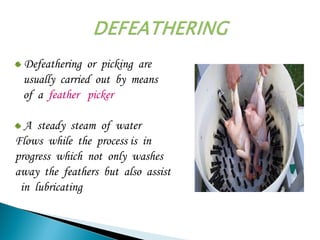
Defeathering or picking are
usually carried out by means
of a feather picker
A steady steam of water
Flows while the process is in
progress which not only washes
away the feathers but also assist
in lubricating
Carcasses are signed over a flame while
they arepassing in the conveyor line to
remove hair like appendages called
piloplumes
Washing removes
 Dirt
 Cleans the soiled areas
It also assits in reducing microbial load
present on the carcass
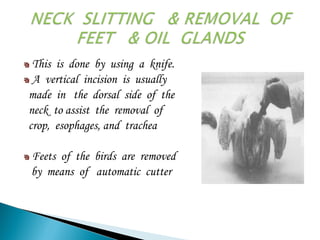
This is done by using a knife.
A vertical incision is usually
made in the dorsal side of the
neck to assist the removal of
crop, esophages, and trachea
Feets of the birds are removed
by means of automatic cutter
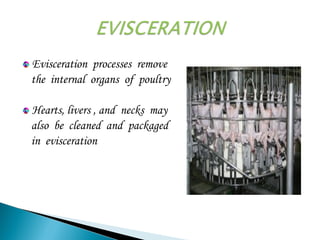
Evisceration processes remove
the internal organs of poultry
Hearts, livers , and necks may
also be cleaned and packaged
in evisceration
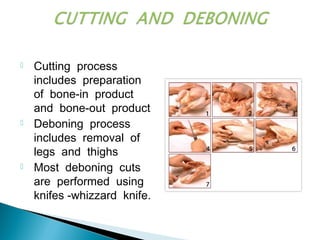
 Cutting process
includes preparation
of bone-in product
and bone-out product
 Deboning process
includes removal of
legs and thighs
 Most deboning cuts
are performed using
knifes -whizzard knife.
Referigeration
Dehydration
Curing
Smoking
Canning
Irradiation
Microwave heating
Use of chemical additives including antibiotics are
important
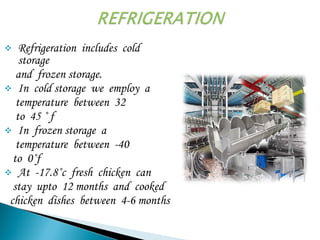
 Refrigeration includes cold
storage
and frozen storage.
 In cold storage we employ a
temperature between 32
to 45 ˚ f
 In frozen storage a
temperature between -40
to 0˚f
 At -17.8˚c fresh chicken can
stay upto 12 months and cooked
chicken dishes between 4-6 months
 Smoke is generally produced due to slow
combustion of sawdust 20-30% hemicellulose
and 20-30% lignin and 40-60% cellulose
which assist in preservation of poultry meat
 Smoke assist in preserving poultry by acting
as an antioxidant
 Imparts specific flavour to meat
 Affect the colour of the finished product
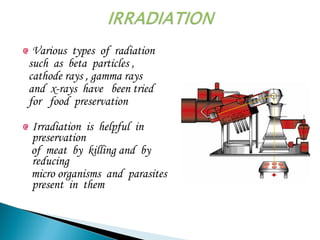
Various types of radiation
such as beta particles ,
cathode rays , gamma rays
and x-rays have been tried
for food preservation
Irradiation is helpful in
preservation
of meat by killing and by
reducing
micro organisms and parasites
present in them
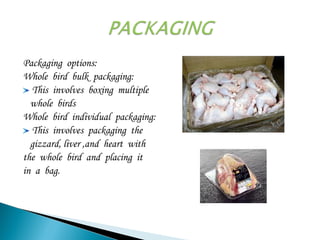
Packaging options:
Whole bird bulk packaging:
This involves boxing multiple
whole birds
Whole bird individual packaging:
This involves packaging the
gizzard, liver ,and heart with
the whole bird and placing it
in a bag.
Processing of poultry

Processing of poultry

  • 1.
    Mrs.R.Sinthiya Assistant Professor Department ofFood Processing and Preservation Technology Faculty of Engineering Avinashilingam Institute for Home Science & Higher Education for Women University, Coimbatore
  • 2.
     The term“poultry” applies to a rather wide variety of birds of several species. The term applies to chicken ,turkeys , geese , swans , fowl , pigeons ,and other game birds.
  • 3.
     There are4 classes of poultry commonly raised  EGG PRODUCING POULTRY  BROILER MEAT CHICKENS  TURKEYS  DUCKS & GEESE
  • 4.
  • 5.
    Recieving ↓ Stunning ↓ Bleeding ↓ Scalding ↓ Defeathering ↓ Singering ↓ Washing ↓ Neck slitting &removalof feet & oil glands ↓ Evisceration ↓ Cutting & Deboning ↓ Preservation ↓ Packaging
  • 6.
     During catching, minimize bruising because  It results in carcass down  grading and yield loss.  Ninety percent of bruising occurs  within 12 to 24 hours before processing.
  • 7.
     RECEIVING:  Whenbirds arrive at the plant, they need adequate ventilation in the holding area to minimize  #mortality  #excessive live shrink  HANGING:  In the hanging area low levels of light to minimize the birds excitement once they are placed in shackles
  • 8.
    Stunning of broilersis commonly done in the range of 12 to 150 mA per bird of electrical current for a duration of 2 to 11 sec. It renders the bird unconscious but also because it affects @ Bleeding @Feather release @Overall quality meat
  • 9.
     The birdsare allowed pass through the bleeding tunnel. Incase of ducks and turkeys the bleeding time is allowed in 3min, while in chicken this is limited to 1 to 1 and half minutes.  Perfect bleeding is very necessary as it influences the keeping quality of meat
  • 10.
    Scalding is atechnique of immersing birds in hot water at a specified temperature for a particular duration that assits in loosening of the feathers For broiler chicken the suitable scalding temperature is 53 for 120 seconds.
  • 11.
    Defeathering or pickingare usually carried out by means of a feather picker A steady steam of water Flows while the process is in progress which not only washes away the feathers but also assist in lubricating
  • 12.
    Carcasses are signedover a flame while they arepassing in the conveyor line to remove hair like appendages called piloplumes
  • 13.
    Washing removes  Dirt Cleans the soiled areas It also assits in reducing microbial load present on the carcass
  • 14.
    This is doneby using a knife. A vertical incision is usually made in the dorsal side of the neck to assist the removal of crop, esophages, and trachea Feets of the birds are removed by means of automatic cutter
  • 15.
    Evisceration processes remove theinternal organs of poultry Hearts, livers , and necks may also be cleaned and packaged in evisceration
  • 16.
     Cutting process includespreparation of bone-in product and bone-out product  Deboning process includes removal of legs and thighs  Most deboning cuts are performed using knifes -whizzard knife.
  • 17.
  • 18.
     Refrigeration includescold storage and frozen storage.  In cold storage we employ a temperature between 32 to 45 ˚ f  In frozen storage a temperature between -40 to 0˚f  At -17.8˚c fresh chicken can stay upto 12 months and cooked chicken dishes between 4-6 months
  • 19.
     Smoke isgenerally produced due to slow combustion of sawdust 20-30% hemicellulose and 20-30% lignin and 40-60% cellulose which assist in preservation of poultry meat  Smoke assist in preserving poultry by acting as an antioxidant  Imparts specific flavour to meat  Affect the colour of the finished product
  • 20.
    Various types ofradiation such as beta particles , cathode rays , gamma rays and x-rays have been tried for food preservation Irradiation is helpful in preservation of meat by killing and by reducing micro organisms and parasites present in them
  • 21.
    Packaging options: Whole birdbulk packaging: This involves boxing multiple whole birds Whole bird individual packaging: This involves packaging the gizzard, liver ,and heart with the whole bird and placing it in a bag.