Welcomes you for the
FREE DEMO CLASS
BioNETVision
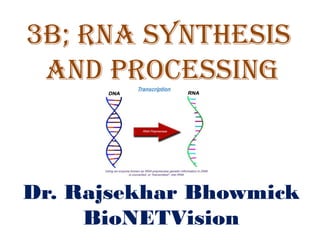
3B; RNA synthesis
and processing
Dr. Rajsekhar Bhowmick
BioNETVision
• Transcription factors and machinery, formation
of initiation complex, transcription activators
and repressors, RNA polymerases, capping,
elongation and termination, RNA processing,
RNA editing, splicing, polyadenylation,
structure and function of different types of
RNA, RNA transport.
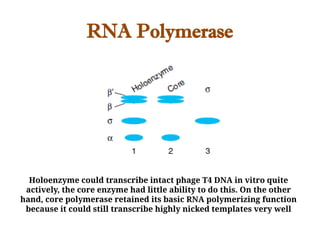
RNA Polymerase
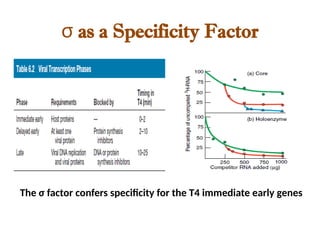
Holoenzyme could transcribe intact phage T4 DNA in vitro quite
actively, the core enzyme had little ability to do this. On the other
hand, core polymerase retained its basic RNA polymerizing function
because it could still transcribe highly nicked templates very well
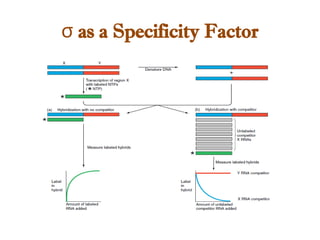
σ as a Specificity Factor
The σ factor confers specificity for the T4 immediate early genes
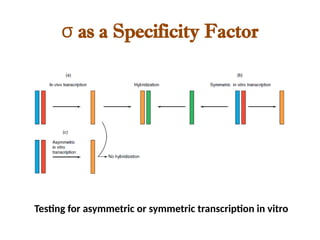
σ as a Specificity Factor
Testing for asymmetric or symmetric transcription in vitro
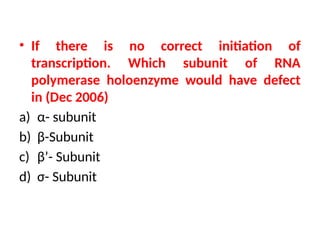
• If there is no correct initiation of
transcription. Which subunit of RNA
polymerase holoenzyme would have defect
in (Dec 2006)
a) α- subunit
b) β-Subunit
c) β’- Subunit
d) σ- Subunit
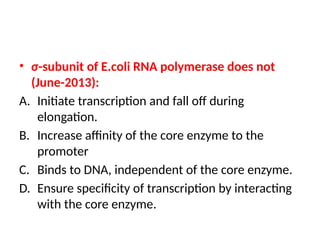
• σ-subunit of E.coli RNA polymerase does not
(June-2013):
A. Initiate transcription and fall off during
elongation.
B. Increase affinity of the core enzyme to the
promoter
C. Binds to DNA, independent of the core enzyme.
D. Ensure specificity of transcription by interacting
with the core enzyme.
• Bacteriophage T4 infects E. coli injects its DNA inside
the cell. The transcription of viral genes occurs in
three stages: immediate early, early and late. All the
promoters on viral genome are available, but the
control takes place at the level of: (June-2013):
A. Promoter strength.
B. Modification of host RNA polymerase.
C. Synthesis of new polymerases.
D. Turn over rate of RNA synthesis.
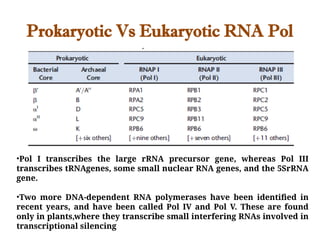
Prokaryotic Vs Eukaryotic RNA Pol
•Pol I transcribes the large rRNA precursor gene, whereas Pol III
transcribes tRNAgenes, some small nuclear RNA genes, and the 5SrRNA
gene.
•Two more DNA-dependent RNA polymerases have been identified in
recent years, and have been called Pol IV and Pol V. These are found
only in plants,where they transcribe small interfering RNAs involved in
transcriptional silencing
• Which eukaryotic RNA polymerase
transcribes t-RNA genes? (Dec-2010)
a) RNA polymerase I
b) RNA polymerase II
c) RNA polymerase III
d) DNA polymerase I
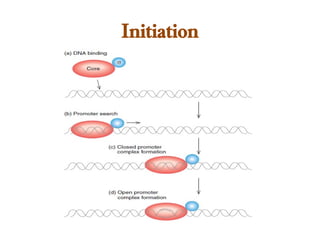
Initiation
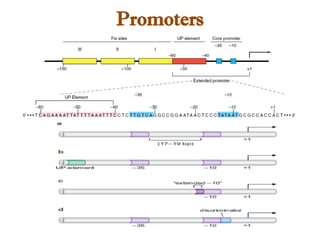
Promoters
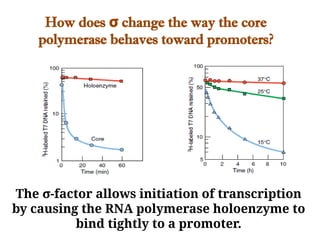
How does change the way the core
σ
polymerase behaves toward promoters?
The σ-factor allows initiation of transcription
by causing the RNA polymerase holoenzyme to
bind tightly to a promoter.
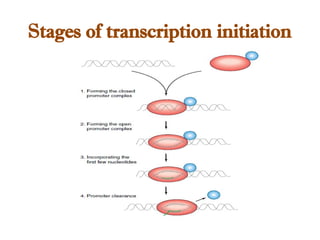
Stages of transcription initiation
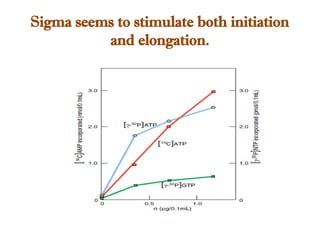
Sigma seems to stimulate both initiation
and elongation.
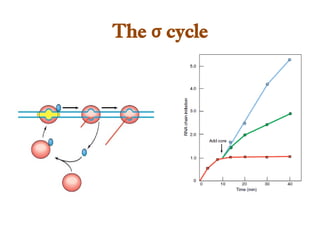
The σ cycle
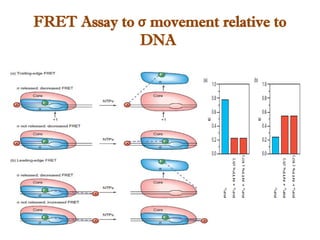
FRET Assay to σ movement relative to
DNA
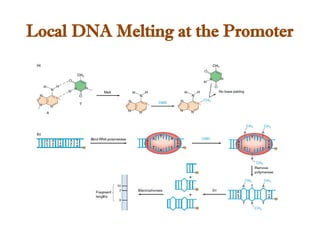
Local DNA Melting at the Promoter
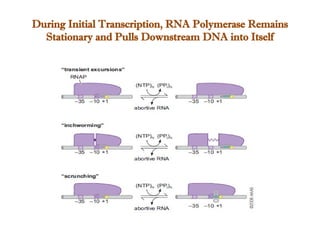
During Initial Transcription, RNA Polymerase Remains
Stationary and Pulls Downstream DNA into Itself
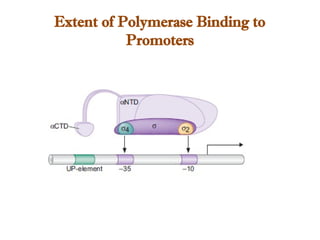
Extent of Polymerase Binding to
Promoters
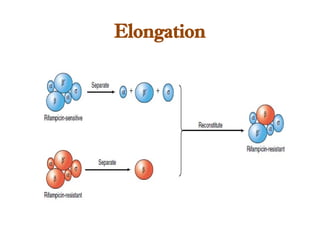
Elongation
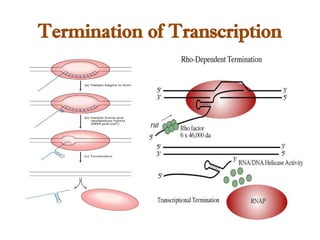
Termination of Transcription
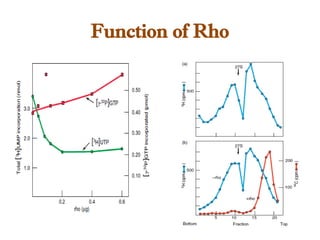
Function of Rho
The Elongating Polymerase Is a Processive Machine
That Synthesizes and Proofreads RNA
• pyrophosphorolytic editing.
• hydrolytic editing
• RNA Polymerase Can Become Arrested and
Need Removing: TRCF and UVR A,B and C
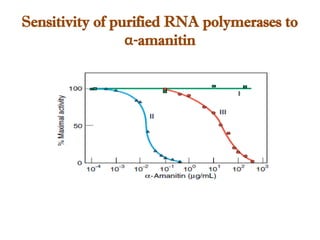
Sensitivity of purified RNA polymerases to
α-amanitin
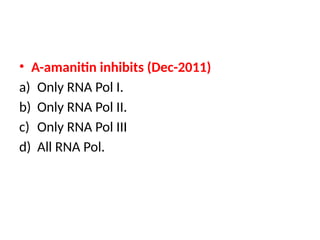
• Α-amanitin inhibits (Dec-2011)
a) Only RNA Pol I.
b) Only RNA Pol II.
c) Only RNA Pol III
d) All RNA Pol.
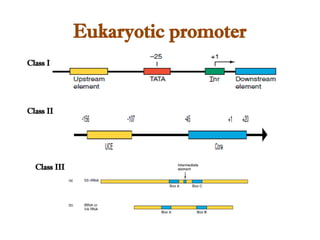
Eukaryotic promoter
Class I
Class II
Class III
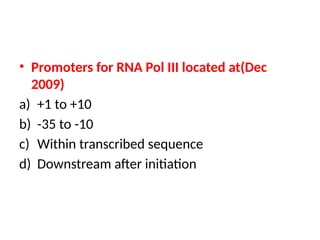
• Promoters for RNA Pol III located at(Dec
2009)
a) +1 to +10
b) -35 to -10
c) Within transcribed sequence
d) Downstream after initiation
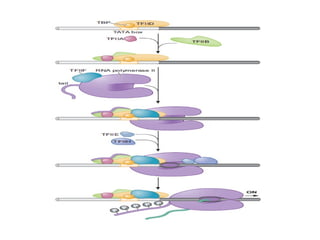
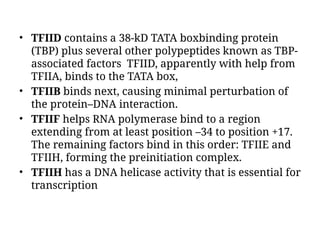
• TFIID contains a 38-kD TATA boxbinding protein
(TBP) plus several other polypeptides known as TBP-
associated factors TFIID, apparently with help from
TFIIA, binds to the TATA box,
• TFIIB binds next, causing minimal perturbation of
the protein–DNA interaction.
• TFIIF helps RNA polymerase bind to a region
extending from at least position –34 to position +17.
The remaining factors bind in this order: TFIIE and
TFIIH, forming the preinitiation complex.
• TFIIH has a DNA helicase activity that is essential for
transcription
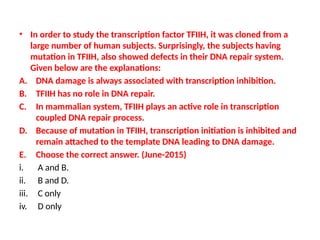
• In order to study the transcription factor TFIIH, it was cloned from a
large number of human subjects. Surprisingly, the subjects having
mutation in TFIIH, also showed defects in their DNA repair system.
Given below are the explanations:
A. DNA damage is always associated with transcription inhibition.
B. TFIIH has no role in DNA repair.
C. In mammalian system, TFIIH plays an active role in transcription
coupled DNA repair process.
D. Because of mutation in TFIIH, transcription initiation is inhibited and
remain attached to the template DNA leading to DNA damage.
E. Choose the correct answer. (June-2015)
i. A and B.
ii. B and D.
iii. C only
iv. D only
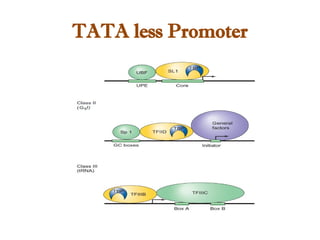
TATA less Promoter
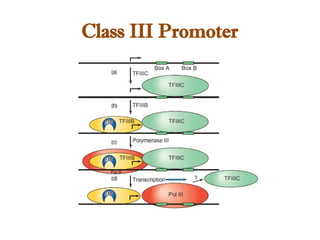
Class III Promoter
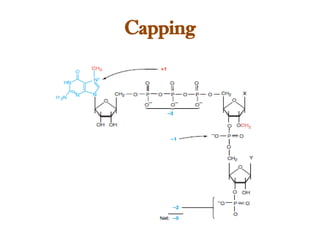
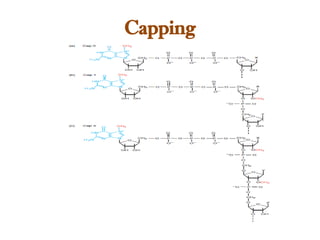
Capping
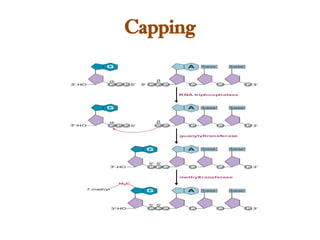
Capping
Capping
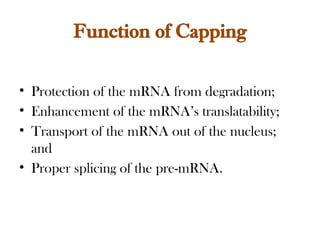
Function of Capping
• Protection of the mRNA from degradation;
• Enhancement of the mRNA’s translatability;
• Transport of the mRNA out of the nucleus;
and
• Proper splicing of the pre-mRNA.
Polyadenylation
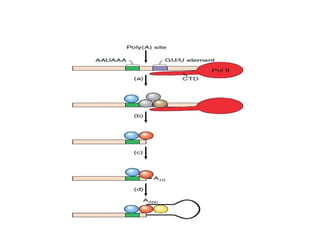
• An efficient mammalian polyadenylation signal consists of
an AAUAAA motif about 20 nt upstream of a
polyadenylation site in a premRNA, followed 23 or 24 bp
later by a GU-rich motif, followed immediately by a U-rich
motif. Many variations on this theme occur in nature,
which results in variations in efficiency of polyadenylation.
Plant polyadenylation signals also usually contain an
AAUAAA motif, but more variation is allowed in this
region than in an animal AAUAAA. Yeast
polyadenylation signals are more different yet, and rarely
contain an AAUAAA motif.
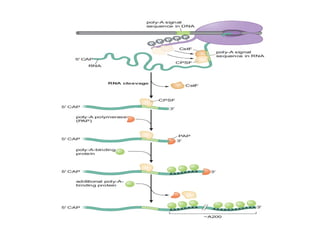
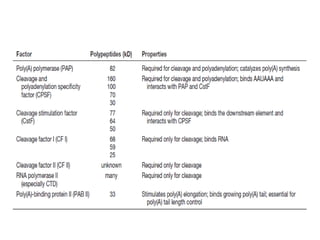
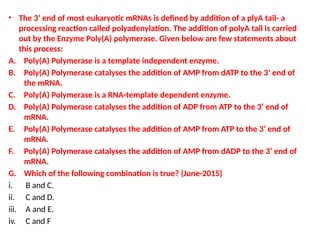
• The 3’ end of most eukaryotic mRNAs is defined by addition of a plyA tail- a
processing reaction called polyadenylation. The addition of polyA tail is carried
out by the Enzyme Poly(A) polymerase. Given below are few statements about
this process:
A. Poly(A) Polymerase is a template independent enzyme.
B. Poly(A) Polymerase catalyses the addition of AMP from dATP to the 3’ end of
the mRNA.
C. Poly(A) Polymerase is a RNA-template dependent enzyme.
D. Poly(A) Polymerase catalyses the addition of ADP from ATP to the 3’ end of
mRNA.
E. Poly(A) Polymerase catalyses the addition of AMP from ATP to the 3’ end of
mRNA.
F. Poly(A) Polymerase catalyses the addition of AMP from dADP to the 3’ end of
mRNA.
G. Which of the following combination is true? (June-2015)
i. B and C.
ii. C and D.
iii. A and E.
iv. C and F
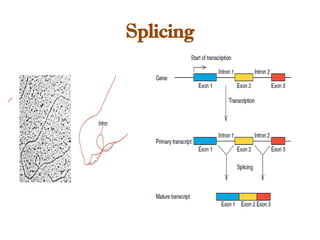
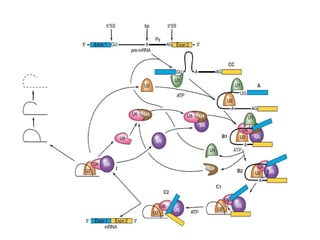
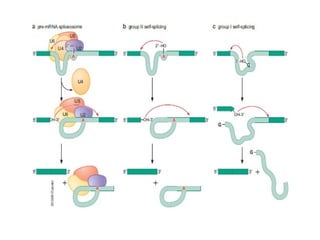
Splicing
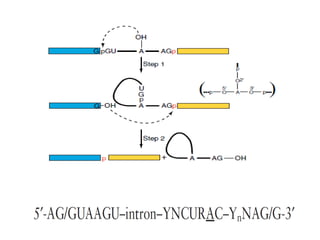
• In type II splicing. (June-2015)
a) A G’-OH from outside makes a nucleophilic
attack on 5’P of first base intron.
b) A free 2’O of an internal adenosine makes a
nucleophilic attack on 5’P of first base of intron.
c) A 3’O of an internal adenosine makes a
nucleophilic attack on 5’P of first base of intron.
d) The hydrolysis of lastbase of exon is carried out
by U2/U4/U6
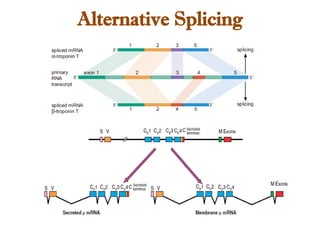
Alternative Splicing
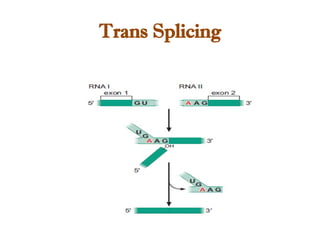
Trans Splicing
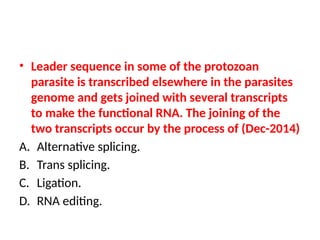
• Leader sequence in some of the protozoan
parasite is transcribed elsewhere in the parasites
genome and gets joined with several transcripts
to make the functional RNA. The joining of the
two transcripts occur by the process of (Dec-2014)
A. Alternative splicing.
B. Trans splicing.
C. Ligation.
D. RNA editing.
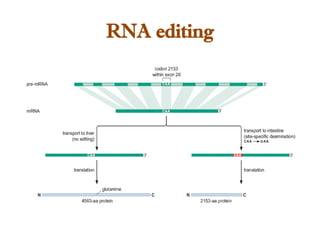
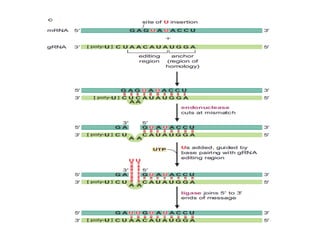
RNA editing
• With an intention to identify the genes expressed in an organism at
specific stage of development, mRNAs were isolated from the given
organism, cDNAs were synthsized, cloned in a suitable vector and
sequenced. A few of the cDNA sequences showed no matches with the
genomic DNA sequence. Further, it was observed that these sequences
were U rich and found to be in stretches dispersed along the sequence.
The following may be possible reason for appearance of such RNA:
A. Splicing.
B. Alternate Splicing.
C. Trans Splicing.
D. Guide RNA mediated introduction of Usinvoving endonuclease,
terminal-U- Transferease and RNA ligase.
E. Determination converting C to U.
F. Which of the followinh is the most appropriate reason/s? (June-2015)
G. A and C.
H. B and D.
I. C, D and E.
J. D only
Thank You

Transcription process explained ppt 1234

  • 1.
    Welcomes you forthe FREE DEMO CLASS BioNETVision
  • 2.
    3B; RNA synthesis andprocessing Dr. Rajsekhar Bhowmick BioNETVision
  • 3.
    • Transcription factorsand machinery, formation of initiation complex, transcription activators and repressors, RNA polymerases, capping, elongation and termination, RNA processing, RNA editing, splicing, polyadenylation, structure and function of different types of RNA, RNA transport.
  • 4.
    RNA Polymerase Holoenzyme couldtranscribe intact phage T4 DNA in vitro quite actively, the core enzyme had little ability to do this. On the other hand, core polymerase retained its basic RNA polymerizing function because it could still transcribe highly nicked templates very well
  • 5.
    σ as aSpecificity Factor
  • 6.
    σ as aSpecificity Factor The σ factor confers specificity for the T4 immediate early genes
  • 7.
    σ as aSpecificity Factor Testing for asymmetric or symmetric transcription in vitro
  • 8.
    • If thereis no correct initiation of transcription. Which subunit of RNA polymerase holoenzyme would have defect in (Dec 2006) a) α- subunit b) β-Subunit c) β’- Subunit d) σ- Subunit
  • 9.
    • σ-subunit ofE.coli RNA polymerase does not (June-2013): A. Initiate transcription and fall off during elongation. B. Increase affinity of the core enzyme to the promoter C. Binds to DNA, independent of the core enzyme. D. Ensure specificity of transcription by interacting with the core enzyme.
  • 10.
    • Bacteriophage T4infects E. coli injects its DNA inside the cell. The transcription of viral genes occurs in three stages: immediate early, early and late. All the promoters on viral genome are available, but the control takes place at the level of: (June-2013): A. Promoter strength. B. Modification of host RNA polymerase. C. Synthesis of new polymerases. D. Turn over rate of RNA synthesis.
  • 11.
    Prokaryotic Vs EukaryoticRNA Pol •Pol I transcribes the large rRNA precursor gene, whereas Pol III transcribes tRNAgenes, some small nuclear RNA genes, and the 5SrRNA gene. •Two more DNA-dependent RNA polymerases have been identified in recent years, and have been called Pol IV and Pol V. These are found only in plants,where they transcribe small interfering RNAs involved in transcriptional silencing
  • 12.
    • Which eukaryoticRNA polymerase transcribes t-RNA genes? (Dec-2010) a) RNA polymerase I b) RNA polymerase II c) RNA polymerase III d) DNA polymerase I
  • 13.
  • 14.
  • 15.
    How does changethe way the core σ polymerase behaves toward promoters? The σ-factor allows initiation of transcription by causing the RNA polymerase holoenzyme to bind tightly to a promoter.
  • 16.
  • 17.
    Sigma seems tostimulate both initiation and elongation.
  • 18.
  • 19.
    FRET Assay toσ movement relative to DNA
  • 20.
    Local DNA Meltingat the Promoter
  • 21.
    During Initial Transcription,RNA Polymerase Remains Stationary and Pulls Downstream DNA into Itself
  • 22.
    Extent of PolymeraseBinding to Promoters
  • 23.
  • 24.
  • 25.
  • 26.
    The Elongating PolymeraseIs a Processive Machine That Synthesizes and Proofreads RNA • pyrophosphorolytic editing. • hydrolytic editing • RNA Polymerase Can Become Arrested and Need Removing: TRCF and UVR A,B and C
  • 27.
    Sensitivity of purifiedRNA polymerases to α-amanitin
  • 28.
    • Α-amanitin inhibits(Dec-2011) a) Only RNA Pol I. b) Only RNA Pol II. c) Only RNA Pol III d) All RNA Pol.
  • 29.
  • 30.
    • Promoters forRNA Pol III located at(Dec 2009) a) +1 to +10 b) -35 to -10 c) Within transcribed sequence d) Downstream after initiation
  • 32.
    • TFIID containsa 38-kD TATA boxbinding protein (TBP) plus several other polypeptides known as TBP- associated factors TFIID, apparently with help from TFIIA, binds to the TATA box, • TFIIB binds next, causing minimal perturbation of the protein–DNA interaction. • TFIIF helps RNA polymerase bind to a region extending from at least position –34 to position +17. The remaining factors bind in this order: TFIIE and TFIIH, forming the preinitiation complex. • TFIIH has a DNA helicase activity that is essential for transcription
  • 33.
    • In orderto study the transcription factor TFIIH, it was cloned from a large number of human subjects. Surprisingly, the subjects having mutation in TFIIH, also showed defects in their DNA repair system. Given below are the explanations: A. DNA damage is always associated with transcription inhibition. B. TFIIH has no role in DNA repair. C. In mammalian system, TFIIH plays an active role in transcription coupled DNA repair process. D. Because of mutation in TFIIH, transcription initiation is inhibited and remain attached to the template DNA leading to DNA damage. E. Choose the correct answer. (June-2015) i. A and B. ii. B and D. iii. C only iv. D only
  • 34.
  • 35.
  • 36.
  • 37.
  • 38.
  • 39.
    Function of Capping •Protection of the mRNA from degradation; • Enhancement of the mRNA’s translatability; • Transport of the mRNA out of the nucleus; and • Proper splicing of the pre-mRNA.
  • 40.
    Polyadenylation • An efficientmammalian polyadenylation signal consists of an AAUAAA motif about 20 nt upstream of a polyadenylation site in a premRNA, followed 23 or 24 bp later by a GU-rich motif, followed immediately by a U-rich motif. Many variations on this theme occur in nature, which results in variations in efficiency of polyadenylation. Plant polyadenylation signals also usually contain an AAUAAA motif, but more variation is allowed in this region than in an animal AAUAAA. Yeast polyadenylation signals are more different yet, and rarely contain an AAUAAA motif.
  • 44.
    • The 3’end of most eukaryotic mRNAs is defined by addition of a plyA tail- a processing reaction called polyadenylation. The addition of polyA tail is carried out by the Enzyme Poly(A) polymerase. Given below are few statements about this process: A. Poly(A) Polymerase is a template independent enzyme. B. Poly(A) Polymerase catalyses the addition of AMP from dATP to the 3’ end of the mRNA. C. Poly(A) Polymerase is a RNA-template dependent enzyme. D. Poly(A) Polymerase catalyses the addition of ADP from ATP to the 3’ end of mRNA. E. Poly(A) Polymerase catalyses the addition of AMP from ATP to the 3’ end of mRNA. F. Poly(A) Polymerase catalyses the addition of AMP from dADP to the 3’ end of mRNA. G. Which of the following combination is true? (June-2015) i. B and C. ii. C and D. iii. A and E. iv. C and F
  • 45.
  • 50.
    • In typeII splicing. (June-2015) a) A G’-OH from outside makes a nucleophilic attack on 5’P of first base intron. b) A free 2’O of an internal adenosine makes a nucleophilic attack on 5’P of first base of intron. c) A 3’O of an internal adenosine makes a nucleophilic attack on 5’P of first base of intron. d) The hydrolysis of lastbase of exon is carried out by U2/U4/U6
  • 51.
  • 52.
  • 53.
    • Leader sequencein some of the protozoan parasite is transcribed elsewhere in the parasites genome and gets joined with several transcripts to make the functional RNA. The joining of the two transcripts occur by the process of (Dec-2014) A. Alternative splicing. B. Trans splicing. C. Ligation. D. RNA editing.
  • 54.
  • 56.
    • With anintention to identify the genes expressed in an organism at specific stage of development, mRNAs were isolated from the given organism, cDNAs were synthsized, cloned in a suitable vector and sequenced. A few of the cDNA sequences showed no matches with the genomic DNA sequence. Further, it was observed that these sequences were U rich and found to be in stretches dispersed along the sequence. The following may be possible reason for appearance of such RNA: A. Splicing. B. Alternate Splicing. C. Trans Splicing. D. Guide RNA mediated introduction of Usinvoving endonuclease, terminal-U- Transferease and RNA ligase. E. Determination converting C to U. F. Which of the followinh is the most appropriate reason/s? (June-2015) G. A and C. H. B and D. I. C, D and E. J. D only
  • 57.