PRESNTATION ON
MOLECULAR BIOLOGY
TOPIC: EUKARYOTIC TRANSCRIPTION
Presented by,
Sandip Paul
INTRODUCTION
• The transcription of eukaryotic genes is a far more complicated process than transcription in prokaryotes.
• Eukaryotic transcription involves separate polymerases for the synthesis of rRNA, tRNA, and mRNA.
• In addition, a large number of proteins called transcription factors (TFs) are involved. TFs bind to distinct sites on the DNA either within the
core promoter region, close (proximal) to it, or some distance away (distal).
• They are required both for the assembly of a transcription complex at the promoter and the determination of which genes are to be
transcribed.
• For TFs to recognize and bind to their specific DNA sequences, the chromatin structure in that region must be altered (relaxed) to allow
access to the DNA.
COMPONENTS OF EUKARYOTIC TRANSCRIPTION
RNA polymerase: there are three types of RNA polymerase in eukaryotes which play different roles in gene expression.
 RNA polymerase I
This enzyme is located in the nucleolus of the cell.
RNA polymerase I synthesize almost all rRNAs except 5S rRNA.
The enzyme has a mass of 600kDa and 13 subunits.
 RNA polymerase II
This enzyme is located in the nucleus.
RNA polymerase II have a 12-subunit RNAP II (with a mass of about 550 kDa).
They contain transcription factors and transcriptional regulators.
It synthesize all protein coded pre-mRNAs.
 RNA polymerase III
 It is located in the nucleus.
 The RNA polymerase III has 14 or more distinct subunits
with a mass of approximately 700 kDa.
 Its function is to transcribe transfer RNA (tRNA),
ribosomal RNA (rRNA), and other small RNAs.
CONTD..
Promoter:
• They are specialized DNA sequences at transcription start sites of protein-coding and non-coding genes that support the
assembly of the transcription apparatus and start transcription.
• They are a vital component of gene expression, as they control the binding of RNA polymerase to DNA.
• They describe the direction of transcription and point out which DNA strand will be translated.
• Eukaryotic promoters are larger and more intricate than the prokaryotic one.
Core Promoter:
• Located upstream or downstream of the TSS and binding site of the basal transcription apparatuses.
• Include one or more consensus sequences.
• It is typically ~40 bp long,
• It typically includes a TATA box or an Inr and a DPE(a promoter have either TATA-box or DPE element, not both).
CONTD..
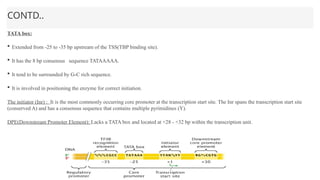
TATA box:
 Extended from -25 to -35 bp upstream of the TSS(TBP binding site).
 It has the 8 bp consensus sequence TATAAAAA.
 It tend to be surrounded by G-C rich sequence.
 It is involved in positioning the enzyme for correct initiation.
The initiator (Inr) : It is the most commonly occurring core promoter at the transcription start site. The Inr spans the transcription start site
(conserved A) and has a consensus sequence that contains multiple pyrimidines (Y).
DPE(Downstream Promoter Element): Lacks a TATA box and located at +28 - +32 bp within the transcription unit.
CONTD..
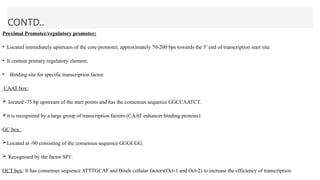
Proximal Promoter/regulatory promoter:
• Located immediately upstream of the core promoter, approximately 70-200 bps towards the 5’ end of transcription start site.
• It contain primary regulatory element.
• Binding site for specific transcription factor.
CAAT box:
 located -75 bp upstream of the start points and has the consensus sequence GGCCAATCT.
it is recognized by a large group of transcription factors (CAAT enhancer binding proteins)
GC box:
Located at -90 consisting of the consensus sequence GGGCGG.
 Recognised by the factor SP1.
OCT box: It has consensus sequence ATTTGCAT and Binds cellular factors(Oct-1 and Oct-2) to increase the efficiency of transcription.
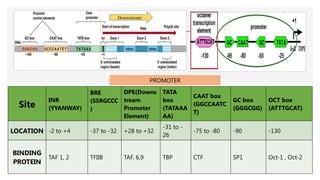
Site
INR
(YYANWAY)
BRE
(SSRGCCC
)
DPE(Downs
tream
Promoter
Element)
TATA
box
(TATAAA
AA)
CAAT box
(GGCCAATC
T)
GC box
(GGGCGG)
OCT box
(ATTTGCAT)
LOCATION -2 to +4 -37 to -32 +28 to +32
-31 to -
26
-75 to -80 -90 -130
BINDING
PROTEIN
TAF 1, 2 TFIIB TAF, 6,9 TBP CTF SP1 Oct-1 , Oct-2
PROMOTER
Downstream
CONTD..
Transcription Factors: A large variety of accessory proteins, which play a role in virtually every aspect of the transcription process, from the
binding of the polymerase to the DNA template, to the initiation of transcription, to its elongation and termination. It controls the rate of
transcription of genetic information from DNA to mRNA.
There are two broad categories of transcription factors: the general transcription factors that are absolutely required for all RNA pol II–
mediated transcription for basal transcription initiation(equivalent σ-factor). GTF contains TATA-binding protein and TATA-associated factors,
recognizes and binds the TATA box (and other core promoter elements).
the specific transcription factors are either enhancer or repressors, which are specified DNA sequence that activate or repress the efficiency or
the rate of RNA pol II transcription. STFs bind to promoter proximal elements to regulate the frequency of transcription initiation, and to distal
elements to mediate the response to signals and regulate which genes are expressed at a given point in time.
CONTD..
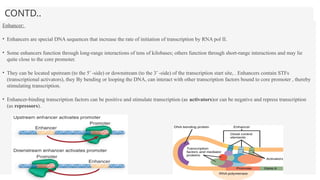
Enhancer:
• Enhancers are special DNA sequences that increase the rate of initiation of transcription by RNA pol II.
• Some enhancers function through long-range interactions of tens of kilobases; others function through short-range interactions and may lie
quite close to the core promoter.
• They can be located upstream (to the 5’ -side) or downstream (to the 3’ -side) of the transcription start site, . Enhancers contain STFs
(transcriptional activators), they By bending or looping the DNA, can interact with other transcription factors bound to core promoter , thereby
stimulating transcription.
• Enhancer-binding transcription factors can be positive and stimulate transcription (as activators)or can be negative and repress transcription
(as repressors).
INITIATION
• RNA polymerase can not initiate transcription so it need a group of proteins for initiation at all promoters. These are known as
General / Basal Transcription Factors(~ 20 polypeptides with a total mass of ~500,000 Dalton). It denoted as “TFIIX” , where
“X” is a latter that identifies the individual factor.
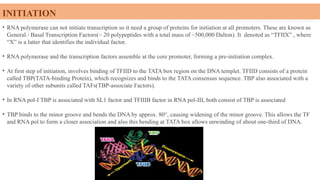
• RNA polymerase and the transcription factors assemble at the core promoter, forming a pre-initiation complex.
• At first step of initiation, involves binding of TFIID to the TATA box region on the DNA templet. TFIID consists of a protein
called TBP(TATA-binding Protein), which recognizes and binds to the TATA consensus sequence. TBP also associated with a
variety of other subunits called TAFs(TBP-associate Factors).
• In RNA pol-I TBP is associated with SL1 factor and TFIIIB factor in RNA pol-III, both consist of TBP is associated
• TBP binds to the minor groove and bends the DNA by approx. 80°, causing widening of the minor groove. This allows the TF
and RNA pol to form a closer association and also this bending at TATA box allows unwinding of about one-third of DNA.
CONTD..
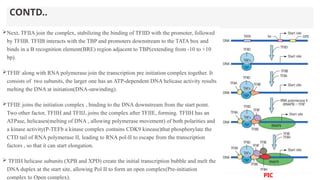
Next, TFIIA join the complex, stabilizing the binding of TFIID with the promoter, followed
by TFIIB. TFIIB interacts with the TBP and promoters downstream to the TATA box and
binds in a B recognition element(BRE) region adjacent to TBP(extending from -10 to +10
bp).
TFIIF along with RNA polymerase join the transcription pre initiation complex together. It
consists of two subunits, the larger one has an ATP-dependent DNA helicase activity results
melting the DNA at initiation(DNA-unwinding).
TFIIE joins the initiation complex , binding to the DNA downstream from the start point.
Two other factor, TFIIH and TFIIJ, joins the complex after TFIIE, forming. TFIIH has an
ATPase, helicases(melting of DNA , allowing polymerase movement) of both polarities and
a kinase activity(P-TEFb a kinase complex contains CDK9 kinease)that phosphorylate the
CTD tail of RNA polymerase II, leading to RNA pol-II to escape from the transcription
factors , so that it can start elongation.
 TFIIH helicase subunits (XPB and XPD) create the initial transcription bubble and melt the
DNA duplex at the start site, allowing Pol II to form an open complex(Pre-initiation
complex to Open complex). PIC
https://youtu.be/XzVXhemtwmA
PROMOTER CLEARENCE AND CTD PHOSPHORYLATION
Elongation
 The transition from initiation to elongation involves shedding of GTFs and binding of elongation factors.
During this step, the RNA Pol II CTD is maintained in the phosphorylated stage by coordinated action of several proteins (elongation factors),as
only phosphorylated CTD can elongate RNA.
The elongation factors prevent pausing of transcription process and are also involved in interaction with protein complexes that mediate post
transcriptional processing of mRNA.
ELL and p-TEFb stimulate elongation and TFIIS stimulates elongation as well as proofreading.
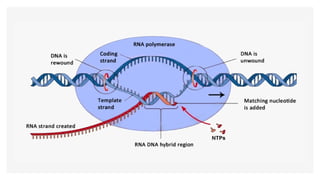
RNA polymerase II moving along the DNA templet, synthesizing of new RNA from 5’ 3’direction by adding new nucleotides to the 3’ end of
the growing strand.
RNA strand synthesizes occurs in a transcription bubble of about 25 unwound DNA base pairs and only 8 nt of newly synthesize RNA remain
basepaired to the DNA templet.
RNA polymerase add one nt at one time means addition of a new nt at 3’ end of the growing strand catalyzed the RNA polymerase moves to the
next DNA templet below it until transcription termination occurs.
TERMINATION
• Unlike in prokaryotes, the termination of RNA pol II is not at specific sequence rather it continues to synthesize RNA hundreds or even
thousands of nucleotides to produce the mRNA .
• The termination begins when pre-mRNA is cleaved at a specific site designated by a consensus sequence of nt (AAUAAA), while transcription is
still taking place at 3’ end.
• Cleavage cuts the pre-mRNA into two pieces: the mRNA that encode the protein and other one is still synthesizing, has its 5’ end.
• An enzyme RNase (Rat1 in yeast and Xrn2 in humans) attach to the 5’ end of RNA and moves towards the 3’ end where RNA pol continues the
transcription.
• RNase is an exonuclease, an enzyme that capable of degrading RNA in the 5’– 3’ direction like a guided torpedo.
• RNase is present on the CTD of RNA pol II, chewing up the RNA as it moves, when it reaches the transcriptional machinery, transcription
terminates.(Torpedo model of termination)
CONTD..
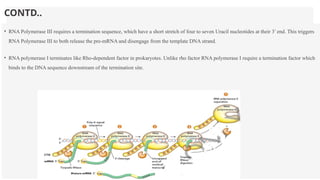
• RNA Polymerase III requires a termination sequence, which have a short stretch of four to seven Uracil nucleotides at their 3′ end. This triggers
RNA Polymerase III to both release the pre-mRNA and disengage from the template DNA strand.
• RNA polymerase I terminates like Rho-dependent factor in prokaryotes. Unlike rho factor RNA polymerase I require a termination factor which
binds to the DNA sequence downstream of the termination site.
Pre-mRNA PROCESSING
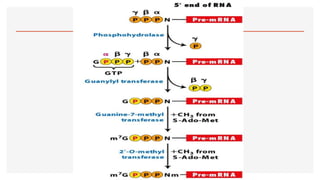
Addition of a 5’ cap
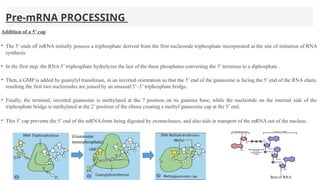
• The 5’ ends of mRNA initially possess a triphosphate derived from the first nucleoside triphosphate incorporated at the site of initiation of RNA
synthesis.
• In the first step, the RNA 5’ triphosphate hydrolyzes the last of the three phosphates converting the 5’ terminus to a diphosphate .
• Then, a GMP is added by guanylyl transferase, in an inverted orientation so that the 5’ end of the guanosine is facing the 5’ end of the RNA chain,
resulting the first two nucleosides are joined by an unusual 5’–5’ triphosphate bridge.
• Finally, the terminal, inverted guanosine is methylated at the 7 position on its guanine base, while the nucleotide on the internal side of the
triphosphate bridge is methylated at the 2’ position of the ribose creating a methyl guanosine cap at the 5’ end.
• This 5’ cap prevents the 5’ end of the mRNA from being digested by exonucleases, and also aids in transport of the mRNA out of the nucleus.
Rest of RNA
(Guanosine
monophosphate)
CONTD..
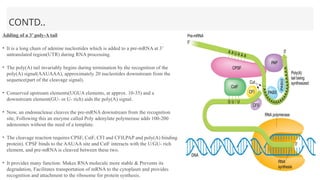
Adding of a 3’ poly-A tail
• It is a long chain of adenine nucleotides which is added to a pre-mRNA at 3’
untranslated region(UTR) during RNA processing.
• The poly(A) tail invariably begins during termination by the recognition of the
poly(A) signal(AAUAAA), approximately 20 nucleotides downstream from the
sequence(part of the cleavage signal).
• Conserved upstream elements(UGUA elements, at approx. 10-35) and a
downstream element(GU- or U- rich) aids the poly(A) signal.
• Now, an endonuclease cleaves the pre-mRNA downstream from the recognition
site, Following this an enzyme called Poly adenylate polymerase adds 100-200
adenosines without the need of a template.
• The cleavage reaction requires CPSF, CstF, CFI and CFII,PAP and poly(A) binding
protein). CPSF binds to the AAUAA site and CstF interacts with the U/GU- rich
element, and pre-mRNA is cleaved between these two.
• It provides many function: Makes RNA molecule more stable & Prevents its
degradation, Facilitates transportation of mRNA to the cytoplasm and provides
recognition and attachment to the ribosome for protein synthesis.
http://youtu.be//DeSRu15VtdM
CONTD..
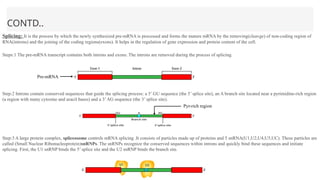
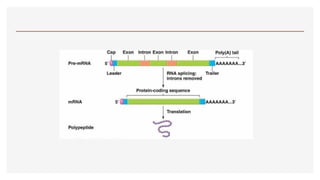
Splicing: It is the process by which the newly synthesized pre-mRNA is processed and forms the mature mRNA by the removing(cleavge) of non-coding region of
RNA(introns) and the joining of the coding regions(exons). It helps in the regulation of gene expression and protein content of the cell.
Steps:1 The pre-mRNA transcript contains both introns and exons. The introns are removed during the process of splicing.
Step:2 Introns contain conserved sequences that guide the splicing process: a 5’ GU sequence (the 5’ splice site), an A branch site located near a pyrimidine-rich region
(a region with many cytosine and uracil bases) and a 3’AG sequence (the 3’ splice site).
Step:3 A large protein complex, spliceosome controls mRNA splicing .It consists of particles made up of proteins and 5 snRNA(U1,U2,U4,U5,UC). These particles are
called (Small Nuclear Ribonucleoprotein)snRNPs. The snRNPs recognize the conserved sequences within introns and quickly bind these sequences and initiate
splicing. First, the U1 snRNP binds the 5’ splice site and the U2 snRNP binds the branch site.
Pre-mRNA
Pyr-rich region
CONTD..
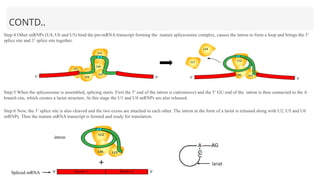
Step:4 Other snRNPs (U4, U6 and U5) bind the pre-mRNA transcript forming the mature spliceosome complex, causes the intron to form a loop and brings the 5’
splice site and 3’ splice site together.
Step:5 When the spliceosome is assembled, splicing starts. First the 5’ end of the intron is cut(remove) and the 5’ GU end of the intron is then connected to the A
branch site, which creates a lariat structure. At this stage the U1 and U4 snRNPs are also released.
Step:6 Now, the 3’ splice site is also cleaved and the two exons are attached to each other. The intron in the form of a lariat is released along with U2, U5 and U6
snRNPs. Thus the mature mRNA transcript is formed and ready for translation.
lariat
Spliced mRNA
+
intron
https://youtu.be/FVuAwBGw_pQ
RNA POLYMERASE-III
• RNA polymerase III is specialized for transcription of short, abundant, nonprotein-coding RNA transcripts, including tRNAs, 5S rRNA and U6
snRNA.
• Promoters are fall into three general classes that are recognized in different ways by different groups of factors.
• The promoters for 5S and tRNA genes are internal, i.e. they lie downstream of the startpoint; in contrast the promoters for snRNA genes lie
upstream of the stratpoint.
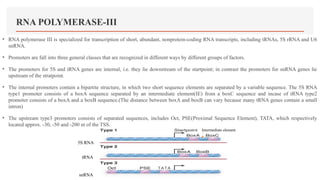
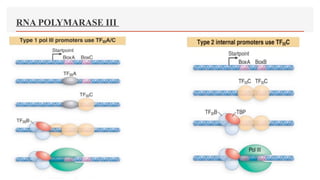
• The internal promoters contain a bipartite structure, in which two short sequence elements are separated by a variable sequence. The 5S RNA
type1 promoter consists of a boxA sequence separated by an intermediate element(IE) from a boxC sequence and incase of tRNA type2
promoter consists of a boxA and a boxB sequence.(The distance between boxA and boxB can vary because many tRNA genes contain a small
intron)
• The upstream type3 promoters consists of separated sequences, includes Oct, PSE(Proximal Sequence Element), TATA, which respectively
located approx. -30, -50 and -200 nt of the TSS.
Intermediate element
5S RNA
tRNA
snRNA
CONTD..
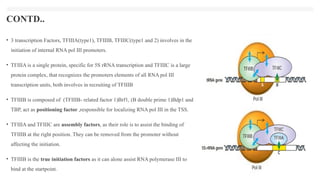
• 3 transcription Factors, TFIIIA(type1), TFIIIB, TFIIIC(type1 and 2) involves in the
initiation of internal RNA pol III promoters.
• TFIIIA is a single protein, specific for 5S rRNA transcription and TFIIIC is a large
protein complex, that recognizes the promoters elements of all RNA pol III
transcription units, both involves in recruiting of TFIIIB
• TFIIIB is composed of (TFIIIB- related factor 1)Brf1, (B double prime 1)Bdp1 and
TBP, act as positioning factor ,responsible for localizing RNA pol III in the TSS.
• TFIIIA and TFIIIC are assembly factors, as their role is to assist the binding of
TFIIIB at the right position. They can be removed from the promoter without
affecting the initiation.
• TFIIIB is the true initiation factors as it can alone assist RNA polymerase III to
bind at the startpoint.
RNA POLYMARASE III
RNA POLYMERASE-I
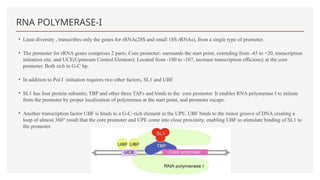
• Least diversity , transcribes only the genes for rRNA(28S and small 18S rRNAs), from a single type of promoter.
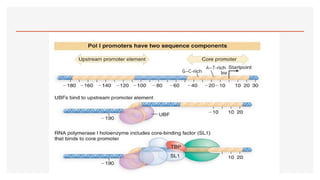
• The promoter for rRNA genes comprises 2 parts; Core promoter: surrounds the start point, extending from -45 to +20, transcription
initiation site, and UCE(Upstream Control Element): Located from -180 to -107, increase transcription efficiency at the core
promoter. Both rich in G-C bp.
• In addition to Pol I initiation requires two other factors, SL1 and UBF.
• SL1 has four protein subunits; TBP and other three TAFs and binds to the core promoter. It enables RNA polymerase I to initiate
from the promoter by proper localization of polymerase at the start point, and promoter escape.
• Another transcription factor UBF is binds to a G-C–rich element in the UPE. UBF binds to the minor groove of DNA creating a
loop of almost 360° result that the core promoter and UPE come into close proximity, enabling UBF to stimulate binding of SL1 to
the promoter.
REFERENCES
1. Benjamin Lewin, GENES V, Oxford University Press,1995
2. Benjamin A. Pierce, Genetics: A Conceptual Approach, Fourth Edition, Kate Ahr Parker, United States of America,
2012
3. Gerald Carp, Cell and Molecular Biology, 6th
Edition,2008
4. Lewin's Genes XII
5. William S. Klug et all, Concepts of Genetics, 9th
edition,
THANK YOU

Eukaryotic Transcription presentation ppt

  • 1.
    PRESNTATION ON MOLECULAR BIOLOGY TOPIC:EUKARYOTIC TRANSCRIPTION Presented by, Sandip Paul
  • 2.
    INTRODUCTION • The transcriptionof eukaryotic genes is a far more complicated process than transcription in prokaryotes. • Eukaryotic transcription involves separate polymerases for the synthesis of rRNA, tRNA, and mRNA. • In addition, a large number of proteins called transcription factors (TFs) are involved. TFs bind to distinct sites on the DNA either within the core promoter region, close (proximal) to it, or some distance away (distal). • They are required both for the assembly of a transcription complex at the promoter and the determination of which genes are to be transcribed. • For TFs to recognize and bind to their specific DNA sequences, the chromatin structure in that region must be altered (relaxed) to allow access to the DNA.
  • 3.
    COMPONENTS OF EUKARYOTICTRANSCRIPTION RNA polymerase: there are three types of RNA polymerase in eukaryotes which play different roles in gene expression.  RNA polymerase I This enzyme is located in the nucleolus of the cell. RNA polymerase I synthesize almost all rRNAs except 5S rRNA. The enzyme has a mass of 600kDa and 13 subunits.  RNA polymerase II This enzyme is located in the nucleus. RNA polymerase II have a 12-subunit RNAP II (with a mass of about 550 kDa). They contain transcription factors and transcriptional regulators. It synthesize all protein coded pre-mRNAs.  RNA polymerase III  It is located in the nucleus.  The RNA polymerase III has 14 or more distinct subunits with a mass of approximately 700 kDa.  Its function is to transcribe transfer RNA (tRNA), ribosomal RNA (rRNA), and other small RNAs.
  • 4.
    CONTD.. Promoter: • They arespecialized DNA sequences at transcription start sites of protein-coding and non-coding genes that support the assembly of the transcription apparatus and start transcription. • They are a vital component of gene expression, as they control the binding of RNA polymerase to DNA. • They describe the direction of transcription and point out which DNA strand will be translated. • Eukaryotic promoters are larger and more intricate than the prokaryotic one. Core Promoter: • Located upstream or downstream of the TSS and binding site of the basal transcription apparatuses. • Include one or more consensus sequences. • It is typically ~40 bp long, • It typically includes a TATA box or an Inr and a DPE(a promoter have either TATA-box or DPE element, not both).
  • 5.
    CONTD.. TATA box:  Extendedfrom -25 to -35 bp upstream of the TSS(TBP binding site).  It has the 8 bp consensus sequence TATAAAAA.  It tend to be surrounded by G-C rich sequence.  It is involved in positioning the enzyme for correct initiation. The initiator (Inr) : It is the most commonly occurring core promoter at the transcription start site. The Inr spans the transcription start site (conserved A) and has a consensus sequence that contains multiple pyrimidines (Y). DPE(Downstream Promoter Element): Lacks a TATA box and located at +28 - +32 bp within the transcription unit.
  • 6.
    CONTD.. Proximal Promoter/regulatory promoter: •Located immediately upstream of the core promoter, approximately 70-200 bps towards the 5’ end of transcription start site. • It contain primary regulatory element. • Binding site for specific transcription factor. CAAT box:  located -75 bp upstream of the start points and has the consensus sequence GGCCAATCT. it is recognized by a large group of transcription factors (CAAT enhancer binding proteins) GC box: Located at -90 consisting of the consensus sequence GGGCGG.  Recognised by the factor SP1. OCT box: It has consensus sequence ATTTGCAT and Binds cellular factors(Oct-1 and Oct-2) to increase the efficiency of transcription.
  • 7.
    Site INR (YYANWAY) BRE (SSRGCCC ) DPE(Downs tream Promoter Element) TATA box (TATAAA AA) CAAT box (GGCCAATC T) GC box (GGGCGG) OCTbox (ATTTGCAT) LOCATION -2 to +4 -37 to -32 +28 to +32 -31 to - 26 -75 to -80 -90 -130 BINDING PROTEIN TAF 1, 2 TFIIB TAF, 6,9 TBP CTF SP1 Oct-1 , Oct-2 PROMOTER Downstream
  • 8.
    CONTD.. Transcription Factors: Alarge variety of accessory proteins, which play a role in virtually every aspect of the transcription process, from the binding of the polymerase to the DNA template, to the initiation of transcription, to its elongation and termination. It controls the rate of transcription of genetic information from DNA to mRNA. There are two broad categories of transcription factors: the general transcription factors that are absolutely required for all RNA pol II– mediated transcription for basal transcription initiation(equivalent σ-factor). GTF contains TATA-binding protein and TATA-associated factors, recognizes and binds the TATA box (and other core promoter elements). the specific transcription factors are either enhancer or repressors, which are specified DNA sequence that activate or repress the efficiency or the rate of RNA pol II transcription. STFs bind to promoter proximal elements to regulate the frequency of transcription initiation, and to distal elements to mediate the response to signals and regulate which genes are expressed at a given point in time.
  • 9.
    CONTD.. Enhancer: • Enhancers arespecial DNA sequences that increase the rate of initiation of transcription by RNA pol II. • Some enhancers function through long-range interactions of tens of kilobases; others function through short-range interactions and may lie quite close to the core promoter. • They can be located upstream (to the 5’ -side) or downstream (to the 3’ -side) of the transcription start site, . Enhancers contain STFs (transcriptional activators), they By bending or looping the DNA, can interact with other transcription factors bound to core promoter , thereby stimulating transcription. • Enhancer-binding transcription factors can be positive and stimulate transcription (as activators)or can be negative and repress transcription (as repressors).
  • 10.
    INITIATION • RNA polymerasecan not initiate transcription so it need a group of proteins for initiation at all promoters. These are known as General / Basal Transcription Factors(~ 20 polypeptides with a total mass of ~500,000 Dalton). It denoted as “TFIIX” , where “X” is a latter that identifies the individual factor. • RNA polymerase and the transcription factors assemble at the core promoter, forming a pre-initiation complex. • At first step of initiation, involves binding of TFIID to the TATA box region on the DNA templet. TFIID consists of a protein called TBP(TATA-binding Protein), which recognizes and binds to the TATA consensus sequence. TBP also associated with a variety of other subunits called TAFs(TBP-associate Factors). • In RNA pol-I TBP is associated with SL1 factor and TFIIIB factor in RNA pol-III, both consist of TBP is associated • TBP binds to the minor groove and bends the DNA by approx. 80°, causing widening of the minor groove. This allows the TF and RNA pol to form a closer association and also this bending at TATA box allows unwinding of about one-third of DNA.
  • 11.
    CONTD.. Next, TFIIA jointhe complex, stabilizing the binding of TFIID with the promoter, followed by TFIIB. TFIIB interacts with the TBP and promoters downstream to the TATA box and binds in a B recognition element(BRE) region adjacent to TBP(extending from -10 to +10 bp). TFIIF along with RNA polymerase join the transcription pre initiation complex together. It consists of two subunits, the larger one has an ATP-dependent DNA helicase activity results melting the DNA at initiation(DNA-unwinding). TFIIE joins the initiation complex , binding to the DNA downstream from the start point. Two other factor, TFIIH and TFIIJ, joins the complex after TFIIE, forming. TFIIH has an ATPase, helicases(melting of DNA , allowing polymerase movement) of both polarities and a kinase activity(P-TEFb a kinase complex contains CDK9 kinease)that phosphorylate the CTD tail of RNA polymerase II, leading to RNA pol-II to escape from the transcription factors , so that it can start elongation.  TFIIH helicase subunits (XPB and XPD) create the initial transcription bubble and melt the DNA duplex at the start site, allowing Pol II to form an open complex(Pre-initiation complex to Open complex). PIC
  • 12.
  • 13.
    PROMOTER CLEARENCE ANDCTD PHOSPHORYLATION
  • 14.
    Elongation  The transitionfrom initiation to elongation involves shedding of GTFs and binding of elongation factors. During this step, the RNA Pol II CTD is maintained in the phosphorylated stage by coordinated action of several proteins (elongation factors),as only phosphorylated CTD can elongate RNA. The elongation factors prevent pausing of transcription process and are also involved in interaction with protein complexes that mediate post transcriptional processing of mRNA. ELL and p-TEFb stimulate elongation and TFIIS stimulates elongation as well as proofreading. RNA polymerase II moving along the DNA templet, synthesizing of new RNA from 5’ 3’direction by adding new nucleotides to the 3’ end of the growing strand. RNA strand synthesizes occurs in a transcription bubble of about 25 unwound DNA base pairs and only 8 nt of newly synthesize RNA remain basepaired to the DNA templet. RNA polymerase add one nt at one time means addition of a new nt at 3’ end of the growing strand catalyzed the RNA polymerase moves to the next DNA templet below it until transcription termination occurs.
  • 17.
    TERMINATION • Unlike inprokaryotes, the termination of RNA pol II is not at specific sequence rather it continues to synthesize RNA hundreds or even thousands of nucleotides to produce the mRNA . • The termination begins when pre-mRNA is cleaved at a specific site designated by a consensus sequence of nt (AAUAAA), while transcription is still taking place at 3’ end. • Cleavage cuts the pre-mRNA into two pieces: the mRNA that encode the protein and other one is still synthesizing, has its 5’ end. • An enzyme RNase (Rat1 in yeast and Xrn2 in humans) attach to the 5’ end of RNA and moves towards the 3’ end where RNA pol continues the transcription. • RNase is an exonuclease, an enzyme that capable of degrading RNA in the 5’– 3’ direction like a guided torpedo. • RNase is present on the CTD of RNA pol II, chewing up the RNA as it moves, when it reaches the transcriptional machinery, transcription terminates.(Torpedo model of termination)
  • 18.
    CONTD.. • RNA PolymeraseIII requires a termination sequence, which have a short stretch of four to seven Uracil nucleotides at their 3′ end. This triggers RNA Polymerase III to both release the pre-mRNA and disengage from the template DNA strand. • RNA polymerase I terminates like Rho-dependent factor in prokaryotes. Unlike rho factor RNA polymerase I require a termination factor which binds to the DNA sequence downstream of the termination site.
  • 20.
    Pre-mRNA PROCESSING Addition ofa 5’ cap • The 5’ ends of mRNA initially possess a triphosphate derived from the first nucleoside triphosphate incorporated at the site of initiation of RNA synthesis. • In the first step, the RNA 5’ triphosphate hydrolyzes the last of the three phosphates converting the 5’ terminus to a diphosphate . • Then, a GMP is added by guanylyl transferase, in an inverted orientation so that the 5’ end of the guanosine is facing the 5’ end of the RNA chain, resulting the first two nucleosides are joined by an unusual 5’–5’ triphosphate bridge. • Finally, the terminal, inverted guanosine is methylated at the 7 position on its guanine base, while the nucleotide on the internal side of the triphosphate bridge is methylated at the 2’ position of the ribose creating a methyl guanosine cap at the 5’ end. • This 5’ cap prevents the 5’ end of the mRNA from being digested by exonucleases, and also aids in transport of the mRNA out of the nucleus. Rest of RNA (Guanosine monophosphate)
  • 22.
    CONTD.. Adding of a3’ poly-A tail • It is a long chain of adenine nucleotides which is added to a pre-mRNA at 3’ untranslated region(UTR) during RNA processing. • The poly(A) tail invariably begins during termination by the recognition of the poly(A) signal(AAUAAA), approximately 20 nucleotides downstream from the sequence(part of the cleavage signal). • Conserved upstream elements(UGUA elements, at approx. 10-35) and a downstream element(GU- or U- rich) aids the poly(A) signal. • Now, an endonuclease cleaves the pre-mRNA downstream from the recognition site, Following this an enzyme called Poly adenylate polymerase adds 100-200 adenosines without the need of a template. • The cleavage reaction requires CPSF, CstF, CFI and CFII,PAP and poly(A) binding protein). CPSF binds to the AAUAA site and CstF interacts with the U/GU- rich element, and pre-mRNA is cleaved between these two. • It provides many function: Makes RNA molecule more stable & Prevents its degradation, Facilitates transportation of mRNA to the cytoplasm and provides recognition and attachment to the ribosome for protein synthesis.
  • 23.
  • 24.
    CONTD.. Splicing: It isthe process by which the newly synthesized pre-mRNA is processed and forms the mature mRNA by the removing(cleavge) of non-coding region of RNA(introns) and the joining of the coding regions(exons). It helps in the regulation of gene expression and protein content of the cell. Steps:1 The pre-mRNA transcript contains both introns and exons. The introns are removed during the process of splicing. Step:2 Introns contain conserved sequences that guide the splicing process: a 5’ GU sequence (the 5’ splice site), an A branch site located near a pyrimidine-rich region (a region with many cytosine and uracil bases) and a 3’AG sequence (the 3’ splice site). Step:3 A large protein complex, spliceosome controls mRNA splicing .It consists of particles made up of proteins and 5 snRNA(U1,U2,U4,U5,UC). These particles are called (Small Nuclear Ribonucleoprotein)snRNPs. The snRNPs recognize the conserved sequences within introns and quickly bind these sequences and initiate splicing. First, the U1 snRNP binds the 5’ splice site and the U2 snRNP binds the branch site. Pre-mRNA Pyr-rich region
  • 25.
    CONTD.. Step:4 Other snRNPs(U4, U6 and U5) bind the pre-mRNA transcript forming the mature spliceosome complex, causes the intron to form a loop and brings the 5’ splice site and 3’ splice site together. Step:5 When the spliceosome is assembled, splicing starts. First the 5’ end of the intron is cut(remove) and the 5’ GU end of the intron is then connected to the A branch site, which creates a lariat structure. At this stage the U1 and U4 snRNPs are also released. Step:6 Now, the 3’ splice site is also cleaved and the two exons are attached to each other. The intron in the form of a lariat is released along with U2, U5 and U6 snRNPs. Thus the mature mRNA transcript is formed and ready for translation. lariat Spliced mRNA + intron
  • 26.
  • 28.
    RNA POLYMERASE-III • RNApolymerase III is specialized for transcription of short, abundant, nonprotein-coding RNA transcripts, including tRNAs, 5S rRNA and U6 snRNA. • Promoters are fall into three general classes that are recognized in different ways by different groups of factors. • The promoters for 5S and tRNA genes are internal, i.e. they lie downstream of the startpoint; in contrast the promoters for snRNA genes lie upstream of the stratpoint. • The internal promoters contain a bipartite structure, in which two short sequence elements are separated by a variable sequence. The 5S RNA type1 promoter consists of a boxA sequence separated by an intermediate element(IE) from a boxC sequence and incase of tRNA type2 promoter consists of a boxA and a boxB sequence.(The distance between boxA and boxB can vary because many tRNA genes contain a small intron) • The upstream type3 promoters consists of separated sequences, includes Oct, PSE(Proximal Sequence Element), TATA, which respectively located approx. -30, -50 and -200 nt of the TSS. Intermediate element 5S RNA tRNA snRNA
  • 29.
    CONTD.. • 3 transcriptionFactors, TFIIIA(type1), TFIIIB, TFIIIC(type1 and 2) involves in the initiation of internal RNA pol III promoters. • TFIIIA is a single protein, specific for 5S rRNA transcription and TFIIIC is a large protein complex, that recognizes the promoters elements of all RNA pol III transcription units, both involves in recruiting of TFIIIB • TFIIIB is composed of (TFIIIB- related factor 1)Brf1, (B double prime 1)Bdp1 and TBP, act as positioning factor ,responsible for localizing RNA pol III in the TSS. • TFIIIA and TFIIIC are assembly factors, as their role is to assist the binding of TFIIIB at the right position. They can be removed from the promoter without affecting the initiation. • TFIIIB is the true initiation factors as it can alone assist RNA polymerase III to bind at the startpoint.
  • 30.
  • 31.
    RNA POLYMERASE-I • Leastdiversity , transcribes only the genes for rRNA(28S and small 18S rRNAs), from a single type of promoter. • The promoter for rRNA genes comprises 2 parts; Core promoter: surrounds the start point, extending from -45 to +20, transcription initiation site, and UCE(Upstream Control Element): Located from -180 to -107, increase transcription efficiency at the core promoter. Both rich in G-C bp. • In addition to Pol I initiation requires two other factors, SL1 and UBF. • SL1 has four protein subunits; TBP and other three TAFs and binds to the core promoter. It enables RNA polymerase I to initiate from the promoter by proper localization of polymerase at the start point, and promoter escape. • Another transcription factor UBF is binds to a G-C–rich element in the UPE. UBF binds to the minor groove of DNA creating a loop of almost 360° result that the core promoter and UPE come into close proximity, enabling UBF to stimulate binding of SL1 to the promoter.
  • 33.
    REFERENCES 1. Benjamin Lewin,GENES V, Oxford University Press,1995 2. Benjamin A. Pierce, Genetics: A Conceptual Approach, Fourth Edition, Kate Ahr Parker, United States of America, 2012 3. Gerald Carp, Cell and Molecular Biology, 6th Edition,2008 4. Lewin's Genes XII 5. William S. Klug et all, Concepts of Genetics, 9th edition,
  • 34.