RNA interference (RNAi)
Submitted by
Malempati Subhash Sri Sanjay
Roll. NO : 190136001,
Ph.D Scholar, Dept. of Plant Pathology,
JNKVV, Jabalpur
Introduction
• RNA interference (RNAi) is a biological process in which RNA
molecules inhibit gene expression or translation, by neutralizing
targeted mRNA molecules. Historically, RNAi was known by other
names, including co-suppression, post-transcriptional gene silencing
(PTGS), and quelling by siRNA and miRNA
• RNA interference (RNAi) is a naturally occurring mechanism for gene
silencing induced by the presence of short interfering RNA (siRNA).
• RNAi is an endogenous catalytic pathway that is triggered by double-
stranded RNA (dsRNA).
• The trigger can occur naturally, as in the case of a cellular infection
by a dsRNA virus, or by the intentional introduction of dsRNA to
induce user-directed degradation of the cognate transcript(s).
• A microRNA is a small non-coding RNA molecule found in plants,
animals and some viruses, that functions in RNA silencing and post-
transcriptional regulation of gene expression. miRNAs function via
base-pairing with complementary sequences within mRNA
molecules.
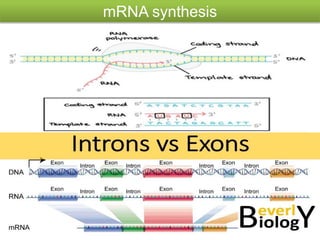
mRNA synthesis
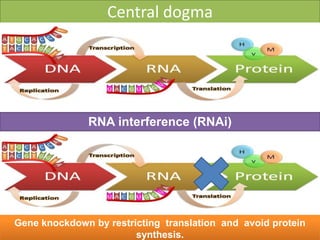
Central dogma
RNA interference (RNAi)
Gene knockdown by restricting translation and avoid protein
synthesis.
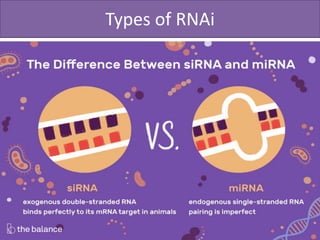
Types of RNAi
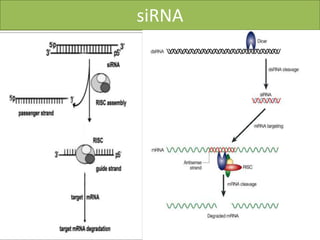
siRNA
siRNA
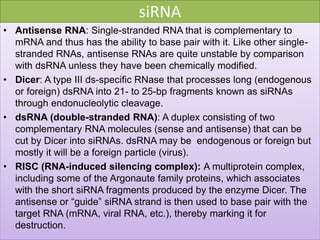
• Antisense RNA: Single-stranded RNA that is complementary to
mRNA and thus has the ability to base pair with it. Like other single-
stranded RNAs, antisense RNAs are quite unstable by comparison
with dsRNA unless they have been chemically modified.
• Dicer: A type III ds-specific RNase that processes long (endogenous
or foreign) dsRNA into 21- to 25-bp fragments known as siRNAs
through endonucleolytic cleavage.
• dsRNA (double-stranded RNA): A duplex consisting of two
complementary RNA molecules (sense and antisense) that can be
cut by Dicer into siRNAs. dsRNA may be endogenous or foreign but
mostly it will be a foreign particle (virus).
• RISC (RNA-induced silencing complex): A multiprotein complex,
including some of the Argonaute family proteins, which associates
with the short siRNA fragments produced by the enzyme Dicer. The
antisense or “guide” siRNA strand is then used to base pair with the
target RNA (mRNA, viral RNA, etc.), thereby marking it for
destruction.
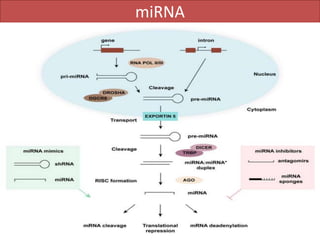
miRNA
miRNA
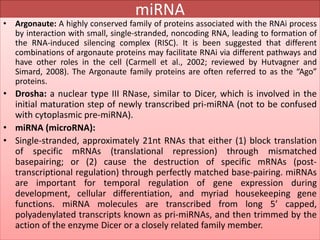
• Argonaute: A highly conserved family of proteins associated with the RNAi process
by interaction with small, single-stranded, noncoding RNA, leading to formation of
the RNA-induced silencing complex (RISC). It is been suggested that different
combinations of argonaute proteins may facilitate RNAi via different pathways and
have other roles in the cell (Carmell et al., 2002; reviewed by Hutvagner and
Simard, 2008). The Argonaute family proteins are often referred to as the “Ago”
proteins.
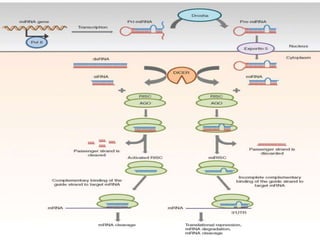
• Drosha: a nuclear type III RNase, similar to Dicer, which is involved in the
initial maturation step of newly transcribed pri-miRNA (not to be confused
with cytoplasmic pre-miRNA).
• miRNA (microRNA):
• Single-stranded, approximately 21nt RNAs that either (1) block translation
of specific mRNAs (translational repression) through mismatched
basepairing; or (2) cause the destruction of specific mRNAs (post-
transcriptional regulation) through perfectly matched base-pairing. miRNAs
are important for temporal regulation of gene expression during
development, cellular differentiation, and myriad housekeeping gene
functions. miRNA molecules are transcribed from long 5’ capped,
polyadenylated transcripts known as pri-miRNAs, and then trimmed by the
action of the enzyme Dicer or a closely related family member.
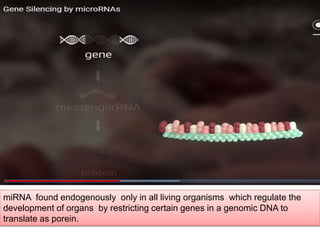
miRNA found endogenously only in all living organisms which regulate the
development of organs by restricting certain genes in a genomic DNA to
translate as porein.
Rna interference (rn ai)

Rna interference (rn ai)

  • 1.
    RNA interference (RNAi) Submittedby Malempati Subhash Sri Sanjay Roll. NO : 190136001, Ph.D Scholar, Dept. of Plant Pathology, JNKVV, Jabalpur
  • 2.
    Introduction • RNA interference(RNAi) is a biological process in which RNA molecules inhibit gene expression or translation, by neutralizing targeted mRNA molecules. Historically, RNAi was known by other names, including co-suppression, post-transcriptional gene silencing (PTGS), and quelling by siRNA and miRNA • RNA interference (RNAi) is a naturally occurring mechanism for gene silencing induced by the presence of short interfering RNA (siRNA). • RNAi is an endogenous catalytic pathway that is triggered by double- stranded RNA (dsRNA). • The trigger can occur naturally, as in the case of a cellular infection by a dsRNA virus, or by the intentional introduction of dsRNA to induce user-directed degradation of the cognate transcript(s). • A microRNA is a small non-coding RNA molecule found in plants, animals and some viruses, that functions in RNA silencing and post- transcriptional regulation of gene expression. miRNAs function via base-pairing with complementary sequences within mRNA molecules.
  • 3.
  • 4.
    Central dogma RNA interference(RNAi) Gene knockdown by restricting translation and avoid protein synthesis.
  • 5.
  • 6.
  • 7.
    siRNA • Antisense RNA:Single-stranded RNA that is complementary to mRNA and thus has the ability to base pair with it. Like other single- stranded RNAs, antisense RNAs are quite unstable by comparison with dsRNA unless they have been chemically modified. • Dicer: A type III ds-specific RNase that processes long (endogenous or foreign) dsRNA into 21- to 25-bp fragments known as siRNAs through endonucleolytic cleavage. • dsRNA (double-stranded RNA): A duplex consisting of two complementary RNA molecules (sense and antisense) that can be cut by Dicer into siRNAs. dsRNA may be endogenous or foreign but mostly it will be a foreign particle (virus). • RISC (RNA-induced silencing complex): A multiprotein complex, including some of the Argonaute family proteins, which associates with the short siRNA fragments produced by the enzyme Dicer. The antisense or “guide” siRNA strand is then used to base pair with the target RNA (mRNA, viral RNA, etc.), thereby marking it for destruction.
  • 8.
  • 9.
    miRNA • Argonaute: Ahighly conserved family of proteins associated with the RNAi process by interaction with small, single-stranded, noncoding RNA, leading to formation of the RNA-induced silencing complex (RISC). It is been suggested that different combinations of argonaute proteins may facilitate RNAi via different pathways and have other roles in the cell (Carmell et al., 2002; reviewed by Hutvagner and Simard, 2008). The Argonaute family proteins are often referred to as the “Ago” proteins. • Drosha: a nuclear type III RNase, similar to Dicer, which is involved in the initial maturation step of newly transcribed pri-miRNA (not to be confused with cytoplasmic pre-miRNA). • miRNA (microRNA): • Single-stranded, approximately 21nt RNAs that either (1) block translation of specific mRNAs (translational repression) through mismatched basepairing; or (2) cause the destruction of specific mRNAs (post- transcriptional regulation) through perfectly matched base-pairing. miRNAs are important for temporal regulation of gene expression during development, cellular differentiation, and myriad housekeeping gene functions. miRNA molecules are transcribed from long 5’ capped, polyadenylated transcripts known as pri-miRNAs, and then trimmed by the action of the enzyme Dicer or a closely related family member.
  • 10.
    miRNA found endogenouslyonly in all living organisms which regulate the development of organs by restricting certain genes in a genomic DNA to translate as porein.