1
9/19/2021
2
CONTENTS
 Definition
 Significance
 General Considerations
 GMP Considerations
 Product Considerations
 Advantages
 Disadvantages
 References
9/19/2021
3
 Plant:- It is a place where the 3 M’s that are Man,
Material and Money are brought together for the
manufacturing of products.
 Pilot Plant:- It is the part of the pharmaceutical industry
where a lab scale formula is transformed into a viable
product by development of liable practical procedure of
manufacturing.
 Scale-up:- The art for designing of prototype using the
data obtained from the pilot plant model.
DEFINITIONS
9/19/2021
4
SIGNIFICANCE
 Permits close examination of formulae to determine its
ability to withstand batch scale and process
modification.
 Review of Equipment - most compatible with the
formulation & most economical, simple and reliable in
producing product.
 Raw materials - consistently meet the specifications
required to produce the product can be determined.
 Production rate adjustment after considering marketing
requirements.
 Give rough idea about physical space required and of
related functions.
9/19/2021
5
 Appropriate records and reports are issued to support
good manufacturing practices.
 Procedure can be developed and validated.
Cont….
9/19/2021
6
GENERAL
CONSIDERATIONS
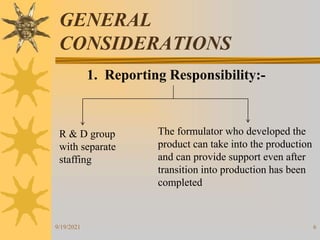
1. Reporting Responsibility:-
R & D group
with separate
staffing
The formulator who developed the
product can take into the production
and can provide support even after
transition into production has been
completed
9/19/2021
7
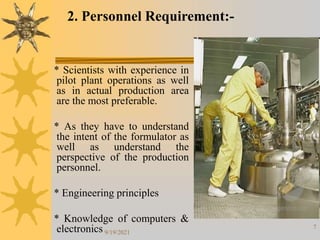
* Scientists with experience in
pilot plant operations as well
as in actual production area
are the most preferable.
* As they have to understand
the intent of the formulator as
well as understand the
perspective of the production
personnel.
* Engineering principles
* Knowledge of computers &
electronics
2. Personnel Requirement:-
9/19/2021
8
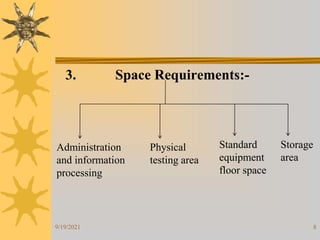
3. Space Requirements:-
Administration
and information
processing
Physical
testing area
Standard
equipment
floor space
Storage
area
9/19/2021
9
 Adequate office and desk space should be provided for
both scientist and technicians.
 The space should be adjacent to the working area.
 Computers.
3.1 Administration And Information Process:-
9/19/2021
10
3.2 Physical Testing Area:-
 This area should provide permanent bench top space for routinely
used physical - testing equipment.
9/19/2021
11
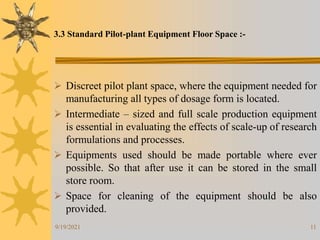
 Discreet pilot plant space, where the equipment needed for
manufacturing all types of dosage form is located.
 Intermediate – sized and full scale production equipment
is essential in evaluating the effects of scale-up of research
formulations and processes.
 Equipments used should be made portable where ever
possible. So that after use it can be stored in the small
store room.
 Space for cleaning of the equipment should be also
provided.
3.3 Standard Pilot-plant Equipment Floor Space :-
9/19/2021
12
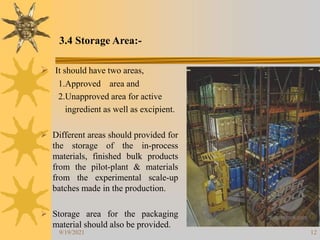
 It should have two areas,
1.Approved area and
2.Unapproved area for active
ingredient as well as excipient.
 Different areas should provided for
the storage of the in-process
materials, finished bulk products
from the pilot-plant & materials
from the experimental scale-up
batches made in the production.
 Storage area for the packaging
material should also be provided.
3.4 Storage Area:-
9/19/2021
13
 A thorough review of the each aspect of formulation is
important.
 The purpose of each ingredient and it’s contribution to
the final product manufactured on the small-scale
laboratory equipment should be understood.
 Then the effect of scale-up using equipment that may
subject the product to stresses of different types and
degrees can more readily be predicted or recognized.
4. Review of the formula:-
9/19/2021
14
 One purpose/responsibility of the pilot-plant is the
approval & validation of the active ingredient &
excipients raw materials.
 Raw materials used in the small scale production cannot
necessarily be the representative for the large scale
production.
 Ingredients may change in particle size, shape or
morphology which result in differences in bulk density,
static charges, rate of solubility, flow properties, color,
etc.
5. Raw materials :-
9/19/2021
15
6. Equipment:-
 The most economical, simplest & efficient equipment
which are capable of producing product within the
proposed specifications are used.
 The size of the equipment should be such that the
experimental trials run should be relevant to the
production sized batches.
 If too small the process developed will not scale up.
 If too big then the wastage of the expensive active
ingredients.
 Ease of cleaning
 Time of cleaning
9/19/2021
16
 The immediate as well as the future market trends /
requirements are considered while determining the
production rates.
7. Production Rates:-
9/19/2021
17
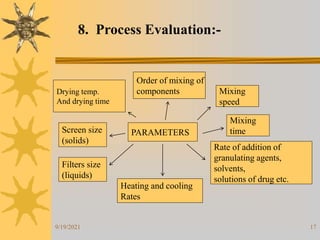
PARAMETERS
Order of mixing of
components Mixing
speed
Mixing
time
Rate of addition of
granulating agents,
solvents,
solutions of drug etc.
Heating and cooling
Rates
Filters size
(liquids)
Screen size
(solids)
Drying temp.
And drying time
8. Process Evaluation:-
9/19/2021
18
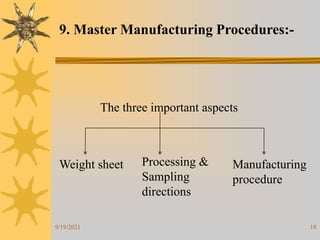
The three important aspects
Weight sheet Processing &
Sampling
directions
Manufacturing
procedure
9. Master Manufacturing Procedures:-
9/19/2021
19
 The weight sheet should clearly identify the chemicals
required in a batch. To prevent confusion the names and
identifying numbers for the ingredients should be used on
batch records.
 The process directions should be precise and explicit.
 A manufacturing procedure should be written by the
actual operator.
 Various specifications like addition rates, mixing time,
mixing speed, heating, and cooling rates, temperature,
storing of the finished product samples should be
mentioned in the batch record directions.
Cont….
9/19/2021
20
 During the scale-up of a new product, the analytic test
methods developed in research must be transferred to the
quality assurance department.
 Early in the transfer process, the quality assurance staff
should review the process to make sure that the proper
analytic instrumentation is available and that personnel are
trained to perform the tests.
Transfer of Analytical Method to
Quality Assurance
9/19/2021
21
 The primary objective of the pilot plant is the physical as
well as chemical stability of the products.
 Hence each pilot batch representing the final formulation
and manufacturing procedure should be studied for
stability.
 Stability studies should be carried out in finished packages
as well.
10. Product Stability And Uniformity:-
9/19/2021
22
GMP CONSIDERATION
 Equipment qualification
 Process validation
 Regularly process review & revalidation
 Relevant written standard operating procedures
 The use of competent technically qualified personnel
 Adequate provision for training of personnel
 A well-defined technology transfer system
 Validated cleaning procedures
 An orderly arrangement of equipment so as to ease
material flow & prevent cross-contamination
9/19/2021
23
ADVANTAGES
 Members of the production and quality control divisions
can readily observe scale up runs.
 Supplies of excipients & drugs, cleared by the quality
control division, can be drawn from the more spacious
areas provided to the production division.
 Access to engineering department personnel is provided
for equipment installation, maintenance and repair.
9/19/2021
24
DISADVANTAGES
 The frequency of direct interaction of the formulator
with the production personnel in the manufacturing area
will be reduced.
 Any problem in manufacturing will be directed towards
it’s own pilot-plant personnel.
9/19/2021
25
9/19/2021
26
 SOLID DOSAGE FORM
1. Material Handling
Laboratory Scale
Deliver accurate amount to the destination
Large Scale
* Lifting drums
* More Sophisticated Methods
-Vacuum Loading System
-Metering Pumps
Prevent Cross Contamination by Validation Cleaning
Procedures.
9/19/2021
27
2. Dry Blending
Powders should be used for encapsulation or to be
granulated prior to tabletting must be well blend to
ensure good drug distribution.
Inadequate blending could result in drug content
uniformity variation, especially when the tablet or capsule
is small & the drug concentration is relatively low.
Ingredients should be lumps free, otherwise it could cause
flow problems.
9/19/2021
28
3. Granulations
 Reasons :-
* To improve the flow properties.
* To increase the apparent density of the powder.
* To change the particle size distribution so that the
binding properties on compaction can be improved.
 Types :-
a) Wet Granulation
b) Dry Granulation
c) Direct Compression Method
 A small amount potent active ingredient can be dispersed
most effectively in a carrier granulation, when the drug is
dissolved in granulating solution and added during the
granulating process.
9/19/2021
29
 Wet granulation has been carried out by using,
- Sigma Blades
- Heavy-duty planetary mixture
-Tumble Blenders
-High Speed Chopper Blades used in mixing of light
powders.
 Multifunctional Processors,
dry blending, wet granulation, drying, sizing &
lubricating.
 Effect of Binding Agent.
Cont….
9/19/2021
30
4. Drying
 Hot Air Oven
* air temperature
* rate of air flow
* depth of granulation on the trays
 Fluidized Bed Dryer
* optimum loads
* rate of airflow
* inlet air temperature
* humidity
Data used for small scale batches(1-5 kg) cannot be
extrapolate processing conditions for intermediated scale
(100 kg) or large batches.
9/19/2021
31
5. Reduction In Particle Size
 Particle size to particle size distribution is important to
the compression characteristics of a granulation.
 Compression factors that may affected by the particle
size distribution are flow ability, compressibility,
uniformity of tablet weight, content uniformity, tablet
hardness, tablet color uniformity.
 Equipments :-
* oscillating granulator a mechanical sieving device
* a hammer mill
* screening device
 If too large particle size :-
* weight variation
* mottling
9/19/2021
32
 If too fines particle size,
* weight variation
* capping
 Both oversized and undersized granulation can adversely
affect tablet content uniformity.
 Lubricants & Gildants are added at final blend
Cont….
9/19/2021
33
6. Blending
Consequent attention should be paid to scale up of the
right design is used and blender loads, mixing speeds,
mixing timing are properly established.
In any blending operation segregation and mixing occurs
simultaneously, both processes are a function a particle
size, shape, hardness, density and dynamics of the mixing
action.
Low dose active ingredients – directly compressed.
Equipments :-
* Planetory type mixer
* Twin shell mixture
* Cone type
9/19/2021
34
 Over loading in blender –
* retards the free flow of granules
* reduce the efficiency
* cause content un-uniformity
 If the load is to small –
* powder blend slides rather than roll in blender
* improper mixing
Cont….
9/19/2021
35
7. Slugging
 A dry powder blend that can not be directly compressed
because of poor flow properties may in some instances be
processed using a slugging operation.
 Instruments :-
* Tablet press – which operates at pressure of 15 tons,
compared with a normal tablet press, which operates at
pressure of 4 tons or less.
9/19/2021
36
8. Compression
 The ultimate test of the tablet formulation and
granulation can be compressed on a high-speed tablet
press.
 Steps involved during compression,
* Filling empty die cavity with granulation
* Pre compression of granules
* Compression of granules
* Ejection of tablet from the die cavity
 Compression characteristics can be evaluated by press
speed equal to normal production speed.
9/19/2021
37
 Then detect the problems such as,
* sticking to punch surface
* tablet hardness
* capping
* weight variation
 Granules must be delivered at adequate rate.
 During compression, the granules are compacted, and in
order for a tablet to form, bonds within the compressible
materials must be formed.
Cont….
9/19/2021
38
TABLET COATING
 Equipments :-
* conventional coating pan
* perforated pans of fluidized-bed coating column
 Types :-
1. Sugar coating
2. Film coating
 Tablet must be sufficiently hard to withstand the the
tumbling to which they are subjected while coating.
 Operation conditions to be established for pan or column
operation are optimum tablet load, operating tablet, bed
temperature, drying air flow rate, temperature, solution
application rate.
9/19/2021
39
CAPSULES
 To produce capsules on high-speed equipment, the
powder blend must have,
* uniform particle size distribution
* bulk density
* formation of compact of the right size and of sufficient
cohesiveness to be filled into capsule shells.
 Equipments :-
1. Zanasi or Mertalli – Dosator(hollow tube)
2. Hoflinger – Karg – Tamping pins
 Weight variation problem can be encountered with these
two methods.
 Overly lubricated granules – delaying disintegration.
9/19/2021
40
 Humidity affect moisture content of –
* granulation
* on the empty gelatin capsules
 Empty gelatin capsules have a recommended storage
condition of 15-25 ºC temperature & humidity 35-65 %
RH.
 At high humidity – capsule swells make separation of the
capsule parts difficult to interfere with the transport of the
capsule through the process.
 At low humidity – capsule brittle increased static charge
interfere with the encapsulation operation.
Cont….
9/19/2021
41
LIQUID ORALS
 Simple solutions are the straight forward to scale up but
they require tanks of adequate size and suitable mixing
capability.
 Most equipment has heating or cooling capabilities to
effect rapid disollution of components of the system.
 All the equipments must be made up of suitable non-
reactive material and be designed and constructed to
facilitate easy cleaning.
 Liquid pharmaceutical processing tank, kettles, pipes,
mills, filter houses etc. are most frequently fabricated
from stainless steel
9/19/2021
42
 Two types of steel –
1. 308
2. 316
 Stainless steel is most non reactive, however it does react
with some acidic pharmaceutical liquids, this problem can
be minimized by PASSIVATION.
 Interaction with metallic surfaces can be minimized by
use of glass or Teflon coating.
 Although they are highly inert materials, they have the
disadvantages of cracking, breaking and flaking with
resultant product contamination.
Cont….
9/19/2021
PARENTERALS
43
9/19/2021
44
 Equipments :-
* tankage
* piping
* ancillary equipment for liquid mixing
* filteration, transfer and related equipments.
 The majority of the equipments are composed of 300
series austenitic stainless steel, with glass lined
vessels employed for preparation of formulations
sensitive to iron and other metal ions.
 The vessels can be equiped with external jackets for
heating and/or cooling and various types of agitators,
depending upon the mixing requirements of the
individual formulation.
Cont….
9/19/2021
45
SUSPENSIONS
 Suspensions require more attention during scale up than
simple solutions because of additional processing needs.
 Equipments :-
* vibrating feed system and power for production scale.
* high shear mixing equipment
 Slurries facilitate rapid and complete hydration of
suspending agent when added to large portion of the
vehicle.
 Active ingredients must be uniformly dispersed
throughout the batch.
 Mixing at too high speed can result in entrapment of air,
which may affect physical or chemical stability of the
product.
9/19/2021
46
VACUUM UNIT VERSATOR
 Filteration – remove unwanted particles.
 Screens of 150 mesh, having 100 microns are used.
 Active ingredients – particle size 10 – 25 microns.
 Transfer and filling of finished suspension should be
carefully monitored.
 It should be constantly mixed during transfer to maintain
uniform distribution of the active ingredients.
9/19/2021
47
EMULSIONS
 Manufacturing of liquid emulsion products entails
specialized procedures as result scale up into production
equipment involves extensive process development and
validation.
 Equipments :-
* mixing equipment
* homogenizing equipment
* screens
* pumps
* filling equipment
 High shear mixers may lead to air entrapment, this
problem can be avoid by carrying out operation under
controlled vacuum.
9/19/2021
48
SEMI SOLID PRODUCTS
 The main difference of semi solid formulation with
comparison to suspensions, liquids and emulsions is their
higher viscosity.
 Viscosity renders certain aspects of the scale-up of semi
solid products more critical.
 Equipments :-
* blenders
* mixers
* pressure filling equipments
9/19/2021
49
SUPPOSITORIES
 The manufacturing of suppositories on a laboratory scale
usually involves,
* the preparation of a molten mass
* the dispersion of drug in the molten base
* casting of suppositories in a suitable mold
* cooling of the mold
* opened & remove the suppositories
 More no. of moulds & large size Pan for melting of drug
& base.
9/19/2021
50
CONTRACT MANUFACTURE
 On occasional, scale-up or manufacture of a product
may need to be done at an outside, contract
manufacturer.
 The reasons for considering contract manufacture
include the needs for additional manufacturing
capacity, high specialized technology or specialized
equipments.
9/19/2021
51
9/19/2021

Pilot plant

  • 1.
  • 2.
    2 CONTENTS  Definition  Significance General Considerations  GMP Considerations  Product Considerations  Advantages  Disadvantages  References 9/19/2021
  • 3.
    3  Plant:- Itis a place where the 3 M’s that are Man, Material and Money are brought together for the manufacturing of products.  Pilot Plant:- It is the part of the pharmaceutical industry where a lab scale formula is transformed into a viable product by development of liable practical procedure of manufacturing.  Scale-up:- The art for designing of prototype using the data obtained from the pilot plant model. DEFINITIONS 9/19/2021
  • 4.
    4 SIGNIFICANCE  Permits closeexamination of formulae to determine its ability to withstand batch scale and process modification.  Review of Equipment - most compatible with the formulation & most economical, simple and reliable in producing product.  Raw materials - consistently meet the specifications required to produce the product can be determined.  Production rate adjustment after considering marketing requirements.  Give rough idea about physical space required and of related functions. 9/19/2021
  • 5.
    5  Appropriate recordsand reports are issued to support good manufacturing practices.  Procedure can be developed and validated. Cont…. 9/19/2021
  • 6.
    6 GENERAL CONSIDERATIONS 1. Reporting Responsibility:- R& D group with separate staffing The formulator who developed the product can take into the production and can provide support even after transition into production has been completed 9/19/2021
  • 7.
    7 * Scientists withexperience in pilot plant operations as well as in actual production area are the most preferable. * As they have to understand the intent of the formulator as well as understand the perspective of the production personnel. * Engineering principles * Knowledge of computers & electronics 2. Personnel Requirement:- 9/19/2021
  • 8.
    8 3. Space Requirements:- Administration andinformation processing Physical testing area Standard equipment floor space Storage area 9/19/2021
  • 9.
    9  Adequate officeand desk space should be provided for both scientist and technicians.  The space should be adjacent to the working area.  Computers. 3.1 Administration And Information Process:- 9/19/2021
  • 10.
    10 3.2 Physical TestingArea:-  This area should provide permanent bench top space for routinely used physical - testing equipment. 9/19/2021
  • 11.
    11  Discreet pilotplant space, where the equipment needed for manufacturing all types of dosage form is located.  Intermediate – sized and full scale production equipment is essential in evaluating the effects of scale-up of research formulations and processes.  Equipments used should be made portable where ever possible. So that after use it can be stored in the small store room.  Space for cleaning of the equipment should be also provided. 3.3 Standard Pilot-plant Equipment Floor Space :- 9/19/2021
  • 12.
    12  It shouldhave two areas, 1.Approved area and 2.Unapproved area for active ingredient as well as excipient.  Different areas should provided for the storage of the in-process materials, finished bulk products from the pilot-plant & materials from the experimental scale-up batches made in the production.  Storage area for the packaging material should also be provided. 3.4 Storage Area:- 9/19/2021
  • 13.
    13  A thoroughreview of the each aspect of formulation is important.  The purpose of each ingredient and it’s contribution to the final product manufactured on the small-scale laboratory equipment should be understood.  Then the effect of scale-up using equipment that may subject the product to stresses of different types and degrees can more readily be predicted or recognized. 4. Review of the formula:- 9/19/2021
  • 14.
    14  One purpose/responsibilityof the pilot-plant is the approval & validation of the active ingredient & excipients raw materials.  Raw materials used in the small scale production cannot necessarily be the representative for the large scale production.  Ingredients may change in particle size, shape or morphology which result in differences in bulk density, static charges, rate of solubility, flow properties, color, etc. 5. Raw materials :- 9/19/2021
  • 15.
    15 6. Equipment:-  Themost economical, simplest & efficient equipment which are capable of producing product within the proposed specifications are used.  The size of the equipment should be such that the experimental trials run should be relevant to the production sized batches.  If too small the process developed will not scale up.  If too big then the wastage of the expensive active ingredients.  Ease of cleaning  Time of cleaning 9/19/2021
  • 16.
    16  The immediateas well as the future market trends / requirements are considered while determining the production rates. 7. Production Rates:- 9/19/2021
  • 17.
    17 PARAMETERS Order of mixingof components Mixing speed Mixing time Rate of addition of granulating agents, solvents, solutions of drug etc. Heating and cooling Rates Filters size (liquids) Screen size (solids) Drying temp. And drying time 8. Process Evaluation:- 9/19/2021
  • 18.
    18 The three importantaspects Weight sheet Processing & Sampling directions Manufacturing procedure 9. Master Manufacturing Procedures:- 9/19/2021
  • 19.
    19  The weightsheet should clearly identify the chemicals required in a batch. To prevent confusion the names and identifying numbers for the ingredients should be used on batch records.  The process directions should be precise and explicit.  A manufacturing procedure should be written by the actual operator.  Various specifications like addition rates, mixing time, mixing speed, heating, and cooling rates, temperature, storing of the finished product samples should be mentioned in the batch record directions. Cont…. 9/19/2021
  • 20.
    20  During thescale-up of a new product, the analytic test methods developed in research must be transferred to the quality assurance department.  Early in the transfer process, the quality assurance staff should review the process to make sure that the proper analytic instrumentation is available and that personnel are trained to perform the tests. Transfer of Analytical Method to Quality Assurance 9/19/2021
  • 21.
    21  The primaryobjective of the pilot plant is the physical as well as chemical stability of the products.  Hence each pilot batch representing the final formulation and manufacturing procedure should be studied for stability.  Stability studies should be carried out in finished packages as well. 10. Product Stability And Uniformity:- 9/19/2021
  • 22.
    22 GMP CONSIDERATION  Equipmentqualification  Process validation  Regularly process review & revalidation  Relevant written standard operating procedures  The use of competent technically qualified personnel  Adequate provision for training of personnel  A well-defined technology transfer system  Validated cleaning procedures  An orderly arrangement of equipment so as to ease material flow & prevent cross-contamination 9/19/2021
  • 23.
    23 ADVANTAGES  Members ofthe production and quality control divisions can readily observe scale up runs.  Supplies of excipients & drugs, cleared by the quality control division, can be drawn from the more spacious areas provided to the production division.  Access to engineering department personnel is provided for equipment installation, maintenance and repair. 9/19/2021
  • 24.
    24 DISADVANTAGES  The frequencyof direct interaction of the formulator with the production personnel in the manufacturing area will be reduced.  Any problem in manufacturing will be directed towards it’s own pilot-plant personnel. 9/19/2021
  • 25.
  • 26.
    26  SOLID DOSAGEFORM 1. Material Handling Laboratory Scale Deliver accurate amount to the destination Large Scale * Lifting drums * More Sophisticated Methods -Vacuum Loading System -Metering Pumps Prevent Cross Contamination by Validation Cleaning Procedures. 9/19/2021
  • 27.
    27 2. Dry Blending Powdersshould be used for encapsulation or to be granulated prior to tabletting must be well blend to ensure good drug distribution. Inadequate blending could result in drug content uniformity variation, especially when the tablet or capsule is small & the drug concentration is relatively low. Ingredients should be lumps free, otherwise it could cause flow problems. 9/19/2021
  • 28.
    28 3. Granulations  Reasons:- * To improve the flow properties. * To increase the apparent density of the powder. * To change the particle size distribution so that the binding properties on compaction can be improved.  Types :- a) Wet Granulation b) Dry Granulation c) Direct Compression Method  A small amount potent active ingredient can be dispersed most effectively in a carrier granulation, when the drug is dissolved in granulating solution and added during the granulating process. 9/19/2021
  • 29.
    29  Wet granulationhas been carried out by using, - Sigma Blades - Heavy-duty planetary mixture -Tumble Blenders -High Speed Chopper Blades used in mixing of light powders.  Multifunctional Processors, dry blending, wet granulation, drying, sizing & lubricating.  Effect of Binding Agent. Cont…. 9/19/2021
  • 30.
    30 4. Drying  HotAir Oven * air temperature * rate of air flow * depth of granulation on the trays  Fluidized Bed Dryer * optimum loads * rate of airflow * inlet air temperature * humidity Data used for small scale batches(1-5 kg) cannot be extrapolate processing conditions for intermediated scale (100 kg) or large batches. 9/19/2021
  • 31.
    31 5. Reduction InParticle Size  Particle size to particle size distribution is important to the compression characteristics of a granulation.  Compression factors that may affected by the particle size distribution are flow ability, compressibility, uniformity of tablet weight, content uniformity, tablet hardness, tablet color uniformity.  Equipments :- * oscillating granulator a mechanical sieving device * a hammer mill * screening device  If too large particle size :- * weight variation * mottling 9/19/2021
  • 32.
    32  If toofines particle size, * weight variation * capping  Both oversized and undersized granulation can adversely affect tablet content uniformity.  Lubricants & Gildants are added at final blend Cont…. 9/19/2021
  • 33.
    33 6. Blending Consequent attentionshould be paid to scale up of the right design is used and blender loads, mixing speeds, mixing timing are properly established. In any blending operation segregation and mixing occurs simultaneously, both processes are a function a particle size, shape, hardness, density and dynamics of the mixing action. Low dose active ingredients – directly compressed. Equipments :- * Planetory type mixer * Twin shell mixture * Cone type 9/19/2021
  • 34.
    34  Over loadingin blender – * retards the free flow of granules * reduce the efficiency * cause content un-uniformity  If the load is to small – * powder blend slides rather than roll in blender * improper mixing Cont…. 9/19/2021
  • 35.
    35 7. Slugging  Adry powder blend that can not be directly compressed because of poor flow properties may in some instances be processed using a slugging operation.  Instruments :- * Tablet press – which operates at pressure of 15 tons, compared with a normal tablet press, which operates at pressure of 4 tons or less. 9/19/2021
  • 36.
    36 8. Compression  Theultimate test of the tablet formulation and granulation can be compressed on a high-speed tablet press.  Steps involved during compression, * Filling empty die cavity with granulation * Pre compression of granules * Compression of granules * Ejection of tablet from the die cavity  Compression characteristics can be evaluated by press speed equal to normal production speed. 9/19/2021
  • 37.
    37  Then detectthe problems such as, * sticking to punch surface * tablet hardness * capping * weight variation  Granules must be delivered at adequate rate.  During compression, the granules are compacted, and in order for a tablet to form, bonds within the compressible materials must be formed. Cont…. 9/19/2021
  • 38.
    38 TABLET COATING  Equipments:- * conventional coating pan * perforated pans of fluidized-bed coating column  Types :- 1. Sugar coating 2. Film coating  Tablet must be sufficiently hard to withstand the the tumbling to which they are subjected while coating.  Operation conditions to be established for pan or column operation are optimum tablet load, operating tablet, bed temperature, drying air flow rate, temperature, solution application rate. 9/19/2021
  • 39.
    39 CAPSULES  To producecapsules on high-speed equipment, the powder blend must have, * uniform particle size distribution * bulk density * formation of compact of the right size and of sufficient cohesiveness to be filled into capsule shells.  Equipments :- 1. Zanasi or Mertalli – Dosator(hollow tube) 2. Hoflinger – Karg – Tamping pins  Weight variation problem can be encountered with these two methods.  Overly lubricated granules – delaying disintegration. 9/19/2021
  • 40.
    40  Humidity affectmoisture content of – * granulation * on the empty gelatin capsules  Empty gelatin capsules have a recommended storage condition of 15-25 ºC temperature & humidity 35-65 % RH.  At high humidity – capsule swells make separation of the capsule parts difficult to interfere with the transport of the capsule through the process.  At low humidity – capsule brittle increased static charge interfere with the encapsulation operation. Cont…. 9/19/2021
  • 41.
    41 LIQUID ORALS  Simplesolutions are the straight forward to scale up but they require tanks of adequate size and suitable mixing capability.  Most equipment has heating or cooling capabilities to effect rapid disollution of components of the system.  All the equipments must be made up of suitable non- reactive material and be designed and constructed to facilitate easy cleaning.  Liquid pharmaceutical processing tank, kettles, pipes, mills, filter houses etc. are most frequently fabricated from stainless steel 9/19/2021
  • 42.
    42  Two typesof steel – 1. 308 2. 316  Stainless steel is most non reactive, however it does react with some acidic pharmaceutical liquids, this problem can be minimized by PASSIVATION.  Interaction with metallic surfaces can be minimized by use of glass or Teflon coating.  Although they are highly inert materials, they have the disadvantages of cracking, breaking and flaking with resultant product contamination. Cont…. 9/19/2021
  • 43.
  • 44.
    44  Equipments :- *tankage * piping * ancillary equipment for liquid mixing * filteration, transfer and related equipments.  The majority of the equipments are composed of 300 series austenitic stainless steel, with glass lined vessels employed for preparation of formulations sensitive to iron and other metal ions.  The vessels can be equiped with external jackets for heating and/or cooling and various types of agitators, depending upon the mixing requirements of the individual formulation. Cont…. 9/19/2021
  • 45.
    45 SUSPENSIONS  Suspensions requiremore attention during scale up than simple solutions because of additional processing needs.  Equipments :- * vibrating feed system and power for production scale. * high shear mixing equipment  Slurries facilitate rapid and complete hydration of suspending agent when added to large portion of the vehicle.  Active ingredients must be uniformly dispersed throughout the batch.  Mixing at too high speed can result in entrapment of air, which may affect physical or chemical stability of the product. 9/19/2021
  • 46.
    46 VACUUM UNIT VERSATOR Filteration – remove unwanted particles.  Screens of 150 mesh, having 100 microns are used.  Active ingredients – particle size 10 – 25 microns.  Transfer and filling of finished suspension should be carefully monitored.  It should be constantly mixed during transfer to maintain uniform distribution of the active ingredients. 9/19/2021
  • 47.
    47 EMULSIONS  Manufacturing ofliquid emulsion products entails specialized procedures as result scale up into production equipment involves extensive process development and validation.  Equipments :- * mixing equipment * homogenizing equipment * screens * pumps * filling equipment  High shear mixers may lead to air entrapment, this problem can be avoid by carrying out operation under controlled vacuum. 9/19/2021
  • 48.
    48 SEMI SOLID PRODUCTS The main difference of semi solid formulation with comparison to suspensions, liquids and emulsions is their higher viscosity.  Viscosity renders certain aspects of the scale-up of semi solid products more critical.  Equipments :- * blenders * mixers * pressure filling equipments 9/19/2021
  • 49.
    49 SUPPOSITORIES  The manufacturingof suppositories on a laboratory scale usually involves, * the preparation of a molten mass * the dispersion of drug in the molten base * casting of suppositories in a suitable mold * cooling of the mold * opened & remove the suppositories  More no. of moulds & large size Pan for melting of drug & base. 9/19/2021
  • 50.
    50 CONTRACT MANUFACTURE  Onoccasional, scale-up or manufacture of a product may need to be done at an outside, contract manufacturer.  The reasons for considering contract manufacture include the needs for additional manufacturing capacity, high specialized technology or specialized equipments. 9/19/2021
  • 51.