Mallareddy college of Pharmacy 
AIR HANDLING SYSTEMS 
guided by: Presented By 
Dr. Satyabrata Bhanja Aslesha.E 
M.Pharmacy 1st yr
AIR HANDLING SYSTEMS 
CONTENTS 
 HVAC systems 
 Air handling units 
 Air filteration systems 
 Dust collectors 
 Humidity and temperature control
HVAC systems 
Heating Ventilation and Air Conditioning 
systems are the integral part of 
environmental control system design. 
Basic components of HVAC: 
1. Air Handling Unit 
2. Air distribution 
 Dust network 
 Insulator 
 Dampers/valves 
 Return lower & grills. 
3. Air filters
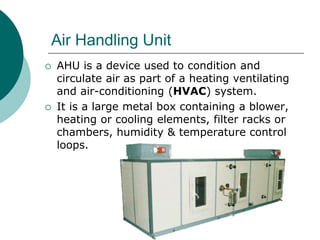
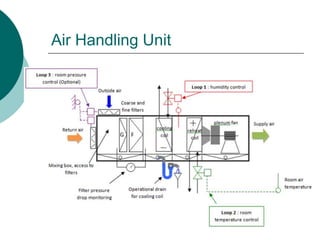
Air Handling Unit 
 AHU is a device used to condition and 
circulate air as part of a heating ventilating 
and air-conditioning (HVAC) system. 
 It is a large metal box containing a blower, 
heating or cooling elements, filter racks or 
chambers, humidity & temperature control 
loops.
Air Handling Unit
Temperature and humidity control 
 Temperatures in the 68-74 F (19-23 C) 
range is comfortable for working 
environment. 
 Temperature control is important in the 
areas where autoclaves, ovens, dry heat 
strerilization tunnels are present. 
 Humidity comfort levels are in the 45-55% 
RH range. 
 Air dryers can be used to maintain lower 
than normal humidity levels.
AIR FILTERATION SYSTEMS 
CONTENTS 
 Introduction 
 Types of filteration 
 Mechanisms of filteration 
 Types of air filters
Introduction 
 Filteration is an important aspect of 
environmental control in Pharmaceutical 
industry. 
 The main aim of filteration is to produce 
dust free atmosphere. 
 It is required in areas like spray drying, 
coating, granulating, milling, packaging etc. 
 Filters are selected based on the required 
environment.
Mechanisms of air filteration 
 Air filteration involves the removal of 
unwanted particles due to collision of 
particles with the filter. 
 Such removal of particles due to collisions 
are governed by forces called as 
a) Impingement 
b) Diffusion 
c) Interception
Mechanisms of air filteration 
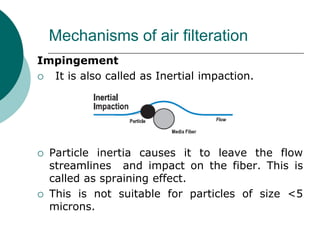
Impingement 
 It is also called as Inertial impaction. 
 Particle inertia causes it to leave the flow 
streamlines and impact on the fiber. This is 
called as spraining effect. 
 This is not suitable for particles of size <5 
microns.
Mechanisms of air filteration 
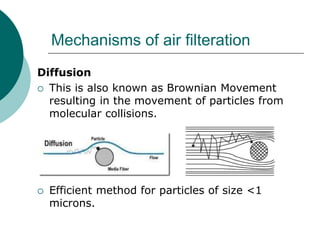
Diffusion 
 This is also known as Brownian Movement 
resulting in the movement of particles from 
molecular collisions. 
 Efficient method for particles of size <1 
microns.
Mechanisms of air filteration 
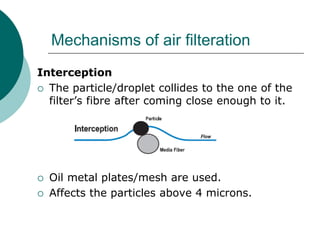
Interception 
 The particle/droplet collides to the one of the 
filter’s fibre after coming close enough to it. 
 Oil metal plates/mesh are used. 
 Affects the particles above 4 microns.
Air filter efficiency 
Air filter efficiency is 
 Maximum – impingement in low velocity 
diffusion at high velocities 
 Minimum – impingement in high velocity 
diffusion at low velocities
Air filters 
Air filters are made up of fibre glass, sinter glass, 
charcoal, glass wool, dry fabric, oil wetting fabric. 
Arrangement: sandwich 
flat 
disk 
pleated 
box 
Purpose: final filter 
post filter 
fine filter 
intermediate filter
Types of air filters 
1. Ultra low penetration and high 
efficiency particulate air filters 
(ULPA & HEPA) 
2. Packed towers 
3. Membrane filter catridges 
4. Hydrophobic filters
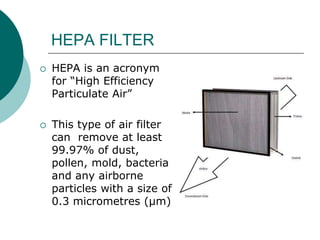
HEPA FILTER 
 HEPA is an acronym 
for “High Efficiency 
Particulate Air” 
 This type of air filter 
can remove at least 
99.97% of dust, 
pollen, mold, bacteria 
and any airborne 
particles with a size of 
0.3 micrometres (μm)
HEPA FILTER 
 Media is the filtering material. 
Eg: glass fiber, synthetic fiber, non-woven fiber 
 Sealant is the adhesive material that creates a 
leak-proof seal between the filter media and the 
frame. 
 Frame is where the filter media is inserted. 
Eg: aluminum, stainless steel, plastic or wood. 
 Faceguard is a screen attached to the filter to 
protect the filter media during handling and 
installation. 
 Gasket is a rubber or sponge like material used 
to prevent air leaks between the filter and its 
housing by compressing the two together.
HEPA FILTER 
Construction: 
 HEPA filter is constructed of borosilicate 
microfibres in the form of pleated sheet 
 Sheet is pleated to increase the overall 
filtration surface area. 
 The pleats are separated by serrated 
aluminum baffles or stitched fabric ribbons, 
which direct airflow through the filter 
 This combination of pleated sheets and 
baffles acts as filtration medium.
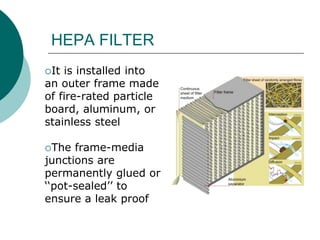
HEPA FILTER 
It is installed into 
an outer frame made 
of fire-rated particle 
board, aluminum, or 
stainless steel 
The frame-media 
junctions are 
permanently glued or 
‘‘pot-sealed’’ to 
ensure a leak proof
HEPA FILTER 
HEPA filter performance is dependent upon th 
following characteristics: 
 Air flow 
 Temperature 
 Pollutant loading 
 Dust holding capacity 
 Filter media 
 Contruction of HEPA 
 Operating conditions etc.
Testing of HEPA filters 
 There are 2 separate tests for HEPA and ULPA 
filter collection efficies. 
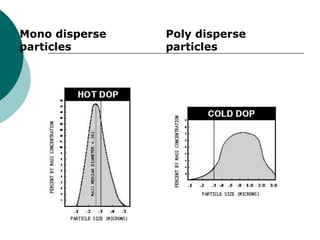
 HEPA efficeincy is rated using a thermal di octyl 
phthalate (DOP) test. The test dust for HEPA filters 
is mono-sized, DOP particles, generated by 
vapourization and condensation. Photometer 
measures particle penetration by sensing the 
scattered light. 
 ULPA efficiency is tested using a particle counter 
upstream & downstream of filter. Automizer 
injects DOP,alcohol & mineral oil in hexane to 
generate particles.
Mono disperse 
particles 
Poly disperse 
particles
Types of air filters 
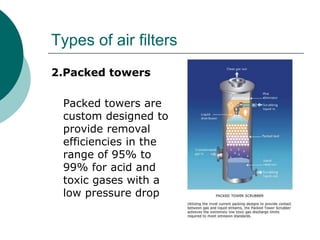
2.Packed towers 
Packed towers are 
custom designed to 
provide removal 
efficiencies in the 
range of 95% to 
99% for acid and 
toxic gases with a 
low pressure drop
Types of air filters 
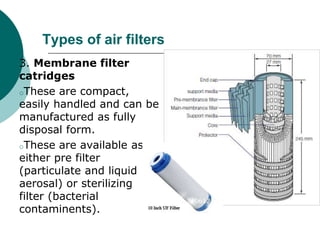
3. Membrane filter 
catridges 
oThese are compact, 
easily handled and can be 
manufactured as fully 
disposal form. 
oThese are available as 
either pre filter 
(particulate and liquid 
aerosal) or sterilizing 
filter (bacterial 
contaminents).
Types of air filters 
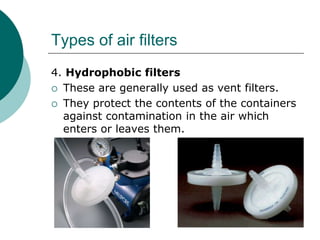
4. Hydrophobic filters 
 These are generally used as vent filters. 
 They protect the contents of the containers 
against contamination in the air which 
enters or leaves them.
Dust collectors 
 Dust collectors are used for equipment 
maintanance. 
 Air pollution is controlled. 
Main features 
 Low cost & maintainance 
 Most commonly used for all type of medium 
from coarse to fine except <5 microns 
particles. 
 Collection efficiency of 10 to 100 microns 
with multiclones.
Dust collectors 
Types of dust collectors 
1) Dry mechanical collectors 
2) Wet collectors & scrubbers 
3) Fabric collectors 
4) ESP
Types of dust collectors 
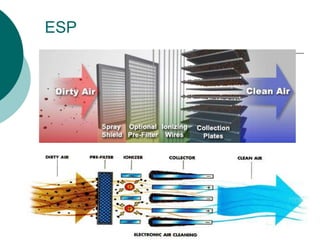
1.Electrostatic precipitators(ESP) 
Mechanism: 
 Ionizing the gas 
 Charging the dust particles 
 Transporting the particles to the collecting 
tube 
 Neutralizing the dust particles 
 Removing the dust from the collecting 
surface
ESP 
 TYPES 
i. Cottrell or single stage – combines 
ionization and collection in a single stage 
ii. Penny or Two stage – ionization and 
collection in different stages 
Advantages: 
 Large gas volumes & high collection 
efficiency for small particles. 
Disadvantages: 
 This is a costly method
ESP
Dust collectors 
2.Fabric collectors 
Collection mechanism: 
 Impaction 
 Interception 
 Diffusion 
Advantages: 
 can handle varying exhaust gas flow rates 
& particle loading
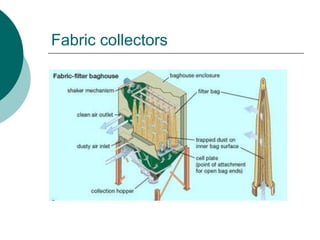
Fabric collectors 
The amount of filter area depends on: 
 Release characteristics of dust 
 Porosity of dust cake 
 Conc. Of dust in carrier gas stream 
 Type of fabric & surface 
 Airflow patternn within the collector 
 Temperature & humidity within the gas 
stream
Fabric collectors
Dust collectors 
3. Wet collectors 
Collection mechanism: 
 Collect the droplets 
 Contact particles with water or another 
liquid 
Advantages: 
 Can handle high temperature & moisture 
 Dust which represent explosion or fire 
hazards in the dry form can be wetted and 
collected
Wet collectors 
Types: 
 Spray dryer 
 Packed towers 
 Wet centrifugal collectors 
 Wet dynamic precipitator 
 Venturi type 
 Orifice type
Dust collectors 
4. Dry centrifugal collectors 
Collection efficiency is influenced by 
 size, shape, weight of the particles 
 Conc. Of dust & inlet velocity 
Types 
 Gravity seperators 
 Inertial seperators 
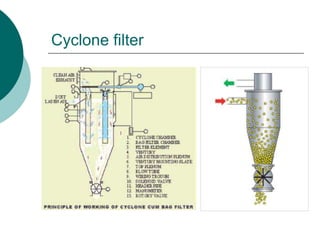
 Cyclone collectors 
 High efficiency centrifugals
Cyclone filter
Inspecting the air handling plant 
1. Verification of design documentation, including 
 description of installation and functions 
 specification of the requirements 
2. Operating procedures 
3. Maintenance instructions 
4. Maintenance records 
5. Training logs 
6. Environmental records 
7. Walking around the plant
Conclusion 
Air handling systems: 
 Play a major role in the quality of pharmaceuticals 
 Must be designed properly, by professionals 
 Must be treated as a critical system
References 
 L.Lachman, The theory and practice 
of industrial pharmacy 
 Bentleys textbook of pharmaceutics 
 Dust collectors – learning guide for 
dust collectors [Internet] 
 Handbook of heating, ventilation & 
air-conditioning.
Air handling systems new

Air handling systems new

  • 1.
    Mallareddy college ofPharmacy AIR HANDLING SYSTEMS guided by: Presented By Dr. Satyabrata Bhanja Aslesha.E M.Pharmacy 1st yr
  • 2.
    AIR HANDLING SYSTEMS CONTENTS  HVAC systems  Air handling units  Air filteration systems  Dust collectors  Humidity and temperature control
  • 3.
    HVAC systems HeatingVentilation and Air Conditioning systems are the integral part of environmental control system design. Basic components of HVAC: 1. Air Handling Unit 2. Air distribution  Dust network  Insulator  Dampers/valves  Return lower & grills. 3. Air filters
  • 4.
    Air Handling Unit  AHU is a device used to condition and circulate air as part of a heating ventilating and air-conditioning (HVAC) system.  It is a large metal box containing a blower, heating or cooling elements, filter racks or chambers, humidity & temperature control loops.
  • 5.
  • 6.
    Temperature and humiditycontrol  Temperatures in the 68-74 F (19-23 C) range is comfortable for working environment.  Temperature control is important in the areas where autoclaves, ovens, dry heat strerilization tunnels are present.  Humidity comfort levels are in the 45-55% RH range.  Air dryers can be used to maintain lower than normal humidity levels.
  • 7.
    AIR FILTERATION SYSTEMS CONTENTS  Introduction  Types of filteration  Mechanisms of filteration  Types of air filters
  • 8.
    Introduction  Filterationis an important aspect of environmental control in Pharmaceutical industry.  The main aim of filteration is to produce dust free atmosphere.  It is required in areas like spray drying, coating, granulating, milling, packaging etc.  Filters are selected based on the required environment.
  • 9.
    Mechanisms of airfilteration  Air filteration involves the removal of unwanted particles due to collision of particles with the filter.  Such removal of particles due to collisions are governed by forces called as a) Impingement b) Diffusion c) Interception
  • 10.
    Mechanisms of airfilteration Impingement  It is also called as Inertial impaction.  Particle inertia causes it to leave the flow streamlines and impact on the fiber. This is called as spraining effect.  This is not suitable for particles of size <5 microns.
  • 11.
    Mechanisms of airfilteration Diffusion  This is also known as Brownian Movement resulting in the movement of particles from molecular collisions.  Efficient method for particles of size <1 microns.
  • 12.
    Mechanisms of airfilteration Interception  The particle/droplet collides to the one of the filter’s fibre after coming close enough to it.  Oil metal plates/mesh are used.  Affects the particles above 4 microns.
  • 13.
    Air filter efficiency Air filter efficiency is  Maximum – impingement in low velocity diffusion at high velocities  Minimum – impingement in high velocity diffusion at low velocities
  • 14.
    Air filters Airfilters are made up of fibre glass, sinter glass, charcoal, glass wool, dry fabric, oil wetting fabric. Arrangement: sandwich flat disk pleated box Purpose: final filter post filter fine filter intermediate filter
  • 15.
    Types of airfilters 1. Ultra low penetration and high efficiency particulate air filters (ULPA & HEPA) 2. Packed towers 3. Membrane filter catridges 4. Hydrophobic filters
  • 16.
    HEPA FILTER HEPA is an acronym for “High Efficiency Particulate Air”  This type of air filter can remove at least 99.97% of dust, pollen, mold, bacteria and any airborne particles with a size of 0.3 micrometres (μm)
  • 17.
    HEPA FILTER Media is the filtering material. Eg: glass fiber, synthetic fiber, non-woven fiber  Sealant is the adhesive material that creates a leak-proof seal between the filter media and the frame.  Frame is where the filter media is inserted. Eg: aluminum, stainless steel, plastic or wood.  Faceguard is a screen attached to the filter to protect the filter media during handling and installation.  Gasket is a rubber or sponge like material used to prevent air leaks between the filter and its housing by compressing the two together.
  • 18.
    HEPA FILTER Construction:  HEPA filter is constructed of borosilicate microfibres in the form of pleated sheet  Sheet is pleated to increase the overall filtration surface area.  The pleats are separated by serrated aluminum baffles or stitched fabric ribbons, which direct airflow through the filter  This combination of pleated sheets and baffles acts as filtration medium.
  • 19.
    HEPA FILTER Itis installed into an outer frame made of fire-rated particle board, aluminum, or stainless steel The frame-media junctions are permanently glued or ‘‘pot-sealed’’ to ensure a leak proof
  • 20.
    HEPA FILTER HEPAfilter performance is dependent upon th following characteristics:  Air flow  Temperature  Pollutant loading  Dust holding capacity  Filter media  Contruction of HEPA  Operating conditions etc.
  • 21.
    Testing of HEPAfilters  There are 2 separate tests for HEPA and ULPA filter collection efficies.  HEPA efficeincy is rated using a thermal di octyl phthalate (DOP) test. The test dust for HEPA filters is mono-sized, DOP particles, generated by vapourization and condensation. Photometer measures particle penetration by sensing the scattered light.  ULPA efficiency is tested using a particle counter upstream & downstream of filter. Automizer injects DOP,alcohol & mineral oil in hexane to generate particles.
  • 22.
    Mono disperse particles Poly disperse particles
  • 23.
    Types of airfilters 2.Packed towers Packed towers are custom designed to provide removal efficiencies in the range of 95% to 99% for acid and toxic gases with a low pressure drop
  • 24.
    Types of airfilters 3. Membrane filter catridges oThese are compact, easily handled and can be manufactured as fully disposal form. oThese are available as either pre filter (particulate and liquid aerosal) or sterilizing filter (bacterial contaminents).
  • 25.
    Types of airfilters 4. Hydrophobic filters  These are generally used as vent filters.  They protect the contents of the containers against contamination in the air which enters or leaves them.
  • 26.
    Dust collectors Dust collectors are used for equipment maintanance.  Air pollution is controlled. Main features  Low cost & maintainance  Most commonly used for all type of medium from coarse to fine except <5 microns particles.  Collection efficiency of 10 to 100 microns with multiclones.
  • 27.
    Dust collectors Typesof dust collectors 1) Dry mechanical collectors 2) Wet collectors & scrubbers 3) Fabric collectors 4) ESP
  • 28.
    Types of dustcollectors 1.Electrostatic precipitators(ESP) Mechanism:  Ionizing the gas  Charging the dust particles  Transporting the particles to the collecting tube  Neutralizing the dust particles  Removing the dust from the collecting surface
  • 29.
    ESP  TYPES i. Cottrell or single stage – combines ionization and collection in a single stage ii. Penny or Two stage – ionization and collection in different stages Advantages:  Large gas volumes & high collection efficiency for small particles. Disadvantages:  This is a costly method
  • 30.
  • 31.
    Dust collectors 2.Fabriccollectors Collection mechanism:  Impaction  Interception  Diffusion Advantages:  can handle varying exhaust gas flow rates & particle loading
  • 32.
    Fabric collectors Theamount of filter area depends on:  Release characteristics of dust  Porosity of dust cake  Conc. Of dust in carrier gas stream  Type of fabric & surface  Airflow patternn within the collector  Temperature & humidity within the gas stream
  • 33.
  • 34.
    Dust collectors 3.Wet collectors Collection mechanism:  Collect the droplets  Contact particles with water or another liquid Advantages:  Can handle high temperature & moisture  Dust which represent explosion or fire hazards in the dry form can be wetted and collected
  • 35.
    Wet collectors Types:  Spray dryer  Packed towers  Wet centrifugal collectors  Wet dynamic precipitator  Venturi type  Orifice type
  • 36.
    Dust collectors 4.Dry centrifugal collectors Collection efficiency is influenced by  size, shape, weight of the particles  Conc. Of dust & inlet velocity Types  Gravity seperators  Inertial seperators  Cyclone collectors  High efficiency centrifugals
  • 37.
  • 38.
    Inspecting the airhandling plant 1. Verification of design documentation, including  description of installation and functions  specification of the requirements 2. Operating procedures 3. Maintenance instructions 4. Maintenance records 5. Training logs 6. Environmental records 7. Walking around the plant
  • 39.
    Conclusion Air handlingsystems:  Play a major role in the quality of pharmaceuticals  Must be designed properly, by professionals  Must be treated as a critical system
  • 40.
    References  L.Lachman,The theory and practice of industrial pharmacy  Bentleys textbook of pharmaceutics  Dust collectors – learning guide for dust collectors [Internet]  Handbook of heating, ventilation & air-conditioning.