PROCESS VALIDATION FOR OINTMENT/CREAMS
AND LIQUID ORALS.
PREPARED BY:
RITESH PHALAK (M.PHARM 2ND
SEM)
SUBJECT: PHARMACEUTICAL
VALIDATION.
DEPARTMENT OF PHARMACEUTICAL
QUALITY ASSURANCE.
GUIDED BY:
Dr. Puja Bhavsar
ASSITANT PROFESSOR
PHARMACEUTICAL QUALITY
ASSURANCE DEPARTMENT.
PARUL INSTITUTE OF PHARMACY.
CONTENT
1. PROCESS VALIDATION INTRODUCTION
2. OINTMENT/ CREAM INTRODUCTION
2.1 CRITICAL PARAMETERS TO BE VALIDATED
2.2 PROCESS TEMPERATURE
2.3 HEATING AND COOLING RATES
2.4 MIXING METHODS AND SPEEDS
2.5 MIXING TIMES
2.6 FLOW RATES
2.7 ADDITION OF POLYMERS AND GUMS
3 LIQUID ORALS INTRODUCTION
3.1 PROCESS VALIDATION TESTS FOR LIQUIDS
3.2 MONITORING OUTPUTS FOR LIQUID ORALS
4. REFERENCES
PROCESS VALIDATION INTRODUCTION
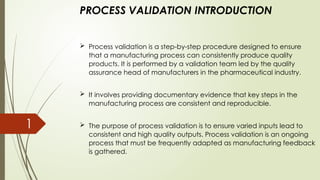
 Process validation is a step-by-step procedure designed to ensure
that a manufacturing process can consistently produce quality
products. It is performed by a validation team led by the quality
assurance head of manufacturers in the pharmaceutical industry.
 It involves providing documentary evidence that key steps in the
manufacturing process are consistent and reproducible.
 The purpose of process validation is to ensure varied inputs lead to
consistent and high quality outputs. Process validation is an ongoing
process that must be frequently adapted as manufacturing feedback
is gathered.
1
CONT….
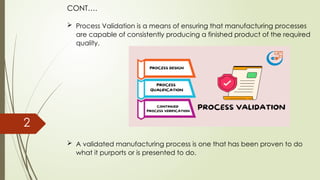
 Process Validation is a means of ensuring that manufacturing processes
are capable of consistently producing a finished product of the required
quality.
 A validated manufacturing process is one that has been proven to do
what it purports or is presented to do.
2
OINTMENT/CREAM INTRODUCTION
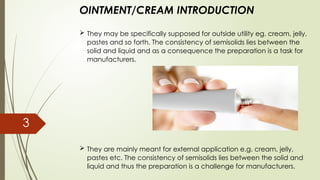
 They may be specifically supposed for outside utility eg. cream, jelly,
pastes and so forth. The consistency of semisolids lies between the
solid and liquid and as a consequence the preparation is a task for
manufacturers.
 They are mainly meant for external application e.g. cream, jelly,
pastes etc. The consistency of semisolids lies between the solid and
liquid and thus the preparation is a challenge for manufacturers.
3
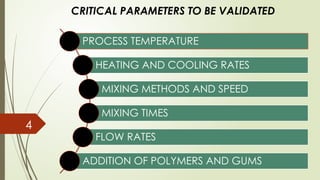
CRITICAL PARAMETERS TO BE VALIDATED
PROCESS TEMPERATURE
HEATING AND COOLING RATES
MIXING METHODS AND SPEED
MIXING TIMES
FLOW RATES
ADDITION OF POLYMERS AND GUMS
4
CONT….
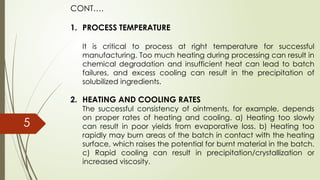
1. PROCESS TEMPERATURE
It is critical to process at right temperature for successful
manufacturing. Too much heating during processing can result in
chemical degradation and insufficient heat can lead to batch
failures, and excess cooling can result in the precipitation of
solubilized ingredients.
2. HEATING AND COOLING RATES
The successful consistency of ointments, for example, depends
on proper rates of heating and cooling. a) Heating too slowly
can result in poor yields from evaporative loss. b) Heating too
rapidly may burn areas of the batch in contact with the heating
surface, which raises the potential for burnt material in the batch.
c) Rapid cooling can result in precipitation/crystallization or
increased viscosity.
5
CONT….
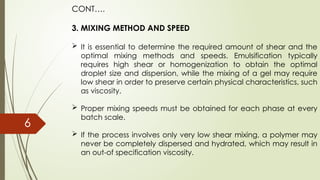
3. MIXING METHOD AND SPEED
 It is essential to determine the required amount of shear and the
optimal mixing methods and speeds. Emulsification typically
requires high shear or homogenization to obtain the optimal
droplet size and dispersion, while the mixing of a gel may require
low shear in order to preserve certain physical characteristics, such
as viscosity.
 Proper mixing speeds must be obtained for each phase at every
batch scale.
 If the process involves only very low shear mixing, a polymer may
never be completely dispersed and hydrated, which may result in
an out-of specification viscosity.
6
CONT….
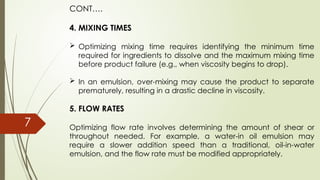
4. MIXING TIMES
 Optimizing mixing time requires identifying the minimum time
required for ingredients to dissolve and the maximum mixing time
before product failure (e.g., when viscosity begins to drop).
 In an emulsion, over-mixing may cause the product to separate
prematurely, resulting in a drastic decline in viscosity.
5. FLOW RATES
Optimizing flow rate involves determining the amount of shear or
throughout needed. For example, a water-in oil emulsion may
require a slower addition speed than a traditional, oil-in-water
emulsion, and the flow rate must be modified appropriately.
7
CONT….
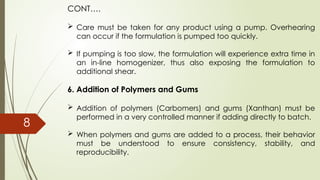
 Care must be taken for any product using a pump. Overhearing
can occur if the formulation is pumped too quickly.
 If pumping is too slow, the formulation will experience extra time in
an in-line homogenizer, thus also exposing the formulation to
additional shear.
6. Addition of Polymers and Gums
 Addition of polymers (Carbomers) and gums (Xanthan) must be
performed in a very controlled manner if adding directly to batch.
 When polymers and gums are added to a process, their behavior
must be understood to ensure consistency, stability, and
reproducibility.
8
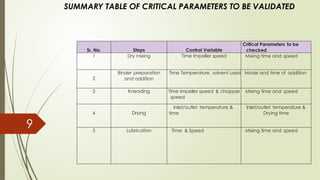
Sr. No. Steps Control Variable
Critical Parameters to be
checked
1 Dry mixing Time Impeller speed Mixing time and speed
2
Binder preparation
and addition
Time Temperature, solvent used Mode and time of addition
3 Kneading Time Impeller speed & chopper
speed
Mixing time and speed
4 Drying
Inlet/outlet temperature &
time
Inlet/outlet temperature &
Drying time
5 Lubrication Time & Speed Mixing time and speed
SUMMARY TABLE OF CRITICAL PARAMETERS TO BE VALIDATED
9
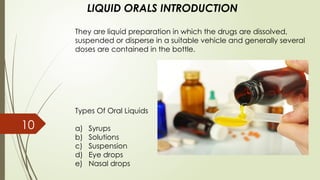
LIQUID ORALS INTRODUCTION
They are liquid preparation in which the drugs are dissolved,
suspended or disperse in a suitable vehicle and generally several
doses are contained in the bottle.
Types Of Oral Liquids
a) Syrups
b) Solutions
c) Suspension
d) Eye drops
e) Nasal drops
10
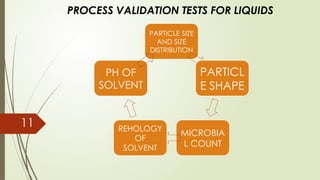
PROCESS VALIDATION TESTS FOR LIQUIDS
PARTICLE SIZE
AND SIZE
DISTRIBUTION
PARTICL
E SHAPE
MICROBIA
L COUNT
REHOLOGY
OF
SOLVENT
PH OF
SOLVENT
11
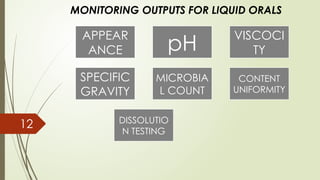
MONITORING OUTPUTS FOR LIQUID ORALS
APPEAR
ANCE pH
VISCOCI
TY
SPECIFIC
GRAVITY
MICROBIA
L COUNT
CONTENT
UNIFORMITY
DISSOLUTIO
N TESTING
12
CONT….
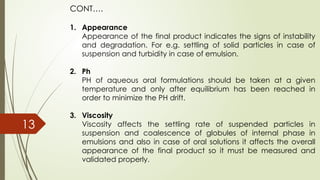
1. Appearance
Appearance of the final product indicates the signs of instability
and degradation. For e.g. settling of solid particles in case of
suspension and turbidity in case of emulsion.
2. Ph
PH of aqueous oral formulations should be taken at a given
temperature and only after equilibrium has been reached in
order to minimize the PH drift.
3. Viscosity
Viscosity affects the settling rate of suspended particles in
suspension and coalescence of globules of internal phase in
emulsions and also in case of oral solutions it affects the overall
appearance of the final product so it must be measured and
validated properly.
13
CONT….
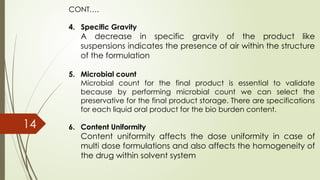
4. Specific Gravity
A decrease in specific gravity of the product like
suspensions indicates the presence of air within the structure
of the formulation
5. Microbial count
Microbial count for the final product is essential to validate
because by performing microbial count we can select the
preservative for the final product storage. There are specifications
for each liquid oral product for the bio burden content.
6. Content Uniformity
Content uniformity affects the dose uniformity in case of
multi dose formulations and also affects the homogeneity of
the drug within solvent system
14
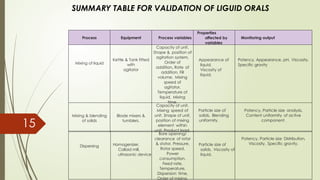
SUMMARY TABLE FOR VALIDATION OF LIGUID ORALS
Process Equipment Process variables
Properties
affected by
variables
Monitoring output
Mixing of liquid
Kettle & Tank fitted
with
agitator
Capacity of unit,
Shape & position of
agitation system,
Order of
addition, Rate of
addition, Fill
volume, Mixing
speed of
agitator,
Temperature of
liquid, Mixing
time.
Appearance of
liquid,
Viscosity of
liquid.
Potency, Appearance, pH, Viscosity,
Specific gravity
Mixing & blending
of solids
Blade mixers &
tumblers.
Capacity of unit,
Mixing speed of
unit, Shape of unit,
position of mixing
element within
unit, Product load.
Particle size of
solids, Blending
uniformity.
Potency, Particle size analysis,
Content uniformity of active
component.
Dispersing Homogenizer,
Colloid mill,
ultrasonic device
Bore opening/
clearance of rotor
& stator, Pressure,
Rotor speed,
Power
consumption,
Feed rate,
Temperature,
Dispersion time,
Order of mixing.
Particle size of
solids, Viscosity of
liquid.
Potency, Particle size Distribution,
Viscosity, Specific gravity.
15
REFERENCES
1. Process Validation of Pharmaceutical Dosages Form: A Review (Available:
https://biomedres.us/fulltexts/BJSTR.MS.ID.000463.php)
2. A review article on “process validation of pharmaceutical dosage form” (
file:///E:/DOWNLOADS/IJHS-10194+3573-3590%20(1).pdf)
Process Validation For Ointment/creams and Liquid Orals

Process Validation For Ointment/creams and Liquid Orals

  • 1.
    PROCESS VALIDATION FOROINTMENT/CREAMS AND LIQUID ORALS. PREPARED BY: RITESH PHALAK (M.PHARM 2ND SEM) SUBJECT: PHARMACEUTICAL VALIDATION. DEPARTMENT OF PHARMACEUTICAL QUALITY ASSURANCE. GUIDED BY: Dr. Puja Bhavsar ASSITANT PROFESSOR PHARMACEUTICAL QUALITY ASSURANCE DEPARTMENT. PARUL INSTITUTE OF PHARMACY.
  • 2.
    CONTENT 1. PROCESS VALIDATIONINTRODUCTION 2. OINTMENT/ CREAM INTRODUCTION 2.1 CRITICAL PARAMETERS TO BE VALIDATED 2.2 PROCESS TEMPERATURE 2.3 HEATING AND COOLING RATES 2.4 MIXING METHODS AND SPEEDS 2.5 MIXING TIMES 2.6 FLOW RATES 2.7 ADDITION OF POLYMERS AND GUMS 3 LIQUID ORALS INTRODUCTION 3.1 PROCESS VALIDATION TESTS FOR LIQUIDS 3.2 MONITORING OUTPUTS FOR LIQUID ORALS 4. REFERENCES
  • 3.
    PROCESS VALIDATION INTRODUCTION Process validation is a step-by-step procedure designed to ensure that a manufacturing process can consistently produce quality products. It is performed by a validation team led by the quality assurance head of manufacturers in the pharmaceutical industry.  It involves providing documentary evidence that key steps in the manufacturing process are consistent and reproducible.  The purpose of process validation is to ensure varied inputs lead to consistent and high quality outputs. Process validation is an ongoing process that must be frequently adapted as manufacturing feedback is gathered. 1
  • 4.
    CONT….  Process Validationis a means of ensuring that manufacturing processes are capable of consistently producing a finished product of the required quality.  A validated manufacturing process is one that has been proven to do what it purports or is presented to do. 2
  • 5.
    OINTMENT/CREAM INTRODUCTION  Theymay be specifically supposed for outside utility eg. cream, jelly, pastes and so forth. The consistency of semisolids lies between the solid and liquid and as a consequence the preparation is a task for manufacturers.  They are mainly meant for external application e.g. cream, jelly, pastes etc. The consistency of semisolids lies between the solid and liquid and thus the preparation is a challenge for manufacturers. 3
  • 6.
    CRITICAL PARAMETERS TOBE VALIDATED PROCESS TEMPERATURE HEATING AND COOLING RATES MIXING METHODS AND SPEED MIXING TIMES FLOW RATES ADDITION OF POLYMERS AND GUMS 4
  • 7.
    CONT…. 1. PROCESS TEMPERATURE Itis critical to process at right temperature for successful manufacturing. Too much heating during processing can result in chemical degradation and insufficient heat can lead to batch failures, and excess cooling can result in the precipitation of solubilized ingredients. 2. HEATING AND COOLING RATES The successful consistency of ointments, for example, depends on proper rates of heating and cooling. a) Heating too slowly can result in poor yields from evaporative loss. b) Heating too rapidly may burn areas of the batch in contact with the heating surface, which raises the potential for burnt material in the batch. c) Rapid cooling can result in precipitation/crystallization or increased viscosity. 5
  • 8.
    CONT…. 3. MIXING METHODAND SPEED  It is essential to determine the required amount of shear and the optimal mixing methods and speeds. Emulsification typically requires high shear or homogenization to obtain the optimal droplet size and dispersion, while the mixing of a gel may require low shear in order to preserve certain physical characteristics, such as viscosity.  Proper mixing speeds must be obtained for each phase at every batch scale.  If the process involves only very low shear mixing, a polymer may never be completely dispersed and hydrated, which may result in an out-of specification viscosity. 6
  • 9.
    CONT…. 4. MIXING TIMES Optimizing mixing time requires identifying the minimum time required for ingredients to dissolve and the maximum mixing time before product failure (e.g., when viscosity begins to drop).  In an emulsion, over-mixing may cause the product to separate prematurely, resulting in a drastic decline in viscosity. 5. FLOW RATES Optimizing flow rate involves determining the amount of shear or throughout needed. For example, a water-in oil emulsion may require a slower addition speed than a traditional, oil-in-water emulsion, and the flow rate must be modified appropriately. 7
  • 10.
    CONT….  Care mustbe taken for any product using a pump. Overhearing can occur if the formulation is pumped too quickly.  If pumping is too slow, the formulation will experience extra time in an in-line homogenizer, thus also exposing the formulation to additional shear. 6. Addition of Polymers and Gums  Addition of polymers (Carbomers) and gums (Xanthan) must be performed in a very controlled manner if adding directly to batch.  When polymers and gums are added to a process, their behavior must be understood to ensure consistency, stability, and reproducibility. 8
  • 11.
    Sr. No. StepsControl Variable Critical Parameters to be checked 1 Dry mixing Time Impeller speed Mixing time and speed 2 Binder preparation and addition Time Temperature, solvent used Mode and time of addition 3 Kneading Time Impeller speed & chopper speed Mixing time and speed 4 Drying Inlet/outlet temperature & time Inlet/outlet temperature & Drying time 5 Lubrication Time & Speed Mixing time and speed SUMMARY TABLE OF CRITICAL PARAMETERS TO BE VALIDATED 9
  • 12.
    LIQUID ORALS INTRODUCTION Theyare liquid preparation in which the drugs are dissolved, suspended or disperse in a suitable vehicle and generally several doses are contained in the bottle. Types Of Oral Liquids a) Syrups b) Solutions c) Suspension d) Eye drops e) Nasal drops 10
  • 13.
    PROCESS VALIDATION TESTSFOR LIQUIDS PARTICLE SIZE AND SIZE DISTRIBUTION PARTICL E SHAPE MICROBIA L COUNT REHOLOGY OF SOLVENT PH OF SOLVENT 11
  • 14.
    MONITORING OUTPUTS FORLIQUID ORALS APPEAR ANCE pH VISCOCI TY SPECIFIC GRAVITY MICROBIA L COUNT CONTENT UNIFORMITY DISSOLUTIO N TESTING 12
  • 15.
    CONT…. 1. Appearance Appearance ofthe final product indicates the signs of instability and degradation. For e.g. settling of solid particles in case of suspension and turbidity in case of emulsion. 2. Ph PH of aqueous oral formulations should be taken at a given temperature and only after equilibrium has been reached in order to minimize the PH drift. 3. Viscosity Viscosity affects the settling rate of suspended particles in suspension and coalescence of globules of internal phase in emulsions and also in case of oral solutions it affects the overall appearance of the final product so it must be measured and validated properly. 13
  • 16.
    CONT…. 4. Specific Gravity Adecrease in specific gravity of the product like suspensions indicates the presence of air within the structure of the formulation 5. Microbial count Microbial count for the final product is essential to validate because by performing microbial count we can select the preservative for the final product storage. There are specifications for each liquid oral product for the bio burden content. 6. Content Uniformity Content uniformity affects the dose uniformity in case of multi dose formulations and also affects the homogeneity of the drug within solvent system 14
  • 17.
    SUMMARY TABLE FORVALIDATION OF LIGUID ORALS Process Equipment Process variables Properties affected by variables Monitoring output Mixing of liquid Kettle & Tank fitted with agitator Capacity of unit, Shape & position of agitation system, Order of addition, Rate of addition, Fill volume, Mixing speed of agitator, Temperature of liquid, Mixing time. Appearance of liquid, Viscosity of liquid. Potency, Appearance, pH, Viscosity, Specific gravity Mixing & blending of solids Blade mixers & tumblers. Capacity of unit, Mixing speed of unit, Shape of unit, position of mixing element within unit, Product load. Particle size of solids, Blending uniformity. Potency, Particle size analysis, Content uniformity of active component. Dispersing Homogenizer, Colloid mill, ultrasonic device Bore opening/ clearance of rotor & stator, Pressure, Rotor speed, Power consumption, Feed rate, Temperature, Dispersion time, Order of mixing. Particle size of solids, Viscosity of liquid. Potency, Particle size Distribution, Viscosity, Specific gravity. 15
  • 18.
    REFERENCES 1. Process Validationof Pharmaceutical Dosages Form: A Review (Available: https://biomedres.us/fulltexts/BJSTR.MS.ID.000463.php) 2. A review article on “process validation of pharmaceutical dosage form” ( file:///E:/DOWNLOADS/IJHS-10194+3573-3590%20(1).pdf)