Distance Vector Routing Protocols Routing Protocols and Concepts – Chapter 4
Objectives Identify the characteristics of distance vector routing protocols. Describe the network discovery process of distance vector routing protocols using Routing Information Protocol (RIP). Describe the processes to maintain accurate routing tables used by distance vector routing protocols. Identify the conditions leading to a routing loop and explain the implications for router performance. Recognize that distance vector routing protocols are in use today
Distance Vector Routing Protocols Examples of Distance Vector routing protocols : Routing Information Protocol  (RIP)  Interior Gateway Routing Protocol  (IGRP)  Enhanced Interior Gateway Routing Protocol  (EIGRP)
Distance Vector Routing Protocols Distance Vector Technology The Meaning of Distance Vector : A router using distance vector routing protocols knows 2 things: Distance  to final destination Vector, or direction,  traffic should be directed
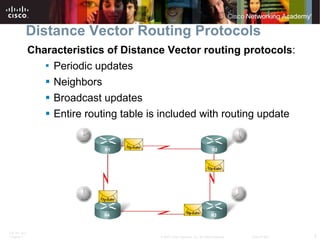
Distance Vector Routing Protocols Characteristics of Distance Vector routing protocols : Periodic updates Neighbors    Broadcast updates Entire routing table is included with routing update
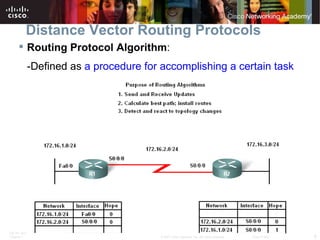
Distance Vector Routing Protocols Routing Protocol Algorithm : -Defined as  a procedure for accomplishing a certain task
Distance Vector Routing Protocols Routing Protocol Characteristics Criteria used to compare routing protocols  includes -Time to convergence  -Scalability  -Resource usage  -Implementation & maintenance
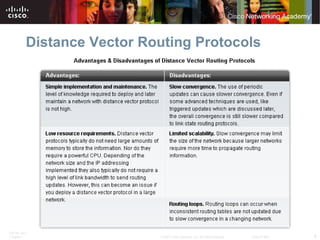
Distance Vector Routing Protocols
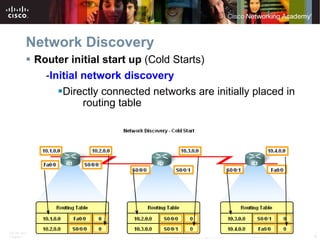
Network Discovery Router initial start up  (Cold Starts) - Initial network discovery Directly connected networks are initially placed in  routing table
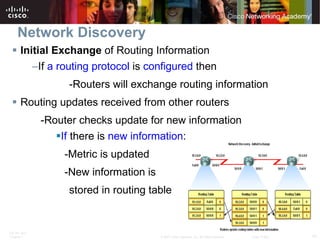
Network Discovery Initial Exchange  of Routing Information If  a routing protocol  is  configured  then -Routers will exchange routing information Routing updates received from other routers -Router checks update for new information If  there is  new information :   -Metric is updated   -New information is  stored in routing table
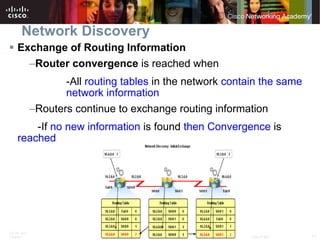
Network Discovery Exchange of Routing Information Router convergence  is reached when -All  routing tables  in the network  contain the same  network information Routers continue to exchange routing information -If  no new information  is found  then Convergence  is  reached
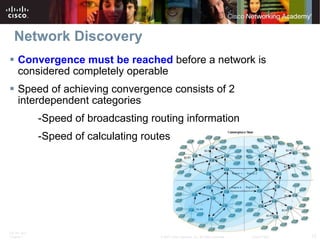
Network Discovery Convergence must be reached  before a network is considered completely operable  Speed of achieving convergence consists of 2 interdependent categories -Speed of broadcasting routing information -Speed of calculating routes
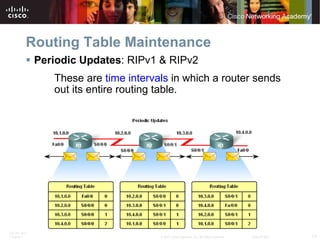
Routing Table Maintenance Periodic Updates : RIPv1 & RIPv2 These are  time intervals  in which a router sends  out its entire routing table.
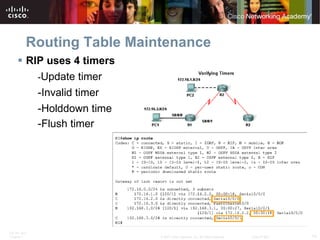
Routing Table Maintenance RIP uses 4 timers - Update timer  -Invalid timer  -Holddown timer  -Flush timer
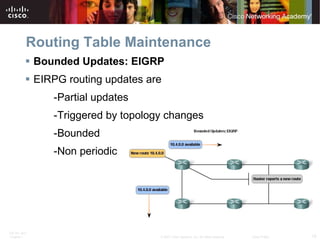
Routing Table Maintenance Bounded Updates: EIGRP EIRPG routing updates are  -Partial updates  -Triggered by topology changes  -Bounded  -Non periodic
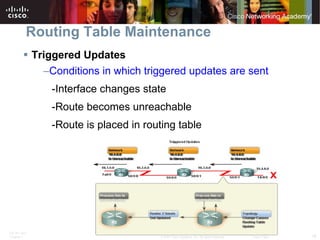
Routing Table Maintenance Triggered Updates Conditions in which triggered updates are sent -Interface changes state -Route becomes unreachable -Route is placed in routing table
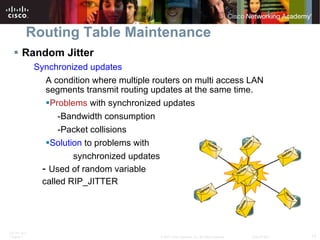
Routing Table Maintenance Random Jitter Synchronized updates A condition where multiple routers on multi access LAN segments transmit routing updates at the same time. Problems   with synchronized updates -Bandwidth consumption -Packet collisions Solution  to problems with  synchronized updates -  Used of random variable  called RIP_JITTER
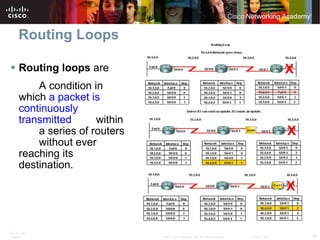
Routing Loops Routing loops  are  A condition in  which  a packet is  continuously  transmitted   within  a series of routers  without ever  reaching its  destination.
Routing Loops Routing loops  may be  caused by : -Incorrectly configured static routes -Incorrectly configured route redistribution -Slow convergence -Incorrectly configured discard routes Routing loops  can  create the following issues -Excess use of bandwidth -CPU resources may be strained -Network convergence is degraded -Routing updates may be lost or not processed in a timely  manner
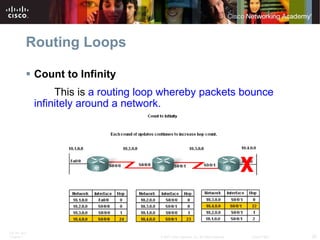
Routing Loops  Count to Infinity This is  a routing loop whereby packets bounce  infinitely around a network.
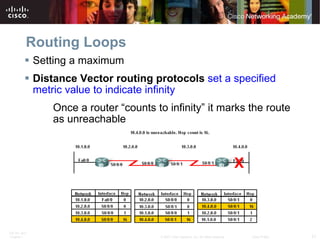
Routing Loops Setting a maximum Distance Vector routing protocols   set a specified metric value to indicate infinity Once a router “counts to infinity” it marks the route  as unreachable
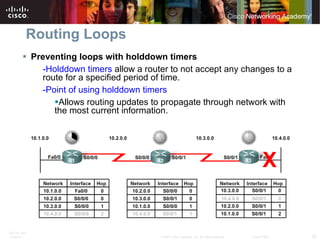
Routing Loops Preventing loops with holddown timers -Holddown timers  allow a router to not accept any changes to a route for a specified period of time. -Point of using holddown timers Allows routing updates to propagate through network with the most current information.
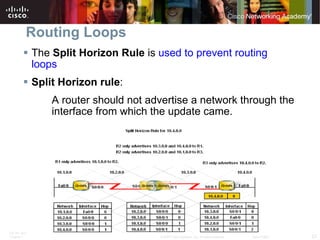
Routing Loops The  Split Horizon Rule  is  used to prevent routing loops Split Horizon rule : A router should not advertise a network through the  interface from which the update came.
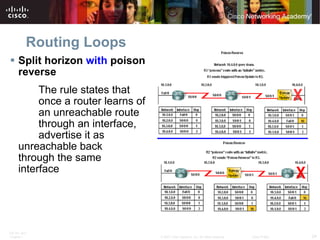
Routing Loops Split horizon  with  poison reverse  The rule states that  once a router learns of  an unreachable route  through an interface,  advertise it as  unreachable back  through the same  interface
Routing Loops IP & TTL Purpose of the TTL field The TTL field is found in an IP header and is  used to prevent packets from endlessly  traveling on a network How the TTL field works -TTL field contains a numeric value The  numeric value is decreased by one  by  every router on the route to the destination. If  numeric value reaches   0  then Packet  is discarded.
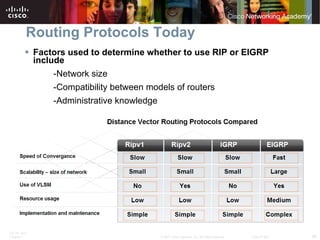
Routing Protocols Today Factors used to determine whether to use RIP or EIGRP include -Network size -Compatibility between models of routers -Administrative knowledge
Routing Protocols Today RIP Features of RIP: -Supports  split horizon & split horizon with  poison reverse -Capable of  load balancing   - Easy to configure - Works in a multi vendor router environment
Routing Protocols Today EIGRP Features of EIGRP : -Triggered updates -EIGRP hello protocol used to establish  neighbor adjacencies -Supports VLSM & route summarization -Use of topology table to maintain all routes -Classless distance vector routing protocol -Cisco proprietary protocol
Summary Characteristics of Distance Vector routing protocols Periodic updates RIP routing updates include the entire routing table Neighbors are defined as routers that share a link and are configured to use the same protocol The network discovery process for D.V. routing protocol Directly connected routes are placed in routing table 1 st If a routing protocol is configured then Routers will exchange routing information Convergence is reached when all network routers have the  same network information
Summary D.V. routing protocols maintains routing tables by RIP sending out periodic updates RIP using 4 different timers to  ensure information is accurate and convergence is achieved in a timely manner EIGRP sending out triggered updates D.V. routing protocols may be prone to routing loops routing loops are a condition in which packets continuously traverse a network Mechanisms used to minimize routing loops include defining maximum hop count, holddown timers, split horizon, route poisoning and triggered updates
Summary Conditions that can lead to routing loops include Incorrectly configured static routes Incorrectly configured route redistribution Slow convergence Incorrectly configured discard routes How routing loops can impact network performance includes: Excess use of bandwidth CPU resources may be strained Network convergence is degraded Routing updates may be lost or not processed
Summary Routing Information Protocol (RIP) A distance vector protocol that has 2 versions RIPv1 – a classful routing protocol RIPv2  - a classless routing protocol Enhanced Interior Gateway Routing Protocol (EIGRP) A distance vector routing protocols that has some features of link state routing protocols A Cisco proprietary routing protocol
 

Exploration Routing Chapter 4

  • 1.
    Distance Vector RoutingProtocols Routing Protocols and Concepts – Chapter 4
  • 2.
    Objectives Identify thecharacteristics of distance vector routing protocols. Describe the network discovery process of distance vector routing protocols using Routing Information Protocol (RIP). Describe the processes to maintain accurate routing tables used by distance vector routing protocols. Identify the conditions leading to a routing loop and explain the implications for router performance. Recognize that distance vector routing protocols are in use today
  • 3.
    Distance Vector RoutingProtocols Examples of Distance Vector routing protocols : Routing Information Protocol (RIP) Interior Gateway Routing Protocol (IGRP) Enhanced Interior Gateway Routing Protocol (EIGRP)
  • 4.
    Distance Vector RoutingProtocols Distance Vector Technology The Meaning of Distance Vector : A router using distance vector routing protocols knows 2 things: Distance to final destination Vector, or direction, traffic should be directed
  • 5.
    Distance Vector RoutingProtocols Characteristics of Distance Vector routing protocols : Periodic updates Neighbors Broadcast updates Entire routing table is included with routing update
  • 6.
    Distance Vector RoutingProtocols Routing Protocol Algorithm : -Defined as a procedure for accomplishing a certain task
  • 7.
    Distance Vector RoutingProtocols Routing Protocol Characteristics Criteria used to compare routing protocols includes -Time to convergence -Scalability -Resource usage -Implementation & maintenance
  • 8.
  • 9.
    Network Discovery Routerinitial start up (Cold Starts) - Initial network discovery Directly connected networks are initially placed in routing table
  • 10.
    Network Discovery InitialExchange of Routing Information If a routing protocol is configured then -Routers will exchange routing information Routing updates received from other routers -Router checks update for new information If there is new information : -Metric is updated -New information is stored in routing table
  • 11.
    Network Discovery Exchangeof Routing Information Router convergence is reached when -All routing tables in the network contain the same network information Routers continue to exchange routing information -If no new information is found then Convergence is reached
  • 12.
    Network Discovery Convergencemust be reached before a network is considered completely operable Speed of achieving convergence consists of 2 interdependent categories -Speed of broadcasting routing information -Speed of calculating routes
  • 13.
    Routing Table MaintenancePeriodic Updates : RIPv1 & RIPv2 These are time intervals in which a router sends out its entire routing table.
  • 14.
    Routing Table MaintenanceRIP uses 4 timers - Update timer -Invalid timer -Holddown timer -Flush timer
  • 15.
    Routing Table MaintenanceBounded Updates: EIGRP EIRPG routing updates are -Partial updates -Triggered by topology changes -Bounded -Non periodic
  • 16.
    Routing Table MaintenanceTriggered Updates Conditions in which triggered updates are sent -Interface changes state -Route becomes unreachable -Route is placed in routing table
  • 17.
    Routing Table MaintenanceRandom Jitter Synchronized updates A condition where multiple routers on multi access LAN segments transmit routing updates at the same time. Problems with synchronized updates -Bandwidth consumption -Packet collisions Solution to problems with synchronized updates - Used of random variable called RIP_JITTER
  • 18.
    Routing Loops Routingloops are A condition in which a packet is continuously transmitted within a series of routers without ever reaching its destination.
  • 19.
    Routing Loops Routingloops may be caused by : -Incorrectly configured static routes -Incorrectly configured route redistribution -Slow convergence -Incorrectly configured discard routes Routing loops can create the following issues -Excess use of bandwidth -CPU resources may be strained -Network convergence is degraded -Routing updates may be lost or not processed in a timely manner
  • 20.
    Routing Loops Count to Infinity This is a routing loop whereby packets bounce infinitely around a network.
  • 21.
    Routing Loops Settinga maximum Distance Vector routing protocols set a specified metric value to indicate infinity Once a router “counts to infinity” it marks the route as unreachable
  • 22.
    Routing Loops Preventingloops with holddown timers -Holddown timers allow a router to not accept any changes to a route for a specified period of time. -Point of using holddown timers Allows routing updates to propagate through network with the most current information.
  • 23.
    Routing Loops The Split Horizon Rule is used to prevent routing loops Split Horizon rule : A router should not advertise a network through the interface from which the update came.
  • 24.
    Routing Loops Splithorizon with poison reverse The rule states that once a router learns of an unreachable route through an interface, advertise it as unreachable back through the same interface
  • 25.
    Routing Loops IP& TTL Purpose of the TTL field The TTL field is found in an IP header and is used to prevent packets from endlessly traveling on a network How the TTL field works -TTL field contains a numeric value The numeric value is decreased by one by every router on the route to the destination. If numeric value reaches 0 then Packet is discarded.
  • 26.
    Routing Protocols TodayFactors used to determine whether to use RIP or EIGRP include -Network size -Compatibility between models of routers -Administrative knowledge
  • 27.
    Routing Protocols TodayRIP Features of RIP: -Supports split horizon & split horizon with poison reverse -Capable of load balancing - Easy to configure - Works in a multi vendor router environment
  • 28.
    Routing Protocols TodayEIGRP Features of EIGRP : -Triggered updates -EIGRP hello protocol used to establish neighbor adjacencies -Supports VLSM & route summarization -Use of topology table to maintain all routes -Classless distance vector routing protocol -Cisco proprietary protocol
  • 29.
    Summary Characteristics ofDistance Vector routing protocols Periodic updates RIP routing updates include the entire routing table Neighbors are defined as routers that share a link and are configured to use the same protocol The network discovery process for D.V. routing protocol Directly connected routes are placed in routing table 1 st If a routing protocol is configured then Routers will exchange routing information Convergence is reached when all network routers have the same network information
  • 30.
    Summary D.V. routingprotocols maintains routing tables by RIP sending out periodic updates RIP using 4 different timers to ensure information is accurate and convergence is achieved in a timely manner EIGRP sending out triggered updates D.V. routing protocols may be prone to routing loops routing loops are a condition in which packets continuously traverse a network Mechanisms used to minimize routing loops include defining maximum hop count, holddown timers, split horizon, route poisoning and triggered updates
  • 31.
    Summary Conditions thatcan lead to routing loops include Incorrectly configured static routes Incorrectly configured route redistribution Slow convergence Incorrectly configured discard routes How routing loops can impact network performance includes: Excess use of bandwidth CPU resources may be strained Network convergence is degraded Routing updates may be lost or not processed
  • 32.
    Summary Routing InformationProtocol (RIP) A distance vector protocol that has 2 versions RIPv1 – a classful routing protocol RIPv2 - a classless routing protocol Enhanced Interior Gateway Routing Protocol (EIGRP) A distance vector routing protocols that has some features of link state routing protocols A Cisco proprietary routing protocol
  • 33.