CCNA 3 Chapter 8   Spanning Tree Protocol By Your Name
Objectives Redundant topologies Spanning Tree Protocol
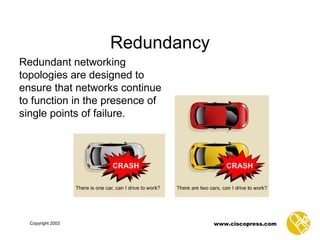
Redundancy Redundant networking topologies are designed to ensure that networks continue to function in the presence of single points of failure.
Redundant Topologies A goal of redundant topologies is to eliminate network outages caused by a single point of failure.  All networks need redundancy for enhanced reliability.
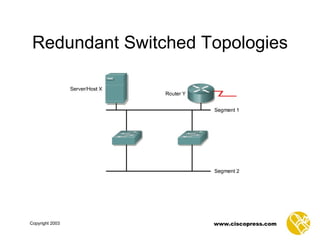
Redundant Switched Topologies
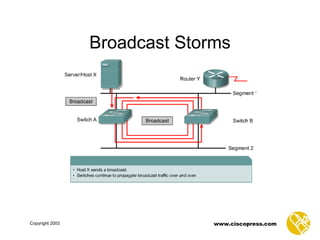
Broadcast Storms
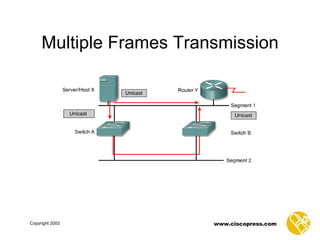
Multiple Frames Transmission
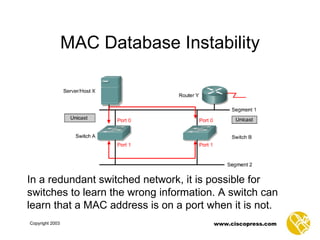
MAC Database Instability In a redundant switched network ,  it is possible for switches to learn the wrong information. A switch can learn that a MAC address is on a port when it is not.
Spanning   Tree Protocol
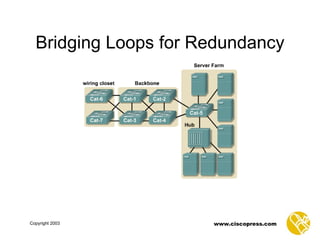
Bridging Loops for Redundancy
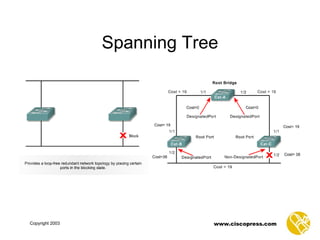
Spanning   Tree
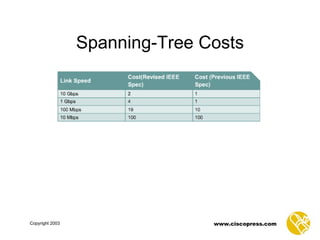
Spanning-Tree Costs
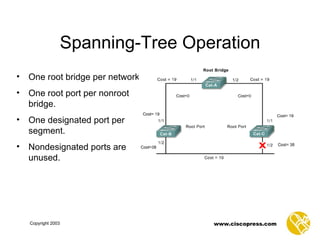
Spanning-Tree Operation One root bridge per network .   One root port per nonroot bridge . One designated port per segment . Nondesignated ports are unused .
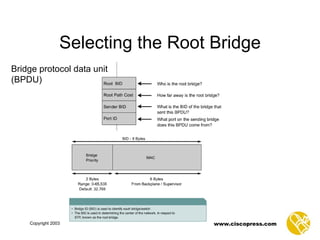
Selecting the Root Bridge Bridge protocol data unit  (BPDU)
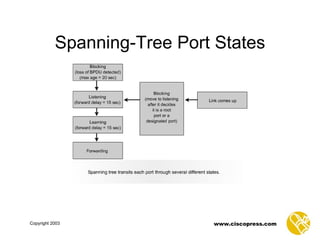
Spanning-Tree Port States
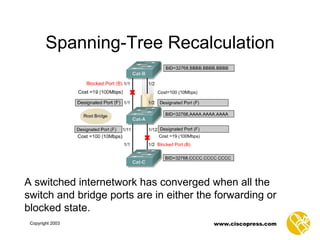
Spanning-Tree Recalculation A switched internetwork has converged when all the switch and bridge ports are in either the forwarding or blocked state.
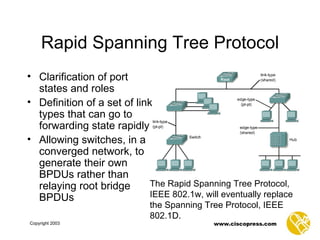
Rapid Spanning   Tree Protocol Clarification of port states and roles  Definition of a set of link types that can go to forwarding state rapidly  Allowing switches, in a converged network, to generate their own BPDUs rather than relaying root bridge BPDUs The Rapid Spanning   Tree Protocol, IEEE 802.1w, will eventually replace the Spanning   Tree Protocol, IEEE 802.1D.

Spannig tree