Pt. Ravishankar Shukla University Raipur (C.G.)
A
Presentation
on
BGP(Border Gateway Protocol)
Session 2016-17
Submitted by
NUTAN SINGH
Roll No. 24
INTRODUCTION OF ROUTING PROTOCOL
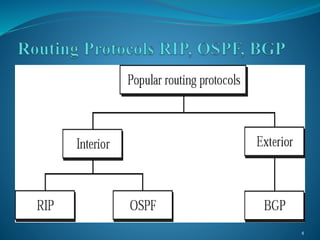
ROUTING PROTOCOLS RIP, OSPF, BGP
OVERVIEW OF BGP
WHEN TO USE BGP AND WHEN NOT TO USE BGP
ESTABLISHING ADJACENCIES WITH NEIGHBOURS
 MESSAGE TYPE IN BGP
ROUTE SELECTION DECISION PROCESS
BGP PATH ATTRIBUTES
CONFIGURING OSPF
ADVANTAGES
DISADVANTAGES
CONCLUSION
REFERENCES
2
Routing is the process that a router uses to forward packets
toward the destination network.
processes for sharing route information allows
routers to communicate with other routers to update and
maintain the routing tables
Examples of routing protocols that support the IP routed
protocol are:
RIP, IGRP,OSPF, BGP, and EIGRP.
Most routing algorithms can be classified into one of two
categories:
• distance vector
• link-state 3
4
BGP stand for Border Gateway Protocol.very to big organization
can use BGP.
Having two or more internet connection.
CLID routing protocol.
Create loop free inter domain routing between Autonomous
Systems (AS). {1-65512: Private; 65513 – 65535: Public}
An AS is a set of routers under a single technical administration.
Two BGP flavors: IBGP & EBGP
 - IBGP work in same AS
 - EBGP work in different AS.
BGP used TCP port 179 and maintains neighbor or peer
relationships
It’s an application layer protocol
BGP describes the path by using Attributes
5
• BGP finds the best path to a network by using the best AS-path
• Exchange of loop-free routing information is guaranteed.
• Updates sent once every 5 sec for IBGP peer & once every 30 sec for
EBGP.
• TCP used for reliability.
• Protocol Type: Path vector.
• EBGP: AD 20
• IBGP: AD 200
• Open standard Protocol
• Supported protocols: IPv4, IPv6
• BGP sends full routing updates at the start of the session.
• Incremental & triggered updates
• Timers: Hello (60 sec)
• Authentication: None, MD5
6
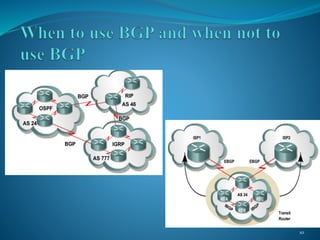
Use BGP
 when the effects of BGP are well understood and one of the following
conditions exist:
The AS allows packets to transit through it to reach another AS (transit
AS).
The AS has multiple connections to other AS’s.
The flow of traffic entering or exiting the AS must be manipulated. This
is policy based routing and based on attributes.
Do not use BGP
A single connection to the Internet or another AS
No concern for routing policy or routing selection
A lack of memory or processing power on your routers to handle constant
BGP updates
A limited understanding of route filtering and BGP path selection process
Low bandwidth between AS’s
7
8
9
10
Before establishing a BGP peer connection the two neighbors must
perform the standard TCP three-way handshake and open a TCP
connection to port 179.
After the TCP session is established, BGP peers exchanges several
messages to open and confirm connection parameters and to send BGP
routing information.
All BGP messages are unicast to the one neighbor over the TCP
connection.
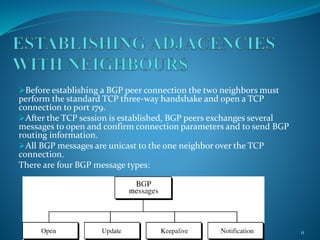
There are four BGP message types:
11
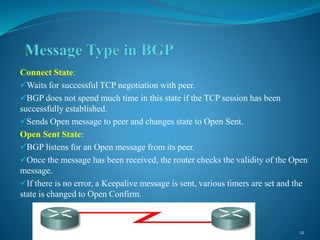
Connect State:
Waits for successful TCP negotiation with peer.
BGP does not spend much time in this state if the TCP session has been
successfully established.
Sends Open message to peer and changes state to Open Sent.
Open Sent State:
BGP listens for an Open message from its peer.
Once the message has been received, the router checks the validity of the Open
message.
If there is no error, a Keepalive message is sent, various timers are set and the
state is changed to Open Confirm.
12
13
Open Confirm State:
The peer is listening for a Keepalive message from its peer.
Established State:
The peers send Update messages to exchange information about each route
being advertised to the BGP peer.
If there is any error in the Update message then a Notification message is sent
to the peer, and BGP transitions back to the idle state.
Active State:
If the router was unable to establish a successful TCP session, then it ends up in
the Active state.
Consider only routes with no AS loops and a valid next hop,
and then:
1. Highest weight (local to router).
2. Highest local preference (global within AS).
4. Shortest AS path.
5. Lowest origin code (IGP < EGP < incomplete).
7. EBGP path over IBGP path.
8. The path through the closest IGP neighbor.
9. Oldest route for EBGP paths.
10. The path with the lowest neighbor BGP router ID.
11. The path with the lowest neighbor IP address.
14
Well-known attributes
- Must be recognized by all compliant BGP implementations. Are
propagated to other neighbors
• Well-known mandatory attributes
- Must be present in all update messages
• Well-known discretionary attributes
- May be present in update messages
15
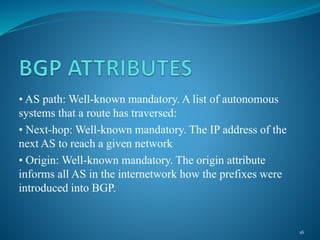
• AS path: Well-known mandatory. A list of autonomous
systems that a route has traversed:
• Next-hop: Well-known mandatory. The IP address of the
next AS to reach a given network
• Origin: Well-known mandatory. The origin attribute
informs all AS in the internetwork how the prefixes were
introduced into BGP.
16
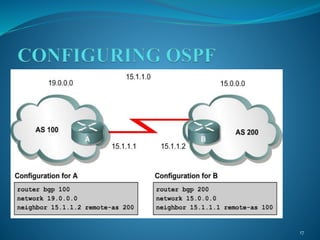
Syntax:-
Example:-
Router(config)# router ospf 1
Router(config-router)# network 10.0.0.0 0.255.255.255
area 0
17
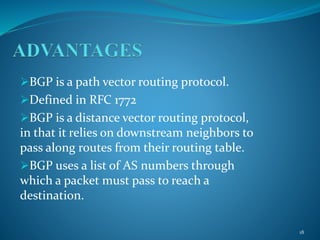
BGP is a path vector routing protocol.
Defined in RFC 1772
BGP is a distance vector routing protocol,
in that it relies on downstream neighbors to
pass along routes from their routing table.
BGP uses a list of AS numbers through
which a packet must pass to reach a
destination.
18
· BGP converges slowly.
· Not used in single connection to the Internet.
19
The protocol designed by Standard protocol system. It’s work
on top of layer 3.it’s a best routing protocol for link state
routing protocol . that is used on a big network ISP for reliable
network establishment.
20
https://www.wikipedia.com/BGP
https://drive.google.com/about
https://www.CCNP CISCO.com/BGP protocol
www.netmetric-solutions.com
21
22
23

Border Gateway Protocol (BGP)

  • 1.
    Pt. Ravishankar ShuklaUniversity Raipur (C.G.) A Presentation on BGP(Border Gateway Protocol) Session 2016-17 Submitted by NUTAN SINGH Roll No. 24
  • 2.
    INTRODUCTION OF ROUTINGPROTOCOL ROUTING PROTOCOLS RIP, OSPF, BGP OVERVIEW OF BGP WHEN TO USE BGP AND WHEN NOT TO USE BGP ESTABLISHING ADJACENCIES WITH NEIGHBOURS  MESSAGE TYPE IN BGP ROUTE SELECTION DECISION PROCESS BGP PATH ATTRIBUTES CONFIGURING OSPF ADVANTAGES DISADVANTAGES CONCLUSION REFERENCES 2
  • 3.
    Routing is theprocess that a router uses to forward packets toward the destination network. processes for sharing route information allows routers to communicate with other routers to update and maintain the routing tables Examples of routing protocols that support the IP routed protocol are: RIP, IGRP,OSPF, BGP, and EIGRP. Most routing algorithms can be classified into one of two categories: • distance vector • link-state 3
  • 4.
  • 5.
    BGP stand forBorder Gateway Protocol.very to big organization can use BGP. Having two or more internet connection. CLID routing protocol. Create loop free inter domain routing between Autonomous Systems (AS). {1-65512: Private; 65513 – 65535: Public} An AS is a set of routers under a single technical administration. Two BGP flavors: IBGP & EBGP  - IBGP work in same AS  - EBGP work in different AS. BGP used TCP port 179 and maintains neighbor or peer relationships It’s an application layer protocol BGP describes the path by using Attributes 5
  • 6.
    • BGP findsthe best path to a network by using the best AS-path • Exchange of loop-free routing information is guaranteed. • Updates sent once every 5 sec for IBGP peer & once every 30 sec for EBGP. • TCP used for reliability. • Protocol Type: Path vector. • EBGP: AD 20 • IBGP: AD 200 • Open standard Protocol • Supported protocols: IPv4, IPv6 • BGP sends full routing updates at the start of the session. • Incremental & triggered updates • Timers: Hello (60 sec) • Authentication: None, MD5 6
  • 7.
    Use BGP  whenthe effects of BGP are well understood and one of the following conditions exist: The AS allows packets to transit through it to reach another AS (transit AS). The AS has multiple connections to other AS’s. The flow of traffic entering or exiting the AS must be manipulated. This is policy based routing and based on attributes. Do not use BGP A single connection to the Internet or another AS No concern for routing policy or routing selection A lack of memory or processing power on your routers to handle constant BGP updates A limited understanding of route filtering and BGP path selection process Low bandwidth between AS’s 7
  • 8.
  • 9.
  • 10.
  • 11.
    Before establishing aBGP peer connection the two neighbors must perform the standard TCP three-way handshake and open a TCP connection to port 179. After the TCP session is established, BGP peers exchanges several messages to open and confirm connection parameters and to send BGP routing information. All BGP messages are unicast to the one neighbor over the TCP connection. There are four BGP message types: 11
  • 12.
    Connect State: Waits forsuccessful TCP negotiation with peer. BGP does not spend much time in this state if the TCP session has been successfully established. Sends Open message to peer and changes state to Open Sent. Open Sent State: BGP listens for an Open message from its peer. Once the message has been received, the router checks the validity of the Open message. If there is no error, a Keepalive message is sent, various timers are set and the state is changed to Open Confirm. 12
  • 13.
    13 Open Confirm State: Thepeer is listening for a Keepalive message from its peer. Established State: The peers send Update messages to exchange information about each route being advertised to the BGP peer. If there is any error in the Update message then a Notification message is sent to the peer, and BGP transitions back to the idle state. Active State: If the router was unable to establish a successful TCP session, then it ends up in the Active state.
  • 14.
    Consider only routeswith no AS loops and a valid next hop, and then: 1. Highest weight (local to router). 2. Highest local preference (global within AS). 4. Shortest AS path. 5. Lowest origin code (IGP < EGP < incomplete). 7. EBGP path over IBGP path. 8. The path through the closest IGP neighbor. 9. Oldest route for EBGP paths. 10. The path with the lowest neighbor BGP router ID. 11. The path with the lowest neighbor IP address. 14
  • 15.
    Well-known attributes - Mustbe recognized by all compliant BGP implementations. Are propagated to other neighbors • Well-known mandatory attributes - Must be present in all update messages • Well-known discretionary attributes - May be present in update messages 15
  • 16.
    • AS path:Well-known mandatory. A list of autonomous systems that a route has traversed: • Next-hop: Well-known mandatory. The IP address of the next AS to reach a given network • Origin: Well-known mandatory. The origin attribute informs all AS in the internetwork how the prefixes were introduced into BGP. 16
  • 17.
    Syntax:- Example:- Router(config)# router ospf1 Router(config-router)# network 10.0.0.0 0.255.255.255 area 0 17
  • 18.
    BGP is apath vector routing protocol. Defined in RFC 1772 BGP is a distance vector routing protocol, in that it relies on downstream neighbors to pass along routes from their routing table. BGP uses a list of AS numbers through which a packet must pass to reach a destination. 18
  • 19.
    · BGP convergesslowly. · Not used in single connection to the Internet. 19
  • 20.
    The protocol designedby Standard protocol system. It’s work on top of layer 3.it’s a best routing protocol for link state routing protocol . that is used on a big network ISP for reliable network establishment. 20
  • 21.
  • 22.
  • 23.