17 Feb 2016 1
Epidemiology of
Rickettsial
Diseases in India
Presenter- Dr. Mamta Gehlawat
Moderator- Dr. Swaroop Kumar Sahu
17 Feb 2016 2
Presentation Outline-
1.Introduction
2.Individual Diseases Epidemiology
Scrub Typhus
Indian Tick Typhus
Murine Typhus
Q Fever
Epidemic Louse borne Typhus
Candidatus R. kellyi
3.Diagnostic procedures
4.Prevention & Control
5.Summary
17 Feb 2016 3
Introduction..
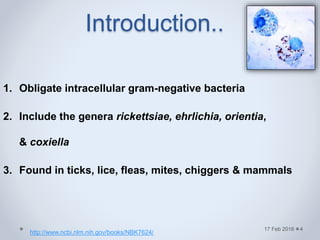
1. Obligate intracellular gram-negative bacteria
2. Include the genera rickettsiae, ehrlichia, orientia,
& coxiella
3. Found in ticks, lice, fleas, mites, chiggers & mammals
17 Feb 2016
http://www.ncbi.nlm.nih.gov/books/NBK7624/
4
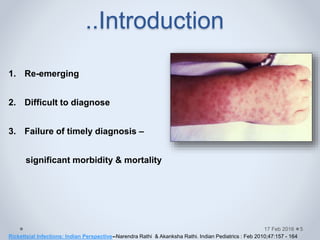
1. Re-emerging
2. Difficult to diagnose
3. Failure of timely diagnosis –
significant morbidity & mortality
17 Feb 2016
Rickettsial Infections: Indian Perspective--Narendra Rathi & Akanksha Rathi. Indian Pediatrics : Feb 2010;47:157 - 164
..Introduction
5
17 Feb 2016
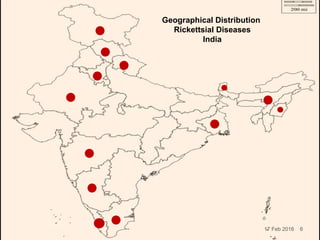
Geographical Distribution
Rickettsial Diseases
India
6
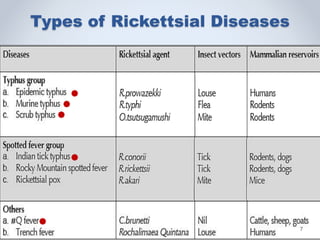
Types of Rickettsial Diseases
17 Feb 2016
#
7
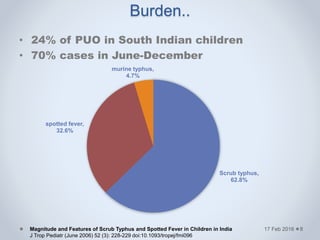
Burden..
• 24% of PUO in South Indian children
• 70% cases in June-December
17 Feb 2016
Scrub typhus,
62.8%
spotted fever,
32.6%
murine typhus,
4.7%
Magnitude and Features of Scrub Typhus and Spotted Fever in Children in India
J Trop Pediatr (June 2006) 52 (3): 228-229 doi:10.1093/tropej/fmi096
8
• untreated cases
• fatality rates - 30-35 %
17 Feb 2016
..Burden
9
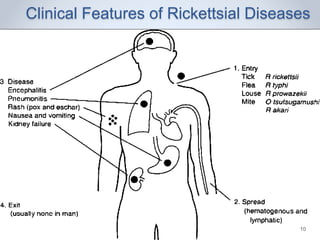
Clinical Features of Rickettsial Diseases
17 Feb 2016 10
Scrub Typhus
17 Feb 2016 11
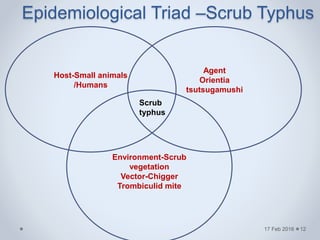
Epidemiological Triad –Scrub Typhus
17 Feb 2016
Host-Small animals
/Humans
Agent
Orientia
tsutsugamushi
Environment-Scrub
vegetation
Vector-Chigger
Trombiculid mite
Scrub
typhus
12
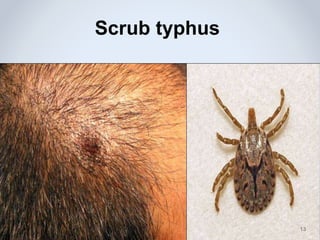
Scrub typhus
17 Feb 2016 13
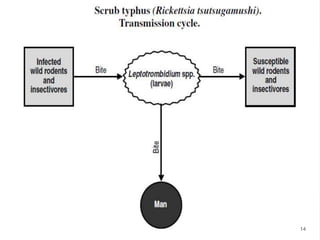
17 Feb 2016 14
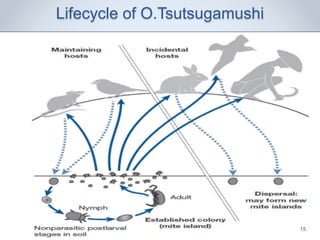
Lifecycle of O.Tsutsugamushi
17 Feb 2016 15
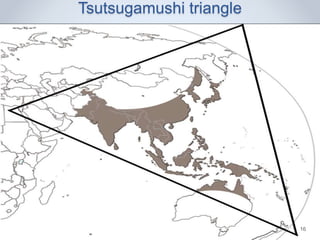
Tsutsugamushi triangle
17 Feb 2016 16
Exposure to Mite Islands..
• Highest incidence –
o Military soldiers
o farmers
• Military operations -brush & jungle areas
• Epidemics affecting 20% to 50% of the troops
17 Feb 2016 17
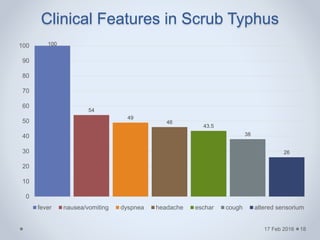
Clinical Features in Scrub Typhus
100
54
49
46
43.5
38
26
0
10
20
30
40
50
60
70
80
90
100
fever nausea/vomiting dyspnea headache eschar cough altered sensorium
17 Feb 2016 18
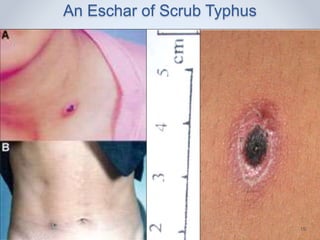
An Eschar of Scrub Typhus
17 Feb 2016 19
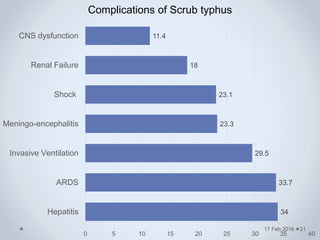
34
33.7
29.5
23.3
23.1
18
11.4
0 5 10 15 20 25 30 35 40
Hepatitis
ARDS
Invasive Ventilation
Meningo-encephalitis
Shock
Renal Failure
CNS dysfunction
Complications of Scrub typhus
17 Feb 2016 21
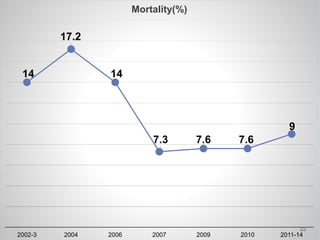
Mortality Trends
17 Feb 2016
14
17.2
14
7.3 7.6 7.6
9
2002-3 2004 2006 2007 2009 2010 2011-14
Mortality(%)
22
17 Feb 2016 24
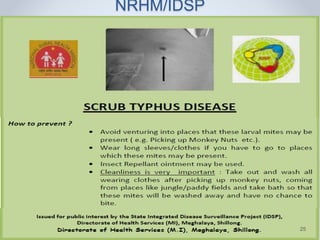
NRHM/IDSP
17 Feb 2016 25
Typhus
Spotted Fever Group
17 Feb 2016 27
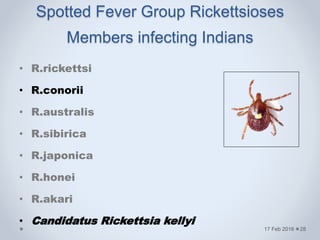
Spotted Fever Group Rickettsioses
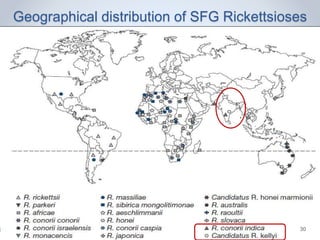
Members infecting Indians
• R.rickettsi
• R.conorii
• R.australis
• R.sibirica
• R.japonica
• R.honei
• R.akari
• Candidatus Rickettsia kellyi
17 Feb 2016 28
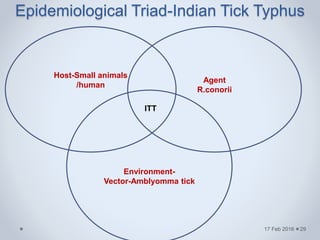
Epidemiological Triad-Indian Tick Typhus
17 Feb 2016
Host-Small animals
/human
Agent
R.conorii
Environment-
Vector-Amblyomma tick
ITT
29
Geographical distribution of SFG Rickettsioses
17 Feb 2016 30
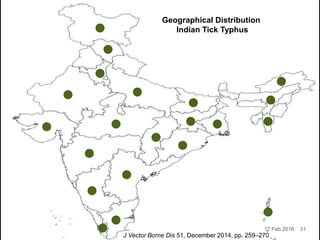
Geographical Distribution
Indian Tick Typhus
J Vector Borne Dis 51, December 2014, pp. 259–270
17 Feb 2016 31
Boutonneuse Fever
17 Feb 2016
1. clinical presentation = mild - very severe
2. fatality =highly virulent rickettsiae 2–6%
3. clinical signs :
I. fever;
II. headache;
III. rash maculopapular or vesicular;
IV.inoculation eschars at site of tick bite;
V. localized lymphadenopathy
32
• Early empirical treatment
• doxycycline
• no vaccines available
• Prevention -minimizing exposure to ticks
17 Feb 2016
Indian tick typhus
33
Prevention
• Ticks are prevalent-control is not feasible
• No vaccine available
• Avoidance of tick bite
o Tick repellant
o Protective clothing
• Regular inspection & removal of ticks from
body
• Removal of ticks prior to inoculation of
rickettsia
17 Feb 2016 34
Candidatus Rickettsia kellyi
• New species
• Vector undetermined
• Thirupattur ,Tamil Nadu
• 2006
• Fever & Maculopapular Lesion
• Dramatic recovery with Doxycycline
Emerging Infectious Diseases • www.cdc.gov/eid • Vol. 12, No. 3, March 200617 Feb 2016 35
Murine Typhus
17 Feb 2016 36
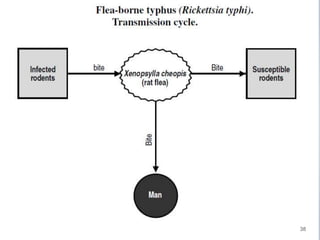
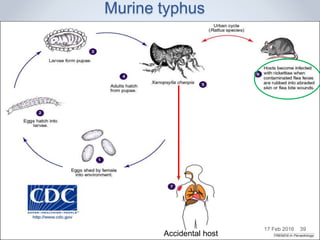
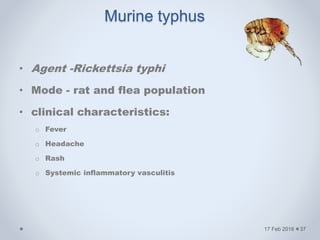
• Agent -Rickettsia typhi
• Mode - rat and flea population
• clinical characteristics:
o Fever
o Headache
o Rash
o Systemic inflammatory vasculitis
17 Feb 2016
Murine typhus
37
17 Feb 2016 38
Murine typhus
Accidental host
17 Feb 2016 39
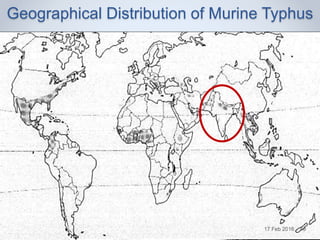
Geographical Distribution of Murine Typhus
17 Feb 2016 40
• Lab :
o liver enzymes elevation,
o hypoalbuminemia
• Disease outcome: usually favorable
• Treatment: doxycycline, chloramphenicol
• Prevention: rodent-control programs
• Garbage workers –high risk
17 Feb 2016
Murine typhus
41
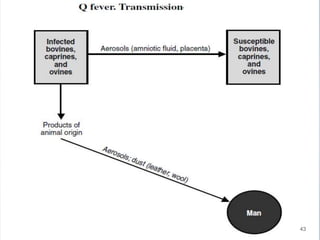
Q-fever
17 Feb 2016 42
17 Feb 2016 43
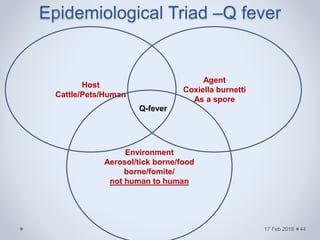
Epidemiological Triad –Q fever
17 Feb 2016
Host
Cattle/Pets/Human
Agent
Coxiella burnetti
As a spore
Environment
Aerosol/tick borne/food
borne/fomite/
not human to human
Q-fever
44
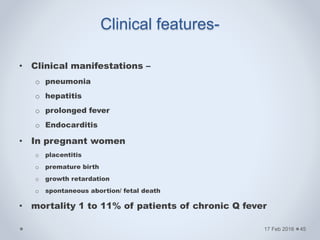
Clinical features-
• Clinical manifestations –
o pneumonia
o hepatitis
o prolonged fever
o Endocarditis
• In pregnant women
o placentitis
o premature birth
o growth retardation
o spontaneous abortion/ fetal death
• mortality 1 to 11% of patients of chronic Q fever
17 Feb 2016 45
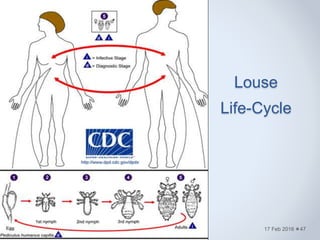
Epidemic Louse Borne
Typhus
17 Feb 2016 46
Louse
Life-Cycle
17 Feb 2016 47
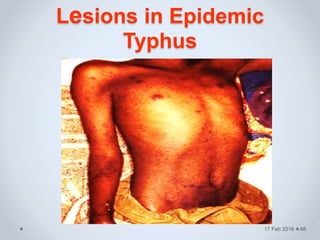
Lesions in Epidemic
Typhus
17 Feb 2016 48
• Presentation-
o Acute febrile illness
o Headache
o Myalgia.
o Neurologic manifestations
o Rash
o Vasculitis
o Gangrene
If Untreated??
high mortality
17 Feb 2016
Epidemic louse-borne typhus
49
• Diagnosis
• -based on clinical suspicion with Serology
• Treatment
• -a single 200-mg dose/ short course of
doxycycline
• Relapses
• -Brill-Zinsser disease -mild
• Control
• -de-lousing & hygiene
17 Feb 2016
Epidemic louse-borne typhus
50
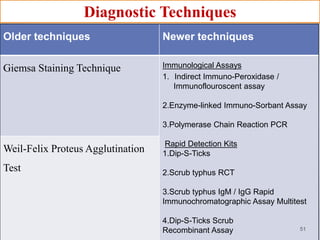
17 Feb 2016
Older techniques Newer techniques
Giemsa Staining Technique Immunological Assays
1. Indirect Immuno-Peroxidase /
Immunoflouroscent assay
2.Enzyme-linked Immuno-Sorbant Assay
3.Polymerase Chain Reaction PCR
Rapid Detection Kits
1.Dip-S-Ticks
2.Scrub typhus RCT
3.Scrub typhus IgM / IgG Rapid
Immunochromatographic Assay Multitest
4.Dip-S-Ticks Scrub
Recombinant Assay
Weil-Felix Proteus Agglutination
Test
Diagnostic Techniques
51
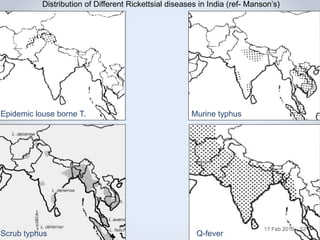
Epidemic louse borne T.
Q-fever
Murine typhus
Scrub typhus
Distribution of Different Rickettsial diseases in India (ref- Manson’s)
17 Feb 2016 52
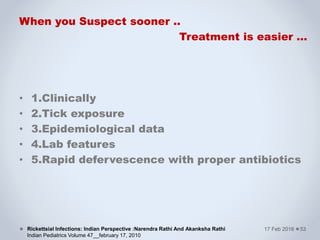
When you Suspect sooner ..
Treatment is easier …
• 1.Clinically
• 2.Tick exposure
• 3.Epidemiological data
• 4.Lab features
• 5.Rapid defervescence with proper antibiotics
17 Feb 2016Rickettsial Infections: Indian Perspective :Narendra Rathi And Akanksha Rathi
Indian Pediatrics Volume 47__february 17, 2010
53
17 Feb 2016 54

Rickettsial diseases seminar 2016

  • 1.
  • 2.
    Epidemiology of Rickettsial Diseases inIndia Presenter- Dr. Mamta Gehlawat Moderator- Dr. Swaroop Kumar Sahu 17 Feb 2016 2
  • 3.
    Presentation Outline- 1.Introduction 2.Individual DiseasesEpidemiology Scrub Typhus Indian Tick Typhus Murine Typhus Q Fever Epidemic Louse borne Typhus Candidatus R. kellyi 3.Diagnostic procedures 4.Prevention & Control 5.Summary 17 Feb 2016 3
  • 4.
    Introduction.. 1. Obligate intracellulargram-negative bacteria 2. Include the genera rickettsiae, ehrlichia, orientia, & coxiella 3. Found in ticks, lice, fleas, mites, chiggers & mammals 17 Feb 2016 http://www.ncbi.nlm.nih.gov/books/NBK7624/ 4
  • 5.
    1. Re-emerging 2. Difficultto diagnose 3. Failure of timely diagnosis – significant morbidity & mortality 17 Feb 2016 Rickettsial Infections: Indian Perspective--Narendra Rathi & Akanksha Rathi. Indian Pediatrics : Feb 2010;47:157 - 164 ..Introduction 5
  • 6.
    17 Feb 2016 GeographicalDistribution Rickettsial Diseases India 6
  • 7.
    Types of RickettsialDiseases 17 Feb 2016 # 7
  • 8.
    Burden.. • 24% ofPUO in South Indian children • 70% cases in June-December 17 Feb 2016 Scrub typhus, 62.8% spotted fever, 32.6% murine typhus, 4.7% Magnitude and Features of Scrub Typhus and Spotted Fever in Children in India J Trop Pediatr (June 2006) 52 (3): 228-229 doi:10.1093/tropej/fmi096 8
  • 9.
    • untreated cases •fatality rates - 30-35 % 17 Feb 2016 ..Burden 9
  • 10.
    Clinical Features ofRickettsial Diseases 17 Feb 2016 10
  • 11.
  • 12.
    Epidemiological Triad –ScrubTyphus 17 Feb 2016 Host-Small animals /Humans Agent Orientia tsutsugamushi Environment-Scrub vegetation Vector-Chigger Trombiculid mite Scrub typhus 12
  • 13.
  • 14.
  • 15.
  • 16.
  • 17.
    Exposure to MiteIslands.. • Highest incidence – o Military soldiers o farmers • Military operations -brush & jungle areas • Epidemics affecting 20% to 50% of the troops 17 Feb 2016 17
  • 18.
    Clinical Features inScrub Typhus 100 54 49 46 43.5 38 26 0 10 20 30 40 50 60 70 80 90 100 fever nausea/vomiting dyspnea headache eschar cough altered sensorium 17 Feb 2016 18
  • 19.
    An Eschar ofScrub Typhus 17 Feb 2016 19
  • 20.
    34 33.7 29.5 23.3 23.1 18 11.4 0 5 1015 20 25 30 35 40 Hepatitis ARDS Invasive Ventilation Meningo-encephalitis Shock Renal Failure CNS dysfunction Complications of Scrub typhus 17 Feb 2016 21
  • 21.
    Mortality Trends 17 Feb2016 14 17.2 14 7.3 7.6 7.6 9 2002-3 2004 2006 2007 2009 2010 2011-14 Mortality(%) 22
  • 22.
  • 23.
  • 24.
  • 25.
    Spotted Fever GroupRickettsioses Members infecting Indians • R.rickettsi • R.conorii • R.australis • R.sibirica • R.japonica • R.honei • R.akari • Candidatus Rickettsia kellyi 17 Feb 2016 28
  • 26.
    Epidemiological Triad-Indian TickTyphus 17 Feb 2016 Host-Small animals /human Agent R.conorii Environment- Vector-Amblyomma tick ITT 29
  • 27.
    Geographical distribution ofSFG Rickettsioses 17 Feb 2016 30
  • 28.
    Geographical Distribution Indian TickTyphus J Vector Borne Dis 51, December 2014, pp. 259–270 17 Feb 2016 31
  • 29.
    Boutonneuse Fever 17 Feb2016 1. clinical presentation = mild - very severe 2. fatality =highly virulent rickettsiae 2–6% 3. clinical signs : I. fever; II. headache; III. rash maculopapular or vesicular; IV.inoculation eschars at site of tick bite; V. localized lymphadenopathy 32
  • 30.
    • Early empiricaltreatment • doxycycline • no vaccines available • Prevention -minimizing exposure to ticks 17 Feb 2016 Indian tick typhus 33
  • 31.
    Prevention • Ticks areprevalent-control is not feasible • No vaccine available • Avoidance of tick bite o Tick repellant o Protective clothing • Regular inspection & removal of ticks from body • Removal of ticks prior to inoculation of rickettsia 17 Feb 2016 34
  • 32.
    Candidatus Rickettsia kellyi •New species • Vector undetermined • Thirupattur ,Tamil Nadu • 2006 • Fever & Maculopapular Lesion • Dramatic recovery with Doxycycline Emerging Infectious Diseases • www.cdc.gov/eid • Vol. 12, No. 3, March 200617 Feb 2016 35
  • 33.
  • 34.
    • Agent -Rickettsiatyphi • Mode - rat and flea population • clinical characteristics: o Fever o Headache o Rash o Systemic inflammatory vasculitis 17 Feb 2016 Murine typhus 37
  • 35.
  • 36.
  • 37.
    Geographical Distribution ofMurine Typhus 17 Feb 2016 40
  • 38.
    • Lab : oliver enzymes elevation, o hypoalbuminemia • Disease outcome: usually favorable • Treatment: doxycycline, chloramphenicol • Prevention: rodent-control programs • Garbage workers –high risk 17 Feb 2016 Murine typhus 41
  • 39.
  • 40.
  • 41.
    Epidemiological Triad –Qfever 17 Feb 2016 Host Cattle/Pets/Human Agent Coxiella burnetti As a spore Environment Aerosol/tick borne/food borne/fomite/ not human to human Q-fever 44
  • 42.
    Clinical features- • Clinicalmanifestations – o pneumonia o hepatitis o prolonged fever o Endocarditis • In pregnant women o placentitis o premature birth o growth retardation o spontaneous abortion/ fetal death • mortality 1 to 11% of patients of chronic Q fever 17 Feb 2016 45
  • 43.
  • 44.
  • 45.
  • 46.
    • Presentation- o Acutefebrile illness o Headache o Myalgia. o Neurologic manifestations o Rash o Vasculitis o Gangrene If Untreated?? high mortality 17 Feb 2016 Epidemic louse-borne typhus 49
  • 47.
    • Diagnosis • -basedon clinical suspicion with Serology • Treatment • -a single 200-mg dose/ short course of doxycycline • Relapses • -Brill-Zinsser disease -mild • Control • -de-lousing & hygiene 17 Feb 2016 Epidemic louse-borne typhus 50
  • 48.
    17 Feb 2016 Oldertechniques Newer techniques Giemsa Staining Technique Immunological Assays 1. Indirect Immuno-Peroxidase / Immunoflouroscent assay 2.Enzyme-linked Immuno-Sorbant Assay 3.Polymerase Chain Reaction PCR Rapid Detection Kits 1.Dip-S-Ticks 2.Scrub typhus RCT 3.Scrub typhus IgM / IgG Rapid Immunochromatographic Assay Multitest 4.Dip-S-Ticks Scrub Recombinant Assay Weil-Felix Proteus Agglutination Test Diagnostic Techniques 51
  • 49.
    Epidemic louse borneT. Q-fever Murine typhus Scrub typhus Distribution of Different Rickettsial diseases in India (ref- Manson’s) 17 Feb 2016 52
  • 50.
    When you Suspectsooner .. Treatment is easier … • 1.Clinically • 2.Tick exposure • 3.Epidemiological data • 4.Lab features • 5.Rapid defervescence with proper antibiotics 17 Feb 2016Rickettsial Infections: Indian Perspective :Narendra Rathi And Akanksha Rathi Indian Pediatrics Volume 47__february 17, 2010 53
  • 51.

Editor's Notes

  • #2 Snapshot taken on 14.2.16 Sunday .why for hp???
  • #3 Howard Ricketts discovered that ticks cause rocky mountain spotted fever RMSF by a mysterious organism…circulated between pigs n mammals.later discovered
  • #4 Time=reported outbreaks and trends….place = World burden v/s india burden …like bharath slide WHO factsheets….
  • #5 In the picture Rickettsia rickettsii (red dots) in the cell of a deer tick…from wikipedia The common threads that hold the rickettsiae into a group are their epidemiology, their obligate intracellular lifestyle, and the laboratory technology required to work with them
  • #6 DD-dengue, Dengue, Kawasaki Disease, Leptospirosis, Malaria, Measles, Meningococcal Infections, Rubella , Streptococcal Infection, Group A, Syphilis, Toxic Shock Syndrome, Vasculitis and Thrombophlebitis measles, rubella, meningococcal infection, malaria, leptospirosis and other viral exanthemslow index of suspicion, nonspecific signs and symptoms, and absence of widely available sensitive and specific diagnosic test, these infections are notoriously difficult to diagnose. As antimicrobials effective for rickettsial disease are usually not included in empirical therapy of nonspecific febrile illnesses, treatment of rickettsial disease is not provided unless they are suspected. Knowledge of geographical distribution, evidence of exposure to vector, clinical features like fever, rash, eschar, headache and myalgia along with high index of suspicion are crucial factors for early diagnosis. The greatest challenge is the difficult diagnostic dilemma posed by these infections early in their clinical course, when antibiotic therapy is most effective. Early signs and symptoms of these illnesses are notoriously nonspecific or mimic benign viral illnesses, making diagnosis difficult http://medind.nic.in/ibv/t10/i2/ibvt10i2p157.pdf
  • #8 #Q fever is excluded from the rickettsiaceae family as it doesn’t have an arthropod vector(ananthanarayan paniker microbiology 2008 edition) Rickettsia are classically classified into 2 groups the SFG and typhus group on the basis of antigenic differences in their cell wall Reference- Tropical Infectious Diseases: Principles, Pathogens and Practice By Richard L. Guerrant, David H. Walker, Peter F. Weller chapter-53-55 commonly reported diseases in India are scrub typhus, murine flea-borne typhus, Indian Tick Typhus and Q fever
  • #9 H. R. Somashekar,  Prabhakar D. Moses,  Sreeja Pavithran,  Leni Grace Mathew, Indira Agarwal,  Jean Marc Rolain,  Didier Raoult,  George M. Varghese,  and Elizabeth Mathai Magnitude and Features of Scrub Typhus and Spotted Fever in Children in India J Trop Pediatr (June 2006) 52 (3): 228-229 doi:10.1093/tropej/fmi096 Done by cmc
  • #10 Spotted fevers & typhus fever in Tamil Nadu Indian J Med Res 126, August 2007, pp 101-103
  • #11 Nicd.nic.in Common clinical manifestations of ????scrub typhus
  • #13 Vaidya VM, Malik SVS, Kaur S, Kumar S, Barbuddhe SB. Comparison of PCR, immunoflorescence assay, and pathogen isolation for diagnosis of Q fever in humans with spontaneous abortions. J Clin Microbiol 2008; 46:2038-2044. C. burnetii infection of pregnant women can provoke placentitis and often lead to premature birth, growth retardation, spontaneous abortion, or fetal death (29). The disease is usually benign, but mortality occurs in 1 to 11% of patients with chronic Q fever
  • #14 The bite caused by a "strikingly big" engorged tick was almost uniformly located on the occipital scalp region. The infection occurred most commonly in young children: the larger half of the patients were less than 10 years of age.
  • #16 Insecticides have been used to control chiggers, both in high-risk habitats and on blankets and clothes, but neither are currently practical in rural Asia for farmers (who are at most risk of scrub typhus). For short-term adult visitors, weekly 200 mg doxycycline reduces the risk of contracting scrub typhus. There is currently no safe and effective vaccine available.
  • #17 Chiggers article. Dangerous bug
  • #18 Figure. The locations of typical eschars in 2 representative patients with scrub typhus. A) An eschar on the neck of a patient (03PE1). B) An eschar on the waist of a patient... Orientia tsutsugamushi in Eschars from Scrub Typhus Patients Yun-Xi Liu*, Wu-Chun Cao* , Yuan Gao†, Jing-Lan Zhang†, Zhan-Qing Yang†, Zhong-Tang Zhao‡, and Janet Foley§ Author affiliations: *Beijing Institute of Microbiology and Epidemiology, Beijing, People's Republic of China;†Center for Disease Control and Prevention of Jinan, Jinan, People's Republic of China; ‡Shandong University, Jinan, People's Republic of China; §University of California, Davis, Davis, California, USA http://wwwnc.cdc.gov/eid/article/12/7/05-0827_article ONE OUTBREAK OF SCRUB TYPHUS REPORTED BETWEEN 2008-2014 IDSP-DIAGNOSIS OF SCRUB TYPHUS BY ELISA
  • #19 Clinical profile and improving mortality trend of scrub typhus in South India.cmc International Journal of Infectious Diseases Volume 23, June 2014, Pages 39–43
  • #20  A patient with fever, headache, and myalgia with an eschar in an endemic area is likely to have scrub typhus. The incubation period is approximately 6–14 days. Ten to fifty percent of patients may have an eschar – this variability probably reflects, atleast in part, the extent to which patients are examined. Eschars, which are usually single and in secluded areas such as the axilla and groin, are painless, erythematous papules that develop a central black scab, resembling a cigarette burn (Fig. 63.3). They are not pathognomonic for scrub typhus, as similar lesions may be produced by spotted fever group rickettsioses. Chiggers are minute and, unlike ticks, are not normally noticed. Patients may scratch off the characteristic black scab. Lymphadenopathy is more frequent than in sympatric murine typhus [2]. Headache, myalgia, and dry cough frequently occur; a maculopapular erythematous rash occurs in a minority of patients [1,2]. Deafness, tinnitus, and conjunctival suffusion occur. Severe disease can manifest as pneumonitis, acute respiratory distress syndrome, jaundice with mildly raised transaminases, meningoencephalitis,coagulopathy, multi-organ failure, acute renal failure, acute transverse myelitis, myocarditis, and Guillain-Barré syndrome. Why some, and not others, develop severe disease is not understood. Mortality is positively correlated with blood bacterial load [5]. Orientia tsutsugamushi DNA has been demonstrated in cerebrospinal fluid (CSF), with normal glucose, a mild increase in white cell density (ranging from 11–88% lymphocytes) and raised protein [7]. Scrub typhus appears to be less severe in children, but there have been no prospective comparisons between children and adults from the same population. Scrub typhus can cause serious adverse effects for mother and baby in pregnancy [8]. The majority of scrub typhus patients are not diagnosed or treated. The differential diagnosis would include spotted fever group rickettsiosis, which would also be expected to respond to tetracyclines. Scrub typhus eschars could be confused with the lesions of anthrax, tularemia, chancroid, lymphogranuloma venereum, and injury. In the absence of an eschar, few clinical features are helpful. Murine typhus, leptospirosis, Q fever, dengue, hemorrhagic fever with renal syndrome (HFRS), infectious mononucleosis, HIV seroconversion, septicemia (especially typhoid), and malaria are important differential diagnoses . Laboratory diagnosis of scrub typhus is difficult. Culture (requiring BSL3 facilities) is 100% specific, but has low sensitivity. Immunofluorescence (IFA) and immunoperoxidase IgM and IgG antibody tests have been commonly used, but these are expensive, rarely accessible and are bedevilled by subjectivity of interpretation and uncertainty as to the most appropriate cut-off titers in different communities [10]. Ideally, they should be interpreted by comparing titers between paired acute and convalescent samples , The Weil-Felix OXK test is still commonly used in Asia, but has low sensitivity. Conventional and quantitative realtime PCR assays for the detection of O. tsutsugamushi in blood, eschar tissue, and CSF have been developed [11, 12]. However, there remain great difficulties in the accessibility of the diagnosis of scrub typhus in rural endemic areas. Mixed infections may occur with, for example, leptospirosis but, given the persistence of antibodies, distinguishing these from serial infections without culture or PCR techniques is difficult. Given the difficulties of making a timely laboratory diagnosis and the significant minority who develop severe disease, empirical treatment should be considered for all cases with scrub typhus in the differential diagnosis. The diversity of O. tsutsugamushi suggests it is unlikely that one treatment regimen will be appropriate across the wide distribution of this organism. Chloramphenicol- and doxycycline-resistant scrub typhus have been described in northern Thailand [13], but there are no subsequent published data on this clinical problem. Given the difficulties of making a timely laboratory diagnosis and the significant minority who develop severe disease, empirical treatment should be considered for all cases with scrub typhus in the differential diagnosis. The diversity of O. tsutsugamushi suggests it is unlikely that one treatment regimen will be appropriate across the wide distribution of this organism. Chloramphenicol- and doxycycline-resistant scrub typhus have been described in northern Thailand [13], but there are no subsequent published data on this clinical problem. There are few data to guide the antibiotic treatment of severe disease – parenteral or nasogastric doxycycline or chloramphenicol are potential options. Appropriate supportive care is essential. The treatment of scrub typhus in pregnancy is problematic – chloramphenicol (although contraindicated in the last trimester), azithromycin, and rifampicin have been used. In children, the risks of short-course doxycycline are almost certainly exceeded by the benefit of effective cure. In a retrospective analysis of children with scrub typhus, no significant differences in fever clearance times were found between doxycycline, chloramphenicol, or roxithromycin therapy [21]. Mortality is very variable, ranging from 0–60% in untreated patients, for reasons that are unclear. Delayed administration of doxycycline has been associated with major organ dysfunction and prolonged
  • #21 Jipmer case classical eschar December 2013 with a history of fever, body aches, and headache since last 15 days. He reported no localizing symptoms. There was no icterus or lymphadenopathy. An eschar was noted on the upper abdomen (Figure). A faint blanching erythema was also apparent on the trunk and proximal limbs
  • #22 Clinical profile and improving mortality trend of scrub typhus in South India.cmc ,,MODS in34% International Journal of Infectious Diseases Volume 23, June 2014, Pages 39–43
  • #23 Clinical profile and improving mortality trend of scrub typhus in South India.cmc ,,MODS in34% International Journal of Infectious Diseases Volume 23, June 2014, Pages 39–43
  • #25 cdc
  • #27 increasing trend in proportion of scrub typhus cases to overall admissions from 1% to 2.2% over four year period (2011-2014). More cases were admitted between the months of September and January.
  • #29 In south american countries,40% pts suspected of dengue but lacking dengue antibodies were diagnosed with SFG rickettsioses In areas with amblyomma species ticks-antibodies against SFG group are very common in africa
  • #30 Vaidya VM, Malik SVS, Kaur S, Kumar S, Barbuddhe SB. Comparison of PCR, immunoflorescence assay, and pathogen isolation for diagnosis of Q fever in humans with spontaneous abortions. J Clin Microbiol 2008; 46:2038-2044. C. burnetii infection of pregnant women can provoke placentitis and often lead to premature birth, growth retardation, spontaneous abortion, or fetal death (29). The disease is usually benign, but mortality occurs in 1 to 11% of patients with chronic Q fever
  • #31 hunter’s book
  • #32 J Vector Borne Dis 51, December 2014, pp. 259–270J Vector Borne Dis 51, December 2014, pp. 259–270 Problem of ticks and tick-borne diseases in India with special emphasis on progress in tick control research: A review Srikant Ghosh & Gaurav Nagar
  • #36 Cmc 2006
  • #38 Synonyms: flea-borne typhus, endemic typhus Xenopsylla chaeopsis Disease outcome: usually favorable – low rate of complications and mortality
  • #41 World Health Organization (WHO). 1989. Geographical distribution of arthropod-borne diseases and their principal vectors
  • #45 Vaidya VM, Malik SVS, Kaur S, Kumar S, Barbuddhe SB. Comparison of PCR, immunoflorescence assay, and pathogen isolation for diagnosis of Q fever in humans with spontaneous abortions. J Clin Microbiol 2008; 46:2038-2044. C. burnetii infection of pregnant women can provoke placentitis and often lead to premature birth, growth retardation, spontaneous abortion, or fetal death (29). The disease is usually benign, but mortality occurs in 1 to 11% of patients with chronic Q fever
  • #46 The disease is usually benign, chronic Q fever Raoult, D. 1990. Host factors in the severity of Q fever. Ann. N. Y. Acad. Sci. 590:33-38.
  • #48 R. prowazekii requires an arthropod vector to infect the human host. In this case, the vector is the body louse, Pediculus humanus humanus (more commonly known as Pediculus humanus corporis):
  • #50 gangrene of extremities , Untreated cases,
  • #52 The poor sensitivity and low specificityof the Weil-Felix test is,PCR also low sensitivity .IgM Elisa now well demonstrated for the diagnosis of Rocky mountain spotted fever (RMSF)10-13 MSF14, murine typhus, epidemic typhus15 and scrub typhus16. Although a good correlation between the results of the Weil-Felix test and detection of IgM antibodies by an IFA is often observed, with the development of techniques that are used to grow rickettsiae, this test should be used only as a first line of testing in rudimentary hospital laboratories. the Weil Felix test still serves as a useful and cheapest available tool for the laboratory diagnosis of rickettsial diseases. A four-fold rise in agglutinin titres in paired sera is diagnostic for infection with these febrile agents.
  • #54 Complications-respiratory,neurological,renal,disseminated intravascular coagulation