The ‘Lousy’ Problem
Dr. Dona Banerjee
DCH, MD.
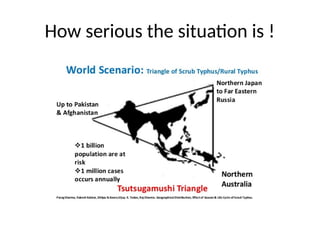
How serious the situation is !
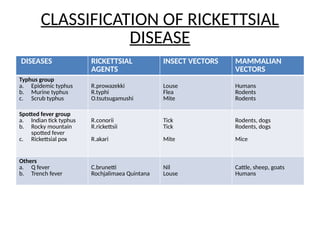
CLASSIFICATION OF RICKETTSIAL
DISEASE
DISEASES RICKETTSIAL
AGENTS
INSECT VECTORS MAMMALIAN
VECTORS
Typhus group
a. Epidemic typhus
b. Murine typhus
c. Scrub typhus
R.prowazekki
R.typhi
O.tsutsugamushi
Louse
Flea
Mite
Humans
Rodents
Rodents
Spotted fever group
a. Indian tick typhus
b. Rocky mountain
spotted fever
c. Rickettsial pox
R.conorii
R.rickettsii
R.akari
Tick
Tick
Mite
Rodents, dogs
Rodents, dogs
Mice
Others
a. Q fever
b. Trench fever
C.brunetti
Rochjalimaea Quintana
Nil
Louse
Cattle, sheep, goats
Humans
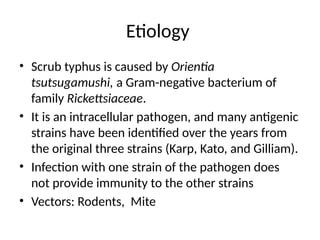
Etiology
• Scrub typhus is caused by Orientia
tsutsugamushi, a Gram-negative bacterium of
family Rickettsiaceae.
• It is an intracellular pathogen, and many antigenic
strains have been identified over the years from
the original three strains (Karp, Kato, and Gilliam).
• Infection with one strain of the pathogen does
not provide immunity to the other strains
• Vectors: Rodents, Mite
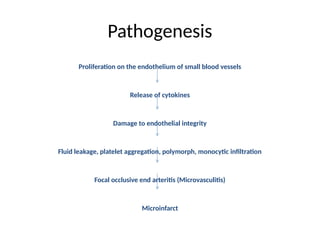
Pathogenesis
Proliferation on the endothelium of small blood vessels
Release of cytokines
Damage to endothelial integrity
Fluid leakage, platelet aggregation, polymorph, monocytic infiltration
Focal occlusive end arteritis (Microvasculitis)
Microinfarct
CASE DEFINITIONS
• Suspected case: A patient having compatible clinical
scenario, suggestive epidemiological features and
absence of definite alternative diagnosis should be
termed as a suspected case of rickettsia. Definition
of ‘compatible clinical scenario’ and ‘suggestive
epidemiological features’ and list of differential
diagnosis is provided in Box 1, 2 and 3, respectively.
Alternative diagnosis can be searched from (but not
limited to) the list of differential diagnoses
BOX 1 Compatible Clinical Scenario for Rickettsial Infection
One or more of the following:
• Undifferentiated fever of more than 5 days.
• Sepsis of unclear etiology.
• Fever with rash.
• Fever with edema.
• Dengue-like disease.
• Fever with headache and myalgia.
• Fever with hepatosplenomegaly and / or lymphadenopathy.
• Aseptic meningitis / meningoencephalitis / acute encephalitic
syndrome.
• Fever with cough and pulmonary infiltrates or community acquired
pneumonia.
• Fever with acute kidney injury.
• Fever with acute gastrointestinal or hepatic involvement.
BOX 2 Suggestive Epidemiological Features for Rickettsial Infections
One or more of the following within 14 days of illness onset:
• Tick bite.
• Ticks seen on clothes or in and around homes or in areas where
children play
• Visit to areas which are common habitats of vectors like high uncut
grass or weeds or bushes or rice fields or woodlands (where rodents
share habitats with animals) or grassy lawns or river banks or poorly
maintained kitchen gardens.
• Animal sheds in proximity of homes.
• Contact with pet or stray dog infested with ticks.
• Living in or travel to areas endemic for rickettsial diseases.
• Occurrence of similar clinical cases simultaneously or sequentially
in family members, coworkers, neighbourhood or pets.
• Exposure to rodents.
BOX 3 Differential Diagnoses For Rickettsial Infections*
• Viral diseases: enteroviral diseases, measles, dengue
fever, chikungunya, infectious mononucleosis.
• Bacterial diseases: meningococcemia, leptospirosis,
typhoid fever, scarlet fever, secondary syphilis, infective
endocarditis.
• Protozoal diseases: malaria.
• Vasculitis: Kawasaki disease, thrombotic
thrombocytopenic purpura.
• Adverse drug reactions.
• Differential diagnoses pertaining to each systemic
presentation.
* Not an exhaustive list.
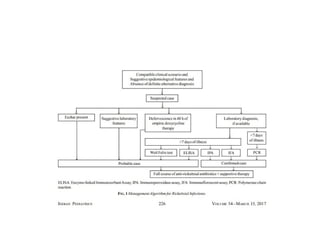
• Probable case: Suspected case having either
eschar, or having rapid (<48 hours)
defervescence with anti-rickettsial therapy, or
having suggestive laboratory features (Box 4),
or having Weil-Felix test positive with titre of
1:80 or more in OX2, OX19 or OXK or positive
IgM ELISA for rickettsia (optical density >0.5).
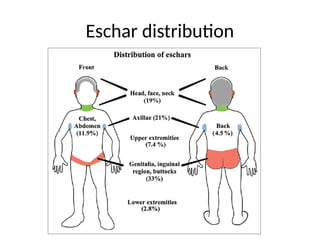
Eschar distribution
BOX 4 Suggestive Laboratory Features For Rickettsial
Infections
• Normal to low total leukocyte count with a shift to
left in early stages and leukocytosis later on
• Thrombocytopenia
• Raised ESR and CRP
• Hyponatremia
• Hypoalbuminemia and
• Elevated hepatic transaminases.
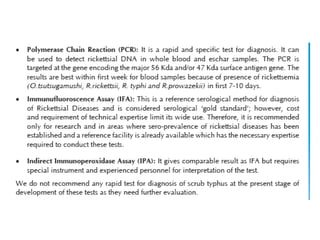
• Confirmed case: Suspected case having
rickettsial DNA detected in whole blood or tissue
samples, or fourfold rise in antibody titres on
acute and convalescent sera detected by
immunofluorescence assay (IFA) or immuno-
peroxidase assay (IPA) [8]. In countries like India,
where PCR and IFA are not commonly available,
properly performed paired serological tests like
ELISA have high positive predictive value
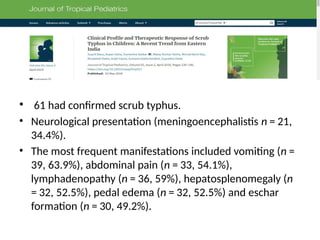
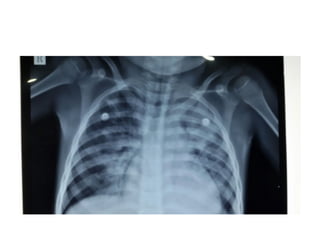
• 61 had confirmed scrub typhus.
• Neurological presentation (meningoencephalistis n = 21,
34.4%).
• The most frequent manifestations included vomiting (n =
39, 63.9%), abdominal pain (n = 33, 54.1%),
lymphadenopathy (n = 36, 59%), hepatosplenomegaly (n
= 32, 52.5%), pedal edema (n = 32, 52.5%) and eschar
formation (n = 30, 49.2%).
Diagnosis
• Weil-felix test…
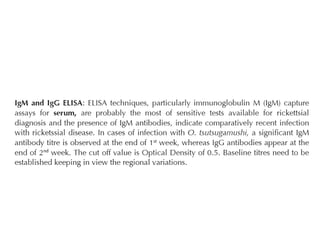
• Scrub typhus IGM…
• Immunofloroscence assay(IFA)
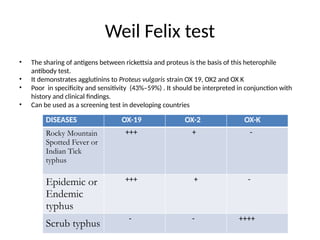
Weil Felix test
• The sharing of antigens between rickettsia and proteus is the basis of this heterophile
antibody test.
• It demonstrates agglutinins to Proteus vulgaris strain OX 19, OX2 and OX K
• Poor in specificity and sensitivity (43%–59%) . It should be interpreted in conjunction with
history and clinical findings.
• Can be used as a screening test in developing countries
DISEASES OX-19 OX-2 OX-K
Rocky Mountain
Spotted Fever or
Indian Tick
typhus
+++ + -
Epidemic or
Endemic
typhus
+++ + -
Scrub typhus
- - ++++
Treatment
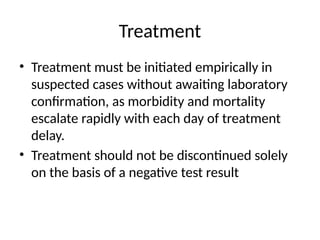
• Treatment must be initiated empirically in
suspected cases without awaiting laboratory
confirmation, as morbidity and mortality
escalate rapidly with each day of treatment
delay.
• Treatment should not be discontinued solely
on the basis of a negative test result
Highlights….
Acute febrile illness caused by Orientia
tsutsugamushi and spread by the bite of the
larval form of the trombiculid mite.
• It is one of the differential diagnoses to be
considered in a child presenting with acute
undifferentiated fever.
• A painless eschar, enlarged liver or spleen, and
thrombocytopenia are pointers towards the
possibility of scrub typhus
• If scrub typhus is endemic to the locality, it is
important to search for an eschar, especially in the
folds of the axilla, neck, and groin.
• Weil–Felix test has poor sensitivity. Scrub typhus IgM
by ELISA is useful for confirmatory diagnosis, but is
useful only after 5–7 days following onset of illness.
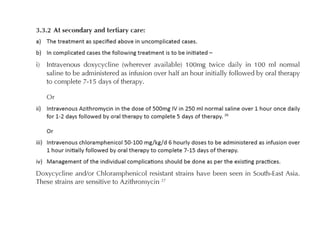
• Treatment: Doxycycline (4.5 mg/kg/day in two divided
doses up to a maximum of 100 mg twice daily for 7–
14 days). Alternatives are azithromycin or
chloramphenicol.
Take home message…
• Rickettsial diseases are present in India and in
our state also..
• Suspect Rickettsia early in cases of PUO.
• Any PUO of infectious etiology, more than 7
days, negative for Malaria, dengue ,Typhoid and
especially if the patient is from rural or
suburban areas, with features of multiorgan
dysfunction ,it should be taken as a rickettsia
unless proved otherwise.

Scrub typhus or Lousy Problem in Children.pptx

  • 1.
    The ‘Lousy’ Problem Dr.Dona Banerjee DCH, MD.
  • 2.
    How serious thesituation is !
  • 3.
    CLASSIFICATION OF RICKETTSIAL DISEASE DISEASESRICKETTSIAL AGENTS INSECT VECTORS MAMMALIAN VECTORS Typhus group a. Epidemic typhus b. Murine typhus c. Scrub typhus R.prowazekki R.typhi O.tsutsugamushi Louse Flea Mite Humans Rodents Rodents Spotted fever group a. Indian tick typhus b. Rocky mountain spotted fever c. Rickettsial pox R.conorii R.rickettsii R.akari Tick Tick Mite Rodents, dogs Rodents, dogs Mice Others a. Q fever b. Trench fever C.brunetti Rochjalimaea Quintana Nil Louse Cattle, sheep, goats Humans
  • 4.
    Etiology • Scrub typhusis caused by Orientia tsutsugamushi, a Gram-negative bacterium of family Rickettsiaceae. • It is an intracellular pathogen, and many antigenic strains have been identified over the years from the original three strains (Karp, Kato, and Gilliam). • Infection with one strain of the pathogen does not provide immunity to the other strains • Vectors: Rodents, Mite
  • 5.
    Pathogenesis Proliferation on theendothelium of small blood vessels Release of cytokines Damage to endothelial integrity Fluid leakage, platelet aggregation, polymorph, monocytic infiltration Focal occlusive end arteritis (Microvasculitis) Microinfarct
  • 6.
    CASE DEFINITIONS • Suspectedcase: A patient having compatible clinical scenario, suggestive epidemiological features and absence of definite alternative diagnosis should be termed as a suspected case of rickettsia. Definition of ‘compatible clinical scenario’ and ‘suggestive epidemiological features’ and list of differential diagnosis is provided in Box 1, 2 and 3, respectively. Alternative diagnosis can be searched from (but not limited to) the list of differential diagnoses
  • 7.
    BOX 1 CompatibleClinical Scenario for Rickettsial Infection One or more of the following: • Undifferentiated fever of more than 5 days. • Sepsis of unclear etiology. • Fever with rash. • Fever with edema. • Dengue-like disease. • Fever with headache and myalgia. • Fever with hepatosplenomegaly and / or lymphadenopathy. • Aseptic meningitis / meningoencephalitis / acute encephalitic syndrome. • Fever with cough and pulmonary infiltrates or community acquired pneumonia. • Fever with acute kidney injury. • Fever with acute gastrointestinal or hepatic involvement.
  • 8.
    BOX 2 SuggestiveEpidemiological Features for Rickettsial Infections One or more of the following within 14 days of illness onset: • Tick bite. • Ticks seen on clothes or in and around homes or in areas where children play • Visit to areas which are common habitats of vectors like high uncut grass or weeds or bushes or rice fields or woodlands (where rodents share habitats with animals) or grassy lawns or river banks or poorly maintained kitchen gardens. • Animal sheds in proximity of homes. • Contact with pet or stray dog infested with ticks. • Living in or travel to areas endemic for rickettsial diseases. • Occurrence of similar clinical cases simultaneously or sequentially in family members, coworkers, neighbourhood or pets. • Exposure to rodents.
  • 9.
    BOX 3 DifferentialDiagnoses For Rickettsial Infections* • Viral diseases: enteroviral diseases, measles, dengue fever, chikungunya, infectious mononucleosis. • Bacterial diseases: meningococcemia, leptospirosis, typhoid fever, scarlet fever, secondary syphilis, infective endocarditis. • Protozoal diseases: malaria. • Vasculitis: Kawasaki disease, thrombotic thrombocytopenic purpura. • Adverse drug reactions. • Differential diagnoses pertaining to each systemic presentation. * Not an exhaustive list.
  • 10.
    • Probable case:Suspected case having either eschar, or having rapid (<48 hours) defervescence with anti-rickettsial therapy, or having suggestive laboratory features (Box 4), or having Weil-Felix test positive with titre of 1:80 or more in OX2, OX19 or OXK or positive IgM ELISA for rickettsia (optical density >0.5).
  • 11.
  • 12.
    BOX 4 SuggestiveLaboratory Features For Rickettsial Infections • Normal to low total leukocyte count with a shift to left in early stages and leukocytosis later on • Thrombocytopenia • Raised ESR and CRP • Hyponatremia • Hypoalbuminemia and • Elevated hepatic transaminases.
  • 13.
    • Confirmed case:Suspected case having rickettsial DNA detected in whole blood or tissue samples, or fourfold rise in antibody titres on acute and convalescent sera detected by immunofluorescence assay (IFA) or immuno- peroxidase assay (IPA) [8]. In countries like India, where PCR and IFA are not commonly available, properly performed paired serological tests like ELISA have high positive predictive value
  • 14.
    • 61 hadconfirmed scrub typhus. • Neurological presentation (meningoencephalistis n = 21, 34.4%). • The most frequent manifestations included vomiting (n = 39, 63.9%), abdominal pain (n = 33, 54.1%), lymphadenopathy (n = 36, 59%), hepatosplenomegaly (n = 32, 52.5%), pedal edema (n = 32, 52.5%) and eschar formation (n = 30, 49.2%).
  • 19.
    Diagnosis • Weil-felix test… •Scrub typhus IGM… • Immunofloroscence assay(IFA)
  • 20.
    Weil Felix test •The sharing of antigens between rickettsia and proteus is the basis of this heterophile antibody test. • It demonstrates agglutinins to Proteus vulgaris strain OX 19, OX2 and OX K • Poor in specificity and sensitivity (43%–59%) . It should be interpreted in conjunction with history and clinical findings. • Can be used as a screening test in developing countries DISEASES OX-19 OX-2 OX-K Rocky Mountain Spotted Fever or Indian Tick typhus +++ + - Epidemic or Endemic typhus +++ + - Scrub typhus - - ++++
  • 24.
    Treatment • Treatment mustbe initiated empirically in suspected cases without awaiting laboratory confirmation, as morbidity and mortality escalate rapidly with each day of treatment delay. • Treatment should not be discontinued solely on the basis of a negative test result
  • 27.
    Highlights…. Acute febrile illnesscaused by Orientia tsutsugamushi and spread by the bite of the larval form of the trombiculid mite. • It is one of the differential diagnoses to be considered in a child presenting with acute undifferentiated fever. • A painless eschar, enlarged liver or spleen, and thrombocytopenia are pointers towards the possibility of scrub typhus
  • 28.
    • If scrubtyphus is endemic to the locality, it is important to search for an eschar, especially in the folds of the axilla, neck, and groin. • Weil–Felix test has poor sensitivity. Scrub typhus IgM by ELISA is useful for confirmatory diagnosis, but is useful only after 5–7 days following onset of illness. • Treatment: Doxycycline (4.5 mg/kg/day in two divided doses up to a maximum of 100 mg twice daily for 7– 14 days). Alternatives are azithromycin or chloramphenicol.
  • 29.
    Take home message… •Rickettsial diseases are present in India and in our state also.. • Suspect Rickettsia early in cases of PUO. • Any PUO of infectious etiology, more than 7 days, negative for Malaria, dengue ,Typhoid and especially if the patient is from rural or suburban areas, with features of multiorgan dysfunction ,it should be taken as a rickettsia unless proved otherwise.