
Myeloproliferative/Myeloproliferative/
MyelodysplasticMyelodysplastic
Dr. Rafi Ahmed GhoriDr. Rafi Ahmed Ghori
Professor MedicineProfessor Medicine
Liaquat University of Medical &Liaquat University of Medical &
Health Sciences, JamshoroHealth Sciences, Jamshoro
BIKHABIKHA
Myeloproliferative DisordersMyeloproliferative Disorders
Chronic Myelocytic LeukemiaChronic Myelocytic Leukemia
Acute Non-Lymphoblastic LeukemiaAcute Non-Lymphoblastic Leukemia
Polycythemia VeraPolycythemia Vera
Essential ThrombocythemiaEssential Thrombocythemia
MyelofibrosisMyelofibrosis
Rafi
BIKHABIKHARafi
BIKHABIKHA
Essential ThrombocythemiaEssential Thrombocythemia
clonal myeloproliferative disorderclonal myeloproliferative disorder
involving increased megakaryopoiesisinvolving increased megakaryopoiesis
Diagnostic criteriaDiagnostic criteria
– platelet count over 600,000platelet count over 600,000
– hemoglobin less than 13.0 g/dL or a normalhemoglobin less than 13.0 g/dL or a normal
redcell massredcell mass
– stainable iron or failure of iron therapystainable iron or failure of iron therapy
– No Ph’ chromosome, no marrow fibrosis,No Ph’ chromosome, no marrow fibrosis,
splenomegaly, leukoerythroblastic reaction orsplenomegaly, leukoerythroblastic reaction or
cause for reactive thrombocytosiscause for reactive thrombocytosis
Rafi
BIKHABIKHA
Essential ThrombocythemiaEssential Thrombocythemia
Peripheral bloodPeripheral blood
• thrombocytosis - variation in size andthrombocytosis - variation in size and
shapeshape
• increased segmented neutrophils withoutincreased segmented neutrophils without
basophiliabasophilia
• RBC normocytic/normochromic unlessRBC normocytic/normochromic unless
complicated by iron deficiencycomplicated by iron deficiency
Rafi
BIKHABIKHA
Essential ThrombocythemiaEssential Thrombocythemia
Bone marrowBone marrow
• Hypercellularity with increasedHypercellularity with increased
megakaryocytic elements showingmegakaryocytic elements showing
clustering and increased sizeclustering and increased size
Therapy and prognosisTherapy and prognosis
• relative long survivalrelative long survival
• thromboemboic or hemorrhagicthromboemboic or hemorrhagic
complicationscomplications
Rafi
BIKHABIKHA
Agnogenic Myeloid MetaplasiaAgnogenic Myeloid Metaplasia
(Myelofibrosis)(Myelofibrosis)
Clonal ineffective hematopoiesisClonal ineffective hematopoiesis
manifesting marrow hypercellularity andmanifesting marrow hypercellularity and
fibrosis with myeloerythroblastosis infibrosis with myeloerythroblastosis in
the peripheral blood - Causes pg 378the peripheral blood - Causes pg 378
Fibrosis is secondary to increasedFibrosis is secondary to increased
release of fibroblastic growth factorsrelease of fibroblastic growth factors
Production of extramedullaryProduction of extramedullary
hematopoiesishematopoiesis
Rafi
BIKHABIKHA
Agnogenic Myeloid MetaplasiaAgnogenic Myeloid Metaplasia
(Myelofibrosis)(Myelofibrosis)
Age 50 - 70Age 50 - 70
Clinical featuresClinical features
• splenomegaly - hepatomegalysplenomegaly - hepatomegaly
• anemiaanemia
• bleedingbleeding
• bone painbone pain
• night sweatsnight sweats
Rafi
BIKHABIKHA
Agnogenic Myeloid MetaplasiaAgnogenic Myeloid Metaplasia
(Myelofibrosis)(Myelofibrosis)
Peripheral bloodPeripheral blood
• leukoerythroblastic blood pictureleukoerythroblastic blood picture
• may have abnormal neutrophil functionsmay have abnormal neutrophil functions
• RBC poikilocytosis with tear dropsRBC poikilocytosis with tear drops
• platelets decreased, normal or increasedplatelets decreased, normal or increased
and may have abnormal functionand may have abnormal function
Bone marrowBone marrow
• hypercellularhypercellular
• dyspoiesisdyspoiesis
Rafi
BIKHABIKHA
Agnogenic Myeloid MetaplasiaAgnogenic Myeloid Metaplasia
(Myelofibrosis)(Myelofibrosis)
Radiologic osteosclerosisRadiologic osteosclerosis
Immunological abnormalitiesImmunological abnormalities
PrognosisPrognosis
• mean survival is 5 yearsmean survival is 5 years
• mortality associated with infection,mortality associated with infection,
hemorrhage, and transformation to acutehemorrhage, and transformation to acute
leukemialeukemia
Rafi
BIKHABIKHA
PolycythemiaPolycythemia
Increase in absolute red cell massIncrease in absolute red cell mass
measure with Crmeasure with Cr5151
Relative polycythemiaRelative polycythemia
• decreased plasma volumedecreased plasma volume
• spurious, stress, Gaisbocks diseasespurious, stress, Gaisbocks disease
Primary polycythemiaPrimary polycythemia
Secondary polycythemiaSecondary polycythemia
• physiologically appropriatephysiologically appropriate
• physiologically inappropriatephysiologically inappropriate Rafi
BIKHABIKHA
PolycythemiaPolycythemia
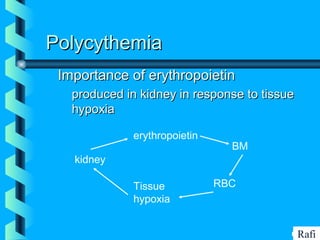
Importance of erythropoietinImportance of erythropoietin
• produced in kidney in response to tissueproduced in kidney in response to tissue
hypoxiahypoxia
erythropoietin
BM
RBCTissue
hypoxia
kidney
Rafi
BIKHABIKHA
PolycythemiaPolycythemia
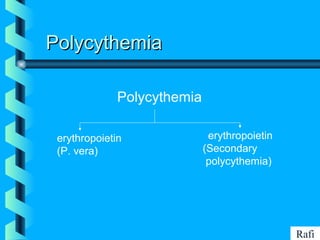
Polycythemia
erythropoietin
(P. vera)
erythropoietin
(Secondary
polycythemia)
Rafi
BIKHABIKHA
Polycythemia veraPolycythemia vera
One of the group of myeloproliferativeOne of the group of myeloproliferative
diseases - group of diseases of bonediseases - group of diseases of bone
marrow proliferationmarrow proliferation
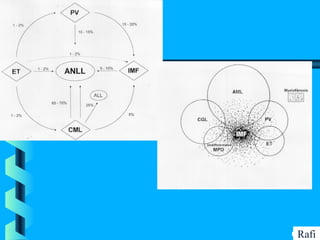
Myeloproliferative DisordersMyeloproliferative Disorders
• RBC - P. vera - DiGuglielmo’sRBC - P. vera - DiGuglielmo’s
• fibrotic - myelofibrosis ( agnogenic myeloidfibrotic - myelofibrosis ( agnogenic myeloid
metaplasiametaplasia
• WBC - chronic myelocytic - acuteWBC - chronic myelocytic - acute
myeloblasticmyeloblastic
• Platelets - Primary thrombocythemiaPlatelets - Primary thrombocythemia Rafi
BIKHABIKHA
Polycythemia veraPolycythemia vera
Diagnosis of P. veraDiagnosis of P. vera
• generally over age 50 - ruddy complextiongenerally over age 50 - ruddy complextion
• All 3 A criteria or A1 and A2 plus 2 BAll 3 A criteria or A1 and A2 plus 2 B
criteriacriteria
– A1. Increased red cell massA1. Increased red cell mass
– A2. OA2. O22 saturation normalsaturation normal
– A3. SpenomegalyA3. Spenomegaly
Rafi
BIKHABIKHA
Polycythemia veraPolycythemia vera
Diagnosis of P. veraDiagnosis of P. vera
• B1. Leukocytosis - left shift - increasedB1. Leukocytosis - left shift - increased
basophilsbasophils
• B2. Thrombocytosis (abnormal)B2. Thrombocytosis (abnormal)
• B3. Increased LAPB3. Increased LAP
• B4. Increased vit BB4. Increased vit B1212 or unbond Bor unbond B1212 bindingbinding
capacitycapacity
Rafi
BIKHABIKHA
Polycythemia veraPolycythemia vera
Diagnosis of P. veraDiagnosis of P. vera
• May have enlarged liverMay have enlarged liver
• 75% have enlarged spleen75% have enlarged spleen
• May have itching (basophils)May have itching (basophils)
• may have increased uric acid (gout)may have increased uric acid (gout)
• 30-40% have bleeding or thrombosis30-40% have bleeding or thrombosis
• 15% progress to AML15% progress to AML
• life span 11 - 13 years after diagnosislife span 11 - 13 years after diagnosis
• treatment - phlebotomy - thentreatment - phlebotomy - then
chemotherapy - radiation for high platelets.chemotherapy - radiation for high platelets. Rafi
BIKHABIKHA
Secondary PolycythemiaSecondary Polycythemia
Physiologically appropriatePhysiologically appropriate
• decreased Odecreased O22 saturationsaturation
• high altitude, chronic obstructivehigh altitude, chronic obstructive
pulmonary disease, heart shunt disorders,pulmonary disease, heart shunt disorders,
hemoglobinopathies, smokers,hemoglobinopathies, smokers,
emphasema, carboxyhemoglobinemphasema, carboxyhemoglobin
Rafi
BIKHABIKHA
Secondary PolycythemiaSecondary Polycythemia
Physiologically inappropriatePhysiologically inappropriate
• normal or increased Onormal or increased O22 saturationsaturation
• tumors producing erythropoietin (renal,tumors producing erythropoietin (renal,
liver, adrenal, uterine fibroid) renal causesliver, adrenal, uterine fibroid) renal causes
(cysts, hydronephrosis, transplantation,(cysts, hydronephrosis, transplantation,
nephrotic syndrome pheochromocytoma)nephrotic syndrome pheochromocytoma)
familialfamilial
Rafi
BIKHABIKHA
Myelodysplastic syndromesMyelodysplastic syndromes
Defect in “colony forming unit” whichDefect in “colony forming unit” which
results in abnormal production andresults in abnormal production and
maturation of all three marrow cell linesmaturation of all three marrow cell lines
Morphologically falls short of acuteMorphologically falls short of acute
nonlymphoblastic leukemianonlymphoblastic leukemia
5 subgroups5 subgroups
Rafi
BIKHABIKHA
Myelodysplastic syndromesMyelodysplastic syndromes
5 subgroups5 subgroups
• Refractory anemiaRefractory anemia
• Refractory anemia with “ringed”Refractory anemia with “ringed”
sideroblastssideroblasts
• Refractory anemia with excessive “blasts”Refractory anemia with excessive “blasts”
in transitionin transition
• Chronic Myelomonocytic LeukemiaChronic Myelomonocytic Leukemia
Rafi
BIKHABIKHA
Myelodysplastic syndromesMyelodysplastic syndromes
Clinical FeaturesClinical Features
• RA and RAEB are the most commonRA and RAEB are the most common
• Age 50 - 60Age 50 - 60
• Males > femalesMales > females
• insidious onset of fatigue and weakness,insidious onset of fatigue and weakness,
bleeding or infections related tobleeding or infections related to
pancytopeniapancytopenia
• CMMoL - 50% have mild splenomegalyCMMoL - 50% have mild splenomegaly
and/or cervical adenopathyand/or cervical adenopathy
Rafi
BIKHABIKHA
Myelodysplastic syndromesMyelodysplastic syndromes
Hematologic features Peripheral smearHematologic features Peripheral smear
• typically cytopenias of 2 or all 3 cell linestypically cytopenias of 2 or all 3 cell lines
except in RA and RA-S which commonlyexcept in RA and RA-S which commonly
present as isolated refractory anemiapresent as isolated refractory anemia
• RBC - macrocytosis - some aniso -RBC - macrocytosis - some aniso -
poikilocytosis with microangiopathicpoikilocytosis with microangiopathic
changes - few teardrops - poly and coarsechanges - few teardrops - poly and coarse
basophilic stippling - dimorphism in RA-S -basophilic stippling - dimorphism in RA-S -
Pappenheimer bodies in splenectomized -Pappenheimer bodies in splenectomized -
NRBC’s in over 50-70%NRBC’s in over 50-70%
Rafi
BIKHABIKHA
Myelodysplastic syndromesMyelodysplastic syndromes
Peripheral smearPeripheral smear
• Platelets - increased numbers of giantPlatelets - increased numbers of giant
and/or bizarre forms - variation in size -and/or bizarre forms - variation in size -
poor or clumped granulation -poor or clumped granulation -
thrombocytosis in 10-30% of RA-S and allthrombocytosis in 10-30% of RA-S and all
cases with chromosome abnormalitiescases with chromosome abnormalities
• Granulocytes - few type I and II blasts -Granulocytes - few type I and II blasts -
Pelgeroid cells - hypermature chromatinPelgeroid cells - hypermature chromatin
clumping and hypogranulation - may haveclumping and hypogranulation - may have
fine vacuolization and Dohle bodiesfine vacuolization and Dohle bodies
Rafi
BIKHABIKHA
Myelodysplastic syndromesMyelodysplastic syndromes
Peripheral smearPeripheral smear
• In CMMoL the monocytes may beIn CMMoL the monocytes may be
morphologically normal or atypical andmorphologically normal or atypical and
difficult to distinguish from myelocytes anddifficult to distinguish from myelocytes and
metas - abnormal monocytes may havemetas - abnormal monocytes may have
hypersegmented and/or horseshoe shapedhypersegmented and/or horseshoe shaped
nuclei - recognized as monocytes bynuclei - recognized as monocytes by
nuclear characteristics, abundantnuclear characteristics, abundant
cytoplasm and vacuolescytoplasm and vacuoles
• Hypersegmented neutrophils NOT seenHypersegmented neutrophils NOT seen
Rafi
BIKHABIKHA
Myelodysplastic syndromesMyelodysplastic syndromes
Bone MarrowBone Marrow
• At least normocellular and usuallyAt least normocellular and usually
hypercellularhypercellular
• Erythroid series - megaloblastoidErythroid series - megaloblastoid
maturation with early nuclear chromatinmaturation with early nuclear chromatin
clumping - nuclear budding andclumping - nuclear budding and
cytoplasmic vacuoles (PAS positive) - incytoplasmic vacuoles (PAS positive) - in
RA-S greater than 15% ringed sideroblastsRA-S greater than 15% ringed sideroblasts
Rafi
BIKHABIKHA
Myelodysplastic syndromesMyelodysplastic syndromes
Bone MarrowBone Marrow
• Myeloid - less than 20% myeloblasts (I/II)Myeloid - less than 20% myeloblasts (I/II)
except in RAEB-T (20-30%) - may haveexcept in RAEB-T (20-30%) - may have
Auer rods - minimal abnormalities in RAAuer rods - minimal abnormalities in RA
and RA-S - RAEB and CMMoL haveand RA-S - RAEB and CMMoL have
myeloid hyperplasia with bulge atmyeloid hyperplasia with bulge at
myelocyte stage - myelocytes appearmyelocyte stage - myelocytes appear
immature with poor cytoplasmicimmature with poor cytoplasmic
granulation - often show monocytoidgranulation - often show monocytoid
featuresfeatures
Rafi
BIKHABIKHA
Myelodysplastic syndromesMyelodysplastic syndromes
Bone MarrowBone Marrow
• Megakarycytes - often occur in clusters -Megakarycytes - often occur in clusters -
many are small and uninucleatedmany are small and uninucleated
(micromegakarycytes)(micromegakarycytes)
Other features - usually haveOther features - usually have
significantly increased amounts ofsignificantly increased amounts of
reticuloendothelial storage iron -reticuloendothelial storage iron -
mild/moderate reactive plasmocytosismild/moderate reactive plasmocytosis
without significant myelofibrosiswithout significant myelofibrosis
Rafi
BIKHABIKHA
Myelodysplastic syndromesMyelodysplastic syndromes
Laboratory FindingsLaboratory Findings
• LAP often lowLAP often low
• PNH-like alteration with positive sucrosePNH-like alteration with positive sucrose
and Ham’s hemolysis testand Ham’s hemolysis test
• Increased serum iron, decreased TIBC,Increased serum iron, decreased TIBC,
increased saturation, increased ferritinincreased saturation, increased ferritin
• May have increased HbF (30% in CMMoL)May have increased HbF (30% in CMMoL)
• Increased serum and/or urine lysozymeIncreased serum and/or urine lysozyme
levels in CMMoLlevels in CMMoL
Rafi
BIKHABIKHA
Myelodysplastic syndromesMyelodysplastic syndromes
Laboratory FindingsLaboratory Findings
• May have acquired thrombopathy evenMay have acquired thrombopathy even
with normal platelet numberswith normal platelet numbers
• Moderate increased LDH is commonModerate increased LDH is common
PrognosisPrognosis
• Survival relates to % blastsSurvival relates to % blasts
• RA/RA-S --- RAEB/CMMoL -- RAEB-TRA/RA-S --- RAEB/CMMoL -- RAEB-T
• Decreased with thrombocytopenia and/orDecreased with thrombocytopenia and/or
anemia and/or chromosomal abnormalitiesanemia and/or chromosomal abnormalities
Rafi
BIKHABIKHA
Myelodysplastic syndromesMyelodysplastic syndromes
Differential DiagnosisDifferential Diagnosis
• Aplastic anemia - lacks morphologicAplastic anemia - lacks morphologic
atypias characteristic of MDS - boneatypias characteristic of MDS - bone
marrow hypocellularmarrow hypocellular
• PNH - laboratory evidence of intravascularPNH - laboratory evidence of intravascular
hemolysis - decreased or absent marrowhemolysis - decreased or absent marrow
iron storesiron stores
• Megaloblastic anemia - hypersegmentationMegaloblastic anemia - hypersegmentation
of PMN - marrow megaloblastic -of PMN - marrow megaloblastic -
decreased Bdecreased B1212 or folateor folate
Rafi
BIKHABIKHA
Myelodysplastic syndromesMyelodysplastic syndromes
Differential DiagnosisDifferential Diagnosis
• CML - peripheral count usually muchCML - peripheral count usually much
higher with eosinophilia and basophilia -higher with eosinophilia and basophilia -
splenomegaly - presence of Ph’ - bonesplenomegaly - presence of Ph’ - bone
marrow in CMMoL may closely resemblemarrow in CMMoL may closely resemble
CMLCML
• Agnogenic myeloid metaplasia - teardropsAgnogenic myeloid metaplasia - teardrops
and poik - more prominent NRB’s andand poik - more prominent NRB’s and
splenomegaly - bone marrow myelofibrosissplenomegaly - bone marrow myelofibrosis
• ANLL - marrow contains over 30% blastsANLL - marrow contains over 30% blasts
Rafi

9..myeloprolef

  • 1.
    Myeloproliferative/Myeloproliferative/ MyelodysplasticMyelodysplastic Dr. Rafi AhmedGhoriDr. Rafi Ahmed Ghori Professor MedicineProfessor Medicine Liaquat University of Medical &Liaquat University of Medical & Health Sciences, JamshoroHealth Sciences, Jamshoro
  • 2.
    BIKHABIKHA Myeloproliferative DisordersMyeloproliferative Disorders ChronicMyelocytic LeukemiaChronic Myelocytic Leukemia Acute Non-Lymphoblastic LeukemiaAcute Non-Lymphoblastic Leukemia Polycythemia VeraPolycythemia Vera Essential ThrombocythemiaEssential Thrombocythemia MyelofibrosisMyelofibrosis Rafi
  • 3.
  • 4.
    BIKHABIKHA Essential ThrombocythemiaEssential Thrombocythemia clonalmyeloproliferative disorderclonal myeloproliferative disorder involving increased megakaryopoiesisinvolving increased megakaryopoiesis Diagnostic criteriaDiagnostic criteria – platelet count over 600,000platelet count over 600,000 – hemoglobin less than 13.0 g/dL or a normalhemoglobin less than 13.0 g/dL or a normal redcell massredcell mass – stainable iron or failure of iron therapystainable iron or failure of iron therapy – No Ph’ chromosome, no marrow fibrosis,No Ph’ chromosome, no marrow fibrosis, splenomegaly, leukoerythroblastic reaction orsplenomegaly, leukoerythroblastic reaction or cause for reactive thrombocytosiscause for reactive thrombocytosis Rafi
  • 5.
    BIKHABIKHA Essential ThrombocythemiaEssential Thrombocythemia PeripheralbloodPeripheral blood • thrombocytosis - variation in size andthrombocytosis - variation in size and shapeshape • increased segmented neutrophils withoutincreased segmented neutrophils without basophiliabasophilia • RBC normocytic/normochromic unlessRBC normocytic/normochromic unless complicated by iron deficiencycomplicated by iron deficiency Rafi
  • 6.
    BIKHABIKHA Essential ThrombocythemiaEssential Thrombocythemia BonemarrowBone marrow • Hypercellularity with increasedHypercellularity with increased megakaryocytic elements showingmegakaryocytic elements showing clustering and increased sizeclustering and increased size Therapy and prognosisTherapy and prognosis • relative long survivalrelative long survival • thromboemboic or hemorrhagicthromboemboic or hemorrhagic complicationscomplications Rafi
  • 7.
    BIKHABIKHA Agnogenic Myeloid MetaplasiaAgnogenicMyeloid Metaplasia (Myelofibrosis)(Myelofibrosis) Clonal ineffective hematopoiesisClonal ineffective hematopoiesis manifesting marrow hypercellularity andmanifesting marrow hypercellularity and fibrosis with myeloerythroblastosis infibrosis with myeloerythroblastosis in the peripheral blood - Causes pg 378the peripheral blood - Causes pg 378 Fibrosis is secondary to increasedFibrosis is secondary to increased release of fibroblastic growth factorsrelease of fibroblastic growth factors Production of extramedullaryProduction of extramedullary hematopoiesishematopoiesis Rafi
  • 8.
    BIKHABIKHA Agnogenic Myeloid MetaplasiaAgnogenicMyeloid Metaplasia (Myelofibrosis)(Myelofibrosis) Age 50 - 70Age 50 - 70 Clinical featuresClinical features • splenomegaly - hepatomegalysplenomegaly - hepatomegaly • anemiaanemia • bleedingbleeding • bone painbone pain • night sweatsnight sweats Rafi
  • 9.
    BIKHABIKHA Agnogenic Myeloid MetaplasiaAgnogenicMyeloid Metaplasia (Myelofibrosis)(Myelofibrosis) Peripheral bloodPeripheral blood • leukoerythroblastic blood pictureleukoerythroblastic blood picture • may have abnormal neutrophil functionsmay have abnormal neutrophil functions • RBC poikilocytosis with tear dropsRBC poikilocytosis with tear drops • platelets decreased, normal or increasedplatelets decreased, normal or increased and may have abnormal functionand may have abnormal function Bone marrowBone marrow • hypercellularhypercellular • dyspoiesisdyspoiesis Rafi
  • 10.
    BIKHABIKHA Agnogenic Myeloid MetaplasiaAgnogenicMyeloid Metaplasia (Myelofibrosis)(Myelofibrosis) Radiologic osteosclerosisRadiologic osteosclerosis Immunological abnormalitiesImmunological abnormalities PrognosisPrognosis • mean survival is 5 yearsmean survival is 5 years • mortality associated with infection,mortality associated with infection, hemorrhage, and transformation to acutehemorrhage, and transformation to acute leukemialeukemia Rafi
  • 11.
    BIKHABIKHA PolycythemiaPolycythemia Increase in absolutered cell massIncrease in absolute red cell mass measure with Crmeasure with Cr5151 Relative polycythemiaRelative polycythemia • decreased plasma volumedecreased plasma volume • spurious, stress, Gaisbocks diseasespurious, stress, Gaisbocks disease Primary polycythemiaPrimary polycythemia Secondary polycythemiaSecondary polycythemia • physiologically appropriatephysiologically appropriate • physiologically inappropriatephysiologically inappropriate Rafi
  • 12.
    BIKHABIKHA PolycythemiaPolycythemia Importance of erythropoietinImportanceof erythropoietin • produced in kidney in response to tissueproduced in kidney in response to tissue hypoxiahypoxia erythropoietin BM RBCTissue hypoxia kidney Rafi
  • 13.
  • 14.
    BIKHABIKHA Polycythemia veraPolycythemia vera Oneof the group of myeloproliferativeOne of the group of myeloproliferative diseases - group of diseases of bonediseases - group of diseases of bone marrow proliferationmarrow proliferation Myeloproliferative DisordersMyeloproliferative Disorders • RBC - P. vera - DiGuglielmo’sRBC - P. vera - DiGuglielmo’s • fibrotic - myelofibrosis ( agnogenic myeloidfibrotic - myelofibrosis ( agnogenic myeloid metaplasiametaplasia • WBC - chronic myelocytic - acuteWBC - chronic myelocytic - acute myeloblasticmyeloblastic • Platelets - Primary thrombocythemiaPlatelets - Primary thrombocythemia Rafi
  • 15.
    BIKHABIKHA Polycythemia veraPolycythemia vera Diagnosisof P. veraDiagnosis of P. vera • generally over age 50 - ruddy complextiongenerally over age 50 - ruddy complextion • All 3 A criteria or A1 and A2 plus 2 BAll 3 A criteria or A1 and A2 plus 2 B criteriacriteria – A1. Increased red cell massA1. Increased red cell mass – A2. OA2. O22 saturation normalsaturation normal – A3. SpenomegalyA3. Spenomegaly Rafi
  • 16.
    BIKHABIKHA Polycythemia veraPolycythemia vera Diagnosisof P. veraDiagnosis of P. vera • B1. Leukocytosis - left shift - increasedB1. Leukocytosis - left shift - increased basophilsbasophils • B2. Thrombocytosis (abnormal)B2. Thrombocytosis (abnormal) • B3. Increased LAPB3. Increased LAP • B4. Increased vit BB4. Increased vit B1212 or unbond Bor unbond B1212 bindingbinding capacitycapacity Rafi
  • 17.
    BIKHABIKHA Polycythemia veraPolycythemia vera Diagnosisof P. veraDiagnosis of P. vera • May have enlarged liverMay have enlarged liver • 75% have enlarged spleen75% have enlarged spleen • May have itching (basophils)May have itching (basophils) • may have increased uric acid (gout)may have increased uric acid (gout) • 30-40% have bleeding or thrombosis30-40% have bleeding or thrombosis • 15% progress to AML15% progress to AML • life span 11 - 13 years after diagnosislife span 11 - 13 years after diagnosis • treatment - phlebotomy - thentreatment - phlebotomy - then chemotherapy - radiation for high platelets.chemotherapy - radiation for high platelets. Rafi
  • 18.
    BIKHABIKHA Secondary PolycythemiaSecondary Polycythemia PhysiologicallyappropriatePhysiologically appropriate • decreased Odecreased O22 saturationsaturation • high altitude, chronic obstructivehigh altitude, chronic obstructive pulmonary disease, heart shunt disorders,pulmonary disease, heart shunt disorders, hemoglobinopathies, smokers,hemoglobinopathies, smokers, emphasema, carboxyhemoglobinemphasema, carboxyhemoglobin Rafi
  • 19.
    BIKHABIKHA Secondary PolycythemiaSecondary Polycythemia PhysiologicallyinappropriatePhysiologically inappropriate • normal or increased Onormal or increased O22 saturationsaturation • tumors producing erythropoietin (renal,tumors producing erythropoietin (renal, liver, adrenal, uterine fibroid) renal causesliver, adrenal, uterine fibroid) renal causes (cysts, hydronephrosis, transplantation,(cysts, hydronephrosis, transplantation, nephrotic syndrome pheochromocytoma)nephrotic syndrome pheochromocytoma) familialfamilial Rafi
  • 20.
    BIKHABIKHA Myelodysplastic syndromesMyelodysplastic syndromes Defectin “colony forming unit” whichDefect in “colony forming unit” which results in abnormal production andresults in abnormal production and maturation of all three marrow cell linesmaturation of all three marrow cell lines Morphologically falls short of acuteMorphologically falls short of acute nonlymphoblastic leukemianonlymphoblastic leukemia 5 subgroups5 subgroups Rafi
  • 21.
    BIKHABIKHA Myelodysplastic syndromesMyelodysplastic syndromes 5subgroups5 subgroups • Refractory anemiaRefractory anemia • Refractory anemia with “ringed”Refractory anemia with “ringed” sideroblastssideroblasts • Refractory anemia with excessive “blasts”Refractory anemia with excessive “blasts” • Refractory anemia with excessive “blasts”Refractory anemia with excessive “blasts” in transitionin transition • Chronic Myelomonocytic LeukemiaChronic Myelomonocytic Leukemia Rafi
  • 22.
    BIKHABIKHA Myelodysplastic syndromesMyelodysplastic syndromes ClinicalFeaturesClinical Features • RA and RAEB are the most commonRA and RAEB are the most common • Age 50 - 60Age 50 - 60 • Males > femalesMales > females • insidious onset of fatigue and weakness,insidious onset of fatigue and weakness, bleeding or infections related tobleeding or infections related to pancytopeniapancytopenia • CMMoL - 50% have mild splenomegalyCMMoL - 50% have mild splenomegaly and/or cervical adenopathyand/or cervical adenopathy Rafi
  • 23.
    BIKHABIKHA Myelodysplastic syndromesMyelodysplastic syndromes Hematologicfeatures Peripheral smearHematologic features Peripheral smear • typically cytopenias of 2 or all 3 cell linestypically cytopenias of 2 or all 3 cell lines except in RA and RA-S which commonlyexcept in RA and RA-S which commonly present as isolated refractory anemiapresent as isolated refractory anemia • RBC - macrocytosis - some aniso -RBC - macrocytosis - some aniso - poikilocytosis with microangiopathicpoikilocytosis with microangiopathic changes - few teardrops - poly and coarsechanges - few teardrops - poly and coarse basophilic stippling - dimorphism in RA-S -basophilic stippling - dimorphism in RA-S - Pappenheimer bodies in splenectomized -Pappenheimer bodies in splenectomized - NRBC’s in over 50-70%NRBC’s in over 50-70% Rafi
  • 24.
    BIKHABIKHA Myelodysplastic syndromesMyelodysplastic syndromes PeripheralsmearPeripheral smear • Platelets - increased numbers of giantPlatelets - increased numbers of giant and/or bizarre forms - variation in size -and/or bizarre forms - variation in size - poor or clumped granulation -poor or clumped granulation - thrombocytosis in 10-30% of RA-S and allthrombocytosis in 10-30% of RA-S and all cases with chromosome abnormalitiescases with chromosome abnormalities • Granulocytes - few type I and II blasts -Granulocytes - few type I and II blasts - Pelgeroid cells - hypermature chromatinPelgeroid cells - hypermature chromatin clumping and hypogranulation - may haveclumping and hypogranulation - may have fine vacuolization and Dohle bodiesfine vacuolization and Dohle bodies Rafi
  • 25.
    BIKHABIKHA Myelodysplastic syndromesMyelodysplastic syndromes PeripheralsmearPeripheral smear • In CMMoL the monocytes may beIn CMMoL the monocytes may be morphologically normal or atypical andmorphologically normal or atypical and difficult to distinguish from myelocytes anddifficult to distinguish from myelocytes and metas - abnormal monocytes may havemetas - abnormal monocytes may have hypersegmented and/or horseshoe shapedhypersegmented and/or horseshoe shaped nuclei - recognized as monocytes bynuclei - recognized as monocytes by nuclear characteristics, abundantnuclear characteristics, abundant cytoplasm and vacuolescytoplasm and vacuoles • Hypersegmented neutrophils NOT seenHypersegmented neutrophils NOT seen Rafi
  • 26.
    BIKHABIKHA Myelodysplastic syndromesMyelodysplastic syndromes BoneMarrowBone Marrow • At least normocellular and usuallyAt least normocellular and usually hypercellularhypercellular • Erythroid series - megaloblastoidErythroid series - megaloblastoid maturation with early nuclear chromatinmaturation with early nuclear chromatin clumping - nuclear budding andclumping - nuclear budding and cytoplasmic vacuoles (PAS positive) - incytoplasmic vacuoles (PAS positive) - in RA-S greater than 15% ringed sideroblastsRA-S greater than 15% ringed sideroblasts Rafi
  • 27.
    BIKHABIKHA Myelodysplastic syndromesMyelodysplastic syndromes BoneMarrowBone Marrow • Myeloid - less than 20% myeloblasts (I/II)Myeloid - less than 20% myeloblasts (I/II) except in RAEB-T (20-30%) - may haveexcept in RAEB-T (20-30%) - may have Auer rods - minimal abnormalities in RAAuer rods - minimal abnormalities in RA and RA-S - RAEB and CMMoL haveand RA-S - RAEB and CMMoL have myeloid hyperplasia with bulge atmyeloid hyperplasia with bulge at myelocyte stage - myelocytes appearmyelocyte stage - myelocytes appear immature with poor cytoplasmicimmature with poor cytoplasmic granulation - often show monocytoidgranulation - often show monocytoid featuresfeatures Rafi
  • 28.
    BIKHABIKHA Myelodysplastic syndromesMyelodysplastic syndromes BoneMarrowBone Marrow • Megakarycytes - often occur in clusters -Megakarycytes - often occur in clusters - many are small and uninucleatedmany are small and uninucleated (micromegakarycytes)(micromegakarycytes) Other features - usually haveOther features - usually have significantly increased amounts ofsignificantly increased amounts of reticuloendothelial storage iron -reticuloendothelial storage iron - mild/moderate reactive plasmocytosismild/moderate reactive plasmocytosis without significant myelofibrosiswithout significant myelofibrosis Rafi
  • 29.
    BIKHABIKHA Myelodysplastic syndromesMyelodysplastic syndromes LaboratoryFindingsLaboratory Findings • LAP often lowLAP often low • PNH-like alteration with positive sucrosePNH-like alteration with positive sucrose and Ham’s hemolysis testand Ham’s hemolysis test • Increased serum iron, decreased TIBC,Increased serum iron, decreased TIBC, increased saturation, increased ferritinincreased saturation, increased ferritin • May have increased HbF (30% in CMMoL)May have increased HbF (30% in CMMoL) • Increased serum and/or urine lysozymeIncreased serum and/or urine lysozyme levels in CMMoLlevels in CMMoL Rafi
  • 30.
    BIKHABIKHA Myelodysplastic syndromesMyelodysplastic syndromes LaboratoryFindingsLaboratory Findings • May have acquired thrombopathy evenMay have acquired thrombopathy even with normal platelet numberswith normal platelet numbers • Moderate increased LDH is commonModerate increased LDH is common PrognosisPrognosis • Survival relates to % blastsSurvival relates to % blasts • RA/RA-S --- RAEB/CMMoL -- RAEB-TRA/RA-S --- RAEB/CMMoL -- RAEB-T • Decreased with thrombocytopenia and/orDecreased with thrombocytopenia and/or anemia and/or chromosomal abnormalitiesanemia and/or chromosomal abnormalities Rafi
  • 31.
    BIKHABIKHA Myelodysplastic syndromesMyelodysplastic syndromes DifferentialDiagnosisDifferential Diagnosis • Aplastic anemia - lacks morphologicAplastic anemia - lacks morphologic atypias characteristic of MDS - boneatypias characteristic of MDS - bone marrow hypocellularmarrow hypocellular • PNH - laboratory evidence of intravascularPNH - laboratory evidence of intravascular hemolysis - decreased or absent marrowhemolysis - decreased or absent marrow iron storesiron stores • Megaloblastic anemia - hypersegmentationMegaloblastic anemia - hypersegmentation of PMN - marrow megaloblastic -of PMN - marrow megaloblastic - decreased Bdecreased B1212 or folateor folate Rafi
  • 32.
    BIKHABIKHA Myelodysplastic syndromesMyelodysplastic syndromes DifferentialDiagnosisDifferential Diagnosis • CML - peripheral count usually muchCML - peripheral count usually much higher with eosinophilia and basophilia -higher with eosinophilia and basophilia - splenomegaly - presence of Ph’ - bonesplenomegaly - presence of Ph’ - bone marrow in CMMoL may closely resemblemarrow in CMMoL may closely resemble CMLCML • Agnogenic myeloid metaplasia - teardropsAgnogenic myeloid metaplasia - teardrops and poik - more prominent NRB’s andand poik - more prominent NRB’s and splenomegaly - bone marrow myelofibrosissplenomegaly - bone marrow myelofibrosis • ANLL - marrow contains over 30% blastsANLL - marrow contains over 30% blasts Rafi