

BLOODBLOOD
PROF. RAFI AHMED GHORIPROF. RAFI AHMED GHORI
PROFESSOR & CHAIRMANPROFESSOR & CHAIRMAN
DEPARTMENT OF MEDICINEDEPARTMENT OF MEDICINE
LIAQUAT UNIVERSITY OF MEDICAL & HEALTH SCIENCELIAQUAT UNIVERSITY OF MEDICAL & HEALTH SCIENCE
JAMSHOROJAMSHORO
BLOODBLOOD
INTRODUCTIONINTRODUCTION
BLOOD CONSISTS OF:BLOOD CONSISTS OF:
 Red CellsRed Cells
 White cellsWhite cells
 PlateletsPlatelets
 Plasma, in which above elements arePlasma, in which above elements are
suspended.suspended.
BLOODBLOOD
FORMATION OF BLOOD:FORMATION OF BLOOD:
 22ndnd
weekweek→blood islands in yolk sac.→blood islands in yolk sac.
 33rdrd
week→migrate to liver and spleen chiefweek→migrate to liver and spleen chief
sites of erythropoisissites of erythropoisis
 55thth
month → bone marrow-MED.month → bone marrow-MED.
Haemopoisis. (erythropoisis).Haemopoisis. (erythropoisis).
 At birth→ marrow of nearly every bone.At birth→ marrow of nearly every bone.
 At adult life→ confined to end of longAt adult life→ confined to end of long
bones→axial skelaton, ribs and skull.bones→axial skelaton, ribs and skull.
BLOODBLOOD
FORMATION OF BLOOD:FORMATION OF BLOOD:
 Path. processesPath. processes→ extramedullary→ extramedullary
haemopoisis in liver & spleen.haemopoisis in liver & spleen.
NB.NB.
All peripheral blood cells are derived fromAll peripheral blood cells are derived from
single stem cell (pleuripotent steam cell),single stem cell (pleuripotent steam cell),
Stems cellsStems cells
 Self renerwalSelf renerwal
 Diff. Into mature cellsDiff. Into mature cells
BLOODBLOOD
NB.NB.
Ist detectable CFU IS CFU-S(colonyIst detectable CFU IS CFU-S(colony
forms unit spleen, which gives rise toforms unit spleen, which gives rise to
CFU-GEMM (i.e. Granulocyte, ErythroidCFU-GEMM (i.e. Granulocyte, Erythroid
cells, Monocytes, Megakaryocytes).cells, Monocytes, Megakaryocytes).
BLOODBLOOD
Haemopoietic growth factors:Haemopoietic growth factors:
 All factors are glycoproteinAll factors are glycoprotein
 Factors include:Factors include:
- Erythropoietin- Erythropoietin
- Colony Stimulating factors (CSF)- Colony Stimulating factors (CSF)
- Interleukins (IL)- Interleukins (IL)
Gene for most of them is 5 chromosome.Gene for most of them is 5 chromosome.
And many growth factors are producedAnd many growth factors are produced
by recombinant DNA tech. e.g. GM-CSFby recombinant DNA tech. e.g. GM-CSF
after B.M. transplantation to accelerateafter B.M. transplantation to accelerate
neutrophil recovery.neutrophil recovery.
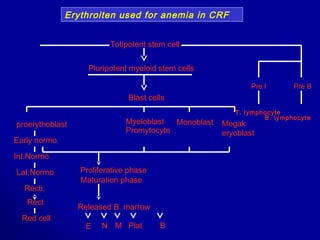
B. lymphocyte
N
proerythoblast
Pre B
Totipotent stem cell
Pluripotent myeloid stem cells
Pre I
Megak
eryoblast
Blast cells
Myeloblast
Promytocyte
Monoblast
T. lymphocyte
Early normo
Int.Normo
Lat.Normo
Recti.
Rect
Red cell
Proliferative phase
Maturation phase
Released B. marrow
E M Plat B
Erythroiten used for anemia in CRF
BLOODBLOOD
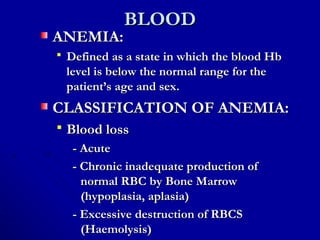
ANEMIA:ANEMIA:
 Defined as a state in which the blood HbDefined as a state in which the blood Hb
level is below the normal range for thelevel is below the normal range for the
patient’s age and sex.patient’s age and sex.
CLASSIFICATION OF ANEMIA:CLASSIFICATION OF ANEMIA:
 Blood lossBlood loss
- Acute- Acute
- Chronic inadequate production of- Chronic inadequate production of
normal RBC by Bone Marrownormal RBC by Bone Marrow
(hypoplasia, aplasia)(hypoplasia, aplasia)
- Excessive destruction of RBCS- Excessive destruction of RBCS
(Haemolysis)(Haemolysis)
BLOODBLOOD
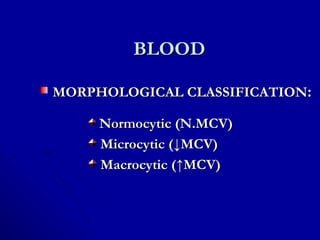
MORPHOLOGICAL CLASSIFICATIONMORPHOLOGICAL CLASSIFICATION::
Normocytic (N.MCV)Normocytic (N.MCV)
Microcytic (Microcytic (↓↓MCV)MCV)
Macrocytic (Macrocytic (↑MCV)↑MCV)
BLOODBLOOD
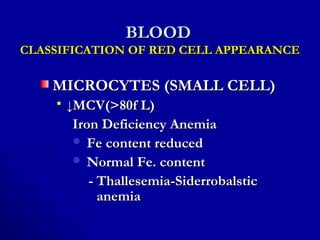
CLASSIFICATION OF RED CELL APPEARANCECLASSIFICATION OF RED CELL APPEARANCE
MICROCYTES (SMALL CELL)MICROCYTES (SMALL CELL)
 ↓↓MCV(>80f L)MCV(>80f L)
Iron Deficiency AnemiaIron Deficiency Anemia
 Fe content reducedFe content reduced
 Normal Fe. contentNormal Fe. content
-- Thallesemia-SiderrobalsticThallesemia-Siderrobalstic
anemiaanemia
BLOODBLOOD
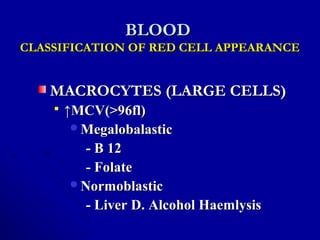
CLASSIFICATION OF RED CELL APPEARANCECLASSIFICATION OF RED CELL APPEARANCE
MACROCYTES (LARGE CELLS)MACROCYTES (LARGE CELLS)
 ↑↑MCV(>96fl)MCV(>96fl)
MegalobalasticMegalobalastic
- B 12- B 12
- Folate- Folate
NormoblasticNormoblastic
- Liver D. Alcohol Haemlysis- Liver D. Alcohol Haemlysis
BLOODBLOOD
CLASSIFICATION OF RED CELL APPEARANCECLASSIFICATION OF RED CELL APPEARANCE
NORMAL CELLSNORMAL CELLS
 MCVMCV

NormoblastNormoblast
Ac blood lessAc blood less
Anemia of Ch.Anemia of Ch.
Disease e.g.Disease e.g.
InfectionInfection
R.F.R.F.
C.T. Dis.C.T. Dis.
Malig.Malig.
Endo.Endo.
BLOODBLOOD
CLASSIFICATION OF RED CELL APPEARANCECLASSIFICATION OF RED CELL APPEARANCE
UNUSUAL CELLSUNUSUAL CELLS
 SpherocyteSpherocyte
 Sickle cellSickle cell
 SchistocytesSchistocytes
 Burr cellsBurr cells
 Howell jolly bodiesHowell jolly bodies
 PoikilocytesPoikilocytes
 Blister cellsBlister cells
BloodBlood
SYMPTOMS & SIGNS OF ANEMIASYMPTOMS & SIGNS OF ANEMIA
SYMPTOMSSYMPTOMS
 LassitudeLassitude
 FatigueFatigue
 Breathlessness on exertionBreathlessness on exertion
 PalpitationPalpitation
 Throbbing in head & earsThrobbing in head & ears
 DizzinessDizziness
 TinitusTinitus
BLOODBLOOD
SYMPTOMS & SIGNS OF ANEMIASYMPTOMS & SIGNS OF ANEMIA
SYMPTOMSSYMPTOMS
 HeadacheHeadache
 Diminish of visionDiminish of vision
 InsomniaInsomnia
 Paraesthesia of finger & toesParaesthesia of finger & toes
 AnginaAngina
BLOODBLOOD
SYMPTOMS & SIGNS OF ANEMIASYMPTOMS & SIGNS OF ANEMIA
SIGNSSIGNS
 Pallor ofPallor of
- Skin- Skin
- Mucous membrane- Mucous membrane
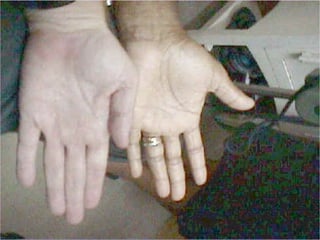
- Palm of hands- Palm of hands
- Conjunctive- Conjunctive
 TachycardiaTachycardia
 Cardiac dilatationCardiac dilatation
 Systolic flow murmurs edema.Systolic flow murmurs edema.
BLOODBLOOD
Anemia due to inadequate production ofAnemia due to inadequate production of
Red cells:Red cells:
CAUSES:CAUSES:
 Deficiency of essential factors:Deficiency of essential factors:
- Iron, vit.12- Iron, vit.12 Folate.Folate.
 Toxic factors:Toxic factors:
- Inflammatory disease, Hepatic or Renal- Inflammatory disease, Hepatic or Renal
dis.,Dgs.dis.,Dgs.
 Endocrine Diseases:Endocrine Diseases:
- Hypo or Hyperthyroidism, hypopittutism- Hypo or Hyperthyroidism, hypopittutism
hypogonad:hypogonad:↓↓erythryroitin.erythryroitin.
BLOODBLOOD
Anemia due to inadequate production ofAnemia due to inadequate production of
Red cells:Red cells:
CAUSES:CAUSES:
 Invasion of Bone MarrowInvasion of Bone Marrow
- Leukemia, sec. ca., fibrosis.- Leukemia, sec. ca., fibrosis.
 Disorders of developing Red cells.Disorders of developing Red cells.
-- Sideroblastic anemia, NeoplasticSideroblastic anemia, Neoplastic
disorders of erythropoisic, otherdisorders of erythropoisic, other
iodiopathic refactory anemia,iodiopathic refactory anemia,
heridatory disorders of Hb. Synthesisheridatory disorders of Hb. Synthesis
(Thallasemia)(Thallasemia)
 Failure of stem cells.Failure of stem cells.
- Hypoplastic & aplastic anemia.- Hypoplastic & aplastic anemia.
BLOODBLOOD
IRON DEFICIENCY ANEMIAIRON DEFICIENCY ANEMIA
CAUSES:CAUSES:
1.1. Poor intakePoor intake
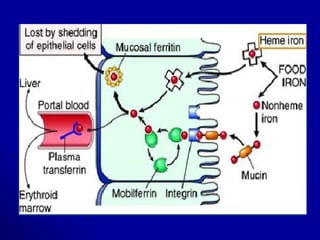
2.2. Decreased absorptionDecreased absorption
3.3. ↑↑ demandsdemands
4.4. Blood lossBlood loss
BLOODBLOOD
IRON DEFICIENCY ANEMIAIRON DEFICIENCY ANEMIA
CLINICAL FEATURES:CLINICAL FEATURES:
 Symptomatology of iron deficeincy isSymptomatology of iron deficeincy is
mainly that of anemia. However theremainly that of anemia. However there
are charachteristic features, these areare charachteristic features, these are
mainly epitelial changes produced bymainly epitelial changes produced by
inadequate iron in the cells.inadequate iron in the cells.
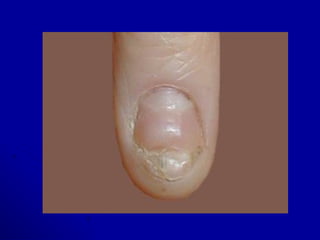
-- Brittle nailsBrittle nails
-- Spoon-shaped nails (koilonychias)Spoon-shaped nails (koilonychias)
-- Atrophy of the papillae of the tongue.Atrophy of the papillae of the tongue.
BLOODBLOOD
IRON DEFICIENCY ANEMIAIRON DEFICIENCY ANEMIA
CLINICAL FEATURES:CLINICAL FEATURES:
 Angular stomatitisAngular stomatitis
 Brittle hairsBrittle hairs
 A syndrome of dysphagia and glossitisA syndrome of dysphagia and glossitis
(Plummer-Vinson ro Peter-Brown-Kelly(Plummer-Vinson ro Peter-Brown-Kelly
syndrome).syndrome).
 Rarely in severe deficiency parotidRarely in severe deficiency parotid
enlargement, spleenomegaly and failureenlargement, spleenomegaly and failure
to grow.to grow.
BLOODBLOOD
GOOD CLINICAL HISTORYGOOD CLINICAL HISTORY
 Dietary intakeDietary intake
 Self Medication –NSAIDS.Self Medication –NSAIDS.
 Blood in faeces (Haemrrhoid or ca.Blood in faeces (Haemrrhoid or ca.
lower Bowl)lower Bowl)
 P/R examination.P/R examination.
BLOODBLOOD
ORALORAL
 Fe sulphate 200 mg/100Fe sulphate 200 mg/100
PARENTERALPARENTERAL
 Iron sorbital 1.5mgIron sorbital 1.5mg
 Per kg/body wt dailyPer kg/body wt daily
 l/m, never give.l/m, never give.
1.. introduction to blood

1.. introduction to blood

  • 1.
    BLOODBLOOD PROF. RAFI AHMEDGHORIPROF. RAFI AHMED GHORI PROFESSOR & CHAIRMANPROFESSOR & CHAIRMAN DEPARTMENT OF MEDICINEDEPARTMENT OF MEDICINE LIAQUAT UNIVERSITY OF MEDICAL & HEALTH SCIENCELIAQUAT UNIVERSITY OF MEDICAL & HEALTH SCIENCE JAMSHOROJAMSHORO
  • 2.
    BLOODBLOOD INTRODUCTIONINTRODUCTION BLOOD CONSISTS OF:BLOODCONSISTS OF:  Red CellsRed Cells  White cellsWhite cells  PlateletsPlatelets  Plasma, in which above elements arePlasma, in which above elements are suspended.suspended.
  • 3.
    BLOODBLOOD FORMATION OF BLOOD:FORMATIONOF BLOOD:  22ndnd weekweek→blood islands in yolk sac.→blood islands in yolk sac.  33rdrd week→migrate to liver and spleen chiefweek→migrate to liver and spleen chief sites of erythropoisissites of erythropoisis  55thth month → bone marrow-MED.month → bone marrow-MED. Haemopoisis. (erythropoisis).Haemopoisis. (erythropoisis).  At birth→ marrow of nearly every bone.At birth→ marrow of nearly every bone.  At adult life→ confined to end of longAt adult life→ confined to end of long bones→axial skelaton, ribs and skull.bones→axial skelaton, ribs and skull.
  • 4.
    BLOODBLOOD FORMATION OF BLOOD:FORMATIONOF BLOOD:  Path. processesPath. processes→ extramedullary→ extramedullary haemopoisis in liver & spleen.haemopoisis in liver & spleen. NB.NB. All peripheral blood cells are derived fromAll peripheral blood cells are derived from single stem cell (pleuripotent steam cell),single stem cell (pleuripotent steam cell), Stems cellsStems cells  Self renerwalSelf renerwal  Diff. Into mature cellsDiff. Into mature cells
  • 6.
    BLOODBLOOD NB.NB. Ist detectable CFUIS CFU-S(colonyIst detectable CFU IS CFU-S(colony forms unit spleen, which gives rise toforms unit spleen, which gives rise to CFU-GEMM (i.e. Granulocyte, ErythroidCFU-GEMM (i.e. Granulocyte, Erythroid cells, Monocytes, Megakaryocytes).cells, Monocytes, Megakaryocytes).
  • 7.
    BLOODBLOOD Haemopoietic growth factors:Haemopoieticgrowth factors:  All factors are glycoproteinAll factors are glycoprotein  Factors include:Factors include: - Erythropoietin- Erythropoietin - Colony Stimulating factors (CSF)- Colony Stimulating factors (CSF) - Interleukins (IL)- Interleukins (IL) Gene for most of them is 5 chromosome.Gene for most of them is 5 chromosome. And many growth factors are producedAnd many growth factors are produced by recombinant DNA tech. e.g. GM-CSFby recombinant DNA tech. e.g. GM-CSF after B.M. transplantation to accelerateafter B.M. transplantation to accelerate neutrophil recovery.neutrophil recovery.
  • 8.
    B. lymphocyte N proerythoblast Pre B Totipotentstem cell Pluripotent myeloid stem cells Pre I Megak eryoblast Blast cells Myeloblast Promytocyte Monoblast T. lymphocyte Early normo Int.Normo Lat.Normo Recti. Rect Red cell Proliferative phase Maturation phase Released B. marrow E M Plat B Erythroiten used for anemia in CRF
  • 9.
    BLOODBLOOD ANEMIA:ANEMIA:  Defined asa state in which the blood HbDefined as a state in which the blood Hb level is below the normal range for thelevel is below the normal range for the patient’s age and sex.patient’s age and sex. CLASSIFICATION OF ANEMIA:CLASSIFICATION OF ANEMIA:  Blood lossBlood loss - Acute- Acute - Chronic inadequate production of- Chronic inadequate production of normal RBC by Bone Marrownormal RBC by Bone Marrow (hypoplasia, aplasia)(hypoplasia, aplasia) - Excessive destruction of RBCS- Excessive destruction of RBCS (Haemolysis)(Haemolysis)
  • 10.
    BLOODBLOOD MORPHOLOGICAL CLASSIFICATIONMORPHOLOGICAL CLASSIFICATION:: Normocytic(N.MCV)Normocytic (N.MCV) Microcytic (Microcytic (↓↓MCV)MCV) Macrocytic (Macrocytic (↑MCV)↑MCV)
  • 11.
    BLOODBLOOD CLASSIFICATION OF REDCELL APPEARANCECLASSIFICATION OF RED CELL APPEARANCE MICROCYTES (SMALL CELL)MICROCYTES (SMALL CELL)  ↓↓MCV(>80f L)MCV(>80f L) Iron Deficiency AnemiaIron Deficiency Anemia  Fe content reducedFe content reduced  Normal Fe. contentNormal Fe. content -- Thallesemia-SiderrobalsticThallesemia-Siderrobalstic anemiaanemia
  • 12.
    BLOODBLOOD CLASSIFICATION OF REDCELL APPEARANCECLASSIFICATION OF RED CELL APPEARANCE MACROCYTES (LARGE CELLS)MACROCYTES (LARGE CELLS)  ↑↑MCV(>96fl)MCV(>96fl) MegalobalasticMegalobalastic - B 12- B 12 - Folate- Folate NormoblasticNormoblastic - Liver D. Alcohol Haemlysis- Liver D. Alcohol Haemlysis
  • 13.
    BLOODBLOOD CLASSIFICATION OF REDCELL APPEARANCECLASSIFICATION OF RED CELL APPEARANCE NORMAL CELLSNORMAL CELLS  MCVMCV  NormoblastNormoblast Ac blood lessAc blood less Anemia of Ch.Anemia of Ch. Disease e.g.Disease e.g. InfectionInfection R.F.R.F. C.T. Dis.C.T. Dis. Malig.Malig. Endo.Endo.
  • 14.
    BLOODBLOOD CLASSIFICATION OF REDCELL APPEARANCECLASSIFICATION OF RED CELL APPEARANCE UNUSUAL CELLSUNUSUAL CELLS  SpherocyteSpherocyte  Sickle cellSickle cell  SchistocytesSchistocytes  Burr cellsBurr cells  Howell jolly bodiesHowell jolly bodies  PoikilocytesPoikilocytes  Blister cellsBlister cells
  • 15.
    BloodBlood SYMPTOMS & SIGNSOF ANEMIASYMPTOMS & SIGNS OF ANEMIA SYMPTOMSSYMPTOMS  LassitudeLassitude  FatigueFatigue  Breathlessness on exertionBreathlessness on exertion  PalpitationPalpitation  Throbbing in head & earsThrobbing in head & ears  DizzinessDizziness  TinitusTinitus
  • 16.
    BLOODBLOOD SYMPTOMS & SIGNSOF ANEMIASYMPTOMS & SIGNS OF ANEMIA SYMPTOMSSYMPTOMS  HeadacheHeadache  Diminish of visionDiminish of vision  InsomniaInsomnia  Paraesthesia of finger & toesParaesthesia of finger & toes  AnginaAngina
  • 17.
    BLOODBLOOD SYMPTOMS & SIGNSOF ANEMIASYMPTOMS & SIGNS OF ANEMIA SIGNSSIGNS  Pallor ofPallor of - Skin- Skin - Mucous membrane- Mucous membrane - Palm of hands- Palm of hands - Conjunctive- Conjunctive  TachycardiaTachycardia  Cardiac dilatationCardiac dilatation  Systolic flow murmurs edema.Systolic flow murmurs edema.
  • 20.
    BLOODBLOOD Anemia due toinadequate production ofAnemia due to inadequate production of Red cells:Red cells: CAUSES:CAUSES:  Deficiency of essential factors:Deficiency of essential factors: - Iron, vit.12- Iron, vit.12 Folate.Folate.  Toxic factors:Toxic factors: - Inflammatory disease, Hepatic or Renal- Inflammatory disease, Hepatic or Renal dis.,Dgs.dis.,Dgs.  Endocrine Diseases:Endocrine Diseases: - Hypo or Hyperthyroidism, hypopittutism- Hypo or Hyperthyroidism, hypopittutism hypogonad:hypogonad:↓↓erythryroitin.erythryroitin.
  • 21.
    BLOODBLOOD Anemia due toinadequate production ofAnemia due to inadequate production of Red cells:Red cells: CAUSES:CAUSES:  Invasion of Bone MarrowInvasion of Bone Marrow - Leukemia, sec. ca., fibrosis.- Leukemia, sec. ca., fibrosis.  Disorders of developing Red cells.Disorders of developing Red cells. -- Sideroblastic anemia, NeoplasticSideroblastic anemia, Neoplastic disorders of erythropoisic, otherdisorders of erythropoisic, other iodiopathic refactory anemia,iodiopathic refactory anemia, heridatory disorders of Hb. Synthesisheridatory disorders of Hb. Synthesis (Thallasemia)(Thallasemia)  Failure of stem cells.Failure of stem cells. - Hypoplastic & aplastic anemia.- Hypoplastic & aplastic anemia.
  • 22.
    BLOODBLOOD IRON DEFICIENCY ANEMIAIRONDEFICIENCY ANEMIA CAUSES:CAUSES: 1.1. Poor intakePoor intake 2.2. Decreased absorptionDecreased absorption 3.3. ↑↑ demandsdemands 4.4. Blood lossBlood loss
  • 24.
    BLOODBLOOD IRON DEFICIENCY ANEMIAIRONDEFICIENCY ANEMIA CLINICAL FEATURES:CLINICAL FEATURES:  Symptomatology of iron deficeincy isSymptomatology of iron deficeincy is mainly that of anemia. However theremainly that of anemia. However there are charachteristic features, these areare charachteristic features, these are mainly epitelial changes produced bymainly epitelial changes produced by inadequate iron in the cells.inadequate iron in the cells. -- Brittle nailsBrittle nails -- Spoon-shaped nails (koilonychias)Spoon-shaped nails (koilonychias) -- Atrophy of the papillae of the tongue.Atrophy of the papillae of the tongue.
  • 26.
    BLOODBLOOD IRON DEFICIENCY ANEMIAIRONDEFICIENCY ANEMIA CLINICAL FEATURES:CLINICAL FEATURES:  Angular stomatitisAngular stomatitis  Brittle hairsBrittle hairs  A syndrome of dysphagia and glossitisA syndrome of dysphagia and glossitis (Plummer-Vinson ro Peter-Brown-Kelly(Plummer-Vinson ro Peter-Brown-Kelly syndrome).syndrome).  Rarely in severe deficiency parotidRarely in severe deficiency parotid enlargement, spleenomegaly and failureenlargement, spleenomegaly and failure to grow.to grow.
  • 27.
    BLOODBLOOD GOOD CLINICAL HISTORYGOODCLINICAL HISTORY  Dietary intakeDietary intake  Self Medication –NSAIDS.Self Medication –NSAIDS.  Blood in faeces (Haemrrhoid or ca.Blood in faeces (Haemrrhoid or ca. lower Bowl)lower Bowl)  P/R examination.P/R examination.
  • 28.
    BLOODBLOOD ORALORAL  Fe sulphate200 mg/100Fe sulphate 200 mg/100 PARENTERALPARENTERAL  Iron sorbital 1.5mgIron sorbital 1.5mg  Per kg/body wt dailyPer kg/body wt daily  l/m, never give.l/m, never give.