PRINCIPLES OF DESIGN…
The designer works with the 4 tools or elements of
design: line, form, color, and texture. But now they
must follow the “RULES” about using those tools.
The rules are called the principles of design.
There are 5 principles
of design:
balance
proportion/scale
RHYTHM
harmony
emphasis
Rhythm





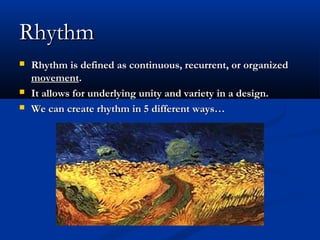
Rhythm is defined as continuous, recurrent, or organized
movement.
It allows for underlying unity and variety in a design.
We can create rhythm in 5 different ways…
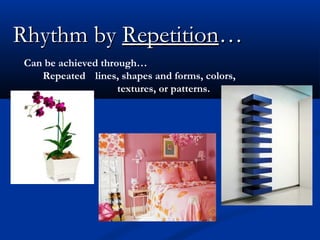
Rhythm by Repetition…
Can be achieved through…
Repeated lines, shapes and forms, colors,
textures, or patterns.
Rhythm by Gradation…
Completed by increasing or decreasing one or more
qualities, such as height or width or overall size.
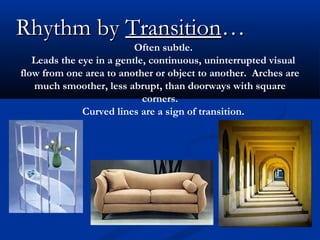
Rhythm by Transition…

Often subtle.
Leads the eye in a gentle, continuous, uninterrupted visual
flow from one area to another or object to another. Arches are
much smoother, less abrupt, than doorways with square
corners.
Curved lines are a sign of transition.
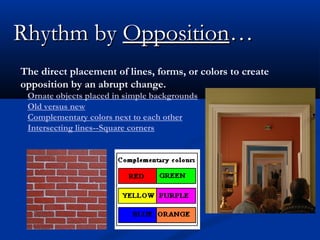
Rhythm by Opposition…
The direct placement of lines, forms, or colors to create
opposition by an abrupt change.
Ornate objects placed in simple backgrounds
Old versus new
Complementary colors next to each other
Intersecting lines--Square corners
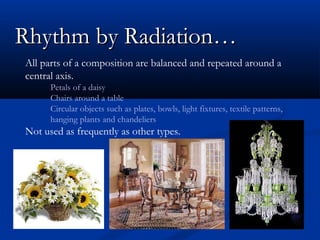
Rhythm by Radiation…
All parts of a composition are balanced and repeated around a
central axis.
Petals of a daisy
Chairs around a table
Circular objects such as plates, bowls, light fixtures, textile patterns,
hanging plants and chandeliers

Not used as frequently as other types.
Rhythm


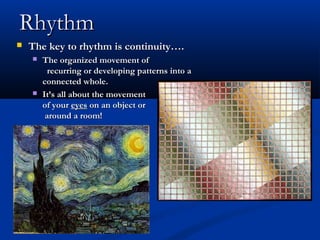
The key to rhythm is continuity….




The organized movement of
recurring or developing patterns into a
connected whole.
It’s all about the movement
of your eyes on an object or
around a room!
1. Using magazines or catalogs, find pictures of objects or other components
of interior design to illustrate the 5 different types of rhythm.
2. Select sheets of paper, white or colored, for this assignment. Also select
paper in a color appropriate for picture mats. The pages should all be the
same color.
3. For each page, you may use a
computer to add a title, your name,
and a description of the type of
rhythm and the source of rhythm in
each picture (ex: transition on sofa).

Types of RHYTHM in Design
by Your Name

4. The title should include the word
“rhythm”.
5. Mat and mount the pictures on the
paper. You may have more than one
picture on a sheet of paper if
desired, but no more than 3 pictures
per sheet.

Transition can be found in
components of interior
design that have curved
lines, such as in this sofa.

Rhythm

  • 2.
    PRINCIPLES OF DESIGN… Thedesigner works with the 4 tools or elements of design: line, form, color, and texture. But now they must follow the “RULES” about using those tools. The rules are called the principles of design. There are 5 principles of design: balance proportion/scale RHYTHM harmony emphasis
  • 3.
    Rhythm    Rhythm is definedas continuous, recurrent, or organized movement. It allows for underlying unity and variety in a design. We can create rhythm in 5 different ways…
  • 4.
    Rhythm by Repetition… Canbe achieved through… Repeated lines, shapes and forms, colors, textures, or patterns.
  • 5.
    Rhythm by Gradation… Completedby increasing or decreasing one or more qualities, such as height or width or overall size.
  • 6.
    Rhythm by Transition… Oftensubtle. Leads the eye in a gentle, continuous, uninterrupted visual flow from one area to another or object to another. Arches are much smoother, less abrupt, than doorways with square corners. Curved lines are a sign of transition.
  • 7.
    Rhythm by Opposition… Thedirect placement of lines, forms, or colors to create opposition by an abrupt change. Ornate objects placed in simple backgrounds Old versus new Complementary colors next to each other Intersecting lines--Square corners
  • 8.
    Rhythm by Radiation… Allparts of a composition are balanced and repeated around a central axis. Petals of a daisy Chairs around a table Circular objects such as plates, bowls, light fixtures, textile patterns, hanging plants and chandeliers Not used as frequently as other types.
  • 9.
    Rhythm  The key torhythm is continuity….   The organized movement of recurring or developing patterns into a connected whole. It’s all about the movement of your eyes on an object or around a room!
  • 11.
    1. Using magazinesor catalogs, find pictures of objects or other components of interior design to illustrate the 5 different types of rhythm. 2. Select sheets of paper, white or colored, for this assignment. Also select paper in a color appropriate for picture mats. The pages should all be the same color. 3. For each page, you may use a computer to add a title, your name, and a description of the type of rhythm and the source of rhythm in each picture (ex: transition on sofa). Types of RHYTHM in Design by Your Name 4. The title should include the word “rhythm”. 5. Mat and mount the pictures on the paper. You may have more than one picture on a sheet of paper if desired, but no more than 3 pictures per sheet. Transition can be found in components of interior design that have curved lines, such as in this sofa.