Elements of Art
LINE
What defines a LINE?
 A line connects two points and can go on
forever. It is made by a pointed tool such as
a pen, crayon, marker, paint brush, etc.
 It can create shapes, texture, and variety in
art depending on how it is used.
 It can also create a sense of depth
depending on how thick or thin you make
them.
What is the difference between
real and implied lines?
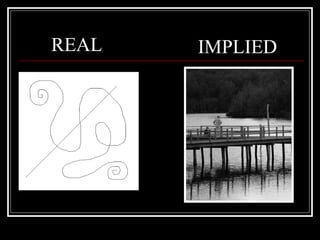
Real lines are the ones that we
draw and the ones that are the
most known.
Implied lines are created through
the sense of the line being there.
Ex: color, value, dotted
REAL IMPLIED
How can a simple line create a sense
of depth?
 LINES have different thicknesses that
artists call their weight. Thick lines are
heavy and thin line are light.
-Heavily Weighted Lines = objects coming
forward.
-Lightly Weighted Lines = object receding
(going back).
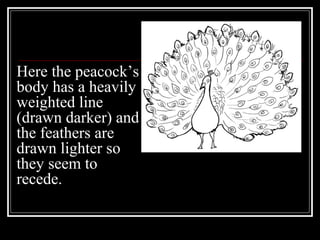
Here the peacock’s
body has a heavily
weighted line
(drawn darker) and
the feathers are
drawn lighter so
they seem to
recede.
Emotional lines? What’s that!
 All lines have a sense of emotion or convey
a feeling:
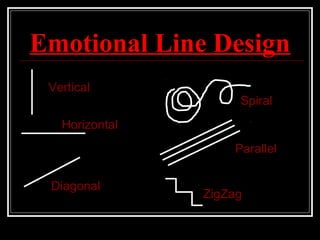
Emotional Line Design
Vertical
Horizontal
Diagonal
Spiral
Parallel
ZigZag
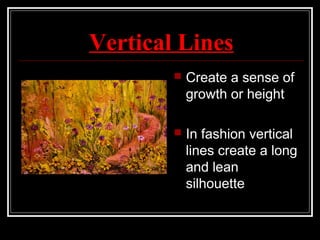
Vertical Lines
 Create a sense of
growth or height
 In fashion vertical
lines create a long
and lean
silhouette
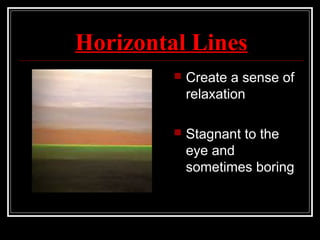
Horizontal Lines
 Create a sense of
relaxation
 Stagnant to the
eye and
sometimes boring
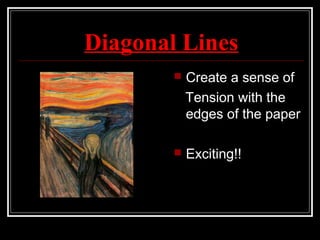
Diagonal Lines
 Create a sense of
Tension with the
edges of the paper
 Exciting!!
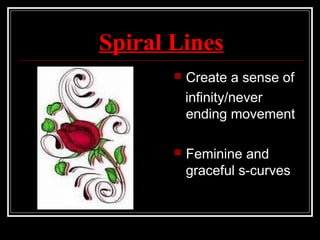
Spiral Lines
 Create a sense of
infinity/never
ending movement
 Feminine and
graceful s-curves
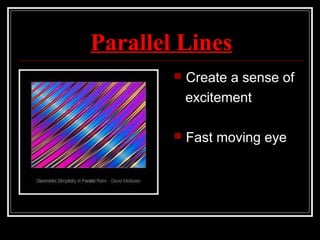
Parallel Lines
 Create a sense of
excitement
 Fast moving eye
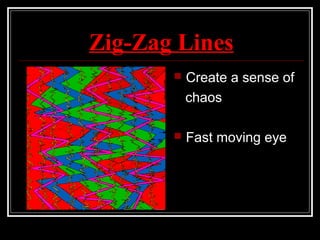
Zig-Zag Lines
 Create a sense of
chaos
 Fast moving eye
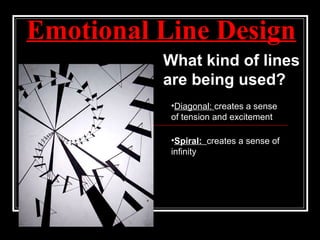
Emotional Line Design
What kind of lines
are being used?
•Diagonal: creates a sense
of tension and excitement
•Spiral: creates a sense of
infinity
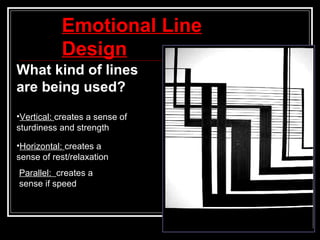
Emotional Line
Design
What kind of lines
are being used?
•Vertical: creates a sense of
sturdiness and strength
•Horizontal: creates a
sense of rest/relaxation
Parallel: creates a
sense if speed

Elements of Art: LINE

  • 1.
  • 2.
    What defines aLINE?  A line connects two points and can go on forever. It is made by a pointed tool such as a pen, crayon, marker, paint brush, etc.  It can create shapes, texture, and variety in art depending on how it is used.  It can also create a sense of depth depending on how thick or thin you make them.
  • 3.
    What is thedifference between real and implied lines? Real lines are the ones that we draw and the ones that are the most known. Implied lines are created through the sense of the line being there. Ex: color, value, dotted
  • 4.
  • 5.
    How can asimple line create a sense of depth?  LINES have different thicknesses that artists call their weight. Thick lines are heavy and thin line are light. -Heavily Weighted Lines = objects coming forward. -Lightly Weighted Lines = object receding (going back).
  • 6.
    Here the peacock’s bodyhas a heavily weighted line (drawn darker) and the feathers are drawn lighter so they seem to recede.
  • 7.
    Emotional lines? What’sthat!  All lines have a sense of emotion or convey a feeling:
  • 8.
  • 9.
    Vertical Lines  Createa sense of growth or height  In fashion vertical lines create a long and lean silhouette
  • 10.
    Horizontal Lines  Createa sense of relaxation  Stagnant to the eye and sometimes boring
  • 11.
    Diagonal Lines  Createa sense of Tension with the edges of the paper  Exciting!!
  • 12.
    Spiral Lines  Createa sense of infinity/never ending movement  Feminine and graceful s-curves
  • 13.
    Parallel Lines  Createa sense of excitement  Fast moving eye
  • 14.
    Zig-Zag Lines  Createa sense of chaos  Fast moving eye
  • 15.
    Emotional Line Design Whatkind of lines are being used? •Diagonal: creates a sense of tension and excitement •Spiral: creates a sense of infinity
  • 16.
    Emotional Line Design What kindof lines are being used? •Vertical: creates a sense of sturdiness and strength •Horizontal: creates a sense of rest/relaxation Parallel: creates a sense if speed