ELEMENTS OF DESIGN
Elements of design are
“tools”. Just like the
carpenter has a hammer and
saw, the designer has the
elements.
There are 4 elements of
design: Line, FORM, Color, &
Texture.
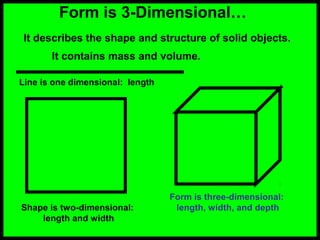
Form is 3-Dimensional…
It describes the shape and structure of solid objects.
It contains mass and volume.
Line is one dimensional: length

Shape is two-dimensional:
length and width

Form is three-dimensional:
length, width, and depth
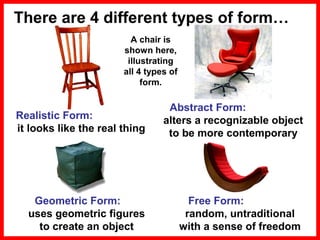
There are 4 different types of form…
A chair is
shown here,
illustrating
all 4 types of
form.

Realistic Form:
it looks like the real thing

Abstract Form:
alters a recognizable object
to be more contemporary

Geometric Form:
uses geometric figures
to create an object

Free Form:
random, untraditional
with a sense of freedom
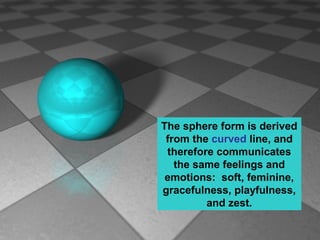
The sphere form is derived
from the curved line, and
therefore communicates
the same feelings and
emotions: soft, feminine,
gracefulness, playfulness,
and zest.
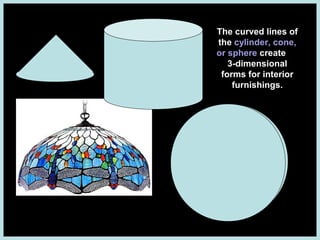
The curved lines of
the cylinder, cone,
or sphere create
3-dimensional
forms for interior
furnishings.
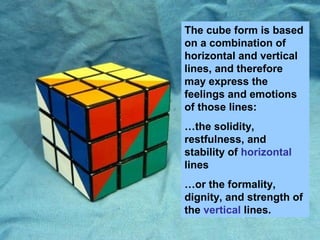
The cube form is based
on a combination of
horizontal and vertical
lines, and therefore
may express the
feelings and emotions
of those lines:
…the solidity,
restfulness, and
stability of horizontal
lines
…or the formality,
dignity, and strength of
the vertical lines.
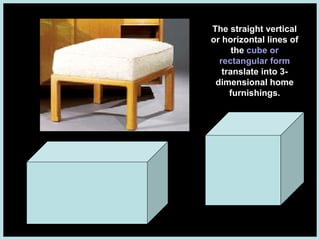
The straight vertical
or horizontal lines of
the cube or
rectangular form
translate into 3dimensional home
furnishings.
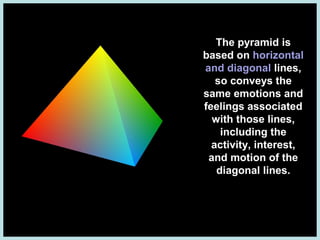
The pyramid is
based on horizontal
and diagonal lines,
so conveys the
same emotions and
feelings associated
with those lines,
including the
activity, interest,
and motion of the
diagonal lines.
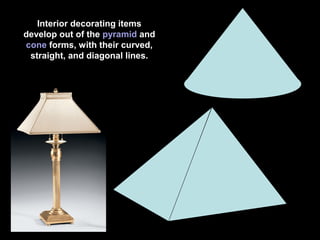
Interior decorating items
develop out of the pyramid and
cone forms, with their curved,
straight, and diagonal lines.
Guidelines for using Form…
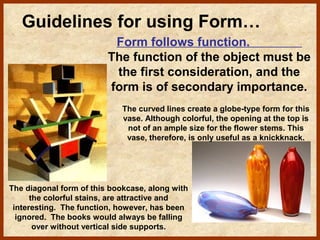
Form follows function.
The function of the object must be
the first consideration, and the
form is of secondary importance.
The curved lines create a globe-type form for this
vase. Although colorful, the opening at the top is
not of an ample size for the flower stems. This
vase, therefore, is only useful as a knickknack.

The diagonal form of this bookcase, along with
the colorful stains, are attractive and
interesting. The function, however, has been
ignored. The books would always be falling
over without vertical side supports.
Guidelines for using Form…
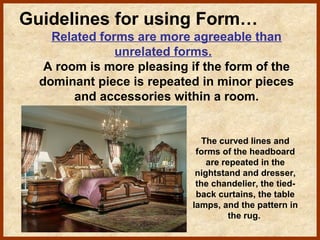
Related forms are more agreeable than
unrelated forms.
A room is more pleasing if the form of the
dominant piece is repeated in minor pieces
and accessories within a room.

The curved lines and
forms of the headboard
are repeated in the
nightstand and dresser,
the chandelier, the tiedback curtains, the table
lamps, and the pattern in
the rug.
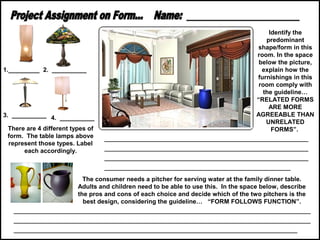
1._________ 2. __________

3. __________ 4. __________
There are 4 different types of
form. The table lamps above
represent those types. Label
each accordingly.

Identify the
predominant
shape/form in this
room. In the space
below the picture,
explain how the
furnishings in this
room comply with
the guideline…
“RELATED FORMS
ARE MORE
AGREEABLE THAN
UNRELATED
FORMS”.

______________________________________________
______________________________________________
______________________________________________
__________________________________________

The consumer needs a pitcher for serving water at the family dinner table.
Adults and children need to be able to use this. In the space below, describe
the pros and cons of each choice and decide which of the two pitchers is the
best design, considering the guideline… “FORM FOLLOWS FUNCTION”.

___________________________________________________________________
___________________________________________________________________
________________________________________________________________

Housing-Form

  • 2.
    ELEMENTS OF DESIGN Elementsof design are “tools”. Just like the carpenter has a hammer and saw, the designer has the elements. There are 4 elements of design: Line, FORM, Color, & Texture.
  • 3.
    Form is 3-Dimensional… Itdescribes the shape and structure of solid objects. It contains mass and volume. Line is one dimensional: length Shape is two-dimensional: length and width Form is three-dimensional: length, width, and depth
  • 4.
    There are 4different types of form… A chair is shown here, illustrating all 4 types of form. Realistic Form: it looks like the real thing Abstract Form: alters a recognizable object to be more contemporary Geometric Form: uses geometric figures to create an object Free Form: random, untraditional with a sense of freedom
  • 5.
    The sphere formis derived from the curved line, and therefore communicates the same feelings and emotions: soft, feminine, gracefulness, playfulness, and zest.
  • 6.
    The curved linesof the cylinder, cone, or sphere create 3-dimensional forms for interior furnishings.
  • 7.
    The cube formis based on a combination of horizontal and vertical lines, and therefore may express the feelings and emotions of those lines: …the solidity, restfulness, and stability of horizontal lines …or the formality, dignity, and strength of the vertical lines.
  • 8.
    The straight vertical orhorizontal lines of the cube or rectangular form translate into 3dimensional home furnishings.
  • 9.
    The pyramid is basedon horizontal and diagonal lines, so conveys the same emotions and feelings associated with those lines, including the activity, interest, and motion of the diagonal lines.
  • 10.
    Interior decorating items developout of the pyramid and cone forms, with their curved, straight, and diagonal lines.
  • 11.
    Guidelines for usingForm… Form follows function. The function of the object must be the first consideration, and the form is of secondary importance. The curved lines create a globe-type form for this vase. Although colorful, the opening at the top is not of an ample size for the flower stems. This vase, therefore, is only useful as a knickknack. The diagonal form of this bookcase, along with the colorful stains, are attractive and interesting. The function, however, has been ignored. The books would always be falling over without vertical side supports.
  • 12.
    Guidelines for usingForm… Related forms are more agreeable than unrelated forms. A room is more pleasing if the form of the dominant piece is repeated in minor pieces and accessories within a room. The curved lines and forms of the headboard are repeated in the nightstand and dresser, the chandelier, the tiedback curtains, the table lamps, and the pattern in the rug.
  • 14.
    1._________ 2. __________ 3.__________ 4. __________ There are 4 different types of form. The table lamps above represent those types. Label each accordingly. Identify the predominant shape/form in this room. In the space below the picture, explain how the furnishings in this room comply with the guideline… “RELATED FORMS ARE MORE AGREEABLE THAN UNRELATED FORMS”. ______________________________________________ ______________________________________________ ______________________________________________ __________________________________________ The consumer needs a pitcher for serving water at the family dinner table. Adults and children need to be able to use this. In the space below, describe the pros and cons of each choice and decide which of the two pitchers is the best design, considering the guideline… “FORM FOLLOWS FUNCTION”. ___________________________________________________________________ ___________________________________________________________________ ________________________________________________________________

Editor's Notes

  • #15 Could have students look in magazines to fine examples of “Form follows function” and “Related forms are more agreeable than unrelated forms.”