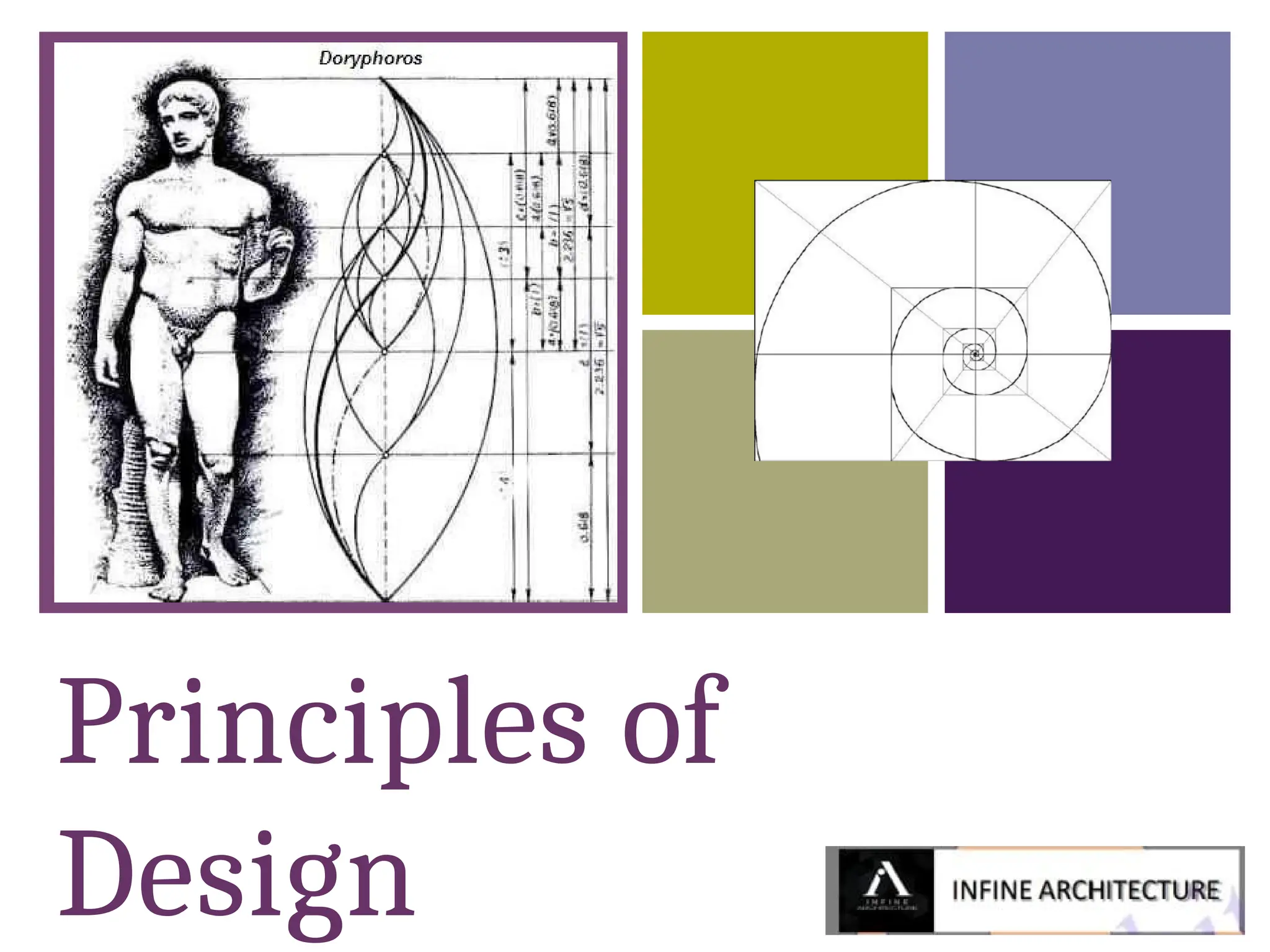
+
Principles of
Design
What is Design
Design is the creation of a plan or convention for the
construction of an object or a system. It may be an
architectural blueprints, engineering drawings, business
processes, circuit diagrams or sewing patterns. Design has
different connotations in different fields
Design is what links creativity and
innovation. It shapes ideas to become
practical and attractive propositions for
users, clients or customers. Design
may be described as creativity deployed
to a specific end
Principles of Design
The principles of design
describe the ways an artist use
different elements of design in a
composition. These ways or
principles are
•Balance
•Rhythm
•Emphasis
•Contrast
•Movement
•Harmony
•Proportion and
scale
Principles of Design
BALANCE
A sense of equilibrium.
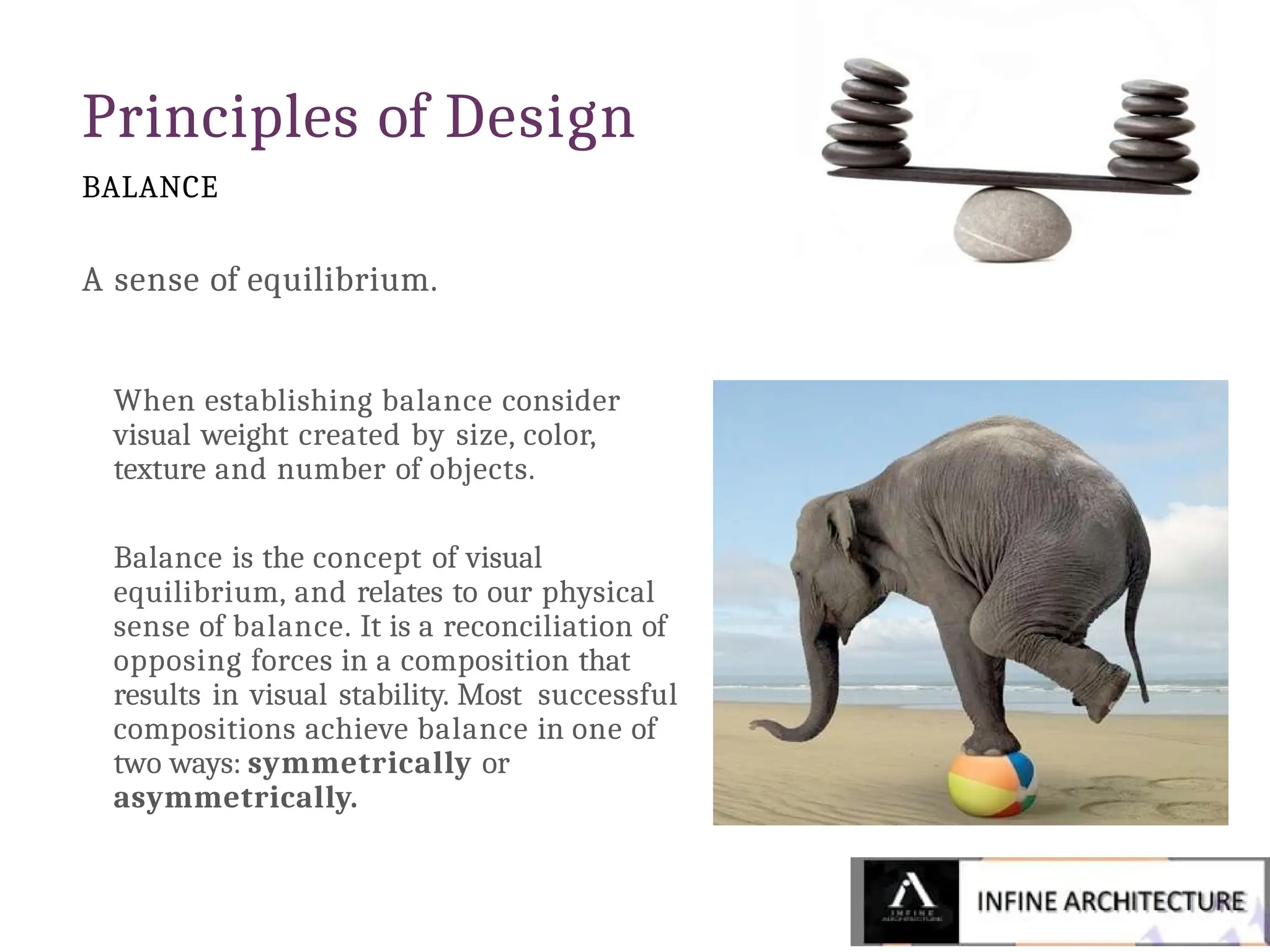
When establishing balance consider
visual weight created by size, color,
texture and number of objects.
Balance is the concept of visual
equilibrium, and relates to our physical
sense of balance. It is a reconciliation of
opposing forces in a composition that
results in visual stability. Most successful
compositions achieve balance in one of
two ways: symmetrically or
asymmetrically.
Principles of Design
BALANCE
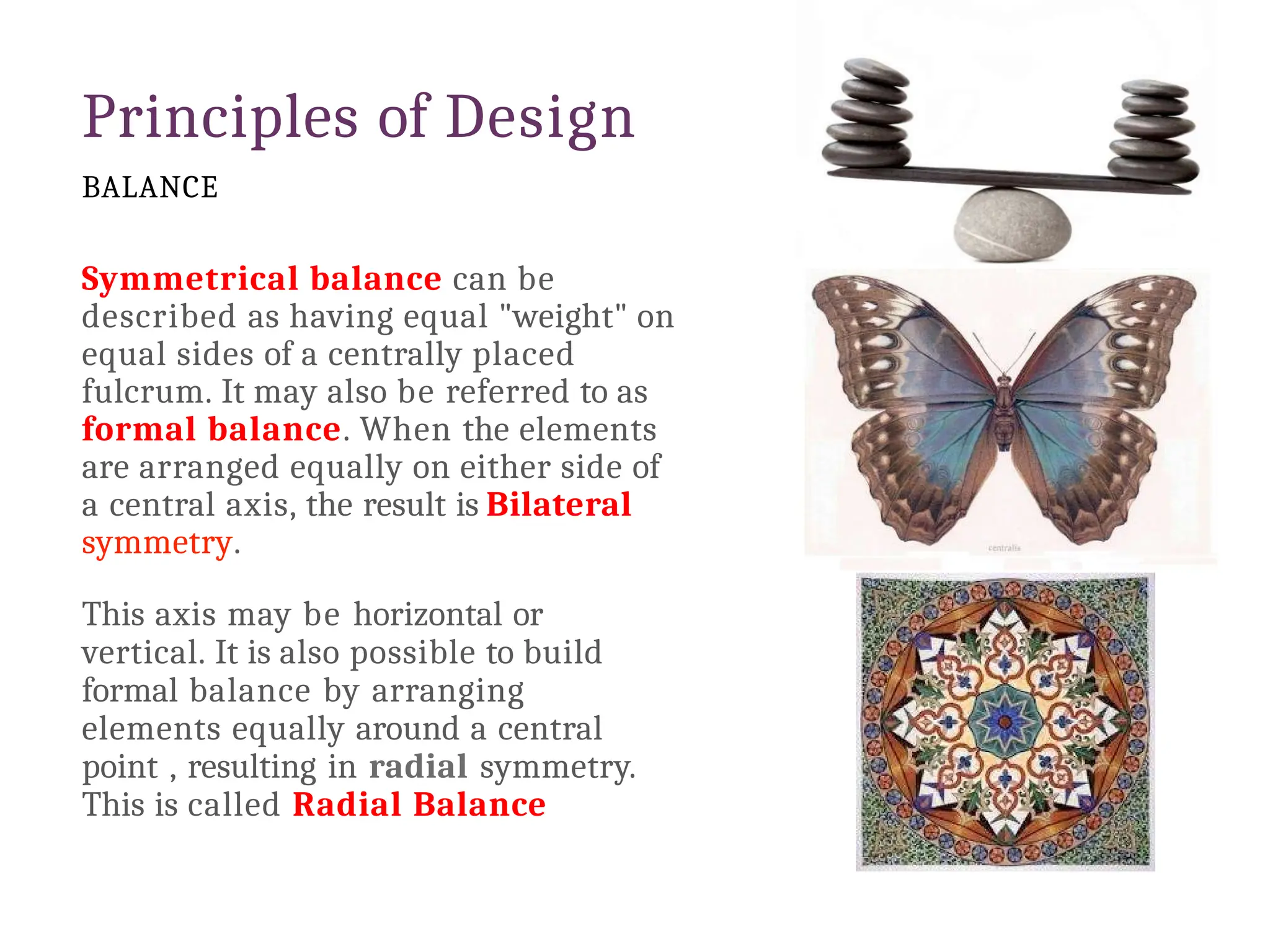
Symmetrical balance can be
described as having equal "weight" on
equal sides of a centrally placed
fulcrum. It may also be referred to as
formal balance. When the elements
are arranged equally on either side of
a central axis, the result is Bilateral
symmetry.
This axis may be horizontal or
vertical. It is also possible to build
formal balance by arranging
elements equally around a central
point , resulting in radial symmetry.
This is called Radial Balance
Principles of Design
BALANCE
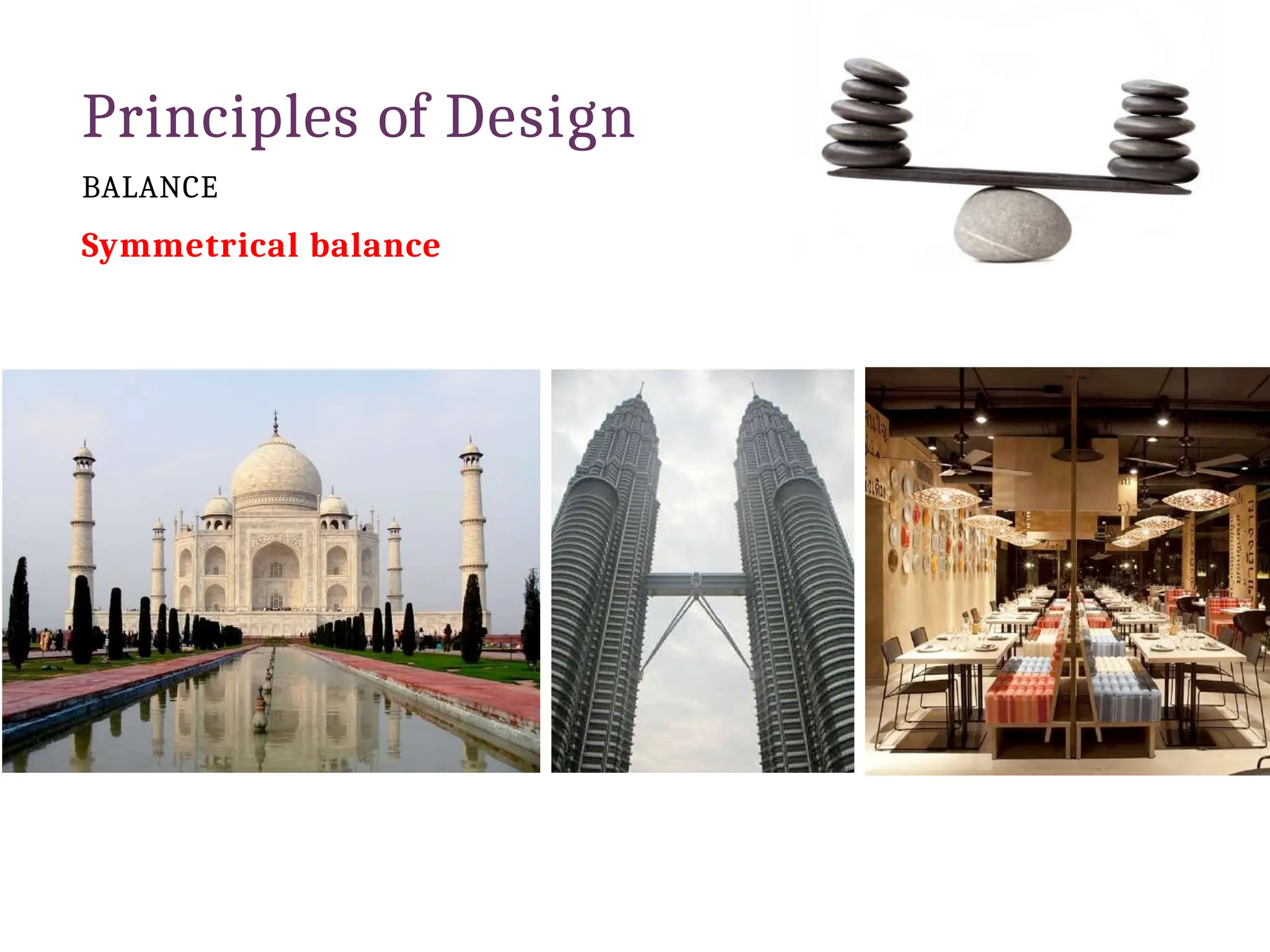
Symmetrical balance
Principles of Design
BALANCE
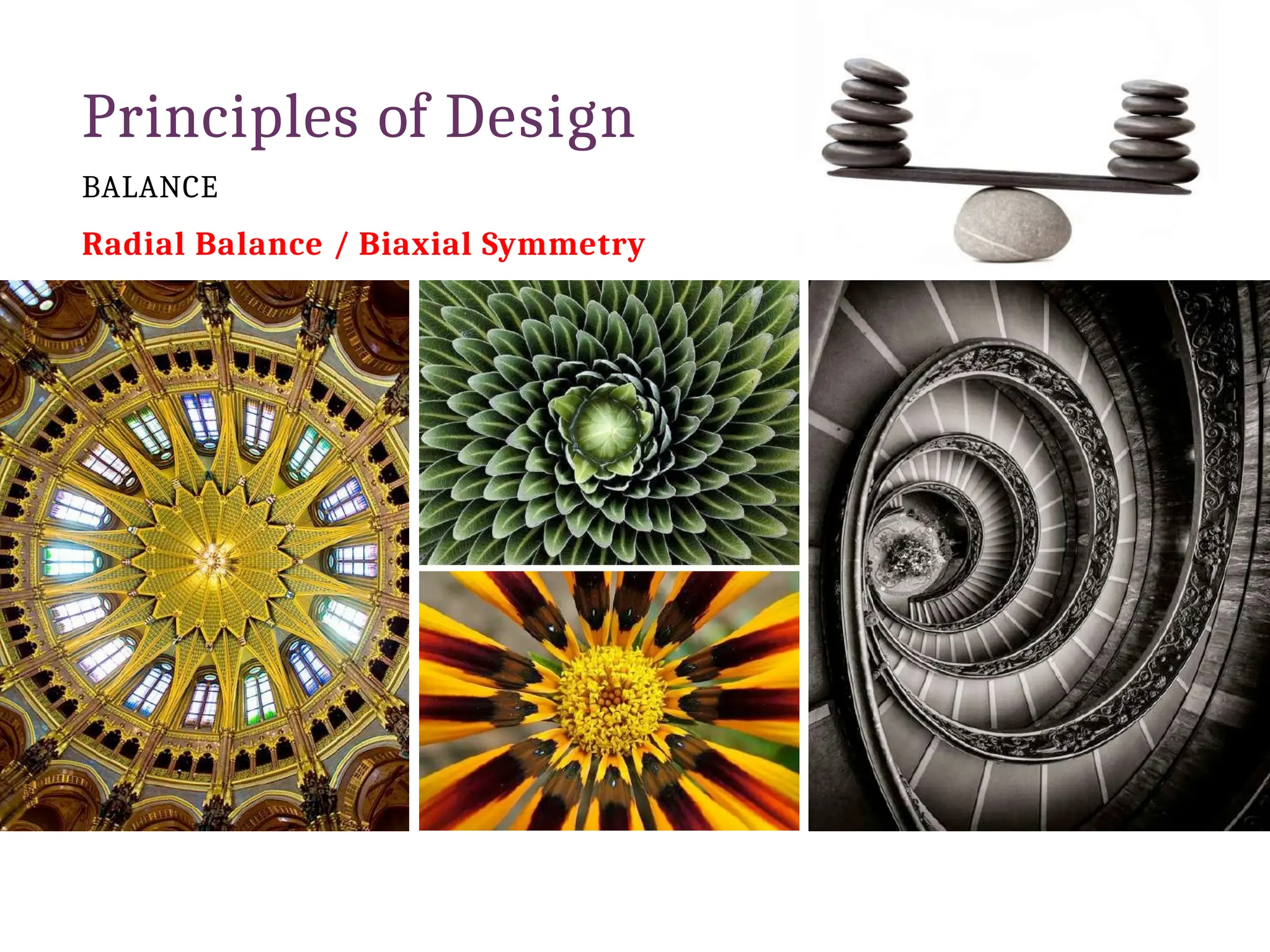
Radial Balance / Biaxial Symmetry
Principles of Design
BALANCE
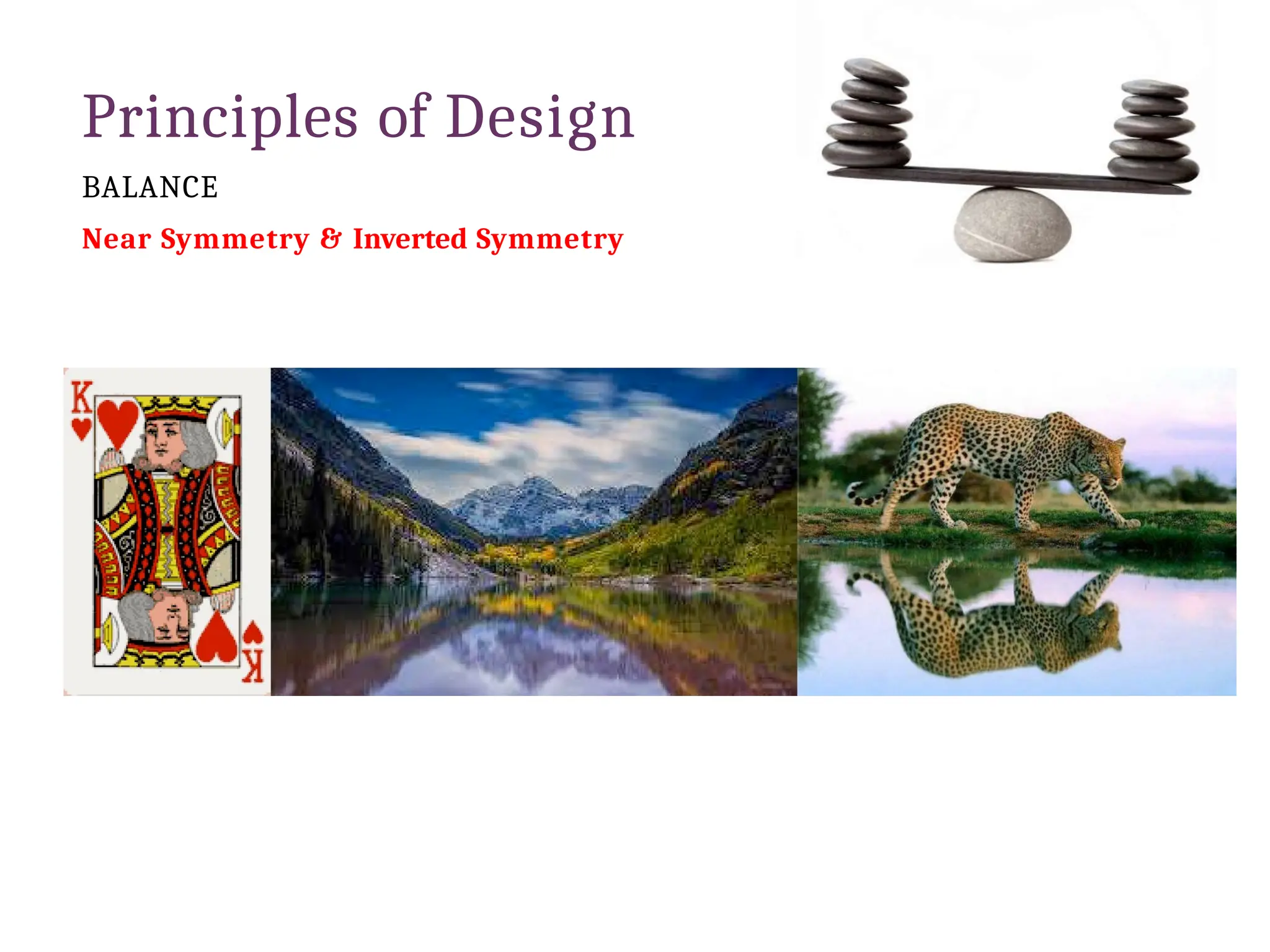
Near Symmetry & Inverted Symmetry
Principles of Design
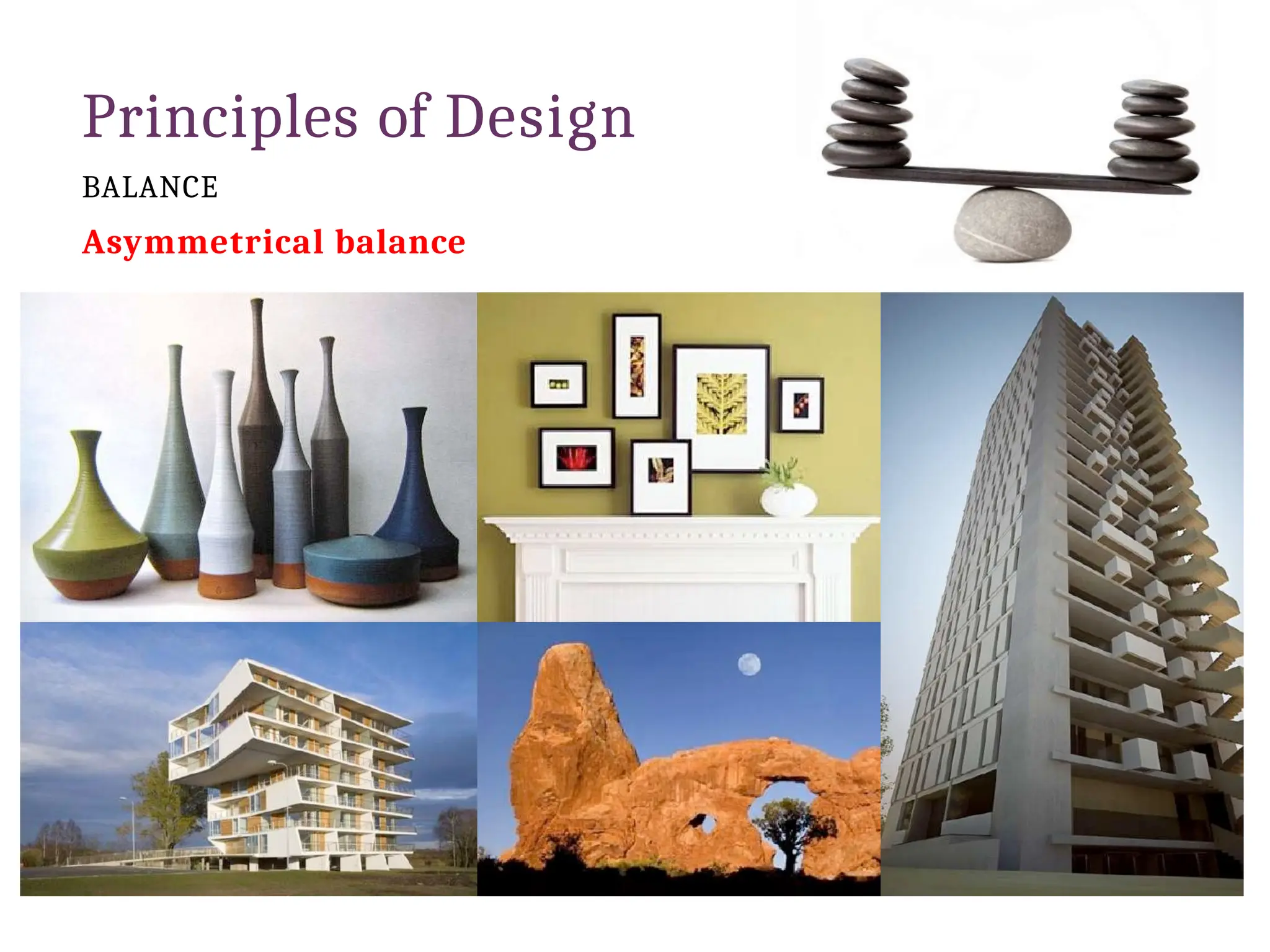
BALANCE
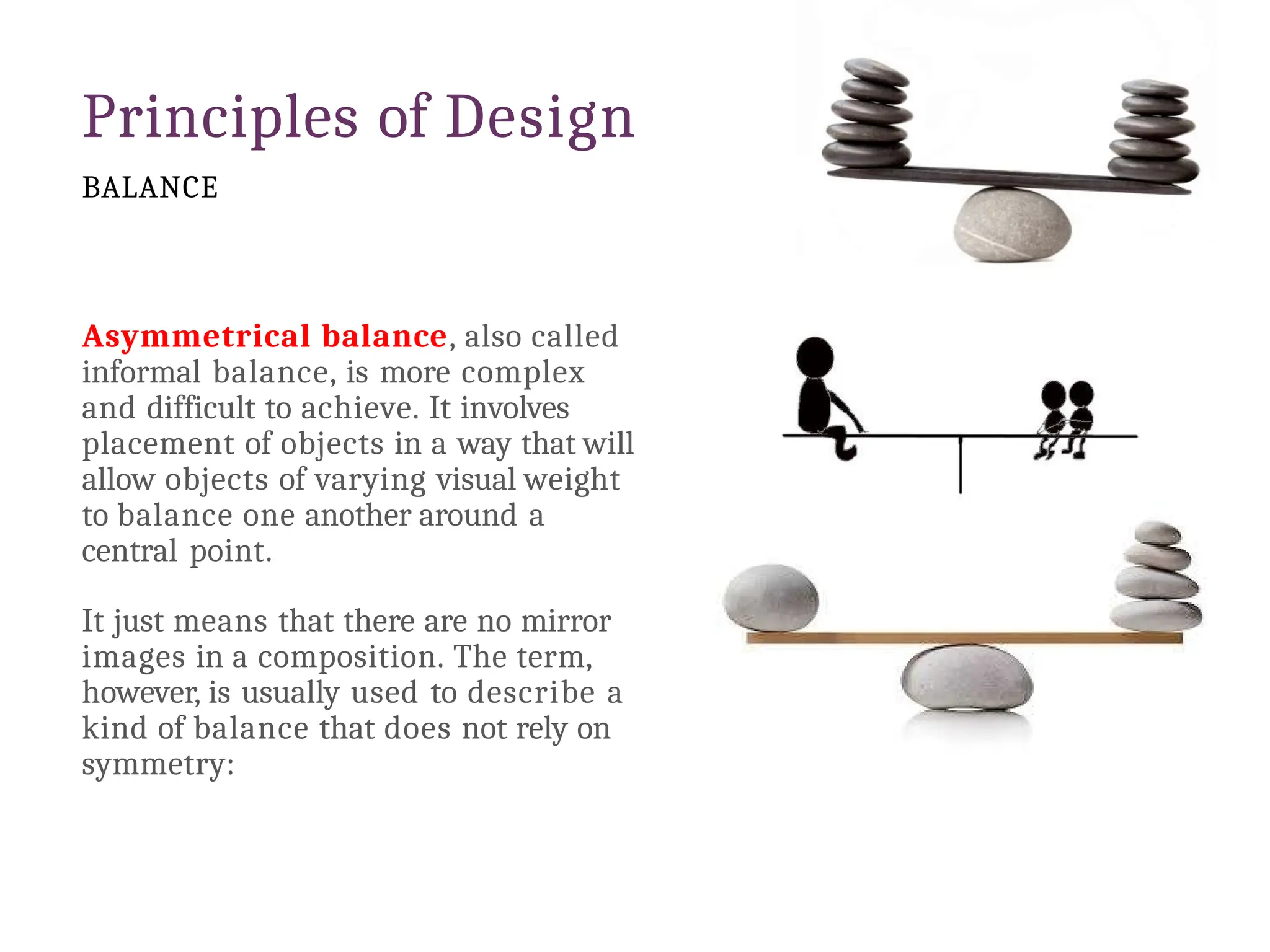
Asymmetrical balance, also called
informal balance, is more complex
and difficult to achieve. It involves
placement of objects in a way that will
allow objects of varying visual weight
to balance one another around a
central point.
It just means that there are no mirror
images in a composition. The term,
however, is usually used to describe a
kind of balance that does not rely on
symmetry:
Principles of Design
BALANCE
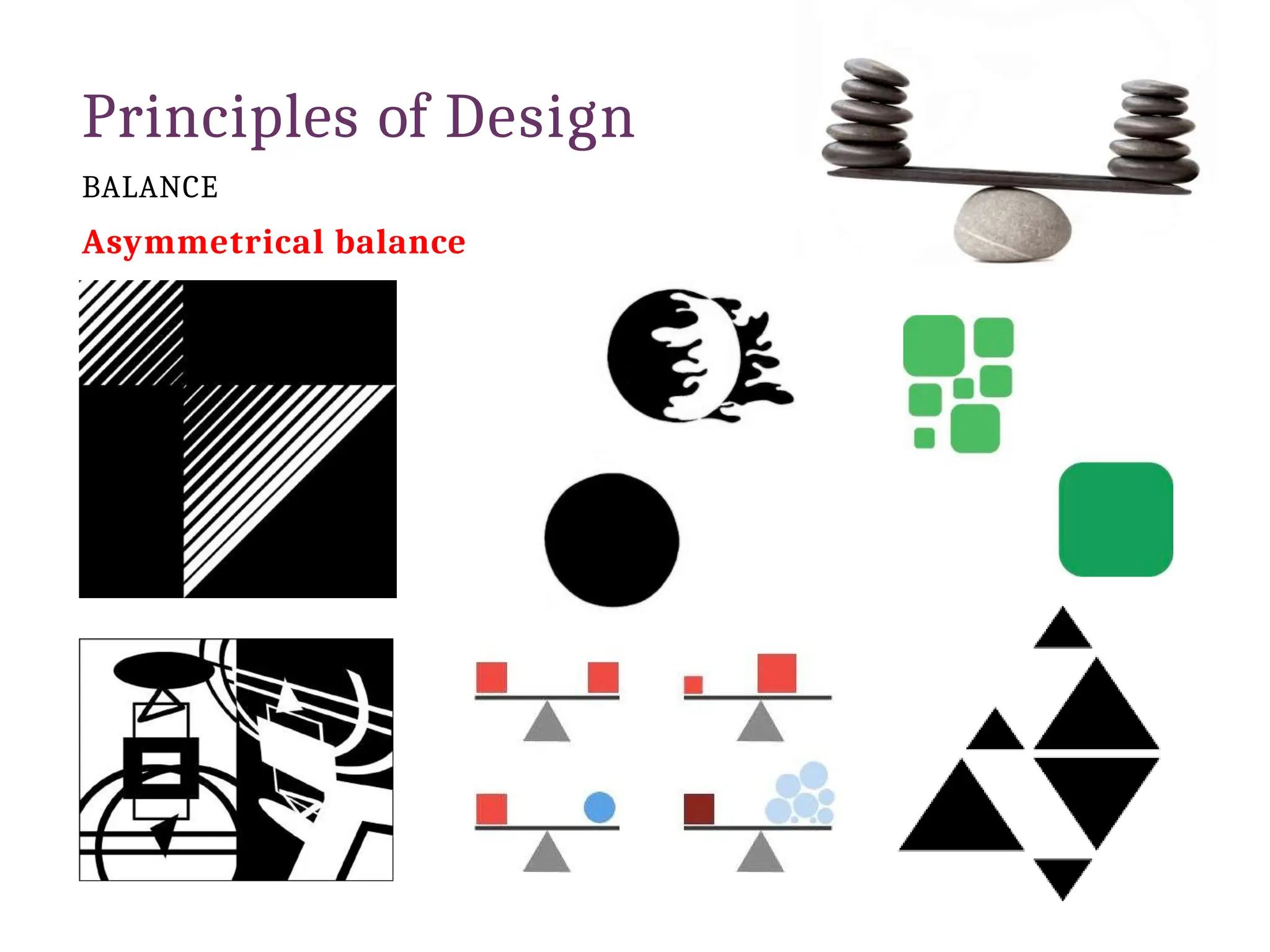
Asymmetrical balance
Principles of Design
BALANCE
Asymmetrical balance
Principles of Design
BALANCE
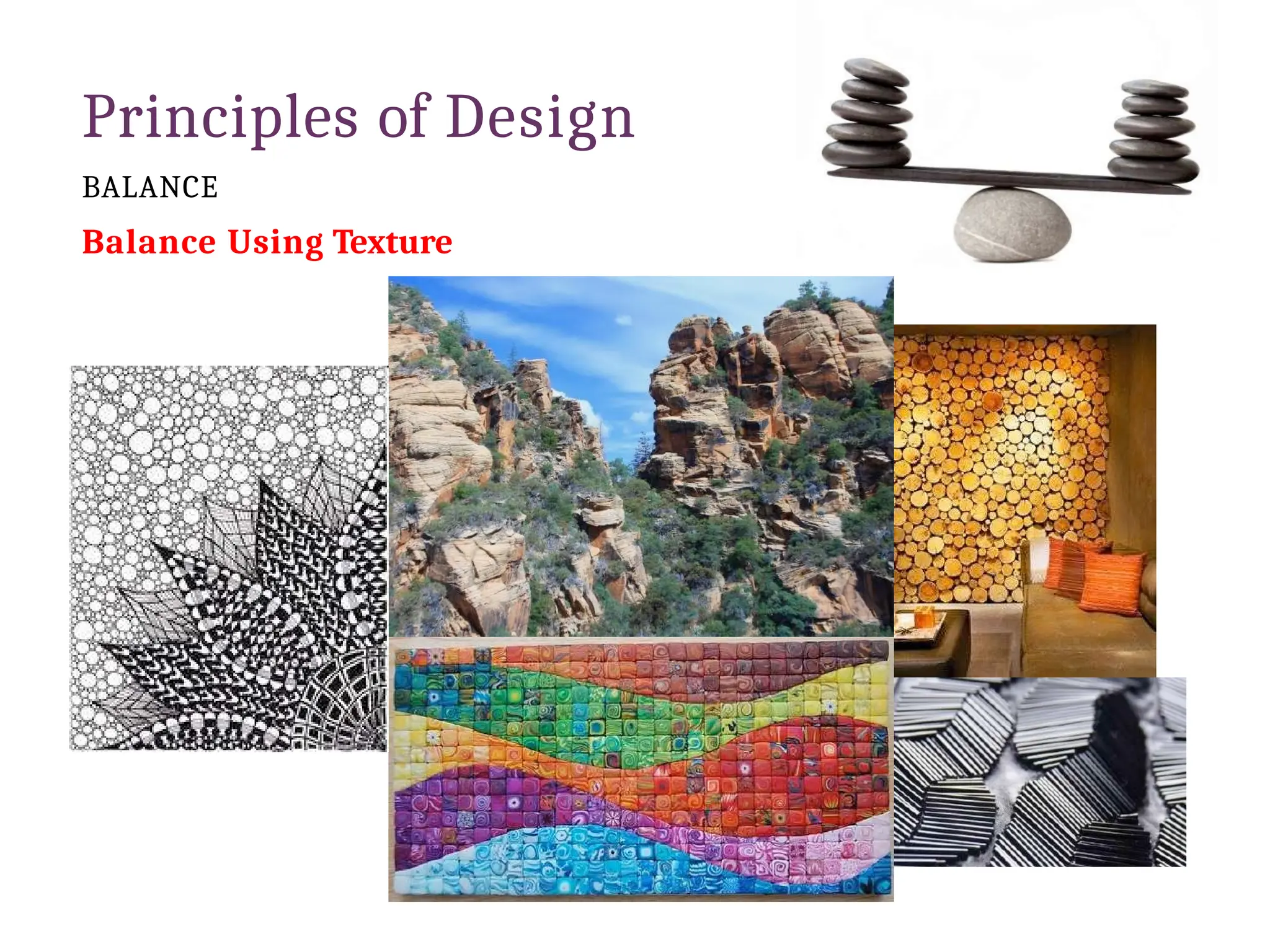
Balance Using Texture
Principles of Design
BALANCE
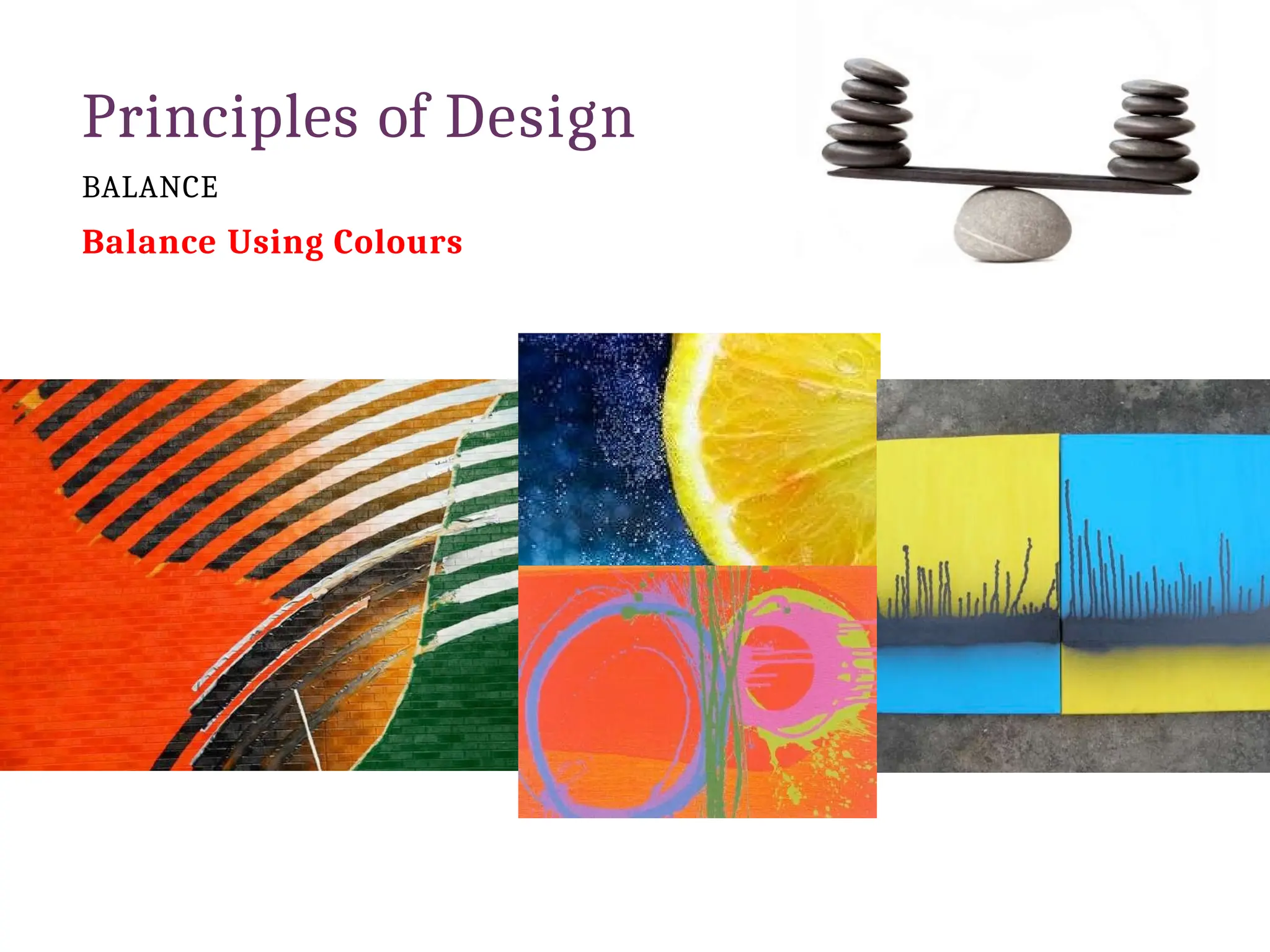
Balance Using Colours
Principles of Design
BALANCE
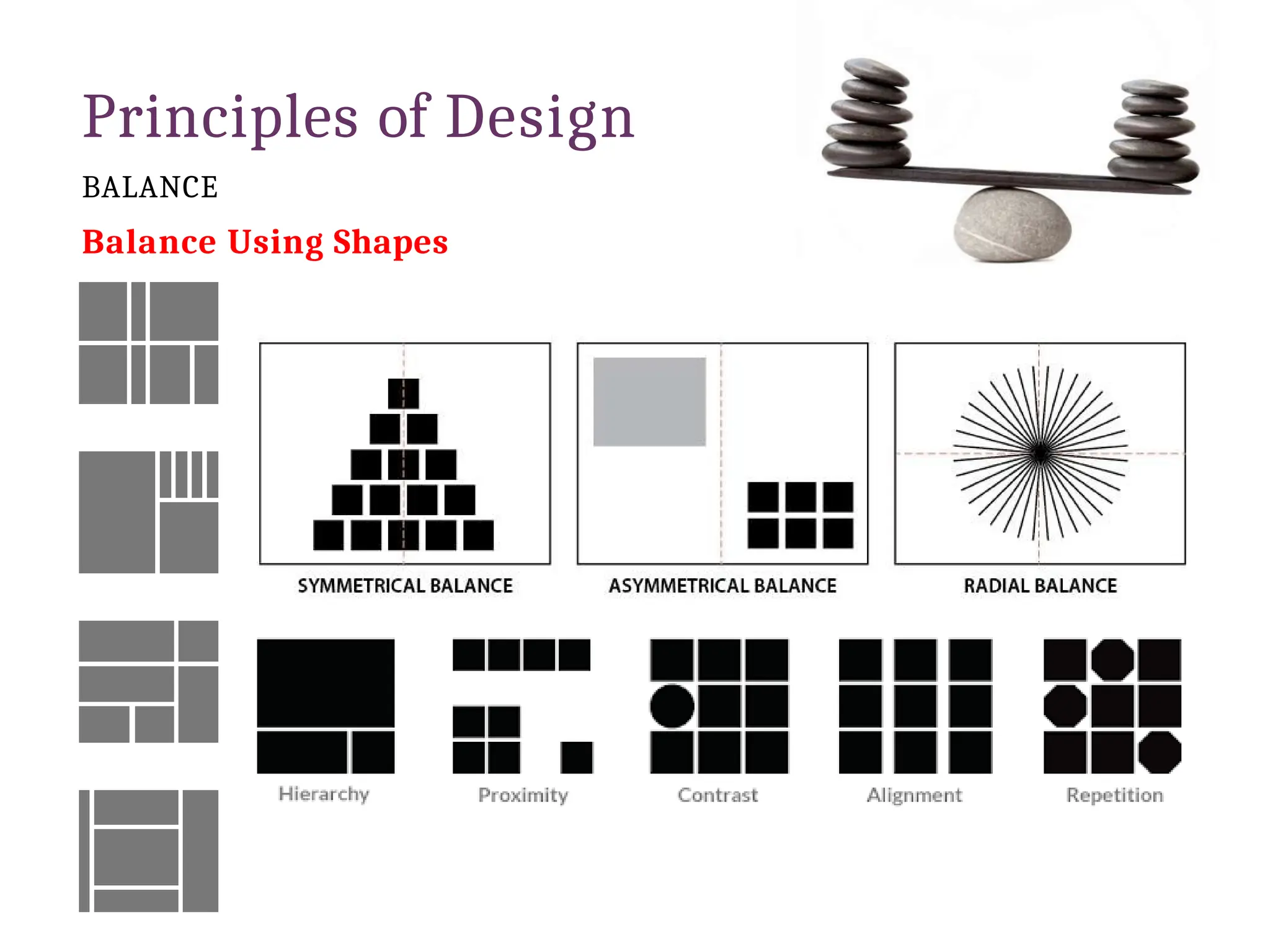
Balance Using Shapes
Principles of Design
BALANCE
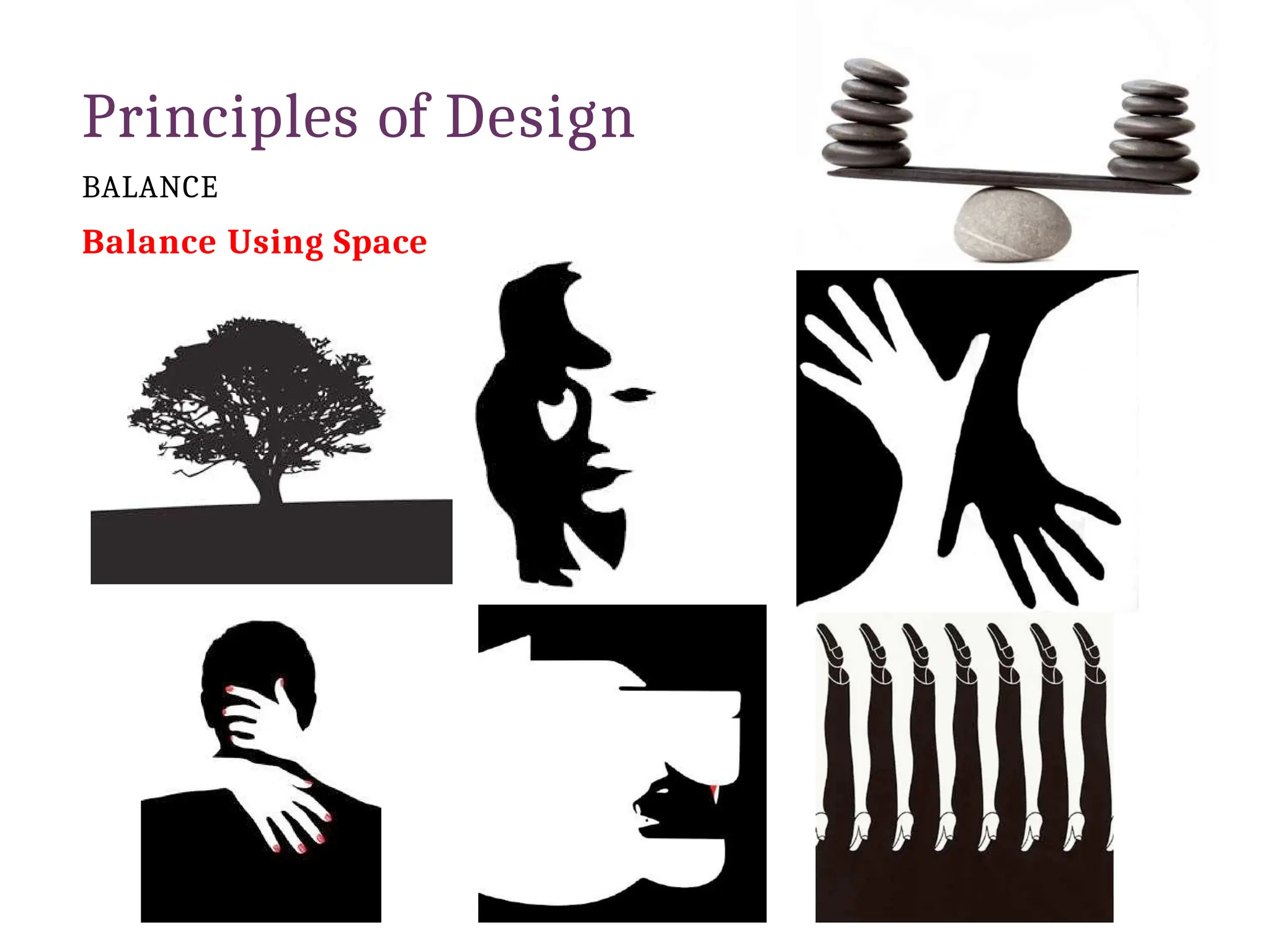
Balance Using Space
Principles of Design
RHYTHM
A visual tempo or beat. The principle of design
that refers to a regular repetition of elements of art
to produce the look and feel of movement. It is
often achieved through the careful placement of
repeated components which invite the viewer's eye
to jump rapidly or glide smoothly from one to the
next.
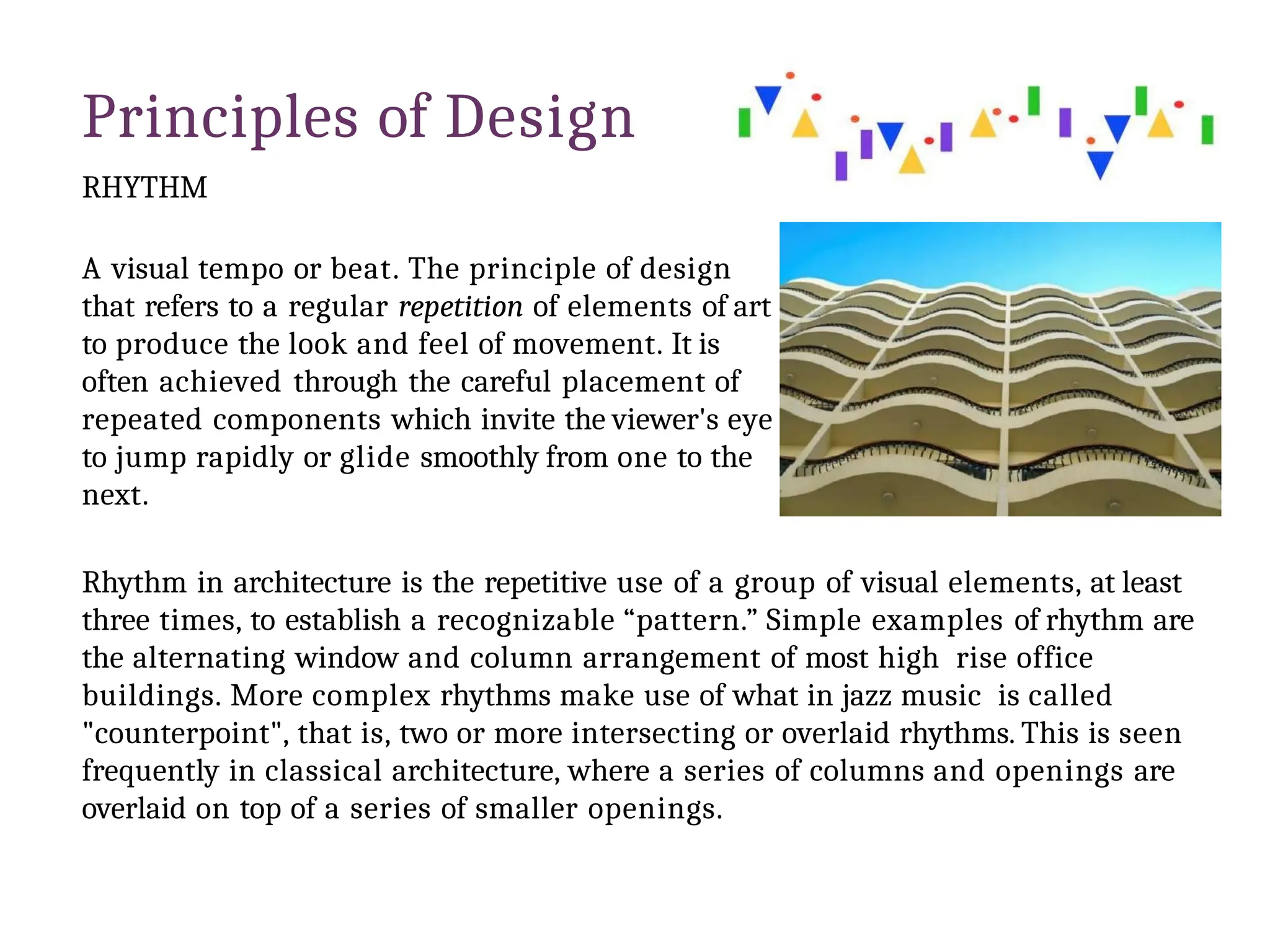
Rhythm in architecture is the repetitive use of a group of visual elements, at least
three times, to establish a recognizable “pattern.” Simple examples of rhythm are
the alternating window and column arrangement of most high rise office
buildings. More complex rhythms make use of what in jazz music is called
"counterpoint", that is, two or more intersecting or overlaid rhythms. This is seen
frequently in classical architecture, where a series of columns and openings are
overlaid on top of a series of smaller openings.
Principles of Design
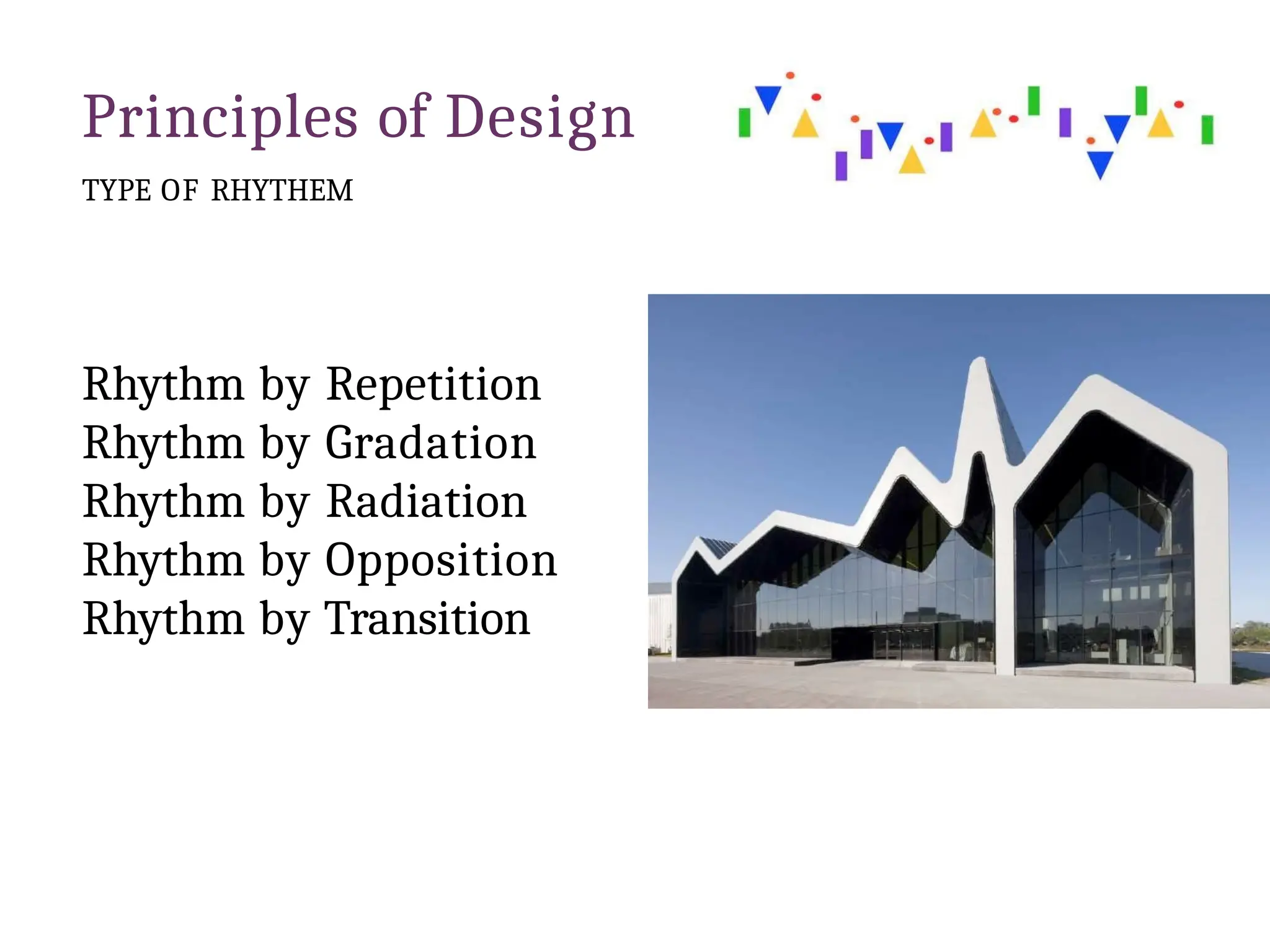
TYPE OF RHYTHEM
Rhythm by Repetition
Rhythm by Gradation
Rhythm by Radiation
Rhythm by Opposition
Rhythm by Transition
Principles of Design
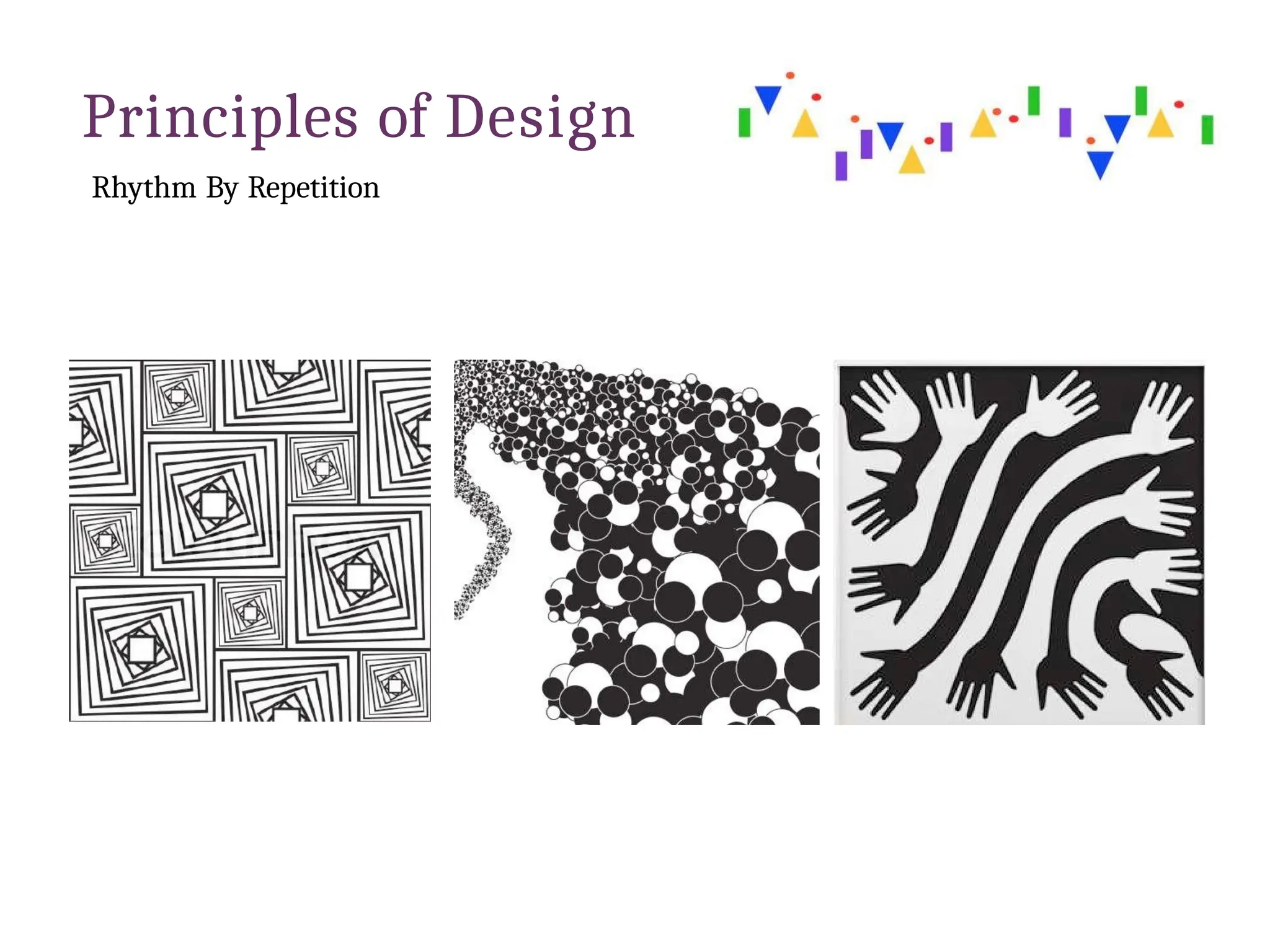
Rhythm By Repetition
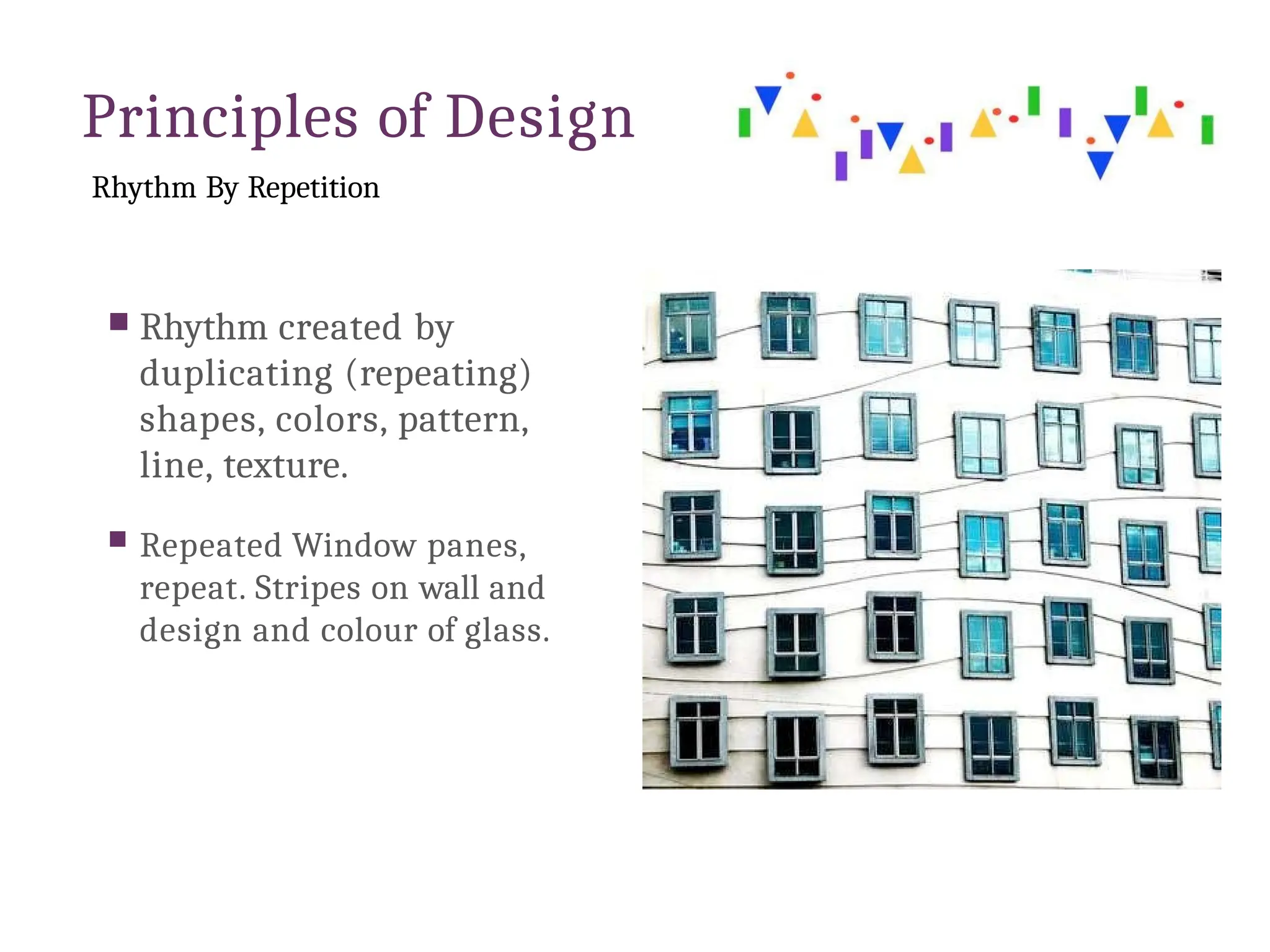
 Rhythm created by
duplicating (repeating)
shapes, colors, pattern,
line, texture.
 Repeated Window panes,
repeat. Stripes on wall and
design and colour of glass.
Principles of Design
Rhythm By Repetition
Principles of Design
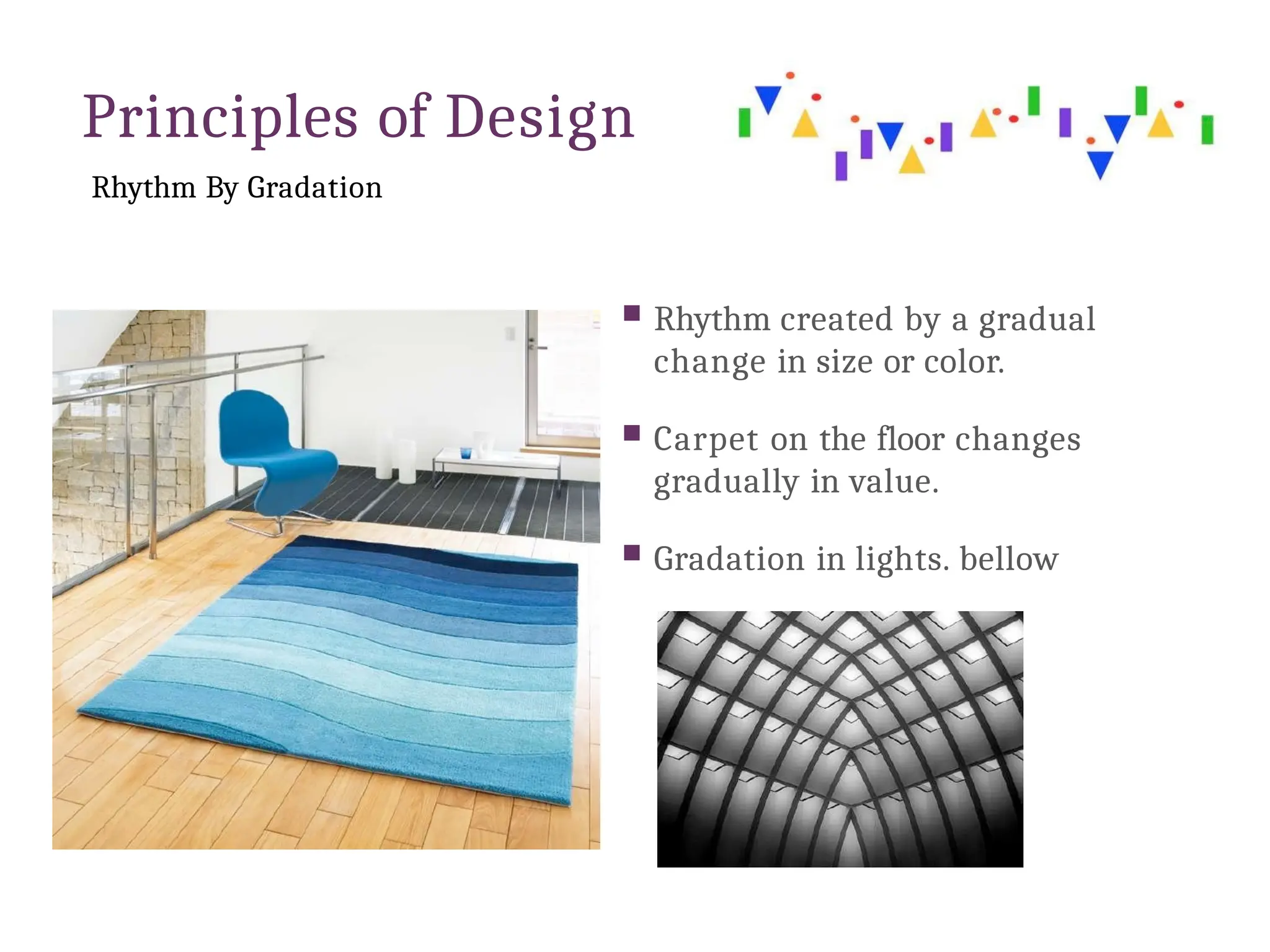
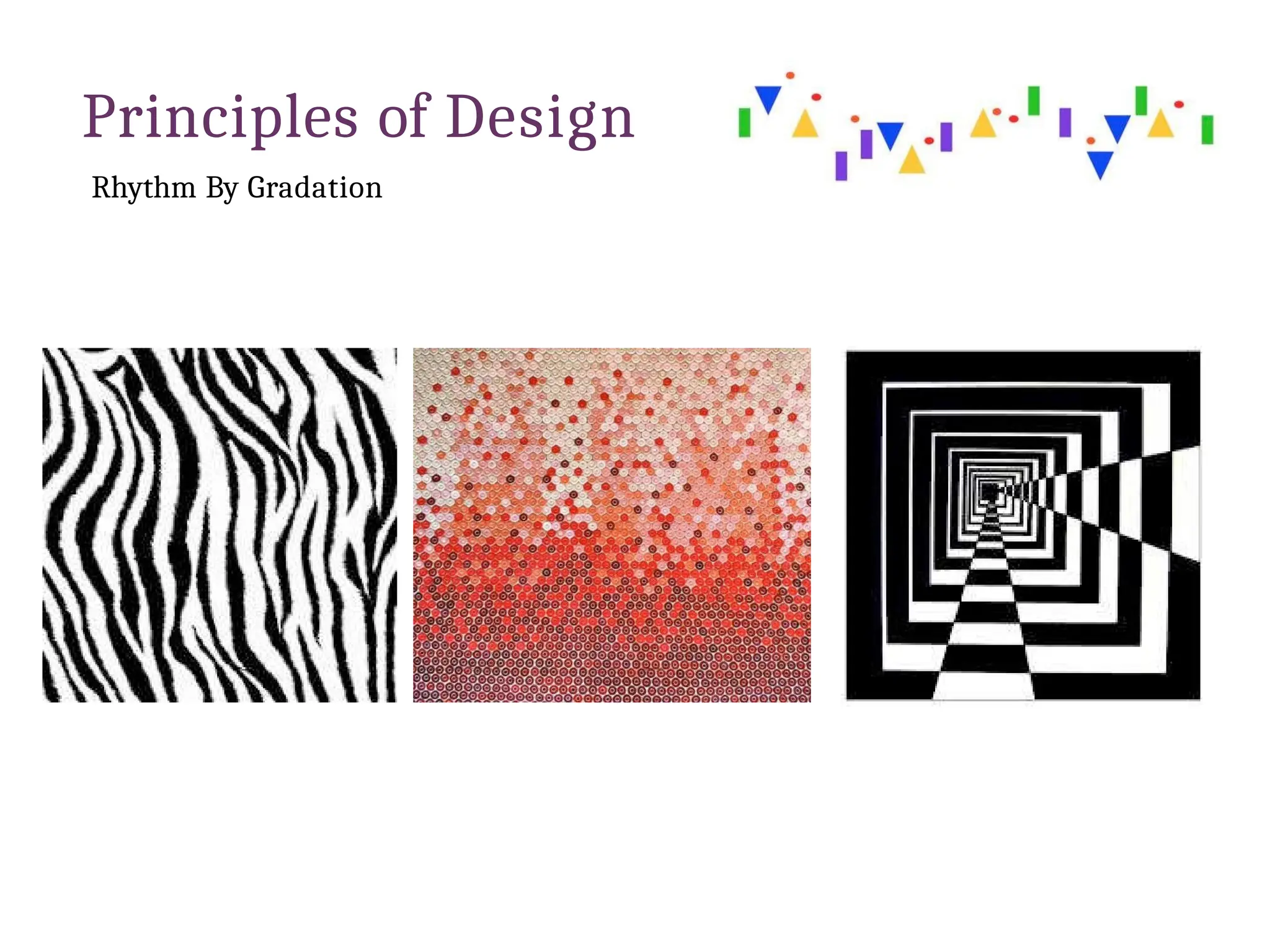
Rhythm By Gradation
 Rhythm created by a gradual
change in size or color.
 Carpet on the floor changes
gradually in value.
 Gradation in lights. bellow
Principles of Design
Rhythm By Gradation
Principles of Design
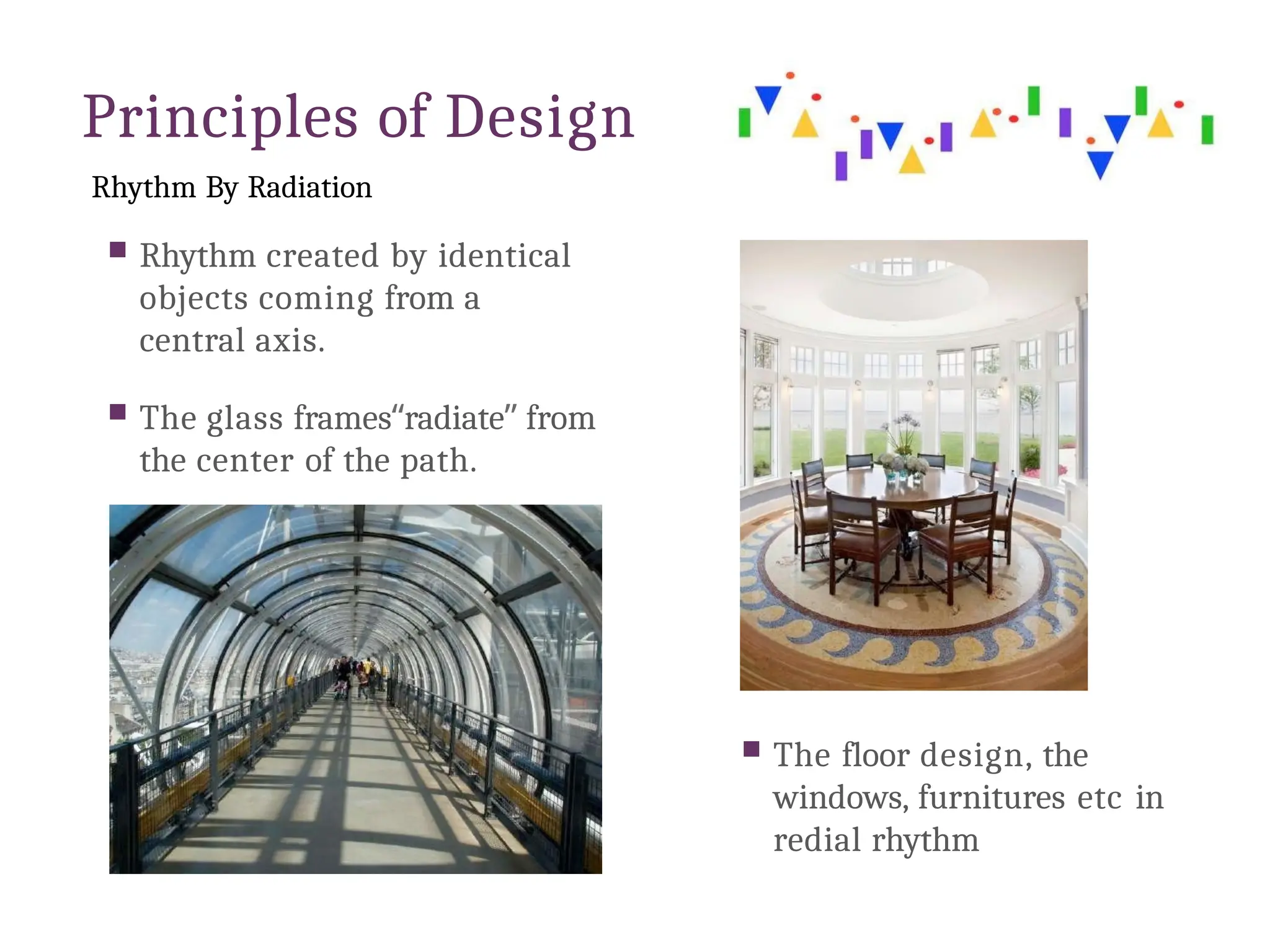
Rhythm By Radiation
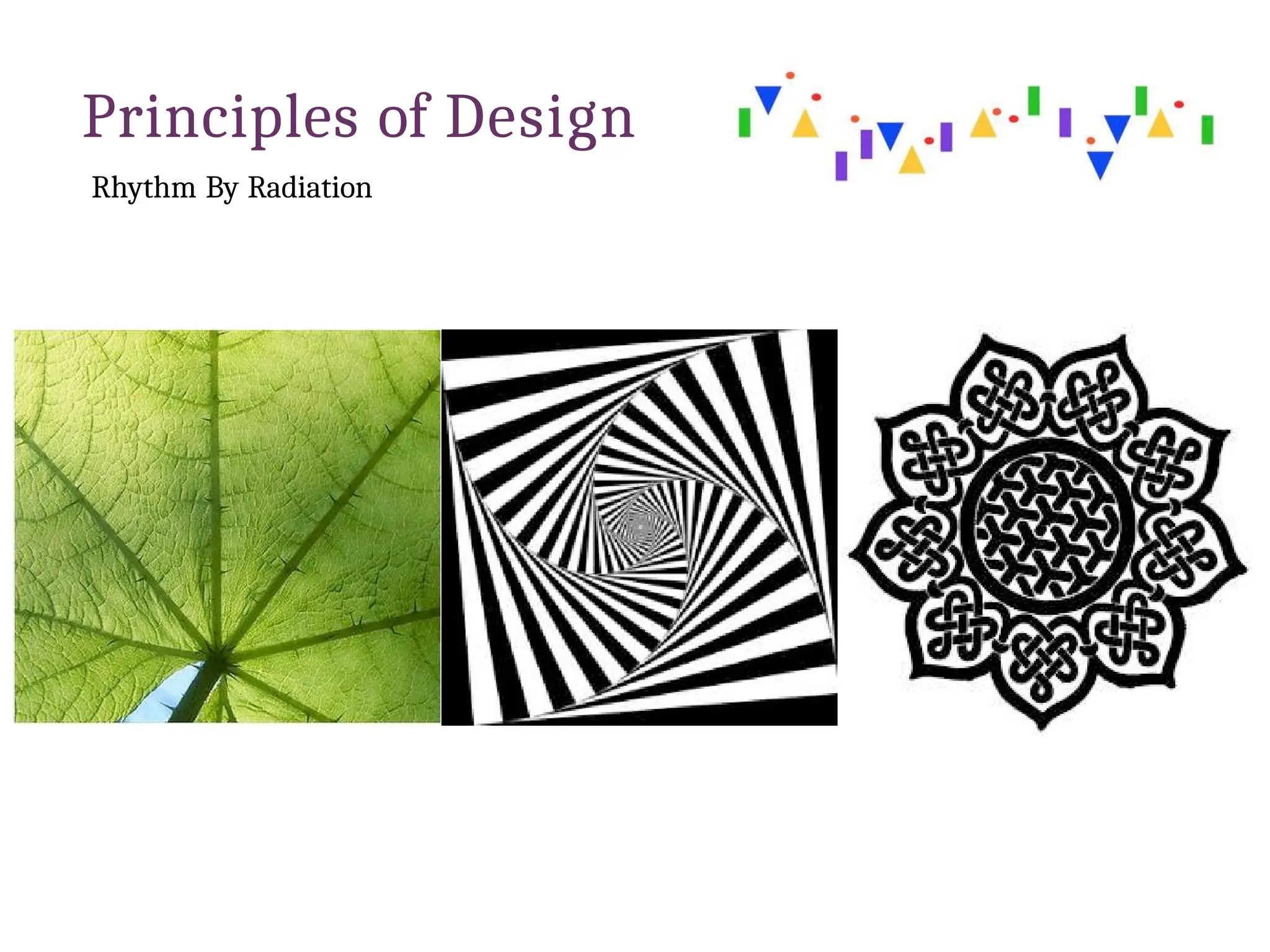
 Rhythm created by identical
objects coming from a
central axis.
 The glass frames“radiate” from
the center of the path.
 The floor design, the
windows, furnitures etc in
redial rhythm
Principles of Design
Rhythm By Radiation
Principles of Design
Rhythm By Opposition
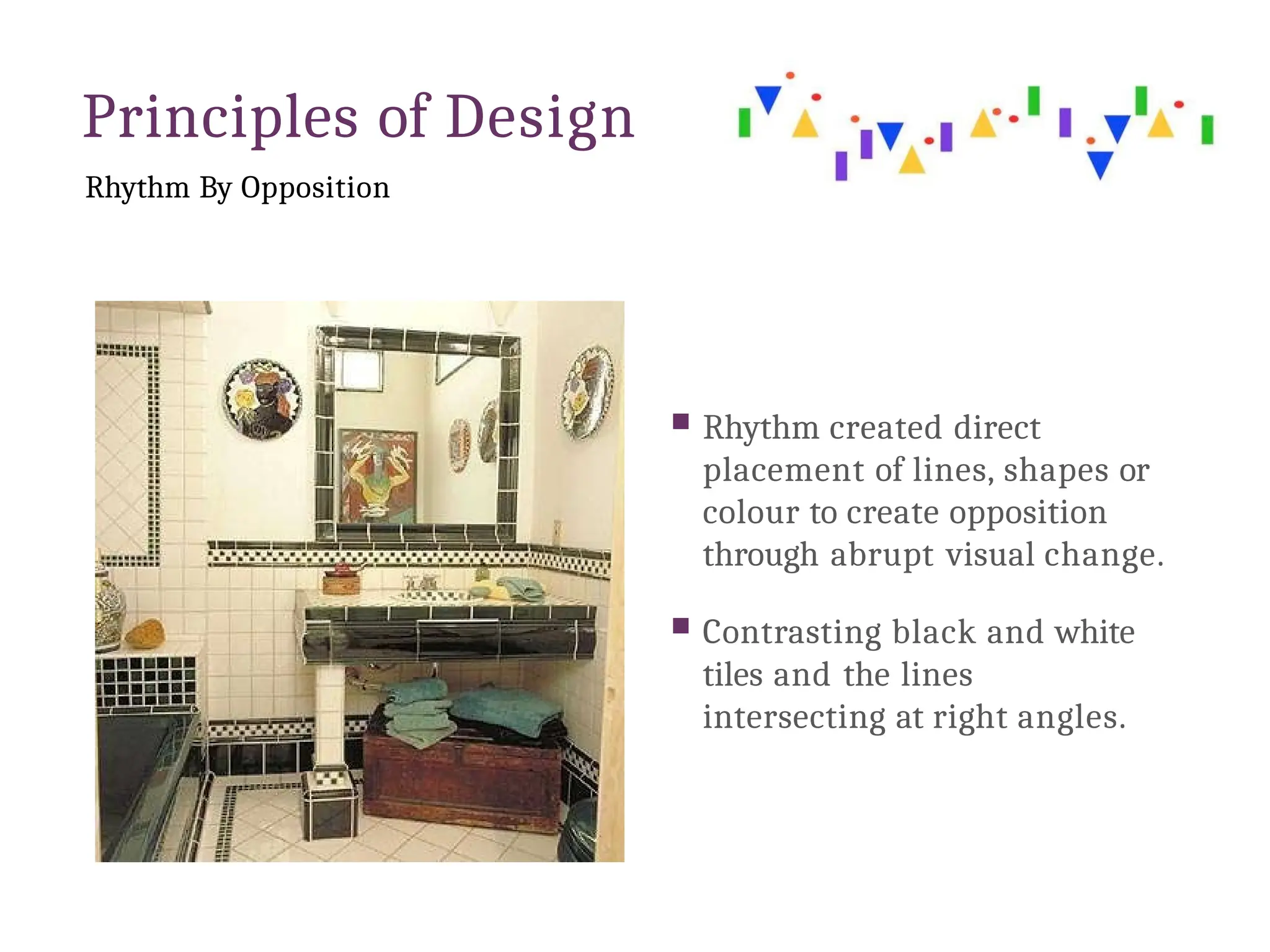
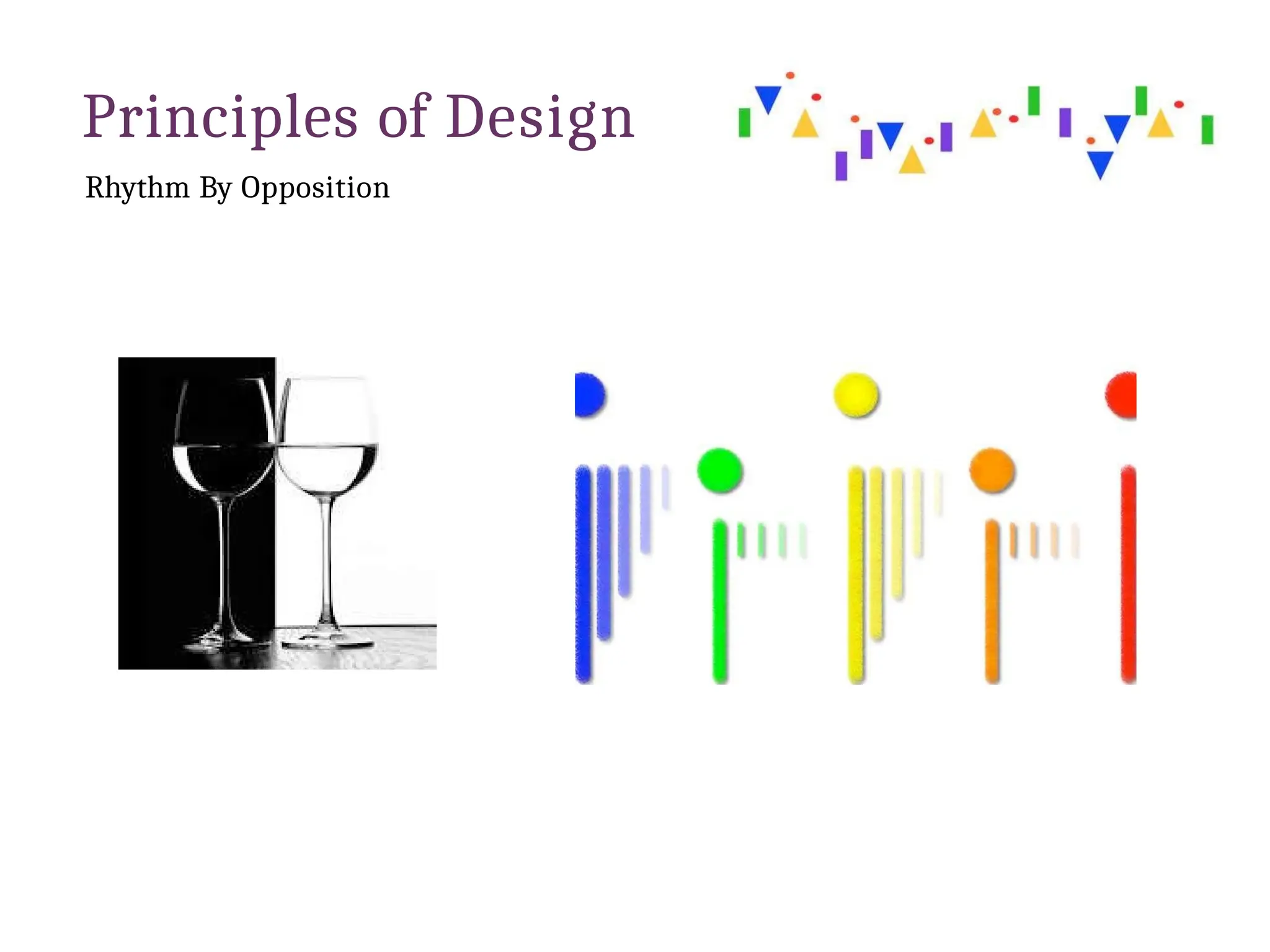
 Rhythm created direct
placement of lines, shapes or
colour to create opposition
through abrupt visual change.
 Contrasting black and white
tiles and the lines
intersecting at right angles.
Principles of Design
Rhythm By Opposition
Principles of Design
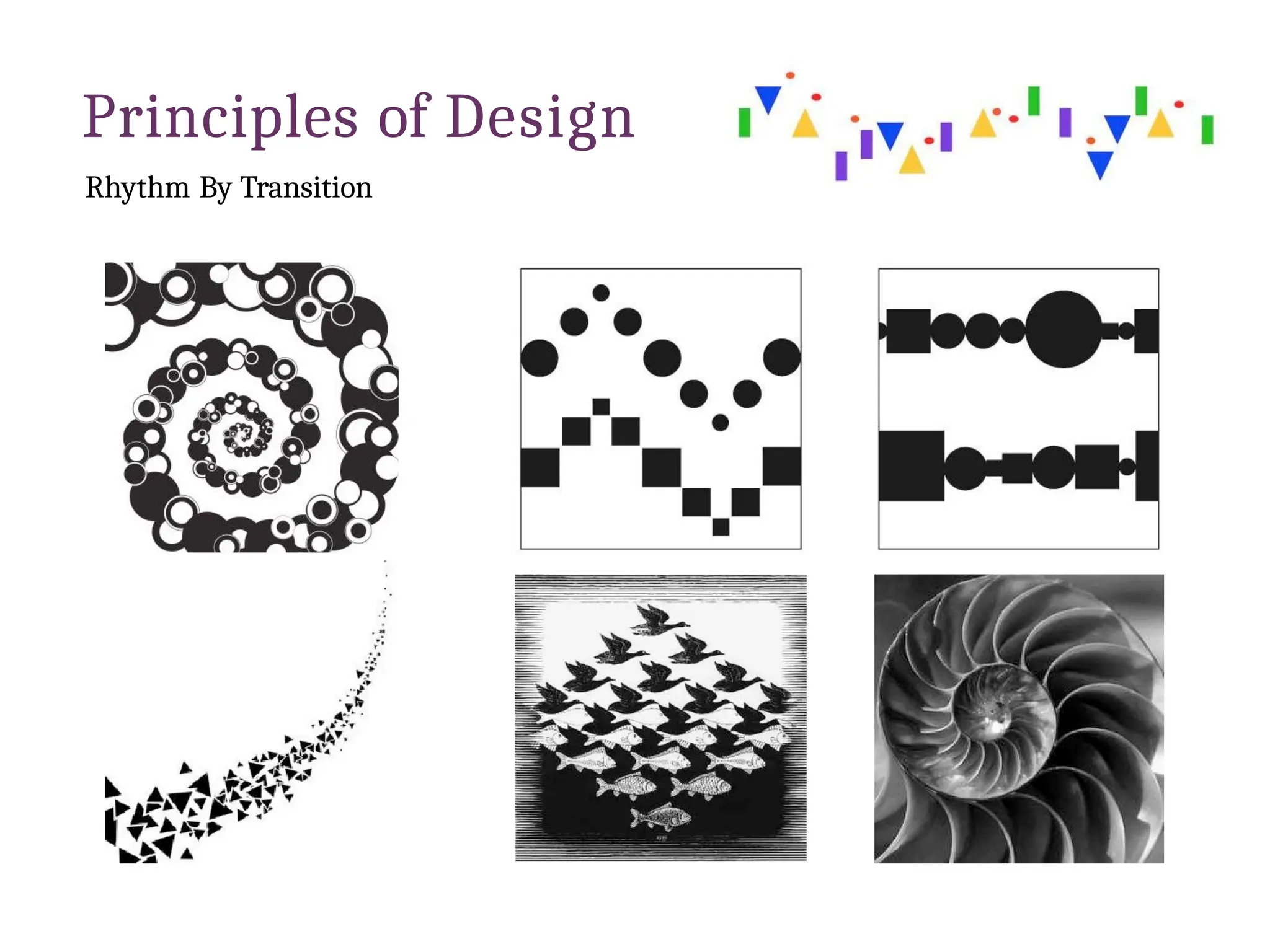
Rhythm By Transition
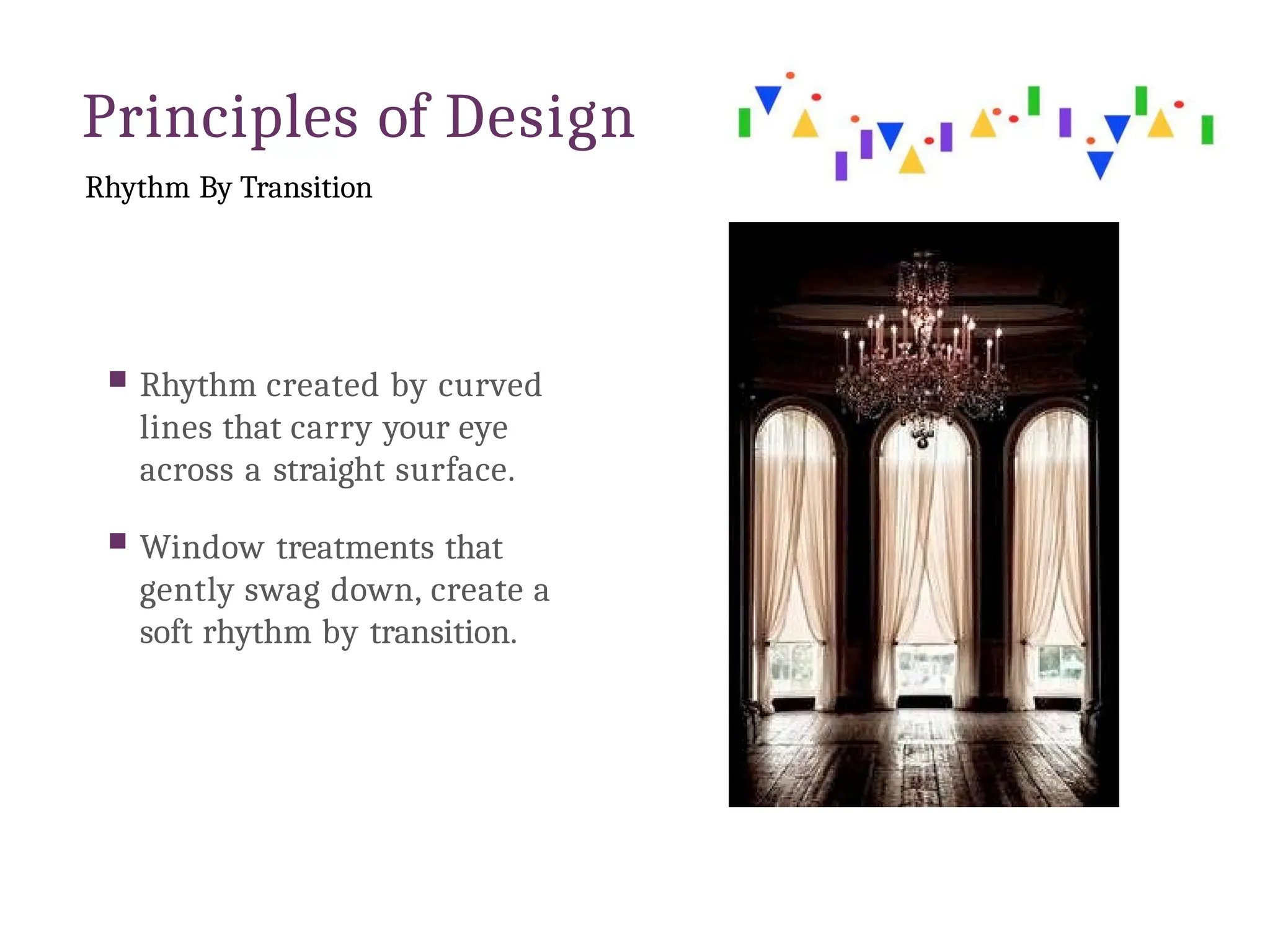
 Rhythm created by curved
lines that carry your eye
across a straight surface.
 Window treatments that
gently swag down, create a
soft rhythm by transition.
Principles of Design
Rhythm By Transition
Principles of Design
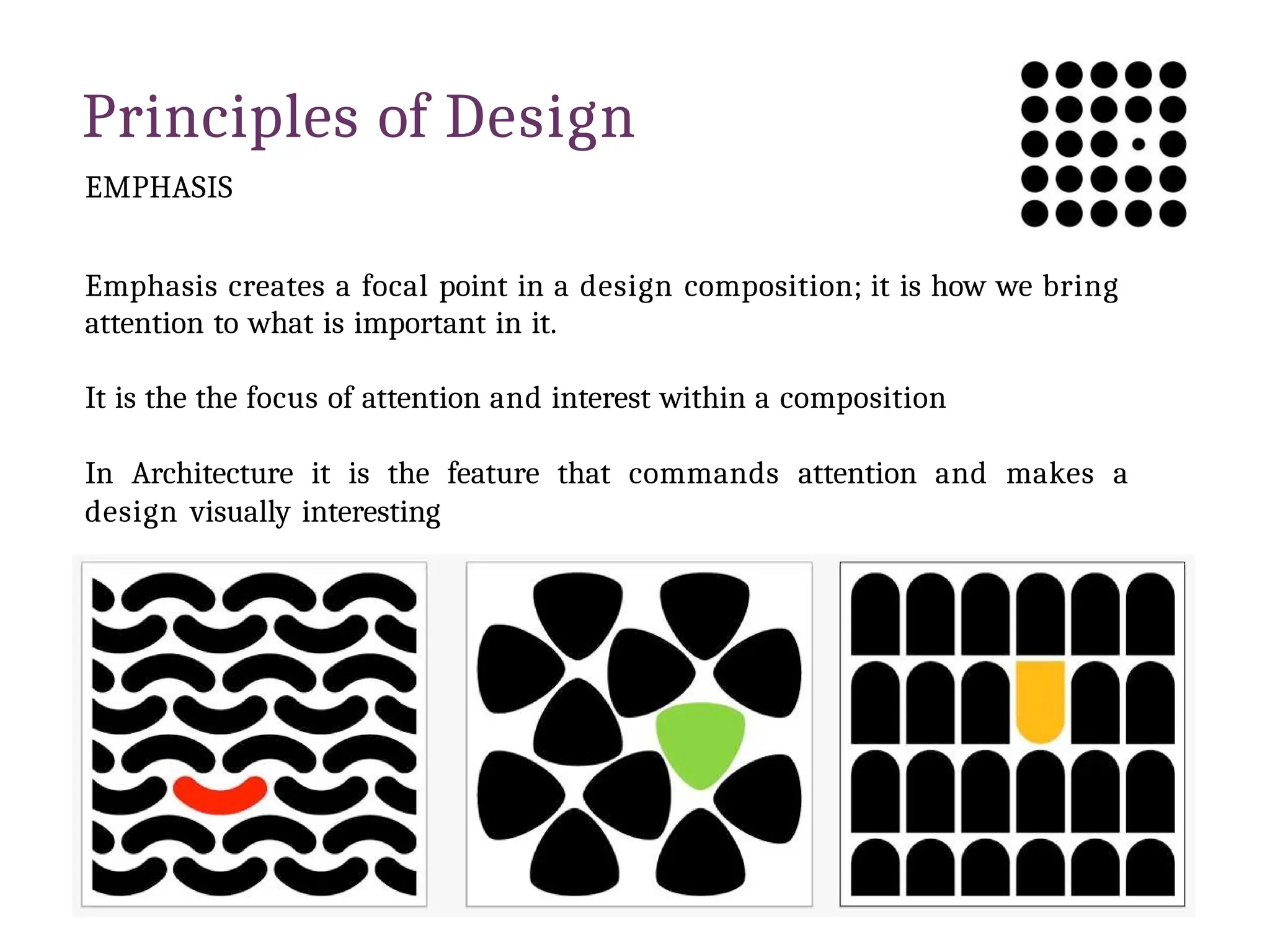
EMPHASIS
Emphasis creates a focal point in a design composition; it is how we bring
attention to what is important in it.
It is the the focus of attention and interest within a composition
In Architecture it is the feature that commands attention and makes a
design visually interesting
Principles of Design
EMPHASIS
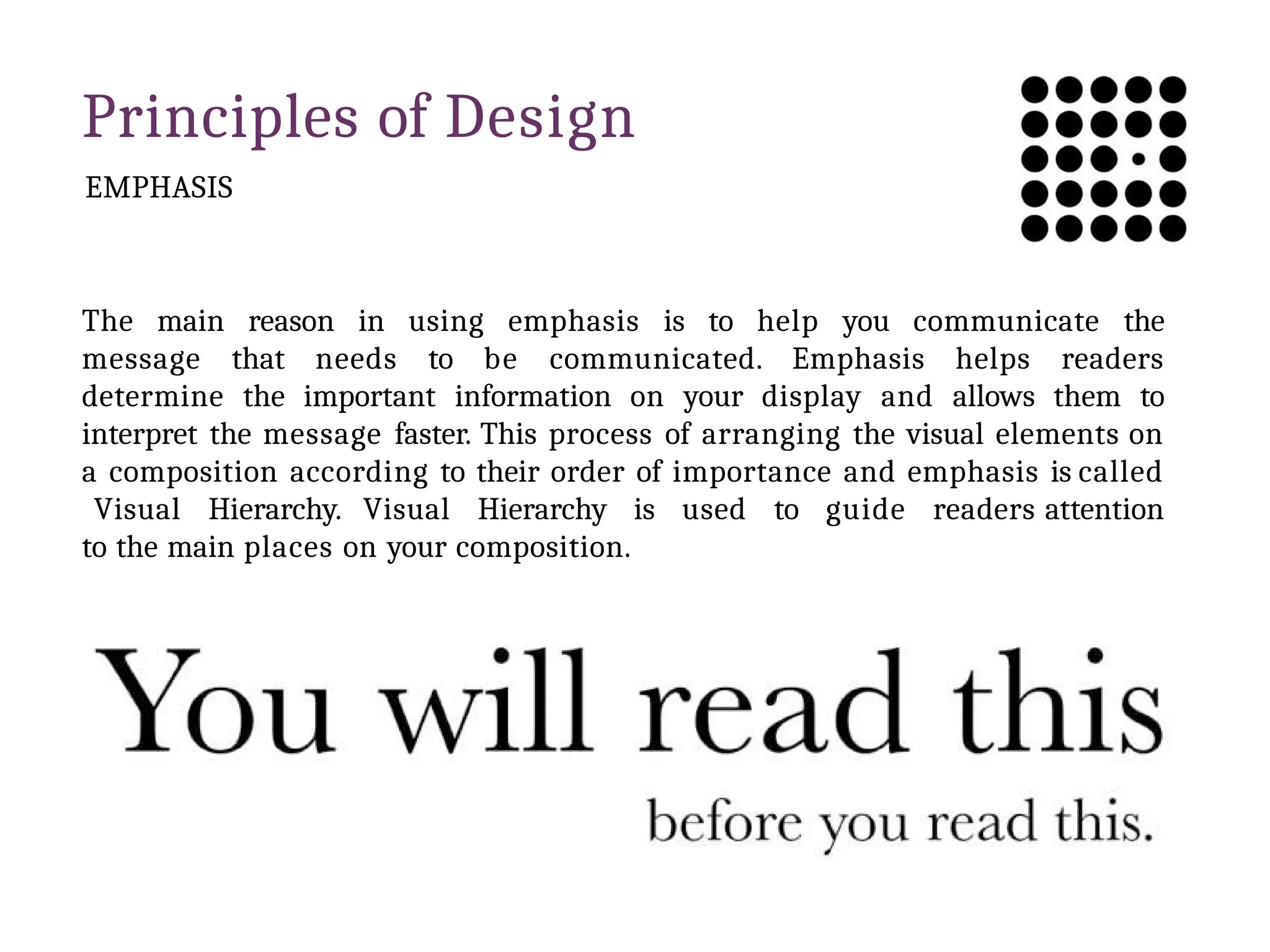
The main reason in using emphasis is to help you communicate the
message that needs to be communicated. Emphasis helps readers
determine the important information on your display and allows them to
interpret the message faster. This process of arranging the visual elements on
a composition according to their order of importance and emphasis is called
Visual Hierarchy. Visual Hierarchy is used to guide readers attention
to the main places on your composition.
Principles of Design
How to Create Emphasis
EMPHASIS
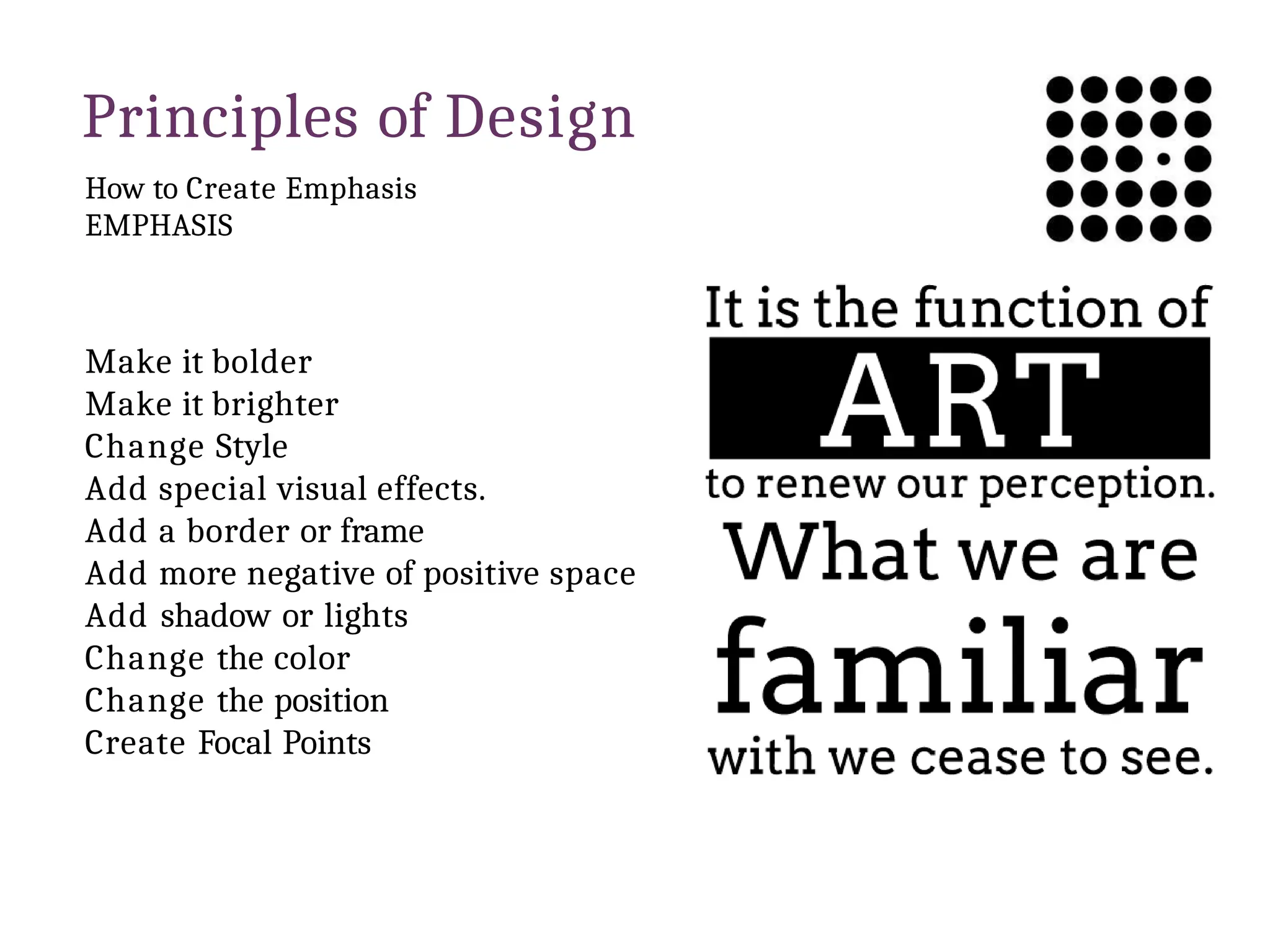
Make it bolder
Make it brighter
Change Style
Add special visual effects.
Add a border or frame
Add more negative of positive space
Add shadow or lights
Change the color
Change the position
Create Focal Points
Principles of Design
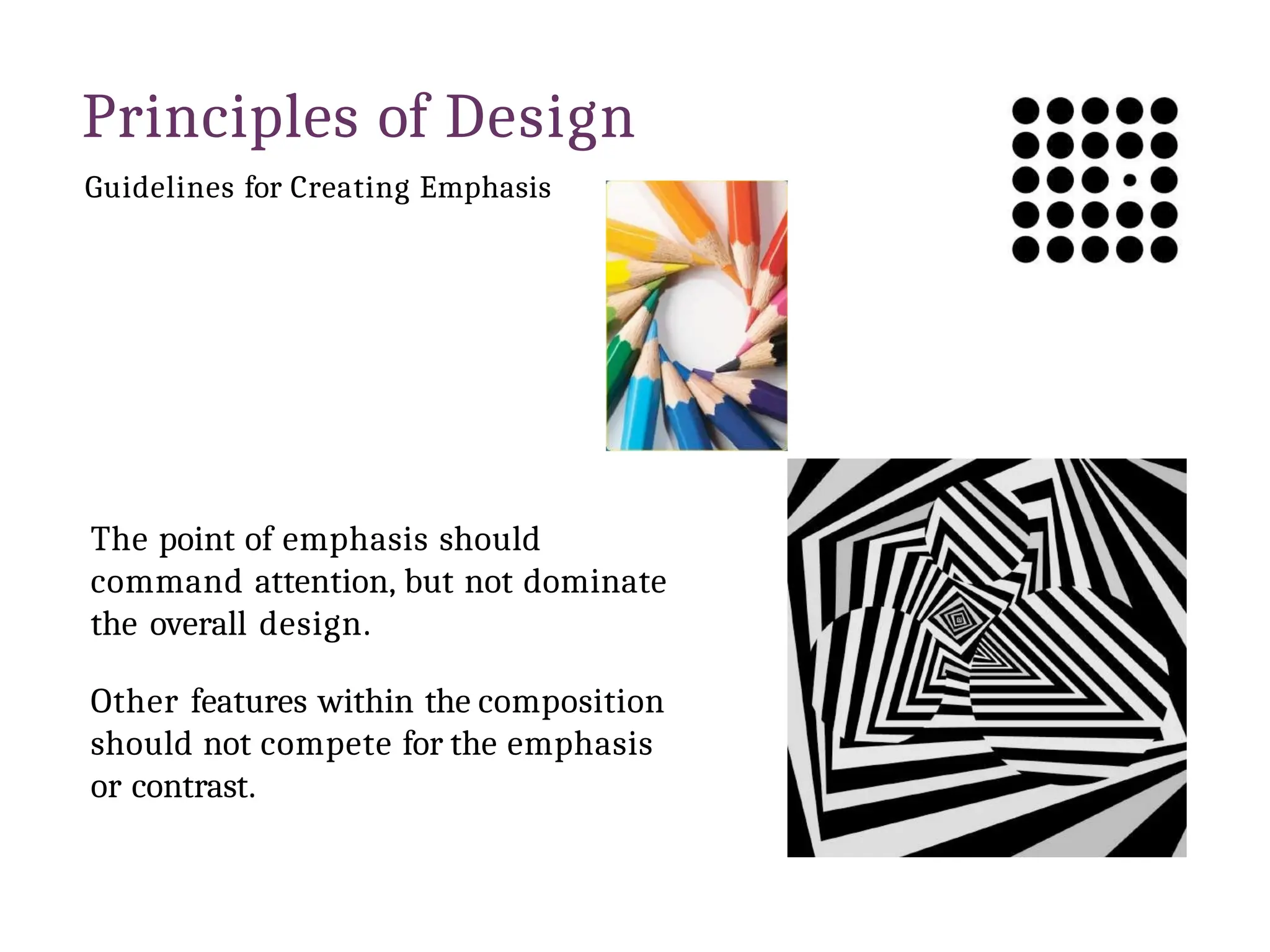
Guidelines for Creating Emphasis
The point of emphasis should
command attention, but not dominate
the overall design.
Other features within the composition
should not compete for the emphasis
or contrast.
Principles of Design
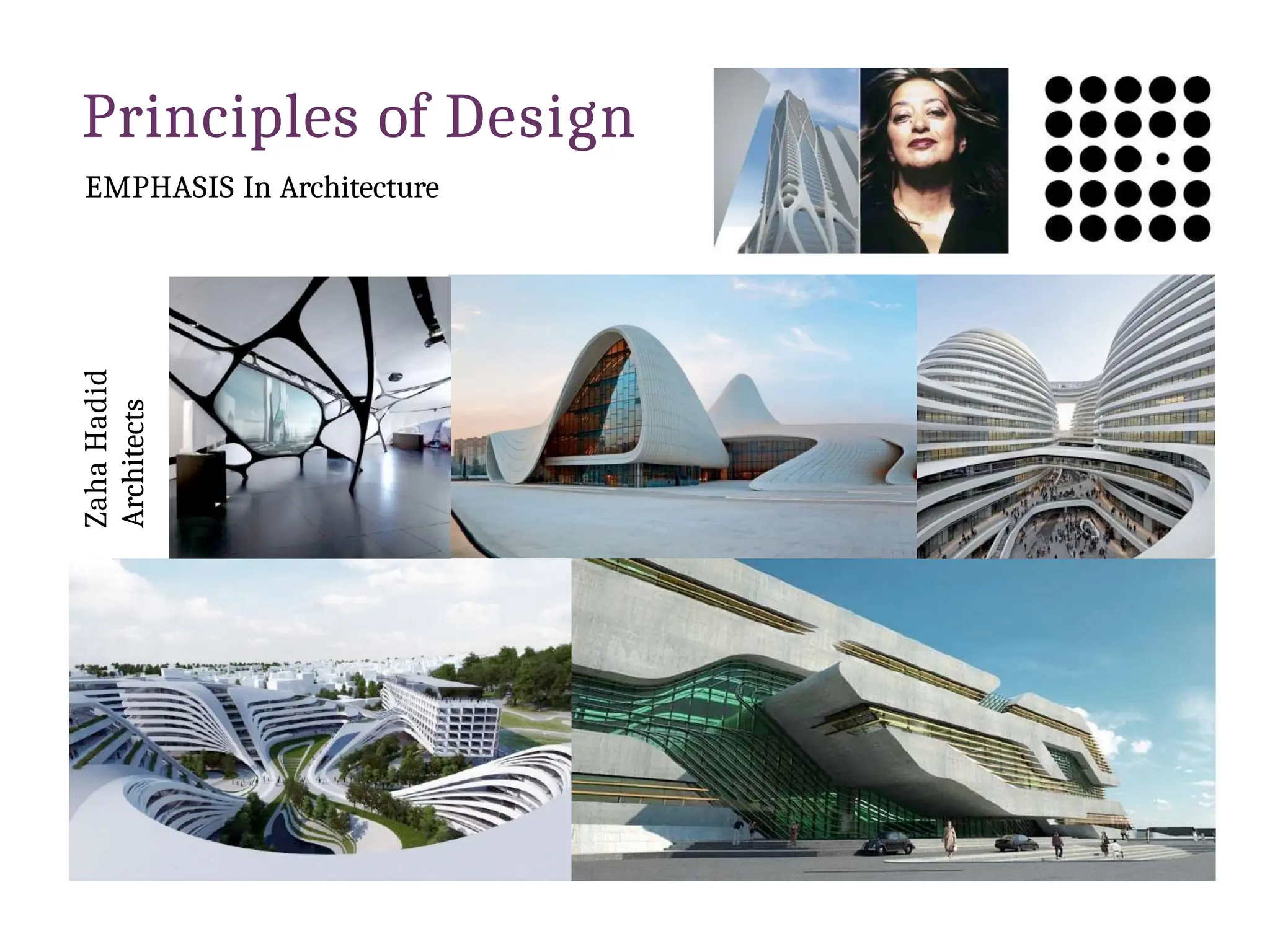
EMPHASIS In Architecture
Zaha
Hadid
Architects
Principles of Design
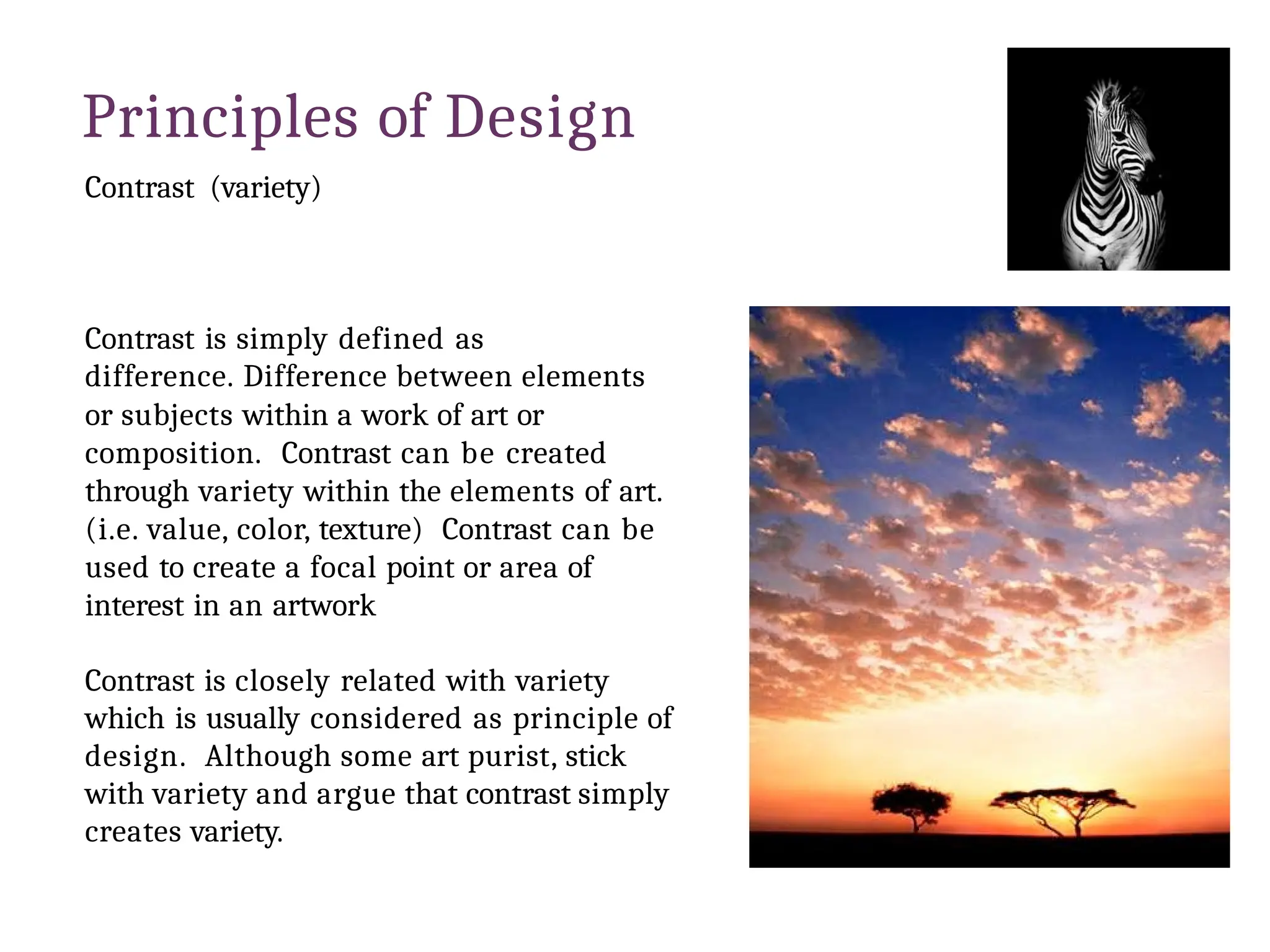
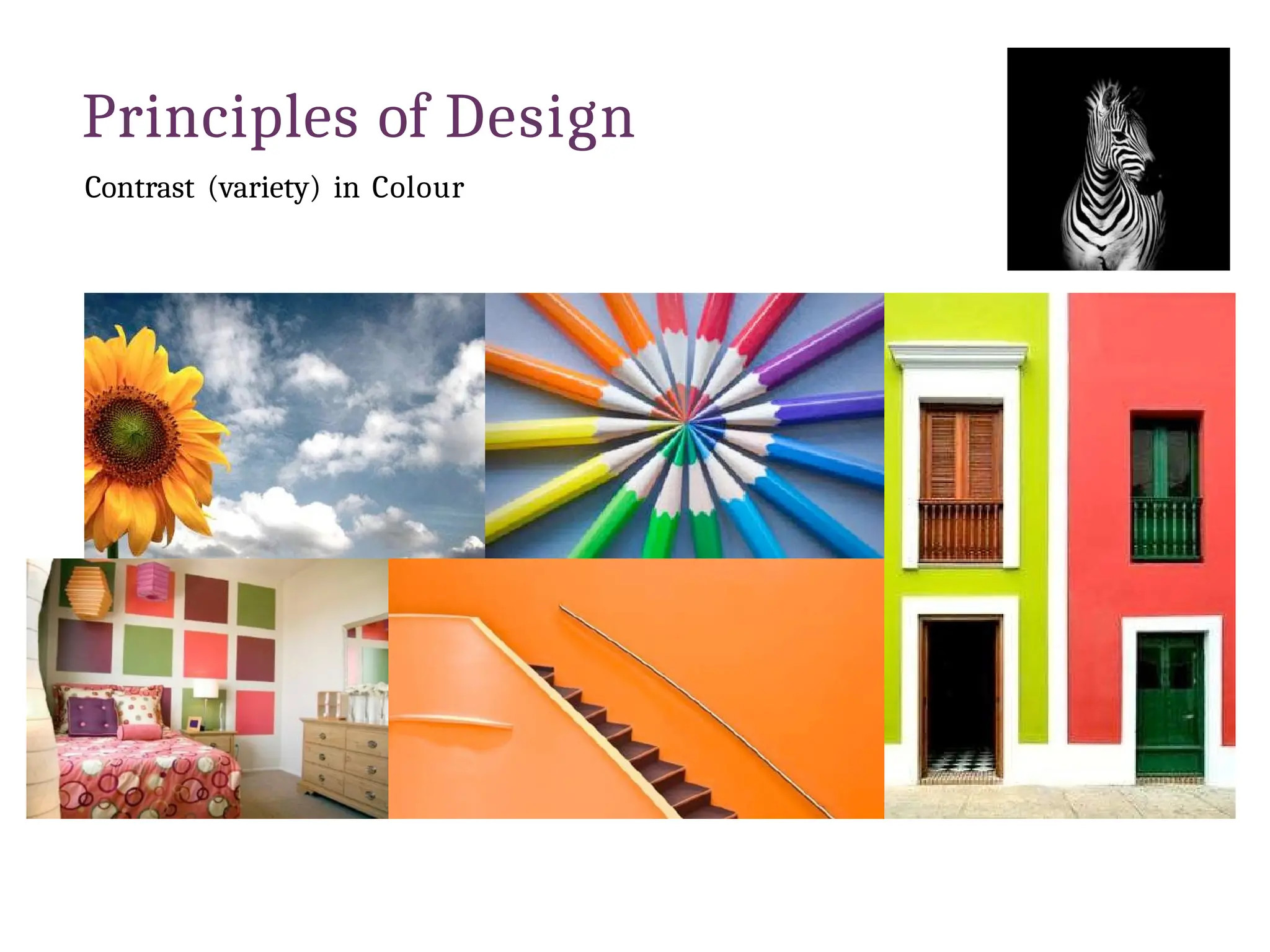
Contrast (variety)
Contrast is simply defined as
difference. Difference between elements
or subjects within a work of art or
composition. Contrast can be created
through variety within the elements of art.
(i.e. value, color, texture) Contrast can be
used to create a focal point or area of
interest in an artwork
Contrast is closely related with variety
which is usually considered as principle of
design. Although some art purist, stick
with variety and argue that contrast simply
creates variety.
Principles of Design
Contrast (variety)
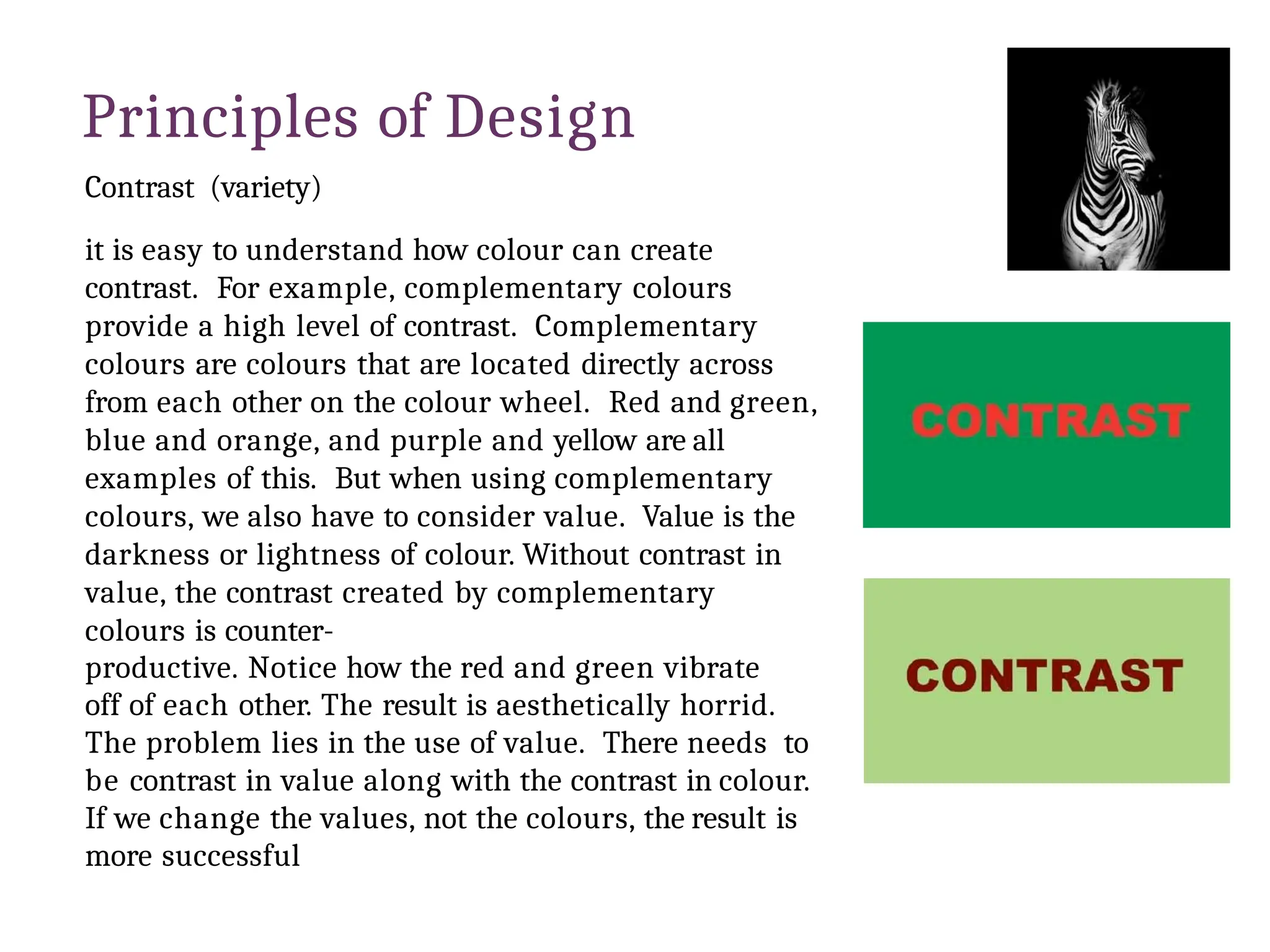
it is easy to understand how colour can create
contrast. For example, complementary colours
provide a high level of contrast. Complementary
colours are colours that are located directly across
from each other on the colour wheel. Red and green,
blue and orange, and purple and yellow are all
examples of this. But when using complementary
colours, we also have to consider value. Value is the
darkness or lightness of colour. Without contrast in
value, the contrast created by complementary
colours is counter-
productive. Notice how the red and green vibrate
off of each other. The result is aesthetically horrid.
The problem lies in the use of value. There needs to
be contrast in value along with the contrast in colour.
If we change the values, not the colours, the result is
more successful
Principles of Design
Contrast (variety) in Colour
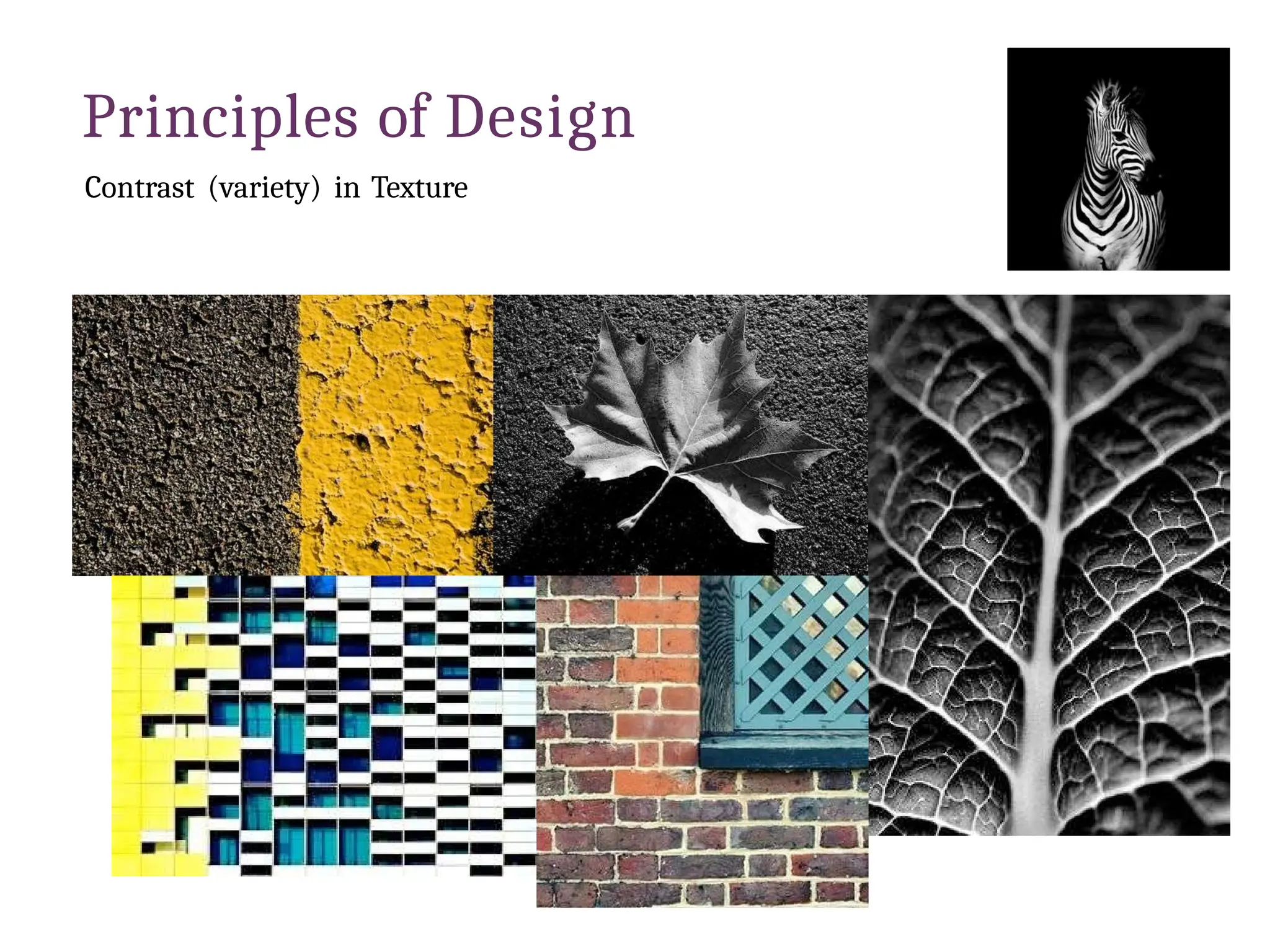
Principles of Design
Contrast (variety) in Texture
Principles of Design
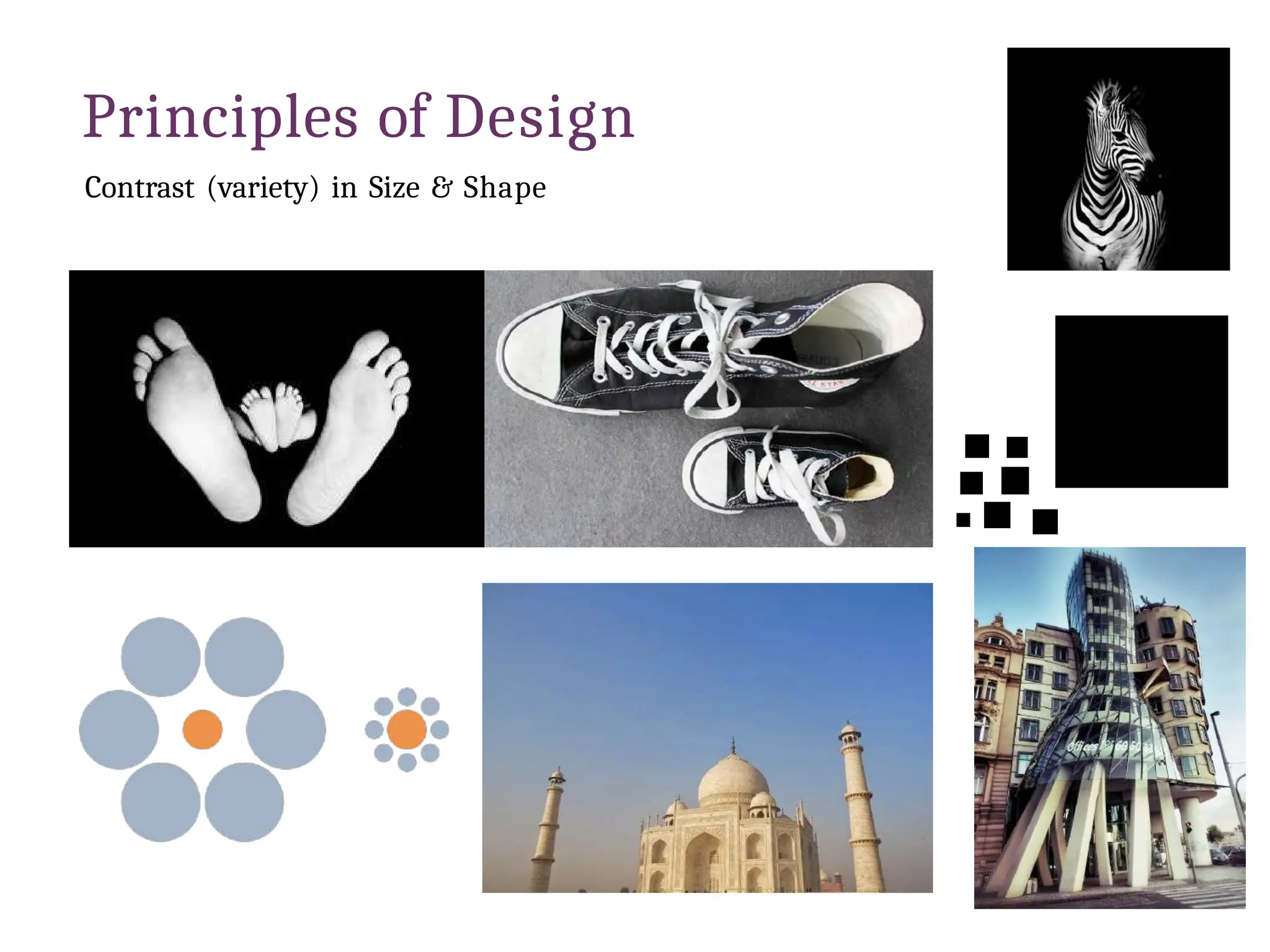
Contrast (variety) in Size & Shape
Principles of Design
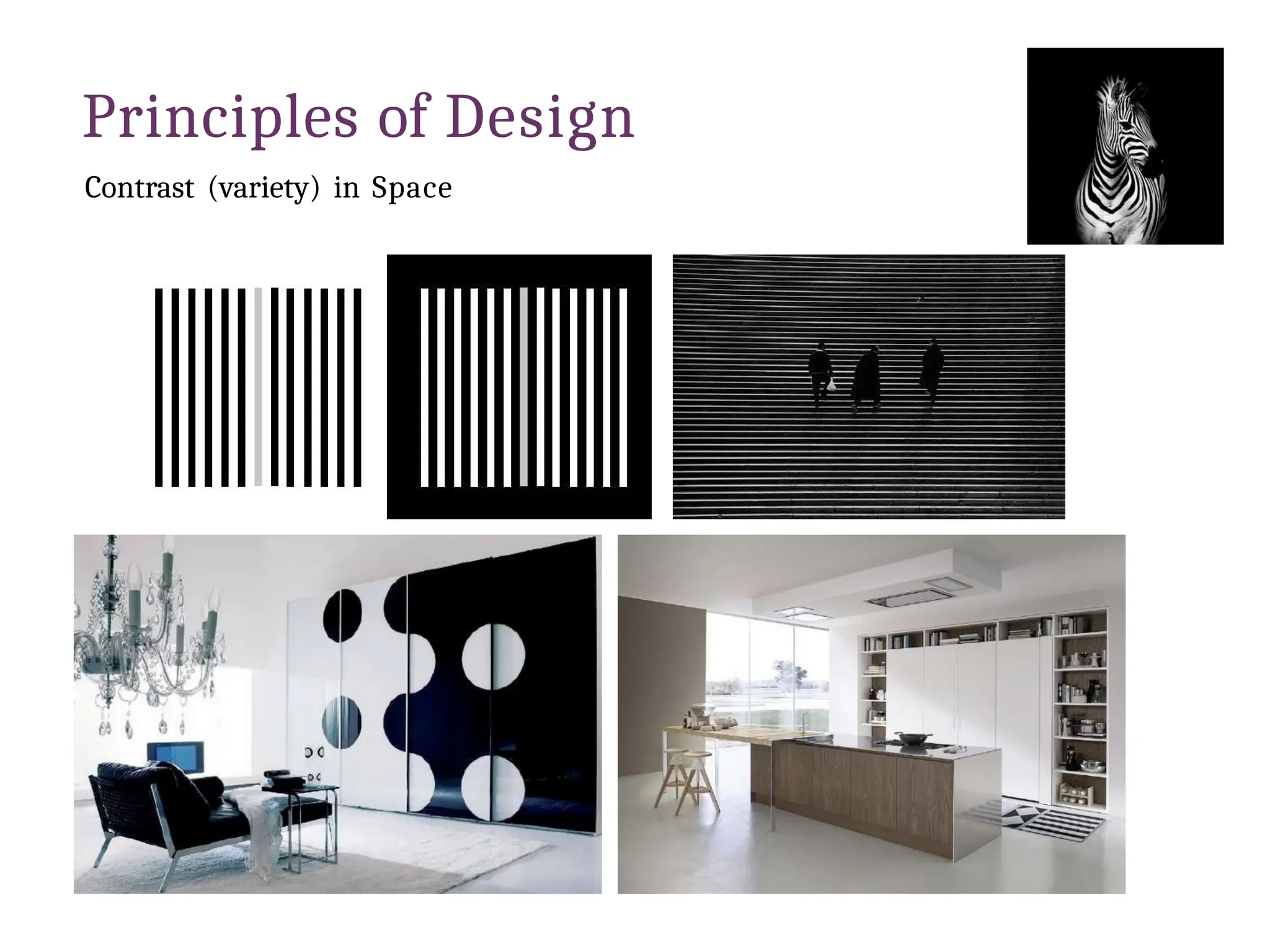
Contrast (variety) in Space
Principles of Design
Movement
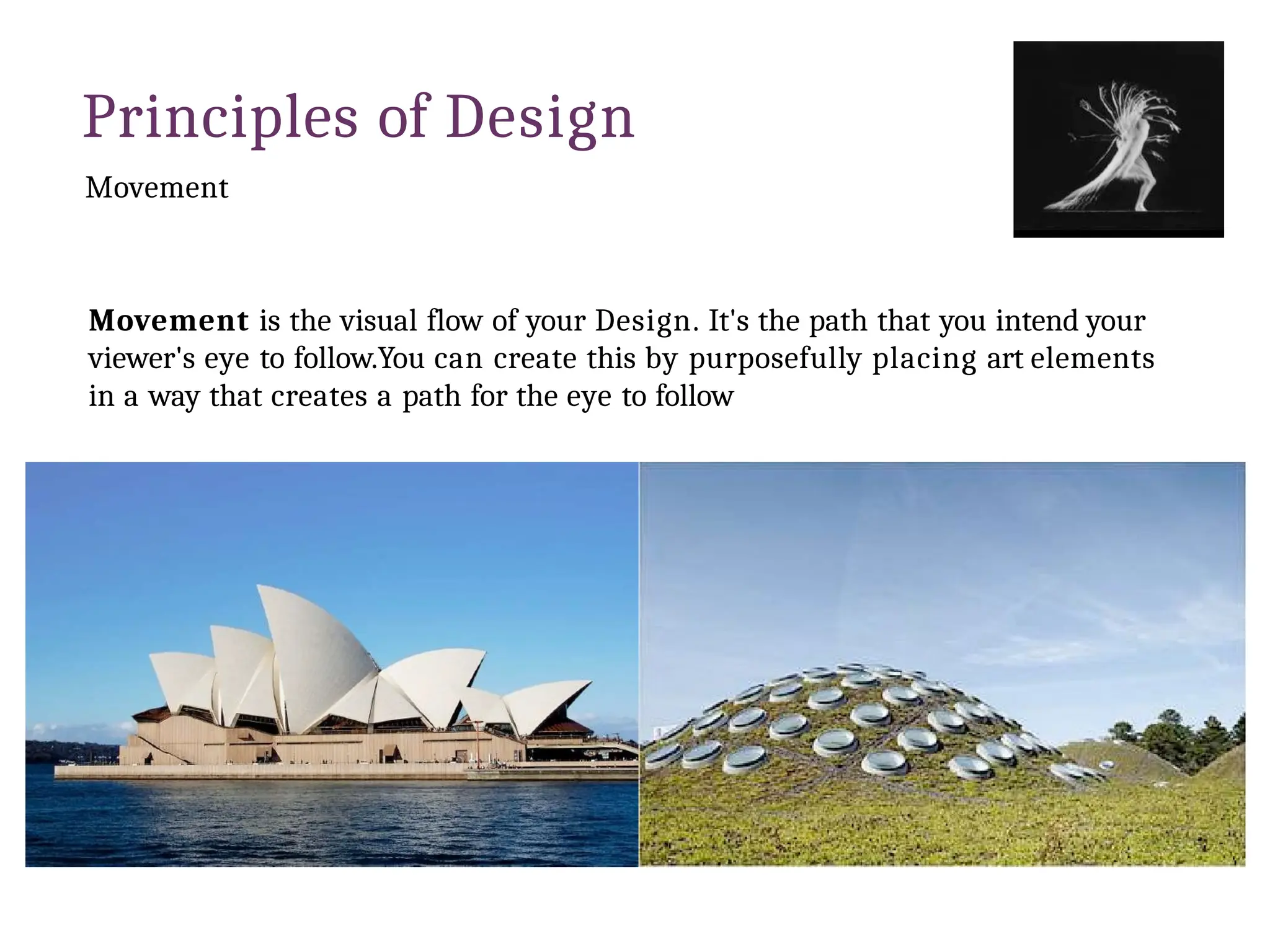
Movement is the visual flow of your Design. It's the path that you intend your
viewer's eye to follow.You can create this by purposefully placing art elements
in a way that creates a path for the eye to follow
Principles of Design
Movement
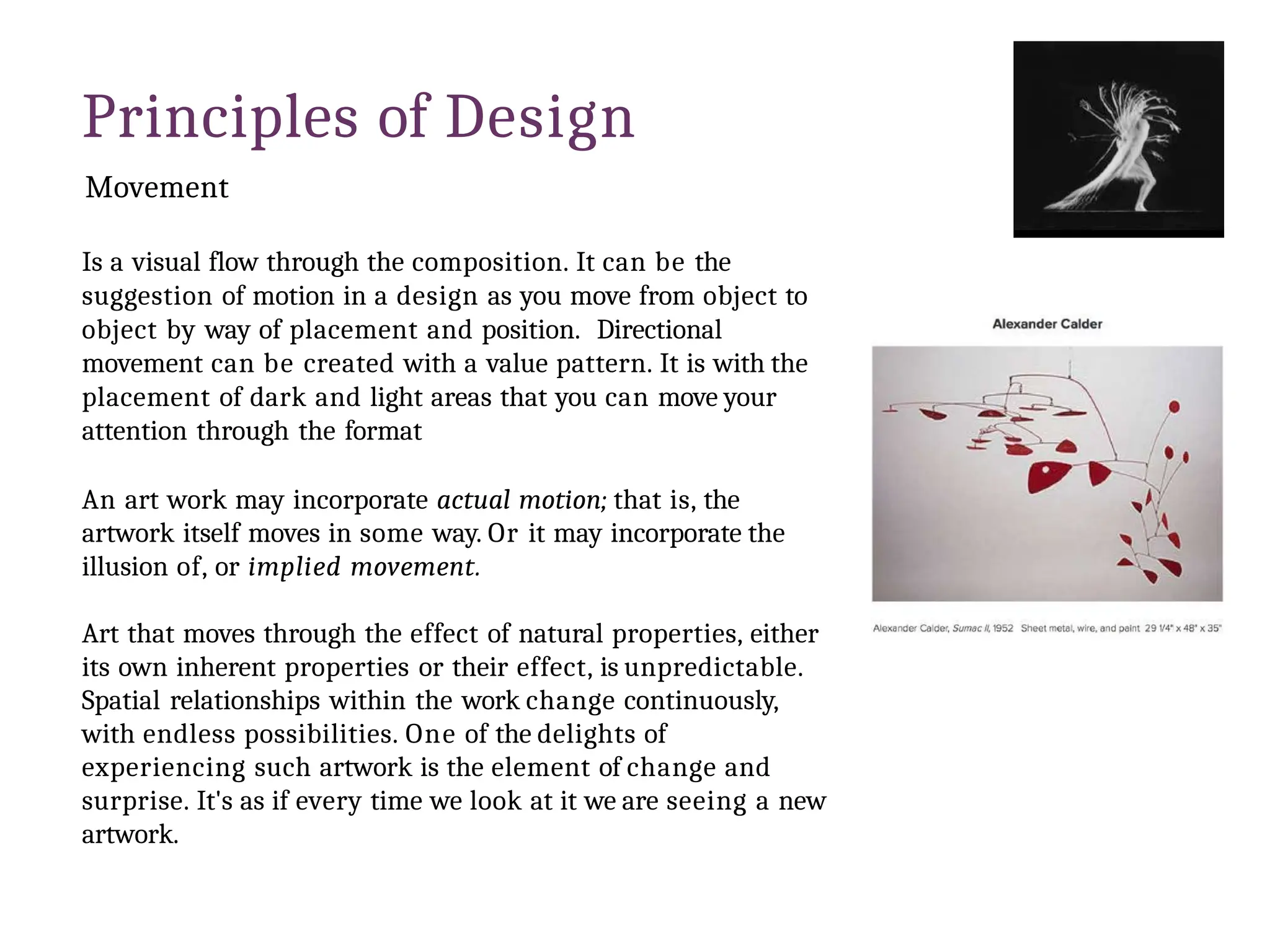
Is a visual flow through the composition. It can be the
suggestion of motion in a design as you move from object to
object by way of placement and position. Directional
movement can be created with a value pattern. It is with the
placement of dark and light areas that you can move your
attention through the format
An art work may incorporate actual motion; that is, the
artwork itself moves in some way. Or it may incorporate the
illusion of, or implied movement.
Art that moves through the effect of natural properties, either
its own inherent properties or their effect, is unpredictable.
Spatial relationships within the work change continuously,
with endless possibilities. One of the delights of
experiencing such artwork is the element of change and
surprise. It's as if every time we look at it we are seeing a new
artwork.
Principles of Design
Movement
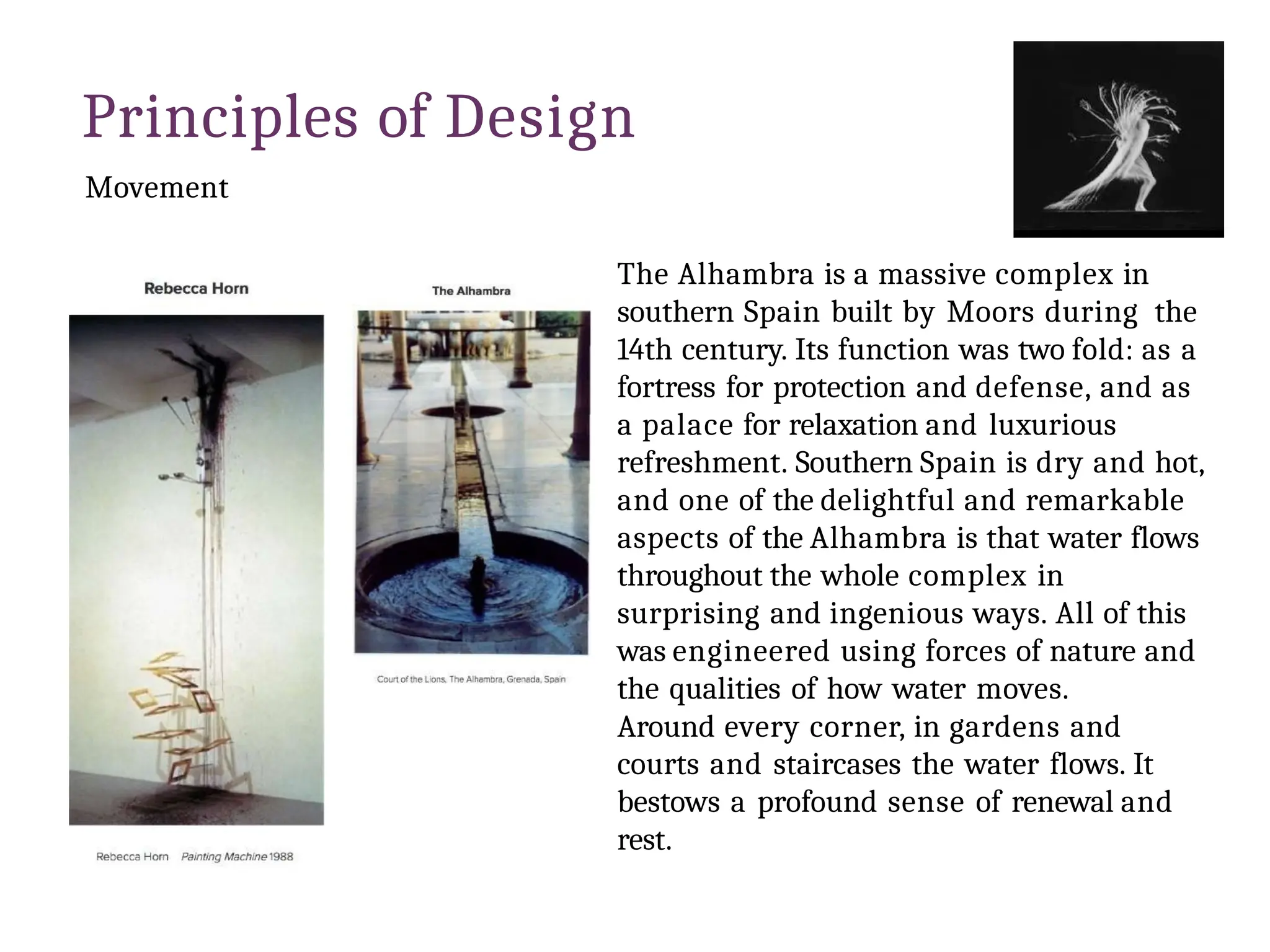
The Alhambra is a massive complex in
southern Spain built by Moors during the
14th century. Its function was two fold: as a
fortress for protection and defense, and as
a palace for relaxation and luxurious
refreshment. Southern Spain is dry and hot,
and one of the delightful and remarkable
aspects of the Alhambra is that water flows
throughout the whole complex in
surprising and ingenious ways. All of this
was engineered using forces of nature and
the qualities of how water moves.
Around every corner, in gardens and
courts and staircases the water flows. It
bestows a profound sense of renewal and
rest.
Principles of Design
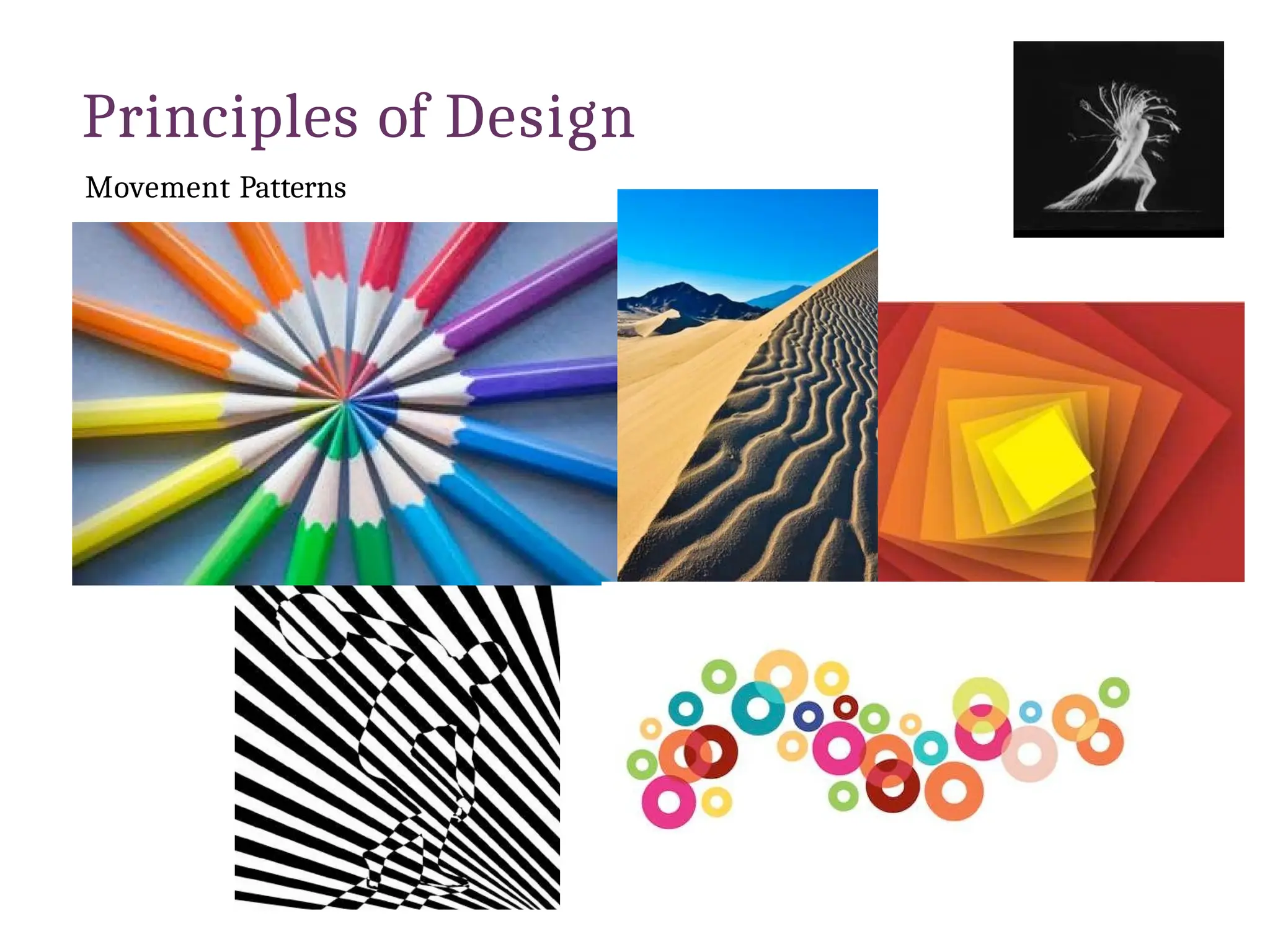
Movement Patterns
Principles of Design
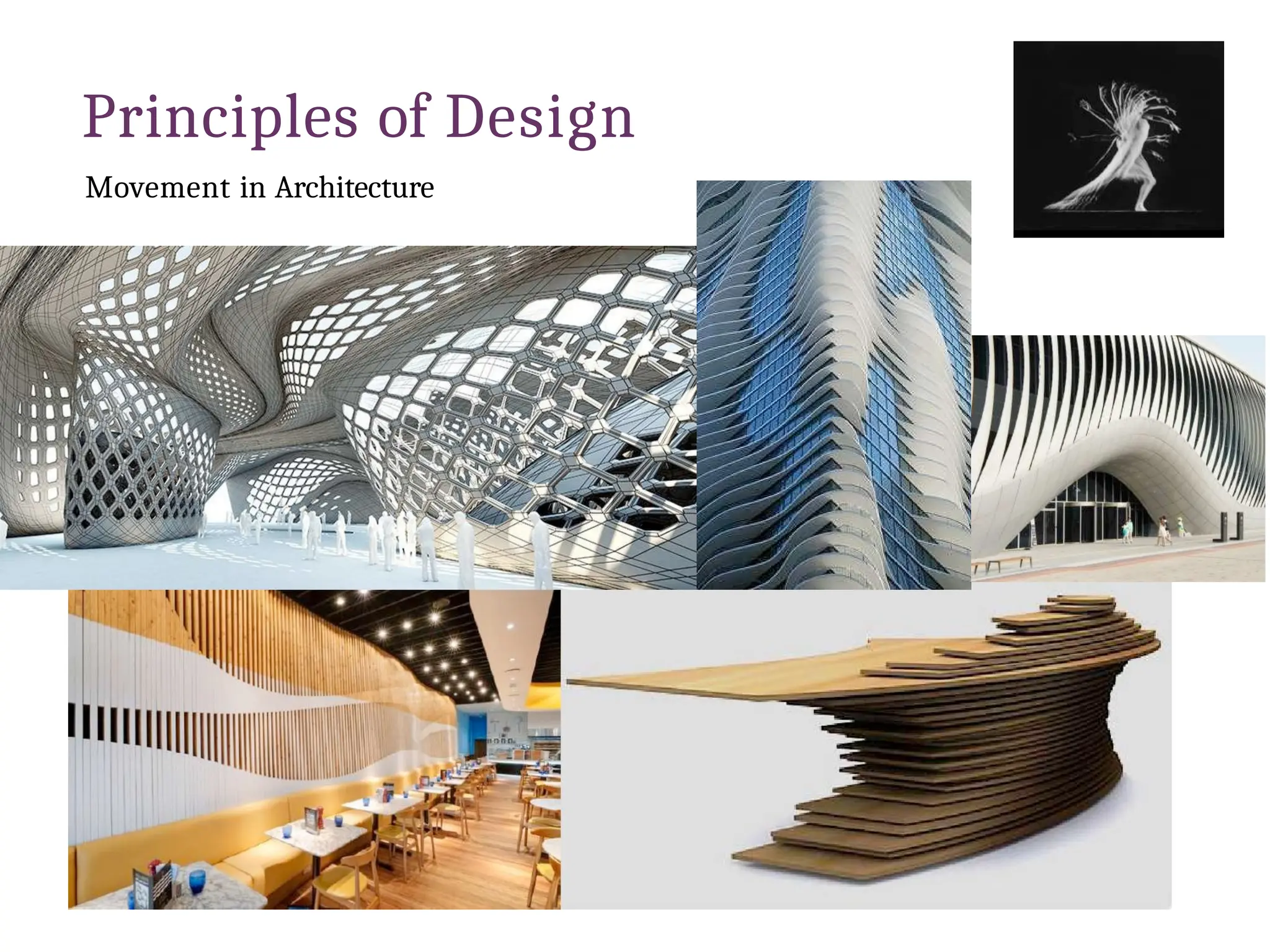
Movement in Architecture
Principles of Design
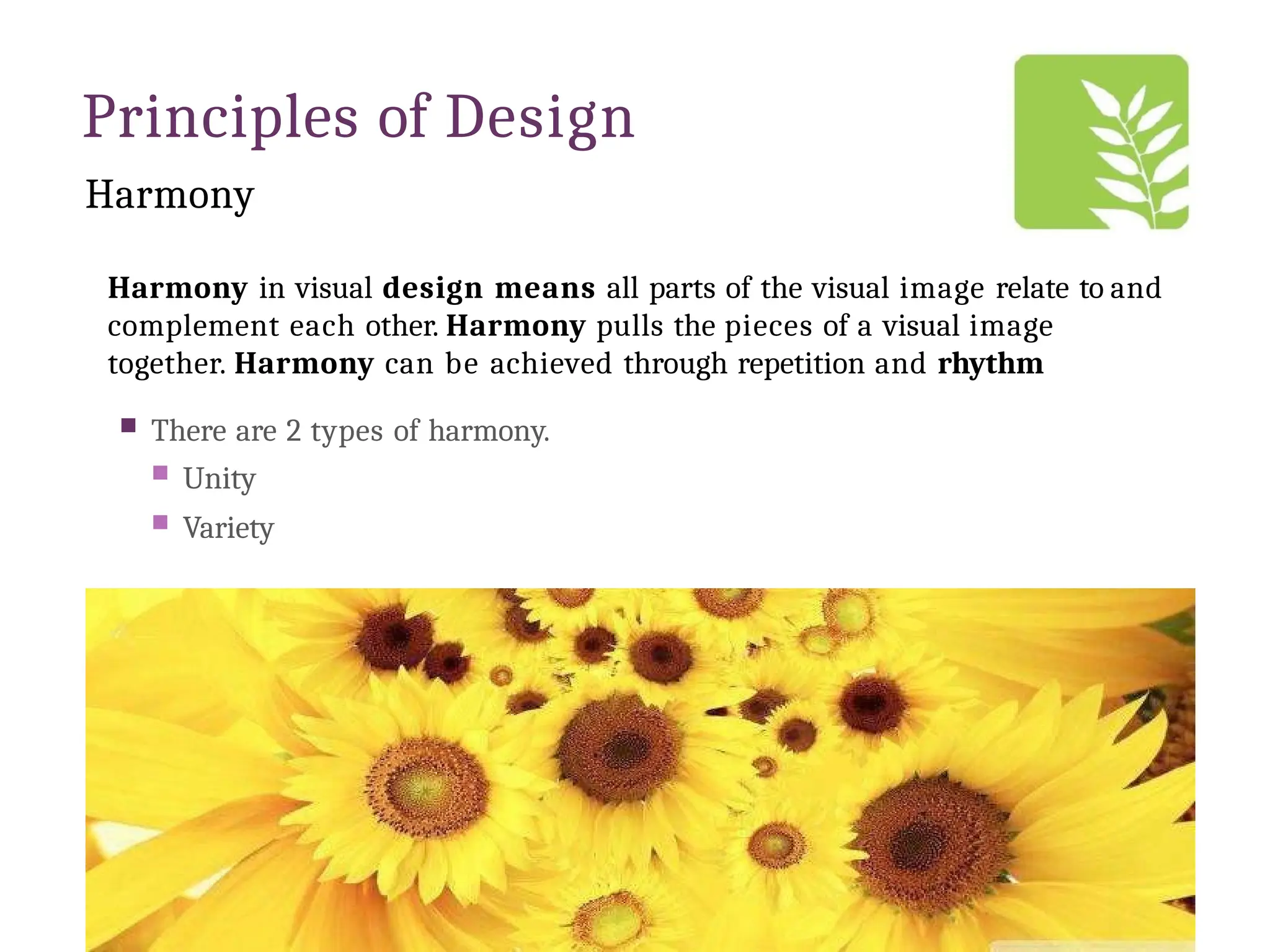
Harmony
Harmony in visual design means all parts of the visual image relate to and
complement each other. Harmony pulls the pieces of a visual image
together. Harmony can be achieved through repetition and rhythm
 There are 2 types of harmony.
 Unity
 Variety
Principles of Design
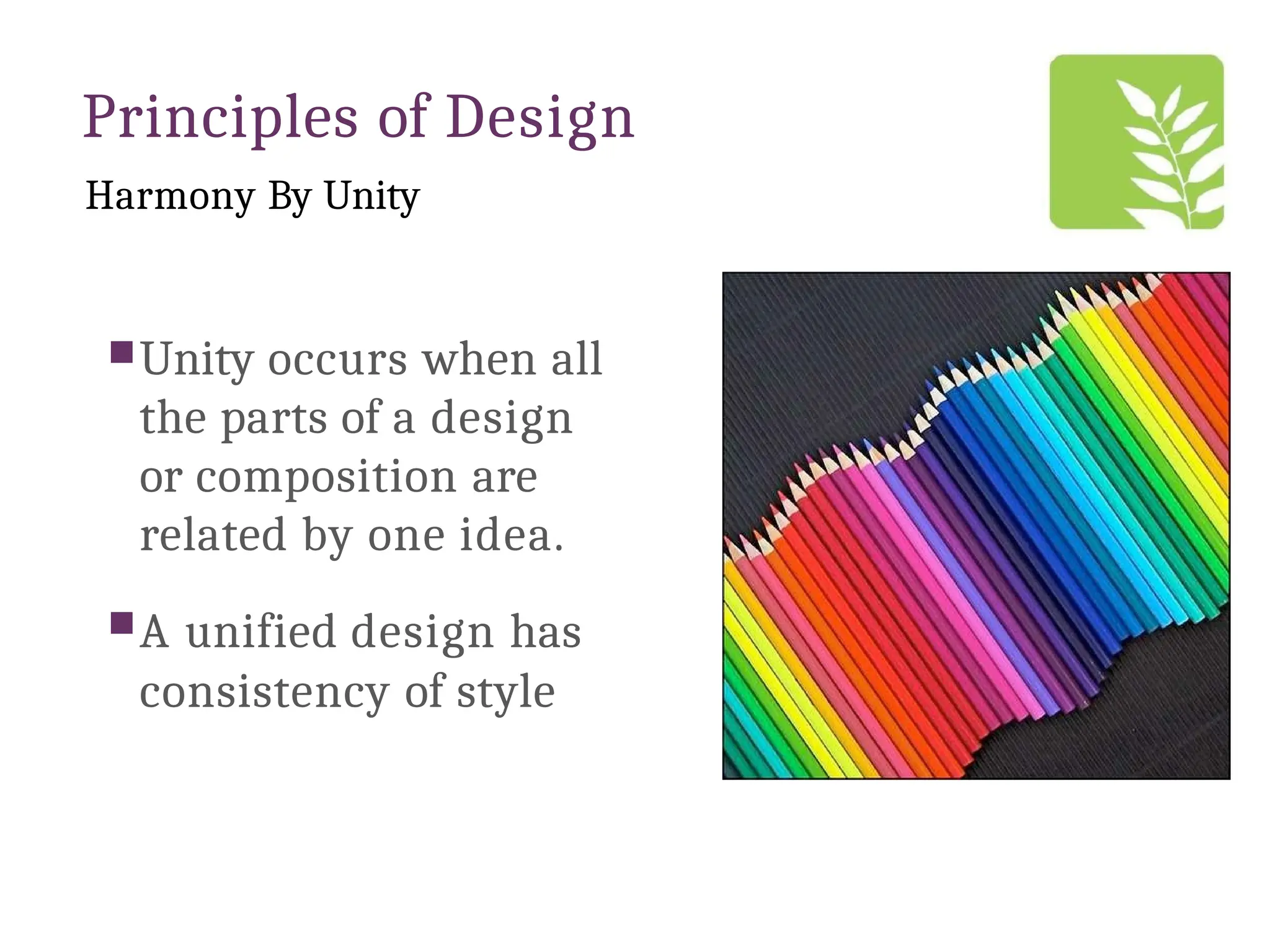
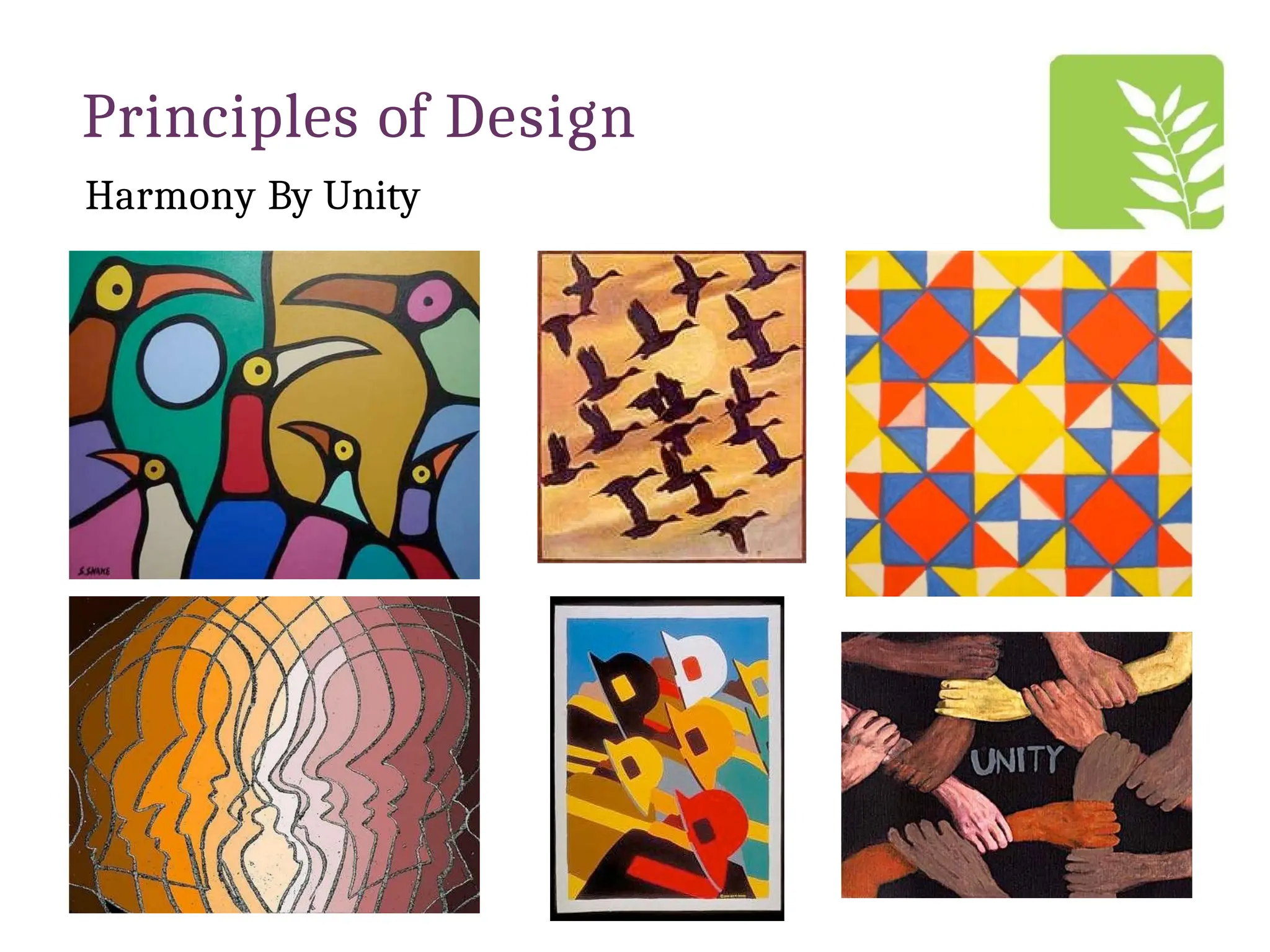
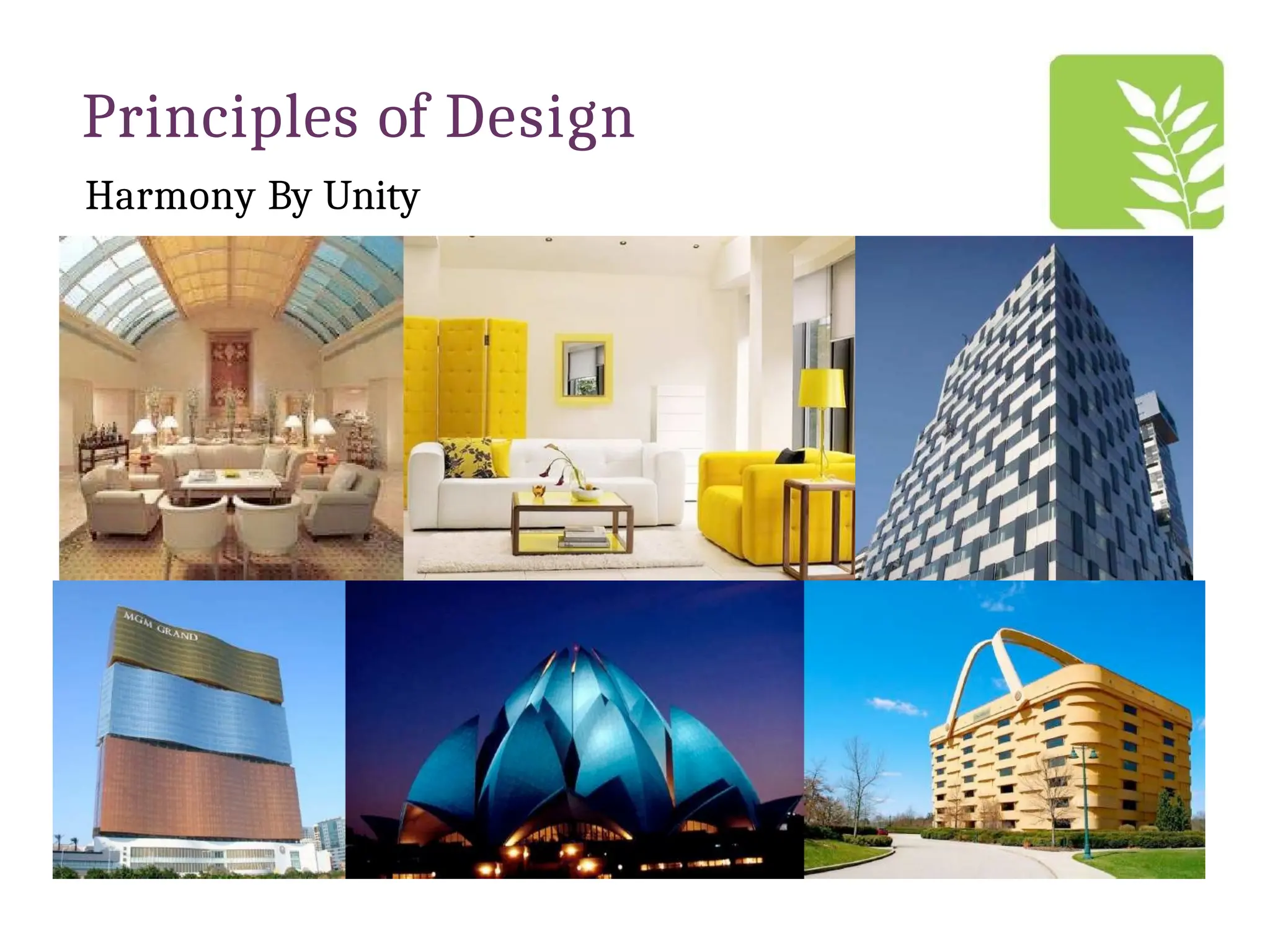
Harmony By Unity
Unity occurs when all
the parts of a design
or composition are
related by one idea.
A unified design has
consistency of style
Principles of Design
Harmony By Unity
Principles of Design
Harmony By Unity
Principles of Design
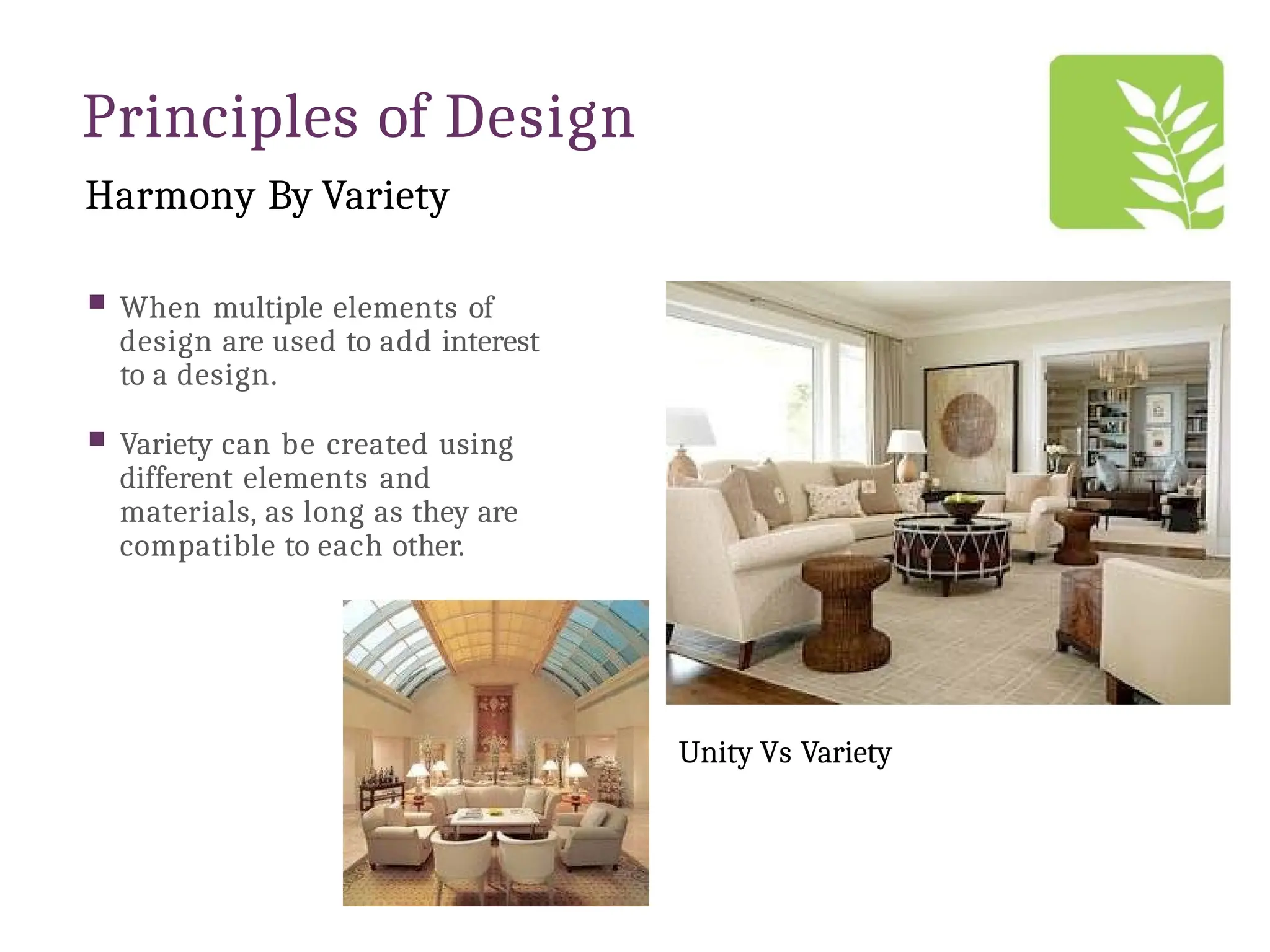
Harmony By Variety
 When multiple elements of
design are used to add interest
to a design.
 Variety can be created using
different elements and
materials, as long as they are
compatible to each other.
Unity Vs Variety
Principles of Design
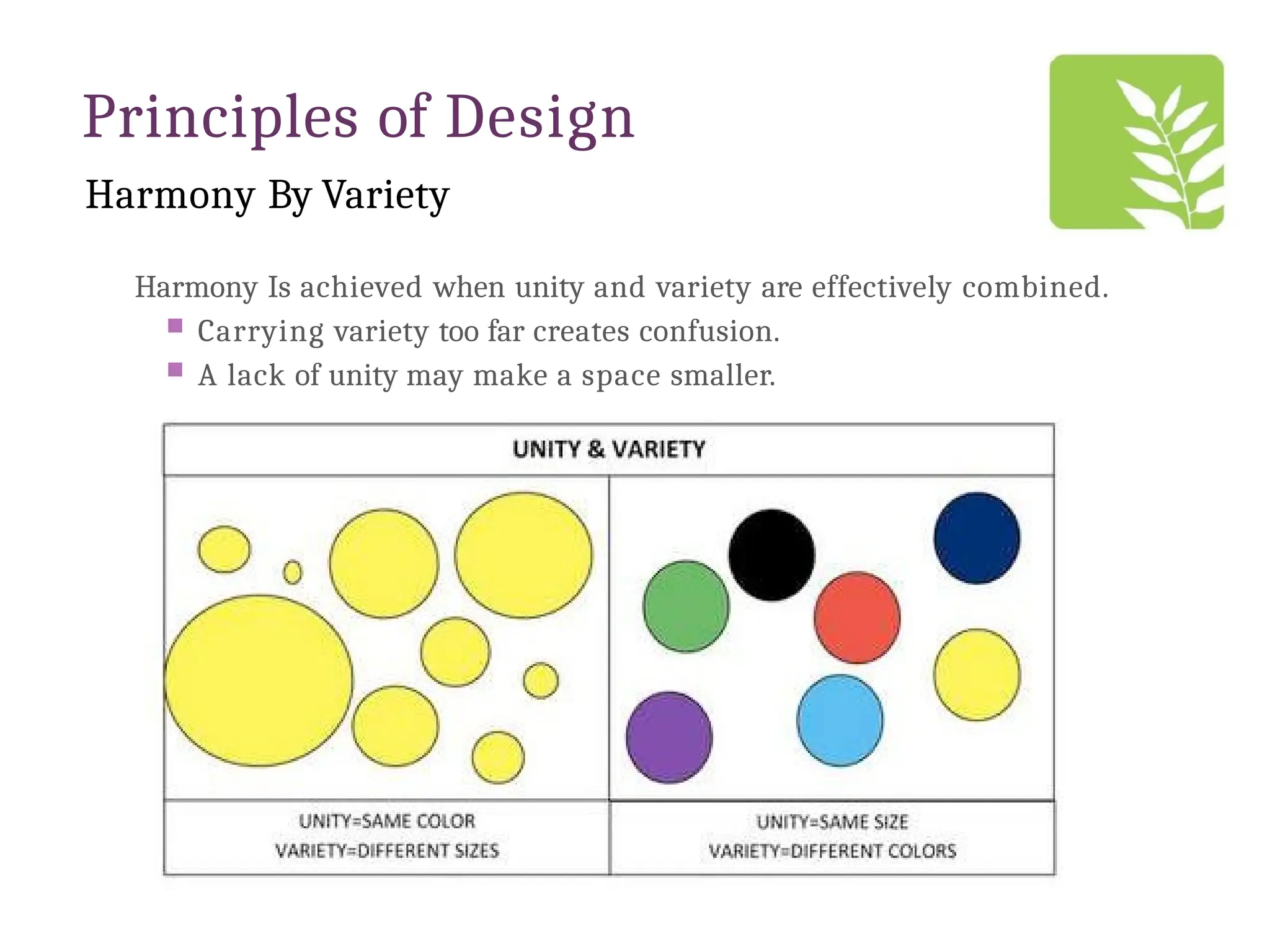
Harmony By Variety
Harmony Is achieved when unity and variety are effectively combined.
 Carrying variety too far creates confusion.
 A lack of unity may make a space smaller.
Principles of Design
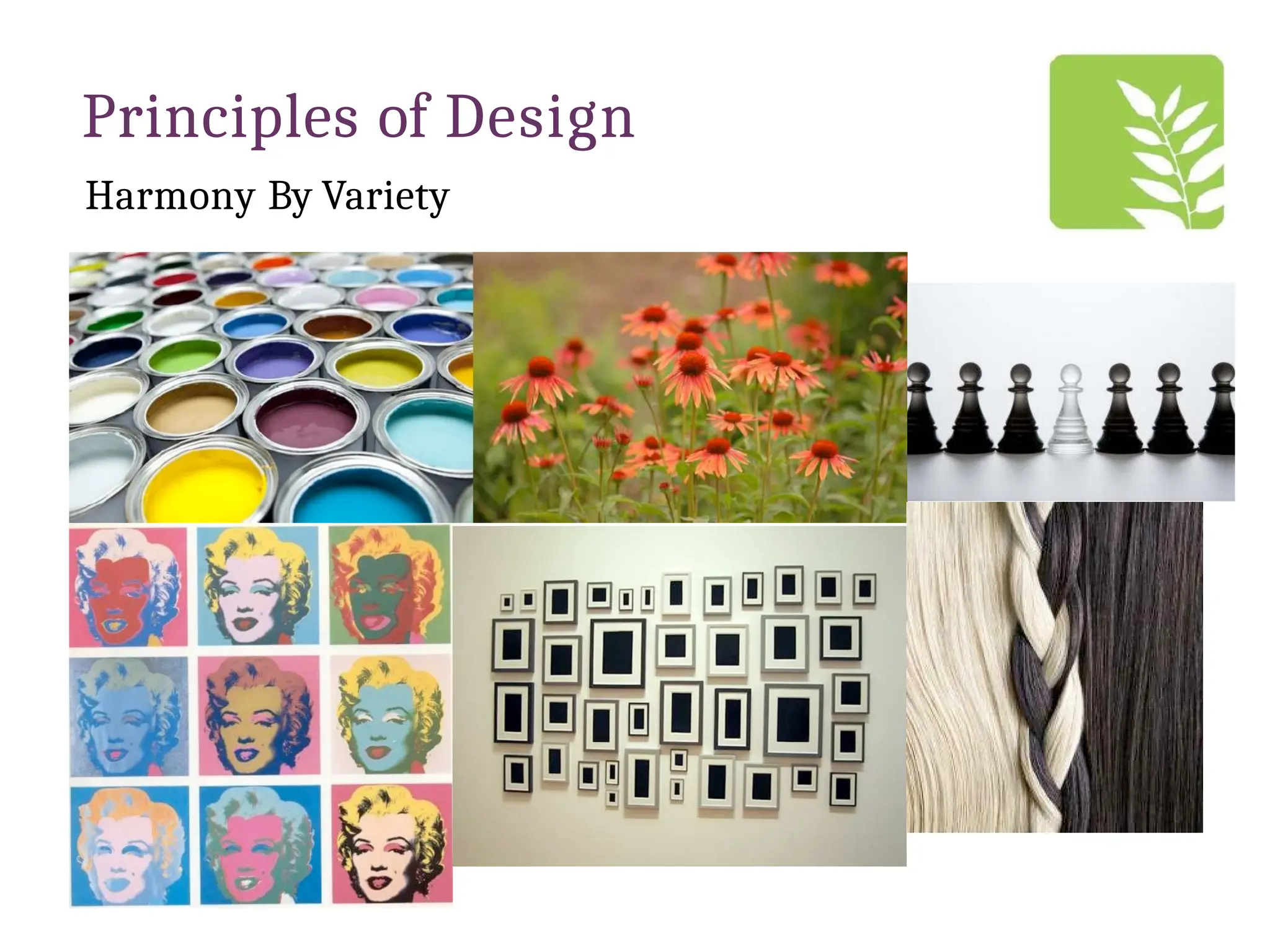
Harmony By Variety
Principles of Design
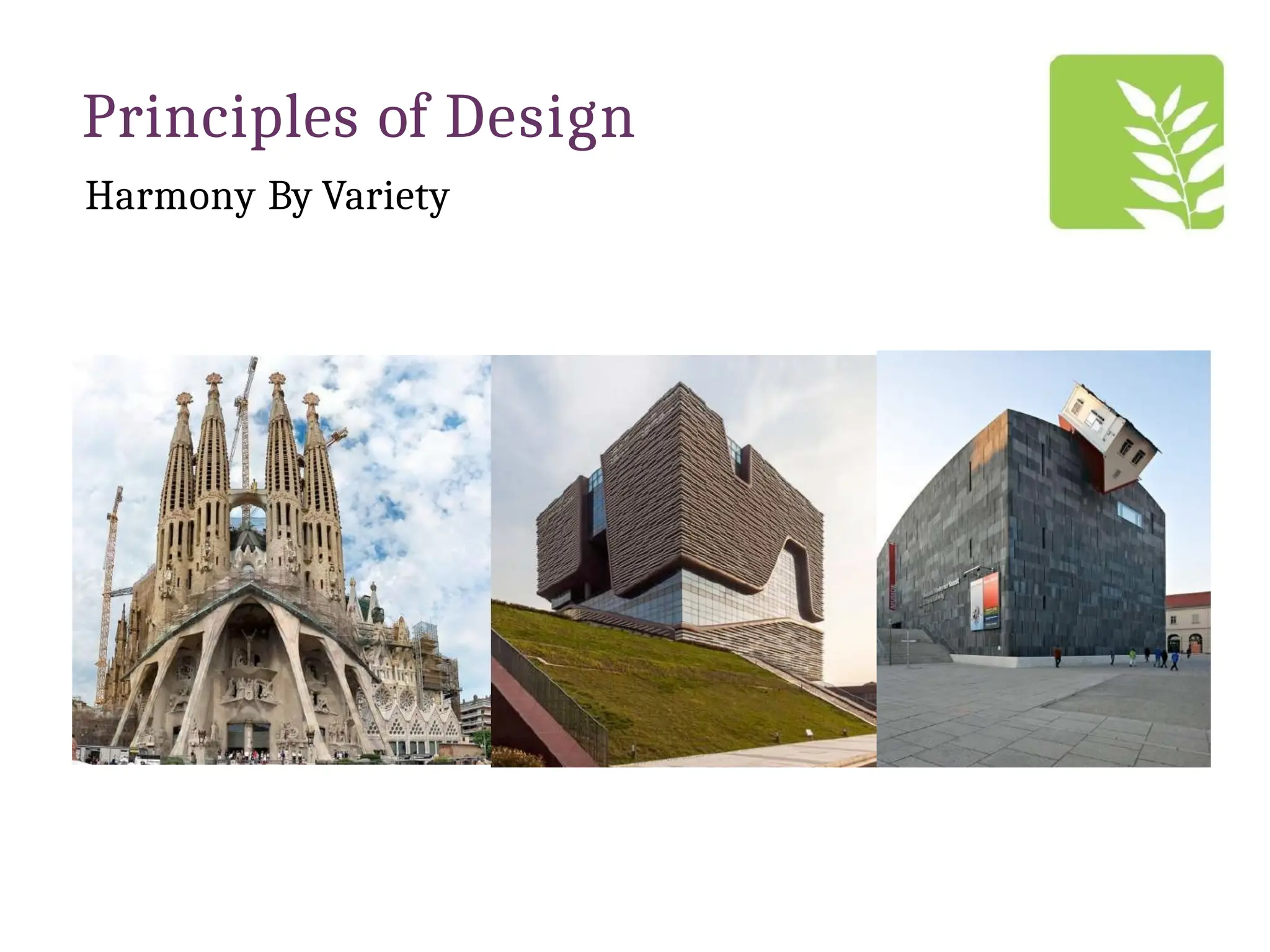
Harmony By Variety
Principles of Design
Proportions & Scales
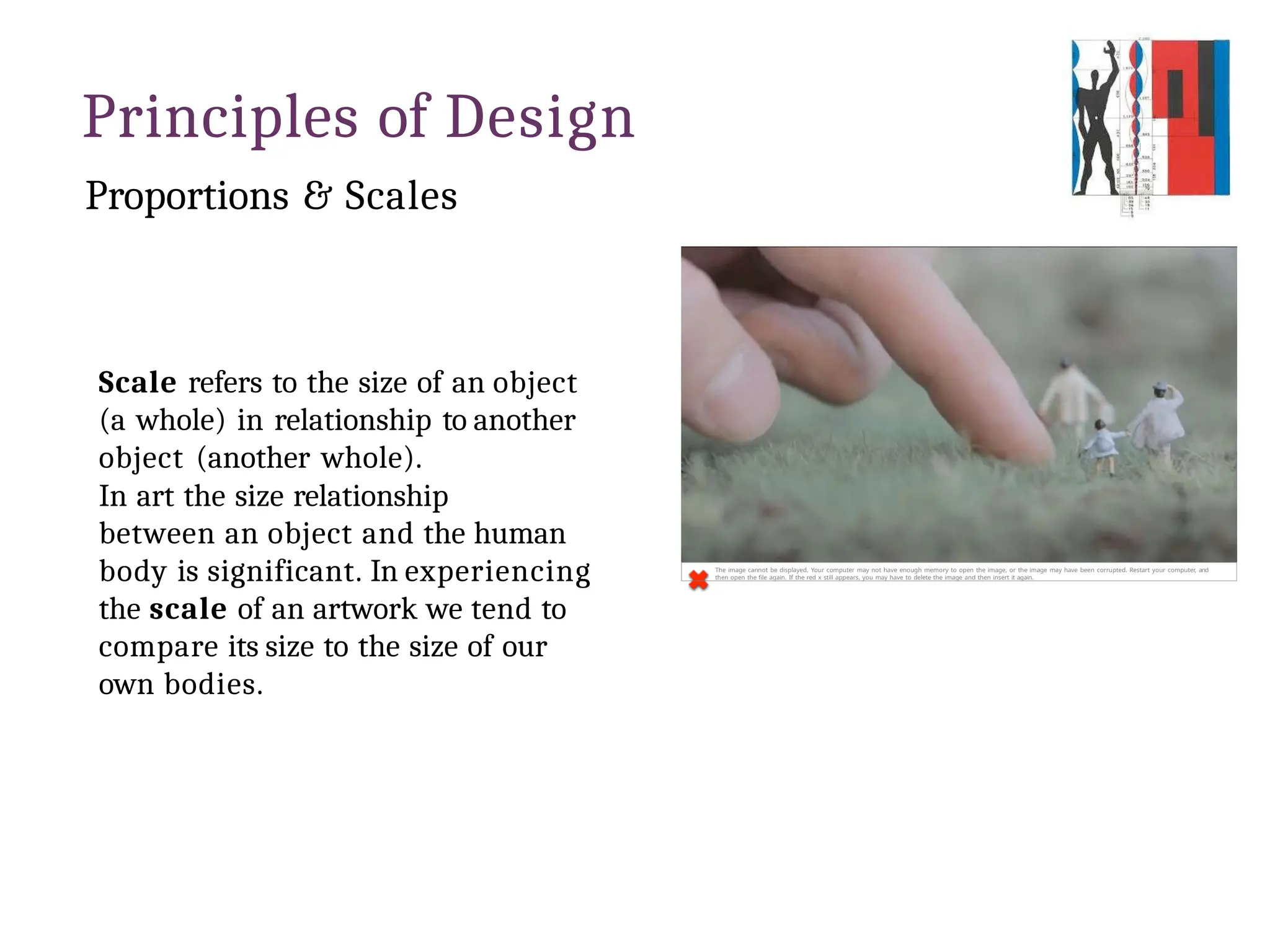
Scale refers to the size of an object
(a whole) in relationship to another
object (another whole).
In art the size relationship
between an object and the human
body is significant. In experiencing
the scale of an artwork we tend to
compare its size to the size of our
own bodies.
The image cannot be displayed. Your computer may not have enough memory to open the image, or the image may have been corrupted. Restart your computer, and
then open the file again. If the red x still appears, you may have to delete the image and then insert it again.
Principles of Design
Proportions & Scales
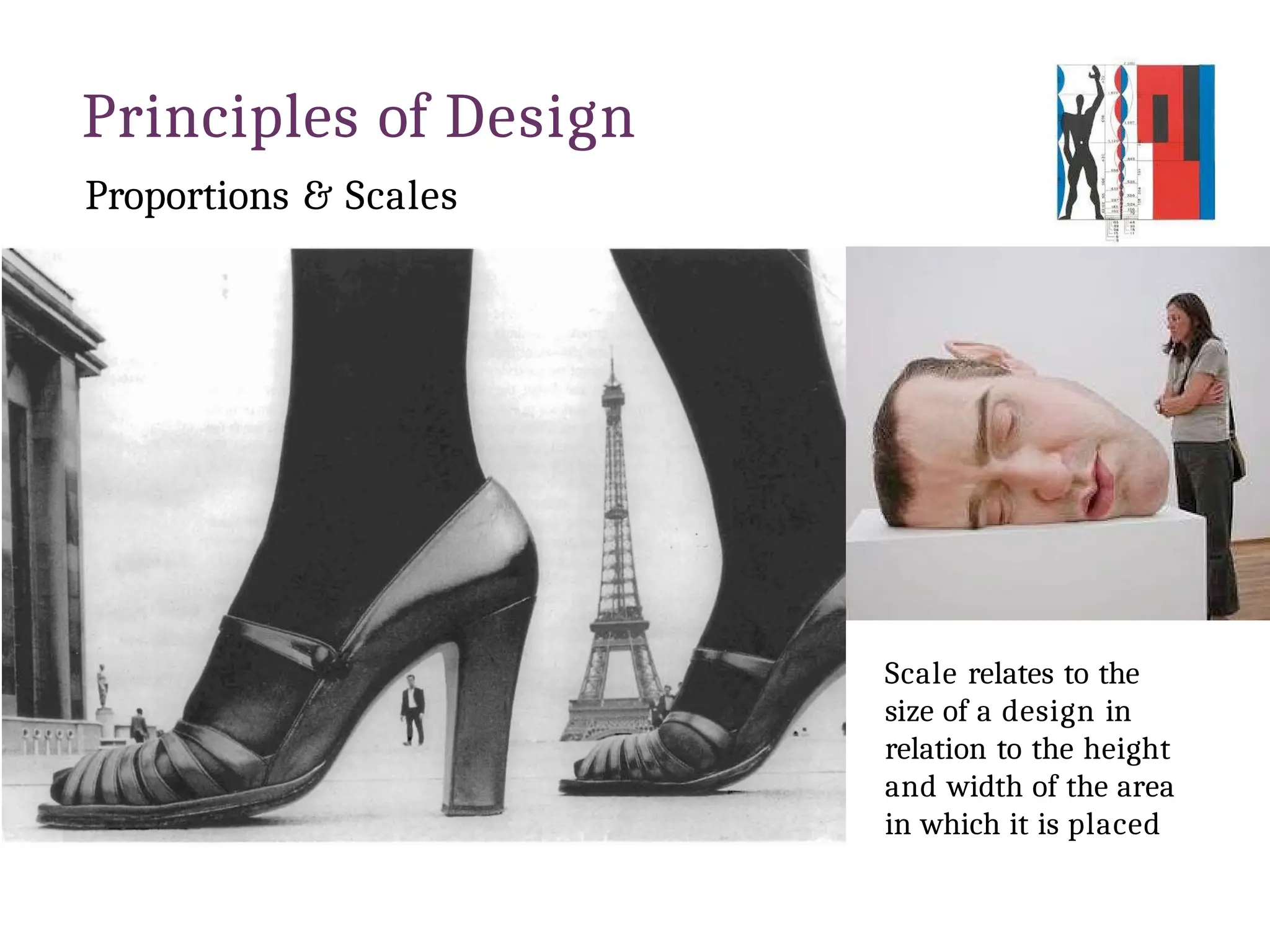
Scale relates to the
size of a design in
relation to the height
and width of the area
in which it is placed
Principles of Design
Proportions & Scales
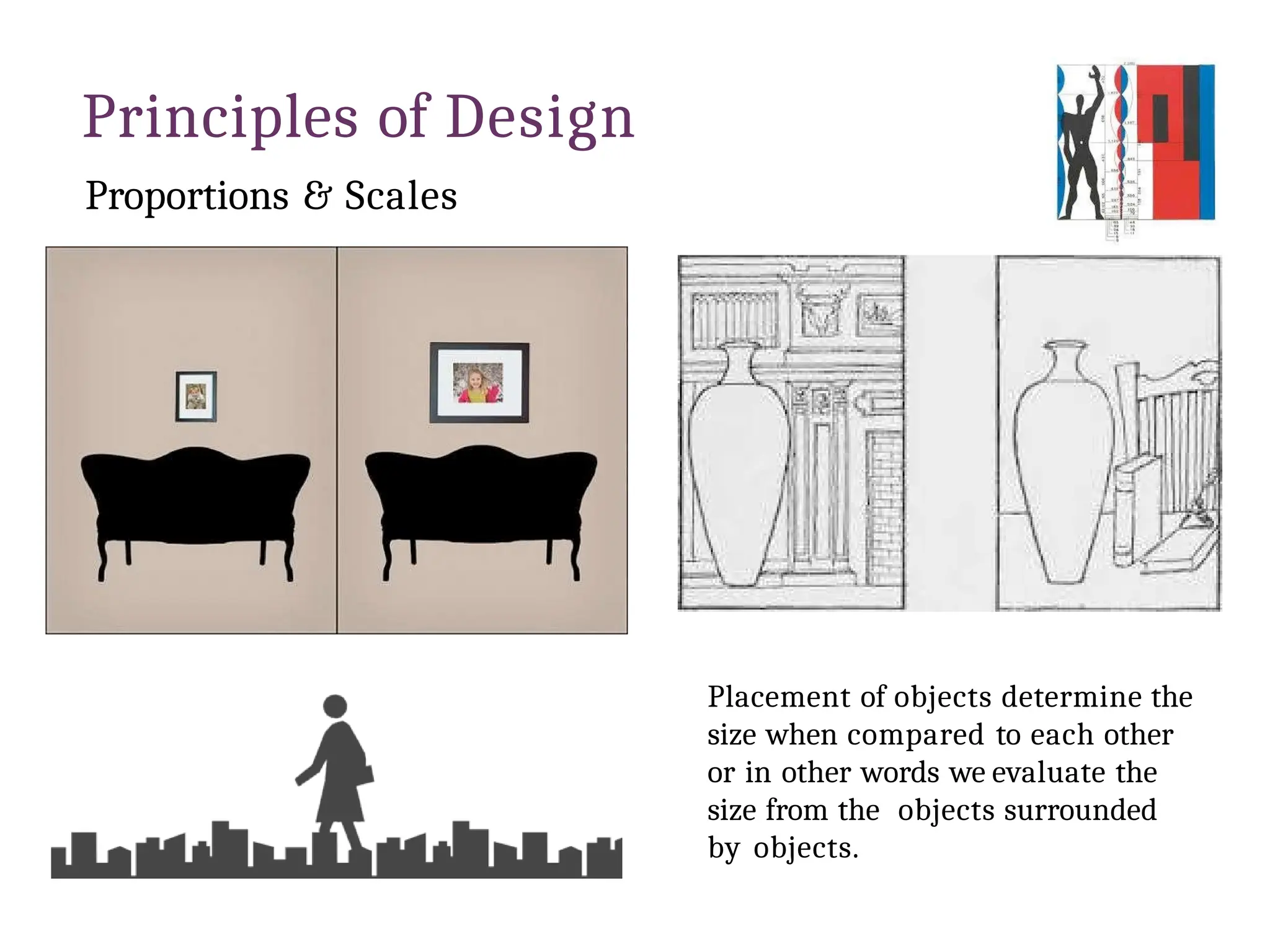
Placement of objects determine the
size when compared to each other
or in other words we evaluate the
size from the objects surrounded
by objects.
Principles of Design
Proportions & Scales
Principles of Design
Proportions & Scales
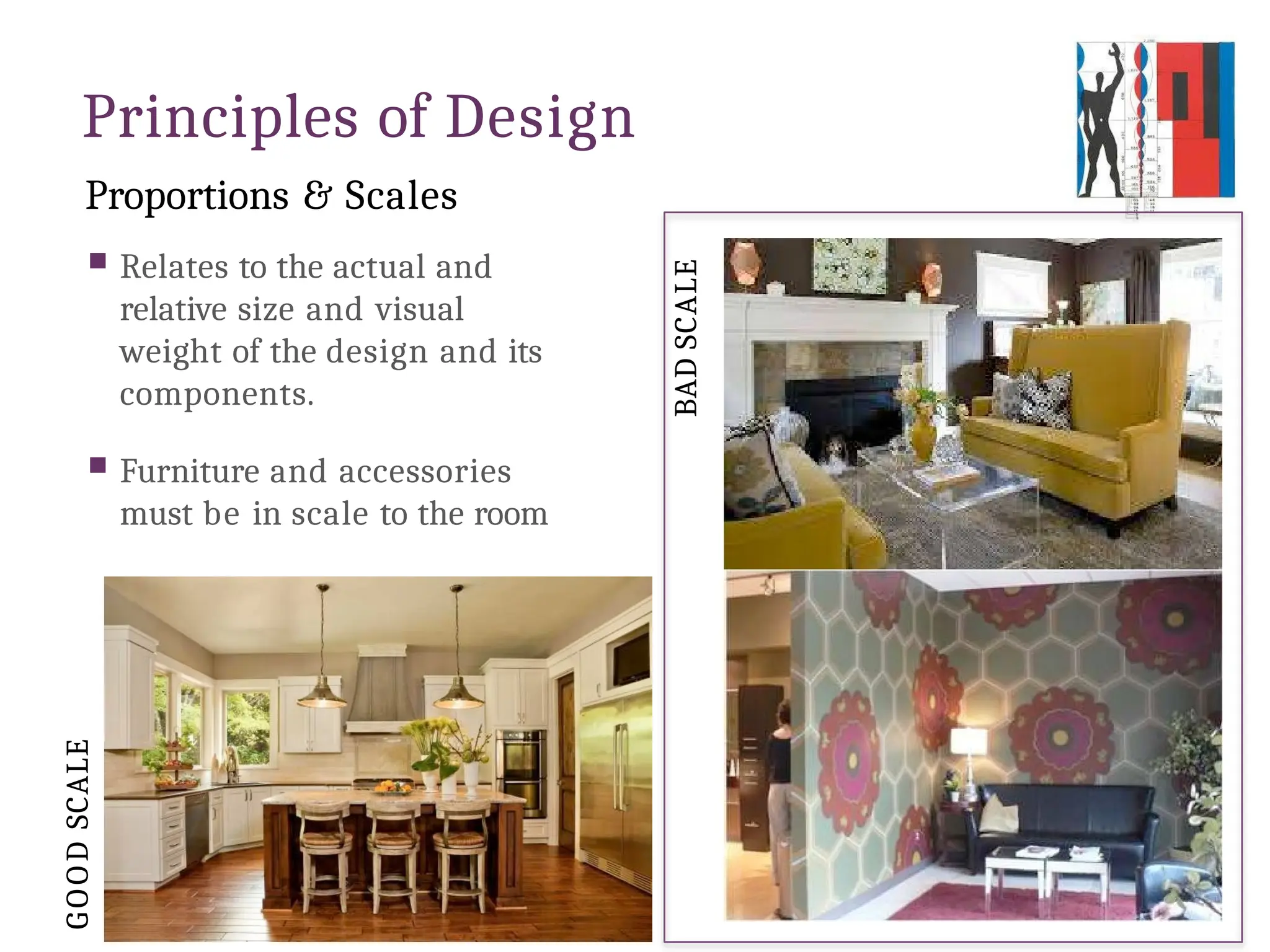
 Relates to the actual and
relative size and visual
weight of the design and its
components.
 Furniture and accessories
must be in scale to the room
BAD
SCALE
G
O
O
D
SCALE
Principles of Design
Proportions & Scales
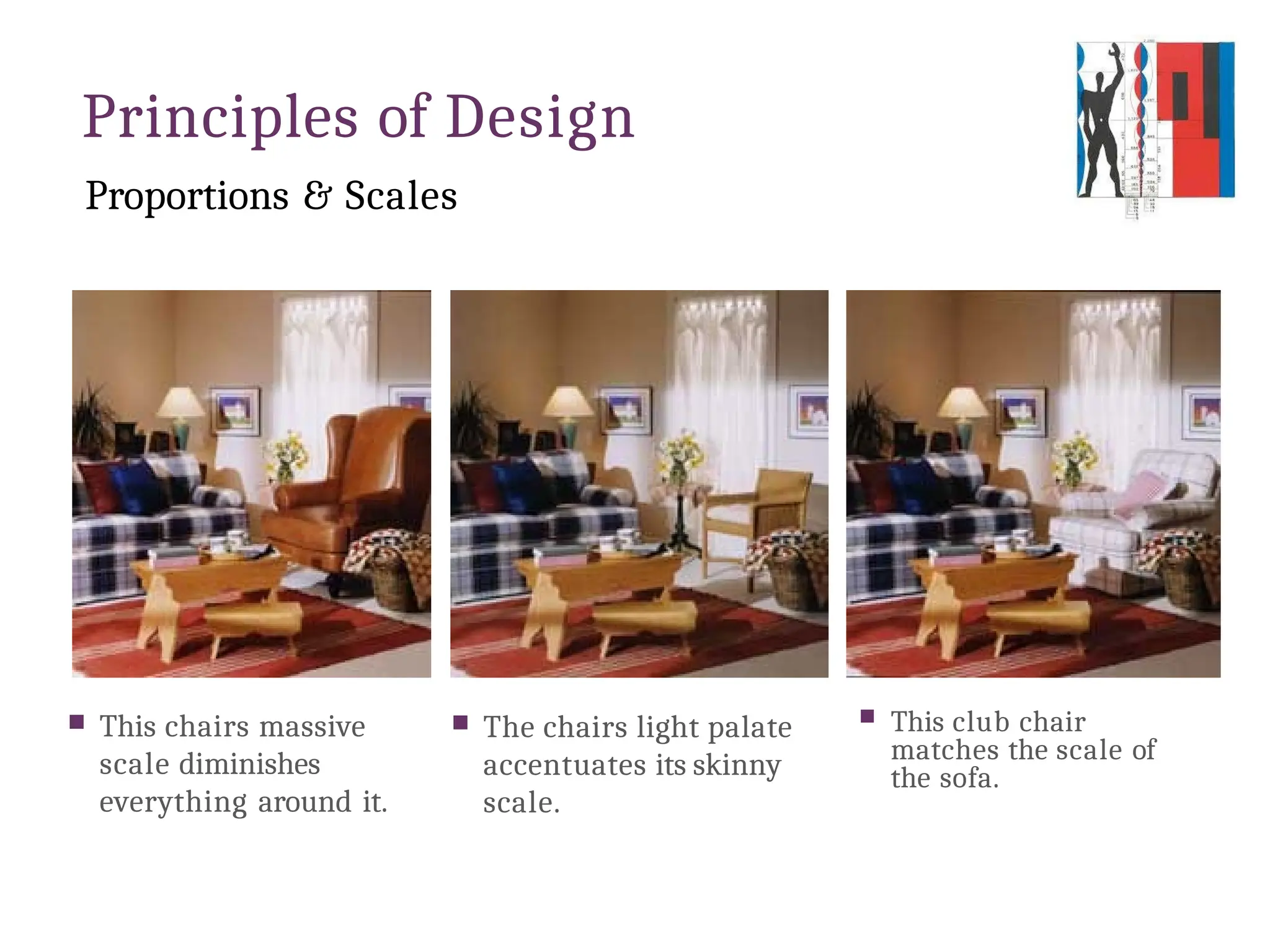
 This chairs massive
scale diminishes
everything around it.
 The chairs light palate
accentuates its skinny
scale.
 This club chair
matches the scale of
the sofa.
Principles of Design
Proportions & Scales
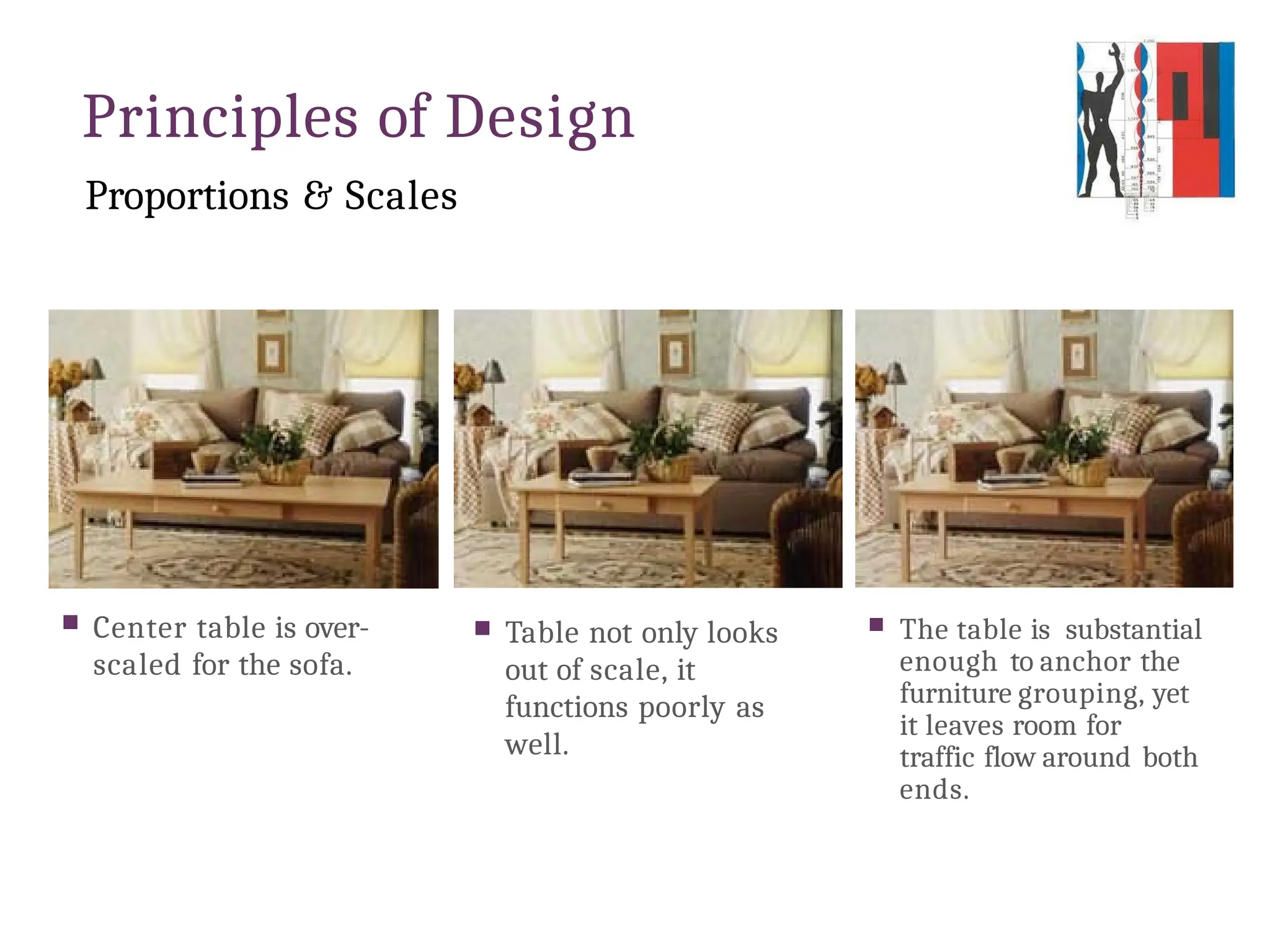
 Center table is over-
scaled for the sofa.
 Table not only looks
out of scale, it
functions poorly as
well.
 The table is substantial
enough to anchor the
furniture grouping, yet
it leaves room for
traffic flow around both
ends.
Principles of Design
Proportions & Scales
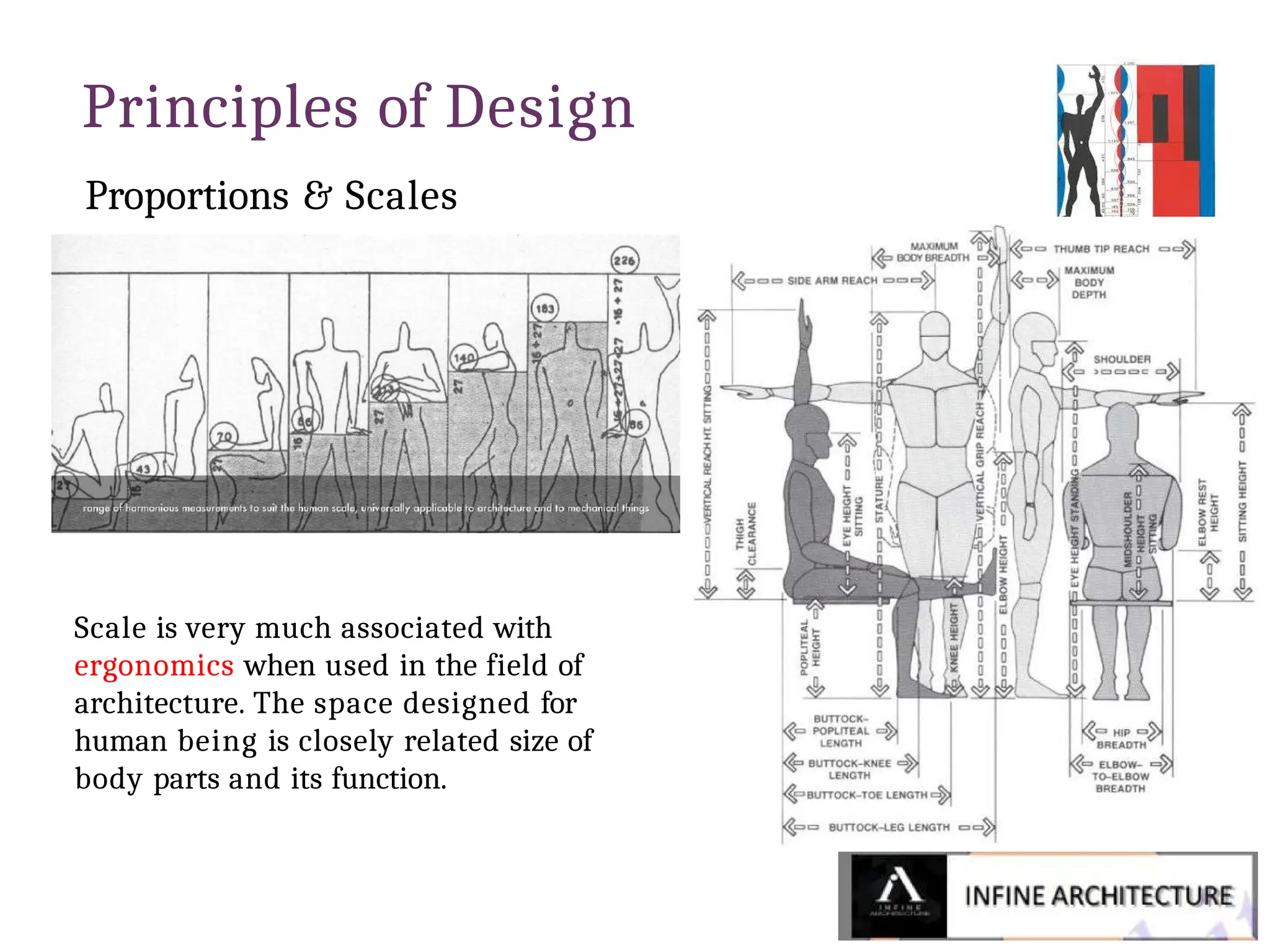
Scale is very much associated with
ergonomics when used in the field of
architecture. The space designed for
human being is closely related size of
body parts and its function.
principlesofdesign-151215182040 (1)_compressed

  • 1.
  • 2.
    What is Design Designis the creation of a plan or convention for the construction of an object or a system. It may be an architectural blueprints, engineering drawings, business processes, circuit diagrams or sewing patterns. Design has different connotations in different fields Design is what links creativity and innovation. It shapes ideas to become practical and attractive propositions for users, clients or customers. Design may be described as creativity deployed to a specific end
  • 3.
    Principles of Design Theprinciples of design describe the ways an artist use different elements of design in a composition. These ways or principles are •Balance •Rhythm •Emphasis •Contrast •Movement •Harmony •Proportion and scale
  • 4.
    Principles of Design BALANCE Asense of equilibrium. When establishing balance consider visual weight created by size, color, texture and number of objects. Balance is the concept of visual equilibrium, and relates to our physical sense of balance. It is a reconciliation of opposing forces in a composition that results in visual stability. Most successful compositions achieve balance in one of two ways: symmetrically or asymmetrically.
  • 5.
    Principles of Design BALANCE Symmetricalbalance can be described as having equal "weight" on equal sides of a centrally placed fulcrum. It may also be referred to as formal balance. When the elements are arranged equally on either side of a central axis, the result is Bilateral symmetry. This axis may be horizontal or vertical. It is also possible to build formal balance by arranging elements equally around a central point , resulting in radial symmetry. This is called Radial Balance
  • 6.
  • 7.
    Principles of Design BALANCE RadialBalance / Biaxial Symmetry
  • 8.
    Principles of Design BALANCE NearSymmetry & Inverted Symmetry
  • 9.
    Principles of Design BALANCE Asymmetricalbalance, also called informal balance, is more complex and difficult to achieve. It involves placement of objects in a way that will allow objects of varying visual weight to balance one another around a central point. It just means that there are no mirror images in a composition. The term, however, is usually used to describe a kind of balance that does not rely on symmetry:
  • 10.
  • 11.
  • 12.
  • 13.
  • 14.
  • 15.
  • 16.
    Principles of Design RHYTHM Avisual tempo or beat. The principle of design that refers to a regular repetition of elements of art to produce the look and feel of movement. It is often achieved through the careful placement of repeated components which invite the viewer's eye to jump rapidly or glide smoothly from one to the next. Rhythm in architecture is the repetitive use of a group of visual elements, at least three times, to establish a recognizable “pattern.” Simple examples of rhythm are the alternating window and column arrangement of most high rise office buildings. More complex rhythms make use of what in jazz music is called "counterpoint", that is, two or more intersecting or overlaid rhythms. This is seen frequently in classical architecture, where a series of columns and openings are overlaid on top of a series of smaller openings.
  • 17.
    Principles of Design TYPEOF RHYTHEM Rhythm by Repetition Rhythm by Gradation Rhythm by Radiation Rhythm by Opposition Rhythm by Transition
  • 18.
    Principles of Design RhythmBy Repetition  Rhythm created by duplicating (repeating) shapes, colors, pattern, line, texture.  Repeated Window panes, repeat. Stripes on wall and design and colour of glass.
  • 19.
  • 20.
    Principles of Design RhythmBy Gradation  Rhythm created by a gradual change in size or color.  Carpet on the floor changes gradually in value.  Gradation in lights. bellow
  • 21.
  • 22.
    Principles of Design RhythmBy Radiation  Rhythm created by identical objects coming from a central axis.  The glass frames“radiate” from the center of the path.  The floor design, the windows, furnitures etc in redial rhythm
  • 23.
  • 24.
    Principles of Design RhythmBy Opposition  Rhythm created direct placement of lines, shapes or colour to create opposition through abrupt visual change.  Contrasting black and white tiles and the lines intersecting at right angles.
  • 25.
  • 26.
    Principles of Design RhythmBy Transition  Rhythm created by curved lines that carry your eye across a straight surface.  Window treatments that gently swag down, create a soft rhythm by transition.
  • 27.
  • 28.
    Principles of Design EMPHASIS Emphasiscreates a focal point in a design composition; it is how we bring attention to what is important in it. It is the the focus of attention and interest within a composition In Architecture it is the feature that commands attention and makes a design visually interesting
  • 29.
    Principles of Design EMPHASIS Themain reason in using emphasis is to help you communicate the message that needs to be communicated. Emphasis helps readers determine the important information on your display and allows them to interpret the message faster. This process of arranging the visual elements on a composition according to their order of importance and emphasis is called Visual Hierarchy. Visual Hierarchy is used to guide readers attention to the main places on your composition.
  • 30.
    Principles of Design Howto Create Emphasis EMPHASIS Make it bolder Make it brighter Change Style Add special visual effects. Add a border or frame Add more negative of positive space Add shadow or lights Change the color Change the position Create Focal Points
  • 31.
    Principles of Design Guidelinesfor Creating Emphasis The point of emphasis should command attention, but not dominate the overall design. Other features within the composition should not compete for the emphasis or contrast.
  • 32.
    Principles of Design EMPHASISIn Architecture Zaha Hadid Architects
  • 33.
    Principles of Design Contrast(variety) Contrast is simply defined as difference. Difference between elements or subjects within a work of art or composition. Contrast can be created through variety within the elements of art. (i.e. value, color, texture) Contrast can be used to create a focal point or area of interest in an artwork Contrast is closely related with variety which is usually considered as principle of design. Although some art purist, stick with variety and argue that contrast simply creates variety.
  • 34.
    Principles of Design Contrast(variety) it is easy to understand how colour can create contrast. For example, complementary colours provide a high level of contrast. Complementary colours are colours that are located directly across from each other on the colour wheel. Red and green, blue and orange, and purple and yellow are all examples of this. But when using complementary colours, we also have to consider value. Value is the darkness or lightness of colour. Without contrast in value, the contrast created by complementary colours is counter- productive. Notice how the red and green vibrate off of each other. The result is aesthetically horrid. The problem lies in the use of value. There needs to be contrast in value along with the contrast in colour. If we change the values, not the colours, the result is more successful
  • 35.
    Principles of Design Contrast(variety) in Colour
  • 36.
    Principles of Design Contrast(variety) in Texture
  • 37.
    Principles of Design Contrast(variety) in Size & Shape
  • 38.
  • 39.
    Principles of Design Movement Movementis the visual flow of your Design. It's the path that you intend your viewer's eye to follow.You can create this by purposefully placing art elements in a way that creates a path for the eye to follow
  • 40.
    Principles of Design Movement Isa visual flow through the composition. It can be the suggestion of motion in a design as you move from object to object by way of placement and position. Directional movement can be created with a value pattern. It is with the placement of dark and light areas that you can move your attention through the format An art work may incorporate actual motion; that is, the artwork itself moves in some way. Or it may incorporate the illusion of, or implied movement. Art that moves through the effect of natural properties, either its own inherent properties or their effect, is unpredictable. Spatial relationships within the work change continuously, with endless possibilities. One of the delights of experiencing such artwork is the element of change and surprise. It's as if every time we look at it we are seeing a new artwork.
  • 41.
    Principles of Design Movement TheAlhambra is a massive complex in southern Spain built by Moors during the 14th century. Its function was two fold: as a fortress for protection and defense, and as a palace for relaxation and luxurious refreshment. Southern Spain is dry and hot, and one of the delightful and remarkable aspects of the Alhambra is that water flows throughout the whole complex in surprising and ingenious ways. All of this was engineered using forces of nature and the qualities of how water moves. Around every corner, in gardens and courts and staircases the water flows. It bestows a profound sense of renewal and rest.
  • 42.
  • 43.
  • 44.
    Principles of Design Harmony Harmonyin visual design means all parts of the visual image relate to and complement each other. Harmony pulls the pieces of a visual image together. Harmony can be achieved through repetition and rhythm  There are 2 types of harmony.  Unity  Variety
  • 45.
    Principles of Design HarmonyBy Unity Unity occurs when all the parts of a design or composition are related by one idea. A unified design has consistency of style
  • 46.
  • 47.
  • 48.
    Principles of Design HarmonyBy Variety  When multiple elements of design are used to add interest to a design.  Variety can be created using different elements and materials, as long as they are compatible to each other. Unity Vs Variety
  • 49.
    Principles of Design HarmonyBy Variety Harmony Is achieved when unity and variety are effectively combined.  Carrying variety too far creates confusion.  A lack of unity may make a space smaller.
  • 50.
  • 51.
  • 52.
    Principles of Design Proportions& Scales Scale refers to the size of an object (a whole) in relationship to another object (another whole). In art the size relationship between an object and the human body is significant. In experiencing the scale of an artwork we tend to compare its size to the size of our own bodies. The image cannot be displayed. Your computer may not have enough memory to open the image, or the image may have been corrupted. Restart your computer, and then open the file again. If the red x still appears, you may have to delete the image and then insert it again.
  • 53.
    Principles of Design Proportions& Scales Scale relates to the size of a design in relation to the height and width of the area in which it is placed
  • 54.
    Principles of Design Proportions& Scales Placement of objects determine the size when compared to each other or in other words we evaluate the size from the objects surrounded by objects.
  • 55.
  • 56.
    Principles of Design Proportions& Scales  Relates to the actual and relative size and visual weight of the design and its components.  Furniture and accessories must be in scale to the room BAD SCALE G O O D SCALE
  • 57.
    Principles of Design Proportions& Scales  This chairs massive scale diminishes everything around it.  The chairs light palate accentuates its skinny scale.  This club chair matches the scale of the sofa.
  • 58.
    Principles of Design Proportions& Scales  Center table is over- scaled for the sofa.  Table not only looks out of scale, it functions poorly as well.  The table is substantial enough to anchor the furniture grouping, yet it leaves room for traffic flow around both ends.
  • 59.
    Principles of Design Proportions& Scales Scale is very much associated with ergonomics when used in the field of architecture. The space designed for human being is closely related size of body parts and its function.