PRINCIPLES OF DESIGN…
The designer works with the 4 tools or elements of
design: line, form, color, and texture. But now they
must follow the “RULES” about using those tools.
The rules are called the principles of design.
There are 5 principles
of design:
BALANCE
proportion/scale
rhythm
harmony
emphasis
Balance




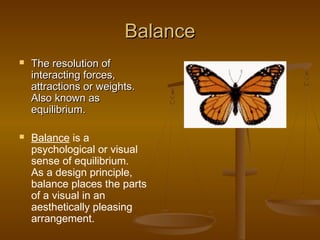
The resolution of
interacting forces,
attractions or weights.
Also known as
equilibrium.
Balance is a
psychological or visual
sense of equilibrium.
As a design principle,
balance places the parts
of a visual in an
aesthetically pleasing
arrangement.
Balance


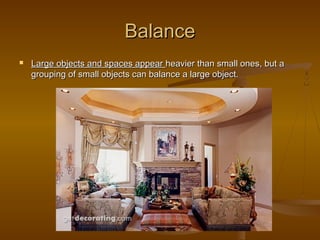
Large objects and spaces appear heavier than small ones, but a
grouping of small objects can balance a large object.
Balance


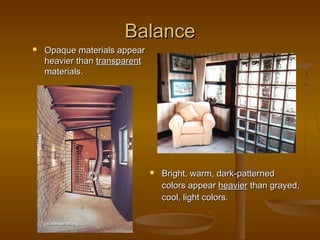
Opaque materials appear
heavier than transparent
materials.



Bright, warm, dark-patterned
colors appear heavier than grayed,
cool, light colors.
Balance




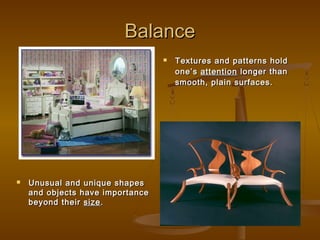
Unusual and unique shapes
and objects have importance
beyond their size .

Textures and patterns hold
one’s attention longer than
smooth, plain surfaces.
Balance


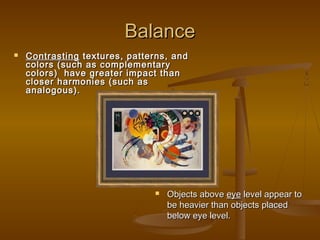
Contrasting textures, patterns, and
colors (such as complementary
colors) have greater impact than
closer harmonies (such as
analogous).



Objects above eye level appear to
be heavier than objects placed
below eye level.
Balance




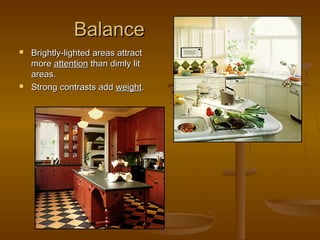
Brightly-lighted areas attract
more attention than dimly lit
areas.
Strong contrasts add weight.
Types of Balance…
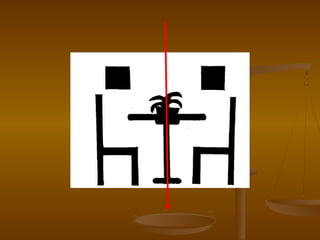
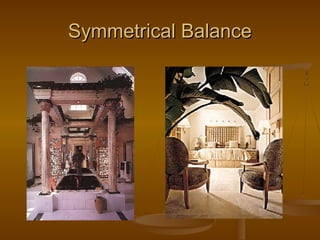
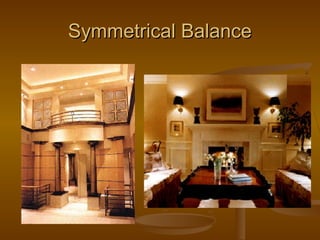
Symmetrical

Formal Balance
One side of the room is the mirror image of the
other
Occurs when the visual weight of a
composition is evenly distributed around a
central vertical or horizontal axis
Gives a quiet and restful feeling
Suits classical and traditional interiors
Easiest balance to create, but not as
interesting
Symmetrical Balance
Symmetrical Balance
Types of Balance…
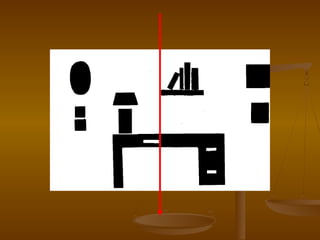
Asymmetrical

Informal Balance
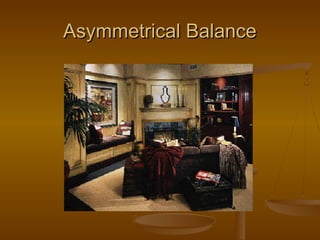
Visual weights are equal, but elements are
different in size, form, color, pattern, and
spacing
Occurs when the weight of a composition
is not evenly distributed around a central
axis
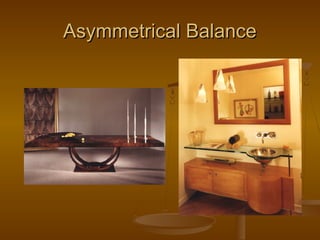
Has an effect of spaciousness
More lasting appeal; interesting
Asymmetrical Balance
Types of Balance…
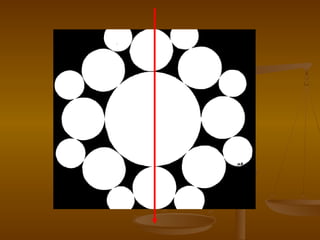
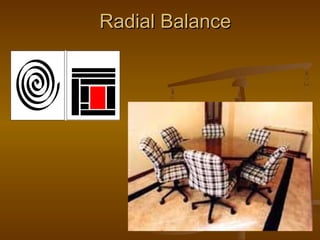
Radial
Furnishings or patterns are arranged in a
circular manner
Creates a dramatic sense of motion in a
room
The right and left sides as well as the top
and bottom halves of the composition are
identical.
Radial Balance
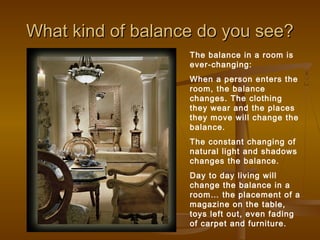
What kind of balance do you see?
The balance in a room is
ever-changing:
When a person enters the
room, the balance
changes. The clothing
they wear and the places
they move will change the
balance.
The constant changing of
natural light and shadows
changes the balance.
Day to day living will
change the balance in a
room… the placement of a
magazine on the table,
toys left out, even fading
of carpet and furniture.
Assignment on Balance
1. Using catalogs or magazines, find and identify one
picture of a whole room arrangement (or an area of
a room) that illustrates symmetrical and one picture
that illustrates asymmetrical balance.
2. Use a computer or templates to title each page and
label each picture. You may mat the pictures as
desired.
3. If the picture you
Symmetrical Balance
Asymmetrical
select does not fill the
by Your
Balance
by
entire page, you may
Name
Your Name
The symmetrical
The asymmetrical balance
want to add a picture of
balance in this room
in this room gives it an
leaves it feeling formal
balancing scales or a
informal or casual appeal.
and peaceful.
picture of an individual
object that illustrates
one of the types of
balance.
Asymmetric lamp
Symmetrical Balance

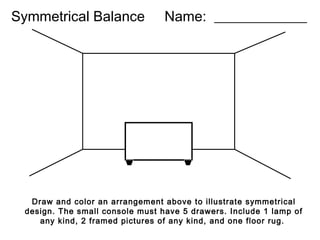
Name: _____________

Draw and color an arrangement above to illustrate symmetrical
design. The small console must have 5 drawers. Include 1 lamp of
any kind, 2 framed pictures of any kind, and one floor rug.
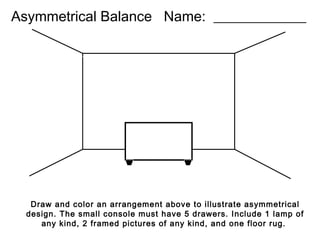
Asymmetrical Balance Name: _____________

Draw and color an arrangement above to illustrate asymmetrical
design. The small console must have 5 drawers. Include 1 lamp of
any kind, 2 framed pictures of any kind, and one floor rug.

Balance

  • 2.
    PRINCIPLES OF DESIGN… Thedesigner works with the 4 tools or elements of design: line, form, color, and texture. But now they must follow the “RULES” about using those tools. The rules are called the principles of design. There are 5 principles of design: BALANCE proportion/scale rhythm harmony emphasis
  • 3.
    Balance   The resolution of interactingforces, attractions or weights. Also known as equilibrium. Balance is a psychological or visual sense of equilibrium. As a design principle, balance places the parts of a visual in an aesthetically pleasing arrangement.
  • 4.
    Balance  Large objects andspaces appear heavier than small ones, but a grouping of small objects can balance a large object.
  • 5.
    Balance  Opaque materials appear heavierthan transparent materials.  Bright, warm, dark-patterned colors appear heavier than grayed, cool, light colors.
  • 6.
    Balance   Unusual and uniqueshapes and objects have importance beyond their size . Textures and patterns hold one’s attention longer than smooth, plain surfaces.
  • 7.
    Balance  Contrasting textures, patterns,and colors (such as complementary colors) have greater impact than closer harmonies (such as analogous).  Objects above eye level appear to be heavier than objects placed below eye level.
  • 8.
    Balance   Brightly-lighted areas attract moreattention than dimly lit areas. Strong contrasts add weight.
  • 9.
    Types of Balance… Symmetrical FormalBalance One side of the room is the mirror image of the other Occurs when the visual weight of a composition is evenly distributed around a central vertical or horizontal axis Gives a quiet and restful feeling Suits classical and traditional interiors Easiest balance to create, but not as interesting
  • 11.
  • 12.
  • 13.
    Types of Balance… Asymmetrical InformalBalance Visual weights are equal, but elements are different in size, form, color, pattern, and spacing Occurs when the weight of a composition is not evenly distributed around a central axis Has an effect of spaciousness More lasting appeal; interesting
  • 15.
  • 16.
  • 17.
    Types of Balance… Radial Furnishingsor patterns are arranged in a circular manner Creates a dramatic sense of motion in a room The right and left sides as well as the top and bottom halves of the composition are identical.
  • 19.
  • 20.
    What kind ofbalance do you see? The balance in a room is ever-changing: When a person enters the room, the balance changes. The clothing they wear and the places they move will change the balance. The constant changing of natural light and shadows changes the balance. Day to day living will change the balance in a room… the placement of a magazine on the table, toys left out, even fading of carpet and furniture.
  • 22.
    Assignment on Balance 1.Using catalogs or magazines, find and identify one picture of a whole room arrangement (or an area of a room) that illustrates symmetrical and one picture that illustrates asymmetrical balance. 2. Use a computer or templates to title each page and label each picture. You may mat the pictures as desired. 3. If the picture you Symmetrical Balance Asymmetrical select does not fill the by Your Balance by entire page, you may Name Your Name The symmetrical The asymmetrical balance want to add a picture of balance in this room in this room gives it an leaves it feeling formal balancing scales or a informal or casual appeal. and peaceful. picture of an individual object that illustrates one of the types of balance. Asymmetric lamp
  • 23.
    Symmetrical Balance Name: _____________ Drawand color an arrangement above to illustrate symmetrical design. The small console must have 5 drawers. Include 1 lamp of any kind, 2 framed pictures of any kind, and one floor rug.
  • 24.
    Asymmetrical Balance Name:_____________ Draw and color an arrangement above to illustrate asymmetrical design. The small console must have 5 drawers. Include 1 lamp of any kind, 2 framed pictures of any kind, and one floor rug.