RHS Level 2 Certificate Year 1 Week 5 More growth and life cycles
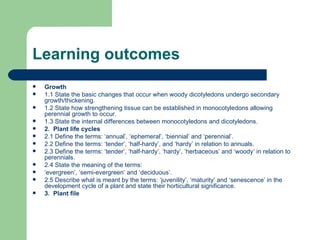
Learning outcomes Growth  1.1 State the basic changes that occur when woody dicotyledons undergo secondary growth/thickening. 1.2 State how strengthening tissue can be established in monocotyledons allowing perennial growth to occur. 1.3 State the internal differences between monocotyledons and dicotyledons. 2.  Plant life cycles 2.1 Define the terms: ‘annual’, ‘ephemeral’, ‘biennial’ and ‘perennial’. 2.2 Define the terms: ‘tender’, ‘half-hardy’, and ‘hardy’ in relation to annuals. 2.3 Define the terms: ‘tender’, ‘half-hardy’, ‘hardy’, ‘herbaceous’ and ‘woody’ in relation to perennials. 2.4 State the meaning of the terms: ‘ evergreen’, ‘semi-evergreen’ and ‘deciduous’. 2.5 Describe what is meant by the terms: ‘juvenility’, ‘maturity’ and ‘senescence’ in the development cycle of a plant and state their horticultural significance. 3.  Plant file
Growth We have seen how growth takes place at the meristems – extending the roots and shoots. Secondary growth – dicotyledons.  Producing thickened stems, creating ‘wood’. Strengthening growth – monocotyledons Internal differences – monocotyledons and dicotyledons
Plant life cycles Duration of life – annuals, biennials, perennials and ephemeral plants Sensitivity to conditions – hardy, half hardy and tender annuals and perennials Leaf replacement – deciduous, evergreen and semi-evergreen.
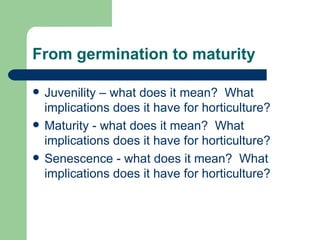
From germination to maturity Juvenility – what does it mean?  What implications does it have for horticulture? Maturity - what does it mean?  What implications does it have for horticulture? Senescence - what does it mean?  What implications does it have for horticulture?
Learning outcomes Growth  1.1 State the basic changes that occur when woody dicotyledons undergo secondary growth/thickening. 1.2 State how strengthening tissue can be established in monocotyledons allowing perennial growth to occur. 1.3 State the internal differences between monocotyledons and dicotyledons. 2.  Plant life cycles 2.1 Define the terms: ‘annual’, ‘ephemeral’, ‘biennial’ and ‘perennial’. 2.2 Define the terms: ‘tender’, ‘half-hardy’, and ‘hardy’ in relation to annuals. 2.3 Define the terms: ‘tender’, ‘half-hardy’, ‘hardy’, ‘herbaceous’ and ‘woody’ in relation to perennials. 2.4 State the meaning of the terms: ‘ evergreen’, ‘semi-evergreen’ and ‘deciduous’. 2.5 Describe what is meant by the terms: ‘juvenility’, ‘maturity’ and ‘senescence’ in the development cycle of a plant and state their horticultural significance. 3.  Plant file

RHS Level 2 Certificate - Year 1 Session 5 overview

  • 1.
    RHS Level 2Certificate Year 1 Week 5 More growth and life cycles
  • 2.
    Learning outcomes Growth 1.1 State the basic changes that occur when woody dicotyledons undergo secondary growth/thickening. 1.2 State how strengthening tissue can be established in monocotyledons allowing perennial growth to occur. 1.3 State the internal differences between monocotyledons and dicotyledons. 2. Plant life cycles 2.1 Define the terms: ‘annual’, ‘ephemeral’, ‘biennial’ and ‘perennial’. 2.2 Define the terms: ‘tender’, ‘half-hardy’, and ‘hardy’ in relation to annuals. 2.3 Define the terms: ‘tender’, ‘half-hardy’, ‘hardy’, ‘herbaceous’ and ‘woody’ in relation to perennials. 2.4 State the meaning of the terms: ‘ evergreen’, ‘semi-evergreen’ and ‘deciduous’. 2.5 Describe what is meant by the terms: ‘juvenility’, ‘maturity’ and ‘senescence’ in the development cycle of a plant and state their horticultural significance. 3. Plant file
  • 3.
    Growth We haveseen how growth takes place at the meristems – extending the roots and shoots. Secondary growth – dicotyledons. Producing thickened stems, creating ‘wood’. Strengthening growth – monocotyledons Internal differences – monocotyledons and dicotyledons
  • 4.
    Plant life cyclesDuration of life – annuals, biennials, perennials and ephemeral plants Sensitivity to conditions – hardy, half hardy and tender annuals and perennials Leaf replacement – deciduous, evergreen and semi-evergreen.
  • 5.
    From germination tomaturity Juvenility – what does it mean? What implications does it have for horticulture? Maturity - what does it mean? What implications does it have for horticulture? Senescence - what does it mean? What implications does it have for horticulture?
  • 6.
    Learning outcomes Growth 1.1 State the basic changes that occur when woody dicotyledons undergo secondary growth/thickening. 1.2 State how strengthening tissue can be established in monocotyledons allowing perennial growth to occur. 1.3 State the internal differences between monocotyledons and dicotyledons. 2. Plant life cycles 2.1 Define the terms: ‘annual’, ‘ephemeral’, ‘biennial’ and ‘perennial’. 2.2 Define the terms: ‘tender’, ‘half-hardy’, and ‘hardy’ in relation to annuals. 2.3 Define the terms: ‘tender’, ‘half-hardy’, ‘hardy’, ‘herbaceous’ and ‘woody’ in relation to perennials. 2.4 State the meaning of the terms: ‘ evergreen’, ‘semi-evergreen’ and ‘deciduous’. 2.5 Describe what is meant by the terms: ‘juvenility’, ‘maturity’ and ‘senescence’ in the development cycle of a plant and state their horticultural significance. 3. Plant file