Review….
Plant Propagation
- The art and science of multiplying plants by sexual or
asexual means.
Types of Plant Propagation
• Sexual Propagation
- starting plants from seeds
• Asexual Propagation
- starting plants by means other than seed
or other planting materials.
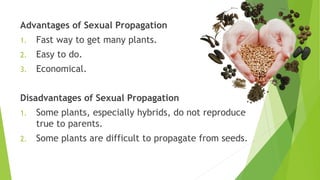
Advantages of Sexual Propagation
1. Fast way to get many plants.
2. Easy to do.
3. Economical.
Disadvantages of Sexual Propagation
1. Some plants, especially hybrids, do not reproduce
true to parents.
2. Some plants are difficult to propagate from seeds.
Tree/Plant for Food
Tree for Shelter
Tree for Medicine
Tree for Money
FARMER
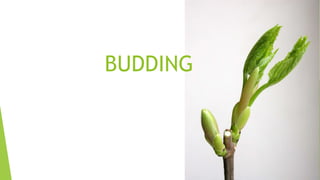
BUDDING
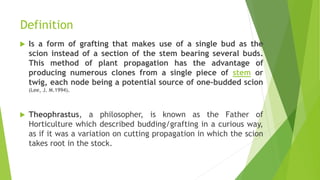
Definition
 Is a form of grafting that makes use of a single bud as the
scion instead of a section of the stem bearing several buds.
This method of plant propagation has the advantage of
producing numerous clones from a single piece of stem or
twig, each node being a potential source of one-budded scion
(Lee, J. M.1994).
 Theophrastus, a philosopher, is known as the Father of
Horticulture which described budding/grafting in a curious way,
as if it was a variation on cutting propagation in which the scion
takes root in the stock.
Advantages
 Asexual reproduction or propagation-plants mature in shorter time.
 Budding is faster or quicker than grafting.
 Some plants do not produce viable seeds.
 New plants are same as parent plant.
Disadvantages
 Some require special equipment and skills, such as budding.
 Cuttings detach plant parts from water and nutrient source.
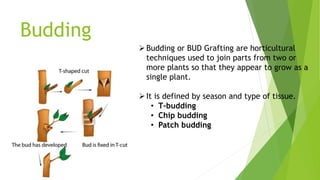
Budding
Budding or BUD Grafting are horticultural
techniques used to join parts from two or
more plants so that they appear to grow as a
single plant.
It is defined by season and type of tissue.
• T-budding
• Chip budding
• Patch budding
Guidelines in Selection of Planting
Materials for Budding
A. The scion (top)material have fully-formed and mature.
B. The rootstock be in a condition of active growth such that the "bark is
slipping".
- This means that the vascular cambium is actively growing, and the bark can
be peeled easily from the stock piece with little damage.
The vascular cambium can regenerate the vascular connections between the
scion and rootstock resulting in a complete plant composed of more than one
genotype.
The vascular bundles (xylem and phloem) of the stock connect to the scion(bud) and
develop as a part of the original plant.
A
B
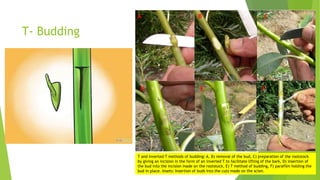
T- Budding
T and inverted T methods of budding: A, B) removal of the bud, C) preparation of the rootstock
by giving an incision in the form of an inverted T to facilitate lifting of the bark, D) insertion of
the bud into the incision made on the rootstock, E) T method of budding, F) parafilm holding the
bud in place. Insets: Insertion of buds into the cuts made on the scion.
A B C
D E F
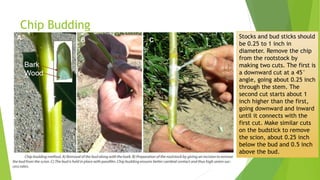
Chip Budding
Stocks and bud sticks should
be 0.25 to 1 inch in
diameter. Remove the chip
from the rootstock by
making two cuts. The first is
a downward cut at a 45°
angle, going about 0.25 inch
through the stem. The
second cut starts about 1
inch higher than the first,
going downward and inward
until it connects with the
first cut. Make similar cuts
on the budstick to remove
the scion, about 0.25 inch
below the bud and 0.5 inch
above the bud.
Patch Budding
These methods are
suitable for plants with
thick bark that renders T
budding an unsuitable
method.
The scion contains no
wood behind the bark
patch.
Procedure
1. Preparation of the rootstock. Rootstocks about the size of an ordinary pencil (0.8cm) and
up to 1.5 cm in diameter are commonly used but there are no hard rules.
2. Preparation of the bud-scion. This consists of a prominent axillary bud (a plant organ
which serves as growing point) on a section of bark, with or without a small piece of wood
attached. This piece of bark is often termed as either a bud patch, chip, or shield piece.
They are also referred to as single-bud scions.
 Budsticks, small stems or twigs having multiple number of nodes from which the bud-containing
barks are to be prepared, are obtained from well selected vigorous, disease-free mother plants
having desirable characteristics.
3. Insertion of the prepared bud-scion. The prepared patch, chip or shield piece is inserted
into the part of the stem of the rootstock to replace the piece of bark that is removed or
where cuts are made to allow union. Correct polarity should be observed, that is, the
patch of bark is oriented upward.
4. Tying or wrapping. The stem-bud union is tied or wrapped to hold the
components firmly together but generally leaving the growing point exposed.
If also wrapped, it must be opened about 15 days later or at the time when
the rootstock is cut back. For practical usage, a thin, transparent
polypropylene (PP) plastic bag can be cut into strips about 2-3 cm wide.
These plastic strips have to be elastic and do not easily break when stretched.
5. Cut back of the rootstock. The rootstock must be decapitated, preferably
with the use of a pruning shear, at the part of the stem immediately above
the union to eliminate apical dominance.
6. Care of clones. This involves activities that are normally performed to hasten
rapid growth of nursery plants and trees. It also
includes debudding and desuckering, the removal of offshoots that may
emerge from the stem below the union. These are done to ensure that the
propagated plants will exhibit only the characters of the mother plant.
Budded Seedlings
of Rubber Tree
Assignment:
Please search about other asexual propagation method and its processes.
Thank you very much! GOD bless us.

Sexual propagation demo dep.ed

  • 1.
    Review…. Plant Propagation - Theart and science of multiplying plants by sexual or asexual means. Types of Plant Propagation • Sexual Propagation - starting plants from seeds • Asexual Propagation - starting plants by means other than seed or other planting materials.
  • 2.
    Advantages of SexualPropagation 1. Fast way to get many plants. 2. Easy to do. 3. Economical. Disadvantages of Sexual Propagation 1. Some plants, especially hybrids, do not reproduce true to parents. 2. Some plants are difficult to propagate from seeds.
  • 3.
    Tree/Plant for Food Treefor Shelter Tree for Medicine Tree for Money FARMER
  • 4.
  • 5.
    Definition  Is aform of grafting that makes use of a single bud as the scion instead of a section of the stem bearing several buds. This method of plant propagation has the advantage of producing numerous clones from a single piece of stem or twig, each node being a potential source of one-budded scion (Lee, J. M.1994).  Theophrastus, a philosopher, is known as the Father of Horticulture which described budding/grafting in a curious way, as if it was a variation on cutting propagation in which the scion takes root in the stock.
  • 6.
    Advantages  Asexual reproductionor propagation-plants mature in shorter time.  Budding is faster or quicker than grafting.  Some plants do not produce viable seeds.  New plants are same as parent plant. Disadvantages  Some require special equipment and skills, such as budding.  Cuttings detach plant parts from water and nutrient source.
  • 7.
    Budding Budding or BUDGrafting are horticultural techniques used to join parts from two or more plants so that they appear to grow as a single plant. It is defined by season and type of tissue. • T-budding • Chip budding • Patch budding
  • 8.
    Guidelines in Selectionof Planting Materials for Budding A. The scion (top)material have fully-formed and mature. B. The rootstock be in a condition of active growth such that the "bark is slipping". - This means that the vascular cambium is actively growing, and the bark can be peeled easily from the stock piece with little damage. The vascular cambium can regenerate the vascular connections between the scion and rootstock resulting in a complete plant composed of more than one genotype. The vascular bundles (xylem and phloem) of the stock connect to the scion(bud) and develop as a part of the original plant. A B
  • 9.
    T- Budding T andinverted T methods of budding: A, B) removal of the bud, C) preparation of the rootstock by giving an incision in the form of an inverted T to facilitate lifting of the bark, D) insertion of the bud into the incision made on the rootstock, E) T method of budding, F) parafilm holding the bud in place. Insets: Insertion of buds into the cuts made on the scion. A B C D E F
  • 10.
    Chip Budding Stocks andbud sticks should be 0.25 to 1 inch in diameter. Remove the chip from the rootstock by making two cuts. The first is a downward cut at a 45° angle, going about 0.25 inch through the stem. The second cut starts about 1 inch higher than the first, going downward and inward until it connects with the first cut. Make similar cuts on the budstick to remove the scion, about 0.25 inch below the bud and 0.5 inch above the bud.
  • 11.
    Patch Budding These methodsare suitable for plants with thick bark that renders T budding an unsuitable method. The scion contains no wood behind the bark patch.
  • 12.
    Procedure 1. Preparation ofthe rootstock. Rootstocks about the size of an ordinary pencil (0.8cm) and up to 1.5 cm in diameter are commonly used but there are no hard rules. 2. Preparation of the bud-scion. This consists of a prominent axillary bud (a plant organ which serves as growing point) on a section of bark, with or without a small piece of wood attached. This piece of bark is often termed as either a bud patch, chip, or shield piece. They are also referred to as single-bud scions.  Budsticks, small stems or twigs having multiple number of nodes from which the bud-containing barks are to be prepared, are obtained from well selected vigorous, disease-free mother plants having desirable characteristics. 3. Insertion of the prepared bud-scion. The prepared patch, chip or shield piece is inserted into the part of the stem of the rootstock to replace the piece of bark that is removed or where cuts are made to allow union. Correct polarity should be observed, that is, the patch of bark is oriented upward.
  • 13.
    4. Tying orwrapping. The stem-bud union is tied or wrapped to hold the components firmly together but generally leaving the growing point exposed. If also wrapped, it must be opened about 15 days later or at the time when the rootstock is cut back. For practical usage, a thin, transparent polypropylene (PP) plastic bag can be cut into strips about 2-3 cm wide. These plastic strips have to be elastic and do not easily break when stretched. 5. Cut back of the rootstock. The rootstock must be decapitated, preferably with the use of a pruning shear, at the part of the stem immediately above the union to eliminate apical dominance. 6. Care of clones. This involves activities that are normally performed to hasten rapid growth of nursery plants and trees. It also includes debudding and desuckering, the removal of offshoots that may emerge from the stem below the union. These are done to ensure that the propagated plants will exhibit only the characters of the mother plant.
  • 14.
  • 15.
    Assignment: Please search aboutother asexual propagation method and its processes. Thank you very much! GOD bless us.