NOTE TAKING
EFFECTIVE NOTE TAKING
Whatever technique you use, effective note taking has three
parts:
1. Read. Active reading – use the SQ3R technique, think about
what you have just read (read in chunks), test comprehension
(formulate a question that has the information you have read
as the answer), etc. You need to understand the material
before you take notes.
2. Record. Make notes – capture your understanding of the
material in your own words. Reformat and condense the
information – use a variety of techniques. Select the best
approach for the information, and the purpose of the notes.
3. Review – memorise, test yourself, apply what you learn, and
NOTE TAKING METHODS
Remember that making notes is a learning activity.
Select the best method for the information and what you want to
use it for:
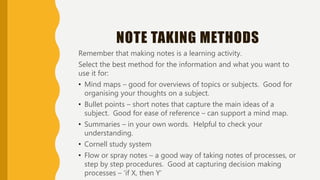
• Mind maps – good for overviews of topics or subjects. Good for
organising your thoughts on a subject.
• Bullet points – short notes that capture the main ideas of a
subject. Good for ease of reference – can support a mind map.
• Summaries – in your own words. Helpful to check your
understanding.
• Cornell study system
• Flow or spray notes – a good way of taking notes of processes, or
step by step procedures. Good at capturing decision making
processes – ‘if X, then Y’
MIND
MAPPING
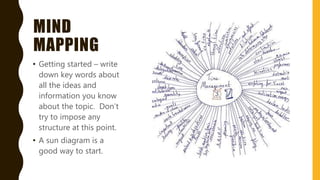
• Getting started – write
down key words about
all the ideas and
information you know
about the topic. Don’t
try to impose any
structure at this point.
• A sun diagram is a
good way to start.
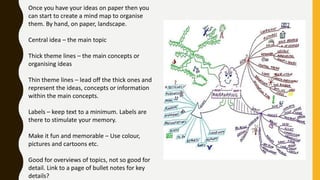
Once you have your ideas on paper then you
can start to create a mind map to organise
them. By hand, on paper, landscape.
Central idea – the main topic
Thick theme lines – the main concepts or
organising ideas
Thin theme lines – lead off the thick ones and
represent the ideas, concepts or information
within the main concepts.
Labels – keep text to a minimum. Labels are
there to stimulate your memory.
Make it fun and memorable – Use colour,
pictures and cartoons etc.
Good for overviews of topics, not so good for
detail. Link to a page of bullet notes for key
details?
CORNELL NOTE
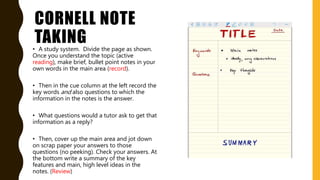
TAKING• A study system. Divide the page as shown.
Once you understand the topic (active
reading), make brief, bullet point notes in your
own words in the main area (record).
• Then in the cue column at the left record the
key words and also questions to which the
information in the notes is the answer.
• What questions would a tutor ask to get that
information as a reply?
• Then, cover up the main area and jot down
on scrap paper your answers to those
questions (no peeking). Check your answers. At
the bottom write a summary of the key
features and main, high level ideas in the
notes. (Review)
FLOW CHART
NOTES
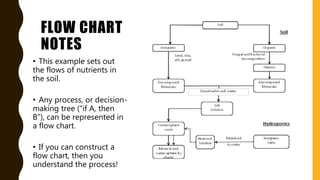
• This example sets out
the flows of nutrients in
the soil.
• Any process, or decision-
making tree (“if A, then
B”), can be represented in
a flow chart.
• If you can construct a
flow chart, then you
understand the process!

Note taking

  • 1.
  • 2.
    EFFECTIVE NOTE TAKING Whatevertechnique you use, effective note taking has three parts: 1. Read. Active reading – use the SQ3R technique, think about what you have just read (read in chunks), test comprehension (formulate a question that has the information you have read as the answer), etc. You need to understand the material before you take notes. 2. Record. Make notes – capture your understanding of the material in your own words. Reformat and condense the information – use a variety of techniques. Select the best approach for the information, and the purpose of the notes. 3. Review – memorise, test yourself, apply what you learn, and
  • 3.
    NOTE TAKING METHODS Rememberthat making notes is a learning activity. Select the best method for the information and what you want to use it for: • Mind maps – good for overviews of topics or subjects. Good for organising your thoughts on a subject. • Bullet points – short notes that capture the main ideas of a subject. Good for ease of reference – can support a mind map. • Summaries – in your own words. Helpful to check your understanding. • Cornell study system • Flow or spray notes – a good way of taking notes of processes, or step by step procedures. Good at capturing decision making processes – ‘if X, then Y’
  • 4.
    MIND MAPPING • Getting started– write down key words about all the ideas and information you know about the topic. Don’t try to impose any structure at this point. • A sun diagram is a good way to start.
  • 5.
    Once you haveyour ideas on paper then you can start to create a mind map to organise them. By hand, on paper, landscape. Central idea – the main topic Thick theme lines – the main concepts or organising ideas Thin theme lines – lead off the thick ones and represent the ideas, concepts or information within the main concepts. Labels – keep text to a minimum. Labels are there to stimulate your memory. Make it fun and memorable – Use colour, pictures and cartoons etc. Good for overviews of topics, not so good for detail. Link to a page of bullet notes for key details?
  • 6.
    CORNELL NOTE TAKING• Astudy system. Divide the page as shown. Once you understand the topic (active reading), make brief, bullet point notes in your own words in the main area (record). • Then in the cue column at the left record the key words and also questions to which the information in the notes is the answer. • What questions would a tutor ask to get that information as a reply? • Then, cover up the main area and jot down on scrap paper your answers to those questions (no peeking). Check your answers. At the bottom write a summary of the key features and main, high level ideas in the notes. (Review)
  • 7.
    FLOW CHART NOTES • Thisexample sets out the flows of nutrients in the soil. • Any process, or decision- making tree (“if A, then B”), can be represented in a flow chart. • If you can construct a flow chart, then you understand the process!