P L A N T B I O L O G Y : Z O L J A R G A L C H I N B A T
THE SEED
2
SEEDS
• Seeds contain a young, developing plant
embryo
• Seeds are covered with a protective seed
coat.
• Inside is stored food or endosperm that the
young plant uses as it begins to sprout or
germinate.
• Seeds form from ripened ovules after
fertilization
SEED STRUCTURE
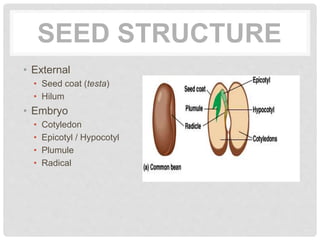
• External
• Seed coat (testa)
• Hilum
• Embryo
• Cotyledon
• Epicotyl / Hypocotyl
• Plumule
• Radical
SEED COAT
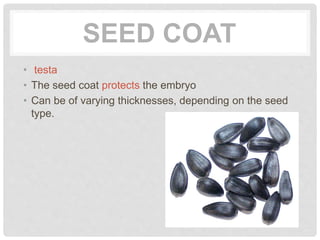
• testa
• The seed coat protects the embryo
• Can be of varying thicknesses, depending on the seed
type.
HILUM
• Scar from the seed being attached to the parent plant
EMBRYO
• The embryo is what forms the new plant once the
opportune conditions are present.
COTYLEDON
• The cotyledon is the first
leaf that germinates.
• It is filled with stored
food that the plant uses
before it begins
photosynthesis.
• Some plants have 1
cotyledon (monocot)
and some have 2
cotyledons (dicot).
EPICOTYL /HYPOCOTYL
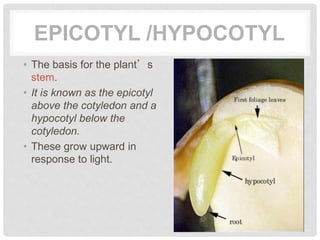
• The basis for the plant’s
stem.
• It is known as the epicotyl
above the cotyledon and a
hypocotyl below the
cotyledon.
• These grow upward in
response to light.
PLUMULE
The shoot tip with a pair of miniature leaves.
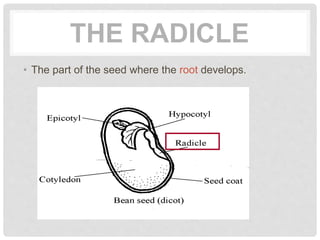
THE RADICLE
• The part of the seed where the root develops.
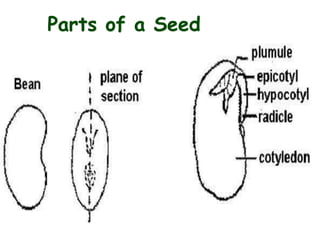
THE STRUCTURES OF THREE DIFFERENT
SEEDS ARE SHOWN HERE 
12
Parts of a Seed
Seed
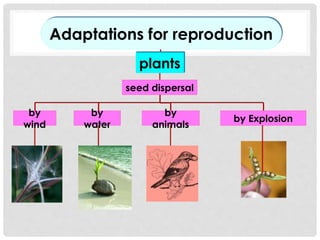
• Flowering plants have different adaptations to enable
their seeds to be dispersed as far away as possible.
• The different methods of seed dispersal are…
• by wind
• by animals
• by water
• by explosion
REPRODUCTION IN PLANTS — GETTING THE SEEDS
DISPERSED
Seed Dispersal
by Explosion
by
wind
seed dispersal
by
water
Adaptations for reproduction
plants
by
animals
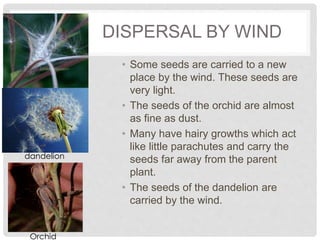
DISPERSAL BY WIND
• Some seeds are carried to a new
place by the wind. These seeds are
very light.
• The seeds of the orchid are almost
as fine as dust.
• Many have hairy growths which act
like little parachutes and carry the
seeds far away from the parent
plant.
• The seeds of the dandelion are
carried by the wind.
dandelion
Orchid
DISPERSAL BY WATER
• Water lily and the coconut palm are
carried by water.
• Coconuts can travel for thousands of
kilometres across seas and oceans.
• The original coconut palms on South
Sea islands grew from fruits which
were carried there from the mainland
by ocean currents.
DISPERSAL BY ANIMALS
• The animal eats the fruit but only the juicy
part is digested.
• The stones and pips pass through the
animal's digestive system and are excreted
to form new plants. This can be far away
from the parent plant.
• Blackberry, cherry and apple seeds are
dispersed in this way.
• Birds also like to eat fruit and they help to
disperse seeds to other areas through their
droppings.
• Squirrels collect nuts like acorns and bury
them for winter food, but they often forget
where they have buried them and these
grow into new trees.
• Some fruits like that of the burdock plant
have seeds with hooks.
• These catch on the fur of animals and are
carried away.
DISPERSAL BY EXPLOSION
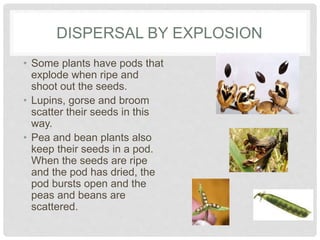
• Some plants have pods that
explode when ripe and
shoot out the seeds.
• Lupins, gorse and broom
scatter their seeds in this
way.
• Pea and bean plants also
keep their seeds in a pod.
When the seeds are ripe
and the pod has dried, the
pod bursts open and the
peas and beans are
scattered.
SEED DORMANCY
What is seed dormancy?
Seed dormancy means to delay germination until
favorable environmental conditions are present for
seed germination and sprout growth.
• Types of dormancy
1. Primary dormancy delays initial seed germination
2. Secondary dormancy
PRIMARY DORMANCY
• Seed coat physical dormancy- is when the seed coat
prevents the seed from absorbing water.
• Seed coat mechanical dormancy- is when the seed
coat prevents the embryo from breaking through.
• Chemical dormancy- is when chemicals within the
seed coat prevent the seed from germination.
• Morphological dormancy- is when the seed has not
completed at the time the seed leaves the plant
• Physiological or intermediate dormancy- occurs
because a physiological condition is not being met.
• Deep dormancy- is when plants stay dormant until
favorable conditions are met, usually involving a period
of cooling.
• Double dormancy- is the combination of any of the
previously mentioned factors.
SECONDARY DORMANCY
• Secondary dormancy prevents the seed from
germinating after it absorbs water.
Is caused by temperature extremes, prolonged
darkness, prolonged light water stress, or oxygen
extremes.
SEED GERMINATION
• What is it?
Process that causes a seed to begin to grow
into a new plant.
• Factors influencing germination
1.Water
2.Oxygen
3.Temperature
4.Light
WATER AND OXYGEN
Water
• Mature seeds have relatively little moisture to
prevent decay.
• Seeds usually mature in fall.
• To germinate, seeds must take in water.
Oxygen
• Oxygen in the presence of enough moisture causes
respiration to start.
• This creates energy for the germination process.
TEMPERATURE AND LIGHT
Temperature
• Most seeds go through a cold period before
germination.
• Helps prevent seeds from sprouting as soon as they
mature.
• Proper temp. for most seeds= 68-85 F.
Light
• Amount of light needed varies.
• Depth of seed planting influences this.
• Too deep=not enough light oxygen.
• Too shallow may=too much light.
seed

seed

  • 1.
    P L AN T B I O L O G Y : Z O L J A R G A L C H I N B A T THE SEED
  • 2.
    2 SEEDS • Seeds containa young, developing plant embryo • Seeds are covered with a protective seed coat. • Inside is stored food or endosperm that the young plant uses as it begins to sprout or germinate. • Seeds form from ripened ovules after fertilization
  • 3.
    SEED STRUCTURE • External •Seed coat (testa) • Hilum • Embryo • Cotyledon • Epicotyl / Hypocotyl • Plumule • Radical
  • 4.
    SEED COAT • testa •The seed coat protects the embryo • Can be of varying thicknesses, depending on the seed type.
  • 5.
    HILUM • Scar fromthe seed being attached to the parent plant
  • 6.
    EMBRYO • The embryois what forms the new plant once the opportune conditions are present.
  • 7.
    COTYLEDON • The cotyledonis the first leaf that germinates. • It is filled with stored food that the plant uses before it begins photosynthesis. • Some plants have 1 cotyledon (monocot) and some have 2 cotyledons (dicot).
  • 8.
    EPICOTYL /HYPOCOTYL • Thebasis for the plant’s stem. • It is known as the epicotyl above the cotyledon and a hypocotyl below the cotyledon. • These grow upward in response to light.
  • 9.
    PLUMULE The shoot tipwith a pair of miniature leaves.
  • 10.
    THE RADICLE • Thepart of the seed where the root develops.
  • 11.
    THE STRUCTURES OFTHREE DIFFERENT SEEDS ARE SHOWN HERE 
  • 12.
  • 13.
  • 14.
    • Flowering plantshave different adaptations to enable their seeds to be dispersed as far away as possible. • The different methods of seed dispersal are… • by wind • by animals • by water • by explosion REPRODUCTION IN PLANTS — GETTING THE SEEDS DISPERSED Seed Dispersal
  • 15.
  • 16.
    DISPERSAL BY WIND •Some seeds are carried to a new place by the wind. These seeds are very light. • The seeds of the orchid are almost as fine as dust. • Many have hairy growths which act like little parachutes and carry the seeds far away from the parent plant. • The seeds of the dandelion are carried by the wind. dandelion Orchid
  • 17.
    DISPERSAL BY WATER •Water lily and the coconut palm are carried by water. • Coconuts can travel for thousands of kilometres across seas and oceans. • The original coconut palms on South Sea islands grew from fruits which were carried there from the mainland by ocean currents.
  • 18.
    DISPERSAL BY ANIMALS •The animal eats the fruit but only the juicy part is digested. • The stones and pips pass through the animal's digestive system and are excreted to form new plants. This can be far away from the parent plant. • Blackberry, cherry and apple seeds are dispersed in this way. • Birds also like to eat fruit and they help to disperse seeds to other areas through their droppings. • Squirrels collect nuts like acorns and bury them for winter food, but they often forget where they have buried them and these grow into new trees. • Some fruits like that of the burdock plant have seeds with hooks. • These catch on the fur of animals and are carried away.
  • 19.
    DISPERSAL BY EXPLOSION •Some plants have pods that explode when ripe and shoot out the seeds. • Lupins, gorse and broom scatter their seeds in this way. • Pea and bean plants also keep their seeds in a pod. When the seeds are ripe and the pod has dried, the pod bursts open and the peas and beans are scattered.
  • 20.
    SEED DORMANCY What isseed dormancy? Seed dormancy means to delay germination until favorable environmental conditions are present for seed germination and sprout growth. • Types of dormancy 1. Primary dormancy delays initial seed germination 2. Secondary dormancy
  • 21.
    PRIMARY DORMANCY • Seedcoat physical dormancy- is when the seed coat prevents the seed from absorbing water. • Seed coat mechanical dormancy- is when the seed coat prevents the embryo from breaking through. • Chemical dormancy- is when chemicals within the seed coat prevent the seed from germination. • Morphological dormancy- is when the seed has not completed at the time the seed leaves the plant • Physiological or intermediate dormancy- occurs because a physiological condition is not being met. • Deep dormancy- is when plants stay dormant until favorable conditions are met, usually involving a period of cooling. • Double dormancy- is the combination of any of the previously mentioned factors.
  • 22.
    SECONDARY DORMANCY • Secondarydormancy prevents the seed from germinating after it absorbs water. Is caused by temperature extremes, prolonged darkness, prolonged light water stress, or oxygen extremes.
  • 23.
    SEED GERMINATION • Whatis it? Process that causes a seed to begin to grow into a new plant. • Factors influencing germination 1.Water 2.Oxygen 3.Temperature 4.Light
  • 25.
    WATER AND OXYGEN Water •Mature seeds have relatively little moisture to prevent decay. • Seeds usually mature in fall. • To germinate, seeds must take in water. Oxygen • Oxygen in the presence of enough moisture causes respiration to start. • This creates energy for the germination process.
  • 26.
    TEMPERATURE AND LIGHT Temperature •Most seeds go through a cold period before germination. • Helps prevent seeds from sprouting as soon as they mature. • Proper temp. for most seeds= 68-85 F. Light • Amount of light needed varies. • Depth of seed planting influences this. • Too deep=not enough light oxygen. • Too shallow may=too much light.