RHS Level 2
Certificate
Week 12 – Understanding the control
of the environment in protected
structures
Learning objectives
4.1 Describe the factors that affect light levels in protected
structures, including shape of structure; site factors;
orientation; type and condition of cladding materials.
4.2 Describe how the temperature can be maintained in
structures, including heating by gas, oil or electricity; heat
distribution using circulating water and air; cooling by forced
or natural ventilation; evaporation; and shading.
4.3 Describe methods of changing the relative humidity (RH) in
a protected environment, including the effects of ‘damping
down’, ventilation and temperature changes.
4.4 Describe manual and automated methods of irrigation,
including the use of watering cans, hose pipes, capillary
systems and ‘drip’ systems
4.5 Describe how light levels can be manipulated, by the use
of supplementary lighting and shading, including blinds and
shading paints.
Factors affecting light levels
 Site – needs an open site with no overhanging
trees or shading buildings
 Orientation – north/south gives even light
distribution; east/west best for winter light
 Glazing materials – compromise between light
transmission and cost and insulation values.
 Shape of building
 Use of shading or supplementary lighting
Light levels – shape of
building
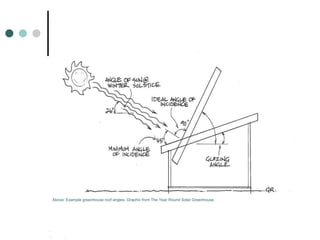
 Light will pass through a transparent material if it hits
the surface at 90°. Otherwise it will be reflected at a
corresponding angle to the angle of incidence.
 No material however is perfectly transparent so some
light will always be reflected from impurities etc within
the material.
 The angle of the light changes with the season and
the latitude.
 So the angle of the roof and sides of the greenhouse
can make a radical difference to the amount of light
that passes through the glazing.
Above: Example greenhouse roof angles. Graphic from The Year Round Solar Greenhouse
Light Levels – shape of
building
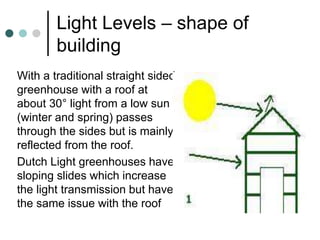
With a traditional straight sided
greenhouse with a roof at
about 30° light from a low sun
(winter and spring) passes
through the sides but is mainly
reflected from the roof.
Dutch Light greenhouses have
sloping slides which increase
the light transmission but have
the same issue with the roof
Light levels – shape of
building
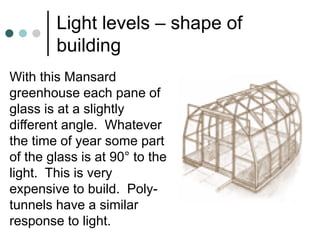
With this Mansard
greenhouse each pane of
glass is at a slightly
different angle. Whatever
the time of year some part
of the glass is at 90° to the
light. This is very
expensive to build. Poly-
tunnels have a similar
response to light.
Controlling light – blinds and
shading
 Reducing light intensity within the greenhouse
will protect plants from scorching and may
reduce temperature. Black out shading can
also be used to create artificial ‘night’ to
control flowering.
 Materials used include blinds (external or
internal), shading paint and shade netting.
 External shading is most effective at reducing
temperature.
 Factors to be considered include cost, life
span, work involved and ease of adjustment.
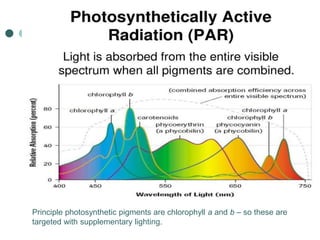
Principle photosynthetic pigments are chlorophyll a and b – so these are
targeted with supplementary lighting.
Controlling light –
supplementary lighting
 The light source chosen must include PAR
 Commonly used are High Pressure Sodium,
LED, and compact fluorescent lights.
 HPS generates heat and is more expensive to
run but gives more light than compact
fluorescent lights. LED lights are a new
development, can provide a ‘light recipe’, lower
cost and less heat.
 Artificial lighting can be used to add to existing
day light in winter and/or to extend the ‘day’ to
mimic light conditions at other times of year.
Controlling temperature -
heating
 Possible sources of heat – electricity, paraffin or
gas or use stored heat from the sun.
 Electricity is more controllable but expensive to
install. Unlike gas and paraffin no need to
ventilate.
 Gas and paraffin are less controllable and produce
condensation but are cheaper than electricity.
 Solar thermal can buffer temperatures in a cool
greenhouse but a very elaborate set up would be
needed for any greater level of heating.
 Insulation is vital to avoid wasting heat.
Controlling temperature -
cooling
 Use of external shading – blinds or shade
netting most effective, shading paint has
some effect
 Evaporation of water – ‘damping down’.
Energy used to turn the liquid to gas is taken
from the heat in the air or in the greenhouse
floor etc.
 Ventilation – natural or forced. Hot air moves
upwards and draws cool after it. Top and
bottom vents must be open for natural
ventilation.
Water - irrigation
 Methods – by hand using a can or hose; by
capillary watering systems; by drip or spray
watering systems.
 Aim is to maintain water content of the
growing media at the ideal level.
 Drip or spray systems can be automated and
easily adjusted to conditions.
 Capillary systems can look after themselves
while you go away for a few days.
 Hand watering allows precise control and
plant monitoring.
Water – Relative Humidity
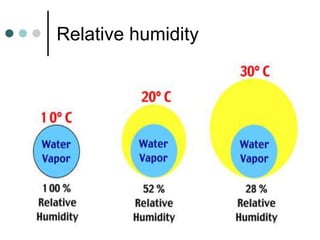
 A measure of the amount of water vapour in the air
relative to the maximum it could hold; this varies
according to the temperature. The warmer the air
the more water molecules it can hold. When air
cools the water that can no longer be held
condenses out – ‘dew point’
 Ideal levels vary according to the plant and its
maturity.
 Relative Humidity can be increased by misting or
damping down and reduced by ventilation.
Relative humidity
Relative humidity
 The higher the humidity the lower the rate of transpiration
from the leaves. This will conserve water in higher
temperatures.
 However once RH is at 100% any additional water vapour
will condense out to liquid – on surfaces that are cooler
than the air (e.g. plant leaves and stems). This can
encourage fungal infection. Condensation on cladding
materials can reflect light out of the greenhouse.
 Ventilation allows dryer air to enter and therefore controls
humidity. Dryer air also allows further evaporation from
damp surfaces, reducing temperature further.
Question sheet answers
1. Shade the outside of the greenhouse, damp down in the
morning or early afternoon, open the side and top ventilators in
the morning and close at night.
2. Blinds allow easy adjustment on cloudy days and provide good
reduction of temperature on hot days.
3. It removes the need for daily watering and increases humidity
in hot weather
4. Benefits: precise amounts applied, plants are checked daily.
Limitations: hard work in large areas and needs someone to
do it.
5. Because light is reflected back through the glass by the inside
surface of the water droplets.
6. A glass clad and steel or aluminium framed greenhouse for
maximum light. Heat would be needed to keep temperatures
above 10 degrees centigrade.
Learning outcomes
4.1 Describe the factors that affect light levels in protected structures,
including shape of structure; site factors; orientation; type and condition
of cladding materials.
4.2 Describe how the temperature can be maintained in structures,
including heating by gas, oil or electricity; heat distribution using
circulating water and air; cooling by forced or natural ventilation;
evaporation; and shading.
4.3 Describe methods of changing the relative humidity (RH) in a protected
environment, including the effects of ‘damping down’, ventilation and
temperature changes.
4.4 Describe manual and automated methods of irrigation, including the
use of watering cans, hose pipes, capillary systems and ‘drip’ systems
4.5 Describe how light levels can be manipulated, by the use of
supplementary lighting and shading, including blinds and shading paints.

Rhs year 2 week 12 presentation 2020

  • 1.
    RHS Level 2 Certificate Week12 – Understanding the control of the environment in protected structures
  • 2.
    Learning objectives 4.1 Describethe factors that affect light levels in protected structures, including shape of structure; site factors; orientation; type and condition of cladding materials. 4.2 Describe how the temperature can be maintained in structures, including heating by gas, oil or electricity; heat distribution using circulating water and air; cooling by forced or natural ventilation; evaporation; and shading. 4.3 Describe methods of changing the relative humidity (RH) in a protected environment, including the effects of ‘damping down’, ventilation and temperature changes. 4.4 Describe manual and automated methods of irrigation, including the use of watering cans, hose pipes, capillary systems and ‘drip’ systems 4.5 Describe how light levels can be manipulated, by the use of supplementary lighting and shading, including blinds and shading paints.
  • 3.
    Factors affecting lightlevels  Site – needs an open site with no overhanging trees or shading buildings  Orientation – north/south gives even light distribution; east/west best for winter light  Glazing materials – compromise between light transmission and cost and insulation values.  Shape of building  Use of shading or supplementary lighting
  • 4.
    Light levels –shape of building  Light will pass through a transparent material if it hits the surface at 90°. Otherwise it will be reflected at a corresponding angle to the angle of incidence.  No material however is perfectly transparent so some light will always be reflected from impurities etc within the material.  The angle of the light changes with the season and the latitude.  So the angle of the roof and sides of the greenhouse can make a radical difference to the amount of light that passes through the glazing.
  • 5.
    Above: Example greenhouseroof angles. Graphic from The Year Round Solar Greenhouse
  • 6.
    Light Levels –shape of building With a traditional straight sided greenhouse with a roof at about 30° light from a low sun (winter and spring) passes through the sides but is mainly reflected from the roof. Dutch Light greenhouses have sloping slides which increase the light transmission but have the same issue with the roof
  • 7.
    Light levels –shape of building With this Mansard greenhouse each pane of glass is at a slightly different angle. Whatever the time of year some part of the glass is at 90° to the light. This is very expensive to build. Poly- tunnels have a similar response to light.
  • 8.
    Controlling light –blinds and shading  Reducing light intensity within the greenhouse will protect plants from scorching and may reduce temperature. Black out shading can also be used to create artificial ‘night’ to control flowering.  Materials used include blinds (external or internal), shading paint and shade netting.  External shading is most effective at reducing temperature.  Factors to be considered include cost, life span, work involved and ease of adjustment.
  • 9.
    Principle photosynthetic pigmentsare chlorophyll a and b – so these are targeted with supplementary lighting.
  • 10.
    Controlling light – supplementarylighting  The light source chosen must include PAR  Commonly used are High Pressure Sodium, LED, and compact fluorescent lights.  HPS generates heat and is more expensive to run but gives more light than compact fluorescent lights. LED lights are a new development, can provide a ‘light recipe’, lower cost and less heat.  Artificial lighting can be used to add to existing day light in winter and/or to extend the ‘day’ to mimic light conditions at other times of year.
  • 11.
    Controlling temperature - heating Possible sources of heat – electricity, paraffin or gas or use stored heat from the sun.  Electricity is more controllable but expensive to install. Unlike gas and paraffin no need to ventilate.  Gas and paraffin are less controllable and produce condensation but are cheaper than electricity.  Solar thermal can buffer temperatures in a cool greenhouse but a very elaborate set up would be needed for any greater level of heating.  Insulation is vital to avoid wasting heat.
  • 12.
    Controlling temperature - cooling Use of external shading – blinds or shade netting most effective, shading paint has some effect  Evaporation of water – ‘damping down’. Energy used to turn the liquid to gas is taken from the heat in the air or in the greenhouse floor etc.  Ventilation – natural or forced. Hot air moves upwards and draws cool after it. Top and bottom vents must be open for natural ventilation.
  • 13.
    Water - irrigation Methods – by hand using a can or hose; by capillary watering systems; by drip or spray watering systems.  Aim is to maintain water content of the growing media at the ideal level.  Drip or spray systems can be automated and easily adjusted to conditions.  Capillary systems can look after themselves while you go away for a few days.  Hand watering allows precise control and plant monitoring.
  • 14.
    Water – RelativeHumidity  A measure of the amount of water vapour in the air relative to the maximum it could hold; this varies according to the temperature. The warmer the air the more water molecules it can hold. When air cools the water that can no longer be held condenses out – ‘dew point’  Ideal levels vary according to the plant and its maturity.  Relative Humidity can be increased by misting or damping down and reduced by ventilation.
  • 15.
  • 16.
    Relative humidity  Thehigher the humidity the lower the rate of transpiration from the leaves. This will conserve water in higher temperatures.  However once RH is at 100% any additional water vapour will condense out to liquid – on surfaces that are cooler than the air (e.g. plant leaves and stems). This can encourage fungal infection. Condensation on cladding materials can reflect light out of the greenhouse.  Ventilation allows dryer air to enter and therefore controls humidity. Dryer air also allows further evaporation from damp surfaces, reducing temperature further.
  • 17.
    Question sheet answers 1.Shade the outside of the greenhouse, damp down in the morning or early afternoon, open the side and top ventilators in the morning and close at night. 2. Blinds allow easy adjustment on cloudy days and provide good reduction of temperature on hot days. 3. It removes the need for daily watering and increases humidity in hot weather 4. Benefits: precise amounts applied, plants are checked daily. Limitations: hard work in large areas and needs someone to do it. 5. Because light is reflected back through the glass by the inside surface of the water droplets. 6. A glass clad and steel or aluminium framed greenhouse for maximum light. Heat would be needed to keep temperatures above 10 degrees centigrade.
  • 18.
    Learning outcomes 4.1 Describethe factors that affect light levels in protected structures, including shape of structure; site factors; orientation; type and condition of cladding materials. 4.2 Describe how the temperature can be maintained in structures, including heating by gas, oil or electricity; heat distribution using circulating water and air; cooling by forced or natural ventilation; evaporation; and shading. 4.3 Describe methods of changing the relative humidity (RH) in a protected environment, including the effects of ‘damping down’, ventilation and temperature changes. 4.4 Describe manual and automated methods of irrigation, including the use of watering cans, hose pipes, capillary systems and ‘drip’ systems 4.5 Describe how light levels can be manipulated, by the use of supplementary lighting and shading, including blinds and shading paints.